Abstract
Luthy, Kyle Anthony. The Development of Textile Based Acoustic Sensing Arrays for Sound Source Acquisition. (Under the direction of Dr. Edward Grant.)
This research project dealt primarily with the production of an electronic textiles
(e-textiles) demonstrator. The goal of electronic textiles is to integrate textiles technology and
electronics to create large area conformal surfaces with embedded electronics. Here, the
e-textiles demonstrator serves as an acoustic array for sound source localization and tracking.
To create portable acoustic arrays on a flexible textile substrate, an understanding of textile
designs and textile processes was obtained. This research resulted in the fabrication of
woven substrates with conducting lines and embedded microphone windscreens. Similarly,
an understanding of the design and manufacture of flexible substrates for electronics had to
be gained in order to produce miniature electronic circuits that will flex when embedded in a
textile substrate. The acoustic array technology developed includes microphone arrays with
their associated software for data capture and analysis, a multiplexer circuit on a flexible
Kapton substrate, and a UC-Berkeley mote-based technology for use with a custom miniature
microphone amplification system.
Ultimately, these arrays are used to demonstrate sound localization by triangulation as
well as via the spatial filtering technique of beamforming. Experiments were performed to
compare different array sizes and geometries in both simulation and real world practice for a
variety of target frequencies. Mote performance in the role of beamforming is compared to
simulation as well as a commercially available system. Although not as ideal as in
simulation, the results achieved are comparable to those of the professional system tested
The Development of Textile Based Acoustic Sensing Arrays for Sound
Source Acquisition
by
Kyle Anthony Luthy
A thesis submitted to the Graduate Faculty of North Carolina State University
in partial fulfillment of the requirements for the Degree of
Master of Science
COMPUTER ENGINEERING
Raleigh
2003
Biography
Kyle Anthony Luthy was born January 6, 1978 in Omaha, Nebraska. Shortly
thereafter his family moved to Baton Rouge, Louisiana where he eventually would attend
Louisiana State University (LSU). While enrolled at LSU, Kyle was an active member of
Theta Xi Fraternity, IEEE, Habitat for Humanity, Eta Kappa Nu, and Golden Key. In May of
2001 he was inferred Bachelor’s degrees in Electrical Engineering, Computer Engineering,
and Computer Science. His interest in robotics then led him to North Carolina State
University to pursue a Master’s degree in Computer Engineering. At NCSU he is affiliated
with the Center for Robotics and Intelligent Machines under the direction of Dr. Edward
Grant. His work has focused on mobile robotic systems, acoustic sensing, electronic textiles,
Acknowledgements
It is appropriate that I first recognize Dr. Edward Grant, my advisor and director of
the Center for Robotics and Intelligent Machines. I thank him for his support and confidence
in my abilities. I would like to also thank my committee members, Dr. John Muth, Dr.
Benham Pourdeyhimi, and Dr. Troy Nagle, for their ideas concerning this thesis as well as
providing direction for future research.
I would have accomplished little without the assistance of all of the members of the
CRIM. It’s a rare opportunity to be able to work with such a talented group. It is safe to say
that I have learned more from working with this group of individuals than I could have in any
classroom. I would particularly like to recognize the contributions of Chris Braly and
Leonardo Mattos from the CRIM and Anuj Dhawan from the College of Textiles for their
assistance.
It is also important to note the contributions of my family, while not directly involved
with the content of this thesis, they are ultimately responsible for its foundation. I would like
to thank my mother for her patience, encouragement, and good cooking; my father for his
unwillingness to let me accept things without asking why, and my sister for the shining
Table of Contents
List of Figures ... vi
List of Tables ... viii
Chapter 1 – Introduction ... 1
1.1 Military Motivation for the Use of Distributed Sensing... 2
1.2 Goals of Thesis ... 4
1.3 Thesis Outline ... 4
Chapter 2 – Literature Review... 6
2.1 Electronic Textiles ... 6
2.2 Acoustic Arrays ... 10
Chapter 3 – 1st Generation System Designs... 12
3.1 Textile Considerations ... 13
3.1.1 Designing a Substrate for E-Textile Usage... 13
3.1.2 Wiring ... 15
3.1.3 Interfacing... 16
3.2 Microphones and Amplifiers ... 17
3.3 Beamforming ... 19
3.3.1 Hardware... 21
3.3.2 Software ... 21
3.3.3 Beamforming Experimentation... 23
3.4 Triangulation... 28
3.4.1 Hardware... 28
3.4.2 Software ... 30
3.4.3 Experimentation... 30
Chapter 4 – System Design... 31
4.1 Electrical Considerations ... 32
4.1.1 The Berkeley Mote Concept ... 32
4.1.2 Data Acquisition Circuitry... 34
4.1.2.1 Flexible Multiplexing Circuit ... 34
4.1.2.2 Intelligent Variable Gain Data Acquisition System... 38
4.2 Array Geometry ... 42
4.3 Software ... 44
4.3.1 Data Acquisition Software... 45
4.3.2 Base Station Software ... 49
4.4 Experimentation... 49
4.4.1 Sampling Frequency Experimentation... 49
4.4.2 Sound Source Frequency Experimentation... 54
4.4.3 Multi-Frequency Sound Source Experimentation ... 58
4.4.4 Mote Vs. Hoontech Data Acquisition Experimentation ... 63
Chapter 5 – Conclusions and Future Work... 66
5.1 Conclusions... 66
5.2 Future Work... 67
5.2.2 Distributed Acoustic Array... 69
References... 72
Appendices... 76
Appendix A... 77
A.1 Mote ... 78
A.1.1 Circuit Schematic... 78
A.1.2 Printed Circuit Board Layout... 79
A.1.3 Materials Listing and Related Datasheets... 81
A.2 Mote Programming Board ... 87
A.2.1 Printed Circuit Board Layouts ... 87
A.2.2 Materials Listing and Related Datasheets... 88
A.3 Mote Serial Communications Board... 90
A.3.1 Printed Circuit Board Layouts ... 90
A.3.2 Materials Listing ... 91
A.4 Flexible Data Acquisition Circuit ... 92
A.4.1 Circuit Schematic... 92
A.4.2 Printed Circuit Board Layout... 93
A.4.3 Materials Listing ... 93
A.5 Variable Gain Data Acquisition Circuit... 98
A.5.1 Circuit Schematic... 98
A.5.2 PCB Layout... 99
A.5.3 Materials Listing and Related Datasheets... 100
Appendix B ... 103
B.1 Mote Data Acquisition Software ... 104
List of Figures
Figure 2.1 A Flexible PDA keyboard utilizing SOFTSwitch technology [10]... 7
Figure 2.2 Infineon's MP3 Jacket can be washed and ironed. ... 8
Figure 2.3 Georgia Tech's Smart Shirt is used to monitor the wearer's vital signs. ... 9
Figure 2.4 GUARDIAN sniper detection system. ... 10
Figure 2.5 Acoustic array necklace for the hearing impaired... 11
Figure 3.1 The 1st generation 10ft, 20 element, textile based acoustic array... 12
Figure 3.2 Camouflage array with woven windscreens. 1 is an unprotected mic, 2 has a lavalier windscreen, 3 is a loosely woven windscreen, and 4 is a tight woven windscreen. ... 14
Figure 3.3 Oscilloscope screen shot demonstrating the performance of the windscreen usage of figure 3.1. Channel 1 has no windscreen, channel 2 has a lavalier windscreen, 3 is loosely woven, and 4 is tightly woven. (Gain of 100) ... 14
Figure 3.4 Textile array containing both microphones and amplifiers on fabric... 16
Figure 3.5 Floats woven for device attachment. ... 17
Figure 3.6 Coaxial snap connector for microphone attachment. ... 17
Figure 3.7 Emkay microphone WP-3502. ... 18
Figure 3.8 Panasonic microphone WM52B... 18
Figure 3.9 Frequency response of the Panasonic WM52B microphone... 18
Figure 3.10 Microphone and non-inverting amplifier with gain of 100. ... 18
Figure 3.11 Hoontech/Staudio audio mixer ...Error! Bookmark not defined. Figure 3.12 Configuration of the 4 element array... 23
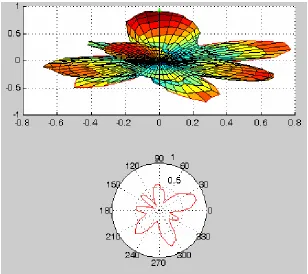
Figure 3.13 Simulated beamforming on 1KHz source at 90 degrees azimuth and no elevation. The result matches the actual location. ... 24
Figure 3.14 Real world beamforming on 1KHz source at 90 degrees azimuth and no elevation. The sound source is detected at an azimuth of 90 degrees and an elevation of 10 degrees. ... 24
Figure 3.15 Frequency spectrum of one of the signals contributing to the beam pattern of figure 3.14... 25
Figure 3.16 Real world result after introducing a software filter. Sound source is at 90 degrees azimuth and no elevation. The sound source is detected correctly... 26
Figure 3.17 Simulation with sound source located at 90 degrees azimuth and 25 degrees elevation. Detected at an azimuth of 200 degrees and elevation of 50 degrees... 27
Figure 3.18 Listening pattern using a three dimensional array. Source location and detected location are identical at 90 degrees azimuth and 25 degrees elevation. ... 27
Figure 3.19 Triangulation electronics housed in a blueprint tube. ... 29
Figure 3.20 Block diagram of circuitry used to measure time delays for triangulation ... 29
Figure 4.1 The mote based acoustic sensing system... 31
Figure 4.2 The Rene mote developed by Jason Hill at UC Berkeley. Top (left), bottom (right) ... 33
Figure 4.3 Flexible data acquisition circuit on a Kapton substrate... 34
Figure 4.5 Multiplexer noise reduces with lower frequency but is still prevalent. Yellow -
clock, Blue - output... 37
Figure 4.6 Kapton based circuit sewn into a miniature array. ... 38
Figure 4.7 Flexibility demonstration of the Kapton based circuit. ... 38
Figure 4.8 The 8 channel variable gain data acquisition circuit. ... 39
Figure 4.9 Protoboard data acquisition circuit... 41
Figure 4.10 4x5 array configuration of the 1st generation array shown in figure 3.1. ... 42
Figure 4.11 Beam Forming Simulations for the Rectangular Array of figure 4.10. Multiple beams are observed with a 1kHz sound source at 90 degrees (left) but are not present when located at 0 degrees (right)... 43
Figure 4.12 8 element array configuration for mote based sensing... 44
Figure 4.13 Beam Forming Simulations of 8 Element Circular Array at 0, 45, and 90 degrees Respectively given a 1kHz sound source... 44
Figure 4.14 Oscilloscope screen shot displaying the sampling frequency used to sample the acoustic source (top) and the sampling time used to sample the 8 microphone elements (bottom)... 47
Figure 4.15 Program Flow Chart for a Sensor Array... 48
Figure 4.16 Simulated sound recordings (left) and real world sound recordings (right)... 54
Figure 4.17: Frequency spectra of (a) tank, (b) truck, (c) helicopter, (d) missile, and (e) gun shot [46] ... 60
Figure 4.18 Samples of a 100Hz sound source taken at 44100Hz using the Hoontech data acquisition system... 63
Figure 5.1 Demonstration of a Leno weave. [1] ... 68
Figure 5.2 Triangulation of sound source position using two acoustic arrays of known position... 70
Figure 5.3 Demonstration of beam thinning using information from multiple arrays to form the same beam-pattern. ... 71
Figure A.1-1 Schematic for the Rene mote designed by Jason Hill of UC Berkeley... 78
Figure A.1-2 Composite of all PCB layers for the Rene mote ... 79
Figure A.1-3 Top PCB layer of the Rene mote. ... 79
Figure A.1-4 First inner PCB layer of the Rene mote. ... 79
Figure A.1-5 Ground plane PCB layer of the Rene mote. ... 80
Figure A.1-6 Second inner PCB layer of the Rene mote... 80
Figure A.1-7 Bottom PCB layer of the Rene mote... 80
Figure A.2-1 Composite PCB layout for the Rene programming board ...86
Figure A.2-2 Top layer PCB layout for the Rene programming board ...86
Figure A.2-3 Bottom layer PCB layout for the Rene programming board...86
Figure A.3-1 Composite PCB layout of the serial communications board...89
Figure A.3-2 Top PCB layer of the serial communications board ...89
Figure A.3-3 Bottom PCB layer of the serial communications board...89
Figure A.4-1 Schematic for the flexible data acquisition circuit ...91
Figure A.4-2 PCB layout for the flexible data acquisition circuit ...92
Figure A.5-1 Circuit schematic for the variable gain data acquisition system ...97
Figure A.5-2 Composite PCB layout of the variable gain data acquisition system...98
Figure A.5-3 Top PCB layer copper and silk from figure A.5-2...98
List of Tables
Table 4.1 Beam-patterns with varying sampling times taken of a 1kHz source at a rate of
12.5kHz... 51
Table 4.2 Beam-patterns with varying sampling times taken of a 100Hz source at a rate of 12.5kHz... 52
Table 4.3 Effects of a sampling period of 0.0124s for various sampling and source frequencies. ... 53
Table 4.4 Simulated and actual beam-patterns realized from various target frequencies at both 0 and 185 degrees. ... 55
Table 4.5 Inconsistent results after sampling a 1KHz source located at 0 degrees. ... 58
Table 4.6 Beam patterns for various sound sources located at 0 degrees... 59
Table 4.7 Demonstration of inconsistent beam patterns formed on truck sounds located at 0 degrees. ... 62
Table 4.8 Beam patterns achieved by sampling at 44100Hz for 1s with the Hoontech system. ... 64
Table A.1-1 Materials listing for the Rene mote. ... 81
Table A.2-1 Materials listing for the Rene programming board. ... 88
Table A.3-1 Materials listing for the mote serial communications board. ... 91
Table A.4-1 Materials listing for the flexible data acquisition circuit... 93
Chapter 1 – Introduction
Distributed sensor systems can provide a tremendous amount of information regarding
one’s environment. Whether embedded in a building or strewn across miles of countryside,
they can tell us the temperature gradient, determine the chemical composition of the air,
detect seismic activity, or simply listen to the surrounding environment to provide sound
localization. The more sensors of a similar type deployed in a given area, the higher quality
the data collected is in terms of resolution and redundancy. To further improve on data
quality, it is often desirable to have sensing systems arranged in arrays where geometry can
be utilized to maximize performance. An example would be an even sensor distribution over
a field to map moisture content. If the distribution is uneven (irregular) then more
information will be gathered about one particular area than another.
This thesis is dedicated in particular to acoustic sensor arrays. Such arrays are useful for
spatial filtering of sound data, also referred to as beamforming. In other words, they
facilitate directional listening without the use of parabolic microphones. Array geometry has
an effect on the detectable frequency of the system such that sensor elements should be
spaced apart by λ/2 where λ is the wavelength of the lowest frequency sought. This thesis
addresses the use of an individual array; one single element in what in the future will be a
distributed system. This is useful since although each array in a distributed system will
provide a relative direction to a sound source, they cannot effectively provide distance
characterized). Using directional information gathered from multiple arrays the distance to
the sound source can be triangulated.
The use of textiles as a substrate for sensor arrays is also examined to provide them with
flexibility and portability. The ability to fold a large area array is particularly useful to a
soldier deploying distributed sensor systems in the field, as it is less cumbersome than would
be a rigid substrate. This allows for the deployment of larger arrays to improve performance.
Textiles are also relatively light which is important as a soldier can already be carrying
upwards of 100lbs of personal equipment [1]. Since the sensor elements are already laid out,
the soldier does not have to measure and place each individual element upon deployment, as
is the current mode of deploying an acoustic array. The focus here is on rapid deployment
and portability. Embedding such systems in textiles also allows for their non-intrusive
inclusion in tents, parachutes, and truck coverings. This can likewise be applied in buildings,
through embedding sensor arrays in rugs or drapes in a dwelling or workplace. Sensor arrays
can be rolled out during construction and embedded into walls to enhance conference room
acoustics, in bridges to measure stress levels, as well as any number of homeland security
applications.
1.1 Military Motivation for the Use of Distributed Sensing
Historically, the military powers of the world have adopted the use of defense barriers to
deter invading armies. By far the most effective of such barriers was the Morice Line
constructed in 1957 by the French to protect their colonial interests in Algeria from Algerian
nationalists. This fortification spanned 460km along the Tunisian border and 750km along
eight foot, 5000 volt electric fence. The line was manned by 80,000 French troops and
patrolled aerially. Algerian nationalist infiltration was effectively countered [2].
Encouraged by such successes, the United States attempted a similar barrier in Vietnam.
The McNamara Line was to expand along the demilitarized zone between North and South
Vietnam as well as the Laotian border. Along with the traditional barbed wire and mines,
acoustic and chemical sensors were also to be deployed. Although the McNamara Line is
considered a failure and was never completed, the sensor technologies implemented proved
to be beneficial. Seismic and acoustic sensors were utilized in the defense of Khe Sanh
where “the sensors indicated when the enemy were massing for attacks against the base,
allowing the concentrated deployment of US aerial and artillery bombardment which
countered the attack…defenders at Khe Sanh did not face their enemy across a broad, linear
front; rather, they were almost surrounded by them. The fighting there showed that sensor
technology worked in 360-degree applications [2]”. Such sensors were further activated for
operations along the Ho Chi Minh trail after which only an estimated 20 percent of vehicles
reached their objective [2] [3].
Within the last 20 years there has been a push towards improving US implementation of
the electronic barrier concept. The rapid deployability of the US military once a target has
been electronically acquired drastically reduces the need for manpower along the protected
border. Also, determining patterns of troop and equipment movement allows for better
localization of mines and physical barriers [3]. Not only is this cheaper, but it also reduces
the post war impact of munitions left on the battlefield. According to the 2000 Land Mine
Monitor Report, there are approximately 1.3 million mines still in place in Algeria. Along
meter [4]. While a wall may impede insurgent forces, once in place and mines are laid,
counter-invasion plans will also be restricted.
Furthermore, in the past few years there has been a substantial push within the US armed
forces towards what is termed the Objective Force Warrior. The premise behind this project
is to use technology to increase the effectiveness of individual soldiers. This is largely
accomplished by inundating soldiers with information gained from various sensors,
providing them with a more comprehensive view of the battlefield [5]. Sensor arrays can
provide target information as well as detect the use and density of biological agents.
1.2 Goals of Thesis
The objectives of this thesis are
• Describe the development of a large area textile based triangulation array.
• Develop a beamforming array sensor system based on UC Berkeley’s mote.
• Examine flexible circuitry implemented on a Kapton substrate.
• Develop a miniature variable gain data acquisition system for the mote.
• Demonstrate beamforming for sound source localization.
1.3 Thesis
Outline
• Chapter 2 - A literature review highlighting current research and applications of
electronic textile technologies and acoustic arrays.
• Chapter 3 - A detailed examination of the design and implementation of a 10’ x 3’
microphone array for sound impulse location through triangulation based on time
computer based beamforming system. This includes different wiring techniques,
the characterization of woven windscreens, and the development of the associated
electronics.
• Chapter 4 – The development of a mote based beamforming array. This includes
information regarding the Berkeley mote, the determination of the array
geometry, the design and implementation of a flexible data acquisition circuit, the
design and implementation of a variable gain data acquisition circuit, software
development, and experimentation evaluating performance.
• Chapter 5 - Conclusions and future work.
• Appendix A - Circuit schematics, board layouts, and material listings for
developed circuitry.
Chapter 2 – Literature Review
This chapter investigates many of the recent technological advances and current
research interests in the fields of electronic textiles and acoustic arrays. This review provides
a wide view of these areas and is not restricted to information pertinent to the content of this
thesis.
2.1 Electronic Textiles
Electronic textiles are created in an effort to incorporate computer technology into a
medium with which we are already familiar and to do so in a non-intrusive manner. “Textile
look and feel must not be impaired by new functions, which means that technology must be
small, light-weight and smooth. Mechanical stress must not lead to failure, washing and
cleaning must be possible.” – Siglinde Zisler [6]. Such requirements have created many
challenges for researchers who have answered with imaginative innovations, bringing these
goals closer to fruition.
To obtain seamless integration, technologies are required from various disciplines,
including textiles, materials, and electronics. Textile engineers and materials scientists have
developed several methods for integrating conductors into textile substrates. Optical fibers,
metallic or composite fibers, and yarns coated with conductive polymers can be woven or
embroidered into the fabric to create transmission lines or circuit layouts [7] [8] [9].
Conductors can also be included in the manufacture of non-woven textiles such as in
making electric blankets. Conductive inks and dyes can also be used to introduce conductors
to a textile [7].
To be better suited for inclusion in textiles, electronic components need to be either
smaller than or as flexible as the fabric in which they are embedded. Current minimization
trends in electronics have produced much in the areas of both micro and nanometer (nano)
scale devices which are well suited for seamless inclusion in textile substrates. Others utilize
special fibers sewn in a particular configuration to create the desired device. Such a
component is demonstrated by the SOFTSwitch (figure 2.1). The SOFTSwitch uses
conductive materials and a quantum tunneling composite to allow resistance to change with
pressure [10] [11]. Fitting with the theme of sensing arrays, this technology can be applied to
pressure mapping; a useful feature for medical applications.
Figure 2.1 A Flexible PDA keyboard utilizing SOFTSwitch technology [10].
Power consumption must also be minimal to avoid the need for large battery packs.
To help solve this problem, Infineon has developed a thermogenerator which utilizes body
heat to generate electricity. Currently, enough energy is produced to power either a digital
based on light harvesting dyes [13]. Flexible battery technology is currently available from
Power Paper Ltd. whose thin batteries are printed onto the desired substrate [14].
The current focus of electronic textile application both commercially and in research
is on wearable devices. There are many commercially available items in which electronic
devices have been embedded [12] such as Infineon’s mp3 player jacket (figure 2.2) [11],
Northface’s MET5 heated jacket [15], and the Polartec electric blanket [16]. The
development of such products fuels the current trend of smaller, more robust electronic
components.
Figure 2.2 Infineon's MP3 Jacket can be washed and ironed.
Research “wearables” typically focus on health and military applications rather than
fashion and entertainment. The Georgia Institute of Technology (Georgia Tech) Smart Shirt
for example, is a T-shirt into which various sensors are woven to monitor several vital signs
(figure 2.3) [17]. Likewise, researchers at Wollongong University in Australia utilize yarns
coated with inherently conducting polymers (ICP) which they imbed into their Knee Sleeve
[18]. Other research focuses on embedded actuators [19] [20], electrically controlled
camouflage [21], and wearable displays [22].
Figure 2.3 Georgia Tech's Smart Shirt is used to monitor the wearer's vital signs.
Many of the aforementioned technologies are funded by the Natick Soldier Center as
a part of their Objective Force Warrior initiative [5]. This program strives to provide the
soldier with all pertinent information about their environment as well as defend them from
harm by including advances such as adaptive camouflage, automatic tourniquets, and vital
sign monitoring directly into their uniform. DARPA has also funded electronic textile
projects not involving wearable systems. This includes research on controllable parafoils and
large area acoustic arrays for vehicle detection which has been performed concurrently at
North Carolina State University [13] [23] and Virginia Tech [24]. This work is discussed in
2.2 Acoustic Arrays
Since the 60’s, the United States military has been looking to mimic the successes of
passive sonar technologies on land in order to improve the localization and tracking of
military units. Throughout the 1980’s and early 1990’s, sensor systems such as REMBASS
(Remote Battlefield Sensor System) [25] and later IREMBASS (Improved REMBASS) were
developed. More recently, the United State’s Army Research Lab and several NATO nations
have focused on Unattended Ground Sensors (UGS) which are smaller than the REMBASS
systems and are more easily deployed [26]. These systems typically comprise a variety of
sensors in addition to acoustic sensors including seismic, chemical, and biological. The
Army Research Lab (ARL) is actively examining acoustic arrays for addition into such
systems since although current systems are useful for providing a large amount of
information, they cannot reproduce the spatial discrimination of an acoustic array.
Consequently, the ARL is responsible for a large amount of literature on acoustic array
processing techniques [27][28][29]. DRDC Valcartier, a Canadian defense contractor, is
responsible for the development of free standing and vehicle mounted acoustic arrays [30].
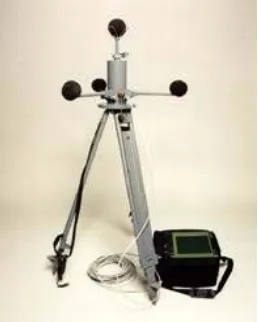
One such system is GUARDIAN (figure 2.4) which is used for sniper localization.
Mounting arrays on vehicles can be particularly challenging, not only because the
system is moving, but vehicles are often inherently noisy [31]. This is likewise a challenge
when including such arrays on robotic platforms. Arrays are incorporated into robots which
are used for surveillance, search and rescue, and target localization and tracking [32][33][34].
With advances in computing power and electronic minimization, acoustic arrays have
been applied to various tasks involving speech processing [35]. This is rather difficult as
human speech encompasses a rather large range of frequencies. Work with array geometries
[35] and processing techniques [36][37][38] has aided in the development of products that
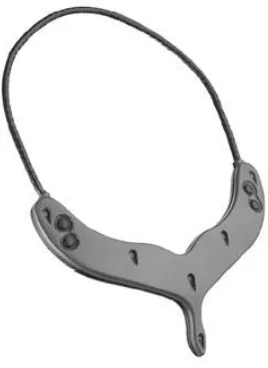
approve acoustics in conference rooms [39][40] or aid the hearing impaired such as the
microphone array necklace shown in figure 2.5 [41].
Chapter 3 – 1
stGeneration System Designs
This chapter examines the development of the first generation acoustic array
constructed on a textile substrate. This system was designed and implemented as part of a
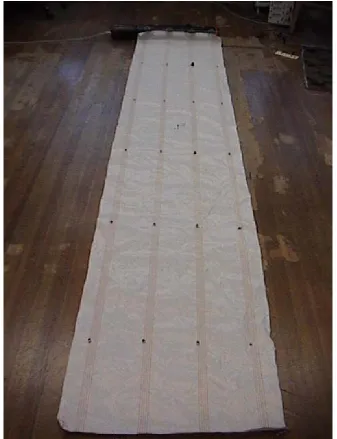
DARPA funded project and has been the subject of several papers [23][8]. The final design
is shown in figure 3.1.
3.1 Textile
Considerations
The textile requirements for this project vary considerably from those associated with
typical fashion directed electronic textiles. Durability is more important than style since
there are no comfort issues involved with the associated wiring and embedded electronics.
3.1.1 Designing a Substrate for E-Textile Usage
The textile substrate for the array was chosen to be polyester. Polyester is a popular
fabric for military applications as it is lightweight (approximately 16g/m2), strong, has good
abrasion resistance, displays uniform characteristics, and is resistant to moisture and other
environmental conditions [42]. It is also a fairly simple material to dye in order to provide
camouflage in the visible spectrum. Larger area arrays would also need to consider
reflectance in the near infrared wavelengths (.7-2um) due to the high infrared reflectance
typical of vegetation. Pigment printing techniques for polyester utilizing azoic colorants or
isoindolinone residues to reduce NIR reflectance have been developed [42].
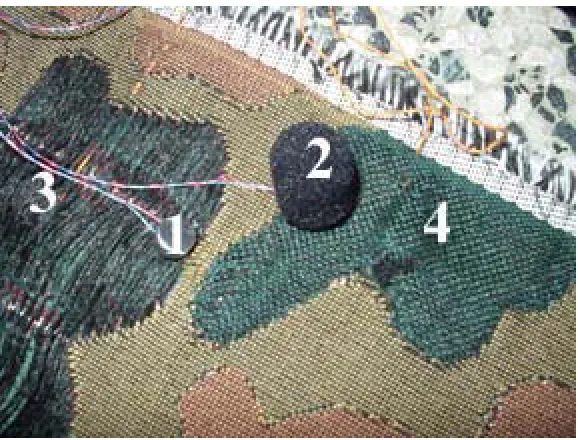
A camouflage array was woven on a Jacquard loom and is shown in figure 3.2. This
array also has pockets woven into it of various densities. These pockets not only conceal the
microphone elements, they also serve as windscreens. This does however have an adverse
effect on electronic interfacing in that the wires are not easily accessible. To test the
effectiveness of the woven windscreens, their performance is compared to that of a
microphone with no windscreen and one with a WindTech™ lavalier windscreen. Using a
compressed air source the microphones were simply grouped closely together and they were
blown upon. The wind speed was regulated by measuring with an anemometer and sustained
approximately at 275 ft/min. The results are shown below in the oscilloscope screen shot of
Figure 3.2 Camouflage array with woven windscreens. 1 is an unprotected mic, 2 has a lavalier windscreen, 3 is a loosely woven windscreen, and 4 is a tight woven windscreen.
As can be seen, the microphone with the lavalier windscreen outperforms the others. As
expected, the unprotected microphone yielded the worst performance. The tightly woven
windscreen performed slightly better than did the loosely woven. This test was performed
several times with comparable results. The sound acceptance of the microphones was also
tested since a windscreen is not effective if it degrades the signal it is intending to pick up.
At various frequencies between 20Hz and 500Hz, no appreciable differences in microphone
performance were detected.
3.1.2 Wiring
The wiring necessary for the array depends on the complexity of the circuitry which
is to reside on the fabric. The preliminary design had each microphone and its associated
amplifier collocated on the fabric. This type of node requires individual power, ground, and
signal lines. The resulting wiring grid is shown in the 4-element prototype pictured in figure
3.4. The spacing of the wires was chosen to be commensurate with the findings of [9] to
reduce crosstalk. All of the wires utilized were stranded to improve flexibility and consisted
of bare copper, insulated copper, and twisted pair wires. These wires are all of 36 gauge or
smaller in order to pass through the reed of the loom that was available. The twisted pair is
particularly important as it carries the resulting signal to some processing station. While not
critical in this small design, when scaled upwards, the twisted pair serves to protect signal
integrity over large distances. Further, it is important to note the need of interconnections
between wires in this design. Interconnects in this array were solder welded but several other
Figure 3.4 Textile array containing both microphones and amplifiers on fabric.
The second and final design removed the amplification from the on fabric node. With
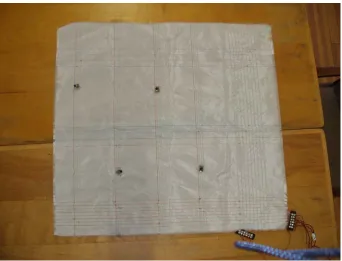
this reduced circuit complexity, the necessity for interconnects and wires woven in the weft
are removed. Only the twisted pair wires remain as is demonstrated in the finished product
of figure 3.1.
3.1.3 Interfacing
Forming external connections to the woven wires requires special consideration.
Weaving can be done to facilitate the attachment of node elements by allowing the wire to
float at the attachment points (figure 3.5). Also a co-axial snap connector was developed for
external device connection (figure 3.6). Not only does such a connection allow for the easy
replacement of an element, it also reduces stresses on the wire and distributes them to the
Figure 3.5 Floats woven for device attachment. Figure 3.6 Coaxial snap connector for microphone attachment.
3.2 Microphones and Amplifiers
To perform well the microphones incorporated into the array must be both small and
have an acceptable signal to noise ratio over all audible frequencies. The Emkay WP-3502
microphone shown in figure 3.7 meets the requirements and is small enough that it could
probably be woven into the array itself. However, due to cost considerations, the Panasonic
WM52B microphone of figure 3.8 was chosen. While larger than the Emkay microphone, it
still has a respectable signal to noise ratio of more than 60dB with consistent response over
Figure 3.7 Emkay microphone WP-3502. Figure 3.8 Panasonic microphone WM52B.
Figure 3.9 Frequency response of the Panasonic WM52B microphone.
In conjunction with the Panasonic microphones, a non-inverting amplifier is used
with a gain of 100. The circuit is based on the standard 741 op-amp and the diagram is
shown in figure 3.10. The circuit is run off of a 5V supply and is therefore biased to 2.5V to
take advantage of the available voltage range. This was done to reduce the amount of woven
wires necessary if the nodes contain the amplifiers.
3.3 Beamforming
Beamforming is a method of spatially filtering acoustic signals. This is accomplished
via constructive and destructive interference as the detected signals are delayed to listen in a
particular direction. These time delays are determined by figuring the time differences from
each microphone to a reference point given a particular listening direction. This is
demonstrated for the two microphone array of figure 3.11. In table 3.1, the waveforms are
shown delayed as well as combined for time delays necessary to listen at 0°, 90°, and 180°
for a sound source of 100Hz located at 0°. At 0°, when the appropriate delays are applied,
the signals are coincident such that when summed, a large magnitude is realized. At 90°,
they are out of phase and the resulting combined signal has a smaller amplitude than when
listening at 0°. At 180°, there is considerable destructive interference yielding a small
amplitude result. If this process is continued for all 360°, then the polar plot of figure 3.12 is
realized. See [38] for a more in depth examination of the time delay method of
beamforming.
The remainder of this section outlines the hardware and software necessary to
perform beamforming as outlined above with this system. The hardware focuses on data
Figure 3.11 Array configuration from which the
results of figure 3.12 and table 3.1 are taken. Figure 3.12 The beam pattern realized if a 100Hz source is placed at 0 degrees with respect to the
array of figure 3.11.
Table 3.1 The delayed and summed signals for the array of figure 3.11 at different listening angles. Listening
Angle Delayed Signals Summed Signals
0°
90°
3.3.1 Hardware
An off the shelf solution was used to acquire and process data for beamforming. The
data acquisition hardware used is the Hoontech DSP24, which is an audio mixer consisting of
8 mono inputs, sampling at a maximum rate of 96kHz with 24bit resolution. Multiple
DSP24s can be installed on the same computer, providing up to 40 input channels. The
hardware setup used is demonstrated in figure 3.13.
CRIM ACOUSTIC ARRAY
CRIM ACOUSTIC ARRAY
Figure 3.13 Hardware flow of the computer based beamforming system featuring the Hoontech DSP24
3.3.2 Software
Cool Edit Pro is the off-the-shelf software used to collect data from the DSP24. Cool
Edit provides excellent control over the DSP24’s features allowing for easy data acquisition
of all available channels. The data acquired can be converted into several different audio
formats. Cool Edit also allows for analysis of the frequency spectrum of the recorded signals
which is useful for identifying noisy channels on the array.
The beamforming software for this project was custom designed by Leonardo Mattos
and programmed in Matlab [33] based on the methods outlined in [38]. First, a reference
point is chosen. The time it takes for sound to travel from every microphone on the array to
the reference point can be calculated for every possible angle of the sound source relative to
the array. Knowing these times, the recorded sound from each element can be delayed to line
when these signals are aligned, they will display constructive interference. If it isn’t
however, it will be destructive. From the analysis at every possible azimuth and elevation
angle, both a 2-D and 3-D beam pattern are created. Figure 3.14 shows a flowchart of this
process. This software can also plot a short history of the perceived location in a waterfall
plot.
Read Array Pattern (Microphone Coordinates)
Read Recorded Sound from Array
Elements
For Azimuth Angle = 0 to 360 For Elevation Angle = 0 to 90
Determine time delays between each element and the reference point assuming the sound source is located
at the current azimuth and elevation
Apply calculated delays to their corresponding signals
Combine the delayed signals and acquire the RMS value, this is the apparent strength of the signal in
the current direction
End Azimuth Loop
End Elevation Loop
Plot the angles and corresponding strengths
on a polar plot
END
3.3.3 Beamforming Experimentation
Beamforming experimentation using the Matlab software was performed on the 2x2
array of figure 3.4, the configuration of which is depicted in figure 3.15. The first
experiment was performed using a 1kHz tone located 1.5m from the center of the array at an
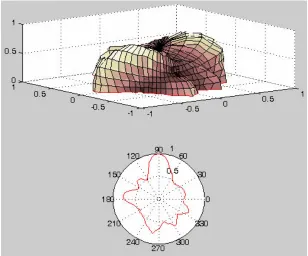
azimuth of 90 degrees and an elevation of 0 degrees. The simulated result for this setup is
shown in figure 3.16 which demonstrates both the 3 dimensional and 2 dimensional result.
This is then compared to the real world result of figure 3.17.
Figure 3.16 Simulated beamforming on 1KHz source at 90 degrees azimuth and no elevation. The result matches the actual location.
The real world beam pattern maintains a form that is similar to the simulated result
but is obviously noisier, indicative of a less pure tone from the sound source. Realizing that
the testing environment was less than ideal it was surmised that other noise introduced by
several computers, air conditioning, and outside foot and road traffic could be responsible for
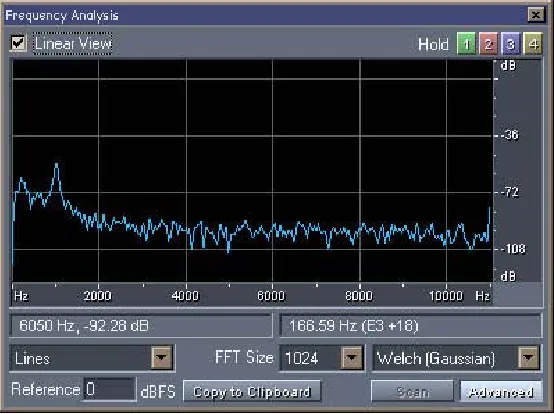
this result. Examining the frequency spectrum of one of the recorded signals shown in figure
3.18 shows that there is a considerable amount of noise lower than the desired 1KHz signal.
Figure 3.18 Frequency spectrum of one of the signals contributing to the beam pattern of figure 3.14.
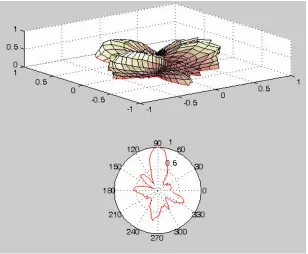
A band-pass filter was introduced in software ranging from 800Hz to 1200Hz to
compensate for the excess noise. As demonstrated in figure 3.19, this produced the desired
result, cleaning up the beam pattern and yielding one more commensurate with the simulated
Figure 3.19 Real world result after introducing a software filter. Sound source is at 90 degrees azimuth and no elevation. The sound source is detected correctly.
The next simulation is introduced to examine the effect of sound source elevation on
the accuracy of the listening pattern. To do this, the same 1kHz source was used but placed
at an azimuth of 90 degrees and elevation of 25 degrees. The resulting beam pattern is
shown in figure 3.20. The detected source is located at an azimuth of 200 degrees and
elevation of 50 degrees, a substantial deviation. Increasing the height of two elements
diagonal to one another yields a non-planar array. Beamforming with the same source at the
same position with this configuration produces the pattern of figure 3.21. The
two-dimensional plot of the beam pattern is misleading as it is a projection of the
three-dimensional plot onto a plane with 0 degrees elevation. The 3 three-dimensional plot has been
oriented to correspond with its two dimensional counterpart. The darker red in this image is
Figure 3.20 Simulation with sound source located at 90 degrees azimuth and 25 degrees elevation. Detected at an azimuth of 200 degrees and elevation of 50 degrees.
3.4 Triangulation
A stand-alone demonstrator was developed to triangulate the position of a sound
source. This requires considerably less processing power than beamforming and can
potentially supply distance information as well as direction. The geometrical basis of
triangulation is demonstrated in figure 3.22.
3.4.1 Hardware
The prototype was developed to be a single soldier deployable system. Keeping that
in mind, all of the electronics developed were contained inside of a 3½ft blueprint tube about
which the array itself could be wound. The tube has an LCD display which outputs the
azimuth of the sound source. It also has a serial interface port through which data can be
recorded or the system can be reprogrammed.
d3,1m
d3m d2,1m d2m
θss
θ3
mic 1 (x1,y1) t1
α
β
mic 3 (x3,y3)
t3 mic 2 (x2,y2)
t2
Y
X
d3,1 = distance between mic 3 and
reference mic
θ3,1 = azimuth of the vector from mic 3 to
reference mic
d3,m = calculated distance based on
time delay between mic 3 and reference mic.
θss,3 = bearing of the sound source from
mic 3
Figure 3.23 Triangulation electronics housed in a blueprint tube.
The electronics were custom designed to record time delays between microphone
elements as a sound impulse propagates across the array. The first microphone to experience
the impulse starts an internal counter. As every microphone hears the sound they latch the
current counter value which is representative of a time delay. A BasicX microprocessor
retrieves this information after all of the microphones have signaled that they have received
the sound. The implemented system is shown in figure 3.23 and a block diagram of this
process is shown in figure 3.24.
3.4.2 Software
After collecting the counter data and converting it to times based on the speed of
sound, the triangulation method outlined in [43] is applied. This approach uses only four of
the available elements to solve the system of equations shown in figure 3.25. The four corner
microphones are chosen as they are the furthest apart and will provide the largest baseline for
triangulation. Error-checking code was also developed due to occasional aberrations in the
data collected. This code essentially checks the data received from these 4 microphones and
determines whether or not they physically make sense. If not, a neighbor of the erroneous
element is chosen and the calculation is performed.
Figure 3.25 Solving this system of equations yields u (x coordinate of sound source), v (y coordinate of sound source), and d (distance to sound source) where ∆T refers to the time difference between the
microphones designated in the subscripts [43].
3.4.3 Experimentation
To evaluate the performance of the array a sound impulse was generated at various
angles with respect to the center of the array. As long as the impulse was generated at or
near 0 degrees elevation, the results achieved were agreeable to the actual location. Some
error is introduced which can be attributed to the resolution of the counters utilized in the
timing circuitry of the array. If the resolution of the timer is increased, the array should yield
more precise results. Much like the beamforming experimentation, this array is not amenable
Chapter 4 – System Design
This chapter focuses on the development of the phase II acoustic array system shown
in figure 4.1. This array inherits the polyester substrate and microphones from the previous
array. The areas of concentration are the development of the electrical systems investigated,
the decisions behind the array geometry, the software involved, and an evaluation of the
system’s performance.
4.1 Electrical Considerations
The electrical aspects of this system are divided into two areas. The first area to
consider is the Mote which is the processing and communications unit of the array. The
second area concerns both the sensors and any signal preprocessing that may be necessary.
This could be a broad topic ranging over several different sensor types, but for the purposes
of this thesis will be limited to the collection, amplification, and filtering of acoustic signals.
4.1.1 The Berkeley Mote Concept
Developed by Jason Hill at the University of California at Berkeley, the mote is a
fully functional microprocessor board centered on the Atmel 90LS8035 microprocessor [44].
This is a 4MHz processor with 32 I/O lines of which 8 can be used as 10-bit analog to digital
converters. It also contains a programmable UART, 512 bytes of SRAM, 512 bytes of
EEPROM, and 8Kb of flash for program storage. The mote is further accentuated with
256Kb of external EEPROM and a 916.5MHz transceiver from RF Monolithics. The entire
device measures only 1.5’’ x 1’’ and is shown in figure 4.2. The mote can function for
several weeks off of two AA batteries if run conservatively. The size and RF capabilities of
the mote are particularly attractive for its inclusion in this system. Since the mote is small it
will minimally affect the flexibility of the host substrate, while the RF transceiver makes it
Figure 4.2 The Rene mote developed by Jason Hill at UC Berkeley. Top (left), bottom (right)
The mote just described is one of the early generations of mote referred to as the
Rene mote, others being the WES mote and the Mica2 mote, with the latter being the most
functional. The Rene was chosen as it is more powerful than the WES and physically
smaller than the Mica. Initial simulations also suggested that the Rene would be suitable for
beamforming. The Rene mote is shown in figure 4.2 and development information for the
Rene mote can be found in Appendix A.1. Sensor boards have also been developed
including light, temperature, and single channel sound.
Berkeley researchers have also developed software tools for use with the Mote.
TinyOS was developed to allow easy interaction with the components of the mote providing
a platform which can be programmed with a language that is essentially a cross between C
and Java. Also available are TinyDB, which is an SQL database configured to run on the
4.1.2 Data Acquisition Circuitry
Two different data acquisition circuits were developed for use with the mote. The
first of the proposed systems was designed as a flexible circuit so as to not interfere with
flexibility when included in the textile array. The second system was designed to overcome
shortcomings of the flexible circuit while providing an additional variable gain stage.
4.1.2.1 Flexible Multiplexing Circuit
The first tenet of electronic textiles is that they must maintain the flexibility of their
textile substrate. While electronic components are inherently rigid, advances in component
manufacturing have drastically reduced their size such that they would add little to the
rigidity of a textile system. The problem then is how to provide the appropriate footprint to
connect these components to the fabric in question. To address this issue, a circuit patch
was designed on a Kapton film (developed by Dupont) and then sewn into the target fabric.
The circuit was etched in the Biomedical Microsensors Laboratory (BMMSL) at NCSU and
is shown in figure 4.3. This circuit is designed to contain a multiplexer, an op-amp, a
programmable filter, resistors, capacitors, and connection points for woven wires from the
array.
The circuit design revolves around the programmable filter which is incorporated to
provide a means for target discrimination in a noisy environment as well as double as an
anti-aliasing filter. It was hoped that by isolating certain frequencies, the array could target
specific vehicles based on identifying frequencies, effectively ignoring other vehicles. The
filter chosen is the MAX263 featuring dual second-order filters, 4 operating modes (band
pass, low pass, high pass, and all pass), 128 possible digitally selected Q values depending on
mode, and a digitally programmable center frequency. It is desirable for all microphones to
use the same device since the filter is relatively expensive and occupies a large amount of
circuit real estate. The microphones were therefore multiplexed using a 74HC4051 analog
mux/demux. This arrangement requires the use of only one of the available analog to digital
converters available on the mote for all eight microphones. To further decrease component
count, the acoustic signals are amplified after the multiplexer. The amplifier is the same 741
op-amp as utilized in the first generation array but is oriented in an inverting configuration
with a gain of 100. The inverting scheme requires fewer external components and reduces
the possibility of undesirable filtering by removing extraneous capacitors. The circuit
diagram and associated bill of materials can be found in Appendix A.4.
Tests on the completed circuit identified a few adverse speed limitations of the
system. The fastest possible sampling time of the mote’s analog to digital converters in the
design used is 154kHz. To simulate simultaneous sampling, all 8 microphones must be
sampled as fast as possible per time step. At 154kHz, each group of eight can sample at a
frequency of 19250Hz. As such however, the time the first microphone is sampled is closer
to the time of the sampling of the last microphone in the previous group than it is to samples
criterion the maximum frequency which can be sampled is 4812.5Hz. To achieve any
reasonable results however, the target frequency range should be considerably lower. It
would likewise be best to have a larger sampling time between groupings of eight. The small
frequency window left is still suitable for beamforming as most frequencies of military
interest are below 200Hz. This will not however allow the full potential of the filter to be
realized, as it is not a high enough order filter to discriminate among frequencies in this
range. Furthermore, when prototyped, the multiplexer was switched at low speeds and the
chosen signal was passed through both the op-amp and filter, and then analyzed. However,
at high speeds, switching the multiplexer switches the input to the filter. Since the filter is
used primarily as a low pass filter and the input is switched at high frequencies, the input is
essentially nullified.
The multiplexer also has issues with high frequencies. When switching the select
lines on the multiplexer, a small amount of noise is introduced in the output signal.
Amplifying the signals after the multiplexer thereby amplifies the switching noise. Since the
microphone signals have very little amplitude, they are indistinguishable in the amplifier
output. To determine the extent of noise introduced in the signal by the 74LS4051, the least
significant bit of the multiplexer’s select lines was clocked using a function generator while
the other two were grounded. Only microphone 0 was connected to the circuit so the
microphone output should appear only on the low cycle of the lsb clock. The initial test
frequency is 75.69kHz, mimicking the desired switching frequency which is commensurate
with the fastest ADC frequency. Figure 4.4 shows universal acceptance of the signal with
yielding figure 4.5. Appearance of the signal during the positive cycle of the select clock has
been diminished but noise is still quite significant throughout.
Figure 4.4 Multiplexer crossover of signals occurs
at high frequencies. Top - clock, Bottom - output. Figure 4.5 Multiplexer noise reduces with lower frequency but is still prevalent. Top - clock, Bottom - output.
Another drawback of this design is that it requires a 5V power supply. The mote,
designed to be a low power device, has only a 3V supply. All of the components on the mote
can happily accept a 5V supply, but that would increase the size of an already large battery
pack.
Although proven to not be particularly useful, this is a working circuit and its
flexibility can be demonstrated. The circuit was populated and sewn into a miniature array as
shown in figure 4.6. This system allows the user to specify which microphone to listen to
and will allow filtering of the received signal. While the Kapton based circuit can not be
crumpled or creased, it is a definite advancement in flexibility when compared to a standard
Figure 4.6 Kapton based circuit sewn into a miniature array.
Figure 4.7 Flexibility demonstration of the Kapton based circuit.
4.1.2.2 Intelligent Variable Gain Data Acquisition System
The data acquisition scheme addressed in this section provides advantages for
distributed arrays working to track the same target. The amplitude of the received target
signal depends on the location of each array with respect to the target sound source. An array
close to the source will have a much higher amplitude than one farther away. While both
the sound or the closer array could actually saturate. With this in mind, it is desirable to be
able to adjust the amplifier gain based on the sound levels the array detects.
The circuit created is shown in figure 4.8 and the circuit diagram can be found in
appendix A.5. While this acquisition system does not have the flexibility of its predecessor,
its size was minimized to reduce added array rigidity. This board measures approximately
1.4’’x1.8’’ and it is directly pluggable into the mote as well as the array, a re-configurability
feature the flexible array did not have. The array is connected via a flat flex cable and a zero
insertion force connector on the data acquisition board.
Figure 4.8 The 8 channel variable gain data acquisition circuit.
This circuit’s primary component is the LTC6910-2 from Linear Technologies. This
chip is a variable gain op-amp adjustable to gains of 0, 1, 2, 4, 8, 16, 32, and 64 via 3 digital
input lines. This chip alone cannot provide adequate gain for sampling of the microphone
signal, so the incoming signal is first sent to a non-inverting op-amp with a static gain of 100.
rail-to-rail operation not provided by the standard 741 op-amp used in the previous amplifier
circuitry.
When determining the gain and the possible variable gains it was important to choose
values that would provide high sensitivity without over accentuating ambient noise while at
the same time allowing a target to be located within a few meters of the array without it
saturating. Unfortunately, an anechoic chamber was not readily available and the following
experiments were performed in a typical computer laboratory. To minimize ambient noise,
unnecessary computers were powered down, air conditioning was turned off, and the tests
were run after business hours to avoid people and outside traffic disturbances. The tests were
run utilizing a sound source of 100Hz at 100 decibels (dB). This was chosen as it is the
mid-range of the military vehicle frequency mid-range (20-200Hz) with the dB equivalence of a large
truck or drill. It is important to note that this is dBA which is frequency dependant and
models the sensitivity of the human ear. This is not an appropriate scale for characterization
of this array as it has, as previously shown, a rather consistent frequency response across the
audible range [45]. The dBC scale is therefore utilized for experimentation as it is
independent of frequency. The 100 decibels on the dBA scale has a measured equivalency to
118dBC. Utilizing just the first amplification stage, with a gain of 100, saturation occurs
within 5 meters. This is sufficient for localization such that if an array is saturating and the
array’s position is known, the source position is also known and it can then be targeted.
Initially, two channels of this system were prototyped and tested. The testing showed
that there is little noise introduced on the signals. After fabrication however, the circuit
demonstrated considerable noise. The signal and power lines on the board are in some cases
make the board as small as possible. It is surmised that this minimization inadvertently
introduced the noise since analog and digital lines run in parallel in close proximity. To
decrease the noise, several approaches were taken. First capacitors were added from power
to ground at each op-amp but showed little benefit. Filtering capacitors were also added at
the output of the op-amp stages also showing no improvement. The coupling capacitor and
pull up resistor for the microphone were removed from the pcb and placed directly on the
back of the microphone, essentially turning it into a three terminal microphone. The power is
therefore run separately from the ground and signal wires which are a twisted pair. This
showed promise but still did not yield the desired results. When completed the alterations
allowed for acceptable performance on only 4 of the 8 channels whereas initially only 2 were
usable.
Although the fabricated circuit is not functional enough to be useful, the circuit
design is still viable. The circuit was therefore prototyped on a standard breadboard and
interfaced to the acoustic array until a new layout could be fabricated. This prototype only
contains the first gain stage (the LT1807) simply for testing purposes (figure 4.9).
4.2 Array Geometry
The second-generation system also attempts to improve performance by altering the
microphone geometry. During simulation with the 4 x 5 element array of figure 3.1, whose
layout is shown in the plot of figure 4.10, system ambiguity was observed when the sound
source was perpendicular to the broad side of the array or at 90 degrees with reference to the
array’s center. This is shown with the spurious spikes in the leftmost image of figure 4.11.
Also shown in this figure is a simulation with the sound source located at 0 degrees. In this
orientation, there is one obvious directional beam with only insignificant extraneous beams.
Figure 4.11 Beam Forming Simulations for the Rectangular Array of figure 4.10. Multiple beams are observed with a 1kHz sound source at 90 degrees (left) but are not present when located at 0 degrees (right).
The new array layout attempts to obtain a more consistent beam pattern regardless of
the position of the sound source. This would help to eliminate any confusion caused by
spurious beams as demonstrated. To accomplish this, the array was laid out in a circular
pattern. Furthermore, it was laid out such that there are 7 elements along the perimeter and
one in the center (only 8 are used as there are only 8 ADC ports available on the mote). The
simulations of figure 4.13 show that the acoustic array geometry as proposed gives more
consistent results and is less likely to introduce confusion. Although there are many
extraneous spikes in the diagrams, it is important to realize that a longer spike equates to
higher confidence, so these particular spikes do not carry as much weight as those in the
rectangular simulation at 90 degrees. With the maximum distance between microphones of
approximately 1 meter, this array is best suited for frequencies greater than 350Hz. For
better performance at lower frequencies a much larger array would be needed. For example,
minimal spacing for detection of a 20Hz signal is 17.25m and for 100Hz is 3.45m. These
would be more ideal for beam-forming with military targets (characteristically 20-200Hz) but
Figure 4.12 8 element array configuration for mote based sensing.
Figure 4.13 Beam Forming Simulations of 8 Element Circular Array at 0, 45, and 90 degrees Respectively given a 1kHz sound source.
4.3 Software
The software involved is responsible for the control of the data acquisition, the
communication between motes or base computer, and processing of the data for
from the base node and then transmit that information back to the base node for processing.
This can be done either directly through the serial port or through an intermediary mote
which essentially serves to provide RF capabilities to a PC. To facilitate the RF operation, a
board was created based on the mote programmer of Appendix A.2 that simply performs
RS232 communication. The layout for this board can be found in Appendix A.3. The home
computer then must process the information gathered and present it to the user.
4.3.1 Data Acquisition Software
The data acquisition software is largely dependant upon the hardware components
available on the mote. Data must not only be sampled and stored at an appropriate
frequency, to sample the target acoustic source, but each of the eight channels must be
sampled fast enough that the sampling delay between channels can be considered negligible.
Due to the stringent timing requirements of this program, it was coded in assembly.
As previously outlined, the mote has three types of memory: 512 bytes of internal
SRAM, 512 bytes of internal EEPROM, and 256Kb of external EEPROM. Ideally the
external EEPROM would be utilized, as it would allow for a considerable amount of
sampling of the target signal. This memory is serial and accessed via the I2C protocol.
While this does not require much of the processor’s resources, it is regrettably slow with a
maximum write time of 5.0ms. While faster, the internal EEPROM is also too slow due to its
large write time of 2.5-4.0ms. The SRAM is the only viable solution as it can be written to in
two clock cycles (0.5µs) but it is important to note that the data must share its meager 512
bytes with the program stack. Fortunately, the software on the array does not require
bytes available for data. The analog to digital converter output on the mote has a 10 bit
resolution, requiring 2 bytes of storage per sample. This would allow for only 31 samples
which is insufficient, so the data is left aligned to ignore the lower 2 bits thereby allowing for
62 samples per microphone.
Ideally, all eight channels would be sampled simultaneously. The mote’s ADCs do
not sample simultaneously so it is necessary to sample all eight channels as fast as possible to
make the timing difference appear negligible. Using the ADC in free running mode and the
maximum 2MHz ADC clock (given a 4MHz system clock), samples are taken at
approximately 154k samples per second. The eight samples at 154kHz in this example are
only taken every 640Hz so a software timer must be introduced to meet this requirement.
Timer Counter 0 is set up for this purpose. This timer uses the system clock (4Mhz),
prescaled by a factor of 32, or 125kHz (otherwise the count necessary would be larger than 1
byte). At this frequency, if the counter counts to 195 every 1.5625ms for a frequency of
640Hz. After 8 ADC samples, the ADC is disabled. After Timer Counter 0 counts to 195,
the counter is reset and the ADC is enabled. The timing associated with the ADC and Timer
Figure 4.14 Oscilloscope screen shot displaying the sampling frequency used to sample the acoustic source (top) and the sampling time used to sample the 8 microphone elements (bottom).
The main program as shown in the flowchart of figure 4.15 primarily serves to
initialize the system for data collection and to communicate with the base station. The
program first awaits a start signal from the base computer (or polls the RF receiver)
instructing it to begin sampling. Once received, the necessary hardware is initialized and the
interrupts are enabled. The ADC and OC2 interrupts perform the sampling operation until
the SRAM is full then stop collecting data. Control is returned to the main program which
transmits the collected data (either through the UART or the RF transceiver). The program