Ftit hilt Tut Go CtU Tool! Dtbug Ouktop WI~')"" Htlp j e •••. "J '" ." •• f~ ~. Cl{') '0 ·Lt + -11 • "'l~O.
I'.• $oet
5 -
c-Lhat_trn = ~im(nEt. trn_inputs Lhat_tzt = 3im(n~t. tst_input3 110
11
12- ~_trn = trr._output~((output_num. perf_:rn =m.3E~e_trn)
ss 5,
I .
l f=le·!t112c utp.rts h..t r,t::Gsure plot(Itrn_outputSloutput_TJum.:)
r,old l~ t.::;;;;;;;;;;;;;;;;;;~jiiii~;;;;;;;;;;;;;;;;;;;;=;;;;;;;;~iiiiiiiiiiiii~ifJI plot(IL hat_trn y_hat_tst)•'b''f
Lecend('M02a~~J:ed data', IPred.ict ecd dat a1,Iloco t....CT'I,Ib?s::I)
12
•• x
€_tst = tzt_outputs(Output_num,
perf_tst s mse(e_tst)
i S 45 ~
040 35
Simulation and optimization of heavy oil cracking (HOC)
unit using neural network and genetic algorithm
c
Team member: Prof. Zainuddin Abdul Manan 250:---:---'----'6:----:---,1':-0 --""12,-'
SI••
Project leader: Gholamreza Zahedi
Research alliance: Sustainability
Universiti Teknologi Malaysia
2.rzahedi@ chellle.utlll.IllY
Abstract
This research presents an artificial neural network (ANN) model to investigate optimum operating condition of heavy oil catalytic cracking (HOC) to reach maximum gasoline yield. In this case, American petroleum institute index (AP!) , weight percentage of sulfur, Conradson carbon residue content (CCR), gas, coke, and liquid volume percent conversion (%L V) of reaction were considered as ANN model inputs while the percentage of normal butane (N-C4), iso-butane (I-C4), butene (C4=), propane (C3), propene (C3=), heavy cycle oil (HCO), and light cycle oil (LCO) and gasoline (GAS0) were considered as network outputs. 70% of all industrial collected data set were utilized to train and find the best neural network. Among the different networks, feed-forward multi-layer perceptron network with Levenberg Marquardt (LM) training algorithm with 10 neurons in hidden layer was found as the best network. The trained network showed good capability in anticipating the results of the unseen data (30% of the aIJ data) of catalytic cracking unit with high accuracy. In the next step of study sensitivity analysis was carried out to find the effect of the operating condition on gasoline and products yields. FinaIJy genetic algorithm (GA) was used to optirnize neural model of the plant. It was found that gasoline yield can beincreased to 73.6429 % by adjusting operating conditions.
1. Introduction
Conversion of heavy oil to light oil products has been important due to the low demand of
heavy fuels and increasing demand of light fuels [I]. Heavy oil catalytic cracking (HOC) isone
of fluid the catalyst cracking (FCC) processes. In early 1942, the process was operated in
United States and so far many progresses have been obtained on developing and modifying of
related catalysts and processes [2].
Comparing to thermal cracking, catalytic cracking generates more gasoline with higher
quality (more octane number) and less coke. Unlike thermal cracking which can be operated
with all type of feed, catalytic cracking uses only low metal content feeds., High temperature
(500-530<>C),low pressure (2-3 bar) and specific catalysts. Vacuum gasoil (VGO), visbreaked
gasoil and the vacuum column residue with low metal content are the feed of catalytic cracking
unit. Main products of FCC consist of gasoline (40-50%), LPG, a light cut of gasoil which is
called light cycle oil (LCO), a heavy cut of gasoil called heavy cycle oil (HCO) and also some
coke which isconsumed in process [1,2].
Heavy feeds like atmospheric distillation residue are hardly refined. They are full of coke
producing molecules. Excessive production of coke leads to significantly increase in
regenerator temperature which causes damage to catalyst or regenerator tools. The amount of
CCR content of heavy feeds is 2-8%. They are enriched of nickel and vanadium which cause
undesirable effects on process catalyst and decrease catalyst selectivity. They are also enriched
of hetro-atomic nitrogenated compounds which neutralize acidic sites of catalyst, and decrease
its activity and play significant role in coke formation. HOC process is one of catalyst cracking
processes which has been designed for treating this type of feeds [2].
2. Methodology
In order to construct a model of ANN, HOC unit data were collected from typical plant. To insure
that the data cover the normal limits of operation data, the off data were removed from data list.
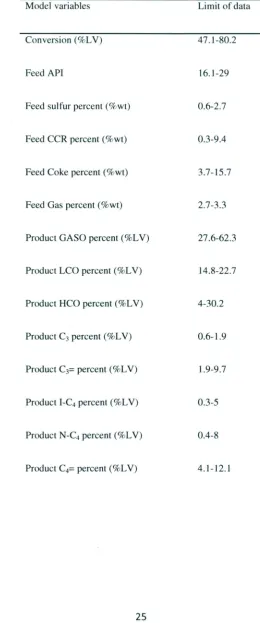
Model variations and data limits are tabulated in Table 1.
Table 1.
In order to train and find the best ANN, all data sets were divided into two sections: train and test
(generalization). 70% of all data were selected for train and the remaining 30% (unseen data) were
selected for test. In this study for each output aseparate network has been trained [27].
API, weight percentage of sulfur, CCR content, gas, coke and liquid volume percent conversion
(%L V) of reaction are network inputs while network outputs include percentage of normal Butane (N
-C4), iso Butane (I-C4), Butene (C4=), Propane (C3), Propene (C3=), HCO, and LCO and gasoline
(GASO).
3. Literature review
Several studies have been focused on FCC and HOC process [3-9]. Artificial neural network
(ANN) with high training capability has many applications. During the recent 15 years, ANNs
have been increasingly used because of their capability and ability to solve complicated
problems. Process modeling and simulation especially while no analytical model exists,
parameter estimation and optimization are among the applications of ANNs in chemical
engineering [10, 11].
According to our literature survey, there are few studies on simulation and modeling of HOC
units .In a novel computer simulation by Bolkan-Kenny et al. [12] it was found that FCC process downer reactors are slightly more beneficial than riser reactors when commercial silica
-alumina catalysts are used.
Maciel Filho and Sugaya presented a computer aided tool for heavy oil thermal cracking
process[ l3].They proposed a dual plug flow reactor representation for the light pyrolysis of
petroleum distillation residues in coil-type reactors.
Effect of feedstock on the product yields and properties of the FCC process using the feed
forward NNs have been estimated by Al-Enezi and Elkamel[14]. Their designed network is
capable of predicting the yields of different products including propane, n-butane, butane, iso
-butane, propylene, butylene, light gas, gasoline, LCO, HCO, coke and CCR number. While
API, Watson characterization factor, sulfur content, and liquid volume percent conversion are
required as feed properties. They proved that their ANN model is more accurate than the
commercial simulators and non-linear regression models.
A hybrid ANN model for scale up of FCC pilot plant to industrial unit has been proposed by
Bollas et al[lS]. The pilot model was capable to anticipate the conversion. The hybrid model
was compared with the pure ANN and pilot model. The results showed that the hybrid model is
more accurate than pure ANN.
Taskin et al. [16], studied Fuzzy logic control of FCC unit. FCC processes are known to be
very difficult to model and control because of the complicated hydro-dynamics and complex
kinetics of both cracking and coke burning reactions. They showed that fuzzy logic control, asa
promising control technique, would be effectively used for improved process control of FCC in
refinery process industry.
According to our literature survey, simulation and optimization study have not been performed on
HOC unit using ANN and Genetic Algorithm (GA).
In this study after process description and brief introduction to ANN, the methodology for
obtaining the best ANN will be described. Finally the best obtained network will be tested with
unseen data. Next sensitivity analysis will be performed to find out the most affecting process
parameters on gasoline production. Finally the optimization will be carried out to find optimum
values ofthe process variables to produce maximum gasoline yield.
3.1 Catalytic cracking unit
Figure I shows schematic of a typical catalytic cracking process [2]. As shown in figure I there are
three main parts in catalytic cracking processes: catalyst part, regeneration part and separation part.
Figure 1.
Catalyst part consists ofa reactor or riser which chemical cracking reactions occur in the presence
of catalyst in the temperature and pressure range of SOO-S30°C and 2-3 bar respectively. In
regeneration part catalyst surface coke isburned. The contact between reactor and regenerator cause
the catalyst circulate from one container to another. Recovered heat by catalyst is saved in
regenerator. Reactor outputs are transferred to separating part which includes series of distillation
towers. The obtained products are full of unsaturated compounds, but they contain few unstable
diolephins. [2]
According to figure 2, HOC plant includes 2 main parts, (i) catalyst part including cracking and
catalyst regeneration and (ii) separation part.
Figure 2.
First vacuum gas oil (VGO), is heated inalong vertical pipe called riser and then introduced tothe
reactor where it is in contact to the catalyst coming from regenerator with high temperature (about
700°C). In figure 3the schematic diagram of the HOC reactor isdepicted. The feed is vaporized and is
cracked dueto occurring reactions and rises toward reactor riser and the pressure iskept at alow level
(2 bars). The reactor temperature is stabilizes at SOOg-C. There is a baffle blade on the riser that carries
out initial separation of hydrocarbon vapors. Catalyst drawn along with the gas is recovered in two
cyclone stages arranged in series. The products are sent to the fractionation column. The output
stream which is free of catalyst is headed to the separator [1,2, 17-20].
Figure 3.
Stripping
The bottom end part of the reactor consists of a stripper column. The vapor is injected through the
catalysts to perform partial recovery of absorbed hydrocarbons. The stream passes to the stripper
which is connected to the regenerator through the pipe called," standpipe". Catalyst level is controlled
by a slide valve to maintain it in a fixed level [1,2, 17-20].
Regeneration
In regeneration part, the required air flow for combustion is supplied by a blower. High-temperature
combustion bums off the coke deposits from catalyst surface. Part of the combustion heat is stored by
the catalyst. Regenerator catalyst off take is regulated by a slide valve. Recent catalytic cracking units
are usually provided with a regenerator functioning at a high temperature (around 700"C ), thereby
ensuring total combustion of coke into carbon dioxide (C02). Such combustion is often catalyzed by
adding small quantities of precious metals such as platinum to the cracking catalyst. Combustion
fumes are separated from catalyst by two cyclone stage inside the regenerator. These fumes can be
used to supply energy before being released into the atmosphere.
A pressure- reducing turbine can be used to recover mechanical energy, usually enough to drive the
air compressor. Installation of such a turbine requires the presence of a third cyclone stage outside the
regenerator, to remove catalyst "fine", thereby reducing the risk of erosion wear. After a reduction in
pressure, the fumes pass through a waste heat boiler, and the recovered sensible energy is used to
generate steam.
Older units were built with regenerators operating at lower temperatures, around 620- 630 "'C,since
the available catalyst could not withstand heat. Regenerator fumes containe alarge quantity of carbon
monoxide (CO) which had to be burnt into carbon dioxide before being released into the
atmosphere.Entrained catalyst is removed from the combustion gases by two stages of cyclones
located in the regenerator. The high temperature flue gases are available at low pressure and can be
used toproduce energy before being released into the atmosphere [1,2, 17-20].
Catalyst circulation- fluidization
The catalyst circulates at a very high rate (several tons per minute) and this is made possible by
injecting oil, gas or steam into the catalyst transportation tubes. In the regenerator, catalyst
fluidization is ensured by the combustion air, and by the cracked gases and the stripper steam in the
reactor. Significant catalyst loss through the cyclones are observed when the particle diameter of the
catalyst is in the 20-150 micron range and when 50- 70% of the catalyst grains are within the 40-80
micron bracket. [17-20].
Fractionation section
The reactor effluent is a feed of main fractionating distillation column which is invapor form. Feed
is directed to the column and the slurry recirculation which is cooled in heat exchangers. From the
separator column, LCO and HCO are equipped with vapor stripper and HCO is mixed with slurry.
Overhead vapors are condensed partially and some of the condensates are used in the main column.
Output gases from top of the column are compressed by compressor. This part consists of a several
distillation and absorption columns for separation of the products including: fuel gas, C3cut (propane
and propene), cut of C4 (butane and butene), LCO, HCO [18-20).
3.2 ANN modeling
An ANN which isinspired by the biological neural system isan idea for processing the information
and a highly capable tool to solve sophisticated and intricate problems like human brain. Artificial
network behaves like the neural cells of human body and it is a network of complicated
interconnected neurons [21]. ANNs just use the typical data set of the system, thereby the prior
information of the system isunnecessary [22). There are different ANN architectures. In this study the
multilayer feed-forward neural network generally called multi layer perceptron has been designed and
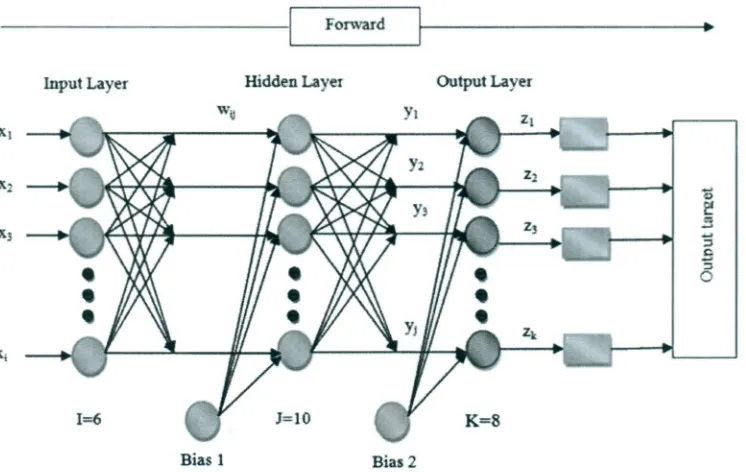
utilized. Figure 4 demonstrates schematic of this network. In this network I, J and K are the input,
hidden and output vectors which represent the number of neurons in input, hidden and output layer,
respectively [23).
Figure 4.
n
n=
(
L
WjjxJ +bi=
(1)
H
id
den
l
a
y
e
r
=
HLj=
({(L WjjX.)+
bl
a
st
]
~=
(2)
I
Outpu ayer =f [(
Y
HLtj I,Vj~)+
bias2~ i=O
(3)
Where I isthe number of elements ininput vector ( ·r)," f' and ••ik are inter connected weights and b
is the neuron bias. The output of each neuron is the summation of the weighted inputs and biases
passing through the activation function which iscalculated according to equation (3).
Generally, the ANNs are trained to receive from the spectacular input to a special target using adapting the corresponding weights. The error between the ANN outputs and targets (desired outputs)
is minimized using the optimized selection of weights and biases. The training operation is stopped
when the corresponding error reaches its minimum value or the number of epochs exceeds the determined epoch number. There are different ANN training algorithms. The most common training algorithm is back propagation (BP) which includes different methods and solutions. An ANN is
trained using one of the BP algorithm methods and changing the weights. In this study the BP algorithm and Levenberg Marquardt (LM) method have been utilized. The supervised ANNs are trained using a set of input and output data. Weights are changed until the error between ANN output and targets meet the minimum value. The common criterion for error calculation is mean square error
(MSE) which is calculated as the following: [22,24-29]
K
MSE = ~
.
I
(Zi,meai=l
(4)
remenr
Where K and Z refer to the number of outputs and their values, respectively [25-29].
4.
F
inding
s
In this research, from various designed ANN, a multi layer feed-forward using back propagation method with Levenberg Marquart (LM) algorithm was found as the best network. In order to find
10
----_._- ---
---optimum number of hidden neurons, the trial and error method was employed. The selection criterion was MSE between ANN outputs and test data as targets. It was found that number of hidden neurons
isten activation function of hidden layer is sigmoid function which is defined as below [24,25].
1
f'(x) -
---1- e-x
(5)
Where x is a weighted input for neuron and
f(x)
is an output of each neuron. The simple linear activation function is also used for the output layer as described below: [24,25]f(x)
=
x (6)As mentioned before 70% of all date were used for training and 30% were employed for
generalization. The percentage of relative error in generalization section is calculated based on the
following equation[24,2S].
100
Error =--K
R
~ Imeasurement - simlated
f
L
measurement ~ij;;;l
(7)
In this study eight ANNs were trained so that each network is designed for each output. The first
ANN is designed for training the gasoline weight percent using all inputs and other ANNs have been
constructed for weight percentage of LCO, HCO, propane, propene, iso-butane, n-butane and butane,
respectively. Figure 5 (a-h) illustrate the comparison between measured and predicted outputs by
ANN for tested and trained data. For each output, network data were compared with unseen
experimental data.
Figure 5.
For precise awareness, the amounts of error are shown infigures 6 (a-h). According tothese figures,
error percentage is between 10-4_10-5 for different outputs, which show the high accuracy of the
trained model in prediction of HOC outputs.
Figure 6.
Table 2 compares MSE (for train and test data) and regression of various algorithms. Among the BP
trained networks LM algorithm had good performance and was employed for HOC process
optimization.
Table 2.
4.1. Sensitivity analysis
Sensitivity analysis is an important tool to solve several problems present in many areas of
human knowledge: engineering, mathematics, physics, economy, medicine, biology, etc.,
especially when nonlinearities are involved. Therefore, it ispossible to infer about the behavior
of the system face to parametric variations without the need of solving a problem that involves
complexity, described by a set of nonlinear differential and algebraic equations. The
conclusions are extracted from the calculation of the derivative function under analysis [30].
A sensitivity analysis method for discovering characteristic features of the input data using NN
classification models was devised. The sensitivity isthe gradient of the NN model response function,
and because neural network models are nonlinear, the gradient depends on the point where it is
evaluated[31 ].
Sensitivity analysis was used to determine how the model would respond to changes in input
parameters. Sensitivity analysis is acknowledged as essential for good modeling practice, and is an
implicit part ofany modeling field[32]. The sensitivity isquantified bythe following equation:
8y
- :1(.
8p
(8)
Where p, the parameter vector, is mapped into the state vector)' (p ~ y). In the present work the
trained NN model is utilized as aprocess simulator. Because the output of a trained NN isa function
of inputs alone (weights are constant after training), sensitivity analysis of asystem can be conducted
using the trained NN to characterize the relationship between inputs and outputs. The sensitivity of
the outputs to the inputs is defined by Eq. (8), can be estimated from the trained NN model by
observing the changes in the value of the kthoutput brought about by a small change in the value of
the jth input at any operating point[33].
At each operating point P, thejth input can be varied over its entire range, and the corresponding
variation in the k" output can beplotted toproduce asensitivity curve[33,34].
For sensitivity analysis and for evaluating the effect of changes in all inputs on each output, one of
the inputs was changed in its industrial ranges while other inputs were fixed at their average values of
industrial limits. The sensitivity curves of the HOC unit are illustrated in figure 7.
GA minimizes the objective function by changing the variable values randomly not according to its
derivatives. Because of its stochastic identification, sticking in the local minimum is a small probable
which is a good advantage of this technique but sometimes the process speed may become slow due to
not handling the some of itsparameters properly" ANN can be used asthe GA guiding function.
Heavy oil demand has decreased due to energy conservation and nuclear power development, and the
demand for light products has increased. This raises the problem of the conversion of heavy products
into light products such as gasoline, kerosene and diesel fuel for the production of motor fuels[17].
Regarding high consumption of gasoline as a fuel and its considerable significance and application in
industry, in this study the optimization of HOC process has been performed focusing on increase in
maximizing gasoline production rate.
For optimization purpose, MA TLAB 7.6 GA tool box was employed. An optimum value of the
HOC gasoline function should to be searched by GA combined with the trained NN model. So, the
input variables and their ranges should be determined. In the present work the volume percent of
gasoline was used as an objective function to be maximized:
Objective function (1)= max(Volume percent of gasoline)
(
9
)
In the optimization procedure, first, an initial population of 100 was used to generate lOO
individuals randomly. Next, the related ANN model was called to calculate the fitness value for all
generated individuals. As GA technique finds the minimum value of the fitness function, the negative
of our objective function is utilized to find the maximum value for gasoline production. At the next
step, three operations (selection, crossover and mutation) produce the new generation[34]. This
procedure continues until the optimum value for gasoline is reached. For accurate optimization, the
initial population was varied. For each initial population the optimum value of gasoline was recorded.
The obtained results aredepicted in figure 8.The optimum value of the initial population is900. More
initial population may result in the accurate amount of the objective function but the computational
time will be too long. To find optimum volume percent of gasoline, with 900 initial populations, 57
generation was carried out. In this case maximum volume percent of gasoline was obtained as
73.6429 LV%.
The similar calculation was performed using fmincon solver of MATLAB 7.6 optimization toolbox.
The similar, 73.6459 LV%, result was obtained using fmincon solver. The optimization results are
summarized in Table 3.
Table 3.
According tofigure 7, sensitivity results are in agood agreement with GA. Sulfur and gas donot have
any significant effect on the gasoline and as GA results show the optimum values for suIfur and gas
are the lower bound of their industrial limits.
5. Conclusion
In this research an ANN model with BP method and LM training algorithm is used to simulate
industrial HOC unit.. the proposed ANN was able to predict unseed industrial date accurately. The
results infer high capability of ANN modelling for simulation of oil processes. Based on sensitivity
analysis it was found that gasoline and HCO are more sensitive to conversion than other products,
Gasoline and C4
=
are more sensitive to feed API, Gasoline and HCO are more sensitive to CCR andgasoline is more sensitive to coke and HCO is more sensitive to sulfur content than other products.
The optimum gasoline was found as 73.6429 and 73.6459 LV% using GA and fmincon solver,
respectively.
Nomenclature
HOC Heavy oil cracking
ANN Artificial neural network
API American Petroleum Institute Index
CCR Carbon condradson residue
N-C4 Normal butane
I-C4 Iso-Butane
C4
=
ButeneC3 Propane
C3
=
PropeneHCO Heavy cycle oil
LCO Light cycle oil
GASO Gasoline
LM Levenberg-Marquardt
GA Genetic Algorithm
FCC Fluid catalytic cracking
VGO Vacuum gas oil
LPG Liquid petroleum gas
I Number of inputs in ANN
J Number of neuron in hidden layer
K Number of outputs in ANN
n Total number of output, number of data
Wij Weight on the hidden layer
x Input variable of activation function
b Bias
f Neuron activation function
Wjk Weight on the output layer
BP Back propagation
MSE Mean square error
Z Output of neuron, output layer
y State vector
p Parameter vector
K Sensitivity
Mea Measurement data
Sim Simulated data
19
6. RESEARCH OUTPUT
1. Citation Details of Articles:
• Leila Sheikhattar,Haslenda Hashim, Gholamreza Zahedi, Saeedeh Amraee,
Mahdieh Abolhasani," Maximizing gasoline yield in heavy oil cracking unit",
submited to Oil &Gas Science and Technology, 2010.
2. Citation Details of Conference Papers
• Hashim, H., L. Sheikhattar, G. Zahedi, " Simulation of heavy oil cracking unit",
International Conference on Process Engineering and Advanced Material
(lCPEAM201O)/ 24th Symposium of Malaysian Chemical Engineers (SOMChE201O),
Kuala Lumpur Convention Centre, Kuala Lumpur, Malaysia, 15th-17th June 2010.
• Zahedi, G., F. Parvizian, M. R. Rahimi, "An expert model for estimation of distillation
seive tray efficiency base on artificial neural network approach", International Conference
on Process Engineering and Advanced Material (ICPEAM201O)/ 24th Symposium of
Malaysian Chemical Engineers (SOMChE201O), Kuala Lumpur Convention Centre,
Kuala Lumpur, Malaysia, 15th-17th June 2010.
• Zahedi G. ,S. Saba, Ali Elkamel, H. Hashim," Prediction of ozone concentration around
an industrial area using fuzzy neural network method", World Academy of Science,
Engineering and Technology, 67, Bali, Indonesia, 14-16 July, 2010.
3. HUMAN CAPITAL DEVELOPMENT
• Graduate Research Assistant (GRA): RMIOOO per month x 2= RM24000
• Conference: RM6000
6. RESEARCH OUTPUT
1. Citation Details of Articles:
• Leila Sheikhattar,Haslenda Hashim, Gholamreza Zahedi, Saeedeh Amraee, Mahdieh Abolhasani," Maximizing gasoline yield in heavy oil cracking unit",
submited toOil &Gas Science and Technology, 2010.
2. Citation Details of Conference Papers
• Hashim, H., L. Sheikhattar, G. Zahedi, " Simulation of heavy oil cracking unit",
International Conference on Process Engineering and Advanced Material
(ICPEAM201O)/ 24th Symposium of Malaysian Chemical Engineers (SOMChE201O),
Kuala Lumpur Convention Centre, Kuala Lumpur, Malaysia, 15th-17th June 2010.
• Zahedi, G., F. Parvizian, M. R. Rahimi, "An expert model for estimation of distillation
seive tray efficiency base on artificial neural network approach", International Conference
on Process Engineering and Advanced Material (ICPEAM20 10)/ 24th Symposium of
Malaysian Chemical Engineers (SOMChE2010), Kuala Lumpur Convention Centre,
Kuala Lumpur, Malaysia, 15th-17th June 2010.
• Zahedi G. ,S. Saba, Ali Elkamel, H. Hashim," Prediction of ozone concentration around
an industrial area using fuzzy neural network method", World Academy of Science,
Engineering and Technology, 67, Bali, Indonesia, 14-16 July, 2010.
3. HUMAN CAPITAL DEVELOPMENT
• Graduate Research Assistant (GRA): RM I000 per month x 2= RM24000
• Conference: RM6000
"'
References
[l].J.H Gary, G. E. Handwerk, MJ.Kaiser. Petroleum Refining Technology and
Economics, 5nd ed.; Taylot &Francis Inc.: New York, 2007; pp 86-112.
[2].Maple, R. E. Petroleum Refinery process economics, 2nd ed.; PennWell books: Tulsa
OK, 2000; pp 129-159.
[3].G. W. Young, K. Rajagopalan. Techniques for evaluating a heavy oil cracking
catalyst. Ind. Eng. Chem. Process. 1985,24,995-999.
[4].F. M. Lee, Effects of recycle on heavy oil cracker. Ind. Eng. Chem. Res. 1989, 28,
542-546.
[5].C. Li, CYang, H. Shan. Maximizing Propylene Yield by Two-Stage Riser Catalytic
Cracking of Heavy Oil. Ind. Eng. Chem. Res. 2007,45,4914-4920.
[6].Jr, V. W. Weekman. Model of Catalytic Cracking Conversion in Fixed, Moving, and
Fluid-Bed Reactors. Ind. Eng. Chem. Process. 1968, 7, 90-95.
[7].C. Araujo-Monroy, F. Lpez-Isunz. Modeling and Simulation of an Industrial Fluid
Catalytic Cracking Riser Reactor Using a Lump-Kinetic Model for a Distinct
Feedstock. Ind. Eng. Chem. Res. 2006,45, 120-128.
[8].F. Ding, S. H. Ng, C. Xu, S. Yui. Reduction of light cycle oil in catalytic cracking of
bitumen-derived crude HGOs through catalyst selection. Fuel Process. Technol. 2007,
88, 833-845.
[9]. E. Fumoto, A. Matsumura, S. Sato, T. Takanohashi. Recovery of Lighter Fuels by
Cracking Heavy Oil with Zirconia-Alumina-Iron Oxide Catalysts in a Steam
Atmosphere. Energy Fuels. 2009, 23, 1338-1341.
[10]. C. A O. Nascimento, R. Giudici, R. Guardani. Neural network based
approach for optimization of industrial chemical process. Comput. Chem. Eng. 2000,
24 (9-10), 2303-2314.
[11]. M. J Wills, G. A Montague, C. Di Massimo, M. T. Tham, A. J. Morris.
Artificial neural networks in process estimation and control. Automatica. 1992,28 (6),
1181-1187.
[12]. Y. G. Bolkan-kenny, T. S. Pugsley, F. Berruti. Computer Simulation of the
Performance of Fluid Catalytic Cracking Risers and Downers. lnd. Eng. Chem. Res.
33, 1994,3043-3052.
[13]. R. Maciel Fliho, M. F. Sugaya. A computer aided tool for heavy oil thermal
cracking process Simulation. Comput. Chem. Eng. 2001,25, 683-692.
[14]. G. AI-Enezi, A Elkamel. Predicting the effect of feedstock on product yields
and properties of the FCC process. Pet. Sci. Technol. 2000,18 (3-4),407-428.
[15]. G. M. Bollas,; S. Papadokonstadakis, J. Michalopoulos, G. Arampatzis, AA
Lappas, I. A Vasalos, A Lygeros. Using hybrid neural networks in scaling up an
FCC model from a pilot plant to an industrial unit. Chem. Eng. Process. 2003,4,697
-713.
[16]. H. Taskin, C. Kubat, O. Uygun, S. Alrslankaya. FUZZYFCC: Fuzzy logic
control of a fluid catalytic cracking unit (FCCU) to improve dynamic performance.
Comput. Chem. Eng. 2006,30, 850-863.
[17]. Typical petrochemical complex III Iran, operating data sheets of Catalytic
Cracking plant, Iran, 2002-2007.
[18]. P. Leprince. Petroleum refining 3 conversion processes, t ed.; TECHNIP:
Paris, 2001; pp 169-223.
22
[19]. W. L. Nelson. Petroleum Refinery engineering, 4nd ed.; Me Graw-Hill: New
York, 1969; pp 759-818.
[20). W. F. B Bland, R. L. Davidson. Petroleum processing handbook, Mc Graw
-Hill: New York, 1967; pp 1-81.
[21]. M. B. Menhaj. Computational intelligence (fundamental of neural networks),
Amirkabir University, Professor Hesabi: Tehran, 2003; pp 35-94.
[22). G. Zahedi, S. Mohammadzadeh, G. Moradi. Enhancing Gasoline Production
in an Industrial Catalytic-Reforming Unit Using Artificial Neural Network. Energy
Fuels. 2008, 22 2671-2677.
[23]. y.c. Lin, J. Zhang, J. Zhong. Application of Neural Networks to predict the
elevated temperature flow behavior of a low alloy steel. Comput. Mater. Sci. 2008,
43, 752-758.
[24]. H. Demuth, M. Beale. User's Guide: Neural Network Toolbox for Use with
Matlab; The Mathworks, Inc: Natick, MA, 2007.
[25]. M. T. Hagen, H. B. Demuth, M. Beale. Neural Network Design; PWS
Publishing Company: Boston, MA, 1995.
[26]. F. O. Hocaoglu,
O.
N. Gerek, M. Kurban. Hourly solar radiation forecastingusing optimal coefficient 2-D linear filters and feed-forward neural networks. Sol.
Energy. 2008, 82, 714-726.
[27]. G. Zahedi, A. Jahanmiri, M. R. Rahimpor. A Neural Network Approach for
Prediction of the CuO- ZnO-Ab03 Catalyst Deactivation. Int.J. Chem. Reactor Eng.
2005, 3, Article A8.
[28). G. Zahedi, H. Fgaier, A. Jahanmiri, G. Al-Enezi. Artificial Neural Network
identification and evaluation of hydrotreater plant. Pet. Sci. Technol. 2006, 24,
1447-1456.
[29]. G. Zahedi,; A. Elkamel,; A. Jahanmiri, M. R. Rahimpor. Hybrid model
formulation for the unsteady state simulation of a packed bed reactor for C02
hydrogenation to methanol. Chem. Eng. J.2005, 115, 113-120.
[30]. A. D. P. Lotufo, M. L. U. M. Lopes, C. R. Minussi. Sensitivity Analysis by
Neural Networks applied to power systems transient stability. Electr. Pow. Syst. Res.
2007,77,730-738.
[31]. P. B. Harrington, A. Urbas, C. Wan. Evaluation of Neural Network Models
with Generalized Sensitivity Analysis. Anal Chem. 2000, 72(20),5004-5013.
[32]. S. Jaiswal, E. R. Benson, J. C. Bernard, G. L. Van Wicklen, Neural Network
Modeling and Sensitivity Analysis of a Mechanical Poultry Catching System.
Biosystems Eng. 2005, 92 0),59-68.
[33]. N. S. Reddy, C. S. Lee, J. H. Kim, S.L. Semiatin. Determination of the bet
a-approach curve and beta-transus temperature for titanium alloys using sensitivity
analysis of a trained neural network. Mater. Sci. Eng., A. 2006, 434 218-226.
[34]. C. R. Chen, H.S. Ramaswamy. Modeling and optimization of variable retort
temperature (VRT) thermal processing using coupled neural networks and genetic
algorithms. J. Food Eng. 2002,53,209-220.
[35]. G. M. Bollas, S. Papadokonstantakis, J. Michalopoulos, G. Arampatzis, A. A.
Lappas, I. A. Vasalos, A. Lygeros. A Computer-aided Tool for The Simulation and
Optimization of the combined HDS-FCC processes. Chem. Eng. Res. Des. 2004, 82
(A7) 881-894.
24
Appendix: tables and figures
Table 1.Variables of Neural network models.
Model variables Limit of data
Conversion (%L V) 47.1-80.2
Feed API 16.1-29
Feed sulfur percent (%wt) 0.6-2.7
Feed CCR percent (%wt) 0.3-9.4
Feed Coke percent (%wt) 3.7-15.7
Feed Gas percent (%wt) 2.7-3.3
Product GAS 0 percent (%L V) 27.6-62.3
Product LCO percent (%L V) 14.8-22.7
Product HCO percent (%L V) 4-30.2
Product C3percent (%L V) 0.6-1.9
Product C3=percent (%L V) 1.9-9.7
Product I-C4percent (%LV) 0.3-5
Product N-C4 percent (%LV) 0.4-8
Product C4=percent (%LV) 4.1-12.1
Table 2. Comparison of MSE and Regression of various training algorithms.
Training algorithms MSE (train) MSE (test) R(Regression)
traincgb 0.1993 0.1818 0.46941
traingd 3.2382 2.0212 0.77217
traingda 0.1278 0.9714 0.234
traingdm 0.1270 0.9726 0.68048
trainlm 0.0342 0.1299
trainoss 0.1237 0.1819 0.17816
trainrp 0.4257 0.2545 0.99575
traincsg 0.0338 0.1587 0.99768
Table 3.Optimum value of gasoline using GA and fmincon solver.
Optimum
value of Conversion
Sulfur CCR Coke Gas
gasoline (%) API
(LV%)
GA* 73.6429 80.19921 25.78462 0.600165 1.572448 15.69982 2.700425
fmincon
73.6459 80.2 25.78564 0.6 1.572335 15.7 2.7
solver
•Initial population=900, Generations=57
spent Catalyst
Coke Combustion
reaction
Crad<edProducts to Fractionation
Flue Gas
Regenerator
===700·( CReraackictionngs
Air Feed
Regenerated
Catalyst
Figure 1.Schematic view of catalytic cracking processes. 17
Fresh Feed Riser Reactor
Drsenqaqer
Gas toRecovery
T~o.yaste HeatRecovery
Power Recovery
Third Stage Separation
Water
Gasoline
Light GasOil
Recycle
Slurry Settler
Heavy Gas O~
11L------Q"------------..JSIUrry Decant Oijl>
Figure 2.Schematic ofHQC uni t.2
Disengager
Flue Gas
RiseJ
Stripper
Regenerator
Bed colis
Air
Catalyst Cooler
Figure 3.Schematic diagram of reactor for the HOCplant."
Forward
Input Layer Hidden Layer Output Layer
Bias 1 Bias 2
Figure 4. Schematic structure of back propagation neural network.
31
15 5 r..
+
+
0 Mea. .. C',
4 (
+
~~
..
+
Sim.10 ..
'*
3 011
m -.:t --+- Sim.
0 0 5
*
, 2 +-& ~ Jt;
(0 '...J '~
0 5 10 0
Samples 0 5 10
Samples (e) (f) 5 15
1
.'
0Mea
I
o
+
-10
Slm.
+
~~,.
:
~<!
sl
+
0 -.:t11'0 } 0
5
5 10
Samples
'*
*
*
+
c
0.!
.5
+
0'
*
*'
*
'
(.i)'
*
0 Mea.+
Sim.o
-
5
~----~---~--~
o
o
o
5 10Samples
(h) (g)
Figure 5.Comparisons between simulation results and industrial HOC output data for different products. (a)
gasoline, (b) LCO, (c) HCO, (d) C3,(e) C3=,(f) I-C4,(g) N-C4, (h) C4=
04 0 3
(f) 0
«
-.J<:3 '0
-0 "- 2
"- Q)
Q) Cl
~2 Cro
C Q)
1
Q) ~
~ 1 Q)
Q) 0..
0.. '
-'-
g
0
e
o
wW
0 5 10 0 5 10Samples Samples
(a) (b)
03r---~---~---' o
:r:
(Y1 0.4 .---~---,
o
~ 0.1
5 10
Samples
(d)
~
o '; 2
0> ell
C
~ 1
Q) 0...
~
~ 0.3
Q) 0> ell
C 0.2
Q)
~
~
g
w°L...L-.&...----L~~----l
o
5 10Samples
(c)
A
1.5.---,o
'oo:t
o,
2.---~---.
~ o '+ -Q) Cl ell C Q) ~ 0.5
Q) 0... ~
g
W ~~ 1.5
Q) Cl ell C Q) u
~ 0.5
5 10
Samples
(f)
5 10
Samples
(e)
~ 1.5r---~---,
Z
11
'oo:t
o 2.---~---,
'
-g
w 5 10
Samples
(g)
~
~ 1.5
Q) Cl ell C Q) u
~ 0.5
~ o '+ -Q) Cl ell C
~ 0.5
Q) 0...
5 10
Samples
(h)
Figure 6. Error percentage between simulation results and industrial HOC output data for different products.
(a) gasoline, (b) LCO,(c) HCO,(d) C3,(e) C3=,(f) I-C4, (g) N-C4, (h) C4=
GASO
,- LCO
- HCO
• C3
• Cr=
I-C.•
60
50
40 ;:,<;. 0
30"
>
...J20
...
.
..
•••
•
::::
.
...•.
.
....•.
.
.
•
.
,.
.
.
...
····
·
·
·
1 ••. ·
·
••.•••••
·
~:
~
~
~
f
~·
••••••••••••••••• ! I J , I 11
o
LOeJJJ !...,..~ l. .1,.~ •.* • ,.•
• •
•
le• •• • ~ • • • •J50 55 60 65 70 75 8'
Conversion (Wt%)
(a)
...
•••.
.
.
.
.
..
..
.
'..
• ••
..
, •• • • • •20~••••••••••••••••••••••••••••••• •
..
'10~••••••• •••••••••
. --
.••...
~~.~.
~~~.,.~'t!t •...o
•
•
•••••
•••••
~
•• ,~.
~
~
~
~
~~
~
~ ~
o 2 468
CCR (Wt%)
c) 50r---~---~----~--~~~~ •••••••••••••••••••••••••••••••••••• 40
:::
.
.
.
:
...••...•...
...
...
••••••••••••••••••••••••••••••••••••.
~~
.
~.~
~
~:
:
:
.
:
:
~
~
~
2 2.5
1.5
S(Wt%)
(e) 60 50 •• • 40"
;:,<;.
0
30
>
...J
20
·
·
..
....
..
·.
.
.
..
·
...
.
• •·
...
·
...
·
...
·
.
.
·
...
10
.
.
• •·
.
• ••
••••
• •••••
• •••
• •••
•
•
• ••••
•-ill:·
.
·
, , OL::.'~ ~-i" j,·
!'• • •...
.
16 18 20 22 24 26 28
Feed API
(b)
60
1
50r •••••••••••••••••••
•
•
•
• ••
•;:,<;.
o 30
:
=i
20 •••••••••••••••••••••••••••••••
•••••••••••••••••••••••••••••••
10
···~···
••••• ;~~~ •••••••• J;•••••••:::::t!%~~
•• O~~~~~~~~~~~~~~~~~4 6 8 10 12 14
COKE (Wt%)
(d)
50,-~--~--~----~--~--~----~ ••••••••••••••••••••••••••••••• 40 30 cf2. >
...J 20
.
.
10~
...
(f)
Figure 7.Sensitivity curves of HOCunit for changes in (a) Conversion percent, (b) FeedAPI, (c) input CCR
percent, (d) input coke percent, (e) input sulfur percent and (f) input gaspercent.
35
-73.66
7364
~ 73.62
~
73.6 q) .s
73.58 0 fI) l'\l 73.56
C)
73.54
73.52
0
-1
1200
Figure 8.The trends of the volume percent of gasoline as an objective function vs.initial population.
200 400 600 800 1000
Initial population