Enhanced Beam forming Designs for
Multiuser MIMO-OFDM Interference
Channels
Asna Nazar
M.Tech Scholar, Department of ECE, MZCE, Kadammanitta, Pathanamthitta, Kerala, India
ABSTRACT: Three enhanced beamforming designs for multiuser multiple input and multiple output with orthogonal frequency-division multiplexing, where the transmit and receive beamformers are obtained iteratively with closed-form steps. In the first case, the transmit (Tx) beamformers are set and the receive (Rx) beamformers are calculated. It works by projecting the Tx beamformers into a null space of appropriate channels. This eliminates one interference term for each user. Then the Rx beamformer for each user maximizes its instantaneous signal-to-noise ratio (SNR) while satisfying an orthogonality condition to eliminate the remaining interferences. The second case is jointly optimizing the Tx and Rx beam formers from constrained SNR maximization. It uses the results from the first case.
The third case is also for joint optimization of Tx–Rx beamformers but combines constrained SNR and signal-to-interference-plus-noise ratio maximization. All cases can include a linear constellation precoder for extracting multipath diversity. The space frequency block codes are used for MIMO construction and SVD technique is used for reducing the complexities during beamforming. Also the system includes a successive interference cancellar at the receiver side to reduce more interference. The system is compared with the existing systems based on BER, sumrate, SER and transmission rate. Our simulations demonstrate faster beamforming, improved error performance, higher transmission rate and has the ability to extract multipath diversity.Which makes the system effective than other existing systems.
KEYWORDS:Beamforming; multiple input multiple output antennas ; SINR;SNR;SVD
I. INTRODUCTION
Beamforming for a multiuser MIMO interference channel is for communications between pairs of terminals where there are several pairs sharing the spectrum simultaneously. Each multi-antenna transmitter strives to direct its data to only one multielement receiver in the presence of interference from all the other users’ transmitters. This is a recent subject, and it is different from multiuser uplink and downlink beamforming. The use of an SINR constraint, where independent data streams are transmitted from a multi-antenna base exploited uplink-downlink SINR duality But none of these can be applied to the more complicated interference channel which is the subject of this paper. In this paper, the signal processing operations are referring to beamforming as a vector operator. Therefore, only singlestream data transmission is considered. So multi-stream data transmission for each user, usually discussed in IA design, is not used here. all users have multiple transmit and receive antennas. The joint transmit beamformer (Tx-BF) and receive beamformer (Rx-BF) design for minimum SINR maximization in a MIMO interference channel system has been proven to be a strongly NP-hard problem.It is clear that there are several different approaches to the beamforming problem. The ultimate metric is a practicable digital communications performance, but it is not yet possible to optimize this directly. Instead, the optimization of some analogue channel performance functions is followed by a calculation of some aspect of the associated communications performance usually an information theoretic capacity or throughput rate, along with some error performance.
maximization where only the Rx-BF at each receiver terminal nulls out all the interference. This problem leads to a multi-objective optimization which can be solved iteratively because it has guaranteed convergence. The third case is joint constrained SNR and SINR maximization. This problem has a solution because its corresponding vector field is
nonexpansive. It can be considered as a new formulation for LI-SP-SINR.Also the system includes a successive interference cancellar at the receiver side to reduce the further interference.Space frequency based block codes are used at the transmitting side which increasing the transmission rate and diversity.
II. RELATED WORK
In [2] they proposed about the Cooperative algorithms for MIMO interference channels. This paper proposes three generalization of IA(interference alignment) for the multiple antenna interference channel with multiple users that account for colored noise ,which models uncoordinated interference.first a minimum interference plus noise leakage algorithm is presented and shown to be equivalent to previous subspace methods when noise is spatially white or negligible.This algorithm results in orthonormal precoders that are desirable for practical implimentation with limited feedback. A joint minimum mean square design that that jointly optimizes the transmit precoders and receive spatial filters is then processed.Finally, a maximum signal to interference plus noise ratio (SINR) algorithm is developed and proven to converge unlike previous maximum SINR algorithms.In [3] Authors proposed about The feasibility of interference alignment over measured MIMO-OFDM channels.In this paper,interference alignment (IA) has been shown to achieve the maximum achievable degrees of freedom in the interference channel.This results in sum rate scaling linearly with the number of users in the high signal to noise ratio regime.Linear scaling is achieved by precoding the transmitted signals to align interference subspaces at the receivers given channel knowledge of all transmit receive pairs,effectively reducing the number of discerrible interferences.The theory of IA was derived under assumptions about the richness of scattering in the propogation channel;practical channels do not guarantee such ideal characteristics This paper presents the first experimental study of IA in measured multiple-input-multiple output orthogonal frequency-division–multiplexing (MIMO-OFDM) interference channels.In [4] authors proposed MSE-based transceiver designs for the MIMO interference channel .Interference alignment(IA) has evolved as a powerful technique in the information theoretic framework for achieving the optimal degrees of freedom of interference channel.In practical systems,the design of specific interference alignment schemes is subject to various criteria and constraints.In this paper novel transceiver schemes for the MIMO interference channel based on the mean square error(MSE) criterion is considered.The objective is to optimize the system performance under a given feasible degree of freedom.Both total MSE and the maximum per user MSE are chosen to be objective functions to minimize .It shows that the joint design of transmit precoding matrices and receiving filter matrices with both objectives can be realized through efficient iterative algorithms.The proposed scheme outperforms the existing IA schemes in terms of BER performance. In [5] they used weighted sum rate maximization by which the constrained problem was converted to an unconstrained problem and solved by gradient descent algorithm.It requires more feedback compared to our proposed system.complexity is high and only single stream data transmisssion is considered because multi stream data transmission for each user in IA design is not used here.
III.EXISTINGSYSTEM
Presents three beamforming design cases. First, a constrained SNR maximization is sought in which the Tx-BFs for all the users are acquired by deploying the null-space of an appropriate channels matrix . This null-space assignment for Tx-BFs eliminates one term of interference at each receiver. The remaining interference terms at each receiver can be eliminated by means of orthogonal vectors. The Rx-BF of each user, in this case, has a closedform solution if its norm is one. The second case is joint Tx–Rx beamformer design for constrained SNR maximization where only the Rx-BF at each receiver terminal nulls out all the interference. This problem leads to a multi-objective optimization which can be solved iteratively because it has guaranteed convergence. The third case is joint constrained SNR and SINR maximization. This problem has a solution because its corresponding vector field is nonexpansive. It can be considered
In order to further improve the digital communications error performance (without compromising the sum rate performance), the system formulation can include a precoder matrix before the transmit beamformer and a sphere decoder (SD) following the receiver beamformer. This is to allow multipath diversity gain from the OFDM system. This precoder is a fixed matrix that does not need instantaneous channel knowledge, although it does need knowledge of some channel characteristics for optimal Deployment.It has high SER less transmissionrate.
A. System model:
The communication situation related model can be considered in the form of system model. There are K pairs of multi-antenna terminals which are striving to share simultaneously the spectrum in time and space. The channel is modeled as 1) a tapped delay line (L +1taps) according to the IEEE 802.11n propagation model or 2) a single-tap flat
fading channel with a perfect spatial correlation matrix. The first channel model justifies both the MIMO-OFDM configuration and deploying the multipath precoder in this paper. The second channel model is used only to compare
the performance of the system. The K users all have Nt transmit antennas and Nr receive antennas, and all users utilize each of the P subchannels.The transmit beamformers for the ith user at the pth subcarrier are written Vi(P),the receive beamformers are Ui(P) the MUX block stacks P samples of Si. where Si is the input symbol stream of user i. The users data symbols are assumed to be mutually independent. we consider an optimal matrix φ to extract multi-path diversity
Fig.1. Existing system
B. Optimal RX-BFS for constrained SNR maximization when the TX-BFS are known:
Vi=N(H , i) where N(A)≜{x|Ax =0,|x| = 1} eq. (1)
Is an orthonormal basis for the null space of A.ForK ∈{2n +1:n N},The next step is to determine Ui such that it ∈ maximizes the signal-to-noise ratio (SNR) of the ith user (i.e., after the Rx-BF) while suppressing the K - 2 remaining interference terms. This optimization problem is denoted P for the first receiver as an example,
P:max , eq. (2)
So P is a constrained SNR maximization formulation where maximization over a quasi-convex object function with affine constraints is sought . The maximizing of the ratio of quadratic forms is a known problem with an eigen solution.
But here the difference is that the P has constraints. This different problem leads to a different solution. These constraints force the interference, for the first user as an example, to be eliminated. To solve P, its Lagrangian function
is needed
C. Joint RX-BF and TX-BF for constrained SNR maximization:
Joint Tx-BF and Rx-BF are designed for the constrained SNR maximization problem by using the extended alternating optimization (EAO) algorithm for a multi-objective optimization. Consider the following optimization problem,
min ∈ τ(x) =τ1(x1, … … … … xk) +τk(x1, … … … … xk) eq. (3)
Where x= [x1, … … xk] and Ωjisa feasible set. Generally, solving such a nonlinear constrained optimization problem is difficult. However, if firstly for each objective function,τi, i = 1, … … … . . k there is a unique global minimizer with xi respect to for fixed , xi,………xi-1,xi+1,xk, then EAO approximates the difficult problem’s solution
by simultaneous solving of the following K problems. optimal solution can be represesnted us
xi=li(x1, … … … … , … … … xi−1, xi + 1, xk).We show that the EAO algorithm can be deployed for joint V and U
design for constrained SNR problem. Assume that theV2,………,Vk are assigned arbitrarily at the first iteration, then
the joint constrained SNR problem for the first user is formulated as,
G: max , U1 H1,1V1V1 H1 U1 eq. (4)
D. TX-BF and RX-BF design for joint constrained SNR maximization and SINR maximization :
Each Rx-BF nulls its interference and then this solution is inserted to the constrained SNR objective function which yields the Tx beamformer. In this section, multiobjective optimization by the fixed point method is applied. Instead of
G, which is optimization w.r.t. V1and U1 , define the problem G1 as ,
G: max U1 H1,1V1V1 H1 U1 eq. (5)
This problem is maximization w.r.t. V1 only.
IV.PROPOSEDSYSTEM
Fig.2. Proposed system
It is proposed to use defected ground structures for improving the isolation as compared to electromagnetic band gap structure. Monopole antenna structure is varied to reduce the self-interference and to analyse the effect in radiation pattern. In order to increase the bandwidth feed to feed transition technique is used.A microstrip-slot transition is a structure that uses a microstrip line on one side of a planar dielectric substrate and a slot line in the ground so that a signal is passed between the two sides. In order to perform this function with minimal power losses, the microstrip line and the slotline have to be orthogonal to each other and use suitable reactive terminations at their ends.The system SER is low and transmissionrate is high compared to the existing system.
V. SIMULATION RESULTS
Fig. 3. The BER performance of approaches 1, 2, 3 for K =3with (w) or without (w.o) deploying LCP precoder and sphere decoder with IEEE 802.11n channel model B.
In terms of performance symbol-wise and frame-wise detection at the receiver have the same result.Fig. 3 shows the BER for K=3 users over IEEE 802.11n channel model B.The complexity of the SD decoding at the receiver increases with the constellation size but not with the number of antennas.
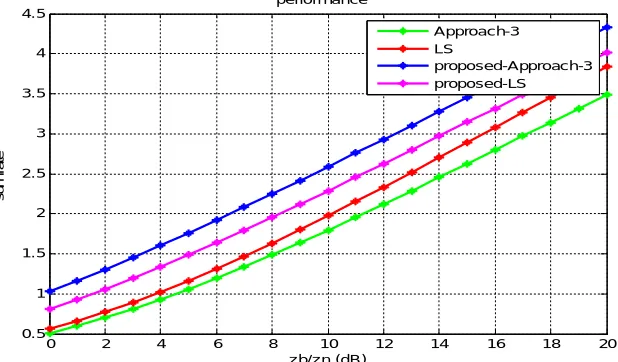
Fig. 4. The sum rate performance of the approach 3 and LS transmit beamformer design for K =4users with IEEE 802.11n channel model A.
Fig. 4 Illustrates that it also has better sum-rate performance and also lower BER performance. The sum rate in bits/s/Hz is computed by ∑ log2(1 + SINR ) Here, the channel is the IEEE 802.11n channel model A, which is a
flat-fading MIMO channel with average path gain of 0 dB, angular spreads AS =40° at the transmitter and receiver, mean angle of departure is 45° and mean angle of arrival is 45°.
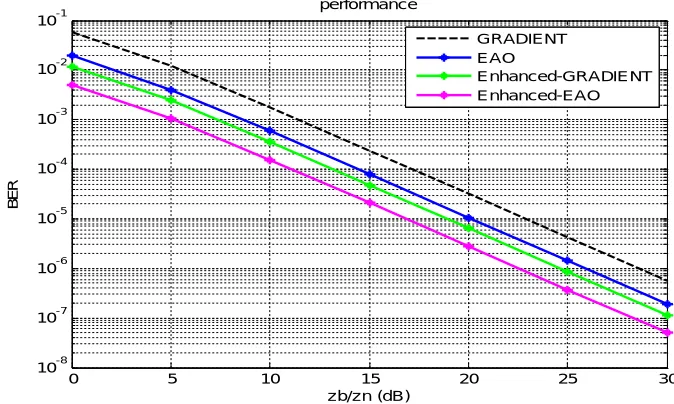
The BER performance and computational complexity of proposed methods have been compared with existing known methods, such as ZF, LI and sum-rate maximization. From Fig. 5, approaches 2 and 3 have better performance than ZF with selection and also much better than LI. The channel for this simulation is flat fading in time domain
denoted by G(0, 1). Fig. 6 compares the sum rate maximization by EAO with sum rate maximization by gradient descent method. From Fig.5, the performance loss is only 0.8 dB. The computational complexity of this gradient method isO(NK M )
where M=max(N , N) However, the computational complexity of all closed-form methods
6 7 8 9 10 11 12 13 14
10-2 10-1 100 101 102 103 performance B E R zb/zn (dB) K=1 K=3 K=2 Enhanced-K=1 Enhanced-K=3 Enhanced-K=2
0 2 4 6 8 10 12 14 16 18 20
presented here is O(NKM ). The required CPU times (not shown) indicate that our proposed method is five times faster
for M =4 and K =3.
Fig. 5. The BER performance of ZF with selection, LI and proposed approaches 2 and 3 for K =3and G(0, 1) channels.
Robustness to imperfect channel information can be readily gauged in the usual way by modeling the channel with
H, =ρH, + (1− ρ )W, where W is a zero mean, unit variance complex Gaussian random matrix
Fig. 6. The BER performance comparison of gradient method and proposed
EAO, with sum rate objective function, for K =3and G(0, 1) channels
6 7 8 9 10 11 12 13 14
10-2 10-1 100 101 102 103
B
E
R
zb/zn (dB)
K=1 K=3 K=2
Enhanced-K=1 Enhanced-K=3 Enhanced-K=2
0 5 10 15 20 25 30
10-8 10-7 10-6 10-5 10-4 10-3 10-2 10-1
performance
B
E
R
zb/zn (dB)
GRADIENT EAO
Fig. 7.Transmissionrate comparison Fig. 8.SER comparison
VI.CONCLUSION
We can enhance the performance of a multi user MIMO-OFDM interference channnel by the use of space frequency block code at the transmitting side and a successive noise cancellar at the receiver side.Singular value based decomposition can be used for reducing the complexity in beamforming.Since the system is converting from time domain to frequency domain complexity can be reduced.We can achieve high transmission rate ,high diversity and error free fast transmission than the existing system.
REFERENCES
1. Milad Amir Toutounchian, Student Member, IEEE, and Rodney G. Vaughan, Fellow IEEE, “Beamforming for Multiuser MIMO-OFDM
Interference Channels With Multipath Diversity” IEEE Trans on wireless communications, vol. 14, no. 3, march 2015.
2. S. Peters and R. Heath, “Cooperative algorithms for MIMO interference channels,” IEEE Trans. Veh. Technol., vol. 60, no. 1, pp. 206–218,
Jan. 2011.
3. O. El Ayach, S. Peters, and R. Heath, “The feasibility of interference alignment over measured MIMO-OFDM channels,” IEEE Trans. Veh.
Technol., vol. 59, no. 9, pp. 4309–4321, Nov. 2010.
4. H. Shen, B. Li, M. Tao, and X. Wang, “MSE-based transceiver designs for the MIMO interference channel,” IEEE Trans. Wireless
Commun.,vol.9, no. 11, pp. 3480–3489, Nov. 2010.
5. H. Sung, S.-H. Park, K.-J. Lee, and I. Lee, “Linear precoder designs for K-user interference channels,” IEEE Trans. Wireless Commun.,vol.9,
no. 1, pp. 291–301, Jan. 2010.
6. A. Pollok, W. Cowley, and N. Letzepis, “Symbol-wise beamforming forMIMO-OFDM transceivers in the presence of co-channel
interferenceand spatial correlation,” IEEE Trans. Wireless Commun., vol. 8, no. 12,pp. 5755–5760, Dec. 2009.
7. M. Kisialiou, X. Luo, and Z.-Q. Luo, “Efficient implementation of quasimaximum-likelihood detection based on semidefinite
relaxation,”IEEETrans. Signal Process., vol. 57, no. 12, pp. 4811–4822, Dec. 2009.
8. G. Zheng, K.-K. Wong, and T.-S. Ng, “Throughput maximization in linear multiuser MIMO-OFDM downlink systems,” IEEE Trans. Veh.
Technol.,vol. 57, no. 3, pp. 1993–1998, May 2008.
9. M. Codreanu, A. Tolli, M. Juntti, and M. Latva-aho, “Joint design of Tx–Rx beamformers in MIMO downlink channel,” IEEE Trans.
SignalProcess., vol. 55, no. 9, pp. 4639–4655, Sep. 2007.
10. T. Tang and R. W. Heath, “Space–time interference cancellation in MIMO-OFDM systems,” IEEE Trans. Veh. Technol., vol. 54, no. 5, pp.
1802–1816, Sep. 2005.
11. M. Schubert and H. Boche, “Iterative multiuser uplink and downlink beamforming under SINR constraints,” IEEE Trans. Signal Process., vol.
53, no. 7, pp. 2324–2334, Jul. 2005.
12. S. Boyd and L. Vandenberghe, Convex Optimization. Cambridge, U.K.Cambridge Univ. Press, 2004.
0 2 4 6 8 10 12 14 16 18 20
0 0.5 1 1.5 2 2.5 3 3.5 Ebno tr a n s m is s io n r a te exsisitng proposed
1 2 3 4 5 6 7 8 9 10
BIOGRAPHY