A Study on Reconfigurable Antennas
Athira T N1, Soumya A M 2
M.Tech Student, Department of ECE., SNGCE, Kadayiruppu, Kolenchery, Kerala, India1
Assistant Professor, Department of ECE, SNGCE, Kadayiruppu, Kolenchery, Kerala, India2
ABSTRACT:Reconfigurable antennas has several uses in wireless communication devices .Compared with conventional antennas, reconfigurable antennas have number of advantages. They are less in weight, smaller in dimension and low cost. Moreover, the reconfigurable antennas can provide instantaneous frequency bandwidths, polarization, and radiation pattern. The researches on the reconfigurable antenna are reviewed and summarized in this paper to present the characteristics and classifications.
KEYWORDS: Reconfigurable antenna; single band antenna; multiband antenna; patch antenna
I. INTRODUCTION
Nowadays we need antennas in our mobile devices and laptops to address several wireless standards such as WiFi, WiMAX and Bluetooth etc. In olden days single band antennas are used to meet these requirements. But single band antennas leads to large space requirement.To improve the quality of service reconfigurable antennas are developed.Reconfigurable antennas are capable of modifyits frequency and radiation pattern using RF switches, varactors, mechanical actuators/tunable materials.
Basically there are three types of reconfiguration. First type is frequency reconfigurable antennas, in which it can adjust dynamically it’s frequency of operation.Multiple antennas can be replaced by single frequency reconfigurable antennas. Second type is radiation pattern reconfiguration. Radiation pattern reconfigurability is based on purposefulmodification ofradiation pattern. The frequency band remains unchanged while the radiation pattern may become different s upon the system needs. The antenna can steer their radiation patterns beams to different direction.Third type is polarization reconfigurable antennas that are capable of switching between different polarizations modes.
The frequency-reconfigurable antennas are most suitable for implementation on consumer-type mobile multi radio platforms. Such antennas are usually equipped with switches that are controlled by dc bias signals. By switching antenna between on and off state it is able to support a set of frequencies. Patch antennas, wire antennas, and planar inverted F antennas (PIFAs) are the major implementation types of frequency reconfigurable antennas. Slots are usually introduced to deviatethe current path on the patch antennas to control their resonances. The length of these slots can be regulated by switches to reconfigure the patch antenna’s operating frequency. Second, for the wire antennas, the resonant frequency will be find out by its length or perimeter, which also can be controlled for reconfigurability. For example, for a monopole antenna has its first resonance when its length becomes one fourth of wavelength, while a loop antenna resonates at a frequency where its perimeter becomes equal to wavelength. Subsequently, different switches can be used to alter the length or perimeter of these wire antennas to allow operation over different frequency bands. For PIFA antenna by changing the PIFA’s feed or ground location, its mode of operation can be reconfigured, allowing its resonant frequency to be controlled.
Advantages of patch antenna over other antennas[7]
lightweight and have a small volume
ISSN(Online): 2320-9801
ISSN (Print) : 2320-9798
I
nternational
J
ournal of
I
nnovative
R
esearch in
C
omputer
and
C
ommunication
E
ngineering
(An ISO 3297: 2007 Certified Organization)
Vol. 4, Issue 7, July 2016
operating at higher power level and directivity. Patch antennas are most suitable for compact wireless devices. In patch antenna we can easily convert linear polarization into circular polarization, which help us to receive signals from all the directions.
II. RELATEDWORK
In this section, several existing reconfigurable antenna are discussed. Reconfigurable antennas can be implemented in several ways. Table 1 [1] shows the comparison between multiple band, multiband, reconfigurable antenna.
Characteristics Multiple
Antenna
Multiband Antenna
Reconfigurable Antenna
Model One antenna
supports one
frequency band
of wireless
service
One antenna
supports all
frequency bands
of wireless
services
One antenna
supports all
frequency bands of wireless standards
Space requirement
Require large
space
Reduced space Reduced space
Individual radio performance
Excellent Good Acceptable
Radio coexistence
Little spacing
between antennas
Poor out of
band rejection
Degraded true
simulation operation
Cost High High Less
Table 1.Comparison of antenna solutions for wireless mobile platforms
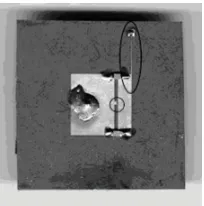
This paper investigates design concepts of reconfigurable antennas. The authors in [1] discuss about several ways of implementation of frequency reconfigurable antennas.Apatch antenna with switchable slots (PASS), in which a vertical slot is cut on the center.A diode which is placed across the slot in the center.When we switch on the diode,horizontal main current of patch’s first resonance is only slightly disturbed compared to the case with no slot. So when the switch is on the effect of slot is insignificant.
Fig. 1(b) Frequency reconfigurable patch antenna with three slots
When switch is turned off, horizontal current is forced to deviate around the slot and travels a longer path.Here slots are introduced to made antenna operate in different frequency bands.A modified version of PASS is also discussed in [1]. In the fig 1(b) three slots are introduced .There are three PIN diodes in each slot.The previously described PASS antenna operates in WiBro frequencies (2.3-2.4 GHz). But here when switches are off, a longer current path results a frequency band of 1.75- 1.8 GHz in K-PCS band.The authors focus only on simple patch antenna design concepts.The intention of surveying frequency reconfigurable antennas which supports more than one frequency bands and wireless standards leads to reviewing more literature.
A. RECONFIGURABLE MULTIBAND ANTENNA DESIGN
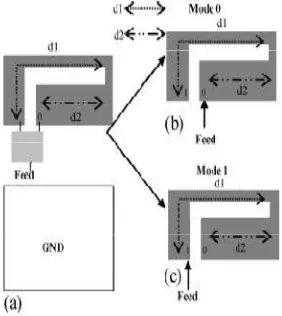
Antenna [2] designed to operate on various combinations of GSM, DCS, PCS, UMTS, WLAN and Bluetooth. Various communication systems can be served by only one antenna. In this design selection of different mode achieved either by i) switched feed or ii) switched ground designs
I) switched feed
Antenna operate in two modes, mode 0 and mode 1.Resonant frequencies corresponding to mode 0 and mode 1 are
f1 .f2 andf1.f3 respectively. The advantage is that using same antenna structure it is able to tune to different frequency
ISSN(Online): 2320-9801
ISSN (Print) : 2320-9798
I
nternational
J
ournal of
I
nnovative
R
esearch in
C
omputer
and
C
ommunication
E
ngineering
(An ISO 3297: 2007 Certified Organization)
Vol. 4, Issue 7, July 2016
Fig. 2(b). switched ground design
ii) Switched ground
Here mode 0 is achieved by making a connection to ground and mode 1 is achieved by breaking the connection to ground.In mode 0 two sets of frequency bands centered at f1and f2 are excited.In mode 1 two sets of frequency bands centered at f2and f3 are excited.
B. FREQUENCY RECONFIGURABLE ANTENNA FOR HANDHELD WIRELESS DEVICES
A balanced frequency reconfigurable antenna [3] for nine bands of operations is designed in this paper.Design composed of a feeding strip and a coupled parasitic shorted strip connected to an electronically tunable T-shaped strip.
Fig. 3.Frequency reconfigurable antenna for handheld devices
Feeding strip generates 950 MHz, 2300MHz; 2615MHza coupled shorted strip is added with feeding strip generates 850MHz,2200 MHz,and 2950MHz Thus covers frequency bands of GSM 850/LTE 2300/LTE 2500/WLAN. To operate in remaining frequency bands parasitic shorted strip is connected to T-shape strip,so that it covers LTE 700/DCS/PCS/UMTS frequency bands.
C.TWO PORT FREQUENCY RECONFIGURABLE ANTENNA FOR COGNITIVE RADIO
Fig. 4.Two port frequency reconfigurable antenna
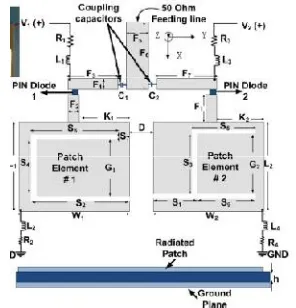
The frequency reconfigurable antennas so far we discussed deals with either narrowband or wideband. Thedesign of implementing a frequency reconfigurable antenna which is both multiband and wideband is discussed in [5].Here two patch elements are used and c slots are cut in each patch element.
Fig. 5.Reconfigurable dual band and multiband antenna
The designed antenna operates in two dual band modes and a wideband mode from 5-7 GHz.The operation of patch element is controlled by PIN diodes.The main advantage of the designed antenna is surface area reduction.
III.CONCLUSION AND FUTURE WORK
In this paper, reconfigurable antennas are surveyed. Frequency reconfigurable antennas are classified into three major categories. Frequency reconfigurable antennas are commonly used for wireless communication application. An effective comparison of single band, multib and, reconfigurable antenna is also presented in this paper.Modifying the antenna structure will help us to generate more number of frequency bands. Cutting slots,adding parasitic elements, usage of tunable materials are some of the ways to achieve desired operating bands. Extensions can be done on the designed model to support more bands in the wireless spectrum.
REFERENCES
1. Song nan Yang,Chunna Zhang, Helen .Pan, “Frequency Reconfigurable Antennas For Multiradio Wireless Platforms” , IEEE microwave magazine, Vol.10,Issue 1, pp. 66-83,Feb. 2009.
ISSN(Online): 2320-9801
ISSN (Print) : 2320-9798
I
nternational
J
ournal of
I
nnovative
R
esearch in
C
omputer
and
C
ommunication
E
ngineering
(An ISO 3297: 2007 Certified Organization)
Vol. 4, Issue 7, July 2016
4. HattanF.Abutarboush,S.W. Cheung,KarimM.Nasar,Thomas Peter,DjuradjBudimir,Hamed Al-Raweshidy.“A Reconfigurable Wideband and Multiband Antenna Using Dual Patch Elements For Compact Wireless Devices”. IEEE Transactions on Antennas and Propogation vol.60,no 1,January 2012.
a. A. Balanis, Antenna Theory, 2nd ed. New York: Wiley, 1997.
5. G. Kumar and K. P. Ray, Broadband Microstrip Antennas. Boston, MA: Artech House, 2003, pp. 18–23.
6. H. Wang, X. B. Huang, and D. G. Fang, “A single layer wideband U-slot microstrip patch antenna array”,IEEE Antennas Wireless Propag. Lett., vol. 7, pp. 9–12, 2008.
a. Mak, R. Chair, K. Lee, K. Luk, and A. Kishk, “Half U-slot patch antenna with shorting wall”,Elect. Lett., vol. 39, pp. 1779–1780, 2003.
7. Y. Li, R. Chair, K.M. Luk, and K. F. Lee, “Broadband triangular patch antenna with a folded shorting wall”,IEEE Antennas Wireless Propag. Lett., vol. 3, no. 1, pp. 189–192, Dec. 2004.
8. S. Qu and Q. Xue, “A Y-shaped stub proximity coupled V-slot microstrippatch antenna”,IEEE Antennas Wireless Propag. Lett., vol. 6, 9. pp. 40–42, 2007.
10. K.-L. Wong and W.-H. Hsu, “A broad-band rectangular patch antenna with a pair of wide slits”,IEEE Trans. Antennas Propag., vol. 49, no. 9, pp. 1345–1347, Sep. 2001.
11. F.Yang, X. Zhang, X.Ye, and Y. Rahmat-Samii, “Wide-band E-shaped patch antennas for wireless communications”,IEEE Trans. Antennas Propag., vol. 49, no. 7, pp. 1094–1100, Jul. 2001.
12. S. Lee, H. Park, S. Hong, and J. Choi, “Design of a multiband antennausing a planner inverted-F structure”, in Proc. 9th Int. Conf. Adv.Commun. Technol., vol. 3, pp. 1665–1668, 2007
13. R. Sujith, V. Deepu, D. Laila, C. Aanandan, K. Vasudevan, and P. Mohanan,“A compact dual-band modified T-shaped CPW-fed monopoleantenna,” Microw. Opt. Technol. Lett., vol. 51, no. 4, pp. 937–939,2009.
BIOGRAPHY
Ms.Athira T N1 received her B.Tech Degree in Electronics and Communications Engineering from Mahatma Gandhi University, Kerala, India in 2014. She is currently studying her M.Tech Degree in Communication Engineering in Mahatma Gandhi University, Kottayam, Kerala, India. Her areas of interest include Antenna, wave propogation and mobile communication.