University of Windsor University of Windsor
Scholarship at UWindsor
Scholarship at UWindsor
Electronic Theses and Dissertations Theses, Dissertations, and Major Papers
2013
Evaluation and Hardware Realization for a Face Recognition
Evaluation and Hardware Realization for a Face Recognition
System
System
Kaushik Ray
University of Windsor
Follow this and additional works at: https://scholar.uwindsor.ca/etd
Recommended Citation Recommended Citation
Ray, Kaushik, "Evaluation and Hardware Realization for a Face Recognition System" (2013). Electronic Theses and Dissertations. 4923.
https://scholar.uwindsor.ca/etd/4923
This online database contains the full-text of PhD dissertations and Masters’ theses of University of Windsor students from 1954 forward. These documents are made available for personal study and research purposes only, in accordance with the Canadian Copyright Act and the Creative Commons license—CC BY-NC-ND (Attribution, Non-Commercial, No Derivative Works). Under this license, works must always be attributed to the copyright holder (original author), cannot be used for any commercial purposes, and may not be altered. Any other use would require the permission of the copyright holder. Students may inquire about withdrawing their dissertation and/or thesis from this database. For additional inquiries, please contact the repository administrator via email
Evaluation and Hardware Realization for a Face Recognition System
By
Kaushik Ray
A Thesis
Submitted to the Faculty of Graduate Studies through Electrical and Computer Engineering in Partial Fulfillment of the Requirements for
the Degree of Master of Applied Science at the University of Windsor
Windsor, Ontario, Canada
2013
Evaluation and Hardware Realization for a Face Recognition System
by
Kaushik Ray
APPROVED BY:
______________________________________________ Dr. Shaohong Cheng, Outside Dept. Reader Department of Civil and Environmental Engineering
______________________________________________
Dr. Mohammed A. S. Khalid, Internal Dept. Reader
Dept. of Electrical & Computer Engineering
______________________________________________ Dr J. Wu, Advisor
Dept. of Electrical & Computer Engineering
iii
Co-Authorship Declaration
I hereby declare that this thesis incorporates material that is result of joint
research, as follows:
This thesis also incorporates the outcome of a joint research undertaken in
collaboration with Ashirbani Saha under the supervision of Professor Jonathan
Wu. The collaboration is covered in Chapter 3 of the thesis. The experimental
designs, data analysis and the hardware design were performed by the author.
The contributions of co-authors were primarily through the face recognition
algorithm idea and implementation, provision of proof reading and reviewing the
research paper regarding the technical content.
I am aware of the University of Windsor Senate Policy on Authorship and I certify
that I have properly acknowledged the contribution of other researchers to my
thesis, and have obtained written permission from each of the co-authors to
include the above materials in my thesis.
I certify that, with the above qualification, this thesis, and the research to which it
refers, is the product of my own work.
I declare that, to the best of my knowledge, my thesis does not infringe upon
iv
techniques, quotations, or any other material from the work of other people
included in my thesis, published or otherwise, are fully acknowledged in
accordance with the standard referencing practices. Furthermore, to the extent
that I have included copyrighted material that surpasses the bounds of fair
dealing within the meaning of the Canada Copyright Act, I certify that I have
obtained a written permission from the copyright owner(s) to include such
material(s) in my thesis.
I declare that this is a true copy of my thesis, including any final revisions, as
approved by my thesis committee and the Graduate Studies office, and that this
thesis has not been submitted for a higher degree to any other University or
v
Abstract
Facial recognition from an image or a video sequence draws attention for many
image processing researchers owing to its myriad applications in real world as
well as in computer vision, human-computer interaction and intelligent systems.
Facial structures have unique features which can be extracted using some
mathematical tools. We have used Principal Component Analysis (PCA) and Local
Binary Pattern (LBP) to extract them and stored them in a database. When the
query image is given the facial features are extracted and compared to the
previously obtained results using Sparse Face recognition. Detailed test methods
have been defined and an extensive testing of the algorithm has been performed
on various standard databases. The results have been tabulated with required
graphs. The proposed algorithm has been compared to other different algorithms
which show significant improvement in results with small number of training
samples. Finally the algorithm was integrated in a hardware system so that it can
vi
to my
vii
Acknowledgements
I express my sincere gratitude to my adviser, Dr. Q.M. Jonathan Wu for giving me
the opportunity to work under his supervision as well as for his constant guidance
and support. I would like to thank Mr. Frank Cicchello for his valuable suggestions
and comments. I would like to thank Ashirbani Saha and Dibyendu Mukherjee for
all their constant guidance, help and motivation during my research work.
I am thankful to my friends and colleagues, in particular Charrie, Carolyn, Conrad,
Carina, Candace, and Gaurav for their help and frequent assistance and
motivation throughout my work and stay. Last but not the least, I would like to
thank my mom, dad and my sister for their love and support which motivated me
viii
Table of Contents
Co-Authorship Declaration ... iii
Abstract ... v
Acknowledgements ... vii
List of Tables ... xiii
List of Figures ... xvi
List of Acronyms ... xx
Chapter 1: Introduction ... 1
1.1 Why use face recognition software? ... 1
1.2 Challenges ... 2
1.3 Motivation ... 2
1.4 Objective ... 3
1.5 Scope ... 3
1.6 Organization ... 4
Chapter 2: Literature Review ... 5
2.1 General Workflow ... 5
2.1.1 Facial image acquisition ... 6
2.1.2 Preprocessing of the facial image ... 6
2.1.3 Facial feature extraction ... 7
2.1.4 Matching the query image with the database image ... 8
ix
Chapter 3: Software and Algorithm ... 11
3.1 Introduction ... 11
3.2 A short description on face recognition ... 11
3.3 Face Detection ... 14
3.3.1 The integral image: ... 14
3.3.2 Classifier learning with AdaBoost ... 15
3.3.3 Attentional Cascade Structure ... 17
3.4 Facial Alignment ... 17
3.5 Feature extraction using Local Binary Pattern (LBP) ... 21
3.6 Principal Component Analysis (PCA) ... 25
3.7 Processing the Images with LBP and PCA ... 26
3.8 Sparse Face Recognition ... 27
3.8.1 Classification Based on Sparse Representation ... 28
3.9 Designing the training set ... 32
3.9.1 Procedure 1 ... 32
3.9.2 Procedure 2 ... 33
3.10 Results ... 34
3.10.1 Face 94 ... 34
3.10.1.1 About the Database ... 34
3.10.1.1.1 Database Description ... 34
3.10.1.1.2 Variation of individual's images ... 34
3.10.1.2 Test Result from Procedure 1 ... 35
3.10.1.3 Test Result from Procedure 2 ... 39
3.10.2 Face95 ... 42
3.10.2.1 About the Database ... 42
3.10.2.1.1 Database Description ... 42
3.10.2.1.2 Variation of individual's images ... 42
x
3.10.2.3 Test Result from Procedure 2 ... 46
3.10.3 Face96 ... 49
3.10.3.1 About the Database ... 49
3.10.3.1.1 Database Description ... 49
3.10.3.1.2 Variation of individual's images ... 49
3.10.3.2 Test Result from Procedure 1 ... 50
3.10.3.3 Test Result from Procedure 2 ... 53
3.10.4 FEI Face database ... 56
3.10.4.1 About the Database ... 56
3.10.4.1.1 Database Description ... 56
3.10.4.1.2Variation of individual's images ... 57
3.10.4.2 Test Result from Procedure 1 ... 58
3.10.4.3 Test Result from Procedure 2 ... 62
3.10.5 JAFFE ... 66
3.10.5.1 About the Database ... 66
3.10.5.1.1 Database Description ... 66
3.10.5.2.2 Variation of individual's images ... 66
3.10.5.2 Test Result from Procedure 1 ... 67
3.10.5.3 Test Result from Procedure 2 ... 71
3.10.6 PUT Vein Pattern Database ... 74
3.10.6.1 About the Database ... 74
3.10.6.1.1 Database Description ... 74
3.10.6.1.2 Variation of individual's images ... 74
3.10.6.2 Test Result from Procedure 1 ... 75
3.10.6.3 Test Result from Procedure 2 ... 78
3.10.7 Yale Face database ... 81
3.10.7.1 About the Database ... 81
3.10.7.1.1 Database Description ... 81
3.10.7.1.2 Variation of individual's images ... 81
xi
3.10.7.3 Test Result from Procedure 2 ... 85
3.11 Conclusion and Discussions ... 88
Chapter 4: Hardware System ... 91
4.1 Objective ... 91
4.2 System Overview ... 91
4.3 Camera Module ... 93
4.3.1 CMOS vs. CCD sensors ... 94
4.3.2 The Camera Setup ... 95
4.4 GUI and IR Intensity level Controller ... 97
4.4.1 System Configuration ... 97
Noise reduction and surge protection capacitor ... 100
Voltage regulator IC ... 100
Power connector ... 101
ADC reference voltage adjuster ... 101
LCD contrast adjust ... 102
ATMEGA 32 controller ... 102
Sensor connector ... 102
Programmer Connector ... 102
Crystal ... 102
Keyboard Cable ... 103
LCD Cables ... 103
4.4.2 20 x 4 LCD ... 103
4.4.3 Keyboard ... 106
4.4.4 AT24C64 ... 107
4.4.5 TTL to RS232 Convertor ... 108
4.4.5.1 TTL and RS232 ... 108
4.4.6 Illumination Control Sensor ... 109
4.4.7 Pulse Width Modulation (PWM) Controller ... 113
4.4.8 AtMega 32L ... 113
xii
4.5 Main Processing Board ... 117
4.5.1 Processor selection ... 117
4.5.2 A brief description/specification of the processor / board ... 118
4.6 Results Obtained ... 120
Chapter 5: Conclusion and Future Work ... 122
5.1 Contribution of the Research Work ... 122
5.2 Scope for future work ... 123
References ... 126
xiii
List of Tables
Table 3.1: Change in percentage accuracy with and without the alignment.
Table 3.2: Different images used for training and testing from Face 94 database.
Table 3.3: Results from Procedure 1 on Face 94 database.
Table 3.4: Different images used for training and testing from Face 94 database.
Table 3.5: Results from Procedure 2 on Face 94 database.
Table 3.6: Different images used for training and testing from Face 95 database.
Table 3.7: Results from Procedure 1 on Face 95 database.
Table 3.8: Different images used for training and testing from Face 95 database.
Table 3.9: Results from Procedure 2 on Face 95 database.
Table 3.10: Different images used for training and testing from Face 95 database.
Table 3.11: Results from Procedure 1 on Face 96 database.
Table 3.12: Different images used for training and testing from Face 95 database.
Table 3.13: Results from Procedure 2 on Face 96 database.
Table 3.14: Different images used for training and testing from FEI face database.
Table 3.15: Results from Procedure 1 on FEI face database for subject 1 to 100.
xiv
Table 3.17: Different images used for training and testing from FEI face database.
Table 3.18: Results from Procedure 2 on FEI face database for subject 1 to 100.
Table 3.19: Results from Procedure 2 on FEI face database for subject 100 to 200.
Table 3.20: Different images used for training and testing from JAFFE database in
different Subsets.
Table 3.21: Results from Procedure 1 on JAFFE database.
Table 3.22: Different images used for training and testing from JAFFE database.
Table 3.23: Results from Procedure 2 on JAFFE database.
Table 3.24: Different images used for training and testing from PUT Vein Pattern
database in different Subsets.
Table 3.25: Results from Procedure 1 on PUT Vein Pattern database.
Table 3.26: Different images used for training and testing from PUT Vein Pattern
database in different Subsets.
Table 3.27: Results from Procedure 2 on PUT Vein Pattern database.
Table 3.28: Shows the different images used for training and testing the Yale Face
database in different Subsets.
Table 3.29: Results from Procedure 1 on Yale Face database.
Table 3.30: Shows the different images used for training and testing the Yale Face
database in different Subsets.
Table 3.31: Results from Procedure 2 on Yale Face database.
Table 3.32: Tablets the results obtained for facial recognition algorithms on
different databases and compared it to SFRLBP
Table 3.33: Tabulates results for face recognition with different listed algorithms
and the accuracy obtained for Yale face database.
Table 4.1: lists all the components on the board marked in Figure 4.5.
Table 4.2: Lists the function of each pin in a 20 x 4 LCD.
xv
xvi
List of Figures
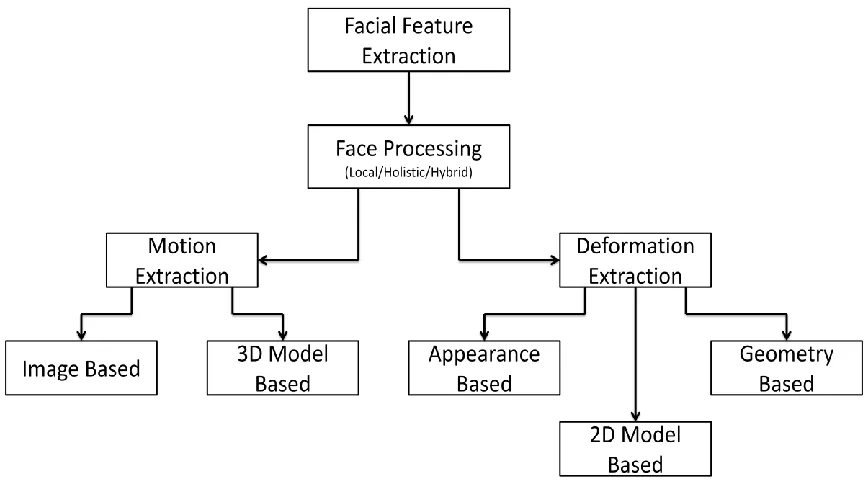
Figure 2.1: General workflow of a face recognition system.
Figure 2.2: Different type of facial feature extraction approaches.
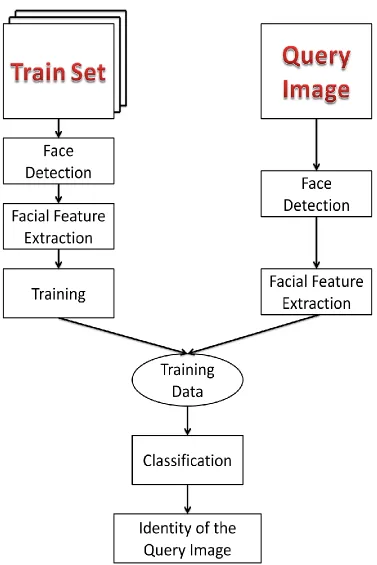
Figure 3.1: Shows the basic blocks and the process flow of the proposed facial
recognition algorithm.
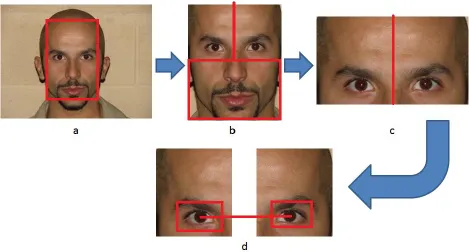
Figure 3.2: Alignment process flow.
Figure 3.3: (a) Shows the holes present due to the rotation of the image marked
by red circles. (b) Shows the image processed with a bilinear filter.
Figure 3.4: The Basic LBP operator.
Figure 3.5: A sample image set from Face 94 database.
Figure 3.6: Graphs showing accuracy in percentage against the number of
Principle Components.
Figure 3.7: Graphs showing accuracy in percentage against the number of
Principle Components.
Figure 3.8: A sample image set from Face 95 database.
Figure 3.9: Graphs showing accuracy in percentage against the number of
Principle Components.
Figure 3.10: Graphs showing accuracy in percentage against the number of
Principle Components.
xvii
Figure 3.12: Graphs showing accuracy in percentage against the number of
Principle Components.
Figure 3.13: Graphs showing accuracy in percentage against the number of
Principle Components.
Figure 3.14: Some examples of image variations from the FEI face database.
Figure 3.15: In this figure, 2 sets of five images have been shown which were used
to test and train the algorithm from FEI Face Database.
Figure 3.16: Graphs showing accuracy in percentage against the number of
Principle Components for Set 1.
Figure 3.17: Graphs showing accuracy in percentage against the number of
Principle Components for Set 2.
Figure 3.18: Graphs showing accuracy in percentage against the number of
Principle Components for Set 1.
Figure 3.19: Graphs showing accuracy in percentage against the number of
Principle Components for Set 2.
Figure 3.20: A sample image set from JAFFE database.
Figure 3.21: Graphs showing accuracy in percentage against the number of
Principle Components.
Figure 3.22: Graphs showing accuracy in percentage against the number of
Principle Components.
Figure 3.23: In A sample image set from PUT Vein Pattern database.
Figure 3.24: Graphs showing accuracy in percentage against the number of
Principle Components.
Figure 3.25: Graphs showing accuracy in percentage against the number of
Principle Components.
Figure 3.26: 2 sets of five images have been showed which were used to test and
train the algorithm.
Figure 3.27: Graphs showing accuracy in percentage against the number of
xviii
Figure 3.28: Graphs showing accuracy in percentage against the number of
Principle Components for Set 2.
Figure 3.29: Shows two sample images from PUT Vein Pattern Database.
Figure 4.1: The following figure shows the major three blocks of the proposed
system.
Figure 4.2: Shows the camera module with the IR LED’s mounted to it.
Figure 4.3: Shows images captured in different lighting conditions.
Figure 4.4: This diagram shows the basic blocks of the GUI and the IR intensity
controller.
Figure 4.5: This picture shows the main board.
Figure 4.6: A simple circuit diagram for 7805 has been displayed in the above
figure.
Figure 4.7: A 20×4 LCD display module.
Figure 4.8: Circuit diagram showing the basic wiring for a LCD module.
Figure 4.9: A picture of the keyboard used for the GUI Design.
Figure 4.10: Displays the pin out of a AT24C64 EEPROM.
Figure 4.11: Shows the pin out and the basic circuit diagram for a MAX 232.
Figure 4.12: This graph shows the illumination verses current output in for
BPW34 sensor.
Figure 4.13: The above picture shows the BPW34 sensor.
Figure 4.14: In this diagram we have a simple design showing a current to voltage
convertor with D1 as the BPW34.
Figure 4.15: Shows the pin out for the opamp.
Figure 4.16: Pin diagram of an AtMega 32 controller.
Figure 4.17: The basic circuit diagram of an AtMega 32 controller.
xix
Figure 4.19: Displays a picture of the main processing board.
xx
List of Acronyms
AAM Active Appearance Method
ADC Analog to Digital Converter
ASCII American Standard Code for Information Exchange
ASIC Application-Specific Integrated Circuit
ASIP Application Specific Instruction set Processor
ASM Active Shape Model
ASSP Application Specific Signal Processor
BJT Bipolar Junction Transistors
CCD Charged Coupled Device
CMOS Complementary Metal-Oxide Semiconductor
CMRR Common Mode Relation Ratio
CPU Central Processing Unit
CUDA Compute Unified Device Architecture
DAQ Data Acquisition
DCT Discrete Cosine Transform
DSP Digital Signal Processors
xxi
EBGM Elastic Bunch Graph Matching
ED Euclidean Distance
EEPROM Electrically Erasable and Programmable Read-Only Memory
FFT Fast Fourier Transform
FPGA Field Programmable Gate Array
GB Gigabyte
GND Ground
GPIO General Purpose Input/Output
GPP General Purpose Processors
GPU Graphics Processing Unit
GUI Graphical User Interface
HD Hamming Distance
HEX Hexadecimal
HMM Hidden Markov Model
HSD Haar Spectral Diagram
IC Integrated Circuits
IDE Integrated Drive Electronics
IO Input/Output
IR Infra-red
JAFFE Japanese Female Facial Expression
JTAG Joint Test Action Group
KB Kilobyte
KN Known Neighbor
xxii
LCD Liquid Cristal Display
LDA Linear Discriminant Analysis
LED Light Emitting Diode
LSB Least Significant Bit
MB Megabyte
MHz Megahertz
MIPS Million Instructions Per Second
OMP Orthogonal Matching Pursuit
OS Operating System
PC Personal Computer
PCA Principal Component Analysis
PDIP Plastic Dual In-line Package
PWM Pulse Width Modulation
RAM Random Access Memory
RBF Radical Based Function
RC Resistance and Capacitance
RGB Red Green Blue
RISC Reduced Instruction Set Computing
ROM Read-Only Memory
RX Receive
SCL Serial Clock
SD Secure Digital
SDA Serial Data
xxiii
SoC System on Chip
SRAM Static Random Access Memory
STFT Sort-Time Fourier Transform
SVM Support Vector Machine
TTL Transistor-Transistor Logic
TX Transmit
UART Universal Asynchronous Receiver/Transmitter
USB Universal Serial Bus
VI Voltage Input
VO Voltage Output
WP Wright Protect
1
Chapter 1: Introduction
The primary objective for this thesis is to explain our proposed algorithm, design,
application and tests for a robust face recognition algorithm and to explain how this
system can be implemented onto hardware in order to realize its portability,
surveillance potential to solve problems involving automotive theft and driver
authentication. We believe this design conception will produce striking results as well
as a critical, distinguished, state-of-the-art product.
1.1 Why use face recognition software?
Every day, thousands of terabytes of images around the world are captured in the form
of videos from surveillance cameras. Of those captured images, 95 percent consist of
facial data, so finding a correct algorithm to extract these facial structures and index
them for facial recognition is vital. Presently, there are a myriad of applications for a
robust face detection and recognition model. These applications are not only crucial
within the theoretical world, but they have a gargantuan significance in the real world.
For example, accurate facial recognition can be used for identification of criminals, for
2
feature-length films, for use by investigators, scientists and engineers in the fields of
human computer interaction and homeland security and for key barriers to automotive
theft.
1.2 Challenges
Over the years, researchers have faced serious challenges with facial recognition
systems. Although in the past few years we have seen significant improvement, most of
the face recognition algorithms work well only with frontal faces. Occlusion of the face
due to sunglasses, long hair, or some object that partially covers the face has made the
production of a reliable face recognition system challenging. In addition, change in
facial expression, low light, and low resolution pictures have proved detrimental for a
trustworthy, consistent face recognition product. Difficulties with robustness verses
processing speed have made the manufacture of this crucial recognition system even
more arduous.
1.3 Motivation
The challenges mentioned in section 1.2 make face recognition one of the major
research topics in computer vision. Face recognition being one of the diverse research
topic with a lot of developments and new algorithms proposed every day but in
retrospect that fact there are major gaps to be filled up for a perfect design. Everyday
researchers are trying to fill these gaps and find a better solution. A trade-off between
the speed and accuracy looms large as the primary research focus. Algorithms with
3
complexity have lower accuracy. One of the other major motivational factors is a
Waterloo based company brought into focus for a requirement of a portable device
capable of face recognition. The primary objective for the device is to be installed in a
car for authentication of the eligible drivers.
1.4 Objective
The objective for the research detailed in this thesis is to improve the accuracy and
speed for a face recognition system using sparse face recognition and Local Binary
Pattern or LBP. Two different test procedures are presented to test the proposed
algorithm on various standard datasets. Each of these datasets carries its own, unique
features including variations in expression, lighting conditions, partial occultation, and,
cluttered backgrounds. The final objective of this thesis is to demonstrate an available
design and execution of a face recognition system in a portable hardware which can be
used as a standalone device.
1.5 Scope
This research comprises a new approach towards face recognition with LBP and sparse
face recognition along with rigorous testing and detailed observations on various
standard datasets in order to reduce the whole system in small scale hardware and
design a standalone system. Most embedded hardware systems use Hidden Markov
Model (HMM) for embedded face recognition. This paper will present one of the first
4
1.6 Organization
This thesis has been organized as follows:
Chapter 2 details a review of the related work involved as well as a general
workflow for a face recognition system.
Chapter 3 specifies an overview of the present research along with required
flowcharts and diagrams. A detailed tabulation of the results obtained is
presented along with relevant graphs.
Chapter 4 concentrates upon system miniaturization with a small sized board to
make it a portable and standalone system along with other hardware support to
assist the proposed algorithm.
Chapter 5 discusses the future work that can be performed to make this
5
Chapter 2: Literature Review
Faces are complex multi-dimensional structures and over the past three decades, image
processing researchers have been working hard to execute a suitable procedure to
extract, analyze and recognize facial features. This system is needed to find the identity
of a test subject that will be significantly more reliable than the present systems.
Most of the early models were based on Construct Detailed models of retinal or striate
activity. It was much later, with the increase in computational power, that face
recognition turned to computational modeling. Most of these computational models of
face recognition contain some basic blocks. Many different researchers have tried
several different procedures to find a perfect algorithm to devise a facial recognition
system that will be almost perfect.
2.1 General Workflow
Most facial recognition algorithms follow a generic frame work which is presented in
Figure 2.1. The basic steps for facial recognition and some of the existing works in the
6
Figure 2.1: General workflow of a face recognition system.
2.1.1 Facial image acquisition
A face acquisition system identifies, locates and extracts features from a complex scene
with cluttered backgrounds. For a face recognition system a good face detector is very
important. There are many approaches for a face detection system - where some use an
[91][92] exact location of faces, others operate [93][94] with a coarse location of faces.
Modular eigenspace method was used by Essa and Pentland [91] for face detection.
Principal component analysis or PCA coefficients of facial images were used to extract
facial information from still images and image sequences. Hong et. al [92] used the
Pearson Spotter system [95] for tracking the head so stereo disparity, skin color
detection and convex region detector to figure out the exact face location. Methods like
Active Appearance or AAM and local motion model [93] can work with a course location
of faces. The most popular and effective face detection system used in recent research
is Viola-Jones’ face detector, which uses boosted haar features to detect faces.
2.1.2 Preprocessing of the facial image
Images captured in different resolution are computed in a uniform scale; RGB images
can be converted to gray image; grey image can be converted to binary image. Noise
reduction filter can be used or face alignment algorithm can be used for aligning the
7
2.1.3 Facial feature extraction
Feature extraction is one of the major tasks in an image processing algorithm. Feature
extraction categorizes the image into correct abstract classes relevant to the context.
Every image is a two dimensional, three dimensional or fore dimensional data set
depending on the type of image or a video sequence. The basic idea is to use some
mathematical tool on these data sets or matrices and extract meaningful information. In
Figure 2.2 we can see some methods in which face detection algorithms are broadly
classified. These methods use local information like portion of the eye or mouth [98]
[99] for extracting the facial features. Holestic methods [92] [94] [97] use the entire face
or points from different positions from the face. Methods which use both global and
local features are also in existence and are commonly known as hybrid methods [91]
[100].
Most commonly the image features are extracted in spatial domain or transform
domain. In spatial domain it mostly calculates the density of the pixel or the distance
between the lips and nose or the distance between the lips and the line joining the two
eyes, mean standard deviation etc. In transformation domain methods like Fast Fourier
Transform (FFT) [73], Discrete Cosine Transform (DCT) [74], Sort-Time Fourier Transform
(STFT) [75], Discrete Wavelet Transform (DWT) [76] etc. are some of the common
8
Figure 2.2: Different type of facial feature extraction approaches.
2.1.4 Matching the query image with the database image
While matching the query image, the features extracted from the training facial images
are stored in a database. Next the query image is compared with the images from the
database which have been processed and stored. Most common methods include
Euclidean Distance (ED), Hamming Distance (HD), Support Vector Machine (SVM) [78],
Known Neighbor (KN) [77] etc.
One of the most efficient computational models was proposed by Matthew Turk and
Alex Pentland [43] in 1991; these are known as Eigenfaces were one of the best
computational models at the time. Eigenfaces were used for a long time for face
detection and recognition, all the while yielding good results. With further research,
many drawbacks of the Eigenfaces were able to be overcome. Jeffery and Masatoshi
9
to represent the Haar spectrum of Boolean function. In 2003 Kan Ma and Xiaoou Tang
[71] proposed something similar to the Garber face graph known as Discrete Wavelet
Face Graph. Duan and Zheng [72] proposed a method which uses grey level AdaBoost
scheme for extracting Haar like features. In the next following years many new
algorithms were developed which has an upper hand on top of the previous algorithm.
Paul and Abbes [80] proposed a method to determine most discriminative coefficients
in DWT/PCA based face recognition algorithm. Jun Ying Gan and Jun Feng Liu [81]
proposed an innovative and novel approach based on wavelet features and their
algorithm is known as Kernel Fisher Discriminant Analysis [82].
In more recent years, there have been more sophisticate algorithms proposed which are
very robust and efficient. Some of the major approaches include PCA [43], Linear
Discriminant Analysis (LDA) [83], Elastic Bunch Graph Matching (EBGM) [84], LBP [9],
Sparse Representation [67] [69]. With the advent of all these new avenues, facial
recognition techniques have been going uphill and reaching towards the goal to give an
accuracy of close to 100% recognition rate. In the next following chapters we will
explore a very new and unique way of designing Face recognition systems with sparse
face recognition.
2.2 Embedded face recognition system
A Face recognition system is challenging by itself, so embedded face recognition
systems must be even more challenging. Due to lower processing power and limitation
10
the most popular embedded face recognition systems available are neural network
based face recognition systems [87]. Eigenfaces have been used for a long time; they are
known to give good results using FFT based calculations for distance measurement as
well as face detection [89], making hardware implementation easier and faster. In 2003
Fan Yang and Michel Paindavoine designed a Radical Based Function (RBF) Neural
Network for real time tracing and face recognition on embedded systems. They
implemented the same algorithm on different embedded hardware; the result and
speed varied based on the hardware used: 92 percent accuracy on Fast Programmable
Gate Array (FPGA); 85 percent accuracy on a ZISC processor [90]; and 98.2 percent
accuracy on a Digital Signal Processor (DSP). With the increase in accuracy there is a
decrease in the processing speed for the system. There are many other efforts for
embedded face recognition systems which include designing a face recognition system
by Liu et al. [84] using optical correlation technique.
In this thesis we have implemented the proposed algorithm on a portable hardware
system. This is the first approach for designing a portable face recognition system with
11
Chapter 3: Software and Algorithm
3.1 Introduction
Development of an automatic face recognition algorithm is one of the major challenges
for the image processing and pattern recognition researchers. Many algorithms have
been proposed and all has some pros and cons. Some algorithms have a high efficiency
rate but with a higher time complexity; others have a lower time complexity but with a
lower efficiency rate (i.e. Eigenfaces). The prime goal for our thesis is to find an
algorithm which can excel in two folds. In some recent research, it has been observed
that LBP can extract useful correlated information out of a facial image [44]. We have
used the same to design an algorithm which is robust as well as fast.
3.2 A short description on face recognition
Any face recognition system has a few steps in common like acquiring a set of training
images for training the system. Find the face inside the image give the image a proper
illumination and align the facial structure using some kind of algorithm and extract the
region of interest for training and testing [43]. After these preliminary processing the
12
In the following few section, we discuss an algorithm which has following features:
Illumination invariant.
Very robust even if trained with small number of training samples.
And very fast recognition time on an average 0.3 sec*
Gives a very good result even without facial alignment reducing the recognition
time.
The proposed algorithm uses LBP [9] and PCA for feature extraction. Sparse
Representation has been used to match the data from the test set to the test sample. In
the Sparse Representation instead of minimization [69], Orthogonal Matching Pursuit
(OMP) has been used to synthesize the matched image from the training dataset and
the test sample. Let’s say the sample image is of size and the train data set is of
size now the synthesized image is derived from these two information
which is of the order of . Orthogonal Matching Pursuit [68] is used instead of
conventional minimization as it is faster and yields better performance [42]. Figure
3.1 shows the basic blocks and the process flow of the algorithm.
*All simulations in this chapter are tested on an AMD X2 1075processor based computer with
13
14
3.3 Face Detection
Viola Jones Face detector is one of the most impacting and robust face detector
available till date. This real time face detector stands on three pillars namely:
The integral image
Classifier learning with AdaBoost
Attentional cascade structure
3.3.1 The integral image:
Integral image is one of the major pillars for Viola Jones. This algorithm can be defined
as a two dimensional lookup table in the form of a matrix with same dimensions as of
the original image. Haar like features are very easy to compute as the algorithm follows
the integral image technique and it provides a good performance for constructing a
frontal face detector. This algorithm is used to quickly and efficiently calculate the sum
of values in a rectangular subset in a grid. The integral image can be calculated by:
where is the integral image at pixel location and is the original
image. Depending on the definition Haar like features may need more than four lookup
tables. Viola and Jones's 2-rectangle features need six lookups, 3-rectangle features
15
3.3.2 Classifier learning with AdaBoost
Adoptive Boosting or AdaBoost is the first step towards the practical boosting algorithm
[2] [3]. In this algorithm we have used a modified version of AdaBoost which is
commonly known as the RealBoost [1] [4] [5] [8]. RealBoost yields substantially better
result than the AdaBoost.
Let us consider a training set say where belongs to the
sample space and belong to the finite label space . For a binary classification
problem, , where for positive set and for the negative set. As
the name suggests AdaBoost is adaptive in nature and produces an adaptive model
which can be represented by for predicting the label of a test
sample . In the above equation is a real function which is represented by
and the predicted label is , where sign(.) is the sign
function. From the statistical view point AdaBoost falls into a additive logistic regression
model and by using adaptive Newton updates of minimization the whole system can be
represented as
Now AdaBoost can find the best additive base function once is known.
Now let’s consider for that which is a base function and is in the form of
confidence rated decision stump. This can be classified as certain form of real feature
16
detector are Haar-like feature computed with integral images. A threshold is obtained
which will now divide the output obtained from to two different parts say
where . Now the base function can be rewritten as:
, if
and this is often known as the stump classifier. gives the confidence of the derived
result and the optimal confidence value can be calculated from the following equations
when and Let
Now the expression for target criteria can be written as:
Using basic calculus we can minimize when
Now if we combine both the equations we get
17
This equation gives us the score [6]. For each and every iteration , the Haar-like
feature we can derive an optimum threshold with a confidence score of and
for minimizing the score .
3.3.3 Attentional Cascade Structure
This is one of the major components in the Viola Jones face detector. The most
important objective of this algorithm is to build a smaller and more efficient, boosted
classifier which can reject most of the negative sub-windows while keeping almost all
the positive sets. This will eliminate most of the sub-window in the early stages of the
detection, making the process extremely efficient. Now the overall process of classifying
a window forms a decision tree which is also called a cascade [7]. Each of these
sub-windows pass through a series of binary decision tree where it is decided whether the
window will be kept for the next round or rejected [7]. As the sub-windows passes to
the next level of binary decision tree the number of weak classifiers increases so that
more details can be extracted. Having lower number of weak classifier in the early
stages of the decision process increases the speed of the algorithm.
3.4 Facial Alignment
Facial image alignment has been one of the fundamental problems in computer vision
since 1990. ASM [9] and AAM [2], [10] are the most popular model-based image
alignment methods as they have very low computational overhead. For AAM, the basic
idea is to use two eigenspaces for modeling the object and shape-free appearance. ASM
18
image processing [16] [17] [18], medical image analysis [19], industrial inspections [8],
image coding [3], object appearance modeling [20] and many others. For many practical
applications like pose estimation, expression analysis, and facial recognition, much
research has been conducted on facial alignment. Although there are many available
algorithms for facial alignment, the majority of them are based on ASM, AAM, or their
variations [22] [23] [24] [27] [28] [29] [30] [31] [32] [33]. When AAM is used for a large
dataset, the alignment has difficulty with generalization [65] [66], so a very simple, yet
robust facial alignment algorithm has been proposed based on Viola Jones object
detection algorithm [45].
As many facial recognition algorithms depend on careful positioning of an object into a
canonical pose, so the position of features relative to a fixed coordinate system can be
examined. Generally, this positioning is done either manually or by training a
class-specialized learning algorithm as described before with samples of the class that have
been hand-labeled with parts or poses. Proper positioning of the facial structures
generally yields in better performance [64].
For the present work we have tried to implement a very fast and simple facial alignment
algorithm and tested the efficiency of the algorithm on Caltech 101 facial database both
Faces Easy and Hard and it gave an accuracy of 98.7%. Algorithm 1 below summarizes
19
Algorithm 1: Facial alignment
1. Find the face in the picture
2. After finding the face divide the obtained facial image in 3 parts out of which
only two parts will be used.
3. Each of these two parts will contain the right and the left eye separately. Now
the right and the left eyes are detected separately for each of those sub images
using Viola Jones Eye detection algorithm. Refer to Figure 3.2 for details.
4. After the eyes has been detected separately we take the mid points for each
eyes and align the picture using rotational matrix which is given by:
5. After the rotation of the faces we can see some holes (refer Figure 3.3) in the
pictures as there are overlapped points so Bilinear interpolation has been used
to fill up the image holes which is given by:
where
where
20
Figure 3.2: Alignment process flow.
Figure 3.3: (a) Shows the holes present due to the rotation of the image marked by red circles. (b) Shows
21
This algorithm is very simple and it uses Viola Jones object detection [ref] for both Face
Detection and eye detection. For eye detection the Viola Jones algorithm was trained
with left eye and right eye separately so that it can have a better result.
One of the major observations for this alignment algorithm is, if the alignment is not
proper then the result of the facial recognition rate falls very rapidly which in turn can
hinder the accuracy of the whole system rather than boosting it.
After aligning the faces with this above mentioned algorithm it has been observed that
the facial recognition rate was falling by certain percentage in accuracy rate which has
been tabulated in Table 3.1 so we finally decided not to include this algorithm for the
system.
Table 3.1: Change in percentage accuracy with and without the alignment.
Name of Database Accuracy with Face
alignment
Accuracy without Face Alignment
Face94 98.07% 100%
Face95 97.0351% 99.0909%
Face96 92.0745% 95.0203%
3.5 Feature extraction using Local Binary Pattern (LBP)
One of the major challenges for face recognition algorithms are to find an efficient as
well as discriminative facial appearance descriptor which can work well in real life
conditions like variation in illumination, pose, change in facial expression, ageing, partial
occlusions out of plane faces etc [14]. There are two ways to design facial appearance
22
geometric feature-based descriptors
appearance-based descriptors
Geometric descriptors are not very reliable under variations in facial appearance, while
appearance-based models blur out the micro-patterns from images [10] that is, the
small details which increases the residual spatial registration errors. Eigenfaces is one of
the major examples for appearance-based models. From the present research
representations based on local pooling of local appearance descriptors has been gaining
popularity. They can capture small appearance details in the descriptor while remaining
robust to real life conditions and to registration errors owing to local pooling. This
model is also persistent in extraction of smaller details in the highly correlated regions
of the image and pooling local structural information or micro-patterns from images
[10]. Some of the most popular methods include Gabor wavelets [12], local
autocorrelation filters [11], and Local Binary Patterns [9].
In the following pages we focus on LBP and its generalizations. LBP is a computationally
efficient nonparametric local image texture descriptor. LBP has successfully been used
on numerous occasions including face recognition [9] [10] [13]. LBP features are
invariant to monotonic gray-level changes so they don’t require prior image
preprocessing before use. In fact, LBP itself is sometimes used as a lighting
normalization stage for other methods [16].
As we know that both Fisher faces and Eigen faces method take somewhat holistic
23
vector in a high-dimensional image space. As we all know high-dimensions make the
algorithm complex, so a lower-dimensional subspace is identified, where more useful
information is preserved. We've already seen that the Eigen faces approach is likely to
find the wrong components on images with a lot of variation in illumination and are
computationally more complex. They also fail to extract any micro-patterns, so small
details and information loss is very common.
The LBP operator on the other hand was originally designed for texture description and
it is one of the best of its kind [15]. It has a lot of key features which makes it very
discriminative. LBP is invariant to monolithic grey level changes, it is illumination
invariant and it is highly efficient as per the computational efficiency, which makes it
ideal for image processing applications [67]. LBP can be used to describe facial
structures very well as it is a composition of micro-patterns which is well described by
this kind of operators. This operator operates on every pixel of the image to assign
them a label by thresholding them on a 3 x 3 neighborhood of each pixel with the centre
pixel value and considering the result as a binary number. Please refer to Figure 3.4 for
the basic operation of LBP. If the intensity of the center pixel is greater-equal than its
neighbor, then it is denoted with 1 and 0 if not. This will give a binary number for each
pixel, just like 11001011. With 8 surrounding pixels we will get possible
24
Figure 3.4: The Basic LBP operator.
LBP code for each pixel is given by:
To deal with more complex structure and for even finer features, LBP is extended to use
neighborhood of different sizes [16]. Defining the local neighborhood as a set of
sampling points, evenly spaced on a circle, centered at the pixel to be labeled, allows
any radius and number of sampling points. Bilinear interpolation is used when a
sampling point does not fall in the center of a pixel. In the following, the notation (P;R)
will be used for pixel neighborhoods which means P sampling points on a circle of radius
of R. Another extension to the original operator is the definition of so-called uniform
patterns [16]. A local binary pattern is called uniform if the binary pattern contains at
most two bitwise transitions from 0 to 1 or vice versa when the bit pattern is considered
circular. For example, the patterns 00000000 (0 transitions), 01110000 (2 transitions)
and 11001111 (2 transitions) are uniform whereas the patterns 11001001 (4 transitions)
and 01010011 (6 transitions) are not. In the computation of the LBP histogram, uniform
patterns are used so that the histogram has a separate bin for every uniform pattern
25
have used this Uniform LBP with radius equal two and with eight neighbors which is
denoted by
We have divided the image into 10 x 10 pixel sub images for calculating the Uniform LBP
with radius equal to two and with eight neighbors. Now with uniform LBP we can only
get 59 different values from any given number between 0 and 255. Each of these
vectors consists of the frequency of occurrence for the calculated histogram.
Example 1: if we have a image which is made of 100 x 100 pixels. Now we sub divide this
image to 10 x 10 sub images and calculate . As we get the histogram for these sub
images to get a vector of (10 x 10 sub images make 100 sub images) 1 x 5900 and this
vector contains all the useful information in the image and also reduces the images
dimension with some degree. Larger the image more will be the reduction of dimension
as the value 59 is fixed [67].
3.6 Principal Component Analysis (PCA)
Principle component analysis (PCA) is a mathematical procedure that uses orthogonal
transformations to convert a set of highly correlated variables to a set of linearly
uncorrelated variables called principal components. In most cases, principal
components are less than or equal to the components in the data set. The principal
components are those that have the largest Eigen values and which account for the
highest variants within the data set. The first principal component always has the largest
possible variance. The second Principal Component is calculated under the constraint of
26
thereafter are calculated in the same way. These new variables are known as factor
scores and these factor scores can be geometrically interpreted as projections of
observations onto the principal components. The four main goals of PCA are as follows:
The first goal is to extract the most significant data from a data table; the second goal is
to compress the data keeping only the important information; the third goal is to
simplify the data set; lastly, the fourth goal is to analyze the structure of the
observations and variables.
3.7 Processing the Images with LBP and PCA
PCA and LBP [9] has been put together to process the data set before the matching
algorithm has been introduced. We call this algorithm the Sparse face recognition with
LBP. Step by step working principal has been described in the following few lines here
after.
Suppose we have a 100 x 100 pixel image which we will use as a training sample
and another image of same dimensions which we will use as test sample. Now the
first step we perform is and these give us a vector of 1 x 5900 and let’s call this
. From we derive three useful information which will be crucial for
designing the training data set:
We find the mean Vector from and lets name it
Principle components from the which we will call .
Projected values of image features on a PCA space which is represented as:
27
With all these information in hand our training is complete. All the training sample data
is kept in a training data set where the vector is stored in each row of
. Now let’s look, how the test sample is processed and matched with the
train dataset [67].
As in training set, the test sample is first processed with and we get a vector of
the order of 1 x 5900 and let’s call this . Now we subtract from . So
let’s say we have . Now is projected on the PCA space
using certain number of Principal Component from which we have obtained while
designing the training set. We do not use the entire results from but we only take
those components that have the largest Eigen values and which account for the most
variance within the set [43]. Taking the entire PC set will make the testing algorithm
slower.
Now we have both the training data and the test data in the PCA space which will help
us to match the test sample with the training data set and we will use Sparse Face
Recognition for the same.
3.8 Sparse Face Recognition
One of the basic challenges faced by researchers for object matching and recognition is
to use labeled training samples from a set of distinct objects and to match a query
sample correctly with the train sample data. A given training sample is arranged from
the class as column of a matrix . For the purpose of
28
given by stacking the column and now each column of is the training face image
of the subject [67] [69].
There are many algorithms and statistical models to deal with for face or object
recognition. One of the very simple yet effective procedures is to sample from a single
class as lying on a linear subspace. These subspace models are very effective as they can
deal with most of the real data set, especially facial images. It has been observed that
these facial images lie on a special lower-dimensional subspace [35] [36] often referred
to as a face subspace. Now if we have enough training samples of the object class,
then , so any given test sample from the same
class will lie in the span of training samples associated with .
For a given new test sample which belongs to the training set, we compute its sparse
representation either by minimization or by Orthogonal Matching Pursuit (OMP).
For the proposed algorithm, we have used OMP over conventional minimization as
OMP has a lower time complexity yielding a better performance [37] [38] [39].
3.8.1 Classification Based on Sparse Representation
Let’s say that is an arbitrary -sparse signal, where and let be
a family of measurement vector. From an matrix whose rows are the
measurement vector, and observe that the measurements of the signal can be
collected in an -dimensional data vector . We refer as the measurement
29
The above mentioned equation is exactly what we need to solve for where
is the query image and or the measurement matrix is the training dataset. In the
training data set all the information are in the form of
.
, so forth where are the columns of the
measurement matrix.
For each class , let be the characteristic function that selects the
coefficients associated with the th class. For is a new vector
whose only nonzero entries are the entries in that are associated with class . Using
only the coefficients associated with the th class, it can be approximated that the given
test sample as . We then classify based on these approximations by
assigning it to the object class that minimizes the residual between and :
30
Algorithm2: Sparse face recognition with LBP
1. Input: A matrix of training samples for class
and a test sample
2. Each and every column of is normalized to have unit -norm.
Let’s say vector so -norm can be defined for a vector as
3. Now we solve for from the equation using Orthogonal Matching
Pursuit (OMP). Algorithm defined in Algorithm 3.
4. Compute the residual for
5. Output: identity
OMP tries to identify and regenerate we need to find out which column of
participate in the measurement of vector . The main objective of the algorithm is to
pick columns in a greedy fashion. For each iteration a column of is chosen which is
strongly correlated with the remaining part of the vector . After each iteration we
subtract of its contribution to and iterate on the residual hoping to find the correct set
31
Algorithm 3: OMP for signal recovery
1. Input: An dimensional matrix (the training data set)
An -dimensional data vector (the query image)
The sparsity level i.e. number of iterations to get back the ideal signal.
2. We have to initialize the residual and the index count as . The
iteration count is set to .
3. Find the index which can give a solution for easy optimization problem
. If the maximum occurs for multiple indicates,
break the tie deterministically.
4. Argument the index set and the matrix of the chosen atom: and
. We use the conversion that is an empty matrix.
5. Solve a least square problem to obtain a new single estimate:
6. Calculate the new approximation of the data and the new residual
7. Increment , and return to Step 3 if .
8. The estimate for the ideal signal has nonzero indices at the components listed
in . The value of the estimate in component equals to the th
component of .
9. Output: Anestimate in for a ideal signal.
32
An -Dimensional approximation of the data
An -Dimensional residual
For OMP it is important to reorganize the residual which should always be orthogonal
to the column of . Provided that the residual is nonzero the algorithm selects a
new atom at iteration and the matrix has full column rank. In this case the solution
for to the list square problem is unique in step 5. The approximation and residual
calculation in step 6 is always uniquely determined. For OMP step 3 has the most
process overhead. To reduce the overhead we have used QR factorization for calculating
[40] [41].
3.9 Designing the training set
In the next few titles we have verified the clams of the proposed algorithm and its
robustness. Standard facial database like Face 94, Face 95, Face 96, FEI Face database,
JAFFE, PUT Vein Pattern Database, Yale Face database has been used for the purpose.
Each database has some special features and each one of them has been used in
different ways to get different results and many different observations were made. We
have designed our training set and the test set in two different ways [34].
3.9.1 Procedure 1
In Procedure 1, we have divided the number of samples of each subject in the database
into two different sets; the Train set and the Test Set. The Train set will be used to train
33
used to test the computer’s facial recognition properties with the same subject. We will
use so many of the images in each test for training and the rest will be used for testing.
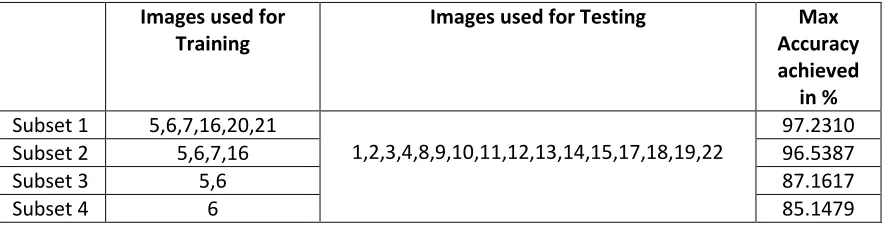
The test results have been tabulated into two tables for this procedure. The first table
indicates the samples of picture used for training and testing. The database has been
divided into several subsets (i.e. Subset 1, Subset 2) with different numbers of test
samples and training samples. The highest percentage of accuracy achieved is also
indicated for each subset alongside. The higher the number of training samples, the
higher the accuracy will be; however, the accuracy of the algorithm also depends on
many other factors such as facial postures, in-plane and out-of-plane variations of the
frontal face, facial alignment etc. We observed a major change in percent accuracy
during one of the tests when the training set was trained with an in-plane, frontal face
versus when it was trained with an out-of-plane, frontal face.
3.9.2 Procedure 2
In Procedure 2 we have divided the images into two subsets as in Procedure 1, the Train
Set and the Test Set; however, in this case we have a fixed number and set of images we
are using for the Test Set, though for each subset, we are using a different amount of
images with ten being the most and one being the least for the Train Set.
In both procedures the second table shows the change in the increase of accuracy with
the increasing change of principle component while running the recognition algorithm.
The accuracy and the time taken have been tabulated for each database in the following
34
results increased and decreased with increasing numbers of images in the Train Set as
well as with an increasing number of principal components. A short description of the
database has been provided along with the detailed tabulation of the Test Set and the
Train Set in the next following titles.
3.10 Results
In this section we have tabulated all the results that have been obtained by running the
Sparse face recognition with LBP for different standard datasets.
3.10.1 Face 94
3.10.1.1 About the Database
Face 94 dataset consists of 153 subjects with 20 images of each. Of these subjects, 20
are female and 133 are male. This dataset has no varying illumination and change in
facial expression. Each and every subject has a green background, and they are
consistent with the posture and facial expression on each image with a 180 x 200
resolution. All images have been extracted from video sequences.
3.10.1.1.1 Database Description
Number of individuals: 153
Image resolution: 180 by 200 pixels (portrait format)
Subjects: female (20), male (133)
3.10.1.1.2 Variation of individual's images
35
Head Scale: none
Head turn, tilt and slant: very minor variation in these attributes
Position of face in image: minor changes
Image lighting variation: none
Expression variation: considerable expression changes
Figure 3.5 shows a set of 20 images from Face 94 image database. As we can see there
are a very little variation with change in lighting condition and each image has a green
background.
Figure 3.5: A sample image set from Face 94 database.
In order to assess the efficiency of the technique we have carried out a series of
experiments using Face 94 dataset in two different procedures which have been
discussed below.
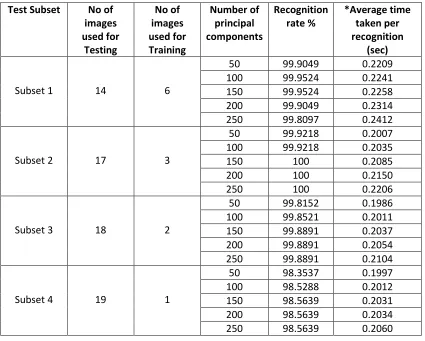
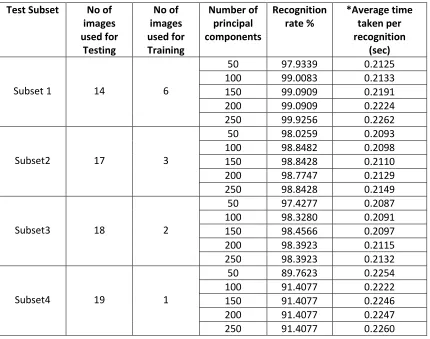
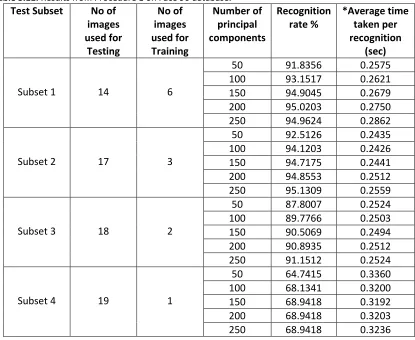
3.10.1.2 Test Result from Procedure 1
In this procedure, the database has been divided into four different subsets. Subset 1
has 6 images which have been used for training and 14 images for testing. Subset 2 has
3 images for training and 17 images for testing, Subset 3 has used only 2 images for