Field spatial scale and predator colonization behavior mediates pest
suppression in diversified agroecosystems
J. E. Banks1, A. N. Laubmeier2,*, and H.T. Banks2
1 Undergraduate Research Opportunities Center (UROC), California State University, Monterey
Bay, Seaside, CA 93955, USA
2 Center for Research in Scientific Computation, North Carolina State University, Raleigh, NC
27695, USA
* Current address: Department of Mathematics, University of Nebraska–Lincoln, Lincoln, NE
68588, USA
ABSTRACT
INTRODUCTION
The role that landscape spatial scale and heterogeneity plays in species’ interactions and distributions is a central theme of modern ecology (Levin, 1992; Wiens, 1989; Andow, 1991; Englund and Hambäck, 2004; Caballero-López et al., 2012). Theoretical and field studies over the past several decades have demonstrated that the spatial scale at which heterogeneous habitats are deployed has a profound effect on growth, movement, reproduction, and mortality of resident plants and animals (Marino and Landis, 1996; Jonsen and Fahrig, 1997; Roland andTaylor, 1997; Turchin, 1998; Banks, 1998; Bommarco and Banks, 2003; Thies et al., 2003; Holland et al. 2004; Hambäck and Englund, 2005). Recent studies in agroecosystems, however, have highlighted the fact that landscape complexity affects different organisms in different ways, prohibiting facile generalizations about the effects of habitat scale and complexity
(Caballero-López et al., 2012; Chaplin-Kramer et al., 2011, 2012). Even less is known about the underlying mechanisms driving differences in species responses, creating challenges for
determining how best to manage landscapes in order to maximize environmental services such as biological control/pest suppression.
Diversifying agroecosystems by establishing or retaining natural vegetation in and around crop areas has long been recognized as a potentially effective means of bolstering pest control (Landis et al., 2000; Östman et al., 2001; MacLeod et al. 2004; Heimpel and Jervis, 2005; Gardiner et al., 2009; Chaplin-Kramer and Kremen, 2012; Schellhorn et al., 2014, Rusch et al. 2006). The natural enemies hypothesis developed by Root (1973) posits that more diversified
The adjacent vegetation may act as a source for predators and parasitoids; though increased pest suppression is not always guaranteed (Jonsson et al. 2008; Rusch et al., 2013, Bianchi et al., 2017; Perez-Alvarez et al., 2018). This highlights the difficulty in establishing a general theory relating non-crop vegetation adjacent to crop fields to pest control. We attempt here to address gaps in our understanding of the link between non-crop vegetation in field margins and pest suppression by using a simple mathematical model that captures the dynamics of crop plants, herbivores, and two generalist predators. We focus on differences in how these two predators (a carabid and a ladybird beetle) colonize crop fields where they forage for prey, examining differences in how they move into the fields from adjacent vegetation as a potential driver of differences in overall pest suppression. Furthermore, we examine how differences in
colonization behavior may interact with spatial scale in determining the ability of predators to suppress prey in diversified agroecosystems.
METHODS:
Simulation/scenario
We modeled the dynamics of a pest-herbivore-predator agroecosystem, using as an example aphids as the principal herbivore feeding on an annual crop, subject to predation by a ladybird beetle (Coleoptera: Coccinellidae) or a carabid beetle (Coleoptera:Carabidae). This scenario, in which a principle herbivore in an annual cropping system is attacked by generalist predators, is quite common throughout temperate regions, and has been the setting for numerous field studies exploring habitat heterogeneity and predator-prey interactions (Root 1972, Risch et al. 1983, Kareiva 1987, Bommarco and Ekbom 1996, Banks 1998, 1999; Elliott et al. 2002, Grez and Prado 2000, Bommarco et al. 2007, Grez et al. 2008, Caballero-López et al.2012). We used a series of coupled differential equations to describe plant population growth, aphid consumption and population growth, and carabid or ladybird beetle colonization and migration from adjacent non-crop vegetation.
Carabid beetles (Coloeoptera: Carabidae) are important predators commonly found in
agroecosystems (Lovei and Sunderland, 1996). Primarily ground-dwelling, carabids typically overwinter in annual cropping systems (especially in no-till schemes) or nearby vegetation, moving into crop fields as prey densities increase during the springtime. The adults prey on aphids and other soft-bodied insects throughout the growing season, consuming aphids that fall to the ground or occasionally climbing up on plants to chase down prey.
take advantage of nearby non-crop vegetation to bolster their populations during the growing season.
Model and parameterization
We modeled the dynamics of tri-trophic interactions in a simulated agroecosystem over the course of a 90-day growing season. Aphids are the principal herbivore; they feed on crop plants and are subject to predation by one of two predators: (i) a ladybird beetle, or (ii) a carabid beetle. At the start of the simulation, there is an initial population of crop plants, aphids, and either species of predators in the crop field. Crop plants grow throughout the season as aphids feed on them, and additional predators enter the field by walking and flying dispersal behavior.
We describe these dynamics with a system of partial differential equations, which include population-level predator-prey interactions as well as spatial processes. For simplicity’s sake, we assume that carabid beetles migrate into the field by dispersing via the ground from
nearby/adjacent vegetation (e.g., weedy margins). In contrast, we assume that ladybird beetles colonize the crop field via the air column, flying in from adjacent/nearby vegetation. We highlight these differences in colonization behavior by varying values of predator population colonization in the model. We then solve for aphid dynamics over 90 days in square fields of varying sizes. In keeping with the mean farm size in the United States in 2017 (approximately 180 ha), we report on results of simulations for farms sizes ranging from 1 to 200 hectares (USDA, 2018), in order to better understand how the way in which the predators colonize crop fields interacts with spatial scale in the suppression of the aphid pest population.
We denote the populations of the crop, aphid, and predator populations by , , and A B C
respectively in the following system of partial differential equations:
AB
dt dA =r
A
(
1− KAA)
A− μAAB ⋅ BC
∂t
∂B =r
B +∇
[
(dB+dBCC)∇B]
− μB⋅d ∇C ⋅
∂t
∂C =∇
C +∇ (V C) +MF
∇B ΔV
∂t
∂V =d
V B +dV
assume that predator-induced disturbance increases this diffusion at rate dBC (Weisser 1999). Carabid predators migrate in solely through the field edges at rate ME, and ladybirds migrate directly into the field interior via the air column at rate MF (this latter term is set to zero for carabids; see Table 3). Once in the field, both predator species diffuse at rate dCwhile hunting within the field, corresponding to a random walk (Holmes et al., 1994; Turchin, 1998). We also assume that in close proximity to aphids both predator species exhibit “prey-taxis” (Kareiva and Odell, 1987) and experience directed movement towards prey items with the same velocity, denoted by . We follow (Arditi et al., 2001) in the formulation of this velocity, assumingV
movement towards aphid resources at rate dV Band smoothing of the movement due to intraspecific competition at rate dV .
At the start of each simulation, crops are uniformly distributed in the field at density A0. Aphids are randomly distributed in the field, but normalized to a constant average density B0. The preliminary predator populations are also randomly distributed in the field at an average density
, assuming some form of no-till farming. The velocity due to directed motion is initially zero
C0
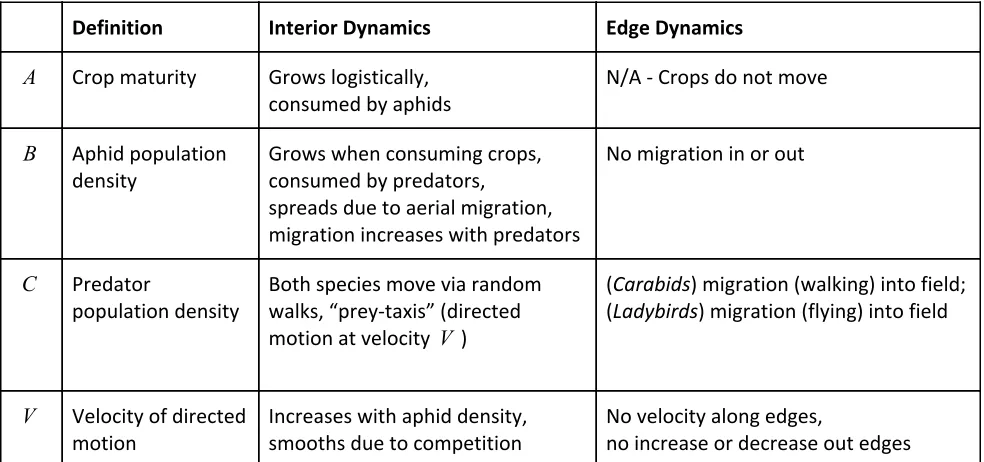
across the field. Aphid populations are unable to pass through the boundary of the spatial domain (the edge of the agricultural field) for the duration of the simulation (we assume no loss of aphids via dispersal out of the system). Velocity is also limited at the edge of the field, as described in (Arditi et al., 2001). We summarize these rates and dynamics in Table 1.
Definition Interior Dynamics Edge Dynamics
A Crop maturity Grows logistically, consumed by aphids
N/A - Crops do not move
B Aphid population density
Grows when consuming crops, consumed by predators,
spreads due to aerial migration, migration increases with predators
No migration in or out
C Predator
population density
Both species move via random walks, “prey-taxis” (directed motion at velocity V )
(Carabids) migration (walking) into field; (Ladybirds) migration (flying) into field
V Velocity of directed motion
Increases with aphid density, smooths due to competition
No velocity along edges,
no increase or decrease out edges
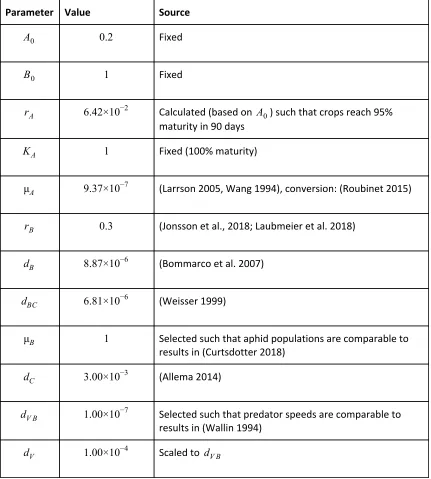
In our simulations, we varied only parameters related to predator migration to the field before or during the season. We fixed other model parameters to values from the literature when possible; the remaining values were selected to produce reasonable model solutions. In Table 2, we list the parameters and values, along with sources for the values where appropriate. We note that most values have been converted to the scale of our simulations.
Parameter Value Source
A0 0.2 Fixed
B0 1 Fixed
rA 6.42×10 −2 Calculated (based on A0) such that crops reach 95% maturity in 90 days
KA 1 Fixed (100% maturity)
μA 9.37×10 −7 (Larrson 2005, Wang 1994), conversion: (Roubinet 2015)
rB 0.3 (Jonsson et al., 2018; Laubmeier et al. 2018)
dB 8.87×10 −6 (Bommarco et al. 2007)
dBC 6.81×10 −6 (Weisser 1999)
μB 1 Selected such that aphid populations are comparable to results in (Curtsdotter 2018)
dC 3.00×10 −3 (Allema 2014)
dV B 1.00×10 −7 Selected such that predator speeds are comparable to results in (Wallin 1994)
dV 1.00×10 −4 Scaled to dV B
Table 2: Parameters fixed in our simulations, with sources for values fixed from literature.
with values of C0and ME(for carabids) falling between 0.80− 0.15 . The corresponding values of MF (for ladybirds) fall between 0.00097− 0.018 . We used the method of lines (Scheisser 2012) to numerically evaluate the PDE for our simulations, in MATLAB version 8.3.0.532 (R2014a).
Parameter C0 ME MF
Value carabids: 0.1 0.1 0
ladybirds: 0.1 0 0.0012
Table 3: “Baseline” parameter values for ladybird and carabid simulations. The rate MF was calculated
to match daily field-level population growth due to field edge migration ME.
RESULTS:
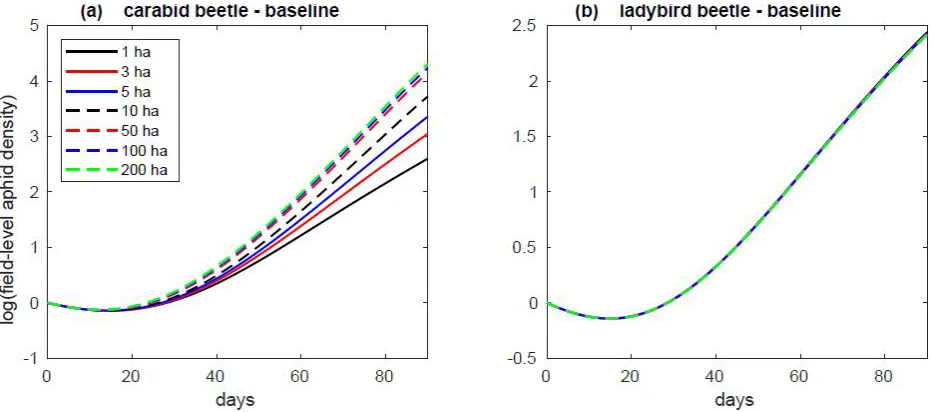
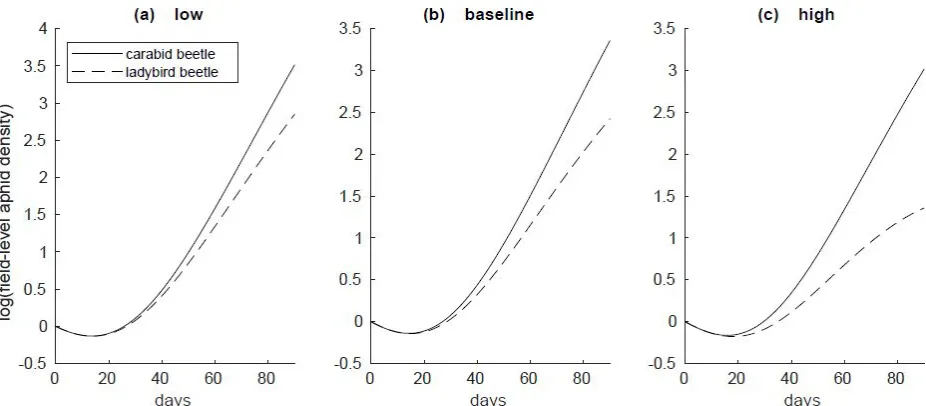
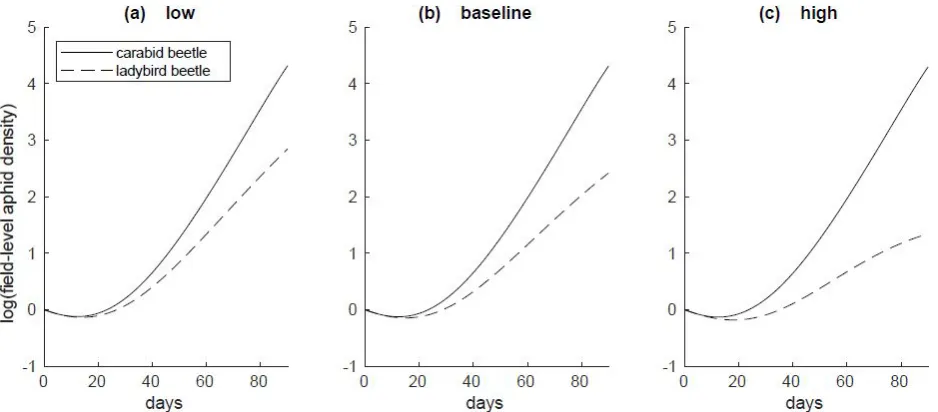
Predator migration/colonization rates had a marked effect on aphid suppression, with the lowest levels of aphids corresponding to simulations with the highest carabid and ladybird migration levels (Figs. 1-3). Spatial scale was an important mediating factor for aphid suppression for carabids, but not for ladybird beetles; for carabid simulations, aphid densities were substantially higher at larger spatial scales than at lower scales (Figs. 1a, 2a, 3a), whereas aphid densities were invariant across scales for ladybird beetle simulations (Figs. 1b, 2b, 3b). At 90 days, aphids in ladybird simulations were reduced on average by 91-92% of their initial population across all spatial scales. The effects of carabid predation were heavily influenced by spatial scale, with aphid reductions ranging from 88% (1ha) to 3% (200ha) for the same time scale. The
relationship between carabid densities and field spatial scale was non-linear, with proportional predation effects diminishing at larger scales (Fig. 4).
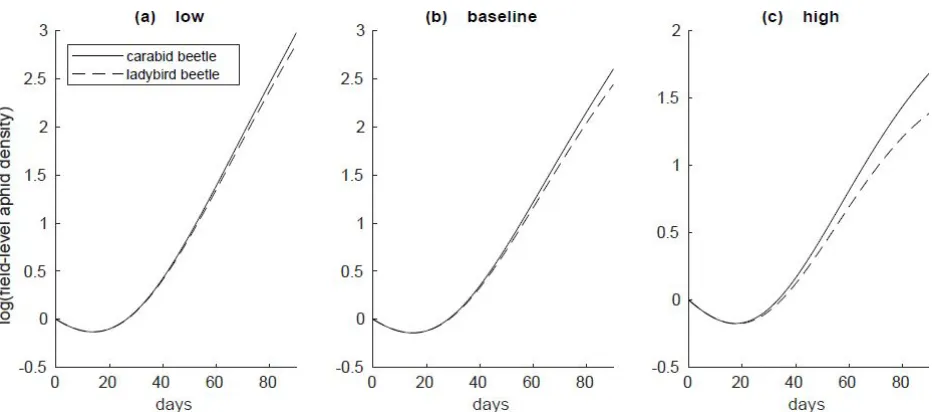
Overall, ladybird beetles flying in to colonize crop plants markedly reduced aphids more than carabids walking in from weedy margins, for all spatial scales and migration rates (Figs. 5-11). Differences between carabid and ladybird pest suppression was the highest at high flux
DISCUSSION:
Pest suppression in our simulations varied widely as a function of both predator colonization behavior and agroecosystem spatial scale. In all cases and across all spatial scales, ladybird beetles more effectively controlled aphids than carabid beetles (Figs. 1-11). Aphid densities subject to carabid predation demonstrated a non-linear relationship between pest suppression and spatial scale. At baseline migration levels, aphids densities were 6 times higher in the 5ha field simulations than in the 1ha simulations, 35 times higher in the 50ha field simulations than in the 1ha simulations, and 43 times higher in the 100ha field simulations than in the 1ha simulations (Fig. 4). This attenuation of spatial scale effects was even more evident at larger spatial scales, with a similar ten-fold increase in spatial scale (from 10ha to 100ha) yielding only 3.3-fold difference in aphid densities.
The spatial details of predator-prey distributions also reveal striking differences in pest suppression between the two predators. At both small and large scales carabids were able to corral aphids into the center of the field by the end of 90 days (e.g., Figs.12,14), whereas
ladybird predation resulted in aphids being more uniformly distributed across the field at the end of the simulation (Figs. 13, 15). However, aphid densities were much higher in simulations with carabid predation at the larger scales (Figs. 1a,2a,3a); despite the fact that carabids were able to concentrate aphids in the center of the field, aphid reproduction was able to overwhelm them by the end of the simulations. Our results highlight the importance of considering both spatial scale as well as predator movement behavior in assessing the effectiveness of habitat manipulations for pest suppression in agroecosystems.
pest suppression. In particular, careful consideration of the colonization modality of important predators in any agroecosystem along with the habitat spatial scale is critical when planning or implementing landscape habitat manipulations for pest control.
Species interactions and community dynamics likely play an important additional role in determining the effectiveness of pest suppression in diversified agroecosystems.
Predator-predator interactions, along with multi-trophic interactions (including intra-guild predation, hyperparasitism, etc.) have been shown to alter population dynamics and interfere with prey suppression (Snyder and Ives, 2001, 2003; Rand et al., 2012). Furthermore, landscape complexity in agroecosystems may simultaneously increase natural enemy pressure while bolstering pest populations (Perez-Alvarez et al., 2018). Understanding the intersection of predator movement behavior and habitat complexity at the landscape scale in the context of species assemblages and interactions is therefore critical to prescribing useful habitat manipulations for biological control in agroecosystems.
ACKNOWLEDGEMENTS
This research was supported in part by the Air Force Office of Scientific Research (HTB, AL) under grant number AFOSR FA9550-18-1-0457, a CRSC/Lord Corporation Fellowship (AL), and a National Science Foundation Research Training Grant (RTG) DMS-1246991 (AL).
Figure 2: Final aphid population density for the duration of the season at low migration levels for (a) carabid beetle and (b) ladybird beetle predation. Populations are plotted at log scale.
Figure 4: Relationship between final aphid densities and field spatial scale.
Figure 6: Aphid population densities over the duration of the season at (a) low, (b) baseline, and (c) high migration levels in a 3 hectare field. Populations are plotted on a log scale.
Figure 8: Aphid population densities over the duration of the season (a) low, (b) baseline, and (c) high migration levels in a 10 hectare field. Populations are plotted on a log scale.
Figure 10: Aphid population densities over the duration of the season at (a) low, (b) baseline, and (c) high migration levels in a 100 hectare field. Populations are plotted on a log scale.
Figure 15: Heatmaps of the aphid population density over a 50 hectare field in the presence of a ladybird predator population on days 0, 30, 60, and 90 of the season.
REFERENCES:
Allema, A.B. Quantifying and simulating movement of the predator carabid beetle Pterostichus melanarius in arable land. Wageningen University, 2014.
Andow, D. A. 1991. Vegetational diversity and arthropod population response. Annu. Rev. Entomol. 36(1), 561-586.
Arditi, R., Tyutyunov, Y., Murgulis, A., Govorukhin, V., Senina, I. 2001. Directed movement of predators and the emergence of density-dependence in predator-prey models. Theor. Popul. Biol. 59, 207--221.
Banks, J.E., 1999. Differential response of two agroecosystem predators, Pterostichus
melanarius (Coleoptera: Carabidae) and Coccinella septempunctata (Coleoptera: Coccinellidae), to habitat composition and fragmentation scale manipulations. Can. Entomol. 131, 645-658. Banks, J.E., 2000. Effects of weedy field margins on Myzus persicae (Hemiptera: Aphididae) in a broccoli agroecosystem. Pan Pac. Entomol. 76, 95-101.
Banks, J.E.,Ekbom, B., 1999. Modeling herbivore movement and colonization: pest management potential of intercropping and trap cropping. Ag. For. Entomol. 1, 165-170.
Banks, J.E., Stark, J.D., 2004. Aphid response to vegetation diversity and insecticide applications. Agr. Ecosyst. Environ. 103(3), 595-599.
Banks, J.E., Bommarco, R., Ekbom, B., 2008. Population response to resource separation in conservation biological control. Biol. Control 47, 141-146.
Banks, J.E., Yasenak, C.L., 2003. Effects of plot vegetation diversity and spatial scale on
Coccinella septempunctata movement in the absence of prey. Entomol. Exp. Appl. 108, 197-204. Bianchi, F. J. J.A., Booij, C. J., Tscharntke, T., 2006. Sustainable pest regulation in agricultural landscapes: a review on landscape composition, biodiversity and natural pest control. Proc. Biol. Sci. 273(1595), 1715-27.
Bianchi, F.J.J.A., Walters, B. J., Cunningham, S.A., Hemerik, L., Schellhorn, N.A., 2017. Landscape-scale mass-action of spiders explains early-season immigration rates in crops. Land. Ecol. doi: 10.1007/s10980-017-0518-7.
Bommarco, R., Banks, J.E., 2003. Scale as modifier in vegetation diversity experiments: effects on herbivores and predators. Oikos 102, 440-448.
Bommarco, R., Firle, S.O., Ekbom, B., 2007. Outbreak suppression by predators depends on spatial distribution of prey. Ecol. Model. 201(2), 163-170.
Bommarco R., Ekbom, B., 1996. Variation in pea aphid population development in three different habitats. Ecol. Entomol. 21, 235-240
Caballero-López, B., Bommarco, R., Blanco-Moreno, J.M., Sans, F.X., Pujade-Villar, J., Rundlöf, M., Smith, H.G., 2012. Aphids and their natural enemies are differently affected by habitat features at local and landscape scales. Biol. Control66, 222-229.
Chaplin-Kramer, R., O'Rourke, M.E., Blitzer, E.J., Kremen, C., 2011. A meta-analysis of crop pest and natural enemy response to landscape complexity. Ecol. Letters, 14, 922–932.
Curtsdotter, A., Banks, H.T., Banks, J.E., Jonsson, M., Jonsson, T., Laubmeier, A., Traugott, M., Bommarco, R., 2018. Ecosystem function in predator-prey food webs -- confronting dynamic models with empirical data. J. Anim. Ecol., https://doi.org/10.1111/1365-2656.12892.
Dixon, A.F.G. 1977. Aphid ecology: life cycles, polymorphism, and population regulation. Annu.
Rev. Ecol. System. 8, 329-353.
Elliott N.C., Kieckhefer R.W., Michels Jr. G.J., Giles K.L., 2002. Predator abundance in alfalfa fields in relation to aphids, within field vegetation, and landscape matrix. Environ. Entomol. 31, 253–260.
Englund, G., Hambäck, P. A., 2004. Scale dependence of emigration rates. Ecology 85(2), 320-327.
Gardiner, M.M., Landis, D.A., Gratton, C., DiFonzo, C.D., O'neal, M., Chacon, J.M., Wayo, M.T., Schmidt, N.P., Mueller, E.E. and Heimpel, G.E., 2009. Landscape diversity enhances biological control of an introduced crop pest in the north-central USA. Ecol. Appl. 19(1), 143-154.
Grez, A.A., Prado, E., 2000. Effect of plant patch shape and surrounding vegetation on the dynamics of predatory coccinellids and their prey Brevicoryne brassicae (Hemiptera: Aphididae). Environ. Entomol. 29(6), 1244-1250.
Grez, A.A., Zaviezo, T., Díaz, S., Camousseigt, B., Cortés, G., 2008. Effects of habitat loss and fragmentation on the abundance and species richness of aphidophagous beetles and aphids in experimental alfalfa landscapes. Eur. J. Entomol. 105(3), 411.
Hambäck, P. A., & Englund, G., 2005. Patch area, population density and the scaling of
migration rates: the resource concentration hypothesis revisited. Ecol. Letters, 8(10), 1057-1065. Heimpel, G.E., Jervis, M.A., 2005. Does floral nectar improve biological control by parasitoids? In: Wäckers, F.L., van Rijn, P.C.J., & Bruin, J. (eds), Plant-provided food for carnivorous insects. Cambridge University Press, Cambridge, pp 267-304.
Hodek, I., van Emden, H.F. Honek, A. eds., 2012. Ecology and behaviour of the ladybird beetles (Coccinellidae). John Wiley & Sons.
Holland, J.D., Bert, D.G., Fahrig, L. 2004. Determining the spatial scale of species' response to habitat. BioSci. 54(3), 227–233,
Holmes, E., Lewis, M., Banks, J.E., Veit, R., 1994. Partial differential equations in ecology: spatial interactions and population dynamics. Ecology 75, 17-29.
Jonsen, I.D., Fahrig, L. 1997. Response of generalist and specialist insect herbivores to landscape spatial structure. Land.Ecol.12: 185. https://doi.org/10.1023/A:1007961006232
Jonsson, M., Wratten, S.D., Landis, D.A., Gurr, G.M., 2008. Recent advances in conservation biological control of arthropods by arthropods. Biol. Control 45(2), 172-175.
Jonsson, T., Kaartinen, R., Jonsson, M., Bommarco, R. 2018. Predictive power of food web models based on body size decreases with trophic complexity. Ecology letters, 21(5), 702-712. Kareiva, P., 1985. Finding and losing host plants by Phyllotreta: patch size and surrounding habitat. Ecology 66, 1809-1816
Kareiva, P., 1987. Habitat fragmentation and the stability of predator-prey interactions. Nature 326, 388–390.
Kareiva, P., Odell, G., 1987. Swarms of predators exhibit “preytaxis” if individual predators use area-restricted search. Am. Nat. 130, 233-270.
Landis, D., Wratten, S.D., Gurr, G.M., 2000. Habitat management to conservation natural enemies of arthropod pests in agriculture. Annu. Rev. Entoml. 45, 175–201.
Larsson, H., 2005. A crop loss model and economic thresholds for the grain aphid, sitobion avenae (F.), in winter wheat in southern Sweden. Crop Prot., 24(5), 397-405.
Laubmeier, A.N., Wootton, K., Banks, J.E., Bommarco, R., Curtsdotter, A., Jonsson, T., et al.. 2018. From theory to experimental design—Quantifying a trait-based theory of predator-prey dynamics. PLoS ONE 13(4): e0195919. https://doi.org/10.1371/journal.pone.0195919
Lee, J. C., Andow, D. A., Heimpel, G. E., 2006. Influence of floral resources on sugar feeding and nutrient dynamics of a parasitoid in the field. Ecol. Entomol. 31(5), 470-480.
Levin, S. A., 1992. The problem of pattern and scale in ecology: the Robert H. MacArthur award lecture. Ecology, 73(6), 1943-1967.
Lövei, G.L., Sunderland, K.D., 1996. Ecology and behavior of ground beetles (Coleoptera: Carabidae). Annu. Rev. Entomol. 41(1), 231-256.
Marino, P.C., Landis, D.A., 1996. Effect of landscape structure on parasitoid diversity and parasitism in agroecosystems. Ecol. Appl. 6(1), 276-284.
Olson, A.C., Ives, A.R., Gross, K., 2000. Spatially aggregated parasitism on pea aphids,
Acryithosiphon pisum, caused by random foraging behavior of the parasitoid Aphidius ervi. Oikos 91, 66-76.
Östman, Ö., Ekbom, B. Bengtsson, J., 2001. Landscape heterogeneity and farming practice influence biological control. Bas. Appl. Ecol. 2(4), 365-371.
Perez-Alvarez, R. , Nault, B. A. Poveda, K., 2018. Contrasting effects of landscape composition on crop yield mediated by specialist herbivores. Ecol. Appl. 28: 842-853. doi:10.1002/eap.1695 Prasad, R.P., Snyder, W.E., 2006. Polyphagy complicates conservation biological control that targets generalist predators. J. Appl. Ecol. 43(2), 343-352.
Rand, T. A., van Veen, F. J., Tscharntke, T., 2012. Landscape complexity differentially benefits generalized fourth, over specialized third, trophic level natural enemies. Ecography 35, 97-104. doi:10.1111/j.1600-0587.2011.07016.x
Risch, S.J., Andow, D. Altieri, M.A. 1983. Agroecosystem diversity and pest control: data, tentative conclusions, and new research directions. Environ. Entomol. 12(3), 625-629.
Roland, J., Taylor, P.D., 1997. Insect parasitoid species respond to forest structure at different spatial scales. Nature 386, 710-713.
Root, R., 1973. Organization of a plant-arthropod association in simple and diverse habitats: The fauna of collards (Brassica Oleracea). Ecol. Mongr. 43(1), 95-124.
Roubinet, E., Straub, C., Jonsson, T., Staudacher, K., Traugott, M., Ekbom, B., Jonsson, M., 2015. Additive effects of predator diversity on pest control caused by few interactions among predator species. Ecol. Entomol. 40, 362--371.
Rusch, A., Bommarco, R., Jonsson, M., Smith, H. G., Ekbom, B., 2013. Flow and stability of natural pest control services depend on complexity and crop rotation at the landscape scale. J. Appl. Ecol.50, 345–354.
Schellhorn, N.A., Bianchi, F.J.J.A., Hsu, C.L., 2014. Movement of entomophagous arthropods in agricultural landscapes: links to pest suppression. Annu.Rev. Entomol. 59:559–581
Scheisser, W.E., 2012. The numerical method of lines: integration of partial differential equations. Elsevier, 2012.
Snyder, W.E., Ives, A.R., 2001. Generalist predators disrupt biological control by a specialist parasitoid. Ecology 82 (3), 705-716.
Snyder, W. E. & Ives, A. R., 2003. Interactions between specialist and generalist natural enemies: parasitoids, predators, and pea aphid biocontrol. Ecology 84, 91–107.
Thies, C., Steffan-Dewenter, I., Tscharntke, T., 2003. Effects of landscape context on herbivory and parasitism at different spatial scales. Oikos, 101(1), 18-25.
Thomas, C.F.G., Brown, N.J., Kendall, D.A., 2006. Carabid movement and vegetation density: Implications for interpreting pitfall trap data from split-field trials. Agric. Ecosyst. Environ., 113, 51-61.
Tonhasca Jr, A., Byrne, D.N., 1994. The effects of crop diversification on herbivorous insects: a meta-analysis approach. Ecol. Entomol. 19(3), 239-244.
Turchin, P., 1998. Quantitative analysis of movement. Sunderland, MA: Sinauer Associates, Inc. USDA, 2018. Farms and Land in Farms: 2017 Summary. USDA, National Agricultural Statistics Service report, February 2018. Available at
https://downloads.usda.library.cornell.edu/usda-esmis/files/5712m6524/3j333500g/ht24wn24x/F armLandIn-02-16-2018.pdf
Wallin, H., Ekbom, B., 1994. Influence of hunger level and prey densities on movement patterns in three species of Pterostichus beetles (Coleoptera: Carabidae). Environ. Entomol. 23(5), 1171-1181.
Wang, X., Fang, Y., Lin, Z., Zhang, L., Wang, H., 1994. A study on the famage and economic threshold of the soybean aphid at the seedling stage. Plant Prot. (Inst. Plant Prot., CAAS, China), 20, 12-13.
Weisser, W.W., Braendle, C., Minoretti, N., 1999. Predator-induced morphological shift in the pea aphid. Proc. R. Soc. Lond. B: Biol. Sci. 266(1424), 1175-1181.