Scholarship at UWindsor
Scholarship at UWindsor
Electronic Theses and Dissertations Theses, Dissertations, and Major Papers
1-1-1987
An examination of emotional and behavioural elements of the
An examination of emotional and behavioural elements of the
escalating interpersonal conflict process.
escalating interpersonal conflict process.
Edward M. Vokes
University of Windsor
Follow this and additional works at: https://scholar.uwindsor.ca/etd
Recommended Citation Recommended Citation
Vokes, Edward M., "An examination of emotional and behavioural elements of the escalating interpersonal conflict process." (1987). Electronic Theses and Dissertations. 6831.
https://scholar.uwindsor.ca/etd/6831
This online database contains the full-text of PhD dissertations and Masters’ theses of University of Windsor students from 1954 forward. These documents are made available for personal study and research purposes only, in accordance with the Canadian Copyright Act and the Creative Commons license—CC BY-NC-ND (Attribution, Non-Commercial, No Derivative Works). Under this license, works must always be attributed to the copyright holder (original author), cannot be used for any commercial purposes, and may not be altered. Any other use would require the permission of the copyright holder. Students may inquire about withdrawing their dissertation and/or thesis from this database. For additional inquiries, please contact the repository administrator via email
by
Edvard M. Yokes
B. A. York University, 1984
A Thesis
Submitted to the Faculty of Graduate Studies through the Department of Psychology
in Partial Fulfillment of the Requirements for the Degree
of Master of Arts at the University of Windsor Windsor, Ontario, Canada
INFORMATION TO USERS
The quality of this reproduction is dependent upon the quality of the copy
submitted. Broken or indistinct print, colored or poor quality illustrations
and photographs, print bleed-through, substandard margins, and improper
alignment can adversely affect reproduction.
In the unlikely event that the author did not send a complete manuscript
and there are missing pages, these will be noted. Also, if unauthorized
copyright material had to be removed, a note will indicate the deletion.
UMI”
UMI Microform E C 54 8 2 6 Copyright 2010 by ProQuest LLC
All rights reserved. This microform edition is protected against unauthorized copying under Title 17, United States Code.
ProQuest LLC
789 East Eisenhower Parkway P.O. Box 1346
To my mother and father who have endured so much, To my sister with whom I've shared so much.
The goal of this study was to identify emotional and behavioural
elements of escalating interpersonal conflict and examine how they
interact during periods of escalation and de-escalation. Fifteen
male and female subjects took part in a preliminary study to
develop an efficient method for naive subjects to identify these
elements of the conflict process. Thirty-nine male and female
subjects participated in the primary study which used the method
derived from the results of the preliminary study. These subjects
viewed each of three filmed episodes of simulated marital conflict
five times. Over the course of these viewings subjects recorded
their perceptions of: points of conflict escalation and
de-escalation; the emotional states actors experienced; the
behaviours which they associated with the emotions; and the
changing intensity of the conflict. A content analysis of subject
responses was conducted using fifteen emotional and five
behavioural categories. Comparisons among categories indicated
that subjects associated the perception of anger with conflict
escalation. They appeared to rely on subtle cues of anger to
recognize the onset of escalation, then focused on more overt
anger cues to determine the conflict intensity. Emotions other
than anger reported during escalation (distress-anguish and fear)
appeared to be related to the particular content of the conflict
and may have contributed to the arousal of anger. De-escalation
was associated with the decline of signs of anger and the
An apparent interaction between surprise and guilt may function to
inhibit anger and, therefore, contribute to the de-escalation of a
conflict interaction. De-escalations which occurred at the end of
poorly resolved conflicts were characterized by emotional states
(distress-anguish) which may lead to the arousal of anger. On the
basis of these findings it was concluded that there appears to be
the potential to regulate conflict interactions through efforts to
influence the emotional states of conflict participants. A
foundation for the development of emotion based conflict
I wish to thank my chairperson Dr. Durhane Wong-Rieger for
encouraging, challenging and guiding me through every step of the
thesis. I am also very grateful to my committee members Or. Ray
Daly and Dr. Fritz Rieger. By asking the right questions at the
right time Dr. Daly helped me remain focused and critical, while
Dr. Rieger provided continual support and imaginative feedback as
the research progressed.
I would also like to express my thanks to Marlene Berish for
challenging my arguments and helping me see things from alternate
perspectives, to Jim Cheston for his critical comments and help in
preparing for the defence, and to Mary McMillan for her endless
coaching, coding, and kind listening. In addition, I am indebted
to L o m e Mitchell and Mike Mayo for their help in the pilot study
and constant support and understanding, to Andy McKay for his
incredible sense of timing, to the past and present staff of 845
Squadron R.C.(Air) C. for their participation in the pilot study,
and to Bob Beck for believing a long time ago.
Page ABSTRACT... il
ACKNOWLEDGEMENTS... iv
LIST OF TABLES... vil Chapter I INTRODUCTION... 1
Interpersonal Conflict... 2
A Systems Approach to Interpersonal Conflict... 3
Definition of Terms... 5
Developing a Systems Definition of Conflict...5
Toward an Operational Definition of Interpersonal Conflict..? Functional Versus Dysfunctional Conflict... 19
Conflict Escalation and the Escalatory Spiral... 24
Dysfunctional Escalating Conflict...31
Resulting Problems... 31
Statement of the Problem... 35
II METHOD... 37
Preliminary Study... 37
Subjects... 37
Procedure... 37
Primary Study... 40
Subjects... 40
Procedure... 41
III RESULTS... 43
Preliminary Study... ... ... 43
Analyses of Data... 43
Primary Study... 45
Critical Interaction Points...47
Conflict Intensity Data... ...48
Selection of Interaction Points... 48
Content Categories and Classification Procedures... 51
Results of the Emotional Data Classification... 55
Results of the Behavioural Data Classification... ...61
Results of the General Data Classification... 67
Analysis of Dual Scenario Interaction Points... 71
Conflict Escalation... '... 79
Emotion... 79
Behaviour... 84
Conflict De-escalation... 86
Emotion... 86
Behaviour... 93
Emotions Common to Escalation and De-escalation... 97
Fear... 97
Distress-Anguish... 98
General Data... 99
Dual Scenario Interaction Points... 100
Conclusions... 101
Summary of Research Findings...101
A Proposed Foundation for Emotion Based Regulation Strategies..104
Limitations and Recommendations for Future Research... .104
Appendix A. PRELIMINARY STUDY SUBJECT RESPONSE PACKAGE... 108
B. NATURAL HISTORY MODEL OF CONFLICT... 113
C. PRIMARY STUDY SUBJECT RESPONSE PACKAGE... 115
D. PRIMARY STUDY SUBJECT INSTRUCTION HANDOUT...126
E. PRIMARY STUDY EXPERIMENTER'S INSTRUCTIONS... 130
F. CRITICAL POINT SUMMARIES... 135
G. MEAN INTENSITY GRAPHS... 141
H. COMPUTER DICTIONARY OF EMOTIONAL STATES... 145
I. DATA CLASSIFICATION SUMMARY...153
J. CONTENT ANALYSIS CODING RULES...159
REFERENCES... 163
Table Page
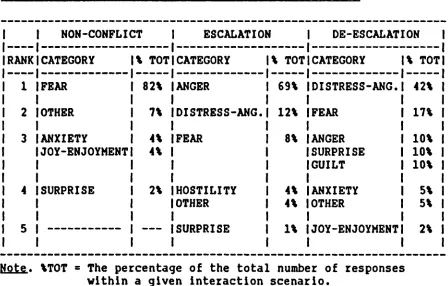
1 Emotional Category and Subcategory Frequencies and Relative Frequencies for Non-conflict, Escalation, and De-escalation Scenarios...56
2 Emotional Category Rankings by Relative Frequency for Non-conflict, Escalation, and De-escalation Scenarios 57
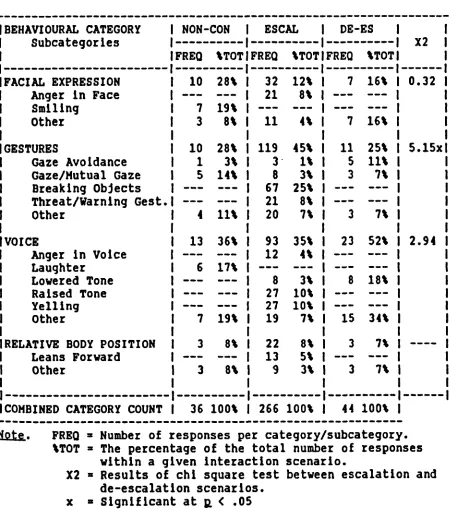
3 Behaviour Category and Subcategory Frequencies and Relative Frequencies for Non-conflict, Escalation, and De-escalation Scenarios...62
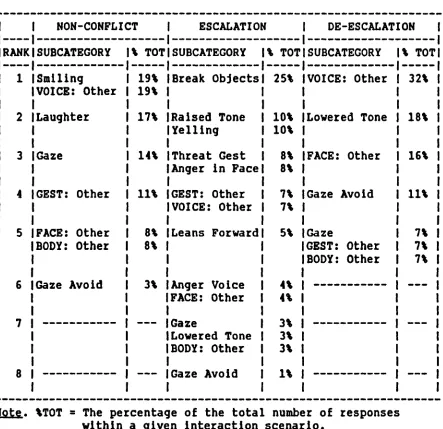
4 Behavioural Subcategory Rankings by Relative Frequency for Non-conflict, Escalation, and De-escalation Scenarios 63
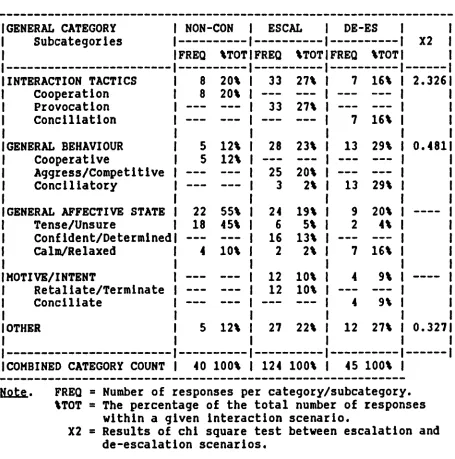
5 General Category and Subcategory Frequencies and Relative Frequencies for Non-conflict, Escalation, and De-escalation Scenarios...68
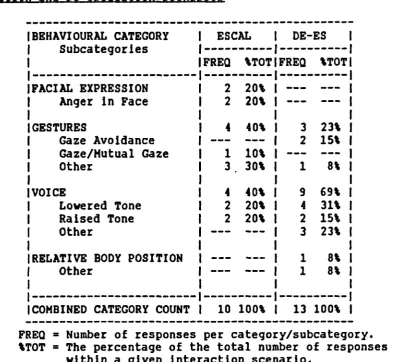
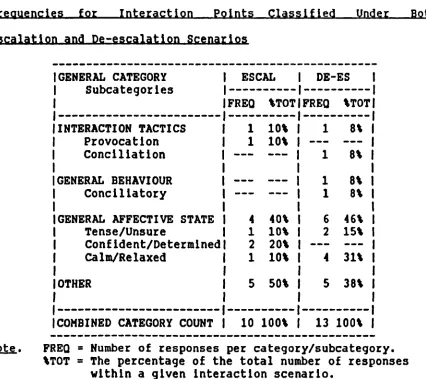
6 Emotional Category and Subcategory Frequencies and Relative Frequencies for Interaction Points Classified Under Both Escalation and De-escalation Scenarios... 74
7 Behaviour Category and Subcategory Frequencies and Relative Frequencies for Interaction Points Classified Under Both Escalation and De-escalation Scenarios...75
INTRODUCTION
The present thesis represents the first stage of a
comprehensive research project which seeks to develop techniques
for the control and regulation of interpersonal conflict
interactions. It is the basic premise of this research that
conflict escalations often produce outcomes dysfunctional to the
existing relationship between conflicting parties. The goal of
the overall project will be to develop a training program which
will provide individuals with practical methods of recognizing and
avoiding conflict escalations.
In this first stage, the goal is to analyze dysfunctional
instances of escalating conflict to identify the emotional states
and associated behaviours of conflicting parties which
consistently suggest to observers that a conflict situation is
getting worse or improving. The second stage will involve the
identification and development of strategies and techniques for
managing the emotional states and behaviours associated with
dysfunctional escalating conflict. Here the emphasis will be on
first party intervention to avert dysfunctional conflict
interactions. The final stage will involve the development and
evaluation of a flexible training program based on the earlier
Allison and Rick have been married for three tranquil years. Allison usually looks after paying the family bills and keeps track of finances. As she is sorting through the receipts from what is turning out to be a particularly expensive month, she comes across a sales slip from an exclusive men's clothing shop for more than six hundred dollars. She is aware of the fact that Rick had purchased a new suit and accessories, but had no idea how much it had cost.
She angrily confronts Rick with the slip and asks how he could ever have imagined that they could afford such an extravagant purchase. He responds by saying that he does not buy a new suit very often and that those he does purchase have to convey the right image of success. Besides, he argues, since when does he have to clear everything he does with her? She retorts that he does not have to clear everything, but when it comes to major purchases he might have enough common sense and courtesy to find out if they can afford it. He responds by stating that he bought the suit at the beginning of the month, and questions how he was supposed to know it would turn out to be a costly month? He continues by stating that every time he does something that is out of the ordinary, she gets on his back about it. Allison turns and, as she leaves the room, exclaims that at least one of the participants in their marriage has to behave responsibly, plan ahead, and be considerate of the other person - and that is obviously not him!
The preceding anecdote illustrates the type of conflict which
is the focus of this thesis. This research examines the problem
of escalating conflict within the context of close personal
relationships. This specific type of dyadic relationship was
selected for three reasons. First, it was thought important to
limit analysis to a single type of Interpersonal relationship to
avoid the difficulties associated with comparing interactions
involving different role relations. Second, escalating conflict
interactions frequently happen in such relationships. And third,
they are common experiences and, therefore, can be meaningfully
The basic perspective which guides this research is general
systems theory. Systems theory is a relatively new approach to
scientific investigation which offers the researcher a unique
theoretical framework for dealing with complex phenomena.
Traditional scientific approaches often require the reduction of a
phenomena to its basic elements before it may be subjected to
analysis. Systems theory offers an alternative approach which
enables one to examine a total phenomenon within its environmental
context (Weinberg, 1975). Thus, in terms of the present research,
systems theory offers the opportunity to examine interpersonal
conflict escalation without having to artificially limit
intervening variables or remove conflict from the real world
setting within which it occurs.
The social dvad as a system. In the simplest sense, a system
can be defined as a set of components (which are themselves often
systems) which interact within a defined boundary (Berrien, 1976).
Implied within this basic definition is the notion that a system
has both a structure and a resulting function (Berrien, 1968). In
the present context, the members of a social dyad can be regarded
as the major components of the system, and together, define its
boundary. This provides the basic conceptual structure of the
dyad as a system. The many possible forms of interpersonal
interaction (the interaction between the system components)
represent the function of the system (e.g. conversation, play, and
independently of its surroundings. Instead, it functions within,
and interacts with, a suprasystem consisting of the surrounding
physical and social environment (e.g. those persons and conditions
most immediate to the dyad which influence and are influenced by
the functioning of the dyad). When a system functions in this
manner, that is, when there is the exchange of energy and/or
information with the environment, then it is classified as an
"open" system (Ferguson & Ferguson, 1980).
The notion of a dyad as an open system is important for two
reasons. First, it implies that anything which happens between
the individuals in a given dyad is likely to have an impact which
extends beyond the boundaries of the dyad. Second, it suggests
that occurrences beyond the dyad have an impact on the
interactions between the individuals. In essence, a systems
conceptualization prevents one from viewing a complex phenomena,
such as interpersonal conflict, as an isolated and externally
uninfluenced process.
According to Frost and Wilmot (1978), most scholars fail to
agree on the definition of conflict. This is due primarily to the
fact that each of the researchers studying conflict has adopted a
unique theoretical approach which has shaped their perception of
conflict. Common to all conflict definitions, however, is the
explicit or implicit recognition that conflict must be regarded as
on the development of an operational definition of conflict which
is consistent with the principles of systems theory. In addition,
the important elaborative concepts of 'functional* and
'dysfunctional* conflict, and 'conflict escalation* will be
examined and defined.
Definition of Terms
Developing a Systems Definition of Conflict
There are many definitions of interpersonal conflict, each
shaped by the assumptions of the author's underlying theoretical
approach. However, very few are based on the assumptions of
systems theory. For this reason, it is necessary to develop an
operational definition based upon systems theory principles to
guide the present research.
There are two essential criteria stemming from systems theory
principles which will be considered in the development of an
operational definition. First, the definition will reflect the
notion that interpersonal conflict is an interaction process
consisting of a series of developmental stages; and second, it
will acknowledge that the conflict process is dependent upon the
dyad members' subjective cognitive interpretations of events,
rather than any absolute criteria. These points are examined in
the following sections.
A process view of conflict. Escalating conflict is only one
relationships known as the "process" (Scherer, Abeles & Fischer,
1975). The goal of a systems analysis is to break down the system
into its components, component relations, intervening variables,
and ordered process stages.
The role of cognitive interpretation. Systems theory
emphasizes the importance of avoiding the fallacy of absolute
thinking and promotes an understanding of the world in relative
terms. The experience of reality is regarded as a construction by
the observer of his or her subjective interpretations and not
based directly on an objective reality (Weinberg, 1975).
This view of reality is reflected in several current theories
of interpersonal conflict. For example, Robbins' (1983) view
regarding the identification of conflict interactions is
consistent with the systems perspective on subjective perceptions.
He states:
...conflict must be perceived by the parties to it. Whether conflict exists or not is a perception issue. If no one is aware of a conflict, it is generally agreed that no conflict exists. Of course, conflicts perceived may not be real, while many situations that otherwise could be described as conflictive are not because the group members involved do not perceive the conflict. For a conflict to exist, therefore, it must be perceived, (p. 336)
Once an individual determines that a given interaction is a
conflict, cognitive interpretation plays a major role in the
conflict process. What is important is not objective reality but
interaction (Mortensen, 1974; Mye, 1973). For example, the actual
behaviours which occur in an interaction need not be overtly
threatening to be considered conflictive by the participants.
Indeed, to any outside observer, they may appear entirely
harmless. However, when one party interprets the behaviour of the
other party as threatening, the subsequent interaction will
proceed as if a threatening event had actually taken place.
Therefore, cognitive interpretations of a situation play a
tremendous role in defining where and when a conflict occurs. The
definition of conflict then, must incorporate the role of
subjective interpretations.
Toward an Operational Definition of Interpersonal Conflict
In the previous section, the need for a cognitive process
definition of interpersonal conflict was established. This
section identifies the elements which should be included in such a
definition. The definition of Frost and Wilmot (1978) proceeds
from a communications perspective; however, it is particularly
relevant to this research because it synthesizes several earlier
definitions and incorporates the notions of subjective perception
and process. Frost and Wilmot state,
This definition can be broken down into three elements which
Frost and Wilmot regard as the essential elements of all
interpersonal conflicts. These are: "an expressed struggle",
"interdependence and independence", and "perceived incompatible
goals". The following sections discuss each of these elements and
introduce emotion as a critical aspect of interpersonal conflict.
An expressed struggle. In order for one to say that a
conflict is occurring, the expression of struggle among the
participants must occur (Coser, 1956; Frost & Wilmot, 1978;
Mortensen, 1974; Nye, 1973; Weber, 1913/1947). In any
interpersonal interaction the nature of the communication
identifies the type of interaction which is taking place. In
interpersonal conflict, the expression of struggle represents the
communication which signals a conflict to an observer. However,
as implied previously, an observer's report of conflict behaviour
does not necessarily indicate that a conflict will take place.
What is necessary is agreement by interacting parties that the
apparent struggle represents conflicting behaviours. When this is
the case, the first element of interpersonal conflict is present.
Some theorists insist that signs of manifest fighting be
present before an interaction can be regarded as a conflict.
Others however, such as Robbins (1974, 1983), insist that this is
only one possible manifestation of conflict. He argues that
interpersonal conflicts often occur with much subtlety. Both
extra work from the office to avoid perpetuating a disagreement
started during breakfast. Here, the interpersonal struggle is
manifest through apparently nonconflictive behaviours.
Conversely, if interactants regularly demonstrate behaviours
commonly associated with conflict but do not consider these to be
conflictive then they cannot be regarded as such. A corollary to
this rule is that interacting parties may agree that particular
amiable-type behaviours are indeed combative. Thus, the
expression of struggle may be idiosyncratic to a given dyad.
Nevertheless, it is important to note that within a given society
there is a general consensus as to the actions which constitute
conflicting and nonconflicting behaviour.
Frost and Wilmot (1976) state that most of these expressed
struggles have a "triggering event" which serves to clearly
indicate to all present that a conflict is occurring.
Additionally, conflicts are often based on issues which are larger
and more long lasting than the trigger event. The essential
premise established here is that all interpersonal conflicts
involve an expressed struggle, regardless of whether the
expression is verbal or non-verbal, subtle or overt, common or
unique.
The previous discussion suggests that it is extremely
difficult to arrive at reliable and measurable indicators of
conflicts which can be used while they are in progress. This is
information are visible behaviours. This is true for the outside
observer as well as the participants. Although each participant
does have the advantage of prior knowledge of the other's motive
or intent, in the end however, he or she must rely on visible cues
to verify or disprove operating beliefs. Under these
circumstances an observer must utilize information from a variety
of sources in order to make a reliable assessment about the
existence of a conflict.
Interdependence and independence. Almost every theorist
reviewed has implicitly or explicitly indicated that
interdependence is a necessary element of social conflict (Coser,
1956; Deutsch, 1973; Frost & Wilmot, 1978; Nye, 1973; Robbins,
1974, 1983; Scherer, et al., 1975; Vliert, 1984; Weber,
1913/1947). Conflict can only exist between individuals who are
somehow linked to one another. This section explores the concept
of interdependence and introduces the associated concepts of
cooperation, competition and interference.
As discussed previously, a social dyad can be regarded as an
interdependent open system. In a general sense, interdependence
implies that the components of the system (dyad members) are in
some way linked to one another so that either member's behaviour
has an impact on the other. It follows, then, that in an
interdependent relationship neither party is able to make a
decision which is totally independent or separate from the other.
but through a series of interdependent decisions (Frost & Wilmot,
1978).
Interdependence is not strictly an objective quality of a
relationship but also involves subjective interpretations. Each
member of a dyad relies on personal feelings, beliefs, goals,
interpretations of present circumstances, and the relationship
history, to assess their level of dependence on the other member
or on a common resource pool. The perception of relative
independence among the interacting participants allows each party
to make decisions without regard for the choices of the other.
The perception of interdependence, however, leads to a
decision-making process like that discussed earlier (Frost &
Wilmot, 1978). Thus, perception plays a significant role in
determining just how interdependent the participants consider
themselves, and this in turn, has an impact on the shape and
development of the conflict process.
Interdependence is generally divided into two types. Each
type describes a general relationship configuration based upon the
link between participant goals which bring both parties into
association. Morton Deutsch (1973) distinguished between
"promotive" and "contrient" interdependence, while Scherer et al.
(1975) prefer the terms "positive" and "negative" interdependence.
When dyad members are dependent upon one another, they are said to
be in a relationship of promotive or positive interdependence. In
this situation the members are linked by mutual dependence, and
respective goals. Conversely, when two individuals are dependent
on the same set of limited resources they are said to be in a
state of contrient or negative interdependence. In this case, if
one member achieves his or her goal, the other necessarily cannot.
Therefore, both parties must compete with one another to maximize
their gains and minimize losses.
According to Deutsch, and Scherer et al., these states of
interdependence serve to define cooperation and competition. That
is, they associate the occurrence of promotive interdependence
with cooperation, and the occurrence of contrient interdependence
with competition. There are two positions regarding the
relationship of conflict to cooperation and competition. One
position is that conflict develops only out of competitive
relationships (e.g. Nye, 1973; Scherer et al., 1975; Weber,
1913/1947). The other is that either form of Interdependence may
lead to conflict (Deutsch, 1973; Frost and Wilmot, 1978). It will
be argued in this thesis that this latter position provides a more
comprehensive view of the conditions from which conflict may
develop.
The fact that competition often results in conflict is a well
established principle in the conflict literature. This
relationship was demonstrated repeatedly by the Sherifs',
beginning with their "Robbers Cave" experiment in the early 1950's
(Sherif, 1966; Sherif, Harvey, White, Hood, and Sherif, 1961). A
efforts. When a situation exists whereby resources are limited
due to natural, social, or institutional factors, the only options
available to participants are to compete or give up their
respective goals.
However, competition does not always lead to conflict. Many
factors including relative power, perceptions of justice, and the
history of the relationship may be involved in determining whether
a competitive interaction will develop into a conflict
interaction. However, a major factor determining whether a
particular competitive interaction will turn into conflict is the
emotional state of the participants as the interaction progresses.
It is suggested that competitive interactions remain competitive
as long as the participants experience positive emotions.
However, a competitive interaction develops into a conflict
interaction with the emergence of intense negative emotions. The
role that negative emotions play in conflict will be discussed in
later sections of this thesis.
In a cooperative relationship members have the option of
either cooperating to produce mutual benefits, or not cooperating
to prevent the other from achieving their goal. In this sense,
cooperation is different from competition in that the interaction
may turn into a conflict if one member chooses to withhold a
resource desired by the other. For instance, an employee is
dependent upon an employer for wages while the employer is
dependent upon the employee for labour. When they cooperate, they
the relationship no longer represents a fair exchange, they may
choose to stop cooperating until the terms of the exchange are
modified to their liking,
A common feature of both forms of interdependence is the
potential for interference or "blocking behaviour". That is,
actions which prevent, or attempt to prevent the attainment of the
other's goal (Frost & Wilmot, 1978; Robbins, 1983; Vliert, 1984).
In a competitive conflict, participants engage in behaviours
intended to block their opponent's attainment of the mutually
desired goal. For example, if two fishermen are competing for a
limited number of fish, one may sabotage the other's boat and
nets. In conflict which stems from not cooperating, withholding
of resources can be regarded as blocking behaviour. The employee
who goes on strike effectively blocks the goal attainment of the
employer who, in turn, withholds the employee's wages.
When parties perceive that their counterpart is in a position
to interfere with their attainment of goals or has attempted to do
so, they recognize that their access to required or desired
resources is threatened. This, in turn, can result in pre-emptive
or retaliatory blocking behaviour which initiates or fuels the
conflict process (Frost & Wilmot, 1978; Robbins, 1983; Thomas,
1976; Thomas & Pondy, 1977). Underlying this interference
interaction, is the important issue of the perception of intent.
Thomas and Pondy (1977) argue that the initial perception of
perceptions o£ intent represent critical points In the conflict
process. They state,
...attributions of intent are asserted to mediate strongly between the frustrating behaviour of the other and the party's own response....[They] may also initiate a conflict episode when the attributed intent forecasts frustrating behaviour by the other party. Likewise, during a conflict episode, the behaviour of the other may suggest intentions which imply further
frustration, (p. 1092)
Furthermore, they suggest that if a participant perceives the
frustrating behaviour of the other as unintentional, then there is
less likelihood that an escalation in blocking behaviour will
develop. However, if one party interprets the other's behaviour
as an Intentional effort to frustrate, it does not matter what the
other's intent actually may have been, retaliation is more
probable. Thus, the perception of Intent to block goal attainment
is as important as blocking behaviour itself. In addition, the
perception of intent plays a significant role in the moderation of
emotion in a conflict situation. This topic will be discussed in
the section on emotion.
In summary, the notion of interdependence is critical to the
understanding of the dynamics of conflict. The distinction that
Deutsch makes between promotive and contrient interdependence is
particularly important in unifying the relationships among the
concepts of conflict, cooperation and competition. In addition,
interdependence leads to the opportunity for interference, and
signals the transition from a competitive or cooperative
interaction to a conflict interaction.
Perceived incompatible goals. If interdependence represents
the relationship structure that is required for conflict, the
perception of incompatible goals can be considered the initial
impetus for interpersonal conflict. In order for conflict to
occur, each participant must perceive that his or her own goals
are incompatible with those of his or her counterpart. This
incompatibility may be real or imagined (Coser, 1956; Deutsch,
1973; Frost & Vilmot, 1978; Robbins, 1983; Simmel, 1908/1955;
Thomas, 1976). One of the first contemporary social theorists to
suggest that incompatibility lies at the root of conflict was
Georg Simmel. He argued that all conflict is based on
incompatibility, and that the conflict process results from a
desire to achieve compatibility.
Conflict is thus designed to resolve divergent dualisms; it is a way of achieving some kind of unity, even if it be through the annihilation of one of the conflicting parties....Conflict itself resolves the tension between contrasts. (Simmel, 1908/1955, p. 13)
The role of emotion. The discussion thus far has focused on
the cognitive and behavioural aspects of interpersonal conflict
but not the emotional aspect. While conflict theorists
acknowledge that emotion is associated with conflict they often
regard it as an unreliable indicator of conflict, and therefore,
do not deal with it. For example. Frost and Vilmot (1978) state:
and showing that anger if a "real" conflict is going on. Emotion does usually accompany conflicts, but often the emotion is sadness, bitterness, the desire to win, or sarcasm, as well as anger, (p. 8)
Others, however, contend that emotion is too important to
disregard (Hortensen, 1974; Thomas £ Pondy, 1977). These conflict
theorists find support for their position from interpersonal
relationship theorists such as Hinde (1981), who states:
The behavioural and affective/cognitive aspects of interpersonal relationships are almost inextricably intertwined....It is thus necessary for studies of interpersonal relationships to be concerned not only with their behavioural but also with their affective/cognitive aspects, (p. 2)
The issue then, is the role which emotions play. In the following
discussion, the role of emotion as the motivational force
mediating the conflict process will be developed.
Thomas and Pondy (1977) regard human beings as thinking
creatures, whose thoughts (and therefore, behaviours) are often
influenced by emotions; and whose emotions are often dependent
upon cognitive interpretations of sensory inputs, and are
therefore, partially influenced by thinking. Support for this
position comes from a number of theorists (Izard 1975, 1977;
Jones, 1985; Tomkins 1984; Zajonc, 1984; Zajonc £ Harkus, 1984).
It is Izard's and Tomkins' additional contention that within this
hypothesized interplay of emotion, cognition, and behaviour,
emotion represents the primary motivational system for the human
being.
Thus, with respect to conflict, the attribution of intent to
reaction to an event. The emotional response, in turn, influences
the behaviour that one party will demonstrate toward the other
(Thomas & Pondy, 1977). For example, the perception of intent to
interfere frequently leads to the experience of hostility (an
emotional blend of anger, and to a lesser extent contempt and
disgust, resulting in the desire to inflict harm on another
(Chaplin, 1975; Izard, 19771). The simultaneous feelings of
hostility serve to motivate retaliatory behaviour. Thus, if the
frustrated individual perceives that the other party had no intent
to interfere with goal attainment, then it is unlikely that
hostility and subsequent retaliation will develop.
Once a conflict has been initiated, reciprocal retaliatory
behaviour is generally regarded as the basic interaction pattern
which maintains or escalates a conflict exchange (Hortensen, 1974;
Teger, 1970; Thomas, 1979; Thomas & Pondy, 1977; Vliert, 1984).
However, as Frost and Vilmot earlier indicated, anger is not
necessarily the only emotion which can be present in a conflict
interaction. Other emotions such as anxiety, sadness, fear,
surprise, bitterness, and disgust, may also be present in a
conflict exchange. There is no indication however, that positive
emotional states are commonly associated with interpersonal
conflict.
Because of the primary role which emotions seem to play in
interpersonal conflict, the final definition should include
definition which includes this and all previously discussed
elements of conflict will be developed in the following section.
Interpersonal conflict defined. In the preceding sections,
it was determined that an operational definition of conflict needs
to regard this phenomena as an interpersonal process which is
governed by the participant's subjective perceptions of reality.
Furthermore, it was argued that there are four major elements of
conflict; an expressed struggle, interdependence, perceived
incompatible goals, and negative emotions. Each of these must be
integrated into the final definition. These criteria lead, then,
to the following definition. Interpersonal conflict is an
interaction process involving two or more interdependent parties.
It is characterized by an expressed struggle which is initiated
and maintained by negative emotions stemming from the mutual
perception of incompatible goals, and interference in achieving
these goals.
Functional Versus Dysfunctional Conflict
Traditionally, social conflict has been approached as a
problem requiring resolution. More recently, however, theorists
have recognized that conflict is not necessarily a negative or
undesirable phenomena and have argued against a "problem"
orientation to the subject (Bach & Vyden, 1969; Coser, 1956;
Deutsch, 1973, 1980; Frost & Vilmot, 1978; Robbins, 1974). An
alternative view is that conflict is a natural and necessary form
dysfunctional. This section operationally defines functional and
dysfunctional conflict.
In assessing the functionality of a conflict, theorists have
tended to focus on interaction outcomes. The drawback to this
approach is that outcome prediction is not possible. Accordingly,
Deutsch (1973, 1980) proposed that functional conflict processes
lead to functional outcomes, while dysfunctional processes lead to
dysfunctional outcomes. This position suggests that once
functional and dysfunctional conflict outcomes are defined, the
processes which lead to these distinct outcomes can be identified.
The following section examines process and outcome as distinct
aspects of interpersonal interactions.
Process versus outcome. According to interpersonal
theorists, personal relationships are established and maintained
through a series of interactions between the participants
(Burgess, 1981; Hinde, 1981). Each of these interactions,
regardless of length, can be described in terms of its process and
the outcome. Process refers to the series of interdependent
cognitions, emotions and behaviours which define the nature and
content of the interaction and determine its eventual outcome.
The outcome is the culmination of the process which, in turn,
influences the process and outcome of subsequent interactions.
With respect to conflict, an interaction might be shaped by
the participant's perceptions of the intent to frustrate, intense
interaction could range from a successful resolution of the
incompatibility between participants to a complete breakdown of
the relationship. With this important distinction, it is now
possible to introduce the notion of functionality to the present
discussion.
Functionality of conflict outcomes. Deutsch (1973) and Frost
and Wilmot (1978) have argued that functionality of a conflict
interaction is determined by the participants' level of
satisfaction with the outcome. In operational terms, a functional
outcome would be one in which the participants have not been
physically and/or psychologically injured during the interaction,
and experience positive emotions toward the other at the end of
the interaction.
Other theorists, however, have suggested that the long-term
impact of the interaction on the relationship Is an equally
important aspect of functionality. From this perspective, for the
conflict to be considered functional the relationship between the
participants must have been strengthened or at least undamaged by
the interaction (Bach & Wyden, 1969; Feldman, 1982; Fisher & Ury,
1981). On an operational level, this implies that there must be
some visible indication of a mutual understanding that there will
be a future interaction on the same positive level (e.g. a hand
shake and verbal commitment to meet again). If the relationship
between parties is in some way damaged, then the likelihood of
dysfunctional conflict processes and outcomes in future
Thus, for the purposes of the present thesis, the
functionality of interpersonal conflict can be regarded as a
measure of the participants' satisfaction with the outcome, and
the degree to which the interaction has a positive effect on the
relationship between the interacting parties.
Functionality of the conflict process. Deutsch stated that
functional conflict processes lead to functional outcomes while
dysfunctional processes lead to dysfunctional outcomes. The goal,
then, has been to identify the characteristics of the conflict
process which distinguish a functional outcome from a
dysfunctional one.
With respect to functional conflict processes, Baxter (1982)
has indicated that when dyad members are able to view their
conflict as a substantive rather than personal challenge they are
generally able to maintain positive emotions and avoid a
dysfunctional outcome. Other variations on this approach include
self-encapsulation strategies where one or both participants adopt
a set of ideological restraints which they refuse to exceed during
the conflict process, and thereby inhibit Intense negative
emotions and threatening behaviours (Wehr, 1979); and, problem
solving approaches where conflicts are viewed as mutual problems
requiring a cooperative partnership to reach a solution (Fisher &
Ury, 1981). In essence, these patterns rely on maintaining a
particular cognitive viewpoint which encourages positive emotions
Several varieties of dysfunctional conflict processes have
also been identified according to their characteristic interaction
patterns. For example, Bach and Vyden (1969) discuss
dysfunctional conflict patterns which produce feelings of
frustration and hostility yet hinder the escalation of the
conflict. This has the effect of preventing the parties from
addressing the deeper issues over which the conflict is actually
occurring.
In "passive-aggressive" conflict interactions for instance,
the conflict is camouflaged by apparently innocent instances of
noncooperation by one or both parties. For example, a husband who
resents his wife's requests for help around the house might
repeatedly "forget" to do the chores he has promised or find other
more pressing tasks unrelated to house work. This type of
conflict tends to build resentment and hostility between the
participants and decreases their level of mutual trust, because
the real issues over which the conflict occurs are never openly
addressed. In such a situation, it is very unlikely that there
will be mutual satisfaction with the outcome or that the
relationship will be undamaged.
A related interaction pattern involves "hit-and-run" tactics,
whereby one party instigates a conflict only to follow it with
disinterest in continuing the exchange (Bach £ Vyden, 1969). A
wife might launch a verbal attack on her husband's appearance and
manners, however, when he enters the argument she decides that she
such an interaction pattern is likely to produce feelings of
hostility and perpetuate the conflict interaction without
addressing the original issues. Thus, the outcome will prove
highly dissatisfying to one or both of the participants and will
very likely damage their relationship.
Of particular concern to many theorists and clinical
practitioners is the conflict pattern known as the "escalatory
spiral" (Deutsch, 1973; Feldman, 1982; Frost & Vilmot, 1978;
Scherer, et al., 1975; Thomas, 1979; Vehr, 1979). This form of
conflict interaction has received attention in the literature for
two reasons. First, it is a common form of conflict interaction
in this culture, and second, it is generally recognized as among
the most dysfunctional of conflict patterns. The following
section discusses the literature on the escalatory spiral.
Conflict Escalation and the Escalatorv Spiral
Escalation is a key concept involved in both functional and
dysfunctional forms of interpersonal conflict. For example, in
terms of the passive-aggressive and hit-and-run conflict patterns
discussed previously, some degree of escalation is required before
the parties will deal with the real issues underlying their
conflict (Bach £ Vyden, 1969; Frost £ Vilmot, 1978). Vith the
escalatory spiral, however, escalation occurs to the point that it
becomes a dysfunctional conflict process. This type of conflict
the escalatory spiral is "a dynamic of conflict that has each
party responding to a hostile act from the other with an even more
hostile one" (p. 205). To reach a more thorough understanding of
how this dysfunctional pattern develops and is perpetuated,
theorists have attempted to identify the characteristic features
of the general escalation process.
Most contend that the exact course of a given escalating
conflict cannot be predicted; however, they also argue that it
contains some predictable elements and dynamics (Deutsch, 1973,
1980; Frost & Vilmot, 1978; Thomas, 1979; Vehr, 1979). These are:
a shift from cooperative to competitive strategies and tactics; an
increase in the number, nature, and size of the issues under
dispute; an increase in hostility and decrease in trust; an
increase in perceptual and cognitive distortions; and
communication distortions and breakdowns. Each of these elements
will be discussed in more detail below.
Strategy shifts. As conflict intensifies, participants use
fewer cooperative strategies of persuasion such as conciliation,
minimization of differences, enhancement of positive feelings and
promotion of mutual understanding, and more competitive
strategies, which include tactics associated with threat,
deception, and coercion (Deutsch, 1973, 1980; Thomas, 1979).
According to Deutsch (1973), this shift to more competitive
processes
The enhancement of one's own power and the complementary minimization of the other's power become objectives. The attempt by each of the conflicting parties to create or maintain a power difference favorable to his own side tends to expand the scope of the conflict from a focus on the immediate issue in dispute to a conflict over the power to impose one's preference upon the other, (p. 353)
Spread of competition. The developing competitive
relationship often spreads to other issues which, under
nonconflict conditions, would be easily resolved. As the issues
proliferate in number and size and their nature becomes more
hostile, the parties will adopt more extreme positions. The
competitive element may be so overwhelming that each party's
objective shifts from his or her own goal attainment to defeating
or blocking the other at all costs. This phenomena known as "goal
substitution" or "displacement" (Robbins, 1979; Thomas, 1979), is
a primary means of spreading competition.
Hostility and distrust. Hostility and distrust are
particularly important aspects of the escalatory spiral because
all other characteristics of this process contribute to, or result
from, these two emotions. As Thomas (1979) states:
According to Deutsch (1973), it is far more difficult to
rebuild the trust necessary for the re-establishment of this power
base than it is to lose it. Thus, the parties resort to coercive
power, which leads to still greater levels of mutual hostility and
decreased trust (Thomas, 1979).
Perceptual and cognitive distortions. A major factor in the
escalation process is perceptual and cognitive distortion.
Deutsch (1973) states that the intensification process often
results in stress and tension which exceeds optimal levels. It is
his claim that this overactivation may lead to several perceptual
and cognitive impairments. These include: an Impairment of the
parties ability to perceive alternative solutions; a reduced
ability to think in terms of the long range consequences of the
perceived alternatives; tendencies toward polarized thought
patterns which simplify percepts into black and white categories;
stereotyped response patterns; and increased defensiveness.
In effect, excessive tension reduces the intellectual resources available for discovering new ways of coping with a problem or new ideas for resolving a conflict. Intensification of conflict is likely to result as simplistic thinking and the polarization of thought push the participants to view their alternatives as being limited to victory or defeat. (Deutsch, 1973, p. 355)
Thomas (1979) provides a further explanation for the
occurrence of perceptual and cognitive distortion in conflict
interactions. Hé argues that because dyad members are for the
most part unaware of the other's motives, yet have access to the
reasonable, while the other's appears arbitrary and unjustified.
To this Deutsch (1973) adds that most people are considerably more
motivated to maintain a positive perception of themselves than
they are of others, and consequently, see their behaviour as more
legitimate and benevolent than their opponent's. Furthermore,
both parties are selective in their perception and interpretation
of the other's behaviour (Thomas, 1979). If both are mistrustful
of the other, then it is very probable that they will be actively
looking for behaviours which could be interpreted as threatening,
competitive, and hostile. Consequently, they are likely to find
them. In addition, as they look for indications of malice from
the other, they are likely to miss any gestures of goodwill and
cooperation that the other may send.
Of further concern is the fact that cognitive distortion of
this nature frequently promotes behaviour which extends beyond
normative limits. Deutsch (1973) explains that the competitive
process develops in the participants a suspicious and hostile
attitude which results in a heightened sensitivity to differences
and threats and a much reduced awareness of similarities and
gestures of cooperation.
Cognitive distortions of this type are extremely effective at
producing aggressive and even violent behaviour. The military,
for example, has developed psychological manipulations which take
advantage of this natural tendency (Dyer, 1985). It is much
easier to have one person behave aggressively toward another if he
or she can be convinced that the other is highly dissimilar.
Another common result of cognitive distortion is the
self-fulfilling prophecy. As indicated earlier, interpersonal
interactions are complex patterns whereby the behaviour of one
person is both a response and a stimulus to the other's. Thus, if
a person expects the other to behave competitively, he or she may
initiate competitive behaviour. When the other responds
competitively, this confirms the first party's belief that the
other was intending to behave in such a manner. Thomas (1979)
states;
The upshot of this is that Party's orientation toward the other and his trust or distrust toward Other have some tendency to be reinforced by generating the predicted behaviour in Other - regardless of the other's original orientation, (p. 278)
Related to this is the process of "entrapment" (Brockner &
Rubin, 1985). Essentially, entrapment is an intrapsychic process
which involves continued commitment to justify previous behaviour.
One of the basic principles of human behaviour is the need to
remain consistent with previous actions. Likewise, in conflict
situations, to justify the original conflict behaviour continued
commitment to escalation is required (Deutsch, 1973). Even when
goals, participants are entrapped into an escalation process in
order to justify their previous behaviour.
The development of an entrapment situation usually indicates
that the original reasons for engaging in conflict have given way
to more emotional factors. Furthermore, there is often the
psychological need to "save face" and demonstrate determination
and strength. As Brockner and Rubin (1985) state, "the entrapped
decision maker's motives shift over time, from the rational to the
rationalizing" (p. 4).
It appears, then, that distortions of perception and
cognition play a significant role in the conflict escalation
process. They work to develop and reinforce hostility and
mistrust, and they promote behaviour which tends to intensify the
conflict. Once engaged in conflict the participants find
themselves unable to break out of this vicious circle.
Communication distortion and breakdown. A prevalent
characteristic of dysfunctional conflict interactions is
communication distortion and breakdown. As a conflict escalates,
it is typical for one or both of the conflicting parties to
distort or misperceive the other's messages. Often, they cease to
attend to the other's message altogether and concentrate on
transmitting their own message (Deutsch, 1973; Thomas, 1979). The
tendency towards poor communication in escalating conflicts is
both produced by, and contributes to, the escalation process.
...trust is diminished as either party uses communications to manipulate or coerce the other or as either party becomes suspicious that the other is doing so. With diminished trust. Other's communications cease to be believed or even listened to, and Party concentrates on getting his own message across, (p. 278)
As communication breaks down altogether, the possibility of
cooperative functional interactions becomes even more remote. A
communication breakdown enables the interactants to maintain and
even enhance their distorted views of each other. Since these
distortions allow no new contradictory input the hostility is free
to grow. The intensification of hostility has been referred to as
"autistic hostility" for it develops in the absence of
communication (Thomas, 1979). In addition, the ability of both
parties to notice and respond to the other's cooperative gestures
is greatly impaired, and this furthers the escalation process
(Deutsch, 1973).
Pygfunctlonal-Eacalatinq.Conflicts
Resulting.Problems
As previously indicated, interpersonal conflicts are an
inevitable part of human interaction which may also produce
desirable and beneficial results. However, in most cases they do
not. The following section examines the typical dysfunctional
outcomes that escalating conflicts produce.
There are several problems with a dysfunctional escalating
conflict. The most important is that it eventually leads to
conflict tends to expand the boundaries of the conflict, rather
than reduce it. Moreover, it often fails to address the real
concerns of the participants and hinders their ability to explore
alternative conflict resolution strategies. Finally, it
frequently promotes irrational and extreme forms of behaviour
which leave residual effects that may re-ignite the conflict with
little provocation.
Dysfunctional outcomes. Dysfunctional conflict escalations
generally fail to solve the original problem between participants.
Instead, as indicated previously, they serve to expand the number
of issues under contention and, therefore, increase the magnitude
of the conflict. As the competition spreads, the interactants
stray away from, and lose sight of, the original issues.
Furthermore, the goal may shift so that winning becomes more
important than the original issues over which the conflict was
initiated. When this occurs the real concerns are lost and the
conflict is fought over false issues, leaving the original problem
unresolved at the end of the interaction (Deutsch, 1973; Frost £
Wilmot, 1978; Robbins, 1979; Thomas, 1979). Under such
circumstances, a mutually satisfactory outcome to a conflict is
unlikely.
In addition, the participants are unable to look for and to
utilize other options for conflict resolution. Once a conflict
begins to escalate it often becomes self-perpetuating (Teger,
1970; Vliert, 1984). Typically, the conflicting parties choose to
In effect, they become trapped by the dynamics of the interaction
which encourage the growth of hostility and mistrust. They are
therefore, compelled to continue contributing to the
intensification of the exchange without serious consideration of
the long range consequences of their behaviour (Frost & Vilmot,
1978). Thus, an escalatory spiral tends to produce dysfunctional
outcomes because, once initiated, there is little chance to break
out of the cycle.
Any interpersonal interaction will have an influence of some
kind on the relationship within which it occurs (Burgess, 1981;
Hinde, 1981). In other words, the relationship may be enhanced,
weakened or merely reinforced through the interaction of the dyad
members. It follows then that the resolution of a conflict will
produce residual effects which may be either functional or
dysfunctional to the relationship (Baron, 1984; Mye, 1973;
Vuchinich, 1985). For example, conflicts which culminate in
compromise may create or enhance feelings of solidarity or
partnership between participants, while those which end in an
unresolved standoff may produce feelings of frustration and
animosity.
Dysfunctional "psychological residues" (Vuchinich, 1985) are
the result of processes such as the extreme behaviours that the
participants often engage in during escalation, the shift to
coercive tactics, cognitive distortions, and the breakdown of
communications. In addition, the decrease in trust and increase
important determinants of dysfunctional residues. The long term
problem associated with dysfunctional psychological residues lies
in their tendency to promote future conflict interactions which
further deteriorate the relationship.
R e U ttftnshtP— btfiaKdfl¥D-and L s m i n a t ipn. i£ one of the
conflicting parties reaches a point in the interaction whereby he
or she perceives that his or her basic concerns are incompatible
with the other's, then the relationship is in danger of breaking
down. The occurrence of such a perception signals a critical
point in the interaction process since it becomes apparent to one
or both of the participants that the relationship cannot continue.
Should this occur, the perceiving party will probably initiate a
strategy to drive the other party away (Thomas, 1979).
In his discussion of dysfunctional marital conflict, Feldman
(1982) describes the typical outcomes of the escalatory spiral.
Usually, such spirals do not reach a crisis point and lead to
uneasy and short lived reconciliations followed by renewed
outbreaks of escalating conflict. If a crisis point is reached,
the parties may make the decision to drastically alter their
relationship and separate or divorce. In the worst case, however,
the spiral reaches a level of destructiveness which leads to
physical injury or death of one or both parties. This last point
demonstrates the severity of behaviour that characterizes the most
extreme instances of escalating conflict. Recent findings on
plays a significant role in interactions leading to death (Felson
& Steadman, 1983).
Other research suggests a more subtle, though equally
dangerous link between dysfunctional interpersonal conflict and
death. Jenkins and Zyzanski (1980) have produced findings which
suggest that sustained interpersonal conflict is related to
coronary heart disease. They suggest that interpersonal
relationships with a sustained pattern of dysfunctional conflict
should be targeted for therapy to reduce the member's chances of
developing serious heart ailments.
It should be acknowledged that not every incidence of an
escalatory spiral concludes with a dysfunctional outcome. If, for
example, in the midst of the escalation one or both of the
participants realize that continued escalation will be damaging to
the relationship, then they may take steps to de-escalate the
interaction process. Should this occur it is conceivable that the
conflict interaction may result in an outcome which is both
satisfying to the participants and preserves or strengthens their
relationship. However, as has been demonstrated, the
dysfunctional dynamics of this interaction process tend to
discourage such shifts to functional interactions and produce
dysfunctional over functional outcomes.
Statement_of_the_Problem
Given that escalating conflict is a relatively common form of
are among the most potentially destructive forms of Interpersonal
conflict, there is a very real need for research targeted at the
development of applied solutions to this problem.
To this end, it is necessary to improve the understanding of
the basic mechanisms of the conflict escalation process. That is,
while the global properties of the escalatory spiral have been
identified (e.g. Deutsch, 1973; Thomas, 1976, 1979), less
attention has been devoted to an examination of the specific
emotional and associated behavioural elements of this type of
conflict. Only after these aspects of the escalatory spiral are
thoroughly understood can work be done to develop effective
strategies for its regulation and control.
The question addressed here is: What emotional states and
associated behavioural cues do observers consistently interpret as
indications of the escalation, or de-escalation of a conflict
interaction? It is hoped that the data obtained in answer to this
question will serve as a guide to the development of interaction
strategies which can reduce the escalatory emotional states and
behaviours and increase those emotions and behaviours associated