ISSN(Online): 2320-9801
ISSN (Print) : 2320-9798
I
nternational
J
ournal of
I
nnovative
R
esearch in
C
omputer
and
C
ommunication
E
ngineering
(An ISO 3297: 2007 Certified Organization)
Vol. 4, Issue 3, March 2016
Survey on Text Based Image Abstraction
1
Preethi Rajakumari L, 2Purbali Kundu, 3Mr.Sharmasth Vali Y
Dept. ofComputer Science and Engineering, Dhanalakshmi College of Engineering, Chennai, Tamilnadu, India1,2
Assistant Professor, Dept. ofComputer Science and Engineering, Dhanalakshmi College of Engineering, Chennai,
Tamilnadu, India3
ABSTRACT:Text based image abstraction is an effective approach to the rerank images based on queries given by the user. In this paper we observe that the images are searched based on the attributes of the image. We observe that semantic attributes are expected to focus more on the semantic gap between low-level visual features and high level semantic meanings. Based on the classifiers for all the predefined attributes, each image is represented by an attribute feature which contains the responses from the classifiers. A hypergraph is used to model the relationship between images by integrating low-level visual features images and semantic attribute features. We perform hypergraph ranking to re-order the images, which is also put together to model the relationship of all images. Its basic principle is that visually similar images should have similar ranking scores.
KEYWORDS: image search,hypergraph,image abstraction.
I. INTRODUCTION
Image search reranking has been premeditated for several years and various approaches have been developed to contribute the act of performing text-based image search engine for general queries. This paper serves as a first attempt to include the attributes in reranking model. We observe that semantic attributes are expected to specialize the semantic gap between low-level visual features images and high level semantic meanings. Based on the classifiers for all the predefined attributes, each image is corresponded by an attribute feature consisting of the responses from these classifiers. Here we use hypergraph which is used to model the relationship between images by integrating low-level visual features images and semantic attribute features. We execute hypergraph ranking to re-order the images, which is also constructed to model the relationship of all images. Its basic principle is that visually similar images should have similar ranking scores. The experimental results demonstrate the effectiveness of our proposed text based image reranking method.
In a simple graph, samples are depicted by vertices and an edge links the two related vertices. Learning tasks can be performed on a simple graph. Presuming that samples are represented by feature vectors in a feature space, an undirected graph can be constructed by using their pair wise distances, and graph-based semi-supervised learning approaches can be performed on this graph to categorize the objects. It is noted that this simple graph cannot reflect higher-order information. When it is compared with the edge of a simple graph, a hyper edge in a hyper graph is able to link more than two vertices.
Figure 1. Hypergraph with edges and vertices
ISSN(Online): 2320-9801
ISSN (Print) : 2320-9798
I
nternational
J
ournal of
I
nnovative
R
esearch in
C
omputer
and
C
ommunication
E
ngineering
(An ISO 3297: 2007 Certified Organization)
Vol. 4, Issue 3, March 2016
attributes are called similes for face verifications. Each attribute detector in smiles are exclusively trained for one specific category, e.g., “the Angelina Jolie’s eye”. However, such category-specific attribute detectors are contrary to the spirit of attributes.The hypergraph model has been widely used to exploit the correlation information among images. In this paper, we regard each image in the data set as a vertex on hypergraph G =(V, E,w). Assume there are n images in the data set, and thus, the generated hypergraph contains n vertices. Let V = {v1,v2,...,vn} denote n vertices and E ={ e1,e2,...,em}represent m hype redges where the images sharing the same attribute are connected by one hyper edge as mentioned in fig1.
II. LITERATURE SURVEY
K. Stevenson and C. Leung, Comparative Evaluation of Web Image Search Engines for Multimedia Applications
While text-oriented document searching are relatively mature on the Internet, image searching, which requires much more than text matching, significantly lags behind. The use of image search engines significantly enlarges the scope of images to users accessibility. This paper provides an understanding of current technologies in image searching on the Internet, and points to future areas of improvement for multimedia applications. We develop a systematic set of image queries to assess the competence and performance of the major image search engines. We find that current technology is only able to deliver an average precision of around 42% and an average recall of around 12%, while the best performers are capable of producing over 70% for precision and around 27% for recall. The reasons for such differences, and mechanisms for search improvement, are also indicated.
B.J. Jansen, A. Spink, and T. Saracevic Real Life, Real Users, and Real Needs: A Study and Analysis of User Queries on the Web
We analyzed transaction logs containing 51,473 queries posed by 18,113 users of Excite, a major Internet search service. We provide data on: (i) sessions — changes in queries during a session, number of pages viewed, and use of relevance feedback; (ii) queries — the number of search terms, and the use of logic and modifiers; and (iii) terms — their rank/frequency distribution and the most highly used search terms. We then shift the focus of analysis from the query to the user to gain insight to the characteristics of the Web user. With these characteristics as a basis, we then conducted a failure analysis, identifying trends among user mistakes. We conclude with a summary of findings and a discussion of the implications of these findings.
R. Datta, D. Joshi, J. Li, and J.Z. Wang, Image Retrieval: Ideas, Influences, and Trends of the New Age
We have witnessed great interest and a wealth of promise in content-based image retrieval as an emerging technology. While the last decade laid foundation to such promise, it also paved the way for a large number of new techniques and systems, got many new people involved, and triggered stronger association of weakly related fields. In this article, we survey almost 300 key theoretical and empirical contributions in the current decade related to image retrieval and automatic image annotation, and in the process discuss the spawning of related subfields. We also discuss significant challenges involved in the adaptation of existing image retrieval techniques to build systems that can be useful in the real world. In retrospect of what has been achieved so far, we also conjecture what the future may hold for image retrieval research.
A. Bhattacharya, V. Ljosa, J.-Y. Pan, M.R. Verardo, H. Yang, C.Faloutsos, and A.K. Singh,Vivo: Visual Vocabulary Construction for Mining Biomedical Images.
ISSN(Online): 2320-9801
ISSN (Print) : 2320-9798
I
nternational
J
ournal of
I
nnovative
R
esearch in
C
omputer
and
C
ommunication
E
ngineering
(An ISO 3297: 2007 Certified Organization)
Vol. 4, Issue 3, March 2016
qualitatively, our "ViVos" do an excellent job as "visual vocabulary terms": they have biological meaning, as corroborated by domain experts; they help spot characteristic regions of images, exactly like text vocabulary terms do for documents; and they highlight the differences between pairs of images.
J. Li and J. Wang ,Real-Time Computerized Annotation of Pictures
Developing effective methods for automated annotation of digital pictures continues to challenge computer scientists. The capability of annotating pictures by computers can lead to breakthroughs in a wide range of applications, including Web image search, online picture-sharing communities, and scientific experiments. In this work, the authors developed new optimization and estimation techniques to address two fundamental problems in machine learning. These new techniques serve as the basis for the automatic linguistic indexing of pictures - real time (ALIPR) system of fully automatic and high-speed annotation for online pictures. In particular, the D2-clustering method, in the same spirit as K-Means for vectors, is developed to group objects represented by bags of weighted vectors. Moreover, a generalized mixture modeling technique (kernel smoothing as a special case) for nonvector data is developed using the novel concept of hypothetical local mapping (HLM). ALIPR has been tested by thousands of pictures from an Internet photo-sharing site, unrelated to the source of those pictures used in the training process. Its performance has also been studied at an online demonstration site, where arbitrary users provide pictures of their choices and indicate the correctness of each annotation word. The experimental results show that a single computer processor can suggest annotation terms in real time and with good accuracy.
III.SCOPE The main scope of this paper can be listed as follows:
In this paper we proposed a hyper graph reranking method to search the images against the queries given by
the user.
The hyper graph produces similar ranking scores for similar images.
The most relevant images will be displayed for the queries given by the user.
IV.DRAWBACKS OF EXISTING SYSTEM
Visual reranking is developed as binary classification problem aiming to identify whether each search result is relevant or not.
The existing model casts the reranking problem as random walk on an affinity graph and reorders images according to the visual similarities.
The irrelevant images are time consuming for user to search for relevant images.
V. NEED FOR PROPOSED SYSTEM
We propose a new text base image abstraction method based on hypergraph learning. We first store the images in the database. Based on the pre-defined attributes, each image is represented by attribute feature consisting of the responses from the hyper graph ranking method.
We amend the hypergraph learning method approach by adding a rules on the hyper edge weights which performs an implicit selection on the semantic attributes.
This paper serves as a first attempt to include the attributes in reranking model. We observe that semantic attributes are expected to focus more on the semantic gap between low-level visual features and high level semantic meanings.
VI.BENEFITS OF PROPOSED SYSTEM
We propose a text based image retrieval model for reranking images. Based on the classifiers for all the predefined attributes.
We perform hypergraph ranking to re-order the images, which is also constructed to model the relationship of
ISSN(Online): 2320-9801
ISSN (Print) : 2320-9798
I
nternational
J
ournal of
I
nnovative
R
esearch in
C
omputer
and
C
ommunication
E
ngineering
(An ISO 3297: 2007 Certified Organization)
Vol. 4, Issue 3, March 2016
Our proposed iterative regularization framework could further explore the semantic similarity between images
Compared with the previous method, a hypergraph is reconstructed to model the relationship of all the images,
in which each vertex denotes an image and a hyperedge represents an attribute and a hyperedge connects to multiple vertices.
VII. IMPLEMENTATION
Net Beans: NetBeans IDE is an open-source integrated development environment. An Integrated Developing Environment is a computer software to help computer programmers develop software. IDEs initially became necessary when doing development in front of a console or terminal. There was a need for a place you could program in front of a terminal and that’s how IDE’s grew. As programming became more large scale and complex there became a growing need for tools such as version control, UI builder, HTML builders (as the Internet became more and more popular) and good debuggers and profilers. That is why today people are referring to an IDE as a program which allows them to do all the developing in one place. By supplying automatic building tools and good intelligence tools, an IDE abstracts many things, makes it a lot easier to learn programming languages and increases the productivity. As Java became a popular programming language, a good IDE became crucial.
Net Beans and itsfeatures:
Has a support for multiple source roots, supplies easy management of libraries, and easily ported to other environments.
Supplies easy to use tools for Web programming and supports the J2EE 1.3 and 1.4 standards
Supplies an easy to create and deploy and import Java Beans.
Contains wizards for creating web services and web services clients, providing the basic (java/wsdl) code needed, and easy to use testing tools of existing web services
Provides a visual design editor with end-to-end support for enterprise applications and J2ME development
An advanced refactoring tool.
A language independent debugger core with variable modification and watches, various breakpoints and “Fix
and continue” mechanism.
A new GUI builder
A version control support
A profiler.
Java Technology: One design goal of Java is portability, which means that programs written for the Java platform must run similarly on any combination of hardware and operating system with adequate runtime support. This is achieved by compiling the Java language code to an intermediate representation called Java byte code, instead of directly to architecture-specific machine code. Java bytecode instructions are analogous to machine code, but they are intended to be executed by a virtual machine (VM) written specifically for the host hardware. End users commonly use a Java Runtime Environment (JRE) installed on their own machine for standalone Java applications, or in a web browser for Java applets.Standard libraries provide a generic way to access host-specific features such as graphics, threading, and networking.
Some of the goals of Java are:
1. It must be "simple, object-oriented, and familiar". 2. It must be "robust and secure".
ISSN(Online): 2320-9801
ISSN (Print) : 2320-9798
I
nternational
J
ournal of
I
nnovative
R
esearch in
C
omputer
and
C
ommunication
E
ngineering
(An ISO 3297: 2007 Certified Organization)
Vol. 4, Issue 3, March 2016
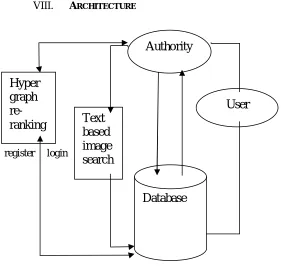
VIII. ARCHITECTURE
query
register login
Figure 2.System Architecture
IX.SPLINTERS
After careful analysis the system has been identified to have the following modules:
Training module
Image retrieval system
Ambiguity module
Training module: Annotation-Based Image Retrieval (ABIR) systems are an attempt to incorporate more efficient semantic content into both text-based queries and image captions for example Google Image Search, Yahoo! Image Search. First module of our project is training module for the whole set of images. Indexing is done using an implementation of the Document Builder Interface. A simple approach is to use the Document Builder Factory, which creates Document Builder instances for all available features as well as popular combinations of features e.g. all JPEG features or all available features. In a content based image retrieval system, target images are sorted by feature similarities with respect to the query (CBIR). In this module, we index the images and training the images accordingly.
Image retrieval system: The methodology proposed in this work encompasses a novel (alternative) approach for Annotation-Based Image Retrieval that, compared to LSI and PLSI, is better suited to sparsely annotated domains, like in image databases where, the per image sparse keyword annotation is also limited. It addresses in a more natural way the zero frequency problems, defined as the fact that the probability to find common keywords even in closely related images is typically small because the images are not annotated with exactly the same keywords. This problem is addressed here by means of an explicit relevance link between keywords that carries a probabilistic weight. We show that assigning logical connections between keywords by means of a Markovian model, permits better generalization over a sparsely annotated domain hence the proposed approach raises the reasoning aspect next to the numerical aspect
Database
Authority
User
Hyper
graph
ISSN(Online): 2320-9801
ISSN (Print) : 2320-9798
I
nternational
J
ournal of
I
nnovative
R
esearch in
C
omputer
and
C
ommunication
E
ngineering
(An ISO 3297: 2007 Certified Organization)
Vol. 4, Issue 3, March 2016
of probabilities. The key idea behind the approach is to compensate for the sparse data by incorporating an annotation procedure of probabilistic qualitative reasoning that will propagate partial beliefs regarding connections between keywords. A mechanism that gains performance from mining the structure of the existing data rather that incorporating new data, as it happens with traditional models is hence introduced.
The proposed approach will be presented in the framework of an online image retrieval system (similar to Google image search) where users search for images by submitting queries that are made of keywords. The queries formed by the users of a search engine are semantically refined, the keywords representing concise semantics when compared to text in documents or other vocabulary related presentations. The aim is to improve user satisfaction by returning images that have a higher probability to be accepted (downloaded) by the user. The assumption is that the users search for images by issuing queries, each query being an ordered set of keywords. The system responds with a list of images. The user can download or ignore the returned images and issue a new query instead. During the training phase of the system the images are considered with no annotation. As the users issue queries and pick images the system annotates the images in an automatic manner and at the same time establishes relevance relations between the keywords as will be explained later on in the manuscript.
Ambiguity module: In this module we propose our contribution of providing more accuracy to the proposed system by enhancing using ambiguity resolving problem. Ambiguity is, Middle vision is the stage in visual processing that combines all the basic features in the scene into distinct, recognizable object groups. This stage of vision comes before high-level vision (understanding the scene) and after early vision (determining the basic features of an image). When perceiving and recognizing images, mid-level vision comes into use when we need to classify the object we are seeing. Higher-level vision is used when the object classified must now be recognized as a specific member of its group. For example, through mid-level vision we perceive a face, then through high-level vision we recognize a face of a familiar person. Mid-level vision and high-level vision are crucial for understanding a reality that is filled with ambiguous perceptual inputs. Thus in this module we resolve the problem of ambiguity and enhance the accuracy and propose an efficient system.
X. CONCLUSION
In reranking framework the first attempt to include is attributes. Based on the classifiers for all predefined attributes, each image is consisting of the response from the classifiers. We consider hyper graph ranking to reorder the image to construct the model of relationship of all images and visual attribute joint hypergraph learning approach has been proposed to explore information source.
XI.FUTURE ENHANCEMENT
In future work the image is open is starts to count the total time taken till the image is load and also count the number of views and download of a particular image. The reranking is occur based on total time taken which image has higher time is displayed at the top of the search result.
REFERENCES
[1]. JunjieCai, Zheng-Jun Zha, Member, IEEE, Meng Wang, Shiliang Zhang, and QiTian, Senior Member, IEEE, “An Attribute-Assisted Reranking Model for Web Image Search”, ieee transactions on image processing, vol. 24, no. 1, pp 261-272, 2015.
[2].L. Yang and A. Hanjalic, “Supervised reranking for web image search,” in Proc. Int. ACM Conf. Multimedia, 2010, pp. 183–192.
[3] X. Tian, L. Yang, J. Wang, Y. Yang, X. Wu, and X.-S.Hua, “Bayesian visual reranking,” Trans. Multimedia, vol. 13, no. 4, pp. 639–652, 2012. [4] F. Schroff, A. Criminisi, and A. Zisserman, “Harvesting image databases from the web,” in Proc. IEEE Int. Conf. Comput. Vis., pp. 1–8,2007 [5] B. Siddiquie, R. S. Feris, and L. S. Davis, “Image ranking and retrieval based on multi-attribute queries,” in Proc. IEEE Conf. Comput. Vis. Pattern Recognit., pp. 801–808,2011.
[6] A. Farhadi, I. Endres, D. Hoiem, and D. Forsyth, “Describing objects by their attributes,” in Proc. IEEE Conf. Comput. Vis. Pattern Recognit.,pp. 1778–1785,2009.
[7] N. Kumar, A. C. Berg, P. N. Belhumeur, and S. K. Nayar, “Attribute and simile classifiers for face verification,” in Proc. IEEE Int. Conf. Comput. Vis., pp. 365–372,2009
[8] K. Järvelin and J. Kekäläinen, “IR evaluation methods for retrieving highly relevant documents,” in Proc. ACM SIGIR Conf. Res. Develop. Inf. Retr., pp. 41–48,2000