Application of Data Mining for understanding
Supply Chain Management in Retailing
Ashish B. Patel1
Research Scholar, Faculty of Computer Science, Pacific Academy of Higher Education and Research University,
Udaipur, Rajasthan, India1
ABSTRACT: Data mining is a tool used to extract information from the large data sets generated in different fields
including business. The fundamental nature of Data mining usage in business applications is that it is useful in identifying relevant information and knowledge which can be used for better decision making in business area. This paper studies the use of data mining, as a tool, in understanding supply chain management. This also happens to generate large amount of data in its operations. Organisations can make use of this data for planning merchandise assortments, pricing the merchandise, vendor performance analysis, inventory control, product movement & supply chain and demand forecasting.
KEYWORDS: Data Mining, Supply Chain Management, Business Applications
I. INTRODUCTION
Data Mining is the process of discovering interesting patterns and knowledge from large amount of data. The data sources can include databases, data warehouses, the web, other information repositories, or data that are streamed into the system dynamically [9].
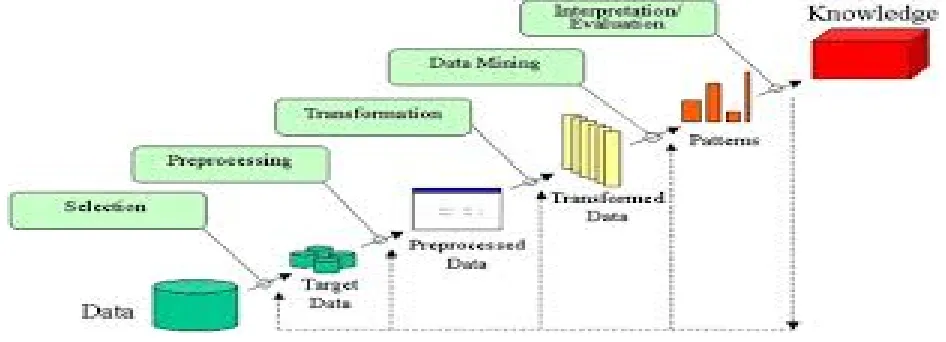
Data mining is an essential step in the knowledge discovery in databases (KDD) process that produces useful patterns or models from data (Figure 1) The terms of KDD and data mining are different. KDD refers to the overall process of discovering useful knowledge from data. Data mining refers to discovering new patterns from a wealth of data in databases by focusing on the algorithms to extract useful knowledge [9].
As shown in the figure 1, KDD process consists of iterative sequence of following steps:
1. Data: It requires cleaning and integration of the collected data in order to remove noise and inconsistent data along with combining multiple sources of data.
2. Data Selection: selecting data relevant to the analysis task from the database.
3. Data Transformation: transforming data into appropriate forms to perform data mining.
4. Data mining: an essential process where intelligent methods are applied to extract data patterns.
5. Pattern evaluation: interpreting the patterns into knowledge by removing redundant or irrelevant patterns; translating the useful patterns into terms that human understandable.
6. Knowledge presentation: where visualization and knowledge representation techniques are used to present mined knowledge to users.
Data mining Applications:
Here is the suggestive list of areas where data mining is widely used:
Financial data analysis, retail marketing, telecommunication industry, biological data analysis, scientific applications, intrusion detection, data mining applications in transportation, data mining applications in medicine, data mining
applications in health care and insurance, visual and audio data mining.
II.RELATEDWORK
DATA MINING AND SUPPLY CHAIN MANAGEMENT
Supply chain management (SCM) is "the systemic, strategic coordination of the traditional business functions and the tactics across these business functions within a particular company and across businesses within the supply chain, for the purposes of improving the long-term performance of the individual companies and the supply chain as a whole" [1]. It has also been defined as the "design, planning, execution, control, and monitoring of supply chain activities with the objective of creating net value, building a competitive infrastructure, leveraging worldwide logistics, synchronizing supply with demand and measuring performance globally” [13].
Today, supply chains are very complex business networks that need to be managed collaboratively and optimized globally. Additionally, global business landscape is constantly and rapidly changing. Uncertainty, growing competition, shorter cycle times, more demanding customers, and pressure to cut costs are just a few characteristics of the 21st century business environment. It has become critical to measure, track, and manage the performance of supply chain processes. Performance management relates to application of processes, methods, metrics, and technologies in order to create a consistent relationship between supply chain strategy, planning, implementation, and controlling.
In this paper we focus on various areas of Supply Chain Management
Planning Merchandise Assortment
Merchandise assortment planning enables retailers to place the right products in the most effective locations in order to maximize sales and margins, while avoiding potential stock outs or over stock situations.
The data mining helps to analysed previous sales performance and building core product-line assortments in line with financial objectives, while taking into account factors such as seasonal and geographical variations and trends. Merchandise assortment planning also gives planners the ability to range assortments across store grades, using their knowledge of the business and the buying personas of their customers, in order to optimize the inventory in each store and channel.
Pricing the Merchandise
Price plays an important role in retailing as it explains the interrelationship between the objectives of the retail store and the components of the retail mix. A pricing strategy should help retailers earn a profit and, at the same time, benefit the customers.
Vendor Performance Analysis
Monitoring and analysis of vendor performance and reliability allows retailers to reduce stock levels, improve operational efficiencies, customer satisfaction and increase profitability. Vendor Performance analysis is the formal process of managing supplier relationships, measuring performance and driving continuous improvement with a company’s strategic suppliers.
Managing and improving the performance of key suppliers is critical to ensuring a well functioning supply chain and in enhancing competitive position. As companies focus increasingly on their core competencies and outsource a greater percentage of work, their success becomes ever more dependent on the performance of strategic suppliers.
Data mining can be used increase performance visibility, increase competitive advantage, and improve stakeholder satisfaction.
Inventory Control
The reasons for inventory control are:
It helps balance the stock as to value, size, color, style, and price line in proportion to demand or sales trends. It helps to plan the winners as well as move slow sellers. It helps to secure the best rate of stock turnover for each item. It helps to reduce expenses and markdowns. It helps to maintain a business reputation for always having new, fresh merchandise in wanted sizes and colors.
Control of inventory, which typically represents 45% to 90% of all expenses for business, is needed to ensure that the business has the right goods on hand to avoid stock-outs, to prevent shrinkage (spoilage/theft), and to provide proper accounting. Many businesses have too much of their limited resource, capital, tied up in their major asset, inventory. Worse, they may have their capital tied up in the wrong kind of inventory. Inventory may be old, worn out, shop-worn, obsolete, or the wrong sizes or colours, or there may be an imbalance among different product lines that reduces the customer appeal of the total operation.
Product Movement and Supply chain
Supply chain management (SCM) is the control of the supply chain as a process from supplier to manufacturer to wholesaler to retailer to consumer. Supply chain management does not involve only the movement of a physical product (such as a microchip) through the chain but also any data that goes along with the product (such as order status information, payment schedules, and ownership titles) and the actual entities that handle the product from stage to stage of the supply chain.
There are essentially three goals of SCM: to reduce inventory, to increase the speed of transactions with real-time data exchange, and to increase revenue by satisfying customer demands more efficiently.
Demand forecasting
Demand forecasting is the area of predictive analytics dedicated to understanding consumer demand for goods or services. That understanding is harnessed and used to forecast consumer demand. Knowledge of how demand will fluctuate enables the supplier to keep the right amount of stock on hand. If demand is underestimated, sales can be lost due to the lack of supply of goods. If demand is overestimated, the supplier is left with a surplus that can also be a financial drain. Understanding demand makes a company more competitive in the marketplace. Understanding demand and the ability to accurately predict it is imperative for efficient manufacturers, suppliers, and retailers. To be able to meet consumer’s needs, appropriate forecasting models are vital. Although no forecasting model is flawless, unnecessary costs stemming from too much or too little supply can often be avoided using data mining methods. Using these techniques, a business is better prepared to meet the actual demands of its customers.
III.LITERATUREREVIEW
There has been lot of research efforts during the last decade that deal with various aspects of supply chain performance management. Shepherd and Gunter provide taxonomy of supply chain performance measurement systems and metrics with critical review of the contemporary literature [6]. The study shows that despite substantial advances in the literature in the last decade, there are still important topics related to supply chain performance management that did not receive adequate attention, such as process modeling, data integration, software support, and forecasting. Estampe et al. provide analysis of various supply chain performance models by stressing their specific characteristics and applicability in different contexts, so that decision-makers can evaluate and apply models and metrics that best suit their needs [7]. Arzu Akyuz and Erman Erkan also provide a critical literature review on supply chain performance measurement. The results show that performance measurement in the new era is still an open area of research [8]. This particularly refers to Framework development, collaboration, agility, flexibility, and IT support systems. Gopal and Thakkar give a comprehensive review of supply chain performance measurement systems [15]. The analysis shows that, in spite of considerable evidence from the literature, there is a large scope for research to address critical issues in supply chain performance measurement, including metrics, benchmarking, integration, business intelligence, and collaborative decision making. The goal of supply chain performance management is business process optimization through monitoring and analysis of key performance indicators. By measuring and monitoring metrics against predefined goals companies can provide added value to large volumes of data generated over time. This type of analysis allows companies to track various metrics at different organization levels and to take timely actions.
As a result of the huge amount of data generated within supply chains, new tools and methods should be developed which are capable of storing, managing, and analyzing the data, as well as of monitoring global supply chain performance. Chae and Olson propose an analytical framework for supply chain management, which is composed of three IT-enabled capabilities: data management, analytics, and performance management [5].
Increasingly, transactional supply chain data is processed and stored in enterprise resource planning systems, and complementary data warehouses are developed to support performance management and decision-making processes [16]. Some organizations have developed data warehouses and integrated data-mining methods that complement their supply chain management operations [11].
Inventory management is probably the key supply chain process, and inventory costs represent a large portion of the total supply chain costs. Incorporating predictive analytics in an inventory management process can lead to many benefits such as cost reduction, higher customer service level, optimal reordering policy, enhanced productivity, shorter cash-to-cash cycle time, and ultimately increased profitability [2]. Different data mining techniques were used for solving supply chain and inventory management related problems. Dhond et al. used neural-network based techniques for inventory optimization in a medical distribution network which resulted in 50% lower stock levels [3]. Symeonidis et al. applied data mining technology in combination with an autonomous agent to forecast the price of the winning bid in a given order [4].When it comes to inventory management, Stefanovic et al. used different data mining models clustering retail stores based on sales.
IV.CONCLUSION
Data mining is the process of analyzing data from different angle or perspective and collecting it to get useful information that can be used to increase revenue costs or both, data mining allows backend processors to analyze data from many different dimensions, categories it & summarize the relationships identified.
In business, the goal of supply chain management is to help decision makers better manage, plan, understand, and control their performance. Supply chain management includes monitoring, measurement, and analysis of various data and also collaborative decision making and synchronization. Performance management is critical to the ultimate success of complex business systems such as supply chains. Key performance indicators are used to measure supply chain performance on a strategic, tactical, and operational level. Inventory management is the key supply chain process, and inventory costs represent a large portion of the total supply chain costs.
As a result of the large amount of data sets generated within supply chains, new tools and methods should be developed which are capable of storing, managing, and analyzing the data, as well as of monitoring global supply chain performance.
REFERENCES
[1] "Supply chain management (SCM)". APICS Dictionary. Retrieved 30 December 2018.
[2] “Predictive inventory management: Keeping your supply chain in balance,” IBM, 2012, ftp://ftp.boulder.ibm.com/common/ssi/ ecm/en/ytw03260usen/ YTW03260USEN.PDF.
[3] A. Dhond, A. Gupta, and V. Vadhavkar, “Data mining techniques for optimizing inventories for electronic commerce,” in Proceedings of the SIGKDD International conference on Knowledge Discovery and Data Mining, pp. 480–486, August 2000.
[4] A. L. Symeonidis, V. Nikolaidou, and P. A. Mitkas, “Exploiting data mining techniques for improving the efficiency of a supply chain management agent,” in Proceedings of the International Conference onWeb Intelligence and Intelligent Agent Technology, pp. 23–26, IEEE, Hong Kong, December 2006.
[5] B. K. Chae and D. L. Olson, “Business analytics for supply chain: a dynamic-capabilities framework,” International Journal of Information Technology & Decision Making, vol. 12, no. 1, pp. 9–26, 2013.
[6] C. Shepherd and H. Gunter, “Measuring supply chain performance: current research and future directions,” International Journal of Productivity and Performance Management, vol. 55, no. 3-4, pp. 242–258, 2006.
[8] G.Arzu Akyuz and T. Erman Erkan, “Supply chain performance measurement: a literature review,” International Journal of Production Research, vol. 48, no. 17, pp. 5137–5155, 2010.
[9] J. Han and M. Kamber, J Pei (2014), “Data Mining: Concepts and Techniques,” Morgan Kaufmann.
[10] K. Bauer, “Predictiveanalytics: the next wave in KPIs,” InformationManagementMagazine, 2005, http://www.informationmanagement.
com/issues/20051101/1040476-1.html.
[11] L. Dignan, “Data depot,” 2003, http://www.baselinemag.com/c/ a/Projects-Supply-Chain/Data-Depot.
[12] M. Hofmann, Best Practices: VW Revs Its B2B Engine, 2004, http://www.informationweek.com/best-practices-vw-revs-itsb2b- engine/18201367.
[13] Mentzer, John T., William DeWitt, James S. Keebler, Soonhoong Min, Nancy W. Nix, Carlo D. Smith, & Zach G. Zacharia (2001): Defining Supply Chain Management. Journal of Business Logistics, Vol. 22, No. 2, pp. 1–25.
[14] N. Stefanovic and D. Stefanovic, “Supply chain business intelligence: technologies, issues and trends,” in Artificial Intelligence: An International Perspective, M. Bramer, Ed., vol. 5640 of LNAI, pp. 217–245, Springer, New York, NY, USA, 2009.
[15] P. R. C. Gopal and J. Thakkar, “A review on supply chain performance measures and metrics: 2000-2011,” International Journal of Productivity and Performance Management, vol. 61, no. 5, pp. 518–547, 2012.