IOT Based Human Less Toll System
Pallavi Nehete1, Atharva Kadam2, Gaurav Chotaliya 3, Aniket Pattankude 4, Saurabh Marne 5
Lecturer, Department of Information Technology, MAEER’S MIT POLYTECHNIC, SSPP, Pune, Maharashtra, India 1 Student, Department of Information Technology, MAEER’S MIT POLYTECHNIC, SSPP, Pune, Maharashtra, India 2, Student, Department of Information Technology, MAEER’S MIT POLYTECHNIC, SSPP, Pune, Maharashtra, India 3, Student, Department of Information Technology, MAEER’S MIT POLYTECHNIC, SSPP, Pune, Maharashtra, India 4, Student, Department of Information Technology, MAEER’S MIT POLYTECHNIC, SSPP, Pune, Maharashtra, India 5
ABSTRACT: The vehicles passing through tollbooth have to pay the toll tax. Presently offered toll collection system uses manual methods. In such methods vehicles have to stop at the tollbooth for payment which causes heavy traffic congestion in the metropolitan cities.
The main idea of this project is to implement smart electronic toll collection system using RFID and speed limit management system using Global Positioning System which greatly reduces the time and cost of travellers by eliminating the long queues at tollbooths.
Our proposed system will automatically deduct the toll amount from payment wallet when the person enters a toll area thereby saving time, money and fuel. GPS continuously monitors the speed of the vehicle and sends a warning if the vehicle over-speeded in special zones via the application. Application informs the user about the amount deduced with reason and warns him regarding the over-speed as well as handles user data.
KEYWORDS: RFID Toll Collection, Global Positioning System, Vehicle Registration, RFID tag, RFID Reader, e-wallet.
I. INTRODUCTION
India is a country where we get to observe most extensive National highways. Government plans various phases to complete the projects under construction. The government signs agreement with the private companies who build the infrastructure like road, port and other stuff for a particular span of time generally in years. The invested amount is charged from the vehicles passing on that newly built highway. This charged amount is called a toll tax. People have no choice to pay for toll tax for using the infrastructure. The private agency involved in the manufacturing of the infrastructure is free to charge citizens.
Initially, there were toll collection systems such as manual toll collection without generating computer receipts. This method is really very inefficient. In existing system, we have to stop the vehicles at toll station and wait for a relatively long time for their turn to come. This was causing congestion of traffic. The states of congestion and inefficiency prompted the government to plan and implement the Toll Collection system which can remove out these problems and facilitate convenience for all who involved in the process of toll collection directly or indirectly.
In this system, vehicles need not stop in toll plazas for paying the toll fee; the toll fee is deduced from the vehicles linked bank account when the vehicles are in motion. This makes the vehicles move faster in the toll area, no vehicular conjunction.
II. LITERATURE SURVEY
Amrita Jhaveri et al. [1] discuss the use of a GPS module for location detection of a vehicle and using IR sensors to achieve speed control. This paper elaborates idea how rotations per minute of the wheel could be used to get speed and then using the application to warn the driver to reduce speed. The drawback of using such a system is that it has to depend on IR sensors which are costly.
B. S. Selvakumaran et al. [2] presents the use of video processing for license plate recognition. This paper proposes that an image from the video taken is processed to recognize the number plate and using the identification toll amount is deducted from prepaid cards associated with that account. This approach has drawbacks related to weather conditions for video processing and processing is unclear at night.
Ousmane Abdoulaye et al. [4] gives an alternate approach for the manual toll collection system. The RFID tag is assigned to each vehicle. When the vehicle approaches toll plaza RFID readers to detect the tags and using unique identification automatically deduct the toll amount of money from the user's prepaid balance card.
The paper [5] gives A GPS based tracking system which keeps track of the location of a vehicle and its speed depending on the mobile phone text messaging system. The system is able to provide real-time text alerts for speed and location. Mostly, the current location can be locked and the system will alert the owner if the vehicle is moved from the present locked location. Again, the speed can be controlled and an alert is sent if this speed is exceeded. The location can find out with position tracking technology of GPS and GSM system.
K. Balamurugan et al. [10] Automated Toll collection and Check-Post system using Radio Frequency Identification (RFID) and Global System for Mobile communications (GSM) module. When the vehicle crosses the Toll- Plaza the reader reads the tag and the tax amount will be detected from their account balance by employing of RFID and GSM module. ATmega328 Arduino controller has to be associated with a GSM network which will capacitate a user to control the system by dispatching SMS or a forming a call and also avoid the stealing of vehicle.
W. A. Syafei et al. [11] Queuing Free Environmentally Friendly Automatic Toll Gate system using RFID. The vehicle is identified by the systems just as it is moving through the toll gate. This method eradicates the queue at the toll gate since the payment is done in the fly.
III.PROPOSEDSYSTEM
A. System Architecture
In today’s world, Common man faces various problems near toll areas such as waiting in long queues, heavy traffic which in turn increases fuel consumption and also causes air pollution which can further cause problems like global warming. Manually operated systems are time-consuming and can give rise to malicious acts like corruption.
1 Vehicle Registration and Account Creation:
With the help of an automated system, it is possible to deduct the toll amount from the user’s prepaid account. To create an account user have to register vehicle number and other required information so that the user can also recharge it with the required amount.
2 Amount Deduction with RFID Reader:
When vehicle approaches to particular toll plaza the RFID reader at the toll scans the RFID tag attached to the vehicle which contains vehicle information along with the user id. This information can be used for automatic toll amount deduction from the account of the user a vehicle can pass from the plaza. This saves the time and fuel of the vehicle as well.
If the amount is less or if the RFID card is not there then the corresponding vehicle is blocked and he will have to pay equivalent cash amount.
3 GPS tracking and Speed Control:
GPS module which continuously sends GPS coordinates like latitude, longitude to the server so that vehicle speed can monitor. In case harsh driving or vehicle is over speeded in the sensitive area then, the system will send him a warning to reduce his speed. If s/he still continues to over-speed then the certain amount will be reduced from his e-wallet as a punishment.
4 Vehicle Theft Detection:
If any vehicle is stolen then the administrator can add the theft complaint. While any vehicle RFID is scan then the system can check the vehicle details, as well as they, check their theft status. If scanned RFID is found as a stolen vehicle then the system can send a notification to the nearest police station as well as the vehicle owner. Also, they play a buzzer for notifying the toll authority.
5 Generate Report:
The system is helpful to automate the toll collection process. The admin can see the entire toll collected in one day and generate an overall report about the collection.
6 Send Notification:
The user is sent a notification about the speed, the amount transferred etc. through an android application.
A. Algorithm Used
1. GPS based distance formula
GPS based distance formula is used to calculate the great distance between two points – that is, the shortest distance over the earth’s surface. We can calculate the distance between latitudes and longitudes. It is also called Haversine Formula.
Where
φ is latitude
λ is longitude R is earths radius (mean radius = 6,371km); Note that angles need to be in radians to pass to trig functions.
IV. IMPLEMENTATION DETAILS
Web pages are created to update the information of vehicle toll tax payment. An application is created which can be installed on any laptop or mobile phone. The fig: 2. shows the home page of the app.
Figure 2. Home Page of Toll Collection System
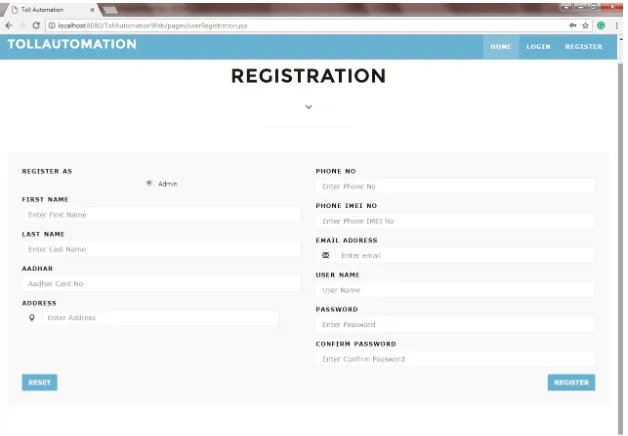
For all the system use users have to register themselves with name, address, and email ID. Figure 3 shows the registration details required for the user.
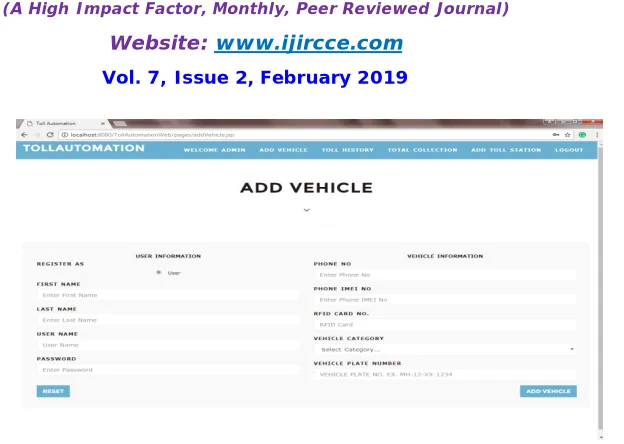
Figure 4. Vehicle Toll Collection System
V. ADVANTAGES
1. This application will reduce traffic congestion at the toll collection booth. 2. The traveling time is decreased as waiting in the queues is avoided. 3. It will help to reduce pollution due to vehicle emissions in the toll area. 4. Less infrastructure cost as most of the work done is automated.
5. It is also helpful for controlling the speed limit of the vehicle in special zones like school.
VI. CONCLUSION
The paper gives a smart electronic toll collection system using RFID and speed limit management system using the Global Positioning System. The system automatically deducts the toll amount from payment wallet when the person enters a toll area thereby saving time, money and fuel. GPS continuously monitors the speed of the vehicle and sends a warning if vehicle over-speeded in special zones via the application. Application informs the user about the amount deduced with reason and warns him regarding the over-speed as well as handles user data.
REFERENCES
[1] Amrita Jhaveri1, Anisha Das2, Kedar Kasarpatil3, Maansee Mohire4, Suyash Karle5, GPS based speed limit and toll collection, VOL-5, issue-4,2016.
[2] A. K. Lavanya B. S. Selvakumaran \DESIGN AND DEVELOPMENT OF AUTOMATED TOLL COLLECTION THROUGH LICENSE PLATE RECOGNI- TION”, International Journal of Technical Research and Applications e - ISSN: 2320 - 8163, www.ijtra.com Volume 3, Issue 4 (July - August 2015), PP. 111 - 115.
[3] T. K. Sethuramalingam, R. Narthana Devi, K. Sangeetha "Speed Control for Motor Vehicles Using Global Positioning System”, International Journal of Advanced Re- search in Electrical, Electronics and Instrumentation Engineering, Vol. 3, Issue 1, January 201 4.
[4] Asif Ali Laghari, M. Sulleman Memon and Agha Sheraz Pathan, "RFID Based Toll Deduction System", I.J. Information Technology and Computer Science, 2012, 4, 40-46 Published Online April 2012 in MECS (http://www.mecs-press.org/) DOI: 10.5815/ijitcs.2012.04.06. [5] M. A. Al Rashed, Ousmane Abdoulaye Oumar, Damanjit Singh, "A real time GSM/GPS based tracking system based on GSM mobile phone",
Second International Conference on Future Generation Communication Technologies (FGCT 2013). [6] Pramod Kumar P.M,"IOT based Toll Collection System", IJAREM - 2018.
[7] Aadish Joshi, 2Gaurav Bhide, 3Shreyas Patil, 4R. D. Komati, "IoT Based Toll Booth Management System",2017
[10] K. Balamurugan, Dr. S. Elangovan, Dr.R.Mahalakshmi,R. Pavithra,, "Automatic Check-Post and Fast Track Toll System Using RFID and GSM Module with Security System", IEEE INTERNATIONAL CONFERENCE ON ADVANCES IN ELECTRICAL TECHNOLOGY FOR GREEN ENERGY 2017 (ICAETGT’ 2K17).