A Study on Discovery of Ranking Fraud for
Mobile Apps
Dr. G. Shankar Lingam1
Professor, Dept. of CSE, Chaitanya Institute of Technology & Science, Warangal, Telangana, India1
ABSTRACT:Positioning misrepresentation in the portable Application business shows to false or dubious activities which have a motivation behind, thumping up the Applications in the popularity list. To be sure, it ends up being more endless for Application architects to adventure shady means, for instance, developing their Applications' business or posting fraud Application assessments, to ponder situating deception. While the ramification of abstaining from positioning misrepresentation has been by and large maintained, there is constrained comprehension and examination here. This paper gives an all-inclusive viewpoint of situating deception and proposes a Positioning misrepresentation distinguishing proof structure for versatile Applications. In particular, it is proposed to precisely discover the mining in order to posture blackmail the dynamic periods, to be particular driving sessions, of compact Applications. Such driving sessions can be used for recognizing the area irregularity as opposed to an overall anomaly of Application rankings. In addition, three sorts of verification s are investigated, i.e., situating based affirmations, displaying to rate based confirmations and study based evidences, Applications' situating, rating and review rehearses through genuine speculations tests. In the request, this paper gets the skill of the proposed system, and shows the distinguishing proof's flexibility estimation furthermore some consistency of situating deception works out.
KEYWORDS: Mobile Apps, ranking fraud detection, evidence aggregation, historical ranking records, rating andreview
I. INTRODUCTION
II. LITERATURE SURVEY
In this paper, developed a situating coercion distinguishing proof structure for flexible applications that situating distortion happened in driving sessions for every application from its obvious situating records [1].
In this strategy, we address the issue of study spammer acknowledgment, or ding customers who are the wellspring of spam reviews. Not at all like the techniques for spammed study acknowledgments, our proposed review spammer area procedure is customer driven, and customer behavior driven. A customer driven technique is favored over the review driven strategy as social event behavioral verification of spammers is less requesting than that of spam reviews. A review incorporates one and just observer and one thing. The measure of evidence is compelled. An examiner on the other hand might have kept an eye on different things and thusly has contributed different overviews. The likelihood of conclusion evidence against spammers will be much higher. The customer driven procedure is in like manner versatile as one can basically combine new spamming rehearses as they develop. [2]
In this paper we first give a general framework for coordinating Regulated Rank Accumulation. We show that we can describe coordinated learning methods identifying with the current unsupervised systems, for instance, Board Check what's more, Markov Chain based schedules by mishandling the framework. By then we overwhelmingly explore the regulated types of Markov Chain based systems in this paper, in light of the way that past work shows that their unsupervised accomplices are unrivaled. All things being equal turns out, then again, that the streamlining issues for the Markov Chain based schedules are hard, in light of the way that they are not bended change issues. We have the ability to add to a framework the upgrade of one Markov Chain based system, called Regulated MC2.Specifically, we show that we can change the headway issue into that of Semi positive Programming.[3]
We first give a general structure for driving Administered Rank Total. We exhibit that we can describe controlled learning schedules identifying with the current unsupervised frameworks, for instance, Board Tally and Markov Chain based techniques by mishandling the structure. By then we essentially inspect the controlled variations of Markov Chain based systems in this paper, in light of the way that past work exhibits that their unsupervised accomplices are dominating. Taking everything in account turns out, regardless, that the improvement issues for the Markov Chain based methodologies are hard, in light of the way that they are not curved progression issues. We have the ability to add to a procedure the upgrade of one Markov Chain based system, called Regulated MC2.Specifically, we show that we can change the progression issue into that of Semi positive Programming.[4]
In this paper, creator demonstrated various sorts of conventions to protect the protection or security of the information. This paper contemplated the issue of centrality sparing in MANETs in context of the system for structure coding and displayed that System Coding is valuable in figuring, and gets less significance use for encryptions/decoding. [5]
III. SYSTEM ARCHITECTURE
We first propose a straightforward yet viable calculation to distinguish the main sessions of each Application in view of its authentic positioning records. At that point, with the investigation of Applications' positioning practices, we find that the fake Applications frequently have distinctive positioning examples in every driving session contrasted and ordinary Applications. In this way, we portray some misrepresentation confirmations from Applications' authentic positioning records, and create three capacities to concentrate such positioning based extortion confirmations. We facilitate propose two sorts of misrepresentation proofs in light of Applications' appraising and survey history, which mirror some irregularity designs from Applications' verifiable rating and audit records.
1). Ranking Based Evidences: By breaking down the Applications' verifiable positioning records, we watch that Applications' positioning practices in a main occasion dependably fulfill a particular positioning example, which comprises of three distinctive positioning stages, in particular, rising stage, keeping up stage and subsidence stage. 2). Rating Based Confirmations: Particularly, after an Application has been distributed, it can be evaluated by any client who downloaded it. To be sure, client rating is a standout amongst the most essential components of Application ad. An Application which has higher rating might pull in more clients to download and can likewise be positioned higher in the leaderboard. Subsequently, evaluating control is likewise a vital point of view of positioning misrepresentation.
use encounters of existing clients for specific portable Applications. Surely, survey control is a standout amongst the most critical viewpoint of Application positioning misrepresentation.
Fig. 1. The framework of our ranking fraud detection system for mobile Apps.
A. IDENTIFYING LEADING SESSIONS FOR APPS
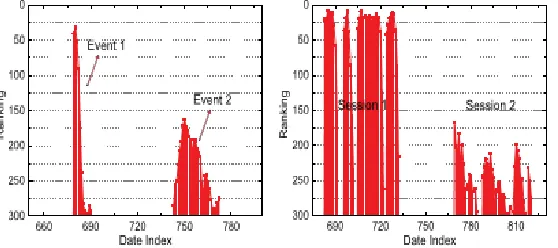
By dissecting the authentic positioning records of mobile Apps, we watch that Applications are not generally positioned high in the leaderboard, but rather just in some driving occasions. For instance, Fig. 2a demonstrates an illustration of driving occasions of a mobile App.
Fig. 2. (a) Example of leading events; (b) Example of leading sessions ofmobile Apps.
Besides, we likewise find that a few Applications have a few nearby driving occasions which are near one another and structure a main session. For instance, Fig. 2b demonstrates an illustration of neighboring driving occasions of a given mobile Application, which shape two driving sessions. Especially, a main occasion which does not have other close-by neighbors can likewise be dealt with as an uncommon driving session.
B. EXTRACTING EVIDENCES FOR RANKING FRAUD RECKONING RANKING BASED EVIDENCES
The positioning based proofs are valuable for positioning extortion location. Be that as it may, once in a while, it is not adequate to just utilize positioning based proofs. For instance, a few Applications made by the renowned engineers, for example, Diversion space, might make them lead occasions with substantial estimations of because of the designers' believability and the "informal "publicizing impact.
dependably fulfill a particular positioning example, which comprises of three the diverse positioning stages, to be specific, pising stage, keeping up stage and retreat stage. In particular, in every driving occasion, an Application's positioning first increments to a crest position in the pioneer board (i.e., rising stage), then keeps those such crest position for a period (i.e., looking after stage), lastly diminishes till the end of the occasion (i.e., retreat stage). Fig.3 demonstrates an illustration of various positioning periods of a main occasion. TIndeed, such a positioning example demonstrates a critical comprehension of driving occasion. In the accompanying, we formally characterize the threepositioning periods of a main occasion.
(a) Example 1 (b) Example 2 Fig. 3. Two real-world examples of leading events.
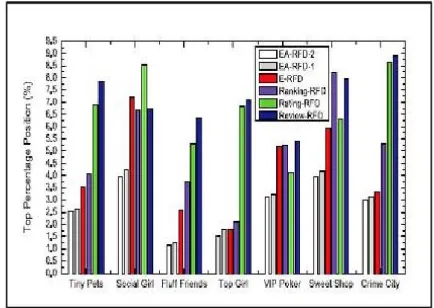
Besides, to recognize the positioning extortion from a few driving sessions, an intuitive methodology is created termed as Proof Collection based Positioning Misrepresentation Location (EA-RFD). Especially, this methodology is meant with score based conglomeration (i.e., Rule 1) as EA-RFD-1, and methodology with rank based collection (i.e., Standard 2) as EARFD-2, separately. In the underneath Fig, there exist a seven free Applications which may include in positioning extortion to be specific as Small Pets, Social Young lady, Cushion Companions, Wrongdoing City, VIP Poker, Sweet Shop, Top Young lady. So every methodology like EA-RFD1 and EA-RFD2 is connected on these Applications to locate the suspicious Applications with high positioning. Subsequent to a decent positioning based identification framework is worked to distinguish extortion Applications from a given dataset of portable Applications. Henceforth by every methodology given in Fig.4, top rate position of each Application in the positioned rundown is renowned.
Fig.4.Histogram chart of reported suspicious mobile App.
(a) Fluff Friends (b) VIP Poker
(c) Tiny Pets (d) Crime City
Fig.5: Demonstration of the ranking records of each reported suspicious Apps
So as to study the execution of positioning extortion discovery by every strategy, we set up the appraisal as takes after. To start with, for every technique, we named 50 top positioned driving sessions (i.e., most worried sessions), 50 center positioned driving sessions (i.e., most uncertain sessions), and 50 base positioned driving sessions (i.e., most ordinary sessions) from every information set. At that point, we consolidated all the chose sessions into a pool which comprises 587 special sessions from 281 exceptional Applications in "Top Free 300" information set, and 541.
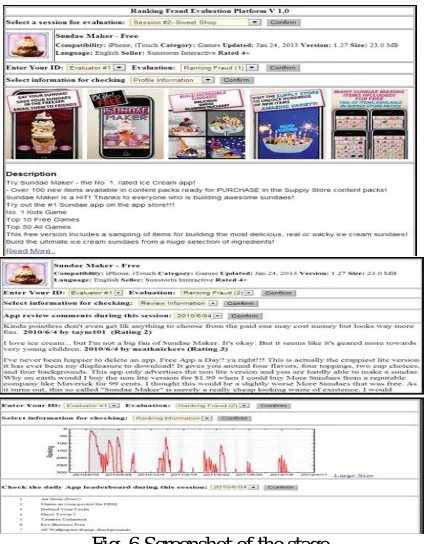
Fig. 6 demonstrates the screenshot of the stage. The left board demonstrates the fundamental menu, the right upper board demonstrates the surveys for the given session, and the right lower board demonstrates the positioning related data for the given session.
V. CONCLUSION
This paper introduces a framework which is developed and it is really a situating crushing revelation system for portable Applications. In particular, basically it is affirmed that situating distortion happened in driving sessions and gave a framework to exhuming driving sessions for each Application from its chronicled situating records. By then, it is perceived that situating based affirmations, rating based evidences and overview based affirmations are utilized for distinguishing situating blackmail. What's more, a remarkable model is proposed which is a change based aggregate framework to coordinate each one of the evidences for evaluating the legitimacy of driving sessions from convenient Applications.
REFERENCES
[1] Discovery of Ranking fraud for mobile apps. Hengshu Zhu,Hui Xiong,Senior members,IEEE,Yong Ge, and Enhong Chen,Senior member,IEEE,IEEE transactions on knowledge and data engineering, vol .27, No.1, January 2015.
[2] Detecting product review spammers using rating behaviors. E.-P. Lim, V.-A. Nguyen, N. Jindal, B. Liu, and H. W. Lauw. In Proceedings of the 19th ACM international conference on Information and knowledge management.
[3] Supervised rank aggregation. Y.-T. Liu, T.-Y. Liu, T. Qin, Z.-M. Ma, and H. Li in Proceedings of the 16th international conference on World
Wide Web.
[4] An unsupervised learning algorithm for rank aggregation, A. Klementiev, D. Roth, and K. Smallin Proceedings of the 18th European conference on Machine Learning, ECML ’07, pages 616–623, 2007.
[5] An unsupervised learning algorithm for rank aggregation, A. Klementiev, D. Roth, and K. Small In Proceedings of the 18th European conference on Machine Learning, ECML ’07, pages 616–623, 2007.
[6] Getjar mobile application recommendations with verysparse datasets. K. Shi and K. Ali. In Proceedings of the18th ACM SIGKDDinternational conference onKnowledge discovery and data mining, KDD ’12, pages204–212, 2012.
[7] Ranking fraud Mining personal context-awarepreferences for mobile users. H. Zhu, E. Chen, K. Yu, H.Cao, H. Xiong, and J. Tian. In Data Mining (ICDM),2012 IEEE 12th International Conference on,pages1212–1217, 2012.
[8] Detection for mobile apps H. Zhu, H. Xiong, Y. Ge, andE. Chen. A holistic view. In Proceedings of the 22ndACMinternational conference on
Information andknowledge management,CIKM ’13, 2013.
BIOGRAPHY