Heart Disease Prediction Approach Using
Machine Learning
Er. Kumari Samriti
1, Er. Monika Pathania
2M. Tech. Student, Department of computer engineering, BIMT Shimla, India
1Assistant Professor, Department of Computer Engineering, BIMT Shimla, India
2ABSTRACT :
In order to extract knowledge and patterns in large datasets, data mining can be used. The data mining
tools can work and analyze different types of datasets irrespective of being structured or unstructured. In this work, the
k-means clustering algorithm and SVM (support vector machine) classifier based prediction analysis technique is used
for clustering and classification of the input data. In order to increase the accuracy of prediction analysis, the back
propagation algorithm is proposed to be applied with the k-means clustering algorithm to cluster the data. The proposed
algorithm performance is tested in the heart disease dataset which is taken from UCI repository. There are 76 attributes
present within a database. However, a subset of 14 amongst them is required within all the published experiments.
Specifically, machine learning researchers have used Cleveland database particularly at all times. The proposed work
will also be compared with the existing scheme (using arithmetic mean) in terms of accuracy, fault detection rate and
execution time.
I. INTRODUCTION
generative taxonomies of plants and animals, classifying the genes that function in similar manner and study the structures inherent within the populations, this approach is today applied in biological research areas. In a city, similar houses and lands area can be identified by employing clustering in geology. To discover new theories, information clustering can be used that classify all documents available on Web. The unsupervised data clustering classification method create clusters, group of objects in such a way that objects in different clusters are distinct and that are in same cluster are very similar to each other. One of the traditional topics that are also known to be the initial step for knowledge discovery within data mining is known as cluster analysis. In order to cluster the tasks being performed in low dimensional data sets, the k-means clustering algorithm is applied. K is utilized as a parameter here and the k clusters are generated by partitioning n objects [6]. It ensures that the similar types of objects are grouped within one cluster and dissimilar objects are placed in separate clusters. The cluster centres are identified here with the help of this algorithm. Supervised and unsupervised learning are the two methodologies utilized by the data mining. In order to learn the parameters of the model, a training set is utilized in supervised learning while in case of unsupervised learning no training set is utilized, for example k-means clustering. Classification and prediction are the main objective of the data mining [7]. Data process rate and unordered values or data are classified by the classification models while continuous value is predicted by the prediction models. A binary classifier through which the margin is increased is known as SVM classifier. This algorithm helps in performing classification in which all the data points present in individual class are separated by the best hyperplane. The best hyperplace of SVM can be presented in the basis of highest margin present in the two classes.
II. LITERATURE REVIEW
Min Chen, et.al (2017) proposed a novel convolutional neural network based multimodal disease risk prediction (CNN-MDRP) algorithm [8]. The data was gathered from a hospital which included within it both structured as well as unstructured types of data. In order to make predictions related to the chronic disease that had been spread within several regions, various machine learning algorithms were streamlined here. A regional chronic disease of cerebral infarction was utilized in order to perform various experiments to evaluate the performance of proposed method. It was seen through the various comparisons made amongst existing and the proposed technique that none of the previously existing methods dealt with both types of data that was gathered from medical fields. 94.8% of prediction accuracy was achieved here along with the higher convergence speed in comparison to other similar enhanced algorithms. Akhilesh Kumar Yadav, et.al (2013) presented different analytic tools used to extract information from large datasets such as in medical field where a huge amount of data is available [9]. The SGPGI real data set has been used that are always linked with different challenges. The classification becomes inefficient due to noise, high dimensional and missing values. Due to the different challenges have to face while performing data analytics clustering is used in replace of it. The foggy k-mean clustering based novel technique need to be developed is the main focus of authors. The proposed algorithm has been tested by performing different experiments on it that gives excellent result on real data sets. In real world problem enhanced results are achieved using proposed algorithm as compared to existing simple k-means clustering algorithm.
Sanjay Chakrabotry, et.al (2014) presented the use of clustering for different forecasting [10]. The weather forecasting has been performed using proposed incremental K-mean clustering generic methodology. The purpose behind this paper is to analyze air pollution for it they have used dataset of west Bengal. The clusters peak mean values are used to develop a weather category list and K-means clustering is applied on the dataset of air pollution. The weather category has been defined in different clusters and a new data is checked by incremental K means to group it into existing clusters. The future weather information is able to be predicted using proposed approach. The used data set contains the weather forecasting information of west Bengal that is able to reduce the air pollutions consequences. The weather events forecasting and prediction becomes easy using modeled computations. In the last the authors have performed different experiments to check the proposed approach correctness.
Chew Li Sa, et.al (2014) proposed Student Performance Analysis System (SPAS) for keeping track of the record of the performance of the students of a particular university [11]. The design and analysis has been performed to predict student’s performance using proposed project on their results data. The data mining technique generated rules that are used by proposed system to gives enhanced results in predicting student performance. The student’s grades are used to classy existing student using classification by data mining technique.
Qasem A. Al-Radaideh, et.al (2013) proposed that data analysis prediction acts as an important subject for forecasting stock return [12]. The data analysis future can be predicted through past investigation. The past historical knowledge of experiments has been used by stock market investors to predict better timing to buy or sell stocks. There are different available data mining techniques out of all a decision tree classifier has been used by authors in this work.
III. RESEARCH METHODOLOGY
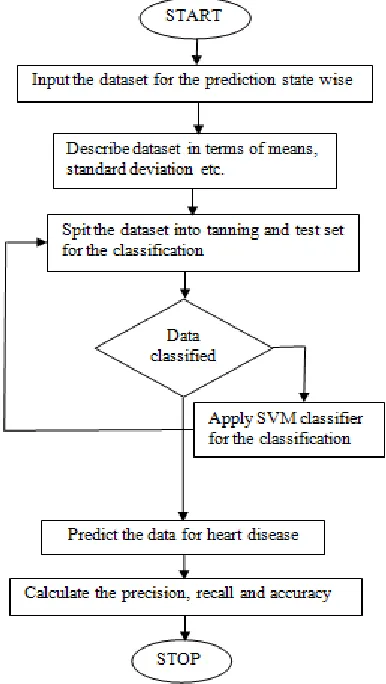
This research work is based on the prediction analysis of heart diseases. The prediction analysis is the technique in which future possibilities can be predicted based on the current dataset. The k-mean clustering is the clustering technique in which similar and dissimilar data is clustered together on the basis of their similarity. In the k-mean clustering, the dataset is considered and from that dataset arithmetic mean is calculated which will be the central point of the dataset. The Euclidian distance from the central point is calculated and points which are similar and dissimilar are clustered into different clusters. The Euclidian distance is calculated dynamically in this work to increase accuracy of clustering. The Euclidian distance is calculated dynamically using back propagation algorithm which clusters the uncluttered points and increase accuracy of clustering. The back propagation algorithm is the algorithm which learns from the previous experiences and drive new values. The formula given below is used to drive values from the input dataset. In the formula given the x is the each point in the dataset and w is the value of the data point from which the actual outputs is taken and bias the value which is used to change the final value of output. The output of each iteration is compared with the output of next iteration and iteration at which error is minimum is the final value of Euclidian distance.
IV. EXPERIMENTAL RESULTS
The proposed research is implemented in Python and the results are evaluated by making comparisons against proposed
and existing techniques in terms of various parameters.
Fig 2: Accuracy Comparison
As shown in figure 2, the accuracy comparison of existing and proposed algorithm is shown. The accuracy of proposed
algorithm is high as compared to existing algorithm
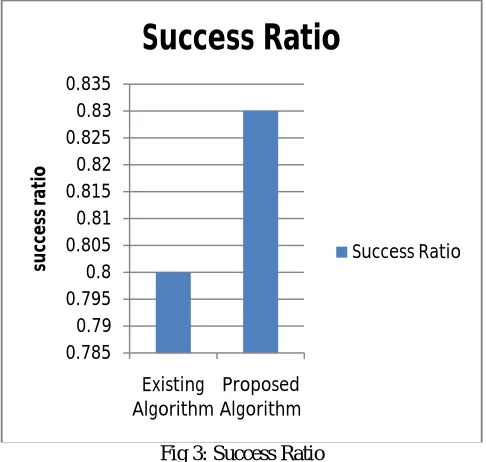
Fig 3: Success Ratio
As shown in figure 3, the success ratio of proposed and existing algorithm is compared for performance analysis. The
success ratio of proposed algorithm is high as compared to existing algorithm.
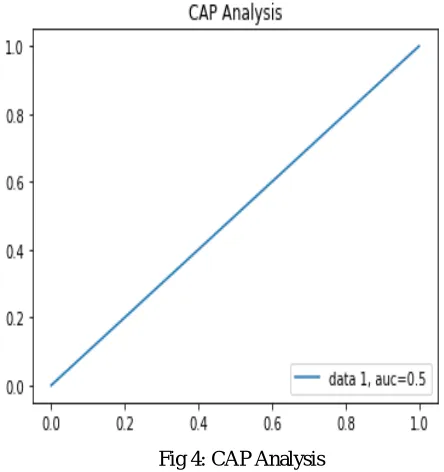
Fig 4: CAP Analysis
As shown in figure 4, the CAP analysis is shown in this figure. On the axis of this cure the training dataset is given as
input and on the y-axis the test data is given as input. The blue line shows that CAP curve which represents accuracy of
the classifier.
V. CONCLUSION
The relevant information is fetched from rough dataset using data mining technique. The similar and dissimilar data is
clustered after calculating a similarity between input dataset. SVM is used to classify both similar and dissimilar data
type in which central point is calculated by calculating an arithmetic mean of the dataset. The central point calculated
Euclidian distance is used to calculate a similarity between different data points. According to the type of input dataset
a clustered data is classified using SVM classifier scheme in the last step. In this research work, the back propagation
algorithm is applied with the k-mean clustering. The clustered result will be given as input for the classification. It is
analyzed that improved technique has less execution time and high accuracy of classification as compared to existing
technique.
REFERENCES
[1] AnandBahety, “Extension and Evaluation of ID3- Decision Tree Algorithm”, ICCCS, ICCC, vol. 4, issue 1, pp. 23-48, 2014.
[2] K. ZakirHussain, M. Durairaj, G. RabialahaniFarzana. “Criminal Behavior Analysis By Using Data Mining Techniques”, IEEE-International Conference on Advances in Engineering, Science and Management (ICAESM -2012), vol. 4, issue 1, pp.30-31, 2012.
[3] Prashant K. Khobragade, Latesh G. Malik, “Data Generation and Analysis for Digital Forensic Application using Data mining”, Fourth International Conference on Communication Systems and Network Technologies, vol. 4, issue 1, pp. 23-48, 2014.
[4] Tejaswini U. Mane, Mrs. Asha M. Pawar, “A Survey On Big Data And Its Mining Algorithm”, IJIRCCE, Vol. 3, Issue 12, pp. 12-22, 2015. [5] Oyelade, O. J, Oladipupo, O. O and Obagbuwa, I. C (2010), “Application of k-Means Clustering algorithm for prediction of Students’ Academic Performance”, International Journal of Computer Science and Information Security, vol. 7, issue 12, pp. 123-128, 2010.
[6] AzharRauf, Mahfooz, Shah Khusro and HumaJaved (2012), “Enhanced K-Mean Clustering Algorithm to Reduce Number of Iterations and Time Complexity”, Middle-East Journal of Scientific Research, vol. 12, issue 4, pp. 959-963, 2012.
[7] K.Srinivas, B.Kavihta Rani and Dr. A.Govrdhan, “Applications of Data Mining Techniques in Healthcare and Prediction of Heart Attacks”, (IJCSE) International Journal on Computer Science and Engineering, vol. 4, issue 9, pp. 23-48, 2010.
[9] Akhilesh Kumar Yadav, DivyaTomar and Sonali Agarwal (2014), “Clustering of Lung Cancer Data Using Foggy K-Means”, International Conference on Recent Trends in Information Technology (ICRTIT), vol. 21, issue 16, pp.121-126, 2013.
[10] Sanjay Chakrabotry, Prof. N.K Nigwani and Lop Dey (2014), “Weather Forecasting using Incremental K-means Clustering”, vol. 8, issue 9, pp. 142-147, 2014.
[11] Chew Li Sa, BtAbang Ibrahim, D.H., Dahliana Hossain, E. and bin Hossin, M. (2014), "Student performance analysis system (SPAS)", in Information and Communication Technology for The Muslim World (ICT4M),The 5th International Conference on, vol.15, issue 6, pp.1-6, 2014. [12] Qasem A. Al-Radaideh, Adel Abu Assaf and EmanAlnagi (2013), “Predicting Stock Prices Using Data Mining Techniques”, The International Arab Conference on Information Technology (ACIT’2013), vol. 23, issue 17, pp. 32-38, 2013.