Automated Irrigation System
S.Revathi, Dr. M.S. Geetha Devasena
PG Scholar, Dept. of Computer Science and Engineering, Sri Ramakrishna Engineering College, Coimbatore, India
Professor, Dept. of Computer Science and Engineering, Sri Ramakrishna Engineering College, Coimbatore, India
ABSTRACT: Agriculture plays main role in economy and development of the nation. The farmers in India uses traditional methods of Irrigation, which consumes more water and energy or else crops failure may arise. The objective of sensor based automation Irrigation in farming land is mainly focuses on reducing excess water consumption, energy, increase productivity and provide more user friendly to the user (farmer). The system identifies the humidity of the soil and reporting the same to the microcontroller to activate or deactivate the system. The rain sensor is used to switch off the system during rainfall. The excess water are drain out from farming land. Water stored in pond that will be useful for future needs because of rain level less so this way more useful to agriculture field. Applied embedded simulation is to achieve the quality of crop yield management.
KEYWORDS: Embedded system, Agriculture, Irrigation
I.INTRODUCTION
Crop yield management system is more important, it just decide the quality of Agriculture system. There is lot of issues in their agriculture field. Main issues in agriculture field is water conservation, how to conservation and how it will be used in efficient manner. Why water conservation is more important because of less than rain level and ground water also is much less. Climate prediction also another challenges of agriculture sector. Nowadays many tools for applied to predict the agriculture land. For example embedded tools applied and sensor based system management to predict the accurate status of land. Irrigation system is mainly focused on water resource management system. Irrigation methods are drip irrigation, surface irrigation, subsurface irrigation, sprinkler irrigation. Every Irrigation methods are focused on water conservation whenever rain occurs it stores the water and will be used. Farmer does not dependent on ground water resource management because ground water percentage less, compare before 15 years. Farmers are moving to modern technology to reservoir and more efficient way to usage the water. Population increases also another problem of water conservation. Sensor based system connected to internet, information are uploaded to internet. This data are more useful to predict the environmental change and more users friendly. Remote access system is connected to users and sensor based system. Internet of things focused on object to object connected through internet. Stimulate the environmental structure and execute the system.
II.LITERATURE SURVEY
distribution under drip irrigation an seepage for production system is used to four major methods [2] 1) monitoring soil water content 2) water table monitoring 3) root length density 4) statistical analysis. Monitoring soil water content is predict the water content level in every root zone, there are two methods used 1) Volumetric Water Content (VWC) 2) Time Domain Reflectometry (TDR). Water table monitoring is measure the rainfall and groundwater level using global positioning system.
Fig.1. Crop Growing Status via Smart Irrigation, Growing Level Vs Year
the crop yield system. Soil sensor is used to predict the accurate amount of water level in the crop yield system and irrigation system applied to runtime. Weather stations are considered as temperature (T), relative humidity (RH), global radiation (GR), rainfall, vapour pressure deflect (VPD) these variables measured in different stations. ANFIS is generating the fuzzy rules from input/output data set. There are two steps followed 1) forward pass 2) backward pass. SIDSS used to drip irrigation system is providing the fixed volume of water content level and it is maintained pressure of water content. Finally irrigation system is predict the accurate value of water level content and during rainy season irrigation system may be problem will occur. Continuous soil measurement and predict the irrigation system data. Sensor based system management highly focused on weather prediction of irrigation system. Objective is efficient way to collect the data and predict the weather condition using input parameters. Every dataset are stored in the database it will used for future needs to predict the quality of system. Objective of this paper water use in efficiency way and taken a decision uncertainty problem [6] of environmental changes. Temperature is high during summer season, how to manage the water allocation. Framer is assign the cropping pattern level depend upon the water level and it will improving the quality of crop. Some unwanted risk will occurs, sudden decision will taken based on situation. Critical problem of irrigation system is decision making of climate change; cost is an important factor of decision making. Assign the water allocation of each crop system and efficiency way to use in water. Every irrigation system is invoked some simulation and using some methodology. Methods are risk programming framework, integrated modeling, modeling environment and assumptions and production function. Risk programming framework is collecting the all possible risk; it will compute the expected utility. Certainty Equivalent (CE) inverse to Expected Utility (EU) some equation is used CE= e(y)-1/2R [E(y)] v(y) where E(y) and v(y) denotes the variance. Integrated modeling is used to water users association (WUA).
III.PROPOSED SYSTEM
Automated irrigation system is mainly focused on water monitoring during the rainy season. Embedded system is used to irrigation system and it can helpful to farmer. There are many sensor used and arduino board include the embedded coding system, it will predict the environmental monitoring system. Every sensor directly connected to arduino board, automated irrigation system is also a sensor based irrigation system. Every sensor data stored in database, that data to predict the accurate value of current status. Crop yield management system’s biggest problem is water so it must be used in an efficient way. This proposed system is helpful to water problem. Irrigation report is more important to be considered the environmental monitoring system. Soil sensor is predicting the water content in the soil. Rain sensor is more important role because of water level in the crop will be monitor. Every sensor is separate coding, connecting through the web communication system. This system useful to analyzes the correct status how to solve the problem. Maintain the database to future prediction.
Every sensor system is finally concluding the irrigation report system. More useful to current modern technology. Some additional features are connecting through on internet easy to access the data.The overall implementation of smart irrigation system is done with arduino software written in embedded C. Arduino is an open-source microcontroller that uses ATmega328, an Atmel AVR processor which can be programmed by the computer in C language via Universal Serial Bus (USB) port. It has 14 digital input/output pins, 6 analog inputs, a 16MHz ceramic resonator, a USB connection, a power jack, an ICSP header, and a rest button. It contains everything needed to support the microcontroller simply connect it to a computer with a USB cable or power it with a AC-to-DC adapter or battery to get started. The open-source Arduino Software(IDE) makes it easy to write code and upload it to the board.
This system consists of
Module 1- moisture sensor
Module 2-rain sensor
Module 3-motor status
Module 4- connect to server
Moisture sensor
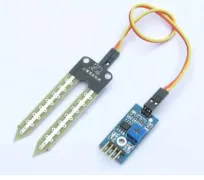
The soil humidity was detected using soil moisture sensor.the control unit was achieved using ATMega328 microcontroller based on arduino platform. The output was the control unit was used to control the irrigation system by switching it on and off depending on the soil moisture contents. If the moisture value obtained is less than the pre set value then the motor will be automatically turned ON. The change in moisture is proportional to the amount of current flowing through the soil.
Fig. 2 soil moisture sensor
Rain sensor
Fig. 3 rain sensor
Fig.3(a). Average Rain Status Vs Year
Motor status
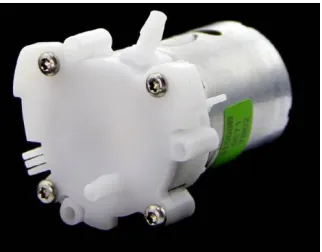
There are two motors connect to the system, motor 1 is supply the water to farming land when moisture level is less automatically motor on. When moisture level is high the motor automatically off. The motor 1 is dependents on the soil sensor. The motor 2 is dependents on the rain status. If rain level is high the motor 2 suck the water from the land, that water stored in pond. It will more helpful to future purpose.
Connect to the server
Every data stored in particular link. This data use full to future purpose to predict the environmental change. Every modules having the some set of data that data stored in the internet. Every one view the data from current status of the system. Internet is must required to connect the local data.
RESULTS AND DISCUSSION
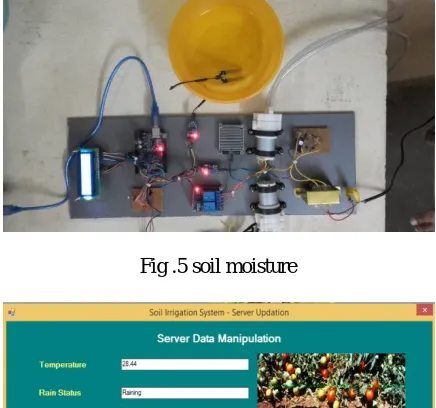
Moisture sensor reading the soil moisture value and display it in the serial monitor
Fig .5 soil moisture
Fig .6 soil status
Display the rain status level
Fig .8 rain status
Display the motor status of the irrigation system
Fig 9.dc motor
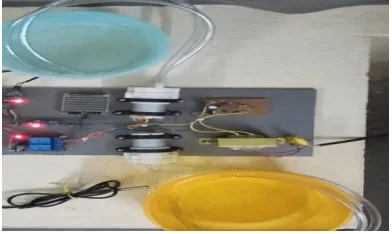
When rain will occur pump 1 is ON
Otherwise pump 2 is ON
Fig .11 Pump 2status
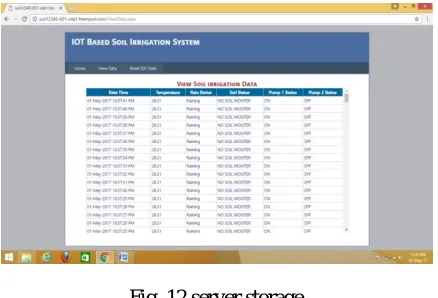
Connect through on internet every data stored in server management
Fig .12 server storage
IV.CONCLUSION
The system that can help in an automated irrigation system will analyze the moisture level of the ground. The grounded sensors all around the farming land will be supplied. Simultaneously configured an automated approach for the water tanker to be filled when it is empty and system will turn off during rainfall. It will overcome the human machine technique and will avoid the over irrigation and under irrigation. Future work in addition to moisture level of ground, nature of crop can also be considered for decision making.
REFERENCES
[1] Junfeng dai, Yuanlai cui, Xueliang cai, larry C.down, yuhui shang.Influence of water management on the water cycle in a small watershed irrigation system based on a distributed hydrologic model. Agriculture water management (2016).
[2] Joel reyes-cabrera, Lincoln zotarelli, micheal D.Dukes, Diane L.Rowland, steven A.Sargent.soil moisture distribution under drip irrigation and seepage for potato production.agriculture water management 169(2016) 183-192.
[3] Sandra cesari de maria, Michele rienzer, Arianna facchi, enrico Antonio chiaradia, marco romani, Claudio gandolfi.water balance implications of switching from continuous submergence to flush irrigation in a rice-growing district. Agriculture water management 171(2016) 108-119.
[4] argenis izquiel, rocio Ballesteros, joes M.tarjuelo, Miguel a. Moreno.optimal reservoir sizing in on-demand irrigation networks: application to a collective drip irrigation network in spain. Biosystem engineering 147 (2016) 67-80.
[5] H. Navarro-hellin, J. Martinez-del-Rincon, R. domingo-miguel, F.soto-valles,R.torres-sanchez.A decision support system for managing irrigation in agriculture. Computer and electronics in agriculture 124 (2016) 121-131.
[8] Adeloye, A.J., Rustum, R., Kariyama, I.D.,2012. Neural computing modelling of the reference crop evapotranspiration. Environ. Model. Softw. 29, 61–73.
[9] Daniel k.Fisher Hirut kebede 2010, “ A low-cost microcontroller-based system to monitor crop temperature and water status ” computers and electronics in agriculture 74 168-173.