A Survey on Interactive Virtual Reality for
Android Mobile Devices
Ankit Shah1, Bhavdeep Singh1, Sumit Kamble1, Aniket Tikotkar1, Nalini Mhetre2
B.E Student, Dept. of Computer Engineering, Smt. Kashibai Navale College of Engineering, Pune, India1
Assistant Professor, Dept. of Computer Engineering, Smt. KashibaiNavale College of Engineering, Pune, India2
ABSTRACT: Virtual reality (VR) has gained immense popularity among tech enthusiasts ever since it became possible to use smartphones to experience it. Most VR headsets available today have two lenses, and a slot provided to mount a smartphone in front of them. However, in all of these products, the only way to interact with the VR interface is with head movements. This limits the level of interactivity and control that such a system can have. This project aims to address this issue by using a second smartphone as a handheld controller. The secondary smartphone would capture hand movements using its accelerometer and relay this data to the head mounted smartphone over a WIFI or Bluetooth channel. This way, it would become possible to incorporate hand gestures as a form of input in the VR interface.
KEYWORDS: Virtual reality, Head Mounted Display, Haptic Technology. I. INTRODUCTION
Virtual Reality (VR) is a technology that uses a combination of special software and hardware to create a realistic 3D environment. It uses devices such as Head Mounted Displays (HMD), motion sensors, cameras and speakers to make the user feel as if he/she is physically present in that environment and can interact with objects as if they physically exist.
VR has changed from very basic 2D rendered static environment to fully immersive interactive 3D environments. The Virtual Environment (VE) creates a sensory environment for the user which includes sight, hearing and different sensory experiences. HMDs take the form of a screen in front of the user's eyes and make them look at the VE. The VE is generally rendered with the help of a powerful processor and the HMDs are connected to a computer. Haptic feedbacks are an important part of an interaction medium with the VE. Haptic technology has taken different forms over the time like sensors, gesture recognition, remote gamepad etc.
VR in the present scenario either is a high end product which uses multiple costly sensors and cameras to generate a virtual environment or it lies on the lower end with really basic 2D interface without any interaction. Most of the immersive VR systems require a full-fledged computer to work. Mobile VR, on the other hand suffers from a lack of interactivity. Also, mobile devices have limited memory and lesser processing power and that poses a challenge in our study, haptic technology to interact between two devices requires complicated processing and presents a latency problem while relaying the haptics signal over the two devices. Designing a system that renders the VE on the processing power of a mobile device while interacting with another device in real-time requires high optimization and elegant design.
In this paper, we propose a design for a system that gives the user freedom to interact with the VE. We initially survey the previous work and then provide the conceptual design of our system. We then discuss the proposed plan of implementing the system.
II. LITERATURE SURVEY
There are three meanings for being virtual: 1) being in fact, acting as what is described; 2) something assumed and imagined, which does not or is not always in accord with facts; 3) potential, possible. The meaning of reality refers to something which accords with a real object and condition [2]. VR creates an immersive environment with the help of various techniques. The major one that is mostly used is by the way of image processing and image rendering. The image processing method involves ways of manipulating an image to create such an immersive virtual environment. The technology of image mosaic based rendering of a virtual environment involves image pretreatment technology (image noise removal and restoration), image feature detection technology, image matching technology, and image fusion technology [2]. VR simulates physical presence in the virtual world and therefore interaction helps in creating a better environment in achieving the goal of VR. A 3D real-time interactive VR system has been implemented many times in the past with varying accuracy and results [3], [4].
There are many applications of VR that can aid in the development of various domains of society and science [7]. The interaction method of VR technology and biological characteristic, at the same time, is a tool to study nature [5]. A major field in which VR can immensely change the dynamics of the process is in the education field. Education field has been changing to include various developments in science to better the process of teaching and VR technology can provide a 3D interactive environment and offer visual display, rather that the abstract and conceptual cognition [8].
A VR system without interaction can only simulate a simple sight and does not create a fully immersive environment. Therefore, it is highly essential that any VR system in the future include interactivity with the virtual environment. Haptic interaction significantly augments our experience with a computer and in cyber worlds in particular. However, haptic interaction requires the content creators to make physical or haptic models of the virtual objects while it is not always possible or feasible, especially when it comes to using real images or videos as elements of interaction [6]. Haptic interaction can be achieved via image-driven rendering or sensor technology or through any other signal input [6], [9], [10], [11]. There are various techniques that can be used for achieving haptic interaction. The one that will be used in this system will be sensor technology with an accelerometer on a mobile device. Many algorithms are present to achieve this like Hidden Markov Models (HMM), Artificial Neural Networks (ANN), Naive Bayes Classification etc. These algorithms give high accuracy while using little processing power and therefore are ideal for a mobile device [9], [10].
There will be two devices that will be used in this system. The Primary Device (PD) will be used as the VR system while the Secondary Device(SD) will be used for establishing a haptic interaction system that will be used for sending signals in real-time in the form of data packets using secure Bluetooth technology [12] or over the Wi-Fi channel.
III. SYSTEM DESIGN
A. Basic Architecture:
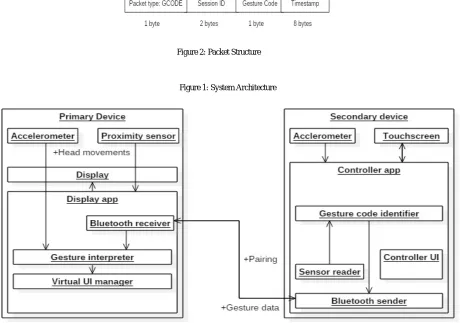
The proposed system has two devices- the primary device, which will be inside the VR headset, and the secondary device, which will be in the user’s hand. On the primary device, the application will display the VR interface. It will fetch readings from the device’s accelerometer to detect head movements, and also listen for gesture code packets arriving on the Bluetooth receiver. Based on the data gathered from these two sources, the application will show UI changes to the user.
On the secondary device, the same application will run in controller mode, wherein it will display a basic controller interface. It will detect gestures performed on the touch screen as well as in the air i.e. by moving the device itself. The accelerometer on this device will be used to detect the movement of the device and to identify the gestures. Any gestures identified by the application will be sent to the primary device over a secure Bluetooth RFCOMM channel in the form of numeric codes.
B. Components of Display Application:
Sensor reader: This module will continuously fetch accelerometer data at a rate between 20Hz-30Hz. It will notify the gesture code identifier whenever there is a change in the readings.
Controller UI: It will provide touch controls as well as haptic feedback.
Bluetooth sender: This module will wait for gestures to be identified by the gesture code identifier. As soon as a gesture is identified, it will send its corresponding numeric code over a Bluetooth socket to the primary device.
C. Interaction And Communication Protocol:
Each supported gesture will have an associated numeric code to uniquely identify it. For everyidentified gesture, the controller application will send a gesture packet to the primary device. The structure of the gesture packet is shown in the figure 2.
D. Packet Fields:
Packet type: The type of the packet- GCODE or MISC (Always GCODE for gesture packets)
Session ID: The 16-bit unique identifier of the current session. Gesture Code: The numeric code of the identified gesture. Timestamp: The time when the gesture was generated.
Figure 2: Packet Structure
IV. INTERACTION BETWEEN PRIMARY AND SECONDARY DEVICE
Bluetooth communication between the primary device and the secondary device will occur in two phases.
A. Pairing Phase:
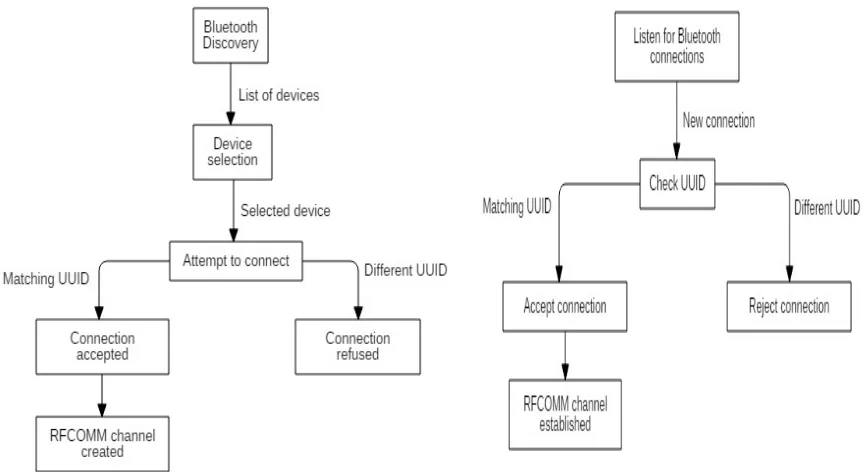
In this phase, the secondary device will perform Bluetooth discovery. Once all nearby devices have been found, the user will be presented with a choice to select any one of these devices. On selecting a device, the application will attempt to connect to that device over a Bluetooth Socket via the Bluetooth Serial Port Profile (SPP), i.e. it will behave as a client. Communication between the devices will proceed only if they both have matching UUID strings. This is a security feature to prevent unauthorized communication with other devices. The UUID will be unique to that specific version of the application i.e. every version of the software will have a different UUID. This will prevent communication between different versions of the application and ensure that the UUID, if discovered, will not compromise the security of the application forever.
B. Gesture Phase:
If both the devices have matching UUIDs, the primary device will accept the connection from the secondary device and an RFCOMM channel will be established between the two. All the data exchanged over this channel will be encrypted. As soon as the channel is established, the controller application will start analyzing the sensor readings and touch input to detect gestures. The primary device, on the other hand, will wait for gesture data to arrive on the Bluetooth receiver from the secondary device.
GESTURE RECOGNITION
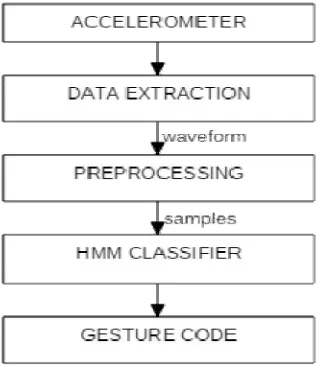
In our proposed system, discrete HMM will be programmed for the purpose of classifying the user gestures. The accelerometer will record the change in orientation according to the gesture in 3D. This will generate a waveform. This waveform will contain a lot of noise due to various factors such as imperfect movement, discrepancy in read data. The waveform will not be normalized due to the varying intensity throughout the motion. Therefore, a preprocessing step is necessary.
Figure 6: Gesture Recognition Model
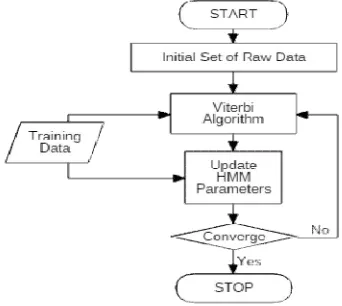
After the data is extracted, a pre-processing step is deployed which removes noise and normalizes the data. Short Fourier transform is applied on the waveform and vector quantization creates discrete samples of the waveform as we are using discrete HMM for classification. There needs to be a strong pre-recorded gesture library which is trained before deployment of the product. The library contains a set of indexed clusters that will have quantized samples corresponding to a gesture. This classification is done by the use of k-medoids clustering or k-means clustering. After the samples are generated in the pre-processing step, Baum-Welch algorithm is used to estimate the states and the maximum probability, based on the pre-recorded gesture library, that the given sequence follows the estimated states.Viterbi Algorithm is used to find the most likely sequence for the estimated states and the evidence. The HMM
parameters are then updated until they do not converge. The classification is done on the basis of the closeness of the current model with a gesture that is in the gesture library.
Figure 7: Classification of Gestures
An HMM can be formulized as
λ = {N, M, π, A, B}
N is the state set,
M is the observation value set,
π is the probability vector of initial states,
A is the state transition probability distribution matrix, B is the observation symbol probability distribution matrix.
The identified gesture is then packaged by the interaction control protocol and transmitted to the PD over the Bluetooth channel.
V. PROPOSED ALGORITHM
The same application will run on both the devices, but it will perform different functions as explained below.
A. Primary Device (Inside HMD) Step 1: Start Bluetooth service. Step 2: Wait for controller to connect. Step 3: Verify protocol version.
If (protocol version matches) Go to step 4. Else
Go to step 8.
Step 4: Start gesture packet reception thread. Step 5: Render the virtual environment. Step 6: While controller is connected, do: 1. Read packet from Bluetooth channel. 2. Identify type of packet.
3. If ( packet is valid )
B. Secondary Device (Handheld Device) Step 1: Start Bluetooth service and initialize sensors. Step 2: Perform Bluetooth discovery.
Step 3: Attempt to connect to the device selected by the user. Step 4: Verify protocol version.
If (protocol version matches) Go to step 5. Else
Go to Step 7
Step 5: Start touch and motion gesture identification threads. Step 6: While the primary device is connected, do:
1. Identify gesture. 2. If (gesture is valid) a. Create gesture packet. b. Send packet to PD.
Step 7: Go to step 2. Step 8: Stop.
VI. CONCLUSION AND DISCUSSION
Our proposed system aims to provide an interactive VR experience with the help of gesture recognition. Most of the work that has been done in this field previously has concentrated on enhancing the VE, ignoring either the interaction facet or the efficient use of processing power. The work that is being carried out contemporarily is focusing on high graphics with high processing power. These systems are costly too. We aim to provide an experience that uses minimal smartphone technology and still be able to facilitate the user with an interactive platform.
REFERENCES
1. Zhao QinPing, Sci China. "A survey on virtual reality", Ser F-InfSci, Mar. 2009, vol. 52, no. 3, pp. 348-400.
2. Ning-Ning Zhou, Yu-Long Deng. "Virtual Reality: A State-of-the-Art Survey", Internatinal Journal of Automation and Computing, 6(4), November 2009, pp. 319-325.
3. Yue Liu, Wenhui Zhang. "3D Interactive Virtual Reality System Based On Wiimote Stereo Structure", Computational Intelligence and Design, 28-29 October 2013.
4. Hongbin DENG, Yihua XU, Li WANG. "A Real-time Virtual Environment Rendering System", Artificial Reality and Telexistence-Workshops, February 2007.
5. Wang Ziqiang, Li Yuanzhou , Chen Manqing, Zhang Zhe, Yang Xiang. "Future Applications of Virtual Reality Technology Outlook", 2011 International Conference of Information Technology, Computer Engineering and Management Sciences.
6. ShahzadRasool and Alexei Sourin. "Image-driven Haptic Rendering in Virtual Environments", 2013 International Conference on Cyberworlds. 7. Zou Xiang-jun, Sun Jian and He Han-wu. “The Development and Prospect of Virtual Reality Technology”, System Simulation Academic
Journal, vol. 16, 2004.
8. Kai Zhang, Sai-Jun Liu. "The Application of Virtual Reality Technology in Physical Education Teaching and Training", IEEE conference 2016. 9. Prekopcsak, Zoltan (2008). “Accelerometer based real-time gesture recognition”. In Proceedings of the 12th International Student Conference
on Electrical Engineering, Prague, Czech Republic.
10. GerritNiezen, Gerhard P. Hancke. "Evaluating and optimising accelerometer-based gesture recognition techniques for mobile devices", IEEE AFRICON 2009.
11. Shenchang Eric Chen. "QuickTime VR – An Image-Based Approach to Virtual Environment Navigation". 1995