IJCSMC, Vol. 9, Issue. 1, January 2020, pg.132 – 136
DENSITY BASED TRAFFIC
CONTROL USING IoT
1Mohan Raj A
AP/CSE, Department of CSE, VSB College of Engineering, Technical Campus, Coimbatore, India [email protected]
2Gayathri K; 2Navidharshini G; 2Renita Praisy S; 2Srimathi W
UG Scholar, Department of CSE, VSB College of Engineering, Technical Campus, Coimbatore, India[email protected], [email protected], [email protected], [email protected]
Abstract- With the rapid development of road infrastructure, the volume of the vehicle on the road network increases which leads to traffic Congestion. The exact situation exists in the Coimbatore cities. Traffic congestions are amongst the top list of the problems faced in Muscat and other cities around Coimbatore. This is mainly caused due to the rapid surprise in the number of vehicles in a short period. To overcome such an impact of traffic congestions, it is required to develop an IoT Based traffic control system. The proposed system would be based on the measurement of the actual traffic density on the road. This would be achieved using real-time video and image processing techniques. Wherein the images captured and are stored in the server, which will be compared with the real-time image captured via camera to identify the density. The theme is to control the traffic by determining the traffic density on each side of the four roads and enabling a controlling option of the traffic signal to the user through a software application.
I. INTRODUCTION
Increasing the number of populations hence, leading to the rapid usage of vehicles, therefore, increasing the traffic level in different areas [1]. Road congestion is the main cause for slower speed, longer waiting time, accidents and frustration.
Therefore, to help to overcome such issue, we propose the initiation of Density-based Traffic Light using Raspberry Pi 3 to reduce traffic through signal control. One major cause identified is traffic congestion. The traffic congestion trend needs to be monitored closely to ensure the development of infrastructure is carried out effectively. In addition to that, traffic congestion has been associated with longer waiting times, delays in travel time and may cause traffic violations. The routine Traffic light signals are set at certain timing and are not able to recognize road density. With the development of technology, the systems are turning smarts and more intelligent. The possibilities of remote controlling and monitoring is not a difficult task compared to a couple of years back.
Figure:- 1 Traffic congestion.
II. REVIEW OF LITERATURE
Many types of research try to find solutions for transportation and traffic management using different approaches using sensors, artificial intelligence techniques, wireless sensor networks and digital image processing.
In [3] an array of IR sensors is deployed to count the number of vehicles on each lane of the road and record the statistics on the cloud using Bluetooth connection, traffic density information is fed to clustering algorithms based on KNN algorithm to determine expected required timing of traffic lights. Using short-range communication technology such as Bluetooth requires that the access points close to the sensor array to achieve data transfer and thus increase the complexity of the system, also using the clustering algorithm based on KNN leads to increased overhead in the cloud computing system, which may result in a delay in decision- making and modification of traffic lights timing, which will reflect negatively on traffic.
Another proposal for IoT based Traffic Signaling system using ultrasonic sensors has been developed in [4] where ultrasonic sensors deployed at every 50 meters of road to capture the traffic density and communicate to Arduino to control the traffic signals accordingly, density information is transmitted via Wi-Fi to Raspberry Pi 3 where analysis made on a heavy congestion and less traffic with date and time and the same communicated to the web page of cloud which can be viewed by the Traffic police authorities for further analysis.
This approach requires a huge number of sensors distributed closely which is not a feasible solution and managing such number of sensors is not quite easy, also using ultrasonic sensors, which measure the distance mainly, for detecting objects is a waste of resources. To reduce the risk of traffic congestion in emergencies, especially ambulances [5] proposed an embedded system fixed in ambulance consists of Arduino Uno, GPS Arduino shield for tracking the ambulance and GSM Arduino shield to update ambulance location on the web database. System tracks the path of ambulance and controls the traffic lights to ensure that road junctions are free of congestion, making it easier for ambulances to pass smoothly and without delay, but this proposal does not take into account the traffic density and the time required to reach to the traffic signal, which may lead to early road evacuation in the case of low density and therefore error in the timing of the signals, leading to increase the density in other directions or delayed evacuation in cases high density. Image processing techniques and “ThingSpeak” IoT platform are utilized in [6] to calculate traffic density, this system deploys IP webcam on the traffic junctions, capturing video and broadcasting it to the server where video and image processing techniques like segmentation and features extraction algorithms are used to get a brief view related to traffic condition, the total number of vehicles will be calculated and presence of the animal on the road will be detected by image processing from the camera. MATLAB programming environment is used for developing the proposed system. The analysis of traffic monitoring would be done using ThingSpeak Channel.
III. DESIGN OF PROPOSED APPROACH
Fig 2. System block diagram.
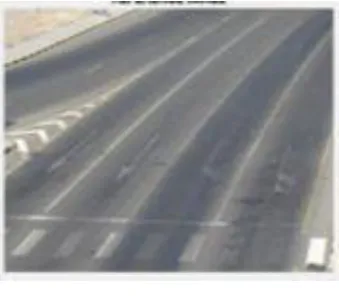
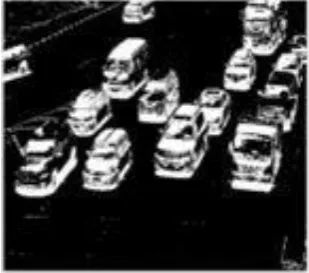
The camera continuously shoots the traffic junction and grabs real-time image as shown in Figure 4. Using digital image processing techniques, Raspberry Pi 3 calculates the difference frame by comparing the real-time image with the reference image shown in Figure 5. Since color information is not important in the process of determining the density of traffic, it is preferable to convert the different frame of the images to grayscale as shown in figure 6. The grayscale image is then converted to a 2 color black white binary image show in figure 7.
Fig. 3. reference image.
Fig. 4. Real time image.
Fig. 5. Difference image.
Fig. 6. Gray scale image.
Density information is uploaded to M2x IoT cloud Platform (Server) using a Wi-Fi connection, this information is accessible by desktop Java application designed to monitor and control the traffic lights by the authoritative of the process. Control commands are uploaded to the cloud platform through the desktop application to be collected by the embedded system and connected via raspberry pi 3to the control the unit consists of a time relay that controls traffic signal times.
•Controlling of GPIO pins in Raspberry pi 3
•Capturing the real-time image using Raspberry Pi 3.
•Processing the real-time image to calculate the traffic density.
•Sending and retrieving data from Raspberry pi 3 to server, to achieve synchronization with the server.
IV. CONCLUSION
The proposed method focused on overcoming the traffic congestion scenarios experienced. The system would primarily focus on the image captured using the camera. The captured image would be cross-verified with a preset image loaded in the server to identify the density. Based on the density, the traffic movements are the trigger for the junctions. This reduces the overall waiting time and results in smoother traffic flow. The system would function automatically based on the collection of density images send from the location to the server. Future Recommendation: Many upgrades on the system are foreseen with more customization that could be adapted for various applications where remote monitoring and controlling is required. The system can have more integration like incident detection and failure notification etc. With the development of advanced technology, the platform can be used to integrate various devices like parking machines, Variable Message Signs, Traffic Count Stations, and City Surveillance Cameras, etc. Giving better control and monitoring on various devices remotely. This would lead the city to have an infrastructure which is smart, and technology-driven.
REFERENCES
[1].Dr.Brenner, “Consultant for Intelligent Transportation System Studies”, Muscat, 2015.
[2].Divya Vani P., Aruna. K. and Ragvendra Rao K., ”Internet of Things-A Practical Approach to Certain Cloud Services using CC3200,” Internet of Things-A Practical Approach to Certain Cloud Services using CC3200-Volume 117 No. 10 , 2017.
[3].S. Kumar Janahan, M. R.M. Veeramanickam, S. Arun, K. Narayanan, R.Anandan and S. Javed Parvez, [4].“IoT based smart traffic signal monitoring system using vehicles counts”, International Journal of
Engineering and Technology, vol. 7, no. 221, p. 309, 2018.
[5].Ashok P.V, SivaSankari. S and V. M. S. Sankaranarayanan, “IoT Based Traffic Signalling System”, International Journal of Applied Engineering Research ISSN 0973-4562 Volume 12, Issue 19 (2017) pp. 8264-8269.
[6].Srinivasan, Y. Priyadharshini Rajesh, S. Yuvaraj and M. Manigandan, “Smart traffic control with ambulance detection”, IOP Conference Series: Materials Science and Engineering, vol. 402, p. 012015, 2018.
[7].R. P. Nimkar and C. N. Deshmukh, “Traffic Density Monitoring And Cattle Menace Alert System Using IoT”, International Journal of Research in Engineering and Technology, pp. 96-104, 2018.
[8].K. Ramachandran and R. Priya, “IoT Based Traffic Management System and Congestion Control”, International Consortium of Scientists and Researchers, Volume 3, Issue 1, Dec, 2017.