American
Society of Range Management
The American Society of Range Management was created in 1947 to foster advancement in the science and art of grazing land management, to promote progress in the conservation and greatest sustained use of forage and soil resources, to stimu- late discussion and understanding of scientific and practical range and pasture problems, to provide a medium for the exchange of ideas and facts among society members and with
allied technologists, and to encourage professional improvement of its members.
Persons shall be eligible for membership who are interested in or engaged in practicing range or pasture management or animal husbandry; administering grazing lands; or teaching, or conducting research, or engaged in extension activities in range or pasture management or related subjects.
T
he JOURNAL OF RANGE MAN- AGEMENT , published bi-monthly, is the official organ of the American Society of Range Management. The Society, however. assumes no responsibility for the statements and opinions expressed by authors and contributors.Off ice, Executive Secretary. Address all inquiries and correspondence including memberships, renewals, replacements of JOURNALS, etc., to Executive Secretary, American Society of Range Management, P.O. BOX 5041, Portland 13, Oregon. Dues. Membership dues should be sent to the Executive Secretary. The dues are $8.00 per year’ including a subscrip- tion to the JOURNAL OF RANGE MAN- AGEMENT. Dues for student members are $4.00 per year, including the JOURNAL. All subscriptions mailed outside the North American continent and insular possessions of the U. S. are $8.50 per year. Subscrip- tions must be paid in advance. Remit by draft or check on U. S. banks in U. S. funds. Reprinting. The reprinting of articles or parts of articles published in the JOURNAL OF RANGE MANAGEMENT is author- ized on the express condition that full credit be given the JOURNAL and the author. The date of original publication must be shown with the credit line.
Posf Office Enfry. Second-class post- age paid at Portland, Oregon, and at ad- ditional offices.
Change of Address. Notices of change of address should be received by the Execu- tive Secretary one month before the date of issue on which the change is to take effect. Both the new and old addresses should be sent to the Executive Secretary, American Society of Range Management, P.O. Box 5041, Portland 13, Oregon.
Printers. The Nebraska Farmer Company, 1428 P Street, Lincoln, Nebraska.
Copyright 1960 by the American Society of Range Management.
JOURNAL OF RANGE MANAGEMENT
EDITOR E. J. WOOLFOLK
Pacific Southwest Forest & Range Exp. Sta. Berkeley 1, California
EDITORIAL BOARD 195860
ARNOLD HEERWAGEN W. R. HANSON
Soil Conservation Service Eastern Rockies Forest 321 New Customs Building Conservation Board
Denver 2, Colorado Calgary, Alberta 1959-61
GEORGE E. GLENDENING U.S. Forest Service
Tempe, Arizona
DONALD R. CORNELIUS JACK R. HARLAN Agricultural Research Service Oklahoma State University
P. 0. Box 245 Stillwater, Oklahoma Berkeley 1, California
1960-62 F. A. BRANSON U.S. Geological Survey
Federal Center Denver, Colorado
L. T. BURCHAM LYNN RADER
California Division of Forestry University of California Sacramento, California Berkeley, California
OFFICERS OF THE SOCIETY President:
FRED H. KENNEDY U. S. Forest Service Albuquerque, N. Mex.
President Elect: Executive Secretary:
V. A. YOUNG JOHN G. CLOUSTON
733 West 2nd St. P. 0. Box 3041 Mesa, Arizona Portland 13, Oregon
BOARD OF DIRECTORS 1958-60
JAMES L. FINLEY MELVIN S. MORRIS P. 0. Box 136 University of Montana Gilbert, Arizona Missoula, Montana
1959-61
JOHN CHOHLIS C. H. MCKINNON
Western Livestock Journal LK Ranches, Ltd. Sacramento, California Calgary, Alberta
1960-62
KARL G. PARKER GERALD W. THOMAS Montana State College Texas Technological College
Bozeman, Montana Lubbock, Texas Past President:
DONALD F. HERVEY Colorado State University
Fort Collins, Colorado
SUMMER FIELD MEETING
CUSTER, SOUTH DAKOTA
JULY 14-16, 1960
Board of Directors’ meeting on July 14 is open to the membership.
Field fours for the 15th and 16th will be developed by the South
Dakota Section. The change in date from that announced in the
March Journal was made to avoid conflict with the Gold Discovery
IN THIS
ISSUE
A Lysimefer Study of Sulfur Fertilization of an Annual-Range Soil
Cyrus M. McKeZl and William A. Williams 113 A Range Man’s Library _________.__________._~____________ __.__ _.___..______.._ _.._ ___ .__._ __ ___._ J. C. Dykes 118 The Rangeland’s Northern Frontier _______ _..._ . . . ..W. R. Hanson 124 College Facilifies and Enrollments in Range Management
Dillard H. Gates 128 Preliminary Investigations of Harvester Ants on Southern Idaho Rangelands
Lee A. Sharp and William F. Barr 131 Historical Highlights of Grazing in the Central and Southern Great Plains
B. W. Allred 135 The Effect of a Leaf Feeding Beetle on Big Sagebrush in British Columbia
William L. Pringle 139 Economics of Improvement of Western Grazing Land
Douglas D. Caton, Chester 0. McCorkZe, and M. L. Upchurch 143
Technical Notes
A Technique for Studying Forage Removal by Game and Livestock
Arthur D. Smith and Arthur M. Sheets, Jr. 151
A Method for Random Location of Sample Units in Range Investigations George M. Van Dyne 152 Ocular Point Frame _..______ .._._. _ _.._ _._____._._ _..._._ _ ._.._ _____._ . . . _ ..__. -Frank W. Stanton 153 Book Reviews: Soil Conservation (Kohnke and Bertrand ); The National
Forests (Carhart); Grass Productivity (Voison) . ..__. _ .._. _ .._._ _ _.__ ___.__.__________ __._. 154 Current Literature ____. _.._ ___. ___ .______ ___._________._ ______..___._... _._._ .._.___. ____ __.__ ____ _____ ___ .____ ___________.___ 158 With fhe Sections _____ _.____ __.__.._.... _._ . .._..._..._. _ ._.___. _ __._.___.__..____ _.____ _____. _ ._...._.___ _ ______ _ _______ ___ 157 News and Notes _.__ _________ ._____. ___._ .__._. _ ._._____.._...____._... _ .__.._.__._.____. _.._ . .._ ___ ___________ ____ _____.______ _.. 159 Society Business _____.._._._..___.._..._... _ __...._..._..._.... _ ____ __ _.__.______ _ ___._____ ___ 161
Cover Photo- “Along the Owyhee Breaks”
Journal of
Volume 13, Number 3 May, 1960RANGE
MANAGEMENT
A Lysimeter Study of Sulfur Fertilization
of an Annual-Range Soil1
Deficiency of the plant nu- trient sulfur is widespread on California soils. The majority of 242 responding sites recorded in a recent sulfur deficiency survey are on range or dry-farmed land (Martin, 1958). The Leguminosae are the group of plants that re- spond to sulfur fertilization most frequently. Several authors have pointed out the benefits from supplying additional sulfur where deficiencies occur (Con- rad, 1950; Bentley and Green, 1954; Arkley, et al., 1955 and Walker, 1957). The economics of the practice appear promising, because carriers of the sulfur are relatively inexpensive. How- ever, choosing a rate and fre- quency of sulfur fertilization and source of sulfur that will maxi- mize returns is a problem. The solution depends on detailed knowledge of such factors as the availability of sulfur in the soil, sulfur supplied by precipitation and air contact, leaching losses, erosion losses, and the differ- ential uptake by various plant
CYRUS M. McKELL AND WILLIAM A. WILLIAMS Plant Physiologist, Crops Research Division, Agricul- tural Research Service, U. S. Department of Agriculture, and Associate Professor of Agronomy, Department of Agronomy, University of California, Davis.
1 Cooperative investigations of the Crops Research Division, Agricul- tural Research Service, U. S. De- partment of Agriculture, and the Department o j Agronomy, Univer- sity of California, Davis.
species. The first of a series of lysimeter investigations to study these factors in relation to the nutrition and production of a range legume was initiated at the San Joaquin Experimental Range’. Lysimetery was the technique chosen for studying these problems because sulfur leaches readily as the sulfate ion (Stauffer and Rust, 1954) and, therefore, study of the percolate was of prime interest. Several workers (Kohnke, et al., 1940; Harrold and Dreibelbis, 1951; Stauffer and Rust, 1954, and Dreibelbis and McGuinness,
1957) reviewed the literature on lysimeter construction and dis- cussed the advantages and prob- lems of lysimetery. The radio- isotope S”” was incorporated in the gypsum fertilizer so that the fate of applied sulfur could be distinguished from that of sulfur from natural sources.
Methods
The lysimeters used for this study are 74 inches in diameter with side walls 25.5 inches deep. Each contains an 8-inch deep conical bottom drained by a polyethylene pipe leading to a 5-gallon glass carboy (Fig. 1). Lysimeter interiors were painted with asphalturn paint. During February 1957 the lysi-
113
meters were installed on a hill- side terrace with rims extend- ing 2 inches above the ground surf ace.
A soil profile was reconsti- tuted in the tanks by stockpiling soil from 0 to 1 inch, 1 to 6 inches, 6 to 12, and 12 to 24 inches, and then placing this soil in the proper sequence in the lysimeters. The soil settled approximately 2 inches during the first spring and summer with essentially no later subsidence. The soil used in this study is Vista sandy loam, an upland soil derived from granitic parent material. The soil contains 75 percent sand, 17 percent silt and
FIGURE 1. Diagram of lysimeter construc-
114
8 percent clay and has a mean
bulk density of 1.43 gms/cc in the lysimeters. It was character- ized by analysis of the 6-12 inch depth in the lysimeters: pH 6.2; organic matter 0.61 percent; P 12.1 ppm; K 0.20 ppm; Ca 2.8 ppm; Na 0.50 ppm; Mg 0.35 ppm; total N 0.029 percent; conduc- tivity 0.40 mmhos/cm, and cation exchange capacity 4.16 me/100 g. The Vista series is a permeable soil with depth of 21 to 36 inches and occurs extensively in the lo- to 20-inch rainfall zone of the Sierra Nevada foothills.In October 28, 1957 the follow- ing treatments were randomized among the lysimeters: Check, 100, 200, and 300 pounds gypsum per acre. There were three check lysimeters, and two of each gypsum rate. The gypsum used at the lOO- and 30Oqoound rates was labeled with approx- imately 2.5 mc. S”” activity per lysimeter and was broadcast as fine powder. All the lysimeters and the adjacent area were seeded with inoculated rose clover (Trifolium hirtum All.) at a rate of 50 pounds per acre and covered with l/4 inch of soil previously removed from the surface. A high rate of seeding was used to insure a complete stand of plants. As a precaution- ary measure against rodent and bird damage and contamination of the surrounding area with the radioisotope, each lysimeter was provided with a wire en- closure.
Percolate and rain water were collected during each storm pe- riod, and sulfur was precipitated as barium sulfate and deter- mined gravimetrically (A.O.A.C., 1955). Rain was caught in glazed pots which were covered with aluminum foil during dry pe- riods. The clover was harvested on May 9, 1958, at the full-bloom stage for yield determination. Clover samples were oxidized by the magnesium nitrate method (A.O.A.C., 1955) and sulfur de- termined (Johnson and Nishita,
McKELL AND WILLIAMS
1952). Radio-sulfur activity was determined on infinitely thick samples of barium sulfate (Hendricks, et al.) in a window- less gas flow counter. Smaller samples were corrected to infi- nite thickness from an appropri- ately determined calibration curve. Lead peroxide candles were exposed at the location to determine the sulfur dioxide content of the atmosphere (Alway, et al., 1937).
Soil samples were obtained from four depths (0 - 1, l-6, 6 - 12 and 12 - 24 inches) at the end of the growing season. These samples were extracted with Morgan’s reagent (sodium ace- tate in acetic acid, pH 4.8) and analyzed by the method de- scribed by Johnson and Nishita
(1952) for the microestimation of sulfur3.
Resulfs and Discussion As might be anticipated from knowledge of the solubility of calcium sulfate in the soil solu- tion (Vanoni and Conrad, 1942), the sulfur in gypsum is very susceptible to leaching loss when applied to a coarse-textured soil. In this experiment sulfate sul- fur4 was lost from all treated tanks at a rapid rate in the ini- tial percolates from early-winter rains (Fig. 2). The magnitude of
the loss was proportional to the amount of gypsum applied. As the rainy season progressed the rate of sulfur loss per unit of percolate gradually declined and towards the end of the season approached asymptotic values for all treatments. The curves in Figure 2 also show that roughly comparable amounts of sulfur between adjacent treatment levels were leached by the end of the 1957-58 season: 15.0 pounds per acre for the first 100 pound increment of gypsum ap- plied per acre, 18.5 pounds for the second increment, and 11.1 pounds for the third increment.
In view of this observation and because of the similarity in shape of the cumulative leached sulfur curves, Figure 3 was drawn. The cumulative amount
3 The authors wish to express sin- cere appreciation to J. E. Ruckman, S. S. Winans, and D. P. Ormrod, who helped in the collection of samples and the performance of chemical and radiological analyses. Preparation of radioactive jertil- izer by Fertilizer Investigations Research, ARS, USDA is also ap- preciated.
4 For simpZicit,a subsequent rejer- ences to sulfate sulfur in percolate will be designated as sulfur.
of sulfur lost by leaching was
plotted as a percent of the total
against the cumulative percolate
expressed as a percent of the
total percolate. The near equi-
valence of the curves for the
three rates of gypsum and also
the check treatment is striking.
Each treatment, including the
check, lost essentially the same
percentage of the total leached
sulfur with each increment of
percolate. The curves of Figure
3 indicate that the amount of
water passing through the soil
was sufficient to maintain maxi-
mum solubility. Figure 3 also
illustrates that the first 50 per-
cent of the percolate carried
down an average of 89.4 percent
of the total leachable sulfur for
all treatments. In 1957-58, a year
of exceedingly heavy rainfall
(31.8 inches), the first 50 percent
of the percolate resulted from
an amount of precipitation very
nearly equal to the annual mean
for the site (19.4 inches).
A large proportion of the sul-
fur applied in the gypsum was
lost in the percolate as indicated
by recovery of the radioisotope
S”“. 77.0 and 77.9 percent of the
sulfur applied, in the lOO- and
300-pound rates, respective‘ly,
were accounted for in the perco-
A LYSIMETER STUDY
115
late collections (Fig. 4). The
gypsum applied in the 200-pound
treatment was not labeled, but
there is no reason to expect that
its fate would differ appreciably
from the lOO- and 300-pound
treatments.
Recovered Sulfur: 60
1
I” plllnts in percolate 50 m percolate from C&O4The sulfur brought down in
rainfall was 21.4 pounds per acre
during the 1957-58 season, a
rather appreciable amount for
an agricultural area (Jordan, et
al., 1959). There was consider-
able variation in the sulfur con-
tent of rain from the season’s
storms (Table 1). Concentration
of sulfur in rain water ranged
from a low of 0.50 ppm to a
high of 4.70 pp. It was expected
that the sulfur concentration
would be high in the first fall
rains and then would decline as
sulfur in the air was washed
out by additional storms (Seay,
1957). However, the data indi-
cate that sulfur content of rain
was as high in the last storms
of the season as it was in the
first storms, and no particular
trend was evident.
jreotmenl: Check 100 gyp. 200 gyp. 300 qyp. Rain SULFUR SOURCE
FIGURE 4. Sulfur added in gypsum and rainwater and recovered in clover plants and percolate.
Lead peroxide candles at the
site did not show any appreciable
amounts of sulfur in the local
atmosphere; 100 sq. cm. of the
exposed surface of the candles
absorbed 0.50 + 0.11 mg. sulfur.
Using a conversion value of 22
percent (average of data from
Alway, et al., 1937) to relate the
surface absorption of the candles
to soil absorption, the amount of
sulfur absorbed from the atmos-
phere by the soil surface was al-
most negligible, 0.1 pound per
acre. Apparently
the sulfur
brought down in the rain was
Table 1. Sulfur contenf of rain- wafer collected af fhe San Joaquin Experimental Range Iysimefer site July 1, 1957 fo June 30, 1958.
FIGURE 3. Relative rate of loss of sulfur by leaching as influenced by the rate of gypsum application,
Collection interval
Rain (in.)
Sulfur content (ppm) 9/17 - 12/3 2.99 2.75
12/4 - 5 .54 .50
12/6 - 16 1.73 3.61
12/17 - 18 .54 3.25
12/19 - 22 .18 4.70
12/23 - l/9 .27 2.32
l/10 - 24 2.10 3.88
l/25 - 27 1.66 2.35
l/27 - 2/5 2.73 3.45
2/6 - 13 .68 1.32
2/14 - 19 1.30 .85
2/20 - 25 2.57 2.50
2/26 - 3/17 6.14 2.73
3/18 - 24 3.20 3.47
3/25 - 4/7 5.14 3.61
116 McKELL AND WILLIAMS
picked up in air masses some Table 3. Additions, losses, and apparent adsorption of sulfur by Vista sandy distance from the site. loam treated with gypsum.
Clover growth was stimulated by the gypsum applications. Yields of clover were significant- ly greater on the 200- and 300- pound treatments than on the check and lOO-pound treatments (Table 2). The increases in sul- fur content of the plant tissues were not significant. Often an increase in sulfur occurs when gypsum is applied to legumes growing on sulfur-deficient soils (Arkley, et al., 1955; Bentley, et
al.,
1955, and Walker, 1957). However, most of the leachable sulfur had been lost by the first week of March in this experi- ment. Rapid spring growth was initiated by the clover at ap- proximately this time, and as a result, high concentrations of sulfur were not available for luxury consumption during the period of rapid plant growth.Sulfur per acre (lbs.) from lysimeters treated with indicated gypsum per acre
Item 0
100 (lbs)
200 (lbs)
300 (lbs) Sulfur added from:
Gypsum Rain Air Seed
0.0 21.3 42.7 74.3
21.4 21.4 21.4 21.4
0.1 0.1 0.1 0.1
0.1 0.1 0.1 0.1
Total 21.6 42.9 64.3 85.9
_ - d
Sulfur lost in:
Percolate (gypsum) -16.4 -50.1
-47.7* Percolate (rain, air
and seed) -14.2 -12.8 - 8.7
Radioassay indicated that clover grown on the 100- and 300-pound treated lysimeters ob-
Crop removal
(gypsum) - 0.6 - 4.3
Crop removal (rain, - 6.0”
air and seed) - 2.5 - 1.3 - 3.2
Total -16.7 -31.1 -53.7 -66.3
Calculated sulfur absorption from:
Gypsum 4.3 9.9
10.6*
Rain, air and seed 4.9 7.5 9.7
Total 4.9 11.8 10.6 19.6
__ - * Non-labeled gvnsum used; thus source of sulfur not distinguishable. tained an average of 30.8 and _” _
57.4 Percent of the sulfur, re- from gypsum, rain water, air spectively, from gypsum, the
proportion increasing at the contact, and seed. The losses re- higher level of application. Re- sulted from leaching removal, the former being the and crop coverY of sulfur from applied greater in magnitude, by far. gYPsum bY
the ‘clover
amounted Calculation of the net change to a 2.8 and 6.7 percent, respec- shows that the soil adsorbedtively. more sulfur than it released in
A sulfur-balance sheet was all treatments. The net adsorp- constructed for each treatment tion varied from 4.9 pounds per using the data for additions to acre for the check up to 19.6 and losses from the soil (Table pounds per acre for the lysi- 3). Additions to the soil were meters receiving the 300-pound
Table 2. Yield and sulfur conienf of rose clover grown in lysimefers treated with various amounts of gypsum.
rate of gypsum. Ensminger (1954) demonstrated sulfur ad- sorption capacity up to as high as 411 ppm in a sandy loam under laboratory conditions. The sulfur adsorbed by the soil from the label gypsum amounted to 20.2 and 15.4 percent of the sul- fur applied in the lOO- and 300- pound rates, respectively. These data lend support to the con- clusion of Kramprath, et al. (1956) that the amount of sulfate adsorbed by soil is directly re- lated to the concentration of sul- fate in the applied solution. Be- cause of the overriding adsorp- tion effect there is no way to determine whether any sulfur was released from the native soil sulfur content.
Gypsum Clover
treatment yield
(lbs/A.) (lbs/A.)
0 2,480
100 1,351
200 4,433
300 5,357
LSD (5%) 3,025
Sulfur
in clover Clover
Clover obtained recovery Area’ sulfur from of S from cover content gypsum gypsum of clover
(%) (%) (%) (%)
0.10 ---___ ___- 62
.14 30.8 2.8 50
.ll ______ .___ 98
.14 57.4 6.7 96
N. S. __..__ ____ ____
Table 4. Effect of raie of gypsum a balance sheei check.
A LYSIMETER STUDY
application on soil adsorption of sulfur-
Sulfur per acre (lbs.) from lysimeters treated with indicated gypsum per acre
Sulfur source
0 100 200 300 Gypsum
(Check) Ibs. Ibs. lbs. mean Total S adsorbed
1958-59 (Table 3) Gypsum S adsorbed
1958-59*
Total S extracted by Morgan’s reagent Gypsum S extracted by
Morgan’s reagent *
4.9 11.8 10.6 19.6
._.. 6.9 5.7 14.7 9.1
37.5 49.7 41.9 48.8
__._ 12.2 4.4 11.3 9.3
* Values obtained by subtracting sulphur absorbed in amounts of sulphur absorbed in treated lysimeters.
check lysimeters from
petted that the contribution of sulfur from rainfall might be less in normal or subnormal rainfall years.
Chemical analysis of the soil at the end of the season showed an average increase of 9.3 pounds per acre of extractable sulfur in the treated lysimeters relative to the checks (Table 4). The increase can be attributed to the adsorption of added gypsum. The above value does not differ significantly from the average increase of 9.1 pounds per acre of sulfur adsorbed from the ap- plied gypsum, as calculated from the balance-sheet data by com- paring the amount of sulfur ad- sorbed in the treated lysimeters with that in the checks. The lack of close agreement among rates of applied gypsum is not surpris- ing since the differences in ex- tractable sulfur represent con- centration differences in the neighborhood of 1 ppm extract- able sulfur, which stretches the sensitive chemical method used to the lower limit of accuracy. However, these data serve as a worthwhile check on the bal- ance sheet results given in Table 3.
It may be concluded from the preceding discussion that in a wet year gypsum applied to cor- rect a sulfur deficiency may be subject to considerable leaching loss. A high rate of sulfur appli-
cation intended to last for sev- eral years could be lost as easily as a lower sulfur application rate intended for one year. Further study under less intense rainfall conditions is desirable.
Summary
A lysimeter study was initi- ated in the annual-range type to study the fate of sulfur applied in gypsum to an annual-legume, rose clover, on Vista sandy loam. The gypsum leached rapidly in a season of heavy rainfall. Sul- fur contributed by rainfall amounted to 21.4 pounds per acre, and sulfur adsorbed from the atmosphere contributed ap- proximately 0.1 pound per acre. Use of the radioisotope S”” per- mitted identification of fertilizer sulfur in the percolate. In the growing season following f ertil- ization 77.0 percent of the sulfur applied in the lOO-pound gypsum rate and 77.9 percent of the sul- fur applied in the 300-pound gypsum rate were accounted for in percolate collections.
Rose clover yield responded significantly to the higher levels of gypsum. The clover took up 30.8 and 57.4 percent of its tissue sulfur content from 100 and 300 pound applications, respectively.
LITERATURE CITED
ALWAY, F. J., A. W. MARSH, AND W. J. METHLEY. 1937. Sufficiency of atmospheric sulfur for maxi- mum crop needs. Soil Sci. Sot. Amer. Proc. 2: 229-238.
117
ARKLEY, R. J., W. N. HELPHENSTINE, AND W. A. WILLIAMS. 1955. Range- land forage almost trebled by seeding rose clover and use of sulfur-bearing fertilizers. Calif. Agric. 9 (8) : 15-16.
ASSOCIATION OF OFFICIAL AGRICUL- TURAL CHEMISTS. 1955. Official and tentative methods of analysis. Ed. 8, 1,008 pp. Washington.
BENTLEY, C. F., D. J. HOFF, AND D. B. SCOTT. 1955. Studies with radio- active sulphur II. Can. Jour. Agr. Sci. 35: 264-281.
BENTLEY, J. R. AND L. R. GREEN. 1954. Stimulation of native annual clovers through application of sul- fur on California foothill range. Jour. Range Mngt. 7:25-30. CONRAD, J. P. 1950. Sulfur fertiliza-
tion in California and some re- lated factors. Soil Sci. 70 (1) :43-54. DREIBELBIS, F. R. AND J. L. MCGUIN- NESS. 1957. Plant nutrient losses in lysimeter percolates. Agron. Jour. 49: 523-527.
ENSMINGER, L. E. 1954. Some factors affecting the adsorption of sul- fate by Alabama soils. Proc. Amer. Sot. Soil Sci. 18:259-264.
HARROLD, L. L., AND DREIBELBIS, F. R. 1951. Agricultural hydrology as evaluated by monolith lysimeters. U.S.D.A. Tech. Bul. 1050.
HENDRICKS, R. H., L. C. BRYNER, M. D. THOMAS, AND J. 0. IVIE. 1943. Measurement of the activity of radiosulfur in barium sulfate. Jour. Phys. Chem. 47: 469-473. JOHNSON, C. M., AND H. NISHITA. 1952.
Microestimation of sulfur in plant materials, soils, and irrigation water. Anal. Chem. 24: 736-742. JORDAN, H. V., C. E. BARDSLEY, JR.,
L. E. ENSMINGER, AND J. A. LUTZ, JR. 1959. Sulfur content of rain- water and atmosphere in southern states as related to crop needs. U.S.D.A. Tech. Bul. 1196.
KOHNKE, HELMUT, F. R. DREIBELBIS, AND J. M. DAVIDSON. 1940. A sur- vey and discussion of lysimeters and bibliography on their con- struction and performance. U.S.D.A. Misc. publ. 372:1-67. KRAMPRATH, E. J., W. L. NELSON, AND
J. W. FITTS. 1956. The effect of pH, sulfate and phosphate con- centrations on the adsorption of sulfate by soils. Soil Sci. Sot. Amer. Proc. 20: 463-466.
MARTIN, W. E. 1958. Sulfur defi- ciency widespread. Calif. Agric. 12(11):10-12.
SEAY, WILLIAM A. 1957. Sulfur con- tained in precipitation in Ken- tucky. Agron. Jour. 49: 453-454. STAUFFER, R. S. AND R. H. RUST. 1954.
A Range Man’s Library
J. C. DYKESAssistant Administrator for Field Services, Soil Con- servation Service, U. S. Department of Agriculture, Washington 25, D. C.
As an amateur range man I
should not attempt to discuss the
technical working tools of the
profession. I would soon be out
of my depth. On the other hand
I should not write as an es-
tablished collector of the litera-
ture of the range. A collector has
been defined as one who tries to
accumulate all that has been
written on a subject-the worthy
and the unworthy. Certainly it
would be out of place to urge
that you buy the unworthy and
become an all out collector of
range books. The late Charlie
Everitt, b e 1 o v e d Americana
dealer of New York City, tells
this tale in his delightful book,
THE ADVENTURES
OF A
TREASURE HUNTER (Boston,
1951). A man walked into his
shop one day and said, “I’ll buy
any damn thing that mentions a
cowboy.” Note the mark of the
collector, “any damn thing.”
Some minutes later Charlie ran
a total on his adding machine.
The stranger tore off a piece of
Charlie’s wrapping paper and
wrote a check for $1,243. The
check was signed, Philip Ashton
Rollins.
Rollins wrote THE
COWBOY (New York, 1922), one
of the classics on the cowboy,
his equipment and his work. He
revised and enlarged it in 1936
and that is the best edition.
Rollins was one of the great
collectors of range life books and
the collection is still intact in the
Princeton University Library.
IPrepared for the annual meeting of the American Society of Range Man- agement, February 1960, by J. C. Dykes, Assistant Administrator for Field Services, Soil Conservation Service, U. S. Department of Agri- culture, Washington 25, D. C., and presented by F. G. Renner.
My recommendations are re-
stricted to the more recent books
and pamphlets on the men and
events of the range. They are
also selective, mentioning main-
ly the worthy books that will
help build a library rather than
a collection. There are two pri-
mary reasons for sticking to the
m o r e recent books-cost
and
availability. While it does not
hold for all kinds of books, most
of the older range life books are
both expensive and hard to find.
Balance Needed
There should be balance in a
range man’s 1 i br ary.
There
should be books about the range
country; biographies and auto-
biographies of cowboys and cow-
men; histories of their associa-
tions; accounts of the trails and
trail drivers; ranch histories;
studies of the range wars; books
about cows, sheep and range
horses; and the literature of the
range including
the novels,
ballads, and art. These are the
books that a range man should
read and reread for pleasure and
for an understanding and essen-
tial background of his profession.
It is perhaps happenstance
that I am in a position to discuss
recent range books. I am a
collector of range books but also
I have two close associates, B.
W. (Bill) Allred and F. G. (Fred)
Renner, who collaborate on a
monthly review column, WEST-
ERN BOOK ROUNDUP, carried
by several magazines. In each
of the past five years we have
reviewed about 150 Western
books. Practically every new
range book issued during that
period has been reviewed by one
of the three of us.
118
The
SiartAn indispensable first book in
any range man’s library is a good
bibliography.
Until December
31, 1959, when THE RAMPAG-
ING HERD (Norman, 1959) by
Ramon F. Adams was issued
such a book was not available.
It lists a total of 2,651 books and
pamphlets on men and events in
the cattle industry. While it is
by no means selective, it will
provide much guidance to any
range man building a library.
As a collector, I have found J.
Frank Dobie’s GUIDE TO LIFE
AND LITERATURE OF THE
SOUTHWEST
(Austin and
Dallas, 1942, and revised and en-
larged, Dallas, 1952) very useful.
In the chapters on Range Life,
Cowboys, Cattle, Sheep; Cow-
boy Songs and Other Ballads;
Horses, Mustangs
and Cow
Ponies; and The Bad Man Tradi-
tion, Dobie comments on range
books in his own particularly
pithy and penetrating fashion.
You will find this book highly
entertaining as well as useful.
Make no mistake-Frank Dobie
is a range man with a deep love
of the land, grass and animals
that shines through everything
he has written.
The greatest single book about
a major segment of the range
country is Dr. Walter Prescott
Webb’s THE GREAT PLAINS
(Boston, 1931). The first printing
is now a collector’s item. A much
more recent book, GRASS
-
LANDS
OF THE GREAT
RANGE LIBRARY 119
Unfortunately, so far as I know there is no book about the intermountain ranges that is comparable in environmental coverage to these three. A book that will be harder to find but worth the search is WESTERN
GRAZING GROUNDS AND
FOREST RANGES (Chicago, 1913) by Will C. Barnes. Leon V. Almirall in FROM COLLEGE TO COW COUNTRY (Caldwell, 1956) has some pertinent re- marks to make on- ranching at the nine thousand foot level. Two books which give consider- able information on desert ranges are worth mentioning- Earl J. Larrison’s OWYHEE, LIFE OF A NORTHERN DESERT (Caldwell, 1957) and Edmund C. Jaeger’s THE NORTH AMERICAN DESERTS (Stanford, 1957). THIS IS THE WEST ‘(N.Y., 1957) edited by Robert West. Howard .has much to say on the whole of the range country. It was issued first as a paper-back at 35 cents and then in hard covers, with numerous fine illustrations, at 6 dollars-a
bargain either way.
. The Trail Driving Era The days of the spread of cat- tle from Texas into the North- ern Plains and of trail driving to rail heads in Kansas is one of the most thrilling periods in the history of the West. This pe- riod has been very thoroughly documented in both fact and fic- tion. No book on trail driving will compare with Andy Adams’ THE LOG OF A COWBOY (Bos- ton and New York, 1903). Frank Dobie in his GUIDE puts it so well-“ If all other books on trail driving were destroyed, a reader could still get a just and authen- tic conception of trail men, trail work, range cattle, cow horses and the cow country in general from THE LOG OF A COW- BOY.” The first printing of this book is getting scarce but the publisher keeps it in-print with colored illustrations (added in
1927) by another range man, R. Farrington Elwell-former man- ager of Buffalo Bill’s Wyoming ranch and well known Western artist now living in Phoenix, Arizona. Frank Dobie’s UP THE
TRAIL FROM TEXAS (New
York, 1955), primarily for younger readers, is a dandy book about real trail drivers. Wayne Gard’s THE CHISHOLM TRAIL (Norman, 1954) is the best book in print on that drove road just as the late Walter S. Campbell’s (Stanley Vestal) QUEEN OF COW TOWNS, DODGE CITY (New York, 1952) is the best book in print on Kansas cowtowns. The late Floyd B. Streeter’s PRAIRIE TRAILS AND COW- TOWNS (Boston, 1936) was is- sued in a small edition and is now very scarce and expensive but most of the text, revised and expanded, is available in his later book, THE KAW (New York, Toronto, 1941). THE CAT- TLE DRIVES OF DAVID SHIRK FROM TEXAS TO THE IDAHO MINES, 1871 and 1873 (Portland, Oregon, 1956) was edited by Martin F. Schmitt and includes some later experiences of Shirk as a cattleman in east- ern Oregon.
Cattle Kings
Some cowmen started as cow- boys, many cowboys never be- came owners, and some owners were never cowboys. CHARLES GOODNIGHT (New York and Boston, 1936) by J. Evetts Haley is the best biography ever writ- ten of a range man and may be the best biography ever written about a Westerner. The first printing of this great book is scarce and expensive but it has been kept in print by the Uni- versity of Oklahoma Press since 1949. Edward F. Treadwell’s
THE CATTLE KING (New
York, 1931) is good on Cali- fornia’s big cowman, Henry Mil- ler. Like the Goodnight book the original publisher permitted Mil- ler’s biography to go OP but an-
other publisher recognized its value and reprinted it. Roscoe Sheller’s BEN SNIPES, NORTH- WEST CATTLE KING (Port- land, Oregon, 1957) is a rags to riches story of a man whose cat- tle ranged over much of central Washington. He had competi- tion from Pete French of Ore- gon. There is a book about French, too, and while it is classed as novel it is said to fol- low closely the life of this well known cowman. It was written by Elizabeth (Lambert) Wood and is entitled PETE FRENCH, CATTLE KING (Portland, Ore- gon, 1951). Here is one more-
PIERRE WIBAUX, CATTLE
KING (Bismarck, 1953), a pam- phlet reprinted by the State His- torical Society of North Dakota. It is about a Frenchman who did well in cattle and became a well known cowtown banker. Frazier Hunt’s CAP MOSSMAN (New York, 1951) is a top biography. Mossman made his reputation as manager of the Hashknife in Arizona where his success in dealing with rustlers led to his appointment as Captain of the Arizona Rangers. Later Cap and his associates controlled a mil- lion acres of range, all under fence, in South Dakota. There are many books about cowmen but none better than these-and these have the added advantage of being readily available.
Associations
120
DYKES
of much interest. Teddy was
quite an organizer.
Autobiography
The books about cowboys are
many. The first was Charles A.
Siringo’s A TEXAS COWBOY,
OR FIFTEEN YEARS ON THE
HURRICANE
DECK OF A
SPANISH
PONY (Chicago,
1885). The first printing is ex-
ceedingly rare, but it has been
reprinted many times. Siring0
claimed that a million copies of
it were sold in his lifetime. This
seems to be an exaggeration but
it was justifiably popular-a rol-
licking account. Fortunately, it
is again in print with an enter-
taining and informative intro-
duction by J. Frank Dobie, il-
lustrations by Tom Lea, typog-
raphy by Carl Hertzog, and the
Sloane imprint (New York, 1950).
Rated just below the Siringo,
and not much at that, is Ike
Blasingame’s’ DAKOTA
COW-
BOY (New York, 1958). Ike was
a Matador cowboy and bronc
peeler and this is a tremendously
entertaining book that is also
down to earth on all cow coun-
try happenings. Fred Gipson’s
COWHAND (New York, 1953) is
matter-of-fact on the day-to-day
jobs of a working cowboy. Rich-
mond P. Hobson, Jr. has written
two very entertaining
books
about the discovery and develop-
ment of the last great cattle fron-
tier on this continent-GRASS
BEYOND THE MOUNTAINS
(Philadelphia, New York, 1953)
and NOTHING
TOO GOOD
FORA COWBOY (Philadelphia,
New York, 1955). Ranch life be-
yond the mountains in British
Columbia was high adventure
indeed. Walt Coburn’s STIRRUP
HIGH (New York, 1957) is his
story of his first summer on the
family ranch in Montana-it
is
completely charming.
Ranch Histories
Ranch histories include much
on the owners and their hired
help as well as operations, fi-
nancing and stocking.
THE
KING RANCH (Boston, 1957) by
Tom Lea, talented Texas writer
and artist, is a handsome two
volume set, designed
by the
equally talented Texas typog-
rapher, Carl Hertzog. It belongs
in any range man’s library. LIFE
ON THE KING RANCH (New
York, 1951) by Frank Goodwyn,
is good on the life and legends
of the Mexican vaqueros, who
make up the working force on
the ranch. Frank was raised on
the Norias division where his
father was the manager.
J.
Evetts Haley in THE XIT
RANCH OF TEXAS (Chicago,
1929) spoke quite plainly about
some folks who started their
herds with XIT cows. A suit was
filed and the unsold remainder
of the first edition was im-
pounded by the court. It is a
very scarce and expensive book.
However, with some changes, it
is now again available with the
imprint of the University of
Oklahoma Press. The State of
Texas traded the land which be-
came the XIT to a Chicago syn-
dicate for the Capitol building
in Austin. FLAT TOP RANCH
(Norman, 1957), edited by Bill
Allred and the writer, is a dif-
ferent kind of a ranch history. It
is the story of the creation of
a ranch from a number
of
eroded, cropped-out farms and
some depleted, brush-infested
range. It also is the story, about
the only one in book form as yet,
of modern conservation ranch-
ing. Since neither Bill nor I re-
ceive a royalty from the sale of
the book I am not too modest to
say it also belongs
in every
range man’s library.
WYO-
MING’S PIONEER RANCHES
(Laramie, 1955) is a big hand-
some encyclopedic volume
on
ranches of the Laramie Plain by
three native sons, R. H. (Bob)
Burns, A. S. (Bud) Gillespie and
Willing G. Richardson. There
are other ranch histories,
of
course, and nearly all of them
are worth having.
The Women’s Viewpoint
The viewpoint of the women
on range life is entertaining and
sometimes informative. A g n e s
Morley Cleaveland’s NO LIFE
FOR A LADY (Boston, 1941) is
generally conceded to be about
the top account. It is certainly
spritely enough without an over-
dose of sentiment but so is Sallie
Reynolds Matthews’ INTER-
WOVEN (Houston, 1936 and El
Paso, 1958). The beautiful re-
print, designed by Carl Hertzog,
is illustrated by E. W. (Buck)
Schiwetz. Mary Kidder Rak’s
A COWMAN’S WIFE (Boston
and New York, 1934) and MOUN-
TAIN CATTLE (Boston and New
York, 1936) are sound matter-of-
fact ranch history. Mary Tay-
lor Bunton’s A BRIDE ON THE
OLD CHISHOLM TRAIL (San
Antonio, 1939) refutes the con-
tention that women didn’t go up
the trail. Emerson Hough’s good
historical novel NORTH OF 36
(New York, 1923) really stirred
up the critics because he has the
young woman owner of the herd
on the trail with it.
Range Wars
RANGE LIBRARY
121
DARK
AND
BLOODY
GROUND (Caldwell, 1936 and
revised and enlarged, 1948) by
Earle R. Forrest is an entertain-
ing account of the Pleasant Val-
ley War in Arizona.
County Histories
I want to call attention here
to another type of book-the
county history-which often con-
tains -biographies of early cow-
men, accounts of the establish-
ing of the first ranches, and
something of the range troubles.
I hope you will carefully scan
the county histories available in
your own State, for in them you
will find range history not avail-
able elsewhere. Here are some
of the recent examples of county
histories of considerable range
interest: George Francis Brim-
low’s HARNEY COUNTY, ORE-
GON AND ITS RANGE LAND
(Portland, Oregon, 1951), Ira A.
Freeman’s’ A HIST’ORY
OF
MONTEZUMA
C 0 U N T Y
,COLORADO (Boulder,
1958),
Cornelia Adams Perkins’ SAGA
OF SAN JUAN (Monticello,
Utah, 1957), Harry N. Campbell’s
THE EARLY
HISTORY
OF
MOTLEY COUNTY (San An-
tonio, 1958). The latter is essen-
tially the history of a great
ranch, the Matador.
Minnie
Dubbs Millbrook’s NESS, WEST-
ERN COUNTY, KANSAS (De-
troit, 1955) has a place of honor
in my own collection because it
was in Ness County
that I
learned some forty years ago
that a cowboy is no longer “a
hired man on horseback” much
of the time.
Range Livestock
“No cows, qp
cowboys. No
sheep, no shepherds. No live-
stock, not much American West.”
This quotation, I believe, should
be credited to the late Colonel
Eddie Wentworth, teacher, au-
thor, and long-time educational
director for Armours. A range
man’s library will include books
about the critters. The number
one book is J. Frank Dobie’s THE
LONGHORNS (Boston,
1941)
based on a terrific amount of re-
search and written as only
Mr. Southwestcould write it-a
major contribution to the his-
tory of the West. The cattlemen
took the lead in settling much
of our west and it was the long-
horns, walking
to their new
homes, that went with them.
Paul C. Henlein’s
CATTLE
KINGDOM IN THE OHIO VAL-
LEY (University of Kentucky
Press, 1959) adds some important
links in the spread of the Brit-
ish breeds westward from the
Atlantic. It was on the prairies
and savannahs of the Ohio Val-
ley that these breeds were first
crossed with the longhorns of
Spanish origin. Today the Here-
ford is the dominant beef breed
in this country. The newest and
best book about the whitefaces
is Don Ornduff’s THE HERE-
FORD IN AMERICA (Kansas
City, Missouri, 1957). Robert J.
Kleberg, Jr. of the King Ranch
has written a pamphlet about
the first beef breed to be devel-
oped in this country,
THE
SANTA GERTRUDIS BREED
OF BEEF CATTLE (Kingsville,
nd, and revised and improved in
format by Carl Hertzog, El Paso,
1954). The Santa Gertrudis are
becoming popular in the Gulf
Coast country. Frank W. Hard-
ing’s MOSTLY ABOUT SHORT-
HORNS (privately printed, 1947)
is a little harder to find but real
Shorthorn fans will do it. The
books by Alvin H. Sanders on
the Hereford, Shorthorn
and
Angus are now scarce but worth-
while. His THE CATTLE OF
THE WORLD
(Washington,
D. C., 1926) is profusely illus-
trated and somewhat easier to
come by. The number one book
about_ range horses is J. Frank
Dobie’s THE MUSTANGS (Bos-
ton, 1952). This is one of the best,
if not the very best of all of
Dobie’s books. In it his love of
the wild and free sings on every
page. Rufus Steele’s
MUS-
TANGS OF THE MESA (Holly-
wood, 1941) is well written but
no longer easy to find. Walker
D. Wyman’s THE WILD HORSE
OF THE WEST (Caldwell, 1945)
is based primarily on the written
records and has a fine bibli-
ography. Luis B. Ortega’s CAL-
IFORNIA STOCK HORSE (Sac-
ramento, 1949) is well illustrated
with photographs and is informa-
tive. John A. Gorman’s THE
WESTERN HORSE (Danville,
Illinois, 1939) is always in de-
mand and therefore, in print.
Wayne
Gard’s
FABULOUS
QUARTER
HORSE:
STEEL
DUST (New York, 1958) is the
story of one of the famous sires
of this purely American breed
so popular as cow horses.
122 DYKES
TRAIL (Denver, 1959) is a de- lightful book of nature stories by a scribbling shepherd. Minor says sheepherding allows him more opportunity to study the whole of nature than any other manner of making a living he has yet discovered. He may be a worthy successor to Archie Gilf illan.
Literature Diverse
The literature of the range is certainly diverse. It encompasses the ballads and other verse, the legends and tall tales, the novels and short stories, the writings of certain range men, cartoons and art, and the heraldry of the range. I am also including here two additional books by Ramon F. Adams, COWBOY LINGO (Boston, 1936) and WESTERN WORDS (Norman, 1944). Both were labors of love in which Ramon strives to preserve for posterity, in dictionary form, the idiom of early range days. With the possible exception of the Negro spirituals, cowboy songs and ballads are believed to be the major contribution of this country to folk songs. John A. Lomax spent thirty years col- lecting and preparing such bal- lads for publication. Any of the books of cowboy songs he has compiled and his ADVENTURES OF A BALLAD HUNTER (New York, 1947) are worthwhile. The late Badger Clark’s SUN AND SADDLE LEATHER (Boston, 1915) received the approval of the severest critics of all, the old-time range men. It is in print and enlarged to include the poems which appeared in a num- ber of other small books of verse by Badger. “The Badger Hole,” his log cabin bachelor home near Custer, South Dakota is now a State shrine. Omar Barker’s SONGS OF THE SADDLE MEN (Denver, 1954) speaks to all those who love grass, blue skies, cattle and horses.
of Eugene Manlove Rhodes are a part of the literature of the range but all are now believed out of print. Several of the Rhodes novels were reprinted in paperback series and can occas- ionally be found in the used book and magazine stores. Conrad Richter’s THE SEA OF GRASS (New York, 1937) is a beautifully written novel with a sound range conservation moral. Owen Wister’s THE VIRGINIAN (New York, 1902) was the beginning of the deluge of “Westerns.” It is still in print and while it does not smell strongly of cows, it has become an American range classic. The short stories and tall tales of Charles M. Russell, the great cowboy artist, are ter- rific. Many of them are included in TRAILS PLOWED UNDER first issued in 1927 but still in print. His GOOD MEDICINE contains a number of brilliantly illustrated letters. It was first issued in 1929 and is still avail- able. Both the illustrations and Russell’s words mirror the range. Russell illustrated many other range books but unfortunately nearly all of them are out of print. Mody C. Boatright’s TALL
TALES FROM TEXAS COW
CAMPS (Dallas, 1934) is no longer easy to find but worth seeking. Dr. James Cloyd Bow- man’s PECOS BILL (Chicago,
1937) is the best of several books on this legendary cowboy.
Carbons and Photographs
The late J. R. Williams’ COW- BOYS OUT OUR WAY (New York, 1951) is a highly enjoyable true-to-life book of cartoons. J. Frank Dobie liked it and gave his reasons in the introduction he wrote for it. Ace Reid’s COW- POKES (Kerrville, Texas, 1958) won’t equal Jim Williams’ expert work but Ace is a comer. The photographs by certain pioneer cameramen. do much to docu- ment the flavor of the range. Brown and Felton’s BEFORE BARBED WIRE (New York, Novels
The novels of Andy Adams and
1956) reproduces many of the pictures of range life made by the pioneer Montana photog- rapher, L. A. Huffman, LIFE ON THE TEXAS RANGE (Aus- tin, 1952) is profusely illustrated with the very fine photographs made by the pioneer Texas camera artist, Erwin E. Smith. The text is by J. Evetts Haley. Ed Borein, like his friend Charlie Russell, was never a top cow hand because he was too interested in sketching the man, cow and horse action that is inevitable on the range. After Ed’s death his friends published two handsome volumes-ETCH- INGS OF THE WEST (Santa Barbara, 1950) and BOREIN’S WEST (Santa Barbara, 1952)- in which most of his great range sketches are saved for our future edification. Harold Bugbee illus- trated several Haley books; Tom Lea several by Dobie; Ross San- tee many of his own books as well as range books by others. Will James stuck pretty much to illustrating his own works. These and such other great western artists as “Buck” Dun- ton, Maynard Dixon, R. Farring- ton Elwell, Nick Eggenhofer, Harvey T. Dunn, and Frederic ‘Remington illustrated range books. Watch for books with drawings by these artists. They are marks of quality.
Life on the Range
A range library should also include books that cover the sweep of men, cattle, horses, and country in their relation to one another. Such a book, for example, is Ernest Staples Osgood’s THE DAY OF THE CATTLEMAN *(Minneapolis, 1929 and reprinted 1954). Here, too, belongs Granville Stuart’s
FORTY YEARS ON THE
RANGE LIBRARY 123
Helena Huntington Smith and the book which resulted from their collaboration, WE POINT- ED THEM NORTH (New York, 1939 and Norman, 1955, with Eggenhof er illustrations) is frank and highly entertaining. Walker D. Wyman’s NOTHING BUT PRAIRIE AND SKY (Nor- man, 1953), based on the notes of Bruce Siberts, is just as frank on the early days on the Dakota range. Both deserve high liter- ary ratings.
Three books have been com- piled recently in which the records left by pioneer range men and those who reported their doings are made available to modern readers-Ramon F. Adams’ THE BEST OF THE
AMERICAN COWBOY (Nor-
man, 1957) THE COWBOY READER (New York etc., 1959) edited by Lon Tinkle and Allen Maxwell and C1ifford.P. Wester- meir’s TRAILING THE COW- BOY (Caldwell, 1955). Wester- meir also wrote what is prob- ably the most realistic book on the rodeo, MAN, BEAST, DUST (Denver, 1947). The classic book on brands is Oren Arnold and John P. Hale’s HOT IRONS (New York, 1940) but Duncan Emrich’ THE COWBOY’S OWN BRAND BOOK (New York, 1954) is a minor classic for readers 7 to 70. It was only after reading Hortense Warner Ward’s CATTLE BRANDS AND COW- HIDES (Dallas, 1953) that I learned why I couldn’t read the Mexican brands I had encount- ered in the lower Rio Grande Valley thirty years ago. One or two of his own State or county brand books should be in each range man’s library.
British Books
Some of the best writing ever done about the range is by edu- cated men from the British Isles. The investment of foreign capital in livestock enterprises in the American West was a major financial phenomenon of
the late seventies and early eighties. Younger sons, experi- enced breeders, and British visitors followed their capital to the West. Unfortunately, there isn’t a book by one of these edu- cated gentlemen in print today. Mostly, they are expensive and hard to find, yet a range man’s library should include one or more of these volumes. Perhaps the best of all, and probably the most expensive, is John Clay’s MY LIFE ON THE RANGE (privately printed in Chicago, 1924). Clay, an educated Scot, was tenderfoot, ramrod, man- ager, owner and founder of a great commission firm. His book is tops in writing style and con- tent. William French’s SOME
RECOLLECTIONS OF A
WESTERN RANCHMAN (Lon-
don, 1927) and John Culley’s CATTLE, HORSES AND MEN (Los Angeles, 1940) rate just below Clay’s book. R. B. Town- shend’s A TENDERFOOT IN COLORAD’O (London, 1923), A TENDERFOOT IN NEW MEX- ICO (London, 1923) and LAST MEMORIES OF A TENDER- FOOT (London, 1926) are all good. They were reissued in this country in the twenties and are somewhat less expensive than those mentioned above. The one range book by an English author you are most likely to find, MY REMINISCENCES AS A COW- BOY (New York, 1930) by Frank Harris, is utterly worthless. It was issued in wraps in what must have been a huge printing and is still rather common. There are many others, fortu- nately, and most of them are good.
Western Frontier Library There never was a time before when so many good range books could be bought for so little. For example, Savoie Lotinville, the canny businessman and scholar, who heads the Univer- sity of Oklahoma Press, is issuing a well printed, hard board cov-
ered series, The Western Fron- tier Library at $2 per volume. In this Library of classic western reprints of particular interest to range men are: Mercer’s THE BANDITTI OF THE PLAINS (1954) with a long introduction by William H. Kittrell; Pat F. Garrett’s THE AUTHENTIC LIFE OF BILLY THE KID (1954) a major Lincoln County War item with an introduction by the writer which shows it isn’t so authentic; Charles L. Martin’s A SKETCH OF SAM BASS (1956), a cowboy and trail driver who turned train robber, with an introduction by Ramon F. Adams; Nelson Lee’s THREE YEARS AMONG THE COMAN- CHES (1957) with an introduc- tion by Dr. Walter P. Webb (Lee was a horse and cow trader and trail driver to Louisiana before he was captured); Will Hale’s TWENTY - FOUR - YEARS A
COWBOY AND RANCHMAN
IN SOUTHERN TEXAS AND
OLD MEXICO (1959), one of the rarest and most sought-for range books; and General James I. Brisbin’s THE BEEF BONAN- ZA or HOW TO GET RICH ON THE PLAINS (1959), one of the books credited with inducing eastern and foreign financiers to invest in the cattle business in the West. It was first issued in 1881 and was really an expan- sion of the first promotional piece of its type done for the Union Pacific Railroad - Dr. Hiram Latham’s TRANS-MIS-
SOUR1 STOCK RAISING
(Omaha, 1871), a very rare range book.
Other Reprints
124
son’s COWHAND, Santee’s
LOST PONY TRACKS and
Campbell’s (Vestal) D 0 D G E CITY. Pennant Books issued Dobie’s A VAQUERO OF THE BRUSH COUNTRY in wraps in 1954 to sell for two bits-this is a somewhat abridged edition of the 1929 First that is one of my favorites among all of Frank’s fine books. Watch the racks of paperbacks in the book stores, newsstands and drug stores. More and more good range books are showing up on them. Also watch the remainder tables (sometimes labled “Publisher’s Overstocks”) in the bookstores- occasionally a publisher overes- timates the number of copies of a good range book the public will take at the original price and has to sell them cheaper.
DYKES
Two other reprints in 1959, both by the Antiquarian Press of New York, rank in impor- tance with the issuing of THE RAMPAGING HERD as news in the field of range books. They are cheap only in comparison with the prices commanded by the originals when one or the other does infrequently appear on the market. James Cox’s
HISTORICAL AND BIO-
GRAPHICAL RECORD OF THE CATTLE INDUSTRY AND THE CATTLEMEN OF TEXAS AND ADJACENT TERRITORY (St. Louis, 1895) and James W. Free- man’s PROSE AND POETRY OF THE LIVESTOCK INDUS- TRY (Denver and Kansas City, 1905) were the two reprinted in handsome numbered editions of 500. The Cox, in two volumes, has a new introduction by J.
Frank Dobie-the Freeman one by Ramon Adams. The price of each is $100. This is the first reprint of each of these exceed- ingly rare books. A good copy of the first of either brings $500.
If you have the time, the patience, and the money, by all means get the first edition of all the books mentioned. The firsts will give you a feeling of pride of ownership as long as you live and will constitute a substantial addition to your estate. But, first editions are not mandatory in a range man’s library. The reprints provide the same or an improved text at much less cost and can be had now. There is no valid reason for a range man to be without a library to supple- ment his working tools and to enrich his understanding of his calling.
The Rangeland’s Northern Frontier1
W. R. HANSONChief Forester, Eastern R o c k i e s Forest Conservation Board, Calgary, Alberta
Since the time of Columbus there has been a movement of western man from Europe to- ward the northwest. Following the early discoveries in America, people sought anxiously, but in vain, for a northwest passage to the Orient. This search opened up a lucrative fur trade in Amer- ica which remained the chief commercial enterprise in the northwest for nearly 200 years. Agricultural settlement and modern industry have gradu- ally replaced the fur trade. In most cases, ranching with its use of open rangeland, was the first type of agricultural use of land
SPresented at the Convention of the American Society of Range Man- agement at Phoenix, January 29, 1958.
with farming following in its wake. In a few cases settlement was not established on an agri- cultural basis, but moved west- ward in the search of gold with farming and ranching coming along to supply meat and farm produce to the miners. Such was the case in parts of California, Montana, and the interior of British Columbia.
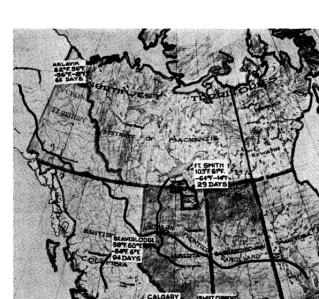
An expansion of the use of rangeland for livestock produc- tion is still going on today in Canada but has become north- ward instead of westward. This northern extremity of the ranch country may be termed its Northern Frontier.
Northern Frontier Most of British Columbia is occupied by the Appalachian Highlands. In between 0 the
mountain ranges lie warm val- leys which are often semi-arid in the rain shadows of high ranges to their westward.
East of the Rockies lies the northern extension of the North- ern Great Plains, the Boreal For- est and the Arctic Tundra. The northern plains fall into two vegetative regions; the open prairies in the south and the parkland (alternate poplar bluffs and moist p r a i r i e s ) toward the north.
By the year 1900 ranching was established on most of the open plains country and in the south- ern valleys of British Columbia. During the next three decades, grain farming east of the Rockies and fruit farming in British Co- lumbia began to take over the rangeland and to push north- ward even beyond the limits of ranching. The demand for food in the first world war and the development of short-season wheats sent farmers into the