Available Online atwww.ijcsmc.com
International Journal of Computer Science and Mobile Computing
A Monthly Journal of Computer Science and Information Technology
ISSN 2320–088X
IJCSMC, Vol. 4, Issue. 10, October 2015, pg.139 – 152
RESEARCH ARTICLE
A Duplication Reduced Pre-copy
Strategy for Live Migration of Virtual
Machine in Cloud Computing
C.SURESH
1, V.VIDHYA
2, E.SHAMLI
3, P.MAHALAKSHMI
4, R.MUTHULAKSHMI
5¹B.TECH Information Technology (Final year) & Mailam Engineering College, India
²B.E Computer Science Engineering (Final year) & Mailam Engineering College, India
³B.E Computer Science Engineering (Final year) & Mailam Engineering College, India
4
B.E Civil Engineering (Final year) & Mailam Engineering College, India
5B.E Computer Science Engineering (Third year) & Mailam Engineering College, India
1[email protected]; 2[email protected]; 3[email protected];
4[email protected]; 5[email protected]
ABSTRACT
In Cloud Computing, Large scale data centre’s have been widely used to host cloud services, which are typically allocated to different virtual machines (VMs) through resource multiplexing across shared physical servers. The fast growing rate of the usage of large-scale computing machines on cloud platform results in need for a optimized load balancing strategy. One way to optimize the load balancing process is by implementing the migration of virtual machines across multiple hosts. Migration at the level of an entire VM means that in-memory state can be transferred in a consistent efficient fashion. Iterative pre-copy is a major mechanism for achieving live migration of virtual machines. The page duplication activity has an adverse impact on computing internet-related applications. To reduce this adverse effect a Duplication Reduced Pre-Copy strategy is proposed.
1. INTRODUCTION
Cloud computing is a way to increase the capacity or add capabilities dynamically without investing in new
infrastructure, training new personnel, or licensing new software. Along with the advancements of cloud technology,
the new possibilities for Internet based applications development are emerging. Various applications like social
networking sites and e-commerce can benefit greatly from cloud infrastructure services to minimize costs and
improve service quality to end users. Cloud has become an alternative means of internet for most of us. Cloud
represents ubiquitous computing. The two main entities involved in cloud computing are the cloud user and the
cloud service provider. Sometimes a cloud broker may also exist. Any resources required by the user are delivered
by the cloud service provider. The main aim of cloud provider 2 is to maximize his revenue and at the same time,
optimize the usage of the datacenter. The data center consists of processors, RAM, storage resources network
resource, computing resource. The user gets the Quality of Service from the provider on the PaaS-you-use basis.
Cloud services are provided to the cloud users as utility services like water, electricity, telephone using
pay-as-you-use business model. These utility services are generally described as XaaS (X as a Service) where X can be Software
or Platform or Infrastructure etc.
1.1 CLOUD COMPUTING
Cloud computing can be defined as an extension of parallel computing, distributed computing and grid
computing. It is meant to provide a secure, quick, convenient data storage and net computing service. Cloud itself
consists of physical machines in the data centers of cloud providers. Virtualization is provided on top of these
physical machines. These virtual machines are provided to the cloud users. Different cloud provider provides cloud
services of different abstraction level. E.g. Amazon EC2 enables the users to handle very low level details where
Google App-Engine provides a development platform for the developers to develop their applications. So the cloud
services are divided into many types like Software as a Service, Platform as a Service , Infrastructure as a Service
Cloud Computing defined by NIST as, “A Model for enabling ubiquitous, convenient, on-demand network access to
a share pool of configurable computing resources (Ex. Network, Servers, Storage, Applications and services) that
can be rapidly provisioned and released with minimal effort or service provider interaction”.
1.2 CHARACTERISTICS OF CLOUD COMPUTING
On-demand self-service
Broad network access
Resource pooling
Rapid elasticity
Measured service
1.3 CLOUD SERVICE MODELS
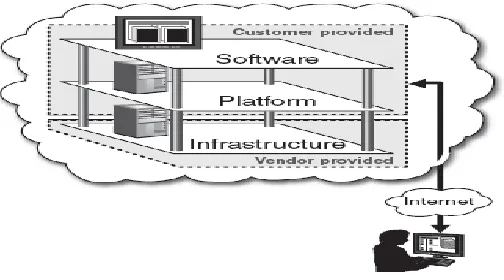
Cloud means the applications and services that are offered from the datacenter to all over the world. These
as a Service (IaaS), Platform as a Service (PaaS), Software as a Service (SaaS) that are made available as
pay-as-you-go model to clients.
Figure 1.1 Structure of service mode
Infrastructure-as-a-Service (IaaS)A service model that involves outsourcing the basic infrastructure used to support operations including
storage, hardware, servers, and networking components. The service provider owns the infrastructure equipment and
is responsible for housing, running and maintaining it. The customer typically pays on a per-use basis. The customer
uses their own platform (Windows, Unix) and applications.
Platform-as-a-Service (PaaS)
A service model that involves outsourcing the basic infrastructure and platform (Windows, Unix). PaaS
facilitates deploying applications without the cost and complexity of buying and managing the underlying hardware
and software where the applications are hosted. The customer uses their own applications.
Software-as-a-Service (SaaS)
It is also referred to as “software on demand,” this service model involves outsourcing the infrastructure,
platform and software/applications. Typically, these services are available to the customer for a fee, pay-as-you-go,
or a no charge model. The customer accesses the applications over the internet.
1.4 CLOUD DEPLOYMENT MODEL
Public Cloud
Private Cloud
Community Cloud
Hybrid Cloud
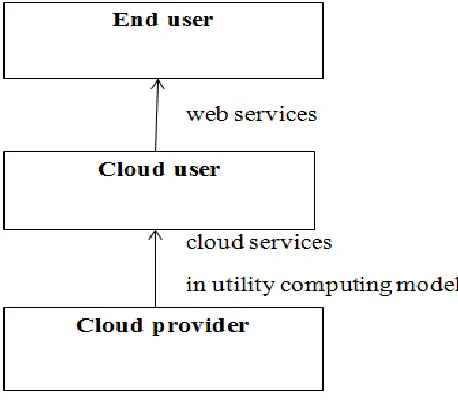
1.5 CLOUD STAKEHOLDERS
There are three types of stakeholders cloud providers, cloud users and the end users. Cloud providers provide
these services pay-as-you-go model. The cloud users develop their product using these services and deliver the
product to the end users.
Figure 1.2 Cloud stakeholders
1.6 VIRTUALIZATION
Virtualization enables the migration of virtual image from one physical machine to another physical machine
and also creates the virtual version of operating system, a server, a storage device and network resources. It is the
creation of a virtual version of an operating system. It is a technique for hiding the physical characteristics of
computing resources to simplify the way in which other systems, applications, or end users interact with those
resources. This feature is useful in optimization and taking backup. Cloud computing use virtualization to minimize
the initial and maintenance cost.
1.6.1 Types Of Virtualization
Full virtualization Para virtualization
1.6.1.1 Full Virtualization
Full virtualization is a type of Virtualization approach to provide Virtual Machine environment that
completely relays on Hardware. In full virtualization, hardware is reflected in virtual machines which includes
1.6.1.2 Para Virtualization
Para Virtualization is virtualization technique that allows multiple Operating systems to run on the
hardware at the same time using the system resource such as processor, memory. The created virtual machine has
separate APIs that talk with Virtual Machine Monitor which sends the virtualization request to the hardware. So the
Virtual Machine Monitor does not need a resource intensive translation of instructions
1.6.2 Hypervisor
In Cloud Computing, Virtualization is achieved through hypervisor. A hypervisor, also called a virtual
machine manager, is a program that allows multiple operating systems to share a single hardware host. Each
operating system appears to have the host's processor, memory, and other resources all to itself. However, the
hypervisor is actually controlling the host processor and resources, allocating what is needed to each operating
system in turn and making sure that the guest operating systems (called virtual machines) cannot disrupt each other.
There are two basic types of Hypervisor
Native Or Bare Metal Hypervisor
Hosted Hypervisors
1.6.3 Terms Used In Virtualization
Host Machine
Virtual Machine(VM)
Host OS
Guest OS
1.7 LIVE VIRTUAL MACHINE MIGRATION
During the peak loads, there will be a need of migration of VM to another physical machine for fulfilling the
requests. Migration is the process used to transfer a VM from the host on which it resides to a different one.
There are two types of Virtual Machine Migration
Hot (live) migration
1.8 EXISTING LIVE VIRTUAL MACHINE MIGRATION MECHANISMS
1.8.1 Pre-copy live migration
Pre-copy migration process pauses the execution of VMs at the source end during the process of migration.
The iterative pre-copy mechanism copies the dirty pages into the destination host by marking them as clean while
the VM is still running. It allows the pages to be concurrently written again and again through the network in next
iterations leading to a dirty page rate. The Xenalike KVM (Kernel VM) and Service Level Managed KVM have
followed a method of forcing the pre-copy iteration if the system does not converge within a reasonable time. It
resulted in significant increase in service levels preventing VM thrashing thereby trading off migration delay and
down time even for higher workload intensities.
1.8.2 Post-copy live migration
Post-copy migration maintains the liveliness of the VMs during the migration process. It improves upon the
important metrics like pages transferred, total migration time and the network overhead. The four mechanisms
utilized by post-copy migration of VMs across a Gigabit LAN for fetching the memory pages from the source and
overall improved performance are, demand paging for ensuring that each page is sent only once through the
network, active push to ensure that the residual dependencies are removed from the source host as quickly as
possible, pre-paging for reducing the number of major network faults and dynamic self-ballooning for reducing the
number of free pages transferred during duration.
1.8.3 Memory management based live migration
The proper management of the memory during the live migration of virtual machines is the prime concern
since it mainly affects the performance of the migration process thereby leading to more energy consumption and
cost. We classify the memory management based live migrations by considering the nature of operation used to
reduce the amount of data transfer as Memory compression based mechanisms, Memory re-use based mechanism
and Memory pruning based mechanism.
1.8.4 Network aware live migration
An approach for placement and migration of VMs in order to minimize the data transfer time in
data-intensive applications during the communication due to network I/O performance places VMs on physical machines
with due considerations to the network conditions between the physical machines and the data storage. It also
considers the instable network condition resulting in changed data access behaviors deteriorating the application
performance by dealing it with migration to other physical machines thereby leading to improved task completion
time. We classify the network aware live migrations mechanisms based on the network structure and the address
translation rule as Topology based mechanisms, transparent migration based mechanism and Network paging based
1.8.5 Energy Management Aware Live Migrations
The live migration of VMs results in more energy consumption thereby leading to higher cost if the
sufficient measures are not considered while selecting the VMs for reducing total migration time, minimizing down
time and minimizing the number of active servers. We further classify the Energy management aware live migration
based on the nature of energy optimizations as Energy consumption aware mechanisms, Load aggregation based
mechanism, Application placement based mechanism and Workload adaptive mechanism.
1.8.6 Security Aware Live Migration
A method leveraging Intel vPro and TPM for improving security in live migration contains an attestation
service for running hypervisor to cryptographically identify itself to a remote hypervisor for trusting the application.
It also contains a sealed storage for encrypting the data using the private key of the tamper resistant TPM that is
responsible for attestation.
1.8.7 Application specific live migration
The live migration of virtual machines can also be performed based on the type of applications specific to
the need of the consumers. We classify them based on the nature of applications as Multitier and I/O intensive.
1.8.8 Decentralized approach based live migration
The peer-to-peer (P2P) network of physical systems based decentralized Virtual Machine Consolidation
(VMC) algorithm uses a novel migration-cost aware Ant Colony Optimization (ACO) algorithm resulting in less
number of migrations with efficiency closer to the centralized system. It assumed that PMs are interconnected by
means of a high-speed LAN and the hardware can be either homogeneous or heterogeneous.
1.8.9 VM placement based live migration
The mathematical model based approach by considering migration overhead for recalculating and
executing VM allocations over time considers operational 20 server hour as a prime metric for quality of the VM
reassignment model. It considers three different servers as small, medium and large with CPU overhead as (20%,
10%), (30%, 20%), and (40%,30%) for numeric experiments using static VM assignment and the proposed VM
scheduling model. The model proved to be saving 50% of the operational server hours by comparing it with the
statistic VM assignment model.
1.8.10 Business aware live migrations
The live migration of the VMs must consider the benefits of the cloud computing services from both the
service provider and the consumers’ perspective by utilizing mechanisms that limit the migration cost without
compromising the performance. We classify the Business aware live migrations based on the nature of business
1.8.11 Stable Matching based live migration
The general stable matching framework enables finding a stable matching fair to both VMs and servers instead
of favouring either side as a result of the deferred acceptance procedure.
1.9 CHALLENGES IN CLOUD COMPUTING
There are several challenges in Cloud Computing that need to be resolved before exploiting the features this technology. Some challenges include
Security issues
Legal and compliant issues
Performance and QoS
Interoperability issues
Load balancing
Data management issues
1.10ADVANTAGES OF USING CLOUD
The advantages for using cloud services can be of technical, architectural, business
2. LITERATURE SURVEY
The fast growing rate of the usage of large-scale computing machines on cloud platform has resulted in
increased consumption of energy and emission of carbon. Such negative effects should be curbed for a more
environmental friendly computing platform, e.g. a green cloud computing platform. One of the important features
that need to be optimized in regards to scheduling is the load balancing process that emphasizes on optimal resource
utilization, maximum throughput, maximum response time and prevention of overload. One way to optimize the
load balancing process is by implementing the migration of virtual machines across multiple hosts, in which
utilization of CPU resources can be optimized. The appropriate use of two different classes of resources e.g.
low-powered and high-low-powered machines based on their Million Instructions Per Second (MIPS) metrics, will lead to
minimal process execution time if both types of resources are being efficiently used and effectively mapped to
suitable types of processing. According to different machine performance, the migration of virtual machines will be
computed based on the current CPU utilization following three different conditions, i.e. when the CPU usage
reaches its 90%, 10% and 0% marker.
3. EXISTING SYSTEM
In pre copy approach, the VM continues to run, while its memory is iteratively copied page wise from the
source to the target host. Iteratively means, the algorithm works in several rounds. It starts with transferring all
active memory pages. Pre-copy is well proven for read intensive workloads. Live migration of virtual machines by
STEP 1
Pre-migration: In this step, it is assumed that a virtual machine on a physical host A has been activated. At
this stage, the pre-specified target machine resources needed to be free to migrate.
STEP 2
Reservation: This step includes reservation of required resources and preparing to begin the migration.
STEP 3
Iterative Pre-Copy: The algorithm consists of repeated iterations before copying for memory migration
from origin to destination is desired. In the first repeat, all the plates, transferred from A to B and in the
next repeat, the damaged pages will be re-migration.
STEP 4
Stop-and-Copy: Virtual machines on host A been suspended and the remaining Incompatible pages
between A and B and status of the CPU will be migrated to the destination machine. At the end of this
stage, transferred plates between A and B are compatible. But also in case of failure migration, A will be
considered as the main host.
STEP 5
Commitment: Host B message that migration done correctly, for Host A sends and Host A turn main virtual
machine's off and from this time onwards B will be known as the main host of the virtual machine. The
fourth and fifth steps show the downtime.
STEP 6
Activation: The last step, the migrated virtual machine will be active and work is resumed.
4. PROPOSED SYSTEM
A virtual machine under migration may compete with internet-related applications for communication
bandwidth. A intensive page duplication activity across hosts degenerates the performance of internet-related
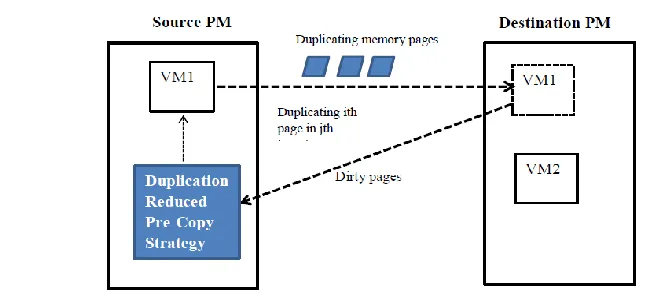
applications. The ultimate aim of duplication reduced pre-copy strategy is to reduce the page duplication in a short
period of time. The duplication reduced pre-copy strategy duplicate a page if the page have kept clean for two
consecutive iterations after it has been dirtied. At the last iteration all the accumulated pages are duplicated. The
duplication rule of duplication reduced pre-copy strategy is given as (di j-3 /\d’ i j-2 /\d’i j- 1 ) = 1 Page Pi is
duplicated across hosts in iteration j if the condition. We also define di-2 = 1, di-1 = 0 and di0 = 0 for all the pages to
be duplicated in the first iteration.
4.1 HARDWARE REQUIREMENT
System : INTEL I5
System Architecture : x86
RAM : 8 GB
Hard Disk : 1 TB
4.2 SOFTWARE REQUIREMENT
Operating System : Linux
Language : Java -1.7
IDE : Net Beans 8.0.1
Cloud Simulation Tool : CloudSim
Hypervisor : xen
5. SOFTWARE DESCRIPTION
5.1 CLOUDSIM
CloudSim is a famous simulator for cloud parameters developed in the CLOUDS Laboratory, at the
Computer Science and Software Engineering Department of the University of Melbourne.
5.2 NETBEANS
The Net Beans Platform is a reusable framework for simplifying the development of Java Swing desktop
applications. The Net-Beans IDE bundle for Java SE contains what is needed to start developing Net-Beans plugins
and Net-Beans Platform based applications; no additional SDK is required. Applications can install modules
dynamically. Any application can include the Update Center module to allow users of the application to download
digitally-signed upgrades and new features directly into the running application. Reinstalling an upgrade or a new
release does not force users to download the entire application again.
5.3 THE JAVA FRAMEWORK
Java is a programming language originally developed by James Gosling at Sun Microsystems and released
in 1995 as a core component of Sun Microsystems' Java platform. The language derives much of its syntax from C
and C++ but has a simpler object model and fewer low-level facilities. Java applications are typically compiled to
byte code that can run on any Java Virtual Machine (JVM) regardless of computer architecture. Java is
general-purpose, concurrent, class-based, and object-oriented, and is specifically designed to have as few implementation
dependencies as possible. It is intended to let application developers "write once, run anywhere".
6. SYSTEM DESIGN
6.2 UML DIAGRAMS
UML stands for Unified Modeling Language. UML is a standardized general-purpose modeling language in the
field of object-oriented software engineering. The standard is managed, and was created by, the Object Management
Group.
6.2.1 Use Case Diagram
A use case diagram in the Unified Modeling Language (UML) is a type of behavioral diagram defined by and
created from a Use-case analysis. The main purpose of a use case diagram is to show what system functions are
performed for which actor.
6.2.2 Data Flow Diagram
Figure 6.2.2 Data Flow Diagram
7. SYSTEM TESTING
7.1 TESTING
The purpose of testing is to discover errors. Testing is the process of trying to discover every conceivable
fault or weakness in a work product. It provides a way to check the functionality of components, sub assemblies,
assemblies and/or a finished product It is the process of exercising software with the intent of ensuring that the
Software system meets its requirements and user expectations and does not fail in an unacceptable manner. There
7.2 TESTING TECHNIQUE
In this process the appropriate testing process is selected from various testing methodologies and the
selection is done by the means of analyzing the nature of the project. The process steps are bent upwards after the
coding phase, to form the typical V shape.
8. SYSTEM MODULES
Datacenter Creation
Datacenter Broker Creation
VM Creation
Cloudlet Creation
Pre-copy with duplication reduction condition
9. CONCLUSION
A Duplication Reduced Pre-Copy Strategy for Live Migration of Virtual Machine in Cloud Computing is
proposed and implemented in cloud computing environment using CloudSim toolkit, in java language. The proposed
system mainly aims at reducing the memory page duplication from source physical machine to destination physical
machine using a enhanced Pre-Copy strategy. On comparing the downtime and migration time with typical
pre-copy, the proposed system takes reasonable amount of downtime and migration time. The performance graph is
generated and it compares amount of duplication in the typical pre-copy and the duplication reduced precopy. On
evaluating the graph it seems to know that duplication is drastically reduced.
REFERENCES
[1]A B M Moniruzzaman, Kawser Wazed Nafi, Syed Akther Hossain, “An Experimental Study Of Load
Balancing Of Opennebula Open-Source Cloud Computing Platform”, 3rd International Conference On
Informatics, Electronics & Vision, 2014.
[2] Adel Amani, Kamran Zamanifar,”Improving the Time of Live Migration Virtual Machine by Optimized Algorithm”.International Conference on Computer and Knowledge Engineering(ICCKE), 2014.
[3] Anja Strunk, “Costs of virtual Machine Live Migration: A Survey”. IEEE Eighth World Congress on
Services, 2012.
[4] Buyya, Rajkumar, Rajiv Ranjan, and Rodrigo N. Calheiros, “Modelling And Simulation of Scalable Cloud Computing Environments And The CloudSim Toolkit: Challenges And Opportunities” High Performance Computing & Simulation. HPCS’09, International Conference on pp: 1-11, IEEE, 2009. [5] C. Clark et al., “Live Migration of Virtual Machines” Proc. 2nd Conf. Symp. Networked Systems
[6] Fei Xu, Fangming Liu, Linghui Liu, Hai Jin,Bo Li,Fellow, and Baochun Li, “iAware: Making Live
Migration of Virtual Machines Interference-Aware in the Cloud”, IEEE Transactions on Computers, VOL.
63, NO. 12, December 2014.
[7] Gaochao Xu, Junjie Pang, and Xiaodong Fu, “A Load Balancing Model Based on Cloud Partitioning for the Public Cloud”, TSINGHUA SCIENCE AND TECHNOLOGY ISSN l l 1007-0214 l l 04/12 l l pp34-39
Volume 18, Number 1, February 2013.
[8] Gulshan Soni, Mala Kalra , “A Novel Approach For Load Balancing In Cloud Data Center”, IEEE,
2014.
[9] Liuhua Chen, Haiying Shen, Karan Sapra, “RIAL: Resource Intensity Aware Load Balancing in
Clouds”, IEEE Conference on Computer Communications, IEEE INFOCOM, 2014.
[10] H. Liu, S. Liu, X. Meng, C. Yang, and Y. Zhang, “LBVS: A Load Balancing Strategy for Virtual Storage”, International Conference on Service Sciences (ICSS), pages 257-262, IEEE, 2010.
[11] Mayank Mishra, Anwesha Das, Purushottam Kulkarni, and Anirudh suhoo “Dynamic Resource Management Using Virtual Machine Migrations”, IEEE Communications Magazine,2012.
[12] H. Mehta, P. Kanungo and M.Chandwani, “Decentralized content aware load balancing algorithm for distributed computing environments”, Proceedings of the International Conference on Emerging Trends in
Technology (ICWET),pages 370-375, February 2011.
[13] Nagamani H. Shahapure, Jayarekha P, “Load Balancing With Optimal Cost Scheduling Algorithm”,
International Conference On Computation of Power, Energy, Information and Communication (ICCPEIC),
2014.
[14] Pradip D. Patel, Miren Karamta, M. D. Bhavsar, M. B. Potdar, “Live Virtual Machine Migration
Techniques In Cloud Computing: A Survey”, International Journal of Computer Applications, Volume 86 –
No 16, January 2014.
[15] Rabiatul Addawiyah Mat Razali, Ruhani Ab Rahman, Norliza Zaini,Mustaffa Samad, “Virtual
Machine Migration Implementation in Load Balancing for Cloud Computing”, IEEE, 2014.
[16] Raghavendra Achar, P. Santhi Thilagam, Nihal Soans, P. V. Vikyath,”Load Balancing in Cloud Based on Live Migration of Virtual Machines”, Annual IEEE India Conference (INDICON), 2013.
[17] Raza Abbas Haidri, C. P. Katti, P. C. Saxena, “ A Load Balancing Strategy for Cloud Computing Environment”, International Conference on Signal Propagation and Computer Technology (ICSPCT), 2014
[18] Sanjay K. Dhurandher, Mohammad S. Obaida, “A Cluster-Based Load Balancing Algorithm in Cloud Computing” IEEE ICC - Mobile and Wireless Networking Symposium, 2014.
[19] Shreenath Acharya,Demian Antony D’Mello, “A Taxonomy Of Live Virtual Machine (VM) Migration
Mechanisms In Cloud Computing Environment”, IEEE Conference, 2013.