Available Online atwww.ijcsmc.com
International Journal of Computer Science and Mobile Computing
A Monthly Journal of Computer Science and Information Technology
ISSN 2320–088X
IJCSMC, Vol. 4, Issue. 4, April 2015, pg.379 – 386
RESEARCH ARTICLE
Baseline JPEG Image Compression with K-Means
Clustering Based Algorithm
Karri Tata Rao
1, Ch. Ramesh
21
Final M.Tech student, Dept .of CSE, AITAM, Tekkali, A.P, India [email protected]
2
Professor, Dept .of CSE, AITAM, Tekkali, A.P, India [email protected]
Abstract: Applications of Digital Image Communication have increased drastically in our day to day activities. Baseline Joint Photographic Experts Group (JPEG) is the common image compression method for reducing bandwidth. Baseline JPEG Compression system comprises of a DCT unit followed by a normalizer and encoder. At the receiving end, image is reconstructed by inverse DCT. In this paper, we develop a JPEG Compression algorithm that joins K-Means clustering technique and DCT to further reduce the bandwidth requirements. Experiments are carried out with many standard images. Our algorithm proved to be giving approximately same Peak Signal-to-Noise Ratio (PSNR) as that of Base line conventional JPEG algorithm.
Keywords:- DCT, IDCT, PSNR, Baseline JPEG, K-Means clustering
I. INTRODUCTION
Image based recognition systems that are used in production industries such as IC manufacturing, fruit processing systems, automatic welding, etc., will be using original images. However, there are some recent applications such as remote monitoring, surveillance, remote surgery, etc., may involve communication of captured images to a server for processing, recognition and control. For example, [7] used compressed face images in JPEG format for the development of their face recognition system that extracts edge based features from the JPEG images and uses with a neural network. Certainly, performance of recognition system based on original images will be giving better results than compressed images as compressed images loses some details which are otherwise useful for recognition. It is reported elsewhere JPEG compression induces some artifacts such as noise around edges, blurring, a smeared appearance, color distortion, and/or checkerboard-like blocking in busy regions. However, it consumes very little bandwidth. Thus, scientific community may be interested in studying about recognition system performance when it is designed to used compressed images rather than original images.
The paper is organized as follows. In section II, a overview of the standard Baseline JPEG is provided. The proposed K-means clustering based Baseline JPEG compression system is described in section III. Experimental results are presented in section IV. Finally, conclusions are reported in section V.
II. OVERVIEW OF BASELINE JPEG SYSTEM
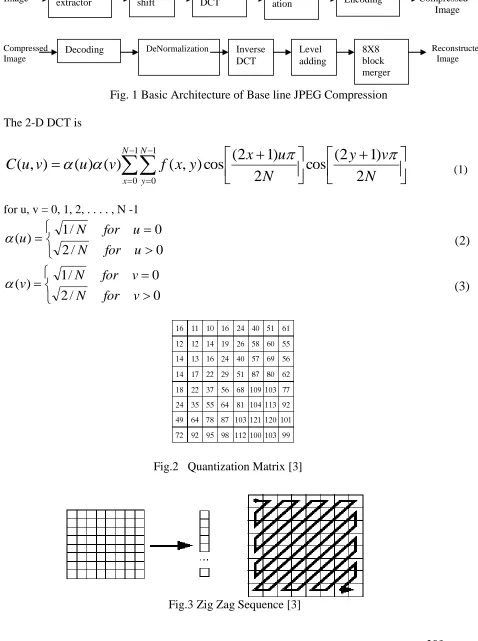
JPEG is a well known standardized image compression technique. JPEG loses information so the decompressed picture is not the same as the original one. The main reason for the use of Baseline JPEG is to reduce the size of image files. Reducing image files is an important procedure for transmitting files across networks or archiving libraries. Usually JPEG can remove the less important data before the compression; hence JPEG is able to compress images meaningfully, which produces a huge difference in the transmission time and the disk space. Fig 1 shows the basic Architecture of JPEG compression system. Here is a brief overview of the JPEG compression system [8]
The image is first subdivided into pixel blocks of size 8X8, which are processed from left to right, top to bottom. As each 8X8 block or sub image is encountered, its 64 pixels are level shifted by subtracting the quantity L/2, where L is the Gray level resolution of the image . The 2-D Forward Discrete Cosine Transform (FDCT) (Eq 1)[5]of the block is then computed, quantized using 64 corresponding step size values from the quantization table in Fig.2[3]. After quantization the DCT coefficients are rearranged in a zigzag sequence order as shown in the Fig.3.[3]
Input
Image Compressed Image
Compressed Re Reconstructed Image Image
Fig. 1 Basic Architecture of Base line JPEG Compression
The 2-D DCT is
1 0 1 02
)
1
2
(
cos
2
)
1
2
(
cos
)
,
(
)
(
)
(
)
,
(
N x N yN
v
y
N
u
x
y
x
f
v
u
v
u
C
(1)for u, v = 0, 1, 2, . . . . , N -1
0
/
2
0
/
1
)
(
u
for
N
u
for
N
u
(2)
0
/
2
0
/
1
)
(
v
for
N
v
for
N
v
(3)Fig.2 Quantization Matrix [3]
Fig.3 Zig Zag Sequence [3]
8X8 block
extractor Encoding
Normaliz ation Forward DCT Level shift
The decompression process performs an inverse procedure. It decodes the Huffman codes. Then, it makes the inversion of the Quantization step. In this stage, the decoder raises the small numbers by multiplying them by the quantization coefficients. The results are not accurate, but they are close to the original numbers of the DCT coefficients. An Inverse Discrete Cosine Transform (IDCT) (Eq.4) [6] is performed on the data received from the previous step. Finally add L/2 to each sub image. Place the sub images in their correct positions.
1 0 1 02
)
1
2
(
cos
2
)
1
2
(
cos
)
,
(
)
(
)
(
)
,
(
ˆ
N u N vN
v
y
N
u
x
v
u
C
v
u
y
x
f
(4)The error between the original image and reconstructed image is calculated in terms of Peak signal to noise ratio (PSNR) = 10 log10 (L2/MSE) (5)
mXn
y
x
f
y
x
f
MSE
m x n y
1 0 1 0 2)
,
(
)
,
(
ˆ
(6)MSE – Mean Squared Error
) , (
ˆ x y
f - Reconstructed Image
f (x, y) – Original Image
m x n – Size of the Image
III. K-MEANS CLUSTERING BASED JPEG ALGORITHM
In the following, we have listed the basic K-Means clustering algorithm [2].
K-means Algorithm
1) Select K random cluster centers z1, z2, …..zk from the training data and call it as code vectors.
2) The training vectors x1, x2, …..xN are classified into the cluster from which their distance is
minimum.
3) Calculate the sum vector for every cluster by adding the corresponding components of all the training vectors that belong to the same cluster.
4) Calculate the centroid for each cluster
z
ˆ
1,
z
ˆ
2...
z
ˆ
kby dividing the individual components of the sum vector by the cluster strength.5) If z1 zˆ1;z2 zˆ2...zk zˆkthen stop else take zˆ2 as z2...zˆkas zk then go to step 3.
KDCT Algorithm
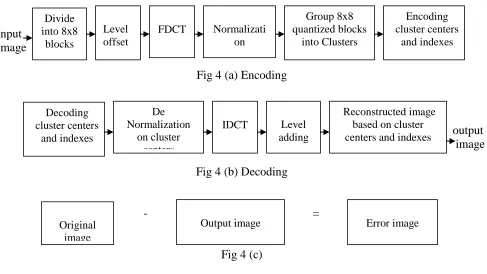
In this approach, we propose to study the possibility of designing code book using K-Means clustering algorithm by taking the quantized DCT arrays of each of the sub-images instead of original sub-images. We feel that clustering results will be good and we may get optimal code book as DCT transforms the image information into first few coefficients only while remaining coefficients are negligible. We have illustrated the steps in our algorithm which we denote as KDCT algorithm. Figure 4 a & b explains the steps involved in both coding and decoding with our algorithm.
1. The image is first subdivided into pixel blocks of size 8x8 which are processed from left
to right, top to bottom.
2. For each block its 64 pixels are level shifted by subtracting the quantity L/2 where L is the
gray level resolution.
3. The 2D-DCT of each block is computed.
4. Normalize the DCT blocks by standard normalization matrix.
5. The normalized blocks are grouped into clusters by using K-means Clustering described
above.
6. Encode the cluster centers and indexes and send to the receiver.
7. The receiver decodes the cluster centers and indexes.
8. Based on the cluster centers and indexes the receiver costruct the output image.
Input
Image
Fig 4 (a) Encoding
output
image
Fig 4 (b) Decoding
- =
Fig 4 (c)
IV. EXPERIMENTAL WORK
In our study, a number of images in tiff format are used. All the above images are taken from
USC-SIPI image database “http://sipi.usc.edu/database” [4] .Experiments are carried out under MS
Windows XP version 2002, SP3 edition. The experimental system is equipped with Intel core 2 Duo 2.60 GHz processor with 1 GB RAM. Programs are written in C language under Micro Soft Visual Studio 2005 version 8.0. In our experiments, we have carried out observations with cluster. sizes of 64, 128, 256, 512, 1024 and 2048. Table-1 illustrates standard Base line JPEG’s compression benefits and PSNR values with the selected images [4].
IMAGE SIZE CONVENTIONAL ENCODING
Compression Ratio PSNR
Tire 128x128 8.1884 32.237621
Pop 128x128 5.0327 28.423471
glad 128x128 7.1612 31.973763
chess 128x128 9.3536 33.146183
floor 128x128 9.8218 35.765728
Cameraman 256x256 9.4928 31.6130
Clock 256x256 12.5286 34.8700
Couple 256x256 10.9814 35.2177
Airplane 256x256 17.1661 37.7847
Aerial 256x256 5.4787 30.0641
Lena 512x512 12.530 35.7939
Peppers 512x512 12.319 34.7604
Girl 512x512 12.1837 33.0329
Car 512x512 10.5626 35.0132
Divide into 8x8
blocks
Level offset
FDCT Normalizati
on
Group 8x8 quantized blocks
into Clusters
Encoding cluster centers
and indexes
IDCT De
Normalization on cluster
centers
Reconstructed image based on cluster centers and indexes Level
adding
Error image Output image
Original image Decoding cluster centers
Stream 512x512 6.3508 29.5155
Man 1024x1024 10.1373 34.1561
Fish 1024x1024 18.0811 38.388565
Sea 1024x1024 18.2175 38.158947
Test 1024x1024 16.7857 21.953581
Table 1: Compression ratios and PSNR values of selected images with conventional Base line JPEG.
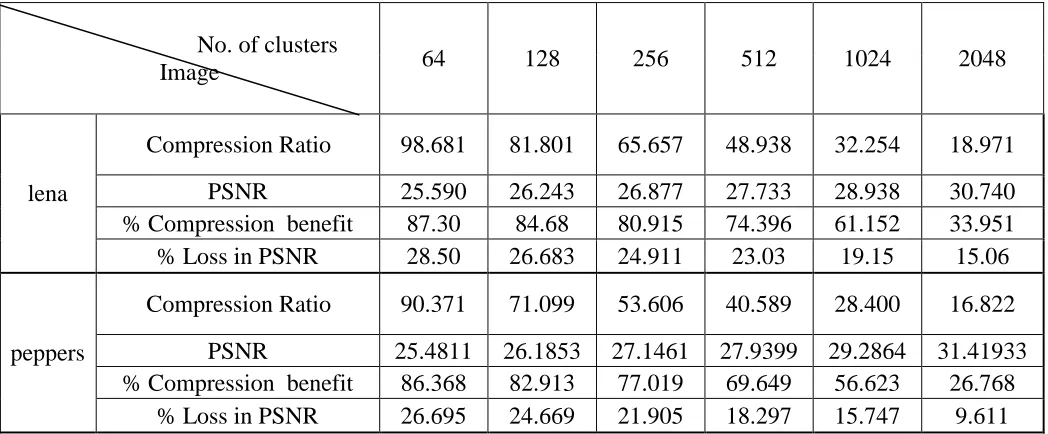
We have carried out experiments with the selected images and proposed algorithm. KDCT algorithm observations on Lena and pepper images is shown in Table 2 for various sizes of clusters. We may find that the compression ratio is reducing with the increasing in the cluster size. With all the images, we found acceptable PSNR value of reconstructed images for cluster size of 1024 and above. However, for cluster size smaller than 1024, PSNR is above 25dB.
No. of clusters
Image 64 128 256 512 1024 2048
lena
Compression Ratio 98.681 81.801 65.657 48.938 32.254 18.971
PSNR 25.590 26.243 26.877 27.733 28.938 30.740
% Compression benefit 87.30 84.68 80.915 74.396 61.152 33.951
% Loss in PSNR 28.50 26.683 24.911 23.03 19.15 15.06
peppers
Compression Ratio 90.371 71.099 53.606 40.589 28.400 16.822
PSNR 25.4811 26.1853 27.1461 27.9399 29.2864 31.41933
% Compression benefit 86.368 82.913 77.019 69.649 56.623 26.768
% Loss in PSNR 26.695 24.669 21.905 18.297 15.747 9.611
Table-2: Compression benefits and PSNR values of KDCT algorithm with “Lena” and “peppers” image
In brief, our experiments indicated the following
1) As the number of clusters in all the observations increases, the bandwidth requirements
increased.
2) As the number of clusters in all the observations increases, the Peak-signal-to-noise ratio
increased.
3) All the retrieved images based on Standard Baseline JPEG system and K-means clustering
based JPEG system are almost same for visual appearance.
4) All the error images based on Conventional JPEG system and K-means based JPEG
system are negligible
5) K-means clustering based JPEG system is somewhat complex as compared to the
V. CONCLUSION
In this paper, K-means clustering based base line JPEG compression algorithm is proposed. We have compared our K-means clustering based base line JPEG compression with traditional base line JPEG compression. From our experiments it is evident that our approaches gives better compression ratios compared to traditional base line JPEG. The Peak Signal-to-Noise Ratio resulting from our approach is slightly less than traditional approach. However, all the reconstructed images resulting from our approach and original images are almost the same in visual perception point of view.
REFERENCES
[1] Bormin Huang,Antonlo J.Plaza,Joan Serra-Sagrista, Chulhee Lee, Younsong LI,Shen-En Qlan Editors Proceedings of SPIE “Satellite Datacompression, communications, and ProcessingVI”,.3- 5 august 2010 San Dlego, California, United States.
[2] K. K. Shukla and M.V. Prasad, “Lossy Image Compression Domain Decomposition-Based Algorithms,” Springer Briefs in Computer Science, 2011
[3] Darrel Hankerson, Greg A. Harris, Peter, D.Johnson Jr,” Introduction to information theoryand data compression” second edition. A CRCpress company.
[4] The USC–SIPI image database (http://sipi.usc.edu/database). Signal and image processing
institute Ming Hgieh Department of Electrical Engineering.
[5] Andrew B.Watson “Image Compression using the discrete cosine transform” Mathematica Journal 4 (1), 1994, p-81-88
[6] Ken cabeen and peter gent,” Image compression and the discrete cosine transform”, Math 45 college of redwoods
[7] Muhammad F. Sabir, Hamid Rahim Sheikh, Robert W. Heath, Alan C.Bovik “A Joint Source-Channel Distortion Model for JPEG Compressed Images” IEEE Transactions on Image Processing Vol 15, No 6, pp1349-1364 June 2006