Available Online atwww.ijcsmc.com
International Journal of Computer Science and Mobile Computing
A Monthly Journal of Computer Science and Information Technology
ISSN 2320–088X
IJCSMC, Vol. 4, Issue. 5, May 2015, pg.243 – 249
RESEARCH ARTICLE
Efficient and Distributed Query Answering
System based on Social Networks
Rajani D R
1, Kavitha G
2, Mohamed Rafi
31
PG Scholar, Department of Computer Science, UBDTCE (VTU), India
2Professor, Department of Computer Science, UBDTCE (VTU), India 3Professor, Department of Computer Science, UBDTCE (VTU), India 1 [email protected], 2 [email protected], 3 [email protected]
Abstract— Nowadays, evolving research efforts have been focused on question and answer (Q&A) systems based on social networks. The Efficient and Distributed Query Answering systems can answer non-factual and factual questions, this Efficient and Distributed Query Answering systems mainly focused on non-factual questions which cannot be easily resolved by web search engines. These systems either rely on a centralized server for identifying friends based on social information or broadcast a user’s questions to all of its friends. The Distributed Query Answering systems, where users can access the Query Answering systems through Internet .However, traditional systems cannot directly use the previous centralized methods or broadcasting methods, which generate high server bandwidth cost, high cost of Internet access and high overhead with the many number of users. We propose a Efficient and Distributed Query Answering systems to get a user satisfaction answers given by humans, with low overhead and system cost as well as quick response to question askers. And also this Query Answering system enables users to forward questions to potential answerers in their friend lists in a decentralized manner for a number of hops before resorting to the server. The execution-driven process results show that The Efficient and Distributed Query Answering systems can achieve a high query precision and recall rate, low overhead and a short response latency.
Index terms— Query Answering system, Online Social networks, Peer to peer networks, Secret key, RSA and AES algorithms.
I.INTRODUCTION
To enhance the asker satisfaction on the Query Answering sites, recently, developing research efforts have been focused on social network based Query Answering systems in which users post and answer questions through social network maintained in a centralized server. As the answerers in the social network know the backgrounds and preference of the askers, they are willing and able to provide more tailored and personalized answers to the askers. The social-based Query Answering systems can be classified into two categories: broadcasting-based and centralized. The broadcasting-based systems broadcast the questions of a user to all of the user’s friends. In the centralized systems, since the centralized server constructs and maintains the social network of each user, it searches the potential answerers for a given question from the asker’s friends, friends of friends and so on.
Question and Answer system is more popular in today’s world. Increasing demand of quick response to non-factual queries like advice, recommendations are not solved perfectly by web search engines like Google. So, proposed Question and Answer system fulfill requirements of non-factual queries by utilizing information on social network. Existing system in market are depend on whatever data already available in database, so new queries not get satisfied answer from such system. By utilizing user’s social information, Question and Answer system give satisfied answer to user. System enables user to forward question to potential answerers in their friend list in decentralized manner. First order logic representation technique is used for calculating interest ID of user in different fields. The question is forwarded to only that friend who able to give best answer based on similar interest thus reducing computation cost of mobile nodes. By using Question and Answer system based on social network user can get high quality.
Broadcasting questions to all friends of a user generates a high computing overhead to the friends. Also, it results in many costly interruptions to users by sending questions that they cannot answer and increase their workload of looking for questions that they can answer through a pool of received questions. Further, broadcasting to a large number of friends cannot guarantee the quality of the answers? .To this problem, in this paper, we propose a distributed Social-based Query Answering System with low overhead and system cost as well as quick response to question askers. In addition, their answers are also more personalized and trustable. The great advantages that online social networks bring to users include:
(1) Decentralized- Low Query congestion and high server bandwidth and Quick response to Question askers.
(2) Low cost or no cost to access the contained resources, with the Web-based nature of these networks meaning data is publicly available;
(3) The sharing of information, philosophy, skills, knowledge, or experiences;
(4) Ubiquity. Because of their value and advantages, the study of these social network websites is of great importance to modern society.
II
.
MOTIVATIONOnline social networks, unlike the Web, are organized around users. To join an online social network, users need create a profile such as interest and backgrounds, publish content and build ways to anyone they want to associate with. As a result, online social networks have become the sites for maintaining social relationships, for locating users with similar or identical interests and for locating content and knowledge or experience that has been contributed other users
.
III. EXISTING SYSTEM
IV.SYSTEMDESIGN
Our Proposed System Architecture mainly consists of Admin, Web server system and User, The steps include in Admin are,
Fig 1 Admin operations
The Fig 1 shows the operations of admin, the Admin has to login by using valid user name and password. After login successful admin can do some operations like list all questions & answers, list users, add groups, view all groups, view all search history, provide accessing permission key to users and logout.
The steps include in End-User are,
The Fig 2 operations of End-users
The Fig 2 shows the operations of End-users, there are n numbers of users present. User should register to a particular group before doing any operations. After registration successful he has to login by using authorized user name and password. After logged in he will do some operations such as view my details, Ask question, answers for the question, question asked in your group, question asked in different group, request for user access key and logout. If user clicks on my details button, then the server will give response to the user with their tags such as user Image, User name, DOB, E-mail, Mobile and Location.
Admin login
List all questions & answers, list users, add groups, view all groups, view all search history and provide accessing permission key
,
Logout
User registration or login
View my details, Ask question
,
answers for the question, question asked in your group, question asked in different group, request for user access keyTo provide user authorization secret key we are using a RSA and AES Algorithm.
KeyGen RSA: Initially, we describe the parameters involved in a standard RSA signature scheme. Each sender includes a public key PK= (e,n) and private key=(d,n) where n is a K-bit modules generated as the product of two random k/2-bit primes p,q and n=p*q where, p,q € discrete prime numbers.
AES Alogrithm:
Cipher(byte in[16], byte out[16], key_array round_key[Nr+1]) 1.begin
2.byte state[16]; 3.state = in;
4.AddRoundKey(state, round_key[0]); 5.for i = 1 to Nr-1 stepsize 1 do 6.SubBytes(state);
7.ShiftRows(state); 8.MixColumns(state);
9.AddRoundKey(state, round_key[i]); 10.end for
11.SubBytes(state); 12.ShiftRows(state);
13.AddRoundKey(state, round_key[Nr]); 14.end
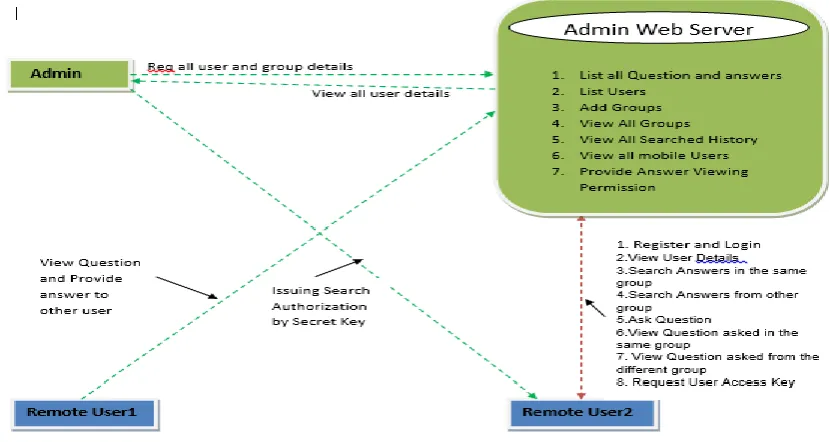
Our Proposed System Architecture mainly consists of Admin, Web server system and User,
Fig 3 the system Architecture of Query Answering System.
In this System Architecture, it mainly consists of three parts Admin, System (web server) and End-user.
Admin: Admin is responsible for user registrations and recommend friends based on user interest profile information and also responsible for following functions like of view all users & search history, Add/view groups, List questions & Answers, and issuing search authorization secret key.
End-user: End-user first uses Query Answering system to register by entering profile information, once done register user can made login by entering user name and password once user done login, user can ask questions, search answer for the question, view answer asked in within group, view answer asked in different group, Request for user access key and logout etc.
The fig 3 shows the system Architecture of Query Answering System. This Architecture shows the admin, system and end-user activity. Here end-user request to get answer for the particular queries, the answer is viewed and provided by another End-user in a system then Admin responses by issuing authorization secret key by using secret key user can view a answer for particular questions.
V. EXPERIMENTAL RESULTS
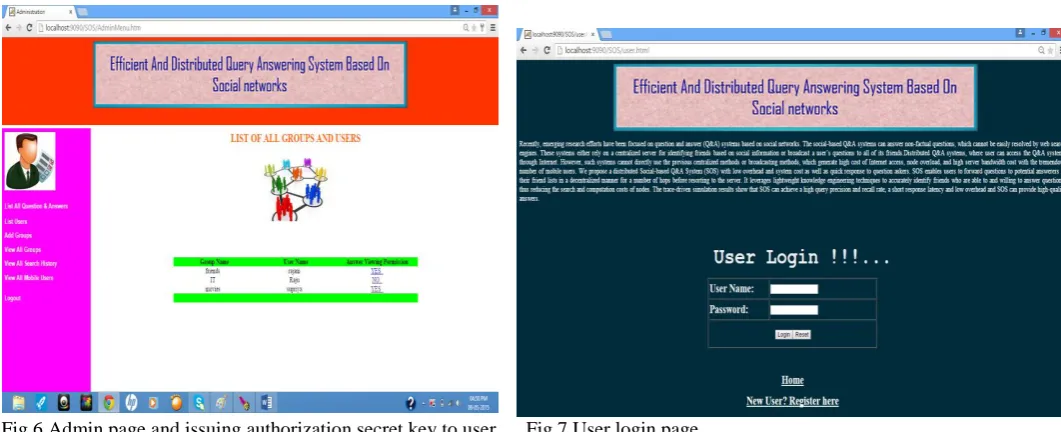
Fig 4 Query Answering system Home page. Fig 5 Admin loin page.
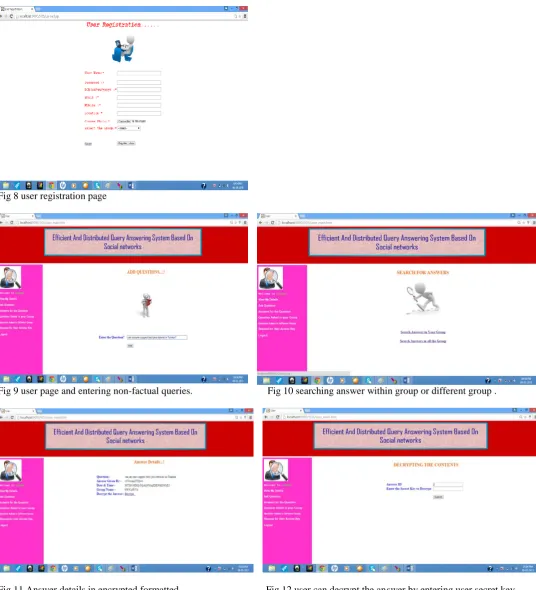
Fig 8 user registration page
Fig 9 user page and entering non-factual queries. Fig 10 searching answer within group or different group .
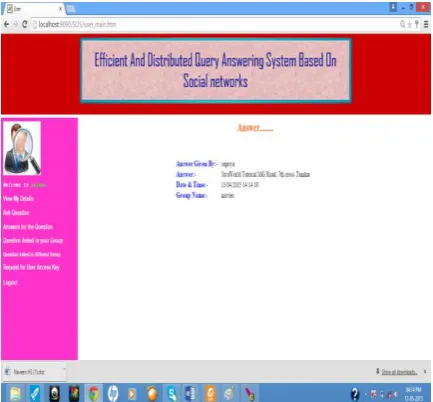
Fig 13.After decrypting, the user can view the answer.
VI.CONCULSION
In this system, we present the design and implementation of a efficient and distributed Query Answering system based on social networks. This system novel in that it achieves lightweight distributed answerer search, while still enables a node to accurately identify its friends that can answer a question. A node considers both its friend’s parsed interests and answer quality in determining the friend’s similarity value, which measures both the capability and willingness of the friend to answer/forward a question. Compared to the centralized social network based Q&A systems that suffer from traffic congestions and high server bandwidth cost, This system is a fully distributed system in which each node makes local decision on question forwarding.
Compared to broadcasting, query answering system generates much less overhead with its limited question forwarding hops. Since each user belongs to several social clusters, by locally selecting most potential answerers, the question is very likely to be forwarded to answerers that can provide answers. Also, efficient and distributed Query Answering system based on social networks earns high user satisfaction ratings on answering both factual and non-factual questions. In the future, we will study the combination of efficient and distributed Query Answering system based on social networks and cloud-based Q&A system.
REFERENCES
[1] Google, http://www.google.com, 2013. [2] Bing, http://www.bing.com, 2013.
[3] Amruta Y.Kotate, Bhushan D.Nighot “Personalized Ontology Model for Web Information Gathering”
[4] L. Terveen, W. Hill, B. Amento, D. McDonald, and J. Crete, “PHOAKS: A System for Sharing Recommendations,” Comm. ACM, vol. 40, pp. 59-62, 1997.
[5] B.M. Evans and E.H. Chi, “An Elaborated Model of Social Search,” J. Information Processing and Management, vol. 46, pp. 656-678, 2009.
[6] M.S. Ackerman, “Augmenting Organizational Memory: A Field Study of Answer Garden,” ACM Trans. Information Systems, vol. 16, pp. 203-224, 1998.
[7] L.G. Terveen, P.G. Selfridge, and M.D. Long, “Living Design Memory: Framework, Implementation, Lessons Learned,” Human-Computer Interaction, vol. 10, pp. 1-37, 1995.
[8] E. Amitay, D. Carmel, N. Har’El, S. Ofek Koifman, A. Soffer, S. Yogev, and N Golbandi, “Social Search and Discovery Using a Unified Approach,” Proc. 20th ACM Conf. Hypertext and Hypermedia (HT ’09), 2009.
[9] D. Carmel, N. Zwerdling, I. Guy, S. Ofek-Koifman, N. Har’el, I. Ronen, E. Uziel, S. Yogev, and S. Chernov, “Personalized Social Search Based on the User’s Social Network,” Proc. 18th ACM Conf. Information and Knowledge Management (CIKM ’09), 2009.
[10] S. Kolay and A. Dasdan, “The Value of Socially Tagged URLs for a Search Engine,” Proc. 18th Int’l Conf. World Wide Web (WWW ’09), 2009.
[11] S. Bao, G. Xue, X. Wu, Y. Yu, B. Fei, and Z. Su, “Optimizing Web Search Using Social Annotations,” Proc. 16th Int’l Conf. World Wide Web (WWW ’07), 2007.