Electronic Thesis and Dissertation Repository
8-18-2011 12:00 AM
Some Single and Combined Operations on Formal Languages:
Some Single and Combined Operations on Formal Languages:
Algebraic Properties and Complexity
Algebraic Properties and Complexity
Bo Cui
The University of Western Ontario
Supervisor Lila Kari
The University of Western Ontario Graduate Program in Computer Science
A thesis submitted in partial fulfillment of the requirements for the degree in Doctor of Philosophy
© Bo Cui 2011
Follow this and additional works at: https://ir.lib.uwo.ca/etd
Part of the Theory and Algorithms Commons
Recommended Citation Recommended Citation
Cui, Bo, "Some Single and Combined Operations on Formal Languages: Algebraic Properties and Complexity" (2011). Electronic Thesis and Dissertation Repository. 234.
https://ir.lib.uwo.ca/etd/234
This Dissertation/Thesis is brought to you for free and open access by Scholarship@Western. It has been accepted for inclusion in Electronic Thesis and Dissertation Repository by an authorized administrator of
Languages: Algebraic Properties and Complexity
(Thesis Format: Integrated-Article)
by
Bo Cui
Graduate Program in Computer Science
Submitted in partial fulfillment of the requirements for the degree of
Doctor of Philosophy
School of Graduate and Postdoctoral Studies The University of Western Ontario
London, Ontario August, 2011
c
CERTIFICATE OF EXAMINATION
Advisor Examining Board
Dr. Lila Kari Dr. Stuart Rankin
Supervisory Committee Dr. Kai Salomaa
Dr. Roberto Solis-Oba
Dr. Kaizhong Zhang
The thesis by Bo Cui entitled
Some Single and Combined Operations on Formal Languages: Algebraic Properties and Complexity
is accepted in partial fulfillment of the requirements for the degree of
Doctor of Philosophy
Date Chair of Examining Board
In this thesis, we consider several research questions related to language operations
in the following areas of automata and formal language theory: reversibility of
op-erations, generalizations of (comma-free) codes, generalizations of basic opop-erations,
language equations, and state complexity.
Motivated by cryptography applications, we investigate several reversibility questions
with respect to the operations parallel insertion and deletion. Among the results we
obtained, the following result is of particular interest. For languages L1, L2 ⊆ Σ∗, if L2 satisfies the condition L2ΣL2 ∩Σ+L2Σ+ = ∅, then any language L1 can be recovered after first parallel-inserting L2 into L1 and then parallel-deleting L2 from the result. This property reminds us of the definition of comma-free codes. Following
this observation, we define the notions ofcomma codes andk-comma codes, and then
generalize them to comma intercodes and k-comma intercodes, respectively. Besides
proving all these new codes are indeed codes, we obtain some interesting properties,
as well as several hierarchical results among the families of the new codes and some
existing codes such as comma-free codes, infix codes, and bifix codes.
Another topic considered in this thesis are some natural generalizations of basic
lan-guage operations. We introduce block insertion on trajectories and block deletion on
trajectories, which properly generalize several sequential as well as parallel binary
language operations such as catenation, sequential insertion, k-insertion, parallel
in-sertion, quotient, sequential deletion,k-deletion, etc. We obtain several closure
prop-erties of the families of regular and context-free languages under the new operations
by using some relationships between these new operations and shuffle and deletion
on trajectories. Also, we obtain several decidability results of language equation
problems with respect to the new operations.
Lastly, we study the state complexity of the following combined operations: L1L∗2,
L1LR2, L1(L2 ∩L3), L1(L2 ∪L3), (L1L2)R, L∗1L2, LR1L2, (L1 ∩L2)L3, (L1 ∪L2)L3,
in the literature.
Keywords: Formal Languages, Finite Automata, Language Operations, Parallel
Insertion and Deletion, Block Insertion and Deletion on Trajectories, Reversibility,
Codes,K-comma Codes,K-comma Intercodes, Language Equations, State
Complex-ity, and Combined Operations.
I sincerely thank all the people who made this thesis possible!
It has been a pleasure to work with my supervisor, Dr Lila Kari. Without her
guidance, encouragement, and support, I would not overcome the difficulties in my
research. Moreover, she inspired me to be successful not only at school but also in
my future life.
I would like to thank Dr. Lucian Ilie and Dr. Sheng Yu for their valuable comments
for my thesis proposal.
Special thanks are given to the members of my examining committee, Dr. Stuart
Rankin, Dr. Kai Salomaa, Dr. Roberto Solis-Oba, and Dr. Kaizhong Zhang, for
their valuable suggestions on revising and finalizing this thesis.
I am grateful to all the other co-authors of the papers included in this thesis, Dr.
Yuan Gao, Dr. Shinnosuke Seki, and Dr. Sheng Yu, for the fruitful collaborations.
I wish to express my gratitude to the Department of Computer Science for providing
me the opportunity to study here and the financial support.
I appreciate the help from the people in the department, especially the staff members
in the main office and the members in the system group.
I am indebted to all my friends who created and shared with me the happiness during
my stay at Western.
Last but not least, I would like to thank my parents and my wife, to whom I dedicate
this work, for their support, encouragement, and love.
Certificate of Examination ii
Abstract and Keywords iii
Acknowledgement v
Table of Contents vi
List of Figures xi
List of Tables xiv
1 Introduction 1
1.1 Reversibility of operations and its role in generalizing comma-free codes 2
1.2 Generalizations of basic operations and language equations . . . 5
1.3 State complexity of combined operations . . . 7
1.4 Structure of the thesis and co-authorship . . . 10
Bibliography . . . 12
Codes 17
Abstract . . . 17
2.1 Introduction . . . 18
2.2 Preliminaries . . . 19
2.3 When does (L1 ⇐L2)⇒L2 equal L1? . . . 21
2.4 Comma codes . . . 30
2.5 Comma intercodes . . . 36
2.6 Conclusion . . . 39
Bibliography . . . 41
3 K-Comma Codes and Their Generalizations 43 Abstract . . . 43
3.1 Introduction . . . 44
3.2 K-comma codes . . . 47
3.3 K-comma intercodes . . . 50
3.4 N-k-comma intercodes . . . 60
3.5 Conclusion . . . 68
Bibliography . . . 69
4 Block Insertion and Deletion on Trajectories 71 Abstract . . . 71
4.1 Introduction . . . 72
4.2 Preliminaries and definitions . . . 74
4.4 Closure properties . . . 83
4.4.1 Closure properties with respect to block insertion . . . 83
4.4.2 Closure properties with respect to block deletion . . . 85
4.5 Decision problems of language equations . . . 89
4.6 Existence of trajectories . . . 94
4.7 Existence of left operands . . . 102
4.7.1 Positive decidability results . . . 102
4.7.2 Undecidability results . . . 105
4.8 Conclusion . . . 108
Bibliography . . . 110
5 State Complexity of Two Combined Operations: Catenation-Star and Catenation-Reversal 112 Abstract . . . 112
5.1 Introduction . . . 113
5.2 Preliminaries . . . 114
5.3 Catenation combined with star . . . 116
5.4 Catenation combined with reversal . . . 124
5.5 Conclusion . . . 133
Bibliography . . . 134
6 State Complexity of Two Combined Operations: Catenation-Union and Catenation-Intersection 137 Abstract . . . 137
6.2 Preliminaries . . . 139
6.3 Catenation combined with union . . . 140
6.4 Catenation combined with intersection . . . 150
6.5 Conclusion . . . 158
Bibliography . . . 159
7 State Complexity of Combined Operations with Two Basic Opera-tions 162 Abstract . . . 162
7.1 Introduction . . . 163
7.2 Preliminaries . . . 165
7.3 State complexity of (L1L2)R . . . 166
7.4 State complexity of LR 1L2 . . . 172
7.5 State complexity of L∗ 1L2 . . . 185
7.6 State complexity of (L1 ∪L2)L3 . . . 194
7.7 State complexity of (L1 ∩L2)L3 . . . 199
7.8 State complexity of L1L2∩L3 . . . 202
7.9 State complexity of L1L2∪L3 . . . 206
7.10 Conclusion . . . 210
Bibliography . . . 213
8 Conclusion and Discussion 216 Bibliography . . . 219
Bibliography . . . 227
Copyright 228
Vita 231
List of Figures
2.1 How uamu overlaps with uanu2 . . . 23
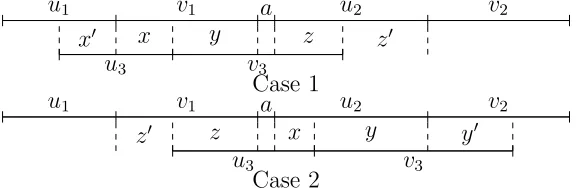
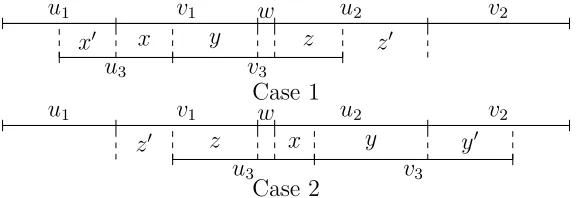
2.2 Foru1, u2, u3 ∈Aand v1, v2, v3 ∈B, ifA∪B is an infix code,u3v3 can be a proper infix of u1v1au2v2 only in these two ways. Note that x′ and y in Case 1 can be empty at the same time, andx and y′ in Case
2 can be empty at the same time. . . 35
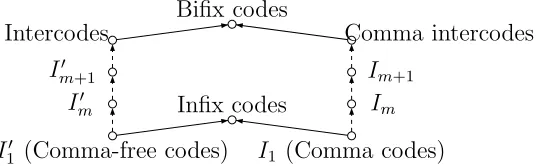
2.3 The inclusion hierarchy of bifix codes, intercodes, comma intercodes,
and infix codes, where arrows indicate proper inclusion. . . 38
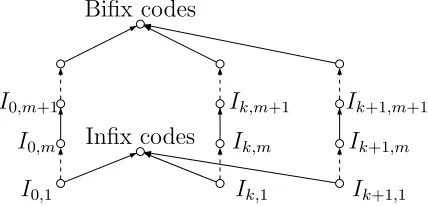
3.1 The inclusion hierarchy of the families of bifix codes, k-comma
inter-codes, and infix inter-codes, where arrows indicate proper inclusion . . . . 54
3.2 Foru1, u2, u3 ∈Aand v1, v2, v3 ∈B, ifA∪B is an infix code,u3v3 can be a proper infix of u1v1wu2v2 only in these two ways, where w∈Σk. Note that x′ and y in Case 1 can be empty at the same time, and x
and y′ in Case 2 can be empty at the same time. . . . . 57
3.3 The inclusion hierarchy ofk-comma intercodes,n-k-comma intercodes,
and bifix codes, where arrows indicate proper inclusion. . . 64
6.1 The DFAB showing that the upper bound in Theorem 15 is reachable
when m= 1 andn, p≥2 . . . 143
6.3 The DFAAshowing that the upper bound in Theorem 19 is attainable
when m≥2 and n, p≥1 . . . 151
6.4 The DFAB showing that the upper bound in Theorem 19 is attainable
when m≥2 and n, p≥1 . . . 151
6.5 The DFACshowing that the upper bound in Theorem 19 is attainable
when m≥2 and n, p≥1 . . . 152
7.1 The setS1 of DFAs that are outputs of reversal when the upper bound for the state complexity of reversal is achieved is disjointfrom the set
S2 of DFAs that are the left operand for catenation which can achieve the upper bound for the state complexity of catenation. . . 164
7.2 Witness DFA N which shows that the upper bound of the state
com-plexity of (L(M)L(N))R, 3·2m+n−2− 2n+ 1, is reachable whenm, n≥2168
7.3 Witness DFAM which shows that the upper bound of the state
com-plexity of L(M)RL(N), 3
42
m+n, is reachable whenm, n≥2 . . . 175
7.4 Witness DFA N which shows that the upper bound of the state
com-plexity of L(M)RL(N), 3
42
m+n, is reachable whenm, n≥2 . . . 175
7.5 Witness DFAM which shows that the upper bound of the state
com-plexity of L(M)RL(N), 2m−1+ 1, is reachable when m≥4 and n = 1 183
7.6 Witness DFAA which shows that the upper bound of the state
com-plexity of L(A)∗L(B), m(2n− 1)− 2n−1+ 1, is reachable when A has only one final state, which is also the initial state, andm, n≥2 . . . 187
7.7 Witness DFAB which shows that the upper bound of the state
com-plexity of L(A)∗L(B), m(2n− 1)− 2n−1+ 1, is reachable, when A has only one final state, which is also the initial state, andm, n≥2 . . . 187
plexity of L(A)∗L(B), 5·2m+n−3 − 2m−1 − 2n+ 1, is reachable when
m, n≥2 . . . 191
7.9 Witness DFAB which shows that the upper bound of the state
com-plexity of L(A)∗L(B), 5·2m+n−3 − 2m−1 − 2n+ 1, is reachable when
m, n≥2 . . . 192
1.1 The state complexity of basic operations on regular languages L1 and
L2over an non-unary alphabet Σ, accepted by DFAs ofmandnstates,
m, n≥1, respectively. Note that these state complexities are obtained
for general cases and can be lower in some special cases such as when
one of m, nis 1. . . 8
1.2 The state complexity of several combined operations on regular
lan-guagesL1 and L2 over an non-unary alphabet Σ, accepted by DFAs of
mand n states,m, n≥1, respectively. Note that these state
complex-ities are obtained for general cases and can be lower in some special
cases such as when one of m, n is 1. . . 9
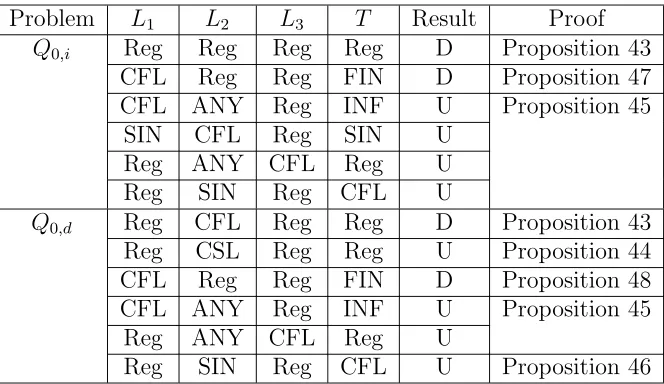
4.1 Decidability results of the problems Q0,i and Q0,d, where L1, L2, L3 are over a non-unary alphabet. SIN, FIN, INF, and CSL stand for a
singleton, a finite, an infinite, and a context-sensitive language,
respec-tively. ANY means that not depending on what L2 is, we can prove the undecidability results. . . 95
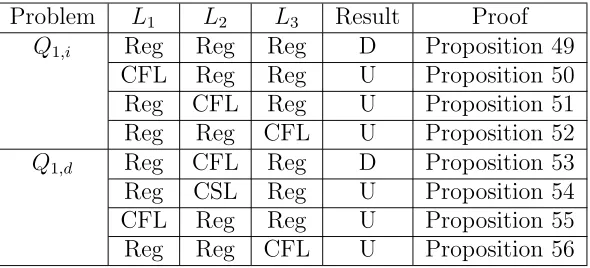
4.2 Decidability results of the problemsQ1,i andQ1,d, whereL1,L2,L3 are over a non-unary alphabet, and CSL stands for the family of
context-sensitive languages. . . 101
over a non-unary alphabet. . . 109
4.4 Decidability results of the problems Qw
2,i and Qw2,d, where L2 and L3 are over a non-unary alphabet. CSL and REC stand for the families
of context-sensitive languages and of recursive languages, respectively. 109
7.1 The state complexities of all the combinations of two basic operations,
where L1, L2, and L3 are accepted by DFAs of m, n, and p states, respectively. Note that we only list the most general case for each
combined operation in this table. . . 212
Chapter 1
Introduction
The study of language operations is a fundamental research area in automata and
formal language theory, and has played an essential role in understanding the
mecha-nisms of generating words and languages. Basic operations, such as catenation, star,
union, intersection, shuffle, quotient, etc., have been extensively studied in the
litera-ture. Many new operations have also been introduced either as generalizations of the
basic operations or motivated by some new applications. There are many research
di-rections related to language operations. For instance, the study of closure properties
of families of languages under a certain operation, the study of language equations
with respect to different operations, and state complexity.
This thesis tackles several research questions related to language operations in the
following areas: reversibility of operations, generalizations of (comma-free) codes,
generalizations of basic operations, language equations, and state complexity. Since
this thesis is formatted as integrated-article, each chapter follows a standard article
structure and is self-contained. Thus, in this chapter, we only briefly present the
background and major results on each topic, and leave the introduction of preliminary
1.1
Reversibility of operations and its role in
gen-eralizing comma-free codes
Among many research directions about operations, one particular topic of interest is
the reversibility of some operations, which was originally motivated by cryptography
applications: If one encrypts a plain-text message by the insertion of a key, and
decryption is accomplished by the deletion of the key, what are the language properties
that would ensure that the plain-text can be uniquely deciphered? In Chapter 2, we
investigate several questions in this framework, wherein the operations involved are
parallel insertion and deletion. We obtain a complete answer to this question for the
singleton case, i.e., for two words u, v ∈ Σ∗, under what conditions, after
parallel-inserting v into u, followed by the parallel deleting ofv from the result, do we obtain
exactly u? Then, we investigate the question for languages L1, L2 ⊆ Σ∗. We prove that, if L2 satisfies the condition L2ΣL2 ∩Σ+L2Σ+ = ∅, any language L1 can be recovered after first parallel-inserting L2 into L1, and then parallel-deleting L2 from the result.
The condition LΣL∩Σ+LΣ+ =∅ reminds us of the definition of comma-free codes, which is as follows: A nonempty setL⊆Σ+ is acomma-free codeif L2∩Σ+LΣ+ =∅. This leads us to defining the notion of comma codes as follows: We call a language
L⊆Σ+ acomma code if LΣL∩Σ+LΣ+ =∅. Note that unlike the comma-free code whereL2 consists of catenations of words inLnot separated by any “commas” (hence the term “comma-free”), in our definition, LΣL contains words in L separated by a
letter in Σ that acts as a “comma”, hence the name “comma code”. We prove that
comma codes are actually codes by establishing a relationship among comma-free
codes, comma codes, and infix codes, where a nonempty setL⊆Σ+ is called aninfix code if L∩(Σ∗LΣ+∪Σ+LΣ∗) =∅.
The notion of codes is not only crucial in cryptography, but also important in many
sys-tems, it is required that, if a message is encoded by using words from a code, then any
arbitrary catenation of words should be uniquely decodable into codewords. Various
codes [1, 40, 45] with specific algebraic properties, such as prefix codes, infix codes,
and comma-free codes have been motivated and defined for the above mentioned and
various other purposes.
In coding theory, the notion of comma-free codes was extended to the more general
one of intercodes [41, 46]. For m ≥1, a nonempty set L⊆Σ+ is called an intercode of index m if Lm+1 ∩Σ+LmΣ+ = ∅. It is clear that an intercode of index 1 is a comma-free code. Based on the similarity between the definition of comma code
and that of comma-free code, we generalize comma codes to comma intercodes. For
m ≥1, a nonempty set L⊆Σ+ is called a comma intercode of index m if (LΣ)mL∩
Σ+(LΣ)m−1LΣ+ =∅. It is immediate that a comma intercode of index 1 is a comma code. A language Lis called acomma intercodeif there exists an integer m≥1 such
that L is a comma intercode of indexm. Then, we prove that comma intercodes are
codes as well. Moreover, we obtain that the families of comma intercodes of index
m form an infinite proper inclusion hierarchy within the family of bifix codes, where
a nonempty set L ⊆ Σ+ is called a bifix code if L ∩LΣ+ = ∅ (prefix code) and
L∩Σ+L=∅ (suffix code). The first element of this hierarchy, the family of comma codes, is a subset of the family of infix codes, while the last element is a subset of the
family of bifix codes.
As seen in the definition of comma codes, even if we put an arbitrary letter between
each two codewords in the catenation of an arbitrary number of codewords, the
re-sulting string can still be uniquely decoded into original codewords. This property
reminds us of the encoding and decoding of genetic information in DNA. It is
com-monly assumed that, in DNA, genes that carry genetic information satisfy certain
coding properties so that they can be decoded and expressed uniquely and efficiently.
Recent developments in biology show that, although genetic information is encoded
formerly known as “junk segments”. Thus, it is not only of mathematical but also of
biological interest to generalize the notion of comma codes tok-comma codes, where
a comma (corresponding to a noncoding segment) is defined as a word of length k,
and no codeword (corresponding to gene or coding segment) is a subword of two other
codewords separated by a comma. Formally, for any k ≥ 0, a set L ⊆ Σ+ is called a k-comma code if LΣkL∩Σ+LΣ+ = ∅. Furthermore, we can generalize the notion of comma-free codes to a more general one ofk-spacer codes, which allow “commas”
between two codewords of lengths up to k ≥0. Formally, for any k ≥ 0, a language
L is called a k-spacer codeif LΣ≤kL∩Σ+LΣ+ =∅.
In Chapter 3, we prove that both k-comma codes and k-spacer codes are in fact
codes. Also, we generalize k-comma codes to k-comma intercodes in a similar way
of generalizing comma-free codes to intercodes. Moreover, we prove that k-comma
intercodes are indeed codes, and obtain some hierarchies of codes.
As a further advance, we define and study the notion of n-k-comma intercodes as a
generalization ofk-comma intercodes, following the research on the generalizations of
several types of codes in the literature. A languageL is ann-codeif every nonempty
subset of L of size at most n is a code. The original motivation for these codes
came from the analysis of 2-codes which had been shown to be the set of antichains
with respect to a partial order derived from anti-commutativity [11]. The authors
of [20] obtained several properties about the combinatorial structure of n-codes and
showed that these codes form an infinite proper inclusion hierarchy. Later, they
applied similar constructions to prefix and suffix codes, and obtainedn-ps-codes [21].
However, unlike the hierarchy of n-codes, the hierarchy of n-ps-codes collapses after
only three steps, and turned out to be finite. In [26], the authors generalized the
notions of intercodes to those of n-intercodes, established relationships among these
codes, and obtained an infinite inclusion hierarchy including both intercodes and n
-intercodes. In Chapter 3, we show that the families ofn-k-comma intercodes form an
1.2
Generalizations of basic operations and
lan-guage equations
One important research direction of language operations is to study generalizations of
basic operations. In the literature, several operations have been introduced as
general-izations of catenation. For example, sequential and parallel insertion and deletion [27],
k-insertion and k-deletion (introduced in [31] under the name of k-catenation and
k-quotient, respectively), synchronized insertion and deletion [10], distributed
cate-nation [32], mix operation [33], and shuffle and deletion on trajectories [13, 35, 29].
The notion of shuffle on trajectories was first introduced by Mateescu, Rozenberg,
and Salomaa [35] with an intuitive geometrical interpretation. It provides us with a
sequential syntactical control over the operation of insertion: a trajectory describes
how to insert the letters of a word into another word. As its left-inverse operation,
deletion on trajectories was independently introduced by Domaratzki [13], and Kari
and Sos´ık [29, 30]. The notion of inverse operations was first defined by Kari [28] for
solving language equations with an unknown language.
We consider two types of language equation problems: (1) equality test, i.e., “Can
we test the equality of a language obtained by performing an operation on some
languages with another language?”, and (2) existence of operand, for example, left
operand problems deal with the question of whether or not we can find a solution X
for the equationX⋄L2 =L3 whereL2 andL3 are given languages, and ⋄is a certain language operation. Note that right operand problems can be described analogously.
The essential role of the notion of inverse operations is very much like the role of
subtraction for solving equations such as x+a = b, where a, b are integers and x is
an unknown.
In order to solve a (left operand) language equation problem with respect to parallel
insertion defined in [27] in a more general framework, we generalize parallel insertion
inverse operation. These new operations provide us with a new framework to study
properties of language operations. With the parallel syntactical constraint provided
by trajectories, these operations properly generalize several sequential as well as
par-allel binary language operations such as catenation, sequential insertion, k-insertion,
parallel insertion, quotient, sequential deletion, k-deletion, etc.
Although we can easily verify that these new operations and shuffle and deletion
on trajectories generalize different sets of operations, we prove that block insertion
on trajectories can be simulated in two steps by using shuffle on trajectories and
substitutions, and similarly we can simulate block deletion on trajectories by using
deletion on trajectories and substitutions.
After obtaining several closure properties of the families of regular languages and
free languages under block insertion and deletion on regular and
context-free trajectory sets, we obtain several decidability results on the language equation
problems involving these new operations.
We investigate the equality test problems for block insertion and deletion on
trajec-tories under different conditions in Section 4.5.
Since we can consider trajectory sets as operands for block insertion and deletion
on trajectories, in Section 4.6, we investigate the language equation problems with
respect to the trajectory sets for both of the operations, i.e., the trajectory sets are
unknown and the other languages are given.
Lastly, in Section 4.7, we investigate language equation problems with respect to
the left operand for block insertion and deletion on trajectories, as well as its
1.3
State complexity of combined operations
State complexity [42] is a type of descriptional complexity based on the deterministic
finite automaton (DFA) model. Here we give the basic concepts about state
complex-ity. The state complexity of a regular languageL, denoted by sc(L), is the number of
states of the minimal complete DFA that accepts L. The state complexity of a class
S of regular languages, denoted by sc(S), is the supremum among all sc(L), L ∈S.
The state complexity of an operation on regular languages is the state complexity of
the resulting languages from the operation as a function of the state complexities of
the operand languages. For example, let L1 be an m-state DFA language and L2 be ann-state DFA language. The state complexity of the union ofL1 and L2 ismn, and it can be considered as a functionf(m, n) =mn. It is clear that the state complexity
of an operation is a type of worst-case complexity.
State complexity is not only interesting from the theoretical point of view, but also
has strong implications for automata applications. For example, it is important to
know the largest possible number of states we need to manipulate in an application,
since this number is usually restricted by memory limit or programming languages.
The general research method for obtaining the exact state complexity of an operation
is to find a matching pair of upper bound and lower bound. Usually, the upper bound
is obtained by theoretical analysis, and the lower bound is obtained from some worst
case examples. However, it is difficult to get a matching pair directly. Thus, we
often need several iterations of modifying either the upper bound or the examples
that prove the lower bound. During this process, we need the help of some software
that manipulates automata, such as Grail+, to test and verify whether or not some
candidate examples can prove a lower bound that matches a pre-obtained upper
bound. If not, we sometimes can get some intuition about how to modify either the
upper bound or the examples.
is that, without the help of computer software, it is very difficult to find worst case
examples that prove the lower bound of the state complexity of an operation.
After the publication by Yu, Zhuang, and Salomaa [44] in 1994, a large number
of papers have been published on the state complexity of individual operations, for
example, the state complexity of basic operations such as union, intersection,
cate-nation, star, reversal, etc. [14, 19, 22, 23, 36, 39, 43, 44], and the state complexity of
several other operations such as shuffle, orthogonal catenation, proportional removal,
and cyclic shift [2, 9, 12, 24]. For instance, the following table shows the exact state
complexity of five basic operations: union, intersection, catenation, reversal, and star.
Operations L1∪L2 L1∩L2 L1L2 LR1 L∗1 State Complexity mn mn m2n− 2n−1 2m 2m−1+ 2m−2
Table 1.1: The state complexity of basic operations on regular languages L1 and
L2 over an non-unary alphabet Σ, accepted by DFAs of m and n states, m, n ≥ 1, respectively. Note that these state complexities are obtained for general cases and can be lower in some special cases such as when one of m, nis 1.
Besides the study of state complexity of individual operations, the study of state
complexity of combined operations, which was initiated by A. Salomaa, K. Salomaa,
and S. Yu in 2007 [37], is considered to be another important direction. This is
because, in practice, the operation to be performed is often a combination of several
individual operations in a certain order, rather than only one individual operation.
For example, in order to obtain a precise regular expression, a combination of basic
operations is usually required. In recent publications [15, 16, 17, 18, 25, 34, 37], it has
been shown that the state complexity of a combined operation is not always a simple
mathematical composition of the state complexities of its component operations. For
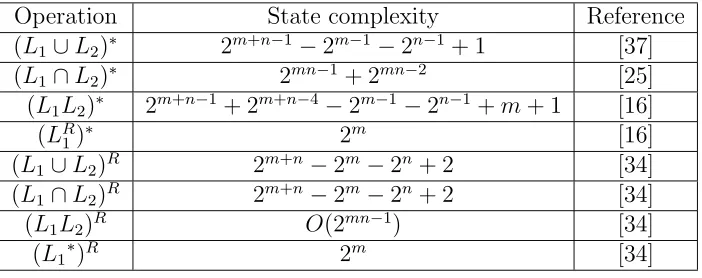
instance, as shown in Table 1.2, the state complexity of union combined with star
of intersection combined with star ((L1∩L2)∗) is exactly equal to the composition of the state complexities of intersection and star.
Operation State complexity Reference
(L1∪L2)∗ 2m+n−1− 2m−1− 2n−1+ 1 [37]
(L1∩L2)∗ 2mn−1+ 2mn−2 [25]
(L1L2)∗ 2m+n−1+ 2m+n−4− 2m−1 − 2n−1+m+ 1 [16] (LR
1)∗ 2m [16]
(L1∪L2)R 2m+n− 2m− 2n+ 2 [34] (L1∩L2)R 2m+n− 2m− 2n+ 2 [34]
(L1L2)R O(2mn−1) [34]
(L1∗)R 2m [34]
Table 1.2: The state complexity of several combined operations on regular languages
L1 and L2 over an non-unary alphabet Σ, accepted by DFAs of m and n states,
m, n ≥ 1, respectively. Note that these state complexities are obtained for general cases and can be lower in some special cases such as when one of m, n is 1.
From the results obtained in the literature, it seems that there is no general method
to compute the exact state complexity of combined operations. Thus, we need to
individually investigate the state complexity of some often used combined
opera-tions. It is clear that an initial and important step of the study of state complexity
of combined operations is to study the state complexity of combinations of two
ba-sic operations. Thus, in this thesis, we study and obtain the state complexity of
combinations of two basic operations that have not been investigated in the
litera-ture, namely the state complexity of the following combined operations,L1L∗2, L1LR2,
L1(L2∩L3),L1(L2∪L3), (L1L2)R,L∗1L2, LR1L2, (L1∩L2)L3, (L1∪L2)L3,L1L2∩L3, andL1L2∪L3 for regular languagesL1,L2, andL3. Note that we do not consider the combined operations (L1∪L2)∩L3 and (L1∩L2)∪L3, because it is clear that their state complexities are simply the compositions of the state complexities of union and
1.4
Structure of the thesis and co-authorship
This thesis consists of 6 co-authored research articles. Three of them were published
in conference proceedings and journals, two of them will be published in journals, and
one of them will be submitted to a journal. In this section, I present the co-authorship
and my contribution in each of the articles.
Chapter 2 contains the article, “On the reversibility of parallel insertion, and its
relation to comma codes”, [6], co-authored with Dr. Lila Kari and Dr. Shinnosuke
Seki. I initiated the research project and proved all the results. After that, Dr.
Shinnosuke Seki revised and shortened several proofs.
Chapter 3 contains the article, “K-comma codes and their generalizations”, [7],
co-authored with Dr. Lila Kari and Dr. Shinnosuke Seki. I initiated the research
project and proved all the results except for Proposition 31, which was proved by Dr.
Shinnosuke Seki. He also provided several comments for improvement.
Chapter 4 contains the article, “Block insertion and deletion on trajectories”, [8],
co-authored with Dr. Lila Kari and Dr. Shinnosuke Seki. I initiated this research project,
and introduced the notion of block insertion and deletion on trajectories. In the
original version of this paper, I proved all the closure properties using constructional
methods, and obtained most of the decidability results. Later, Dr. Shinnosuke Seki
established the relationships between these new operations and shuffle and deletion
on trajectories, and therefore shortened the proofs of the closure property results. It
is difficult to enumerate my results or his results, because this paper went through
several major revisions. So, I would say that I contributed at least half of the content
of this paper.
Chapter 5 contains the article, “State complexity of two combined operations:
catenation-star and catenation-reversal”, [3], co-authored with Dr. Yuan Gao, Dr. Lila Kari,
and Dr. Sheng Yu. I initiated this research project and my contribution to this
star (Section 5.3), lemmas 38 and 39, and a major part (the reachability proof) of
the proof of Theorem 12.
Chapter 6 contains the article, “State complexity of two combined operations:
catenation-union and catenation-intersection”, [4], co-authored with Dr. Yuan Gao, Dr. Lila
Kari, and Dr. Sheng Yu. My contribution to this paper is the section about the state
complexity of catenation combined with union (Section 6.3).
Chapter 7 contains our recently submitted manuscript, “State complexity of
com-bined operations with two basic operations”, [5], co-authored with Dr. Yuan Gao,
Dr. Lila Kari, and Dr. Sheng Yu. This research project is a continuation of our
research on state complexity of combined operations. My contribution to this project
includes the sections about the state complexities of L∗
Bibliography
[1] Berstel, J., Perrin, D.: Theory of Codes, Academic Press. Inc., Orlando, Toronto.
(1985)
[2] Campeanu, C., Salomaa, K., Yu, S.: Tight lower bound for the state complexity
of shuffle of regular languages, Journal of Automata, Languages and
Combina-torics, 7 (3) (2002) 303-310
[3] Cui, B., Gao, Y., Kari, L., Yu, S.: State complexity of two combined operations:
catenation-star and catenation-reversal, International Journal of Foundations of
Computer Science, accepted
[4] Cui, B., Gao, Y., Kari, L., Yu, S.: State complexity of two combined operations:
catenation-union and catenation-intersection, International Journal of
Founda-tions of Computer Science, accepted
[5] Cui, B., Gao, Y., Kari, L., Yu, S.: State complexity of combined operations with
two basic operations, submitted
[6] Cui, B., Kari, L., Seki, S.: On the reversibility of parallel insertion, and its
relation to comma codes, in: Proc. of CAI 2009, LNCS 5725, 204-219
[7] Cui, B., Kari, L., Seki, S.: K-comma codes and their generalizations,
[8] Cui, B., Kari, L., Seki, S.: Block insertion and deletion on trajectories,
Theoret-ical Computer Science,412 (2011) 714 - 728
[9] Daley, M., Domaratzki, M., Salomaa, K.: State complexity of orthogonal
cate-nation, in: Proc. of DCFS 2008, Charlottetown, PE, Canada, July 16-18, 2008,
134-144
[10] Daley, M., Ibarra, O., Kari, L.: Closure and Decidability Properties of Some
Language Classes with respect to Ciliate Bio-operations, Theoretical Computer
Science,306 (2003) 19-38
[11] Day, P.H., Shyr, H.J.: Languages defined by some partial orders, Soochow J.
Math,9 (1983) 53-62
[12] Domaratzki, M.: State complexity and proportional removals, Journal of
Au-tomata, Languages and Combinatorics,7 (2002) 455-468
[13] Domaratzki, M.: Deletion along trajectories, Theoretical Computer Science,320
(2004) 293-313
[14] Domaratzki, M., Okhotin, A.: State complexity of power, Theoretical Computer
Science,410 (24-25) (2009) 2377-2392
[15] ´Esik, Z., Gao, Y., Liu, G., Yu, S.: Estimation of state complexity of combined
operations, Theoretical Computer Science, 410 (35) (2009) 3272-3280
[16] Gao, Y., Salomaa, K., Yu, S.: The state complexity of two combined operations:
star of catenation and star of Reversal,Fundamenta Informaticae,83(1-2) (2008)
75-89
[17] Gao, Y., Yu, S.: State complexity approximation, in: Proc. of Descriptional
[18] Gao, Y., Yu, S.: State complexity of union and intersection combined with star
and reversal, Computing Research Repository, (2010) arXiv:1006.3755v1
[19] Holzer, M., Kutrib, M.: State complexity of basic operations on nondeterministic
finite automata, in: Proc. of International Conference on Implementation and
Application of Automata, LNCS 2608, 2002, 148-157
[20] Ito, M., J¨urgensen, H., Shyr, H. J., Thierrin, G.: Anti-commutative languages
and n-codes, Discrete Applied Math, 24 (1989) 187-196
[21] Ito, M., J¨urgensen, H., Shyr, H. J., Thierrin, G.: N-prefix-suffix languages,
Intern. J. Computer Math,30 (1989) 37-56
[22] Jir´asek, J., Jir´askov´a, G., Szabari, A.: State complexity of concatenation and
complementation of regular languages, International Journal of Foundations of
Computer Science,16 (2005) 511-529
[23] Jir´askov´a, G.: State complexity of some operations on binary regular languages,
Theoretical Computer Science,330 (2005) 287-298
[24] Jir´askov´a, G., Okhotin, A.: State complexity of cyclic shift, in: Proc. of DCFS
2005, Como, Italy, June 30-July 2, 2005, 182-193
[25] Jir´askov´a, G., Okhotin, A.: On the state complexity of star of union and star of
intersection, Turku Center for Computer Science TUCS Technical Report, No.
825, 2007
[26] J¨urgensen, H., Yu, S. S.: Relations on free monoids, their independent sets, and
codes, Intern. J. Computer Math, 40 (1991) 17-46
[27] Kari, L.: On Insertion and Deletion in Formal Languages, Ph.D. Thesis,
[28] Kari, L.: On language equations with invertible operations, Theoretical
Com-puter Science,132 (1994) 129-150
[29] Kari, L., Sos´ık, P.: Language deletion on trajectories, Technical Report,
Univer-sity of Western Ontario, 606 (2003)
[30] Kari, L., Sos´ık, P.: Aspects of shuffle and deletion on trajectories, Theoretical
Computer Science,331 (2005) 47-61
[31] Kari, L., Thierrin, G.: K-catenation and applications: k-prefix codes, Journal
of Information and Optimization Sciences,16 (2) (1995) 263-276
[32] Kudlek, M., Mateescu, A.: On distributed catenation, Theoretical Computer
Science,180 (1997) 341-352
[33] Kudlek, M., Mateescu, A.: On mix operation.New Trends in Formal Languages,
G. Pˇaun and A. Salomaa, Eds., LNCS, 1218 (1997) 35-44
[34] Liu, G., Martin-Vide, C., Salomaa, A., Yu, S.: State complexity of basic language
operations combined with reversal, Information and Computation, 206 (2008)
1178-1186
[35] Mateescu, A., Rozenberg, G., Salomaa, A.: Shuffle on trajectories: syntactic
constraints, Theoretical Computer Science, 197 (1998) 1-56
[36] Pighizzini, G., Shallit, J.: Unary language operations, state complexity and
Ja-cobsthal’s function, International Journal of Foundations of Computer Science,
13 (1) (2002) 145-159
[37] Salomaa, A., Salomaa, K., Yu, S.: State complexity of combined operations,
Theoretical Computer Science,383 (2007) 140-152
[38] Salomaa, A., Salomaa, K., Yu, S.: Undecidability of the state complexity of
composed regular operations, in: Proc. of International Conference on Language
[39] Salomaa, A., Wood, D., Yu, S.: On the state complexity of reversals of regular
languages, Theoretical Computer Science,320 (2004) 293-313
[40] Shyr, H. J.: Free Monoids and Languages. Lecture Notes, Institute of Applied
Mathematics, National Chung-Hsing University, Taichung, Taiwan. (2001)
[41] Shyr, H. J., Yu, S. S.: Intercodes and some related properties, Soochow J. Math,
16 No.1 (1990) 95-107
[42] Yu, S.: Regular languages, in: Rozenberg, G., Salomaa, A. (Eds.), Handbook of
Formal Languages, Vol. 1, Springer-Verlag, 1997, 41-110
[43] Yu, S.: State complexity of regular languages, Journal of Automata, Languages
and Combinatorics, 6 (2) (2001) 221-234
[44] Yu, S., Zhuang, Q., Salomaa, K.: The state complexity of some basic operations
on regular languages, Theoretical Computer Science,125 (1994) 315-328
[45] Yu, S. S.: Languages and Codes, Lecture Notes, Department of Computer
Sci-ence, National Chung-Hsing University, Taichung, Taiwan 402. (2005)
[46] Yu, S. S.: A characterization of intercodes,Intern. J. Computer Math,36(1990)
Chapter 2
On the Reversibility of Parallel
Insertion, and Its Relation to
Comma Codes
Abstract
This paper studies conditions under which the operation of parallel insertion can be
reversed by parallel deletion, i.e., when does the equality (L1 ⇐L2)⇒L2 =L1 hold for languages L1 and L2. We obtain a complete characterization of the solutions in the special case when both languages involved are singleton words. We also define
comma codes, a family of codes with the property that, if L2 is a comma code, then the above equation holds for any language L1 ⊆Σ∗. Lastly, we generalize the notion of comma codes to that of comma intercodes of index m. Besides several properties,
we prove that the families of comma intercodes of index m form an infinite proper
inclusion hierarchy, the first element which is a subset of the family of infix codes,
2.1
Introduction
In combinatorics on words and formal language theory, operations play an essential
role in understanding the mechanisms of generating words and languages. Several
generalizations of catenation and quotient, such as shuffle, shuffle on trajectories, [14],
sequential and parallel insertion and deletion, [5], distributed catenation, [10], mix
operation, [11], deletion on trajectories, [2], and hairpin completion and reduction,
[13], have been studied in the literature. Follow-up studies investigated properties of
languages produced by sequential and parallel insertion and deletion in [3, 6, 7, 8, 9].
One particular topic of interest was the reversibility of some of these operations,
originally motivated by cryptography applications: If one uses the insertion of a key
as one component of a cryptosystem to encrypt a plain-text message, and one step of
decryption is accomplished by the deletion of the key, what are the language properties
that would ensure that the plain-text can be uniquely deciphered? Motivated by
this potential application, the determinism and inversibility of insertion and deletion
operations on words were studied in, e.g., [6].
The question can be asked in a more general framework wherein the operations
in-volved are the parallel insertion and deletion. This paper represents a first step
towards an answer. More precisely, similar to sequential insertion and deletion, if we
parallel-delete a word v from the language obtained by parallel-inserting v into u, we
will not always obtain u. Thus, the question we ask is “Under what conditions, after
parallel-inserting v into u, followed by the parallel deletion of v from the result, do
we obtain exactly u?”.
In Sect. 2.3, after the investigation of various properties of parallel insertion and
deletion, we give a complete answer to this question for the singleton case, and
The notion of codes was defined for applications in communication systems. That is,
if a message is encoded by using words from a code, then any arbitrary catenation
of words should be uniquely decodable into code-words. Various codes with specific
algebraic properties, such as prefix codes, infix codes, and comma-free codes [1, 16, 17],
have been defined and used for various purposes. In Sect. 2.4, we define a family of
codes, namedcomma codes, and show that this family is a proper subfamily of that of
infix codes. Also, we give a characterization of comma codes, obtain some closure and
algebraic properties, as well as compare the comma code family with other families,
such as that of comma-free codes and that of solid codes.
Based on the similarity between the definition of comma codes and that of comma-free
codes, in Sect. 2.5, we generalize comma codes and introduce the notion of comma
intercodes. Similar to the notion of intercodes [16, 17, 18], the families of comma
intercodes of index m form a proper inclusion hierarchy within the family of bifix
codes. However, we show that any two families of intercodes and comma intercodes
are incomparable.
2.2
Preliminaries
An alphabet Σ is a nonempty finite set of letters. A word over Σ is a sequence of
letters in Σ. The length of a word w, denoted by |w|, is the number of letters in this
word. The empty word, denoted by λ, is the word of length 0, while a unary word is
a word of the form aj, j ≥ 1, a ∈ Σ. The set of all words over Σ is denoted by Σ∗,
and Σ+ = Σ∗\ {λ} is the set of all nonempty words. A language is a subset of Σ∗. A
language with exactly one word is called asingleton. In this paper, for a wordw∈Σ∗,
A word x∈Σ∗ is called an infix (prefix, suffix) of a word u∈Σ+ if u=zxy (u=xy,
u =zx) for some words y, z ∈ Σ∗. In this definition, if z and y are nonempty, then
such an x is called a properinfix, prefix, or suffix of u. For a word u∈Σ∗, the set of
its infixes (prefixes, suffixes) is denoted by F(u) (resp. Pref(u), Suff(u)). For a word
u ∈ Σ∗, we denote the prefix (suffix) of length n ≥ 0 by pref
n(u) (resp. suffn(u)).
These notations can be naturally extended to languages, e.g., Pref(L) is the set of
prefixes of the words in L.
A nonempty wordu∈Σ+is said to beprimitiveifu=vnimpliesn= 1 and u=v for
any v ∈Σ+. Any non-primitive word can be written as a power of a unique primitive word [16], which is called the primitive root of the word.
It is well known that [16], if nonempty words x, y, z ∈Σ+ satisfyxy =yz, then there exist α, β ∈Σ∗ such that αβ is primitive, x = (αβ)i, y = (αβ)jα, and z = (βα)i for
some i≥1 and j ≥0.
A nonempty word u ∈ Σ+ is called bordered if there exists a nonempty word which is both proper prefix and proper suffix of u. Abordered primitive word is a primitive
word which is bordered, and it can be written as xyx for some x, y ∈Σ+ [16].
Parallel insertion and deletion on words and languages are variants of well-known
(sequential) insertion and deletion, introduced in [5]. For two words u, v ∈ Σ∗, the
parallel insertion of v into u results in a word va1va2· · ·anv, where u = a1a2· · ·an
for letters a1, . . . , an ∈ Σ. We denote this resulting word by u ⇐ v. This operation
can be generalized to languages as follows: for two languagesL1, L2 ⊆Σ∗, theparallel insertion of L2 into L1 generates a language
L1 ⇐L2 =
[
n≥1,a1, . . . , an∈Σ s.t. a1a2· · ·an ∈L1
Example 1 For L1 ={cd} and L2 ={a, b},
L1 ⇐L2 = L2cL2dL2
= {acada, acadb, acbda, acbdb, bcada, bcadb, bcbda, bcbdb}.
In contrast, the parallel deletion of a language L2 from another language L1 results in a set of words which can be obtained by deleting elements of L2 from an element of L1 in a “maximal parallel manner”. We denote the resulting set by L1 ⇒L2. For
u∈L1, let
u⇒L2 =
u1u2· · ·ukuk+1|u1, . . . , uk+1 ∈Σ∗, k ≥1,u∈u1L2u2L2· · ·L2uk+1 and F(ui)∩(L2\ {λ}) = ∅ for all 1≤i≤k+ 1 .
By this definition, it is clear that if u does not contain any word in L2 as its infix, then u⇒L2 =∅. Then we define L1 ⇒L2 =Su∈L1(u⇒L2).
Example 2 Let L1 ={abababa, aababa, abaabaaba} and L2 ={aba}. Then
L1 ⇒L2 = ({abababa} ⇒ L2)∪({aababa} ⇒L2)∪({abaabaaba} ⇒L2)
= {b, abba} ∪ {aba, aab} ∪ {λ}={b, abba, aba, aab, λ}.
2.3
When does
(
L
1⇐
L
2)
⇒
L
2equal
L
1?
By definitions, parallel insertion and deletion are not inverse operations in the sense
that L1 may not equal to (L1 ⇐ L2) ⇒ L2. Thus, a question of interest is to find under what conditions does the equality (L1 ⇐ L2) ⇒ L2 = L1 hold. We start by providing some properties of parallel insertions and deletions relevant to this question.
are singleton words. The next theorem will show that, unless w and u are unary
words over the same letter, w⇐u is primitive.
Lemma 1 Let u∈Σ+ and u
s∈Suff(u). If usau∈Pref(u2) for some a∈ Σ, then u
is a power of a.
Proof: Due to the assumption, u=usau′p =up′usa for some u′p ∈Σ∗. It well known
that, for two words u, v ∈ Σ+, if uv = vu, then they share their primitive roots. Therefore, the primitive root of u is same as that of usa. Hence, if us is empty, it is
clear that u∈a+. Even, otherwise, since u
s∈Suff(u′pusa),us is a power ofa. Thus,
this lemma holds. 2
Theorem 1 Let u, w∈Σ+. Thenw⇐u is not primitive if and only if w andu are unary words over the same letter a∈Σ.
Proof: The if-direction is trivial. So we consider here the only-if direction under the
assumption that w ⇐ u is non-primitive. Then w ⇐ u overlaps with its square in
a nontrivial way. Let w = a1a2. . . an for some n ≥ 1 and a1, . . . , an ∈ Σ. Also let
w ⇐ u = vk for some v ∈ Σ+ and k ≥ 2. In the following, we prove that in all possible cases v is a unary word, which trivially implies what we want.
Firstly we consider the case when there is an integer ℓ such that ua1· · ·uaℓ =vi for
some i≥1, which further implies that ua1· · ·uaℓ=an−ℓ+1u· · ·anu. In this case, we
can always find such ℓ in the range⌈n/2⌉ ≤ℓ. For such ℓ, this equation implies that
all of a1, . . . , an are the same, say a, andv is a power of a. If |u|= 1, this is always
the case so that all we have to consider is the case|u| ≥2 under the assumption that
such ℓ cannot be found. Note that then we cannot find an integer ℓ′ ≥ 0 such that
ua1· · ·aℓ′u is a power of v, either.
Under the assumption, one of the occurrences of uinw⇐u overlaps with the factor
u2 of (w⇐u)2 nontrivially (x 6=λ and y 6=λ in Fig. 2.1.) As shown there, we have
over am longer than 1. Note that the overlap between w⇐ u and its square implies
that for all 1≤i≤n, ai =an because these characters in w⇐u must be contained
within some uin (w⇐u)2. 2
an a1
am
x y
us
u u u u
u u
Figure 2.1: Howuamuoverlaps with uanu2
As mentioned before, (L1 ⇐L2)⇒L2 =L1 is not always the case. Even if we limit
L1 and L2 to be singletons {w} and {u}, (w⇐u)⇒u can contain words except w. Since parallel insertion of a word into another word certainly generates a singleton,
it is the parallel deletion that creates such words. We initiate our investigation on
this problem with a more general question: under what conditions, parallel deletion
results in a singleton.
Note thatw⇒u=∅if and only ifwdoes not containuas its infix. In the following,
we only consider cases wherewcontainsuas its infix. Also, note that two occurrences
of u in w have to overlap in a nontrivial manner forw ⇒u not to be a singleton. If
u is unbordered, two occurrences of u never overlap non-trivially regardless of what
w is. Thus we have the following proposition.
Proposition 1 If u ∈ Σ∗ is unbordered, then w ⇒ u is a singleton for any word
w∈Σ∗ that contains u as its infix.
This also suggests that, even for a bordered wordu,w⇒u is at most a singleton as
long as the form of wguarantees that nontrivial overlaps between u’s do not occur in
it. We will give a necessary and sufficient condition for w ⇒ u to be a singleton in
the case when w and u share the same primitive root.
Proposition 2 For a∈Σ, let w=aj and u=ak for some j ≥k ≥1. Then w⇒u
Proof: We consider the if-direction first. If k = 1, then this operation results in a
singleton of the empty word. If j < k, then we cannot delete any u from w so that
w ⇒ u = {w}. If k ≤ j ≤ 2k − 1, then by the definition of parallel deletion, the
operation deletes exactly oneufromw, and hencew⇒u={aj−k}. In the case when
j = 3k− 1, we letw=ai1akai2 for some 0≤i
1 < k. Then k ≤i2 ≤2k− 1. We know that ai2 ⇒u ={ai2−k}. Hence w⇒u is a singleton.
On the other hand, we show that if k and j do not satisfy these conditions, then
w ⇒ u contains at least two elements. If 2k ≤ j ≤ 3k − 2, then it is clear that
we can delete two u’s from w. In addition, we can write w as ak−1akaj−2k−1. Since
j− 2k− 1< k, ak−1aj−2k−1 is also included in w⇒u. In the case 3k ≤j, note that (a2k ⇒ u)(aj−2k ⇒ u) ⊆ w ⇒ u. We know that (a2k ⇒ u) is not a singleton, and
hence w⇒ucannot be a singleton. 2
Since a primitive word cannot be a proper infix of its square [17], this proposition has
the following corollary.
Corollary 1 Letw=gj andu=gk for some primitive word g and j ≥k ≥1. Then
w⇒u is a singleton if and only if either k = 1, k ≤j ≤2k, or j = 3k− 1.
Next we consider the more general case when w and u may have distinct primitive
roots. If the primitive root of u is unbordered, then we can give a condition similar
to the one given in Proposition 2. The proof for this proposition works to prove the
next proposition.
Proposition 3 Let w ∈ Σ∗ and u = gk for some unbordered primitive word g and
k ≥1. If the following condition holds, then w⇒u is a singleton.
(Condition) whenever w = wpgjws for some wp, ws ∈ Σ∗ with g 6∈ Suff(wp) and
g 6∈Pref(ws), and j ≥1, either k = 1, k ≤j ≤2k− 1, or j = 3k− 1.
L1 ={w}andL2 ={u}. Hence our first aim is to clarify when (w⇐u)⇒udoes not contain any word other thanw. If eitherworuis the empty word, then (w⇐u)⇒u
is always{w}. Therefore in the remainder of this paper we will assume, without loss
of generality, that u and w are nonempty. Let w = a1a2· · ·an for some n ≥ 1 and
a1, . . . , an ∈ Σ. In order for the parallel deletion to create another word besides w,
there must exist at least two different ways to parallel-delete the occurrences of u
from w⇐u. In other words, we have to delete some occurrences of u that have not
been parallel-inserted into w. Formally speaking, u has to be a proper infix of uaiu
for some 1≤i≤n. Based on this idea, we define the set:
X = u∈Σ+ |prefx(u)= suff6 x(u) or prefy(u)6= suffy(u)
for any (x, y)∈N2 with x+y+ 1 =|u| .
Informally, X contains words u which cannot be proper infixes of ubu for any letter
b∈Σ. For such words u∈X, there cannot exist two different ways to parallel-delete
the occurrences of ufrom w⇐u, and hence we have the following result.
Proposition 4 If u∈X, then (w⇐u)⇒u={w} for any w∈Σ∗.
In the following, we give a characterization ofX. First of all, no unary word can be in
X. By the informal definition ofX, the set of all unbordered words of length at least
2, denoted by U>1, is a subset of X. Let N
(>1) denote the set of all non-primitive words whose primitive root is of length at least 2. The next result shows that no
word u in N(>1) can be a proper infix ofubu, for any b ∈Σ.
Lemma 2 N(>1) ⊆X.
Proof: Suppose that there were u ∈ N(>1) such that u 6∈ X. Let u = gi for some primitive word g of length at least 2 and i > 1. Also we can let u= usaup for some
inside one and only one of these g’s. Since g2 cannot overlap with g in any nontrivial way, either us orup is a power ofg. We only consider the case when us=gj for some
j ≥1; the other can be proved in a similar way. Thenaup =gi−j. Sinceup ∈Pref(gi),
this means g is a power ofa, a contradiction with the primitivity ofg. 2
LetQB be the set of all bordered primitive words. Any word inQB can be written as
w= (αβ)kα for some primitive word αβ, and k ≥1. We partition Q
B into two sets.
The first one, Q(=1)B , denotes the set of all bordered primitive words w that can be written as (αβ)kα with |β|= 1. The second one is simply the complement, Q(>1)
B =
QB\Q(=1)B . For example, aaabaa, abbabba ∈ Q
(>1)
B while aabaabaa ∈ Q
(=1)
B . This is
because even though we can regard aabaabaaasαβα withα =a andβ =abaaba, we
can also consider it as (α′β′)2α′, where α′ =aa and β′ =b.
The next result shows that every bordered primitive word wthat can only be written
as (αβ)kα such that αβ is primitive, k ≥1, and|β|cannot be 1, cannot be a proper
infix of waw for any a∈Σ. Formally, we have
Lemma 3 Q(B>1) ⊆X.
Proof: Suppose that there exists u ∈Q(B>1) but u 6∈X. This means that u=usaup
for some us ∈ Suff(u) and up ∈ Pref(u) and a, b ∈ Σ such that u = upbus. The
Parikh vector of a word contains the occurrences of each letter in Σ. Since the
Parikh vectors of up and us together contain the same number of occurrences of
each letter in usaup and upbus, we can obtain a = b and hence u = upaus. Due
to a well known result mentioned in Sect. 2.2, there exist α, β ∈ Σ∗ such that
usa = (αβ)i and up = α(βα)j for some i ≥ 1 and j ≥ 0 and βα is primitive. Then
ua = upausa = upa(αβ)i = α(βα)i+ja, and hence the suffix of length |αβ|+ 1 of
ua is bαβ = βαa. Again, based on the Parikh vector of this suffix, b = a, i.e.,
aαβ =βαa. Note that|β| ≥2 because u∈Q(B>1) and hence a is a proper suffix ofβ. Therefore, this equation means that βα overlaps with its square in a nontrivial way,
The next result states that any word w that is either a unary word or a bordered
primitive word that can be written as (αβ)kα with αβ being primitive, k ≥ 1, and
|β|= 1, can be a proper infix ofwaw for some a ∈Σ.
Lemma 4 Q(=1)B ∪ {ai |a ∈Σ, i≥1}∩X =∅.
Proof: As mentioned above, any unary word cannot be in X. Let w ∈ Q(=1)B . By definition, there exist α ∈ Σ+ and b ∈ Σ such that αb is primitive and w = (αb)kα
for some k ≥1. Then w is a proper infix of wbw, and hence w6∈X. 2
The next proposition characterizes the set of all wordsuthat cannot be a proper infix
of uau for any a ∈Σ, as being either unbordered words of length greater than 1, or
bordered primitive words of the form (αβ)kα such that αβ is primitive, k ≥ 1, and
|β| cannot be 1, or non-primitive words whose primitive root has length longer than
1.
Proposition 5 X =U>1∪Q(>1)
B ∪N(>1).
Proof: Note that Σ+ =U>1∪Q
B∪N(>1)∪ {ai |a∈Σ, i≥1}. Combining Lemmas
2, 3, and 4 together, we can reach this proposition. 2
As mentioned in Proposition 4, u being an element of X is sufficient for it to satisfy
(w⇐u)⇒ u={w}for any wordw. In the following, we give necessary and sufficient
conditions for the equality to be true in the case when u 6∈ X, that is, either u is
unary or u∈Q(=1)B .
Proposition 6 Let w ∈ Σ∗ and u = ak for some a ∈ Σ and k ≥ 1. Then (w ⇐
u)⇒u={w} if and only if
1. if k = 2, then aa6∈ F(w);
Proof: If w contains aa as its infix, then a3k+2 ∈ F(w ⇐ u). Proposition 3 implies that (w ⇐ u) ⇒ u is not a singleton. Next we consider the case when w contains
no aa but a as its infix, and k = 2. Then a5 ∈ F(w ⇐ u). Since 5 = 3k − 1, (w⇐u)⇒ uis a singleton due to the proposition. It is clear that forw∈(Σ\ {a})∗,
(w⇐u)⇒ u={w}. 2
Having considered the case ofubeing unary, now the only one remaining case is when
u is an element of Q(=1)B . For such a word u, there exist α ∈ Σ+, b ∈ Σ, and k ≥ 1 such thatu= (αb)kα. We defineM
u ={a∈Σ|u∈Suff(u)aPref(u)}. By definition,
Mu 6=∅ if and only ifu6∈X.
Lemma 5 For a bordered primitive word u, if b ∈Mu, then there exists a nonempty
word α ∈Σ+ such that u=α(bα)k for some k ≥1 and αb is primitive.
Proof: Sinceb ∈Mu,u =upbus=usbup for someup, us∈Σ∗. Thenusb= (αβ)i and
up =α(βα)j for somei≥1,j ≥0, and α, β ∈Σ∗ such that αβ is primitive. Suppose
that α were empty. Then u = βi+j. On one hand, i+j has to be 1 because u is
primitive; on the other hand,i+j ≥2 because up cannot be empty, otherwise, uis a
unary word over b longer than 2. Thus, α is nonempty. So ub=upbusb=α(βα)i+jb,
and henceb(αβ)i = (βα)ib. Sinceαβ is primitive, β has to be of length 1, and hence
β =b. 2
Lemma 6 For u∈Q(=1)B , |Mu| = 1.
Proof: Suppose |Mu|> 1, say two distinct characters b, d are in Mu. Then Lemma
5 implies that u = α(bα)i = γ(dγ)j for some i, j > 0 and α, γ ∈ Σ∗ such that both
αb and γd are primitive. Without loss of generality, we assume |αb| > |γd|. Then
by Fine-and-Wilf’s theorem [12], i = 1. Hence u = αbα =γ(dγ)j. If j is odd, then
clearly b =d, a contradiction. Otherwise, α = (γd)j/2γ
p = γs(dγ)j/2 and γ = γpbγs
for someγp, γs ∈Σ∗ of same length. Then we have (γd)j/2−1γdγp =γs(dγ)j/2−1dγpbγs,
Proposition 7 Let u∈Q(=1)B . Then (w⇐u)⇒u={w} for w∈Σ+ if and only if
w∈(Σ\Mu)+.
Proof: If w does not contain any letter in Mu, then it is clear that (w⇐u)⇒u=
{w}.
We prove the converse implication. Due to Lemmas 5 and 6, Mu = {b} and there
exists α ∈ Σ+ such that u = α(bα)k for some k ≥ 1 and αb is primitive. Let
w = a1· · ·an for some n ≥ 1 and ai ∈ Σ for all 1 ≤ i ≤ n, and assume that w
contains b. Then we can find an integer 1 ≤ m ≤ n such that am−1 6= b (if any),
am =· · ·=am+j−2 =b, and am+j−1 6=b (if any) for somej ≥2. Now
w⇐u=ua1· · ·uam−1[α(bα)kbα(bα)kb· · ·bα(bα)k]am+j−1u· · ·anu.
We can parallel-deleteu’s from the bracketed infix in two ways: one is to delete j u’s
that were actually inserted by the preceding insertion; the other is to leave the first
αβ and deleteufrom every (k+1)|αβ|position. Note that in the latter way, we delete
exactly j − 1u’s. If in both cases, we parallel-delete the inserted u’s from the prefix
and suffix, then we obtain two distinct words w, a1· · ·am−1αbbj−2(bα)kam+j−1· · ·an.
We still need to check that the latter parallel deletion is valid. For that, it is enough
to check that neither am−1αb or (bα)kam+j−1 contain u. Their lengths are at most |u| so that if one of them contains u, then it is u itself. However, this is not the case
because of the primitivity of αband α6=λ. 2
Since
u∈Σ+=N(>1)∪ {aa+|a∈Σ}
| {z }
non-primitive
∪Σ∪U>1∪Q(=1)B ∪Q(B>1)
| {z }
primitive
,
Propositions 4, 5, 6, 7 completely characterize the solutions to the equation (w ⇐
u)⇒u={w}.