Scholarship@Western
Scholarship@Western
Electronic Thesis and Dissertation Repository
6-21-2011 12:00 AM
A Social Relations Analysis of Transactive Memory in Groups
A Social Relations Analysis of Transactive Memory in Groups
Sarah J. Ross
University of Western Ontario Supervisor
Natalie Allen
The University of Western Ontario
Graduate Program in Psychology
A thesis submitted in partial fulfillment of the requirements for the degree in Doctor of Philosophy
© Sarah J. Ross 2011
Follow this and additional works at: https://ir.lib.uwo.ca/etd
Part of the Industrial and Organizational Psychology Commons
Recommended Citation Recommended Citation
Ross, Sarah J., "A Social Relations Analysis of Transactive Memory in Groups" (2011). Electronic Thesis and Dissertation Repository. 172.
https://ir.lib.uwo.ca/etd/172
This Dissertation/Thesis is brought to you for free and open access by Scholarship@Western. It has been accepted for inclusion in Electronic Thesis and Dissertation Repository by an authorized administrator of
A SOCIAL RELATIONS ANALYSIS OF TRANSACTIVE MEMORY IN GROUPS
(Spine title: Social Relations Analysis of Transactive Memory)
(Thesis format: Monograph)
by
Sarah J. Ross
Graduate Program in Psychology
A thesis submitted in partial fulfillment of the requirements for the degree of
Doctor of Philosophy
The School of Graduate and Postdoctoral Studies The University of Western Ontario
London, Ontario, Canada
ii
THE UNIVERSITY OF WESTERN ONTARIO
SCHOOL OF GRADUATE AND POSTDOCTORAL STUDIES
CERTIFICATE OF EXAMINATION
Supervisor
______________________________ Dr. Natalie Allen
Supervisory Committee
______________________________ Dr. Lorne Campbell
______________________________ Dr. Joan Finegan
Examiners
______________________________ Dr. Lorne Campbell
______________________________ Dr. John Meyer
______________________________ Dr. Fernando Olivera
______________________________ Dr. Chet Robie
The thesis by
Sarah Jane Ross
entitled:
A Social Relations Analysis of Transactive Memory in Groups
is accepted in partial fulfillment of the requirements for the degree of
Doctor of Philosophy
iii ABSTRACT
Transactive memory is the knowledge of what others in a group know and the exchange
of that knowledge. In groups with effective transactive memory systems, members know
“who knows what”, send knowledge to the appropriate individuals, and develop
strategies for retrieving that information (Mohammed & Dumville, 2001; Wegner, 1995).
Transactive memory studies tend to focus on the group as a whole, but useful information
might be gathered by investigating transactive memory in dyads within groups. The
purpose of this research was to use the social relations model (Kenny & LaVoie, 1984) as
the basis for operationalizing transactive memory and to examine this new
operationalization of transactive memory as it related to group performance. In social
relations model terms, an effective transactive memory system was operationalized as
consensus about expertise and knowledge seeking. Data were collected from two
samples of student engineering project groups (n = 55 groups and n = 77 groups) and a
sample of organizational engineering project groups (n = 7 groups). Groups whose
members had spent significant time working together were hypothesized to have effective
transactive memory systems and to exhibit significant consensus. Groups whose
members had spent relatively less time with one another were hypothesized to have
poorer transactive memory systems and to make use of unique relations in the group and
assimilation as the basis for identifying expertise. The hypotheses were partially
supported. In groups whose members spent relatively more time together, there was
some agreement about who was expert and from whom to seek knowledge; however,
knowledge exchange tended to be mostly based on seeking knowledge from no one or
iv
relationships with particular others when identifying expertise and seeking knowledge.
In fact, members of groups that performed better were likely to exchange knowledge
based on their unique dyadic relationships with others. This study advances earlier
research on transactive memory by suggesting that dyadic relations within groups are
important to fully understanding transactive memory and its relationship with
performance.
v
ACKNOWLEDGEMENTS
Although only one name graces the cover of a dissertation, so many people make
that dissertation possible. I would especially like to thank my advisor, Natalie Allen.
Natalie has played various roles in our supervisor-student dyad—she has mentored,
advised, reassured, and supported me throughout my years as a graduate student. I am
forever grateful for her understanding as I tackled parenthood and a full time job at the
same time as my dissertation. The compassion and understanding that Natalie provided
made the balance of work, family, and school possible.
This dissertation certainly would not exist without my student and organizational
samples. I am grateful to the Faculty of Engineering organizers and instructors for
working with us over the past few years to provide a source for data collection for my
project and for others. To all of the organizations whose employees were willing to
complete my lengthy questionnaires—thank you for taking a chance with this study. In
particular, a huge thank you to the engineering organization that participated in my final
study. The time and effort that you put into this project was incredible, and the passion
that you put into your own work inspired me.
I am so grateful for all of the wonderful members of The TeamWork Lab— Kevin
Doyle, Helen Lee , Tom O’Neill, and Hayden Woodley—who helped so much with data
collection that this dissertation truly would not be possible without them. Kevin was
particularly helpful in orchestrating data collection for one of my studies and answering
vi
To the members of my various committees—Joan Finegan, Lorne Campbell, John
Meyer, Fernando Olivera, and Chet Robie. Thank you for the time you took to review
my work. Your wonderful comments helped to make my dissertation better.
To Justin Veenstra for his prompt, clear, and helpful stats advice. I know few
people quicker to respond to e-mails about stats. I am very grateful to Justin for helping
me to work through alternative methods for analyzing my data.
To everyone at work— Dr. Elizabeth Finger, Dr. Stephen Pasternak, Dr. Sarah
Morrow, Sarah Jesso, Kathy Ayers, Darlene ten Haaf, Jack Morlog, and Darlyne
Morlog—for aiding with ideas for new samples and allowing me the time and flexibility
to pursue this dissertation. This thesis was made much easier with your support.
To my parents, grandparents, aunts, and uncles—for taking Kyla for sleepovers
when I had to enter data, for showing interest in what I do, for being excited to brag about
my dissertation to everyone they know, and for listening to my complaints over the years.
Thanks for being there to listen and provide advice.
To my incredible daughter, Kyla—your smiles, laughter, tears, witty comments,
hugs, kisses, and even the temper tantrums were a welcomed distraction from conducting
analyses and writing lit reviews. You mean the world to me. Finally, to my wonderful
husband, Fred. I can’t thank you enough for everything you have been through with me
over the past few years as I completed my dissertation and we started a family. You
provided advice when I was unsure and encouraged me when I wanted to give up. I
vii
TABLE OF CONTENTS
CERTIFICATE OF EXAMINATION……….. II
ABSTRACT……… III
ACKNOWLEDGEMENTS……… V
LIST OF TABLES……….. IX
LIST OF APPENDICES……… XI
INTRODUCTION………. 1
TRANSACTIVE MEMORY THEORY……….. 4
EMPIRICAL RESEARCH……….. The Pioneering Studies……… The Expertise Recognition Studies………. The Experience-in-Groups Studies………. The Development Studies……… The Field Studies……….
6 6 11 14 19 21
TRANSACTIVE MEMORY MEASUREMENT……… Level……… Format……….. Content……… Summary……….. 22 22 30 31 33
SOCIAL RELATIONS MODEL………. The Round-Robin Design……… Actor, Partner, and Relationship Effects………. Actor, Partner, and Relationship Variance……….. Assumptions and Considerations………. Suitability of the Social Relations Model………
TRANSACTIVE MEMORY AND THE SOCIAL RELATIONS MODEL..
34 35 35 36 37 40 41
CURRENT RESEARCH……… 44
viii
DISCUSSION……….. 49
STUDY 2……… METHOD………. Participants……….. Task……….. Measures……….. RESULTS………. Analyses………... Findings………... DISCUSSION………. 51 57 57 58 59 61 61 62 77 STUDY 3……… METHOD……… Participants………. Task………. Measures……….. RESULTS………. Analyses……….. Findings………... DISCUSSION……….. 80 83 83 83 84 85 85 87 95 STUDY 4……… METHOD………. Participants……….. Measures……….. RESULTS………. DISCUSSION………. 97 98 99 99 100 104 GENERAL DISCUSSION………. Sources of Variance and Their Contributions to Transactive Memory…... Sources of Variance and Group Member Familiarity……….. Sources of Variance and Group Performance………. Implications………. Limitations………... Future Directions………. 105 107 108 109 110 113 113
CONCLUSION……….. 114
REFERENCES……….. 116
ix
LIST OF TABLES
Table Description Page
1 Transactive Memory Measures 23
2 Explanations of the Social Relations Model Components for
Interpersonal Behaviour and Interpersonal Perception
38
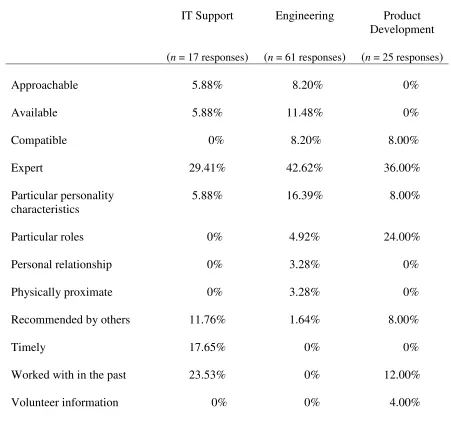
3 Factors that Influence Group Member Awareness of Expertise 48
4 Factors that Influence Group Member Knowledge Seeking 50
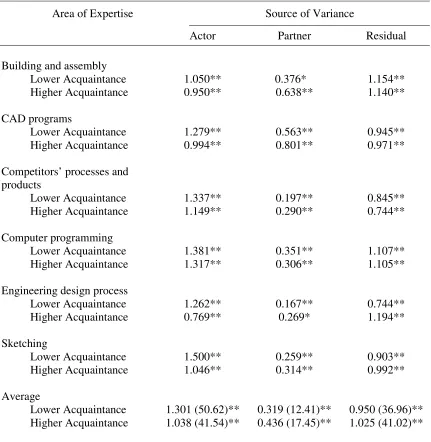
5 Amount (and Percentage) of Variance in Expertise Due to Actor,
Partner, and Residual
63
6 Amount (and Percentage) of Variance in Expertise for Lower- and
Higher-Acquaintance Groups
65
7 Amount (and Percentage) of Variance in Knowledge Seeking Due to
Actor, Partner and Residual
66
8 Amount (and Percentage) of Variance in Knowledge Seeking for
Lower- and Higher-Acquaintance Groups
68
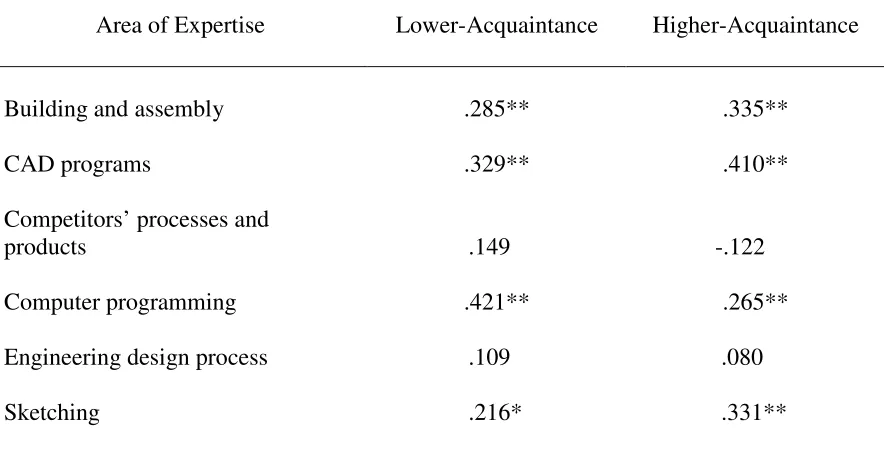
9 Correlations between Partner Effects for Expertise and Partner
Effects for Knowledge Seeking
69
10 Correlations between Self-Ratings and Partner Ratings of Expertise 71
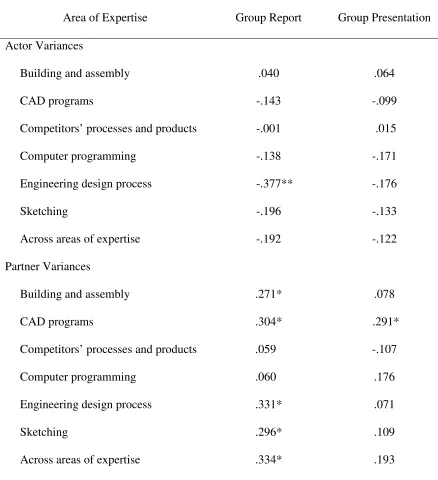
11 Correlations between Group Performance and Actor and Partner
Variance in Expertise
72
12 Correlations between Group Performance and Actor and Partner
Variance in Knowledge Seeking
x
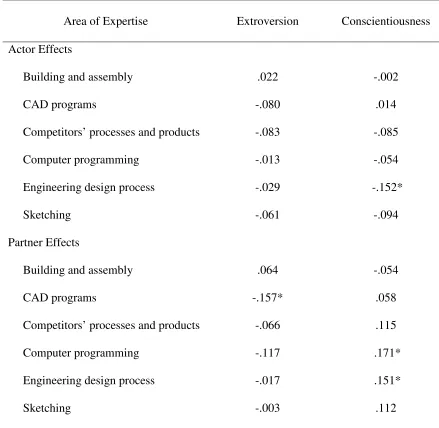
13 Correlations between Actor Effects and Partner Effects in Expertise
and Each of Extroversion and Conscientiousness
75
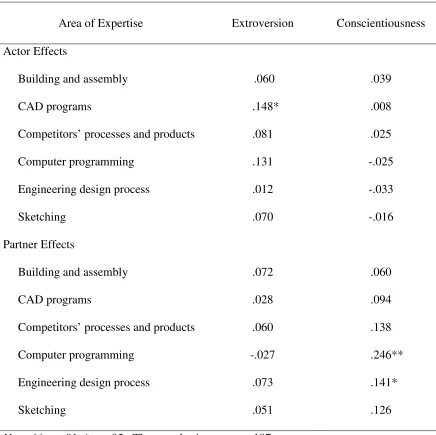
14 Correlations between Actor Effects and Partner Effects in Knowledge
Seeking and Each of Extroversion and Conscientiousness
76
15 Time 1 Amount (and Percentage) of Variance in Expertise Due to
Actor, Partner, Relationship, and Residual
88
16 Time 2 Amount (and Percentage) of Variance in Expertise Due to
Actor, Partner, Relationship, and Residual
90
17 Time 1 Amount (and Percentage) of Variance in Knowledge Seeking
Due to Actor, Partner, Relationship, and Residual
91
18 Time 2 Amount (and Percentage) of Variance in Knowledge Seeking
Due to Actor, Partner, Relationship, and Residual
92
19 Correlations between Performance and Dimensions of Transactive
Memory
94
20 Amount (and Percentage) of Variance in Expertise Ratings Due to
Actor, Partner, and Residual for a Sample of Engineering Employees
101
21 Amount (and Percentage) of Variance in Knowledge Seeking Due to
Actor, Partner, and Residual for a Sample of Engineering Employees
102
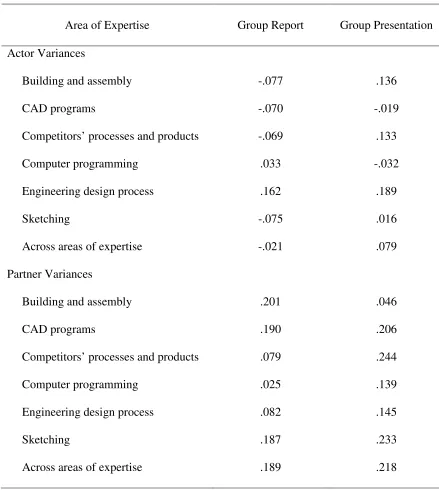
22 Relationship Between Self-Ratings of Expertise and Partner Effects 103
xi
LIST OF APPENDICES
Appendix Description Page
A An Example of The Social Relations Model 132
B Ethics Approval 135
INTRODUCTION
Despite widespread interest in and use of teams in organizations (Devine,
Clayton, Philips, Dunford, & Melner, 1999; Ilgen, Hollenbeck, Johnson, & Jundt, 2005;
Osterman, 1994), teams do not always work (Hackman, 1998; Locke, Tirnauer,
Roberson, Goldman, Latham, & Weldon, 2001). Teams may be ineffective for numerous
reasons, such as lack of cohesion (Beal, Cohen, Burke, & McLendon, 2003), abundance
of conflict (De Dreu & Weingart, 2003), or inadequate systems of knowledge exchange
(HR Zone, 2009; Kozlowski & Ilgen, 2006). The latter problem is particularly
worrisome due to the fairly recent increase in knowledge-based work (see Kunzler &
Payne, 2004).
One interesting line of knowledge exchange research concerns transactive
memory. Transactive memory is “a combination of individual minds and the
communication among them” (Wegner, Giuliano, & Hertel, 1985, p. 256). More
specifically, transactive memory consists of (a) organized knowledge held by group
members and (b) transactive processes that occur amongst those group members
(Wegner et al., 1985).
The organized knowledge held by group members includes the knowledge that
each group member possesses plus the information that each member has about what his
or her teammates know. In other words, organized knowledge is comprised of
“knowing” and “knowing who knows what” in a group (Liang, Moreland, & Argote,
1995; Mohammed & Dumville, 2001; Moreland, Argote, & Krishnan, 1996; Rau, 2005;
Rulke & Rau, 2000; Wegner et al., 1985). The notion of knowing “who knows what” is,
need to know who has the information they are looking for—rather than actually
possessing that knowledge themselves.
Knowing who possesses information is only useful if that information can be
communicated in some way. Through communication or transactive processes amongst
group members, encoding, storage, and retrieval of knowledge take place—much as
individual memories encode, store, and retrieve information (Hollingshead & Brandon,
2003; Wegner et al., 1985). Thus, in groups with effective transactive memory systems,
members know who knows what, send new or incoming knowledge to the appropriate
group members, and develop strategies for retrieving that information within the group
(Mohammed & Dumville, 2001; Wegner, 1995).
According to Brandon and Hollingshead (2004), an important component of an
effective transactive memory system is sharedness. That is, who to send knowledge to
and who to seek knowledge from should be shared amongst group members. Shared
ideas about who knows what and who to seek knowledge from are important because
they allow for a smooth flow of information to and from the group members who are
most likely to remember that information.
Above is an overly simplistic explanation of transactive memory. For example,
although first introduced as a dyadic construct in intimate couples (Hollingshead, 1998a,
1998d; Johansson, Andersson, & Ronnberg, 2000; Wegner, 1986, 1995; Wegner, Erber,
& Raymond, 1991; Wegner et al., 1985; Wegner & Wegner, 1995), transactive memory
research has expanded to include studies of groups (e.g., Austin, 2003; Lewis, 2003;
Liang et al., 1995; Moreland & Myaskovsky, 2000) and even organizations (e.g., Anand,
Argote, 2003; Nevo & Wand, 2005; Peltokorpi, 2004). In addition, transactive memory
has been operationalized in many ways. For example, Lewis (2003) defined transactive
memory as group member self-reports of whether their teammates had specialized
knowledge, trust in others’ knowledge, and coordination in their groups, and then
aggregated results within the group. Moreland and Myaskovsky (2000) coded videotapes
for behaviors that would reflect transactive memory in groups. Wegner et al. (1991)
examined the number and types of words recalled by dyads composed of strangers versus
intimate couples. Peltokorpi (2004) asked individuals to respond to three items about
who had what expertise in their organizations.
Evidently, differences exist in the content of transactive memory measures and
levels of analysis at which transactive memory is studied, and sense must be made of
these differences. The goal of this research was to review the numerous
conceptualizations of transactive memory, outline their differences, and propose a novel
way of conceptualizing and studying transactive memory that takes into account the
dyadic relationships that are present within groups. Kenny’s social relations model
(Kenny & La Voie, 1984) was the basis of this new definition of transactive memory.
Then, analyses were conducted with group acquaintance and performance to show the
benefits of using this new conceptualization of transactive memory. The purpose of this
research was to determine whether transactive memory, defined on the basis of the social
relations model, differed in lower- and higher-acquaintance groups and was associated
with performance. Transactive memory theory, empirical research, and measurement
Transactive Memory Theory
Wegner and his colleagues (Wegner, 1986, 1995; Wegner et al., 1985, 1991;
Wegner & Wegner, 1995) established the concept of transactive memory in their work on
relationships in close couples. In an intimate couple, Wegner proposed, partners develop
a sense of what the other person knows through disclosure of interests, skills, education,
and other personal characteristics. Similarly, identity negotiation researchers (e.g.,
London, Polzer, & Omoregie, 2005) suggested that, in the early stages of group
formation, group members disclose information about themselves. As the relationship
progresses, members realize that they converge in some knowledge domains and diverge
in others. That is, in some domains members share information and interpretation of this
information; in other domains, members specialize or diverge in the information they
hold.
While sharedness of knowledge is indeed important, the focus in much of the
recent transactive memory literature is on divergence or distribution of knowledge (e.g.,
Hollingshead, 1998a, 1998d; Lewis, 2003; Moreland & Argote, 2003; Wegner, 1995)1.
When knowledge is distributed and members are aware of this distribution, they simply
need to ask for this information rather than possess it themselves. For example, a person
only needs to know that his partner is a computer expert rather than learn about
computers. Distributed or specialized knowledge is essential to the development of an
efficient group memory system; however, importantly, group members must take
responsibility for information in their areas of expertise (cognitive interdependence;
Brandon & Hollingshead, 2004; Hollingshead, 2001).
1
In order to develop a distributed or specialized memory system, group members
need reasons for assigning responsibility for certain domains of knowledge to particular
individuals (Hollingshead & Fraidin, 2003; London et al., 2005; Wegner, 1986, 1995;
Wegner et al., 1991). Most sensibly, responsibility would be assigned to the person
perceived to be an “expert” in a particular domain; however, identification of expertise is
not a straightforward process. Assigning responsibility for domains of knowledge might
be made based on anything from surface characteristics to actual knowledge (Nickerson,
1999; Wegner, 1995; Wegner et al., 1991; Wittenbaum, Stasser, & Merry, 1996). For
example, early in a group’s life, members might be presumed experts on a topic based on
their surface characteristics—such as gender, age, and ethnicity. Without knowing
anything else, group members may need to rely on the surface characteristics of their
teammates in order to assign responsibility for knowledge domains. Craig (2004) and
Hollingshead and Fraidin (2003) found that participants used gender information to infer
the expertise of their partners. Note that such surface characteristics are not necessarily
accurate indicators of expertise (see Myaskovsky, Unikel, & Dew, 2005; Wegner, 1986).
In addition, responsibility might be established by someone volunteering or being
volunteered to be accountable for certain knowledge. As well, responsibility for
information may be assigned through circumstance; that is, the group member who
presented a piece of information first (primacy), most recently (recency), or most often
(duration) could be assigned responsibility for that domain. Finally, once group members
have had the chance to communicate and interact with one another, the opportunity exists
for members to learn about each other’s skills, education, interests, abilities, and other
Craig (2004) found that participants made use of information about their partner’s school
major when deciding which words to recall.
Partly due to their ability to accurately recognize “true” expertise, teams with
transactive memory systems are hypothesized and found to perform well (Austin, 2003).
Indeed, awareness of others’ expertise is vital to a transactive memory system. However,
not only must members learn who knows what, they must also send relevant information
to the appropriate group member and retrieve that information when needed (Mohammed
& Dumville, 2001; Wegner, 1995). The strength of the transactive memory construct is
evident when members are assigned responsibility for knowledge based on their
expertise, have shared ideas of who knows what, and fulfill their expected responsibilities
within the group (Brandon & Hollingshead, 2004).
Empirical Research
The volume of empirical work on transactive memory is explained here in terms
of five different phases of research. The five phases discussed here include the
pioneering, expertise recognition, experience-in-groups, development, and field studies.
Each is described below, generally in order from the earliest to the most recent work.
The Pioneering Studies
The pioneering studies include Wegner’s (Giuliano & Wegner, as cited in
Wegner, 1986; Wegner et al. 1991) and Hollingshead’s (Hollingshead, 1998a, 1998d,
2000, 2001) laboratory research with dating couples and pairs of strangers. Studies by
both researchers required participants to remember lists of words in various domains.
Research within this phase highlighted (a) the importance of accepting responsibility for
Hollingshead, 2000, 2001; Wegner et al., 1991) and (b) the role of communication in
transactive memory systems (Hollingshead, 1998a, 1998d).
Accepting responsibility for information. Using dating couples, Giuliano and
Wegner (as cited in Wegner, 1986) illustrated the importance of dyad members accepting
responsibility for particular domains of knowledge. Generally, participants in this study
recalled words within their self-reported areas of expertise—an unsurprising finding
explained by individual memory research. However, in addition to remembering words
in their own areas of expertise, partners took responsibility for remembering words based
on circumstance. Specifically, the member of each dating couple who was provided with
more time took responsibility for remembering words in those domains in which his or
her partner was not an expert. Wegner considered this finding as evidence of transactive
memory. Participants were aware of what their partners did and did not know and, when
given more time to view the words, participants took responsibility for those domains
with which their partners were not familiar.
In the above study, researchers examined the natural assignment of responsibility
within close couples. In later work, Wegner and colleagues (1991) allowed for such
natural assignment of responsibility in some dating couples and stranger dyads; but, in
other pairs, the researchers themselves assigned responsibility for recalling certain
categories of words. Results of these latter studies suggested, first, that members of
dating couples agreed more than strangers about who was expert in each domain. More
substantive results revealed that, when the researchers did not assign responsibility for
learning certain domains of knowledge, dating couples recalled more words than
domains of knowledge, dating couples recalled fewer words than strangers. In addition,
dating couples that were not assigned responsibility for particular domains outperformed
dating couples that were assigned responsibility for particular domains. This
“impairment” for dating couples suggests that dating couples have their own transactive
memory systems in place; these memory systems become unusable when participants are
assigned to use a memory system that is not familiar to them.
Work by others supported Wegner’s research on the assignment of responsibility
within pairs. Hollingshead (2000) was interested in which categories of words
participants would choose to learn when assigned to work with either a partner with
similar knowledge or a partner with different knowledge. Participants were clerical
workers at a university who were assigned to work with a partner (who did not really
exist) to recall words from various categories related to clerical work. Results of this
study indicated that, when participants thought that their partners had different expertise
(relative to their own), they recalled significantly more words inside their expert
categories than they did when they thought their partners had similar expertise. In a later
study (Hollingshead, 2001) participants were again told that, compared to their own
expertise, their partners had either the same or different expertise. In addition,
participants were given incentives to learn information that was the same as or different
from the information that their partners were assigned to learn. The most differentiation
in transactive memory occurred when partners had distinct expertise from one another
and were given incentives to remember different information; transactive memory was
most integrated when partners had comparable expertise and were given incentives to
Wittenbaum et al. (1996) found similar results in their study of tacit coordination.
That is, when working on a task in which differentiation was assumed to be important to
success (i.e., a collective recall task), participants remembered different information from
what they expected their teammates to remember. When working on a task in which
integration was assumed to be important to success (i.e., a group decision-making task),
participants remembered similar information to what they expected their teammates to
remember.
The above studies illustrated the importance of accepting responsibility for
information based on circumstance or expertise. Dyad partners use factors such as
circumstance or expertise to ensure that all information is accounted for by one member
or another. Important in uncovering and making use of this expertise is the
communication process, another key line of research in the pioneering studies.
The role of communication. Communication was an important variable in
Hollingshead’s (1998a, 1998d) work. Hollingshead (1998d) examined communication at
retrieval in dating couples and dyads composed of strangers. Dating couples working
to-face were more effective at retrieving knowledge than were strangers in the
face-to-face condition and dating couples working via a computer system. Further analyses
indicated that dating couples performed well when they had access to nonverbal or
paralinguistic cues to aid in retrieval of knowledge. However, dating couples made fewer
explicit references to their individual expertise, presumably because their partners were
already aware of the knowledge differentiations within the dyad. Later work by
Andersson and Ronnberg (1996) was consistent with Hollingshead’s (1998d) findings.
as well as nominal groups (i.e., individuals working alone whose outputs are pooled);
however, friendship couples did perform as well as nominal groups. The authors
suggested that the improved results for friends were due to friends being able to cue each
other during recall—an explanation that fits with Wegner’s transactive memory theory.
Interestingly, communication during learning can be problematic for dating
couples (Hollingshead, 1998a). In fact, communication during learning led dating
couples to disregard their expertise and use alternative means of assigning responsibility
for knowledge categories. This resulted in dating couples recalling fewer words than
stranger couples when communication was allowed during learning.
Summary. The pioneering studies provided the first empirical support for the
existence of transactive memory. In particular, research demonstrated that dyads develop
means of ensuring that each member is responsible for some of the knowledge within the
dyad. When possible, responsibility is based on actual expertise in the dyad
(Hollingshead, 1998a, 1998d; Wegner et al., 1991); in other situations, circumstance is
used as a basis for determining who is responsible for what information (Giuliano &
Wegner, 1985; as cited in Wegner, 1986). Furthermore, this phase of research examined
the advantages and disadvantages of communication in transactive memory systems.
Specifically, communication at learning can be detrimental to familiar couples
(Hollingshead, 1998a), whereas nonverbal communication at retrieval is particularly
useful to such pairs (Andersson & Ronnberg, 1996; Hollingshead, 1998d). Overall, these
studies stressed that dyad members take responsibility for particular domains of
knowledge, and they use their knowledge of “who knows what” for encoding, storing,
expert at which domains became an important topic in the next phase of empirical
research.
The Expertise Recognition Studies
The literature on expertise recognition is vital to understanding transactive
memory (Austin, 2003; Hollingshead & Fraidin, 2003; London et al., 2005; Wegner,
1986, 1995; Wegner et al., 1991). Studies on expertise recognition have focused on (a)
the ability of groups to uncover “hidden” expertise (Stasser, Stewart, & Wittenbaum,
1995; Stasser, Vaughan, & Stewart, 2000; Stewart & Stasser, 1995) and (b) the accurate
recognition of expertise (e.g., Henry, Strickland, Yorges, & Ladd, 1996; Libby, Trotman,
Zimmer, 1987; Littlepage & Mueller, 1997; Littlepage, Schmidt, Whisler, & Frost, 1995;
Littlepage & Silbiger, 1992). Each line of research is discussed below.
Uncovering hidden expertise. Stasser and his colleagues used the hidden profile
paradigm (Stasser & Titus, 1985) to investigate recognition of expertise in groups. The
essence of the hidden profile paradigm is that group members working together to solve a
problem often arrive at a particular solution based on the information held in common
amongst the members; however, a different (and better) solution would be favoured if the
information that is unique to each group member were revealed during discussion.
Hence, the better solution tends to be hidden from group members due to common
information being shared over and above unique information. The hidden profile will
only be revealed if group members reveal information that each holds uniquely prior to
group discussion.
Stasser and his colleagues sought ways to reduce the preference for discussing
unshared information may be revealed more often during group discussion if members
were aware of others’ expertise in the group. Students performed a murder mystery task
in which the goal was to discover which of three suspects committed a crime. Clues were
distributed amongst three group members. In order to simulate expertise, each group
member was provided with all the clues for a particular suspect. In one condition, the
researcher made known to groups which member held information on which suspect;
hence, in this condition, expertise was evident to the group. Results of Stasser et al.’s
study indicated that groups in which expertise was evident (i.e., groups in which
members were told they were experts on a particular suspect) mentioned unshared
information and selected the correct suspect more often than groups in which expertise
was not evident.
Further support for these findings was provided by Stewart and Stasser (1995) and
Stasser et al. (2000). In both a decision-making task and a collective recall task, the
researchers discovered that groups that were assigned expertise in particular categories
mentioned unshared information more often than groups that were not assigned expertise.
Stasser et al. (1995) speculated that, in groups in which expertise is assigned, members
divide their responsibilities during retrieval according to that expertise; this division of
labour during retrieval was presumed to explain the better performance of groups in the
expertise condition. However, Stasser et al. (2000) found no evidence for this division of
labour explanation in their study.
Accurate recognition of expertise. With respect to the second line of expertise
recognition research, Libby and his colleagues (1987) discovered that participants are
1993, 1995; Henry et al., 1996) reported positive results as well. In their work, Henry
and her colleagues asked participants to identify the members in their group who were
most accurate at responding to a variety of questions and to state their confidence in their
responses. Generally, participants agreed on who the most accurate member was and
were reasonably accurate in their decisions (Henry, 1993, 1995). Further, and most
relevant to the transactive memory literature, participants in Henry’s research were asked
to explain how they determined who the most accurate member was for a particular
question (Henry et al., 1996). The most popular response was that participants relied on
“relevant background information”, followed by “backing up an estimate with sound
reasoning” and “how confident the person seemed”.
Unfortunately, participants are not always accurate at determining expertise in
their groups. Littlepage and colleagues (Littlepage & Mueller, 1997; Littlepage et al.,
1995) were interested in the characteristics that group members used to identify experts.
Results from their research suggested that group members were perceived as experts if
they talked relatively more than other group members. Thus, participants seemed to use
talkativeness to identify expertise in the group. But, while talkativeness predicted
perceived expertise, it was not associated with actual expertise (Littlepage et al., 1995).
Participants appear to infer incorrectly that participation by group members is indicative
of actual expertise. Thus, this research suggested that participants are not accurate at
recognizing expertise in groups.
Summary. The expertise recognition phase of empirical research suggested some
controversy as to whether participants are able to accurately recognize the expertise of
recognizing “who knows what” (Henry, 1993, 1995; Henry et al., 1996; Libby et al.,
1987), other research suggested that participants are not so accurate (Littlepage et al.,
1995). Perhaps such controversy is based on the length of time or the number of
experiences that participants share together. In groups whose members have ample
experience working together, expertise recognition should be fairly accurate; in groups
whose members have little chance to learn what others know, expertise may be more
difficult to recognize (Littlepage, Robison, & Reddington, 1997). Experience working
with others was the next line of empirical research on transactive memory.
The Experience-in-Groups Studies
Expertise may become apparent when participants (a) are familiar with one
another or (b) are trained together.
Familiarity. Research by Goodman and colleagues (Goodman & Garber, 1988;
Goodman & Leyden, 1991; Goodman & Shah, 1992) examined the construct of
familiarity in crews working in underground coal mines. Familiarity was defined as the
amount of knowledge a person had about his or her crew members, work environment,
and job. Goodman hypothesized that absenteeism would change the familiarity within a
crew. Goodman and Garber (1988) found that periods of absence led to more accidents,
perhaps because absenteeism provided less opportunity for crew members to become
familiar with one another and to gain knowledge about each other. Later work by
Goodman examined the relationship between familiarity and productivity. Results
suggested that crew members with greater familiarity experienced higher productivity
(Goodman & Leyden, 1991; Goodman & Shah, 1992). Similarly, Gruenfeld, Mannix,
were more effective at a decision making task in which members held distinct
information from their teammates.
Training together. Expertise may become particularly apparent when groups of
individuals are trained together on a task (Rulke & Rau, 2000). Research by Moreland
and his colleagues (e.g., Liang et al., 1995; Moreland, 1999; Moreland & Argote, 2003;
Moreland et al., 1996; Moreland, Argote, & Krishnan, 1998; Moreland & Myaskovsky,
2000) focused on whether individuals trained together would develop transactive memory
systems and perform better than individuals trained alone on a task. In perhaps the first
group-based empirical transactive memory study, Liang and her colleagues (1995)
developed a paradigm for understanding the transactive memory of individuals trained in
groups and trained alone. The premise behind this paradigm was that those groups whose
members were trained together (and, thus, shared experiences) should have transactive
memory systems not present in those groups whose members were trained apart. While
working in groups, team members have the opportunity to experience the task together,
observe expertise in the group, and divide tasks according to expertise. Because
members know who knows what, they can seek information from the experts, trust that
the expertise they receive is correct, and coordinate their actions efficiently. In addition,
Wong (2003) suggested that collectively learning information, as group members trained
together are able to accomplish, can create an accurate mental map about who knows
what.
In Moreland’s paradigm (e.g., Liang et al., 1995; Moreland et al., 1996; Moreland
& Myaskovsky, 2000), participants were either asked to work alone or placed in
participants were released and asked to return the following week for a testing phase.
During the testing phase, those who were trained in groups were asked to work in these
same groups. Those who were trained individually were paired up with others who
worked individually, thus creating groups from those who previously worked alone. So,
during the testing phase, all participants were part of a group.
During the testing phase, participants were asked, as a group, to recall the
procedure for building a radio. Then, participants were asked to build a radio without
assistance from the experimenter; groups’ accuracy and speed were measured during this
building process. Thus, each of recall, accuracy, and speed were performance measures.
Transactive memory was measured as judges’ ratings on three dimensions: knowledge
specialization within the group (memory differentiation), participants’ trust that the other
group members knew their areas of expertise (task credibility), and coordination in group
interactions (task coordination).
Across multiple studies (i.e., Liang et al., 1995; Moreland et al., 1996; Moreland
& Myaskovsky, 2000), Moreland’s findings were clear. The performance of groups
whose members were trained together was significantly greater than the performance of
groups whose members were trained alone; transactive memory mediated this
training-performance relationship. Thus, training members together in groups improved groups’
transactive memory systems, which strengthened their task performance.
In addition, Moreland and his colleagues were able to rule out other possible
explanations for the training-performance relationship, including cohesion (Liang et al.,
1995), team-building (Moreland et al., 1996), building radios in groups (Moreland et al.,
revealed that, during testing, groups of individuals trained together were no more
cohesive than groups of individuals trained alone—suggesting that cohesion was not
responsible for the training-performance relationship. Second, team-building exercises
did not increase the performance of groups of individuals trained alone; that is, the
training-performance relationship could not be explained by more “teaminess” or group
development in groups whose members were trained together versus groups whose
members were trained alone. Third, the training-performance relationship seemed to be a
result of training in a particular group, not training in “any old group”, since reassignment
to new groups resulted in poor performance2. Finally, what seemed to be important was
not the actual communication processes that occurred in a group but, rather, what was
communicated during this process: expertise information. Moreland and Myaskovsky
(2000) found that groups whose members were trained alone but received paper-based
expertise information prior to testing performed as well as groups whose members were
trained together; in addition, the two groups evidenced similar amounts of behaviours
indicative of transactive memory.
Others who used Moreland’s paradigm found similar results. In particular,
Hollingshead’s (1998c) participants worked individually or in groups on two trials of a
rule-induction task, then all participants worked in groups for the third trial. Results
showed that participants trained in groups performed better than participants trained
alone, supporting Moreland’s work. As well, Lewis and her colleagues (Lewis,
Belliveau, Herndon, & Keller, 2007; Lewis, Lange, & Gillis, 2005) used Moreland’s
paradigm and discovered that performance on a telephone assembly task was better in
2
groups with intact transactive memory systems than in groups where transactive memory
had been disabled by reassigning participants.
However, not all studies using this paradigm produced significant results.
Joerding (2004) made use of Moreland’s paradigm, but discovered that performance on a
bridge building task was no better for participants trained in groups than participants
trained alone. Joerding rationalized these findings by suggesting that her task had no
clearly correct answer and that her participants were not together for as many sessions as
were Moreland’s participants. Myaskovsky (2002) found no differences in the
performance of participants trained together versus participants trained alone and no
relationship between transactive memory and performance. Myaskovsky suggested that
transactive memory was generally weak within her study, thus providing a potential
explanation for her results.
Summary. In summary, experience with others can be valuable to the
development of transactive memory systems. Familiarity working with others (Goodman
& Garber, 1988; Goodman & Leyden, 1991; Goodman & Shah, 1992) and training in
groups (e.g., Liang et al., 1995; Moreland et al., 1996; Moreland & Myaskovsky, 2000)
both allow participants the opportunity to gain fairly accurate knowledge about “who
knows what” in the group. While at this point researchers recognized that experience
with others was important to transactive memory development, little else was understood
about transactive memory development. The next phase of research more clearly
The Development Studies
Rulke and Rau (2000) used Moreland’s paradigm to further explore transactive
memory development. By coding group members’ communication during the training
phase of the radio building task, they were able to discover the process by which
transactive memory is developed. Rulke and Rau found that members of groups trained
together began the process of transactive memory development by asking questions or
indicating a lack of knowledge about the task. This was followed by group members
declaring expertise in a particular domain and by the group evaluating members’
expertise. Finally, the encoding process ended with coordination of who does what in the
group. Evident from Rulke and Rau’s (2000) work is that (a) self-disclosure and (b)
communication are vital to transactive memory development.
Self-disclosure. Xu (2006) and Lewis (2004) also recognized the importance of
self-disclosure to transactive memory development. Xu (2006) found that, when group
members disclosed their strengths and weaknesses to their teammates, the group could
develop a better idea of who knows what. Lewis (2004) discovered that division of
expertise and familiarity of group members early on in a group’s tenure were important
for the later development of transactive memory; self-disclosure can aid the development
of familiarity and the division of labour.
Communication. Rulke and Rau (2000) were not the only researchers to
recognize the importance of communication in the development of transactive memory.
Yoo and Kanawattanachai (2001) noted that communication early in virtual teams’ tenure
is important for understanding who knows what. Similarly, Xu (2006) found that, in a
important to the development of transactive memory. Lewis (2004) discovered that
face-to-face communication was important in the emergence of transactive memory systems.
However, Yoo and Kanawattanachai (2001) suggested that quantity of communication
becomes less important once groups have developed their transactive memory systems.
Work by Prichard and Ashleigh (2007) on team-skills training also provides clues
to the development of transactive memory. Prichard and Ashleigh argued that knowing
who knows what in a group may be insufficient if group members cannot effectively
communicate this information within the group. Hence, they developed a program to
train groups on team skills such as interpersonal relations, allocation of roles, and
equality of participation. Half of the groups received the training, while the other half did
not. Results indicated that transactive memory and performance were greater for groups
provided with team-skills training. Thus, having team skills such as interpersonal
relations, allocation of roles, and equality of participation appeared to aid in the
development of transactive memory.
Summary. Research on the development of transactive memory was important in
tying together the “loose ends” in the empirical literature to this point. Development
research showed that communication is vital early on in the development of a transactive
memory system. When group members are given the opportunity to work together (e.g.,
Liang et al., 1995; Moreland et al., 1996; Moreland & Myaskovsky, 2000), they can ask
questions (Rulke & Rau, 2000) or use background information supplied by group
members (Henry et al., 1996) to engage in a process of self-disclosure and determine who
knows what in the group. Knowing who knows what allows group members to accept
(Giuliano & Wegner, 1985; as cited in Wegner, 1986; Hollingshead, 2000; Rulke & Rau,
2000; Wegner et al., 1991). Once such expertise assignments are in place, quantity of
communication becomes less important to smooth functioning of the group (Yoo &
Kanawattanachai, 2001). With transactive memory empirically established using
laboratory studies, researchers then turned to field settings in the most recent phase of
transactive memory research.
The Field Studies
Research in the field focused on the positive relationship between transactive
memory and performance. This relationship was demonstrated in numerous industries,
including sporting goods (Austin, 2003), technology (Faraj & Sproull, 2000; Lewis,
2003; Wong, 2003; Zhang, Hempel, Han, & Tjosvold, 2007), consulting (Lewis, 2003,
2004), electricity production (Ashworth, 2008), financial services (Rau, 2005; Wong,
2003), health care (Wong, 2003), day care (Peltokorpi & Manka, 2008), product
development (Akgun, Byrne, Keskin, Lynn, & Imamoglu, 2005), and sales (Peltokorpi,
2004). Performance in these studies was defined in terms of goal attainment (Austin,
2003), external evaluation (Austin, 2003), internal evaluation (Austin, 2003), knowledge
sharing effectiveness (Majchrzak & Malhotra, 2004), team effectiveness (Faraj &
Sproull, 2000), efficiency (Faraj & Sproull, 2000; Wong, 2003), viability (Lewis, 2004),
return on average assets (Rau, 2005), technical innovation (Wong, 2003), work
excellence (Wong, 2003), new product success (Akgun et al., 2005), speed-to-market
(Akgun et al., 2005), team learning (Akgun et al., 2005), and accurate response to
Importantly, the field studies built a solid case for the transactive
memory-performance relationship. Even more intriguing, the transactive memory-memory-performance
relationship existed despite the highly diverse measures used to operationalize transactive
memory across studies. These measures are the focus of the following section.
Transactive Memory Measurement
Transactive memory has been measured in a variety of ways (e.g., Austin, 2003;
Faraj & Sproull, 2000; Hollingshead, 1998a; Lewis, 2003; Liang et al., 1995; Palazzolo,
2003, 2005; Rau, 2001; Wegner et al., 1991). Due to the abundance of measures
available in the literature, the need exists for their categorization. Based on the empirical
literature on transactive memory, transactive memory measures are categorized and
described here according to their level, format, and content. Table 1 provides short
summaries of many of the available measures.
Level
Transactive memory measures vary in their level of measurement and their level
of analysis. Level of measurement is the level at which data are gathered (Kozlowski &
Klein, 2000) or the source of the data (Klein, Dansereau, & Hall, 1994). For example,
Liang and colleagues (1995) had judges observe groups of participants interacting
together and rate the extent of transactive memory based on group interactions; here, the
level of measurement was the group. Lewis (2003) asked participants to provide
individual ratings of specialization within the group; thus, Lewis’ level of measurement
Table 1
Transactive Memory Measures
Authors Description of Measure Others Who Used
the Measure Level of Measurement, Analysis Format of Measure Content of Measure Ashworth (2008)
Group members individually reported frequency of communication and expertise for each teammate. Transactive memory was defined as the density of the networks derived from the above two items, where density was the proportion of actual communication (or expertise) to maximum possible communication (or expertise).
Individual, Group
Self-report Expertise
Austin (2003) Group members were asked individually about each member’s expertise on 11 skills/knowledge areas (e.g., written communication, product testing) identified through semi-structured interviews with
organizational members. The resulting information was used by the researcher to operationalize transactive memory in terms of 4
dimensions: group knowledge stock (total resources available within the group), transactive memory consensus (agreement about who is an expert for a particular skill), knowledge specialization (identification of different individuals as experts on different skills), and transactive memory accuracy (matching of an individual’s self-rated expertise on each skill with others’ expertise ratings of that individual).
Individual, Group
Self-report Expertise
Ellis (2003) Coded frequency of communication about directory updating (verbal communication in which team members shared expertise or requested expertise), information allocation (verbal communication in which information was sent to team members thought to be expert on a topic), and retrieval coordination (request of information by someone known to be the expert on that topic), then aggregated to the group level.
Authors Description of Measure Others Who Used the Measure Level of Measurement, Analysis Format of Measure Content of Measure Faraj & Sproull (2000)
Group members individually responded to 11 items on a 5-point Likert scale measuring three dimensions: knowing expertise location, recognizing where expertise is needed, and bringing expertise to bear. Individual responses were aggregated to the group level.
Majchrzak & Malhotra (2004)
Wong (2003)
Individual, Group
Self-report Expertise Knowledge
exchange
Fraidin (2004) Dyad members were assigned areas of specialization (i.e., different information) on a murder mystery task and on a hiring task. In the control condition, all participants received all information.
Group, Group
Unclear Expertise
Hollingshead (1998a)
Dyad members worked with their significant other or with a stranger to learn and recall words in various domains (e.g., math, fashion). Transactive memory was assessed based on the number of words recalled (total, unique, and overlapping recall) by the strangers versus the couples.
Individual, Dyad
Recall Expertise
Hollingshead (1998d)
Dyad members worked with their significant other or with a stranger to answer questions on a knowledge-based test. Transactive memory was assessed based on the number of questions answered correctly by strangers versus couples as well as behaviors indicative of expertise and transactive memory searches (captured by computers or on videotape).
Individual, Dyad Recall Observed behaviors Expertise Knowledge exchange Hollingshead (2000)
Participants worked with a partner (who did not really exist) to recall words in various categories. Transactive memory was operationalized as the types of words recalled (i.e., words within or not within one’s areas of expertise).
Hollingshead (2001) Hollingshead & Fraidin (2003) Individual, Individual
Authors Description of Measure Others Who Used the Measure Level of Measurement, Analysis Format of Measure Content of Measure Joerding (2004)
Developed a 24-item measure of transactive memory that assessed five content areas on a 5-point Likert scale: learning from group members, sharing information in groups, recognizing expertise, feeling
responsible for the information you possess, and using others as a memory aid.
Individual, Group
Self-report Expertise Knowledge exchange
Johansson et al. (2000)
Married couples were asked about whether they were both aware of a transactive memory system and were asked to provide examples of transactive memory use.
Individual, Dyad
Self-report Expertise Knowledge
exchange
Kotlarsky & Oshri (2005)
Interviews, documentation, and archival records were used to identify transactive memory and its frequency in groups.
Individual, Unclear
Self-report Unclear
Lewis (2003) Group members individually responded to 15 items on a 5-point Likert scale measuring three transactive memory dimensions: specialization, credibility, and coordination. Individual responses were aggregated to the group level.
Akgun et al. (2005) Lewis (2004)
Lewis et al. (2005) Pearsall & Ellis
(2006) Pearsall et al.
(2010) Peltokorpi & Manka (2008)
Zhang et al. (2007)
Individual, Group
Authors Description of Measure Others Who Used the Measure Level of Measurement, Analysis Format of Measure Content of Measure
Liang et al. (1995)
Coders analyzed videotapes of groups performing a radio-building task. Transactive memory was measured as judges’ ratings on three
dimensions: knowledge specialization within the groups (memory differentiation), participants’ trust that the other group members knew their areas of expertise (task credibility), and coordination in group interactions (task coordination).
Grace (2004) Joerding (2004)
Moreland et al. (1996) Moreland & Myaskovsky (2000) Myaskovsky (2002) Myaskovsky et al. (2005) Prichard & Ashleigh (2007)
Rulke & Rau (2000) Smith (2000), Study 1 Group, Group Observed behaviors Expertise Outcomes Littlepage et al. (2008)
Dyad members were asked about their own and their partners’
knowledge in six domains. Members were individually quizzed in these knowledge domains. Transactive memory was defined by agreement about who knows what, knowledge specialization, accuracy, and performance improvement.
Individual, Dyad
Self-report Expertise
Moreland et al. (1998)
Participants responded to questions used to determine the complexity of members’ beliefs about each other’s radio-building knowledge, the accuracy of those beliefs, and the level of agreement about knowledge distribution in the group.
Smith (2000), Study 2-3
Individual, Group
Self-report Expertise
Ohtsubo (2005)
Participants were either (a) given all clues to a puzzle or (b) given a subset of clues, such that the group as a whole had all clues. The latter case, in which a division of labour exists, may be more likely to develop a transactive memory system.
Authors Description of Measure Others Who Used the Measure Level of Measurement, Analysis Format of Measure Content of Measure Palazzolo (2003)
Participants were asked for their self-reports of their own expertise, group members from whom they are likely to retrieve information, and their perceptions of others’ knowledge. This information was used in social network analysis.
Palazzolo (2005) Individual, Group
Self-report Expertise Knowledge
exchange
Peltokorpi (2004)
Subsidiary members responded to 3 items on a 5-point Likert scale referring to member expertise. For example, “I know who has what kind of specialized expertise in my company”.
Individual, Individual
Self-report Expertise
Rau (2001) From a list of ten possible areas of expertise, participants selected, for each group member, the two most important areas of expertise contributed by that member. Cohen’s kappa was used to calculate a coefficient of agreement for each pair of group members in a group. Agreement scores were then averaged within a group.
Individual, Group
Self-report Expertise
Rau (2005) Group members responded to items on two transactive memory dimensions: expertise composition (diversity and depth of cognitive resources available to the group) and expertise location (group agreement about areas of expertise contributed by each team member). Expertise composition was operationalized as dispersion in functional background, industry experience and organizational tenure as well as average industry and organizational experience. Expertise location was operationalized as per Rau (2001).
Rau (2006) Individual, Group
Self-report Expertise
Ren et al. (2006)
Links between group members were defined by whether or not group members had knowledge of others’ resources. Transactive memory was calculated using a density measure of the actual knowledge of who knows what divided by the maximum possible knowledge of who knows what in the group.
Individual, Group
Authors Description of Measure Others Who Used the Measure Level of Measurement, Analysis Format of Measure Content of Measure
Wegner et al. (1991)
Participants worked with their dating partner or a stranger and were either assigned or not assigned responsibility for recalling items from particular domains (e.g., food, science). Transactive memory was inferred from the recall scores in the different conditions.
Individual, Dyad
Recall Expertise
Xu (2006), Study 1
Participants responded to 9 items on a 5-point Likert scale assessing directory updating (e.g., “I frequently learn about the expertise of other members of my group”), information allocation (e.g., “When I come across information that is not closely related to my expertise, I’ll pass it to a relevant expert and let the expert be responsible for processing and storing that information”), and retrieval coordination (“My group coordinates knowledge well”).
Individual, Group
Self-report Expertise Outcomes Knowledge exchange Yoo & Kanawattanac hai (2001)
Group members responded to 3 expertise-based items on a 5-point Likert scale (e.g., “Team members know what task-related skills and knowledge they each possess”); responses were aggregated within the group. Items were derived from Faraj & Sproull (2000).
Individual, Group
Self-report Expertise
Yuan et al. (2007)
Group members were asked to indicate the amount of knowledge possessed by themselves and their teammates. Responses were used to create indices of accuracy (shared ideas of knowledge distribution within the team) and extensiveness (awareness of expertise in the team). Group members also indicated whether they provided and retrieved information from each other member. Data were aggregated within the group.
Individual, Group
Self-report Expertise Knowledge
measure transactive memory at the individual level, but with items focusing on relations
between particular group members. For example, Palazzolo (2003, 2005) asked
participants to report from whom in the group they retrieved information; participants
thus responded to items about each particular group member separately.
Level of analysis “describes the treatment of the data during statistical
procedures” (Klein et al., 1994, p. 198). If a construct is measured at the individual level
but data are aggregated to the group level for conducting analyses, the level of analysis is
the group. Early research analyzed transactive memory data at the dyad level. In
particular, Wegner (Giuliano & Wegner, as cited in Wegner, 1986; Wegner et al. 1991)
and Hollingshead (Hollingshead, 1998a, 1998d) examined the types of words recalled or
the information known by participants working together as intimate couples or dyads
comprised of strangers. Generally, though, transactive memory data are analyzed at the
group level. For example, Lewis’ (2003) participants responded to self-report items, and
then data were aggregated to the group level for analyses. Austin (2003) asked
participants to rate how proficient group members were on a set of skills. Data were
aggregated to the group level to form measures of accuracy, consensus, specialization,
and knowledge stores within the group. Although data are typically analyzed at the dyad
or group levels, Su’s (2008) research is an exception. Su considered the knowledge area
as a level of analysis, such that data were analyzed separately within each area of
knowledge important to a team. For example, one knowledge area was the
“organizational contract and rules” of Team A. Thus, researchers have analyzed data in
transactive memory studies at the knowledge area, dyad, and group levels, with the latter
Format
Lewis (2003) outlined three formats that researchers have used to assess
transactive memory: recall, observation, and self-report. Early research on transactive
memory in dyads tended to use a recall format (Hollingshead, 1998a; Hollingshead,
2001; Wegner, 1986; Wegner et al., 1991), in which transactive memory systems were
inferred based on the “quantity, content, and structure of what participants remembered
individually and with their partners” (Lewis, 2003, p. 588). As explained earlier, much
of Wegner’s (Giuliano & Wegner, as cited in Wegner, 1986; Wegner et al. 1991) and
Hollingshead’s (Hollingshead, 1998a, 2001) work required participants to recall (as pairs
of strangers or dating couples) lists of words in various domains. The observation format
was developed by Moreland and his colleagues (Liang et al., 1995; Moreland &
Myaskovsky, 2000). Moreland asked judges to observe videotapes of groups and note
evidence of three dimensions of transactive memory systems: knowledge specialization
within the groups (i.e., memory differentiation), participants’ trust that the other group
members knew their areas of expertise (i.e., task credibility), and coordination in group
interactions (i.e., task coordination). Finally, researchers have used self-reports of
transactive memory. For example, Moreland and colleagues (1998) operationalized
transactive memory as self-reports of knowledge complexity, accuracy, and agreement.
Knowledge complexity was defined as the intricacy of beliefs about knowledge
distribution in the group; accuracy was operationalized as correctness about expertise
distribution in the group; and agreement was the sharedness of beliefs about expertise
distribution in the group. Participants individually responded to items about the above
self-report measures to operationalize transactive memory (e.g., Austin, 2003; Faraj &
Sproull, 2000; Johansson et al., 2000; Lewis, 2003; Palazzolo, 2003, 2005; Peltokorpi,
2004). Austin (2003) noted that self-report measures may be most appropriate in ongoing
groups in which individuals have the opportunity to continuously assess their skills.
Content
Finally, transactive memory measures tend to vary in their content. Generally,
measures fall into one of three categories of content: outcomes, expertise, and knowledge
exchange. Measures of outcomes operationalize transactive memory as the result of
participants’ interactions with one another. For example, Lewis’ (2003) “coordination”
dimension of transactive memory asked participants about whether the group
accomplished its task smoothly and efficiently. Liang et al. (1995) coded videotapes
based on whether participants seemed to trust the knowledge of others in the group and
whether participants coordinated smoothly. However, such measures seem to assess the
products of transactive memory, rather than the transactive memory construct itself. For
example, Yuan, Fulk, and Monge (2005) noted that credibility and coordination are
perhaps antecedents and products of transactive memory rather than about transactive
memory itself. Zhu (2009) suggested that trust and coordination might be considered
transactive memory manifestation, while transactive memory structure is comprised of
specialization, sharedness, and accuracy. Outcome measures may be an indirect way of
examining transactive memory.
Transactive memory measures that are based on expertise investigate (a) whether
knowledge is specialized in the group or (b) whether individuals know “who knows