© 2014, IJCSMC All Rights Reserved 586 Available Online atwww.ijcsmc.com
International Journal of Computer Science and Mobile Computing
A Monthly Journal of Computer Science and Information Technology
ISSN 2320–088X
IJCSMC, Vol. 3, Issue. 9, September 2014, pg.586 – 591
RESEARCH ARTICLE
Digital Image Watermarking using DCT
Chetna
M.Tech Department of Computer Science and Engineering, JCDM College of Engineering, Sirsa (Haryana)
Abstract: In digital management, multimedia content and data can easily be used in an illegal way—being copied, modified and distributed again. In this paper, we apply DCT technique to embed the watermark. With the help of DCT technique we can insert the data in short variation of time. A digital watermark is an invisible mark embedded in digital image which may be used for Copyright Protection. We describe a watermarking scheme for ownership verification and authentication. Depending on the desire of the user, the watermark can be either visible or invisible. The scheme can detect any modification made to the image and indicate the specific locations that have been modified.
Keywords: digital images, discrete cosine transform (DCT), digital watermarking, peak Signal to Noise Ratio (PSNR), mean squared Error (MSE).
I. INTRODUCTION
Digital watermarking is a technology for embedding various types of information in digital content. In general, information for protecting copyrights and proving the validity of data is embedded as a watermark. A digital watermark is a digital signal or pattern inserted into digital content. The digital content could be a still image, an audio clip, a video clip, a text document, or some form of digital data that the creator or owner would like to protect. The main purpose of the watermark is to identify who the owner of the digital data is, but it can also identify the intended recipient.
© 2014, IJCSMC All Rights Reserved 587
apply a similar method to digital content. Watermarked content can prove its origin, thereby protecting copyright. A watermark also discourages piracy by silently and psychologically deterring criminals from making illegal copies.
A. Materials suitable for watermarking
Digital watermarking is applicable to any type of digital content, including still images, animation, and audio data. It is easy to embed watermarks in material that has a comparatively high redundancy level ("wasted"), such as color still images, animation, and audio data; however, it is difficult to embed watermarks in material with a low redundancy level, such as black-and-white still images. To solve this problem, we developed a technique for embedding digital watermarks in black-and-white still images and a software application that can effectively embed and detect digital watermarks.
B. Types of Watermarking:
1) Visible watermarking: A visible watermark is a visible translucent image which is overlaid on the primary image. Perhaps consisting of the logo or seal of the organization which holds the rights to the primary image, it allows the primary image to be viewed, but still marks it clearly as the property of the owning organization.
It is important to overlay the watermark in a way which makes it difficult to remove, if the goal of indicating property rights is to be achieved.
2) Invisible watermarking: An invisible watermark is an overlaid image which cannot be seen, but
which can be detected algorithmically. Different applications of this technology call for two very different types of invisible watermarks:
A watermark which is destroyed when the image is manipulated digitally in any way may be useful in proving authenticity ofan image. If the watermark is still intact, then the image has not been "doctored." If the watermark has been destroyed, then the image has been tampered with. Such a technology might be important, for example, in admitting digital images as evidence in court.
An invisible watermark which is very resistant to destruction under any image manipulation might be useful in verifying ownership of an image suspected of misappropriation. Digital detection of the watermark would indicate the source of the image.
C. Structure of a digital watermark
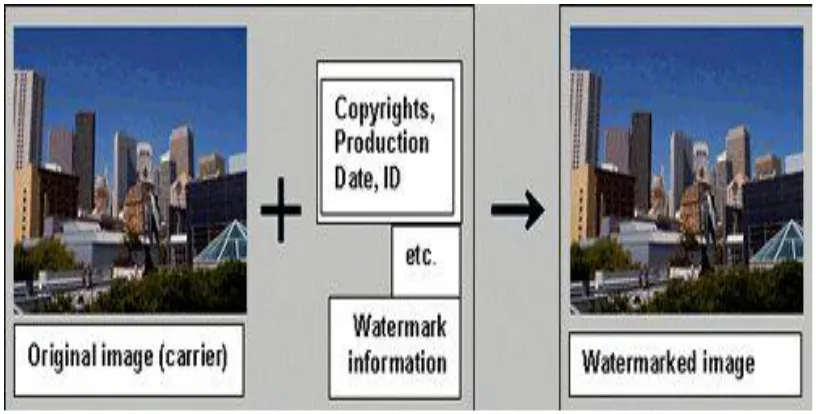
The structure of a digital watermark is shown in the following figure 1.
© 2014, IJCSMC All Rights Reserved 588
The material that contains a digital watermark is called a carrier. A digital watermark is not provided as a separate file or a link. It is information that is directly embedded in the carrier file. Therefore, simply viewing the carrier image containing it cannot identify the digital watermark. Special software is needed to embed and detect such digital watermarks. Kowa 's Stegano Sign is one of these software packages.
Both images and audio data can carry watermarks. A digital watermark can be detected as shown in the following illustration.
Figure 2: Unmarked watermarked Image
II. RESULTS & DISCUSSION
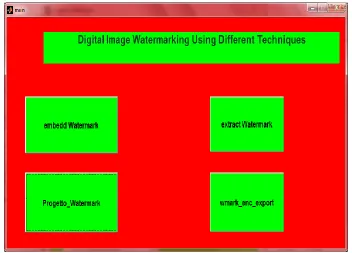
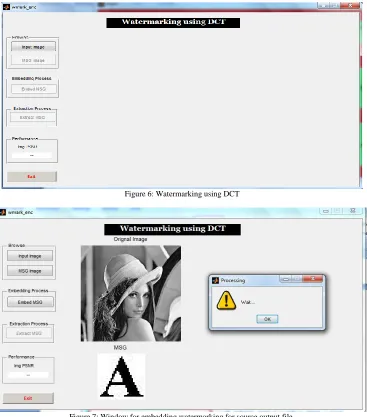
The figure 3 shows the starting of the work, where we have to choose the operations and calculate MSE&PSNR values. In next window in which insert and extract button is provided for selecting options insert button to add watermark in image or text and by button extract get out watermarked data and in this figure 4&5 firstly insert the image and extract the watermark image .Figure 6 apply the watermarking using DCT technique. Figure 7 embedding watermarking for source output file.
© 2014, IJCSMC All Rights Reserved 589
Above is shown the window in which three different ways for hiding the image or text to be get out as a watermarked images.
MSE2 =
8.7564e+03
PSNR2 =
8.7075
Figure 4: Window for inserting watermarking
© 2014, IJCSMC All Rights Reserved 590 Figure 6: Watermarking using DCT
Figure 7: Window for embedding watermarking for source output file.
III. CONCLUSION & FUTURE
This paper has presented a technique for embedding digital watermark into the images. The embedding and extracting methods of the DCT-based approach have been described. The experimental results show the proposed embedding technique can survive the cropping of an image, image enhancement and the JPEG lossy compression. By carefully defining the “user key,” multiple watermarking and repeatedly embedding to harden the robustness are available. Our technique could also be applied to the multiresolution image structures with some modification about the choice of middle frequency coefficients Lastly it is expected by the authors that any kind of future endeavors in this field will definitely route it a path to design a secure system using the proposed algorithm for both Internet and Mobile Communication Technology
REFERENCES
[1]JianRen, TongTong Li, MehrdadNadooshan, “A Cryptographic Watermark Embedding Technique”, IEEE,(2004), 382-386.
[2]Ping Wah Wong “Secret and Public Key Image Watermarking Schemes for Image Authentication and
© 2014, IJCSMC All Rights Reserved 591
[3]Mauro Barni “Improved Wavelet-Based Watermarking Through Pixel-Wise Masking “IEEE transactions on
image processing, vol. 10, no. 5, may 2001 .
[4]Farid Ahmed, Ira S. Moskowitz"Correlation-based watermarking method forimage authentication applications"Opt. Eng. 43(8) 1833–1838 (August 2004) 0091-3286/2004.
[5]Santa Agrestea, Guido Andalorob, Daniela Prestipinob, LuigiaPuccio “An image adaptive, wavelet-based
watermarking of digital images “ science direct Journal of Computational and Applied Mathematics 210 (2007) 13 – 21.
[6]Ahmad A. Mohammad_, Ali Alhaj, Sameer Shaltaf “An improved SVD-based watermarking scheme for
protecting rightful ownership “science direct Journal of Computational and Applied Mathematics Signal Processing 88 (2008) 2158– 2180 .
[7]ManjitThapa, Sandeep Kumar Sood” On Secure Digital Image Watermarking Techniques “Journal of
Information Security, 2011, 2, 169-184doi:10.4236/jis.2011.24017 Published Online October 2011.
[8]Cun Shang and Peng Yang" Research of Colorde Image Digital Watermark" Advances in CSIE, Vol. 2, AISC 169, pp. 559–563.
[9]SushilaKamble, VikasMaheshkar , SuneetaAgarwal , Vinay K “dwt-svd based secured image watermarking for
copyright protection using visual cryptography “NatarajanMeghanathan, et al. (Eds): ITCS, SIP, JSE-2012, CS & IT 04, pp. 143–150, 2012.
[10]Preeti Gupta” Cryptography based digital image watermarking algorithm to increase security of watermark
data” International Journal of Scientific & Engineering Research, Volume 3, Issue 9, September 2012 1 ISSN 2229-5518.