zkLedger: Privacy-Preserving Auditing for Distributed Ledgers
Neha Narula
MIT Media Lab
Willy Vasquez
University of Texas at Austin
∗Madars Virza
MIT Media Lab
Abstract
Distributed ledgers (e.g. blockchains) enable financial in-stitutions to efficiently reconcile cross-organization trans-actions. For example, banks might use a distributed ledger as a settlement log for digital assets. Unfortunately, these ledgers are either entirely public to all participants, re-vealing sensitive strategy and trading information, or are private but do not support third-party auditing without revealing the contents of transactions to the auditor. Au-diting and financial oversight are critical to proving insti-tutions are complying with regulation.
This paper presents zkLedger, the first system to protect ledger participants’ privacy and provide fast, provably cor-rect auditing. Banks create digital asset transactions that are visible only to the organizations party to the transac-tion, but are publicly verifiable. An auditor sends queries to banks, for example “What is the outstanding amount of a certain digital asset on your balance sheet?” and gets a response and cryptographic assurance that the re-sponse is correct. zkLedger has two important benefits over previous work. First, zkLedger provides fast, rich auditing with a new proof scheme using Schnorr-type non-interactive zero-knowledge proofs. Unlike zk-SNARKs, our techniques do not require trusted setup and only rely on widely-used cryptographic assumptions. Second, zk-Ledger providescompleteness; it uses a columnar ledger construction so that banks cannot hide transactions from the auditor, and participants can use rolling caches to produce and verify answers quickly. We implement a dis-tributed version of zkLedger that can produce provably-correct answers to auditor queries on a ledger with a hundred thousand transactions in less than 10 millisec-onds.
1
Introduction
Institutions engage trusted third-party auditors to prove that they are complying with laws and regulation. Tradi-tionally this is done by auditing companies like Deloitte, Pricewaterhouse Coopers, Ernst and Young, and KPMG (known as the “Big Four”), which together audit 99% of
* Work completed at the MIT Media Lab.
† Source code and full version of the paper:zkledger.org.
the companies in the S&P 500 [19]. This type of audit-ing is laborious and time-consumaudit-ing, so regulators and investors do not get real-time access to information about the financial status of institutions. In addition, trusted third parties can make mistakes. The most well-known example of this is the collapse of Arthur Anderson in 2002, after it failed to catch Enron’s $100 billion account-ing fraud.
Recently, financial institutions are exploring distributed ledgers (or blockchains) to reduce verification and recon-ciliation costs in an environment with multiple distrusting parties. Distributed ledgers enable real-time validation by all participants (known aspublic verifiability), but at the cost of privacy—every participant must download all transactions in order to verify their integrity. This is untenable for institutions that rely on secrecy to protect strategy and intellectual property (e.g. trading strategies), and for organizations that have to comply with laws and regulation around data privacy (for example, the General Data Protection Regulation in Europe [24]).
Distributed ledgers that support privacy generally op-erate in one of two ways: either by only committing to hashes of transactions on the ledger, using trusted third parties to independently verify transactions [22, 23], or by using cryptographic commitment schemes to hide the content of transactions [17, 42, 47, 51]. The former class of ledgers suffers from the fact that participants can no longer verify the integrity of private transactions, elimi-nating the distributed ledger benefit. The latter class still has public verifiability, but either reveals the transaction graph [17, 42] or requires trusted setup, which, if compro-mised, would let an adversary undetectably create new assets [47, 51]. None of the existing privacy-preserving distributed ledgers offer an important property for real-world systems—efficient auditing.
verify transactions are maintaining important financial invariants, like conservation of assets, and an auditor can issue a rich set of auditing queries to the participants and receive answers that are provably consistent with the ledger. zkLedger supports a useful set of auditing primi-tives including sums, moving averages, variance, standard deviation, and ratios. An auditor can use these primitives to measure financial leverage, asset illiquidity, counter-party risk exposures, and market concentration, for the system as a whole or for individual participants.
A set of banks might use zkLedger to construct a set-tlement log for an over-the-counter market trading digital assets. In these markets, buyers and sellers are matched via electronic exchanges, trades are frequent and fast set-tlement helps lower counterparty risk. Once a trade is confirmed, a bank can initiate the transfer of the asset as a transaction in zkLedger, which, when accepted in the ledger, settles the transaction. Each bank stores plain-text transaction data in its own private datastores. In zkLed-ger, instead of storing plain-text transactions, participants store valuecommitmentson the distributed ledger. Im-portantly, these commitments can be homomorphically combined. A bank can prove to an auditor how much of an asset it has on its balance sheet by opening up the prod-uct of all transaction commitments it has referencing that asset. The auditor can confirm that the opened product is consistent with the product of the commitments on the ledger.
Designing zkLedger required overcoming three key challenges:
Providing privacy and auditing. The first challenge is to preserve privacy while still allowing an auditor to compute provably correct measurements over the data in the ledger. zkLedger is the first system to simultane-ously achieve this, by combining several cryptographic primitives. To hide values, zkLedger uses Pedersen com-mitments [41]. Pedersen comcom-mitments can be homomor-phically combined, so a verifier can, for example, confirm that the sum of the outputs is less than or equal to the sum of the inputs, conserving assets. More than that, an auditor can combine commitments to compute linear combinations of values in different rows in the ledger. Previous confidential blockchain systems also use Ped-ersen commitments to hide values but end up revealing linkages between transactions, and do not support private auditing [17, 34, 42].
zkLedger uses an interactivemap/reduceparadigm over the ledger with non-interactive zero-knowledge proofs (NIZKs) to compute measurements that go beyond sums. These are Generalized Schnorr Proofs [48], which are fast and rely only on widely accepted cryptographic
assump-tions. Banks can provably recommit to functions over values in the ledger, such as f:v→v2, which lets the auditor compute measurements like variance, skew, and outliers without revealing individual transaction details. Auditing completeness. Since an auditor cannot deter-mine who was involved in which transactions, zkLed-ger must ensure that during auditing, a participant can-not leave out transactions to hide assets from the audi-tor. We call this propertycompleteness. At the same time, we do not want to reveal to the auditor who was involved in which transactions. zkLedger uses a novel table-construction in the ledger. A transaction is a row which includes an entry for every participant, and an empty entry is indistinguishable from an entry involving a transfer of assets. All of a participant’s transfers are in its column in the ledger. An auditor auditseverytransaction when auditing a participant, meaning a participant can-not hide transactions. This presents efficiency challenges, which zkLedger addresses by usingcommitment caches
andaudit tokens, described below.
Efficiency. The third challenge is supporting all of this efficiently. zkLedger implements a number of optimiza-tions: every participant and the auditor keepscommitment caches, which are rolling products of every participants’ column in the ledger; this makes it fast to generate asset proofs and to answer audits. To reduce communication costs, zkLedger is designed so that participants do not have to interact to construct the proofs for the transac-tion; the spender can create the transaction alone (this is similar to how other blockchain systems work). But a malicious spender could try to encode incorrect values in the commitments for other banks—we must ensure all of the commitments and proofs are correct and that every participant has what they need to later respond to an audit. To do this, we designed a set of proofs that everyone can publicly verify—transactions with incorrect proofs will be ignored. These proofs ensure that every participant has an
zkLedger might require multiple range proofs, but by using disjunctive proofs, we can multiplex different values into one range proof per entry.
In summary, the contributions of this paper are:
• zkLedger, the first distributed ledger system to achieve strong privacy and complete auditing;
• a design combining fast, well-understood cryptographic primitives using audit tokens and map/reduce to com-pute provably correct answers to queries;
• an evaluation of zkLedger showing efficient transaction creation and auditing; and
• an analysis of the types of queries zkLedger can support, suggesting that zkLedger can efficiently handle a useful set of auditing measurements.
2
Related Work
zkLedger is related to work in auditing or computing on private data and privacy-preserving blockchains. zkLed-ger achieves fast, provably correct auditing by creating a new distributed ledger table model and applying a new scheme using zero-knowledge proofs.
2.1
Computing on Private Data
Previous work proposed a multi-party computation scheme in which participants use a secure protocol to compute the results of functions which answer questions about systemic financial risk, the same problem which zk-Ledger aims to address [3, 10], and network security [14]. This work provides privacy benefits over existing analyt-ics systems by allowing participants to keep their data secret. However, it only supports overall system auditing, it is not a solution to audit individual participants. There is also nothing preventing participants from lying in the inputs to the multi-party computation; they do not achieve completeness.
Provisions [21] is a way for Bitcoin exchanges to prove they are solvent without revealing their total holdings. Provisions uses Proof of Assets and Proof of Liabilities, which are very similar to the zero-knowledge proofs we use in zkLedger. However, in Provisions, an exchange could “borrow” private keys from another Bitcoin holder and thus prove assets they do not actually hold; in fact multiple exchanges could share the same assets. More-over, Provisions does not provide completeness. By using a columnar construction with a distributed ledger, zkLed-ger achieves completeness.
In Prio [18], untrusted servers can compute privately on mobile client data. Prio does not operate on distributed ledgers, and thus does not guarantee public verifiability.
Prio requires all servers to cooperate in order for client proofs to validate; zkLedger can tolerate non-cooperating participants.
Several systems provide private and correct computing using trusted hardware [4–6, 49, 52]. In our setting, we cannot guarantee that all participants will trust the same hardware provider. In addition, it would be a conflict of interest to use such a system to audit the company providing the trusted hardware.
There are many systems which compute on encrypted data to protect user confidentiality in the event of a server compromise [25, 31, 32, 40, 43, 44, 50]. These systems address a different problem than what zkLedger is trying to solve. Instead, we provide interactive, provably correct auditing over private data generated by many parties.
2.2
Privacy-preserving blockchains
Bitcoin, a decentralized cryptocurrency released in 2009, was the first blockchain [37]. Many companies have ex-plored using a blockchain to record the transfer of assets. These systems are marked by the following characteris-tics: (1) Multiple, possibly distrusting participants, all with write permissions and no single point of failure or control; (2) A consensus protocol to construct an append-only, globally ordered log with a chain of hashes to pre-vent tampering with the past; and (3) Digitally signed transactions to indicate intent to transfer ownership.
trans-action amount between bank customers. While this con-struction also provides private transactions, Solidus can only support auditing by revealing all of the keys used in the system to an auditor, and opening transactions. zk-Ledger achieves performance similar to Solidus while providing private auditing.
R3’s Corda [22], and Digital Asset Holding’s Global Synchronization Log (GSL) [23] are distributed ledgers geared towards financial institutions that rely on trusted third parties to pass through information. In Corda, no-taries verify transactions and maintain privacy of partici-pants, while GSL segments its ledger, only storing a hash of the values globally and limiting access to fine-grained transaction data. Neither support private auditing.
Another approach is that of Zerocash [47], and its re-lated implementation Zcash [51], an anonymous cryp-tocurrency based on Bitcoin. Zerocash uses zk-SNARKs [7] to hide transaction amounts, participants, and the transaction graph. The zk-SNARKs as used in Zcash can be extended to handle policies to enforce regulations, KYC/AML laws, and taxes [27]. These policies do not support arbitrary queries, but instead put limits on the new types of transactions that can take place. These ideas have not yet been implemented in a practical system.
zk-SNARKs are quite efficient for some statements but unfortunately, the price of this efficiency is paid in setup assumptions: as of now, all concretely efficient zk-SNARKs require a trusted third party for setup. The consequences of incorrect or compromised setup are po-tentially disastrous: an adversary who can learn the secret randomness used during setup can make fraudulent proofs of false statements that are indistinguishable from proofs of true statements. In our setting (international bank-ing), such proofs would permit unrestricted creation or destruction of financial assets or liabilities. There may not even be a viable party to perform the one-time trusted setup. For example, Russia might not trust the Federal Reserve or the European Central Bank, or it might not be politically expedient to be seen as doing so. While it is possible to mitigate this concern, e.g., by distributing the setup between multiple parties [8, 11, 12], this process is onerous and expensive. Ideally, the financial integrity of the system would not rely on trusted setup at all. We choose to base consensus-critical portions of zkLedger’s design on standard NIZKs.
3
zkLedger Overview
3.1
Architecture
System participants.There arenparticipants which we callbanksthat issue transactions to transfer digital assets,
Bank1, . . . ,Banknand an auditor Auditor, that verifies
certain operational aspects of transactions performed by the banks (e.g. “is a particular bankBanki solvent?”).
These roles are not distinct; a bank could also audit. A
Depositoror set ofDepositorscan issue and withdraw assets from the system; for example, the European Cen-tral Bank might issue 1M C toBankiin the system.
Is-suance and withdrawal of all assets are controlled by the
Depositorsand are global, public events.
Transactions.Banksexchange assets by creating trans-fertransactions, whose details are hidden. A transfer transaction captures an event whereBankiis transferring
vshares of assetttoBankj. Our scheme supports a bank transferring to multiple other banks, but for simplicity we assume there is one spending and one receiving bank in each transaction.Banksdetermine the details of a trans-fer transaction outside of zkLedger, perhaps through an exchange. We assume they use encrypted channels. Append-only ledger. Bankssubmit transactions to an append-only ledger, which globally orders all valid trans-actions. If a digital asset only exists on the ledger, then transfer on the ledgerischange in legal custody of the dig-ital assets, not merely a record of ownership change, and anAuditoris guaranteed aBankis not hiding assets. This ledger could be maintained by a trusted third party, by the banks themselves, or via a blockchain like Ethereum or Bitcoin. Maintaining a fault-tolerant, globally ordered log is outside the scope of this paper, but can be done using standard techniques [15, 30, 39].
3.2
Cryptographic building blocks
Commitment schemes.To protect their privacy partici-pant banks do not broadcast payment details, such as the transaction amount, in plain. Instead the banks post hid-ingcommitmentsto the append-only ledger; in particular, zkLedger uses Pedersen commitments [41]. LetGbe a cyclic group withs=|G|elements, and letgandhbe two random generators ofG. Then a Pedersen commitment to an integerv∈ {0,1, . . . ,s−1}is formed as follows: pick commitment randomnessr, and return the commitment
cm:=COMM(v,r) =gvhr.
Pedersen commitments are perfectly hiding: the com-mitmentcmreveals nothing about the committed valuev. In a similar way, the commitments are also computation-ally binding: if an adversary can open a commitmentcm
in two different ways (for the samer, two different values
vandv0), then the same adversary can be used to compute logh(g)and thus break the discrete logarithm problem in G. In zkLedger we chooseGto be the group of points on the elliptic curve secp256k1.
Use Commitment
Cache to prove answer
0 $
1 €
2 $
TX DB
Commitment Cache
Bank of America
13:05:58 2/17/18
13:05:59 2/17/18
13:06:01 2/17/18
Add transaction
Notify of new transaction
Determine
trade
details
Commitment Cache
Auditor
Notify of new transaction
TX DB
Commitment Cache
JPMorgan
Respond
to Audit Audit
Use Commitment
Cache to verify audit
Bank of America Goldman Sachs JP Morgan
transaction commitments and proofs
Figure 1: Overall
zkLed-ger system design showing the interactions between the three main entities (banks, auditor, and the shared ledger) in our system. Each bank maintains private state, consisting of the transaction database for transactions the bank originated, and the bank’s secret key.
two commitments to valuesv1andv2, using commitment randomnessr1andr2, respectively, thencm:=cm1·cm2 is a commitment tov1+v2using randomnessr1+r2, as
cm= (gv1hr1)·(gv2hr2) =gv1+v2hr1+r2. To speed up trans-action generation and auditing zkLedger makes extensive use of the ability to additively combine commitments.
Public-key encryption. Every bankialso generates a Schnorr signature keypairkeypairconsisting of a secret keyski and public keypki:=hski, and distributes the
public keypkito all other system participants.
Non-interactive zero-knowledge proofs. To make privacy-preserving assertions about payment details zk-Ledger relies on non-interactive zero-knowledge proofs (NIZKs) [9]. In brief, zero-knowledge proofs concern two parties: the prover, who holds some private data, and the verifier, who wishes to be convinced of some property about this private data. For example, the prover might know the opening of a commitmentcm, and wish to con-vince the verifier that the committed valuevis in some range, e.g., 0≤v<106. Using NIZKs, the prover can produce a binary stringπ, the proof, that simultaneously
persuades the verifier, yet does not reveal anything else aboutv. Verifying π does not require any interaction between the prover and the verifier, and the prover can appendπ to the ledger, where it can be verified by any party of the system.
In theory, NIZK proof systems exist for all properties inNPwhereas the practical feasibility of NIZKs is highly-dependent on the complexity of the property at hand. In particular, algebraic properties in cyclic groups, such as, knowledge of discrete logarithm, equality of values com-mitted in Pedersen commitments, or similar have very efficient NIZK proof systems. The design of zkLedger is carefully structured so that all NIZK proofs have particu-larly efficient constructions.
3.3
Security Goals
The goals of zkLedger are to hide the amounts, partici-pants, and links between transactions while maintaining a verifiable transaction ledger, and for theAuditorto receive
reliableanswers to its queries. Specifically, zkLedger lets banks issue hidden transfer transactions which are still publicly verifiable by all other participants; every partici-pant can confirm a transaction conserves assets and assets are only transferred with the spending bank’s authority. For example, ifBankitransfers 10,000 C toBankj, both
the banks and amount are hidden. The asset ( C) and time of the transaction are not hidden. zkLedger also hides the transaction graph, meaning which previous transaction(s) supplied the 10,000 C toBankiin the first place.
AnAuditorcan query aBankabout its contents on the ledger, for example “How many euros doesBankjhold?”
A bank should be able to produce commitments which will convince the auditor that the bank’s answer to the auditing query is correct, meaning consistent with the transactions on the ledger. zkLedger ensures that if a bank gives theAuditoran answer that is inconsistent with the ledger, theAuditorwill catch such attempt of cheating with high probability (and of course, a trustworthy answer must always be accepted).
3.4
Threat model
beyond what is necessarily leaked by an audit is revealed. However, frequent auditing might reveal transaction con-tents; e.g. if an auditor asks for banks’ assets after every transaction.
4
Design
The challenge in creating zkLedger is to practically sup-port complete, confidential auditing—anAuditorshould not be able to see individual bank transactions, but aBank
should not be able to hide assets from theAuditor dur-ing an audit, and the auditor should be able to detect an incorrect answer.
Figure 1 shows a general overview of zkLedger. There are banks which determine transactions out of band and then settle them by appending transactions to the ledger. The ledger makes sure all banks and any auditors see new transactions. Each bank and auditor maintains a
commitment cache, which are commitments to summed values used to make creating transactions and responding to audits faster. Each bank also has private stores of plain-text transaction data.
The rest of this section describes the zkLedger trans-action format, how banks create transtrans-actions, and how a bank can answer a simple query from the auditor.
4.1
Transactions
The ledger in zkLedger is a table where transactions cor-respond torows, andBankscorrespond tocolumns. Each transaction has an entry for eachBank. Figure 2 shows a ledger withnbanks. Each entry in a transaction includes a commitment to a value which is the amount of the asset that is being debited or credited to the bank. For exam-ple, ifBankiwants to transfer 100 shares of an asset to
Bankj,i’s entry in the transaction would contain a
com-mitment to -100 and j’s would contain a commitment to 100. All other entries in the transaction would contain commitments to 0, since none of the other bank balances were changed. This scheme has the nice property that an outside observer can look at a bank’s entire column and know that this represents the entirety of the bank’s holdings.
Hiding amounts. As described in §3.2, zkLedger does not include the value in plain-text in the transaction. In-stead, zkLedger uses Pedersen commitments to commit to the value in transfer transactions. This makes value commitments completely indistinguishable—an outside observer cannot tell the difference between a commitment to a positive value, a negative value, or 0. Recall that a commitment to a valueviscm:=COMM(v,r) =gvhr. If desired, a prover can revealvandrto a verifier who knowscmand the verifier can confirm this is consistent.
Since a transaction in zkLedger contains an entry for everyBank, there is a size-nvectorcm~ committing to values in~v. Each commitment cmk uses a fresh com-mitment randomnessrk. Most of the entries will contain
commitments to 0, for banks that are not involved with the transaction, but this is not apparent to an outside observer. zkLedger maintains the following financial invariants: • A transfer transaction cannot create or destroy assets
• The spending bank must give consent to the transfer and must actually own enough of the particular asset to execute this transaction
In a public blockchain, the validators could simply confirm that these things are true by looking at the history of transactions and the current transaction, and making sure the spending bank has the funds to spend. However, in zkLedger these values are not public. Instead, we create a set of proofs that the spender can create to prove the invariants are maintained. The spender can create a transaction without interacting with any of the other banks.
First, zkLedger introduces a Proof of Balance(πB).
This is a proof that the transaction conserves assets; no assets are created or destroyed (of course, public is-suance and withdrawal transactions do not have such proofs). More formally, the committed values should satisfy∑nk=1vk=0. To prove this, the prover chooses the rkcarefully: it should also be the case that∑nk=1rk=0.
If this is true and the values also sum to 0, then the ver-ifier can check to make sure that∏nk=1cmk=1 for the
commitments in the row.
Next, zkLedger must ensure that the spending bank actually has the assets to transfer. To do this, zkLedger in-troduces aProof of Assets(πA). Other privacy-preserving
blockchain systems useUnspent Transaction Outputs, or UTXOs, to show proof of assets and prevent double spending. For example, if Alice wants to send a coin to Bob, she chooses one of her coins, creates a new trans-action addressing the coin to Bob, and includes a pointer to the previous transaction where she received the coin. This previous transaction is anoutput. All of the valida-tors in the system maintain the invariant that outputs can only be spent once. Unfortunately, in systems without zk-SNARKs, this leaks the transaction graph. In zkLedger, a bank proves it has assets by creating a commitment to the
order to produce a proof with the correct sum, the bank must have seen every previous transaction. This implies that banks must create transactionsserially. In its own entry where the value is negative, the bank includes proof of knowledge of secret key to show that it authorized the transaction. This requires creating a disjunctive proof— either the committed value for entryihasvi≥0, or the creator of the transaction knows the secret key forBanki.
Range proofs. Because commitment values are in an elliptic curve group and rely on modulus, we need to make sure that the commited values are within an acceptable range. To see why, note that if N is the order of the group, thenCOMM(v,r) =COMM(v+N,r); there is no way to distinguish between the two. Without a check to make sure the commited value is within the range [0,N−1], a malicious bank could undetectably create assets. To address this, we use range proofs as described in Confidential Assets [42], which uses Borromean ring signatures [35]. zkLedger supports asset value amounts up to a trillion. Range proofs are the most expensive part of the transaction; as described, our scheme requires two range proofs—one for the commitment value, and another for the sum of assets in the column. We can squash the two range proofs down to one range proof by introducing an auxiliary commitment,cm0i.cm0iiseither
a re-commitment to the value incmi or the sum of the
values in the column up to rowm,∑mk=0vk, which can be
achieved by computing the product of the commitments in the column, ∏mk=0cmk. Then, we can do one range
proof on the value incm0i. Either this is the spending bank, in which casecm0imust be a commitment to the
sum, or it is another bank which is receiving funds or not involved, in which casecm0icould be either (and it does
not matter which it is).
This satisfies the financial invariants described above. However, a particular design choice we made in zkLedger is that a spending bank can create a transaction spending its own assets without interacting with other banks. This means that a malicious bank could create transactions which maintain financial invariants but are ill-formed. We will address this problem after describing how auditing works.
Once created, a bank broadcasts the transaction, and it will be appended to the ledger. If the banks are main-taining the ledger, each bank is responsible for validating the transaction before accepting it to the ledger. If a third party is maintaining the ledger, then the third party should verify the proofs in a transaction before accepting it. Example transaction. Figure 2 shows a transaction where Bank of America is transferring one million euros to Goldman Sachs. Bank of America creates the transfer
transaction, publishing the transaction id, timestamp, and asset type (euros) publicly. Bank of America commits to the amount deducted from its own assets,−1,000,000, in its own entry and 1,000,000 in Goldman Sachs’s en-try. For every other bank, Bank of America commits to 0. This serves to hide the banks involved in the transfer; no one except Bank of America can distinguish between the commitments to determine which are commiting to nonzero values. Bank of America then broadcasts the transaction to the ledger. The ledger maintainer validates the transaction and appends it to the ledger. Once ac-cepted to the ledger, this serves as a complete transfer of 1,000,000 euros from Bank of America to Goldman Sachs.
4.2
Auditing Protocol
TheAuditorhas a copy of the ledger and interacts with the banks to calculate functions on their private data, in order to get a view of the financial system represented by the ledger.
TheAuditorauditsBankiby issuing a query toBanki,
for example, “How many euros do you hold at timet?”.
Bankiresponds to the auditor with an answer and a proof
that the answer is consistent with the transactions on the ledger. TheAuditormultiplies the commitments on the ledger inBanki’s column for euros, and verifies the proof
and answer with the total. This is a commitment to the the total amount of eurosBankiholds.
The key insight here is that given this table construction, theAuditorcan read banki’s column and know that it is seeing every asset transfer involvingi. There is no way forito “hide” assets on the ledger withoutactually transferring assetsand giving control to another bank. In contrast, during a traditional audit, a bank could simply not show the auditor some of its balance sheet.
Banks could collude to hold assets for each other tem-porarily; for example Bankj might transfer assets to
Banki and take them back later. For that time period, the assets would be part ofBanki’s holdings. But banks cannot collude after anAuditorposes a query because theAuditorhas already specified the timetat which the query applies. Any transfer would necessarily have to be aftert. So at this point, it is too late for a malicious bank to create a new transaction transferring assets to another bank.
Metadata Bank1 Bank2 Bank3 . . . Bankn
ID Asset Time (Bank of America) (Goldman Sachs) (JPMorgan) . . . (Citigroup) 1 e 13:06:01 COMM(−106,r1) COMM(106,r2) COMM(0,r3) · · · COMM(0,rn)
2/17/18 Token1 Token2 Token2 · · · Tokenn
π1A,π1B,π1C π2A,π2B,π2C π3A,π3B,π3C · · · πnA,πnB,πnC
Figure 2: Contents of the ledger pertaining to a transaction that sends 106euros fromBank
1toBank2. Note that while asset type (euro) is visible as part of the metadata, the transaction amount (106e) and participating institutions (Bank of America and Goldman Sachs) remain private. We use Pedersen commitments, so the commitment part of the row has valuesg−106hr1,g106
hr2,andhr3,. . .,hrn. Similarly, audit tokens pictured
have values(pk1)r1,(pk2)r2,. . .. For each bankBanki, the corresponding column also includes proof-of-assetsπiA, proof-of-balanceπBi , and
proof-of-consistencyπiC.
total all of the commitments in its column to respond to theAuditor—even commitments for transactions in which it was not involved. A maliciousBanki could create a transaction and not inform the anotherBankj of therj
used in its entry, even if it is not transferring assets to
Bankj. Bankjwould be unable to respond to theAuditor
because it would not be able to open up the product of the commitments in its column.
In order to prove the integrity of a transfer transaction, zkLedger must ensure an additional invariant:
• All banks have enough information in the transaction to open up commitments for theAuditor
zkLedger does this by requiring the spending bank to include a publicly verifiableTokenin every entry. This is defined asTokenk:= (pkk)rk.Bankkuses this token to
open up the product of its commitments for theAuditor, without needing to knowrk.
Using audit tokens.Consider a query for a sum of values in a bank’s column. One way of answering this query would be to reveal∑vkand∑rk. Then the auditor would
simply check that these plain values are consistent with the homomorphically computed value∏cmk=g∑vkh∑rk.
However, a bank does not necessarily know all the commitment randomnessesrk(in particular, these values
are unknown for any transaction that the bank was not party to), so the naive approach does not work.
One approach could be to ask the preparer of the trans-action (i.e. the sender) to encrypt rk so that the
non-participating bankBankkcan decrypt it. To prevent the sending bank from placing a “garbage” ciphertext on the ledger (and thus makingBankkfail the auditor’s queries), one would need a zero-knowledge proof of consistency between the encrypted value and the commitment. Con-structing a concretely efficient proof for this statement is non-trivial: in a nutshell, standard encryption schemes (e.g. ElGamal) embed plain-text in a group element, while Pedersen commitments would have this value in the expo-nent.
Our insight is thatBankk does not need to open∑rk
to prove that∑vkis correct. Instead, suppose thatBankk
wants to claim that s=g∑vkh∑rk opens up to a value ∑vk. To do so, the bank computess0=s/g∑vk=h∑rkand t=∏kTokenk=hsk∑rk. Note that the auditor can also
compute the values ofs0andt from the ledger and the claimed answer∑vk.
It suffices for the bank to prove that logs0t=loghpk.
Observe that both logarithms evaluate toskso a bank can produce this proof without knowing∑ri. Moreover, if
this equation holds thent1/sk=s0=s/g∑v, but if the∑v
was incorrect then knowledge ofskwould reveal a linear relationship betweengandh, which is ruled out by our security assumption.
To show that therin theTokenk is the same as the
rinrk, we require an additionalProof of Consistency
(πC). This is a zero-knowledge proof asserting that for eachkthe valuerkused to formcmkandTokenkis the
same. (See Appendix B for details of how such proof is constructed.)
Note that audit tokens are only useful to the bank open-ing its commitment; though public, a malicious bank cannot use another bank’sTokento successfully open an incorrect result or learn information about other bank’s transactions.
4.3
Final transaction construction
For a transfer transaction in rowm, each entryicontains the following items:
• Commitment (cmi): (gvihri) a Pedersen commitment
to the value we are transferring.
• Audit Token (Tokeni):(pki)ri. This is used to answer
audits without knowing the randomness used in the commitment.
• Proof of Balance (πB): a zero-knowledge proof assert-ing that the committed values satisfy∑nk=1vk=0.
• Proof of Assets (πA): a new commitmentcm0i,
corre-sponding tokenToken0i, and a zero-knowledge proof asserting that either cm0i is a re-commitment of the
value incmior a recommitment to the sum of the
val-ues in∏mj=0cmj, andcm0i is in range[0,240). If the
committed value incmiis negative, the proof asserts
• Proof of Consistency (πC): two zero-knowledge proofs asserting the randomness used incmiandTokeni
are the same, and the randomness used in cm0i and
Token0i are the same. This is to prevent a malicious bank from adding data to the ledger that would stop another bank from being able to open its commitments for theAuditor.
Transactions may contain additional metadata in plain-text or not. For example, banks might want to include encrypted account numbers, addresses, or identifying in-formation on behalf of a customer to satisfy the Travel Rule specified in the Bank Secrecy Act of 1970 [1]. zk-Ledger supports auditing over metadata in the transaction as well, but it does not have a way to publicly verify additional metadata.
4.4
Adding or removing banks
zkLedger can support dynamically adding or removing banks if done so publicly. The participants (or another authority) append a signed transaction to the ledger indi-cating which banks, and thus columns, should be added or removed. For example, to add a new bank to the ledger shown in Figure 2, the involved banks would ap-pend a transaction to the ledger indicating an intent to addBankn+1. From that point forward, all transactions should containn+1 entries. The Proof of Assets for
Bankn+1’s entry in each transaction will start at the row where Bankn+1was added. Similarly, if a bank is re-moved, later transactions should not include entries for that bank. Since all participants can see which banks were added or removed, they can adjust their proofs and verifications accordingly.
4.5
Optimizations
zkLedger employs several optimizations to make produc-ing and verifyproduc-ing these proofs faster, and to support faster auditing. First, caching the product of the commitments in a bank’s column improves auditing and proof creation speed. Each bank stores a rolling product of commitments by row and by asset so that it can quickly produce proofs of assets and answer queries from auditors. Using these caches, a bank can quickly answer an auditor’s query on a subset of rows in the ledger.
Most transactions in zkLedger do not include every bank. Every bank can pre-generate many range proofs for the value 0. We speedup transaction throughput by parallelizing range proof generation and validation.
5
Auditing
Auditing is a critical component of the financial system, and regulators use various techniques to measure systemic financial risk. Through the use of sums, means, ratios,
variance, co-variance, and standard deviation, an auditor in zkLedger can determine the following, among other measurements:
• Leverage ratios. zkLedger can show how much of an asset a bank has on its books compared to its other holdings. This is helpful to estimate counterparty risk. • Concentration. Regulators use a measure called the Herfindahl-Hirschman Index (HHI) to measure how competitive an industry is [29].
• Real-time price indexes. Auditors can get a sense of the price of assets that are traded over-the-counter and thus not tracked through exchanges.
Natively, zkLedger supports sums, which means linear combinations of values stored in the ledger. This comes from the additive structure of Pedersen commitments. But zkLedger also supports a more general query model, which can be considered in two parts: Amapstep and a
reducestep.
Basic auditing. Consider the basic example where an auditor wants to determine how much of an asset a bank has on its books. As described in §4.2, the auditor will filter the rows by asset, multiply the entries in the bank’s column, and then ask the bank to open the commitment product. This only requires one round of communica-tion between the auditor and the bank and the messages are a constant size, independent of the number of rows. Because of zkLedger’s commitment caches, this is very fast.
Map/reduce.An auditor can issue more complex queries that might require the exchange of more data or might require the participants to look at most of the rows in the ledger. Let’s consider an auditor which wants to know the mean transaction size for a given bank and asset. An au-ditor cannot verify a bank’s answer by simply totaling the bank’s column of commitments and dividing the opened value by the number of rows, because such a computation would have an incorrect denominator. Namely, when the bank is not involved in a transaction, its column in the row will be commitment to 0, and should be discounted. In order to determine the correct denominator, the auditor and the bank run the following protocol:
1. Filter.The bank will filter the rows by asset.
correctly computed; in our example, for each transac-tion, the bank would produce a NIZK proof thatb=1 if and only if the transaction value was not equal to 0. 3. Compute number of non-zero transactions. The bank computes the homomorphic sum of the new com-mitments to bits~b and opens it to reveal how many transactions were non-zero. This is thereducestep. This is the correct denominator to compute the mean transaction size. The auditor cannot tell anything about the values in~bbeyond what is revealed by the sum. 4. Respond to auditor.The bank then sends the auditor
the sum of the values in its column, the vector of bit commitments and corresponding NIZK proofs, the number of its non-zero transactionsn, and the sum of thervalues in the commitments.
5. Verification. The auditor verifies the map step by verifying the commitments were done correctly, and verifies the reduce step and the number of non-zero transactions by confirming that the product of the vec-tor of bit commitments isgnh∑Nk=1rk.
6. Compute answer. The auditor computes the mean from the sum of the bank’s column and the number of non-zero transactions.
An auditor could ask a bank for outlier transactions using a similar technique. For each row, the bank will commit to a bitbwhereb=1 if a transaction’s value for that bank is outside a specified range. As when computing the mean, the auditor can verify these commitments were produced correctly and obtain the sum. The bank can then open only the transactions whereb=1, and the auditor knows exactly how many transactions should be opened. More complex auditing queries require multiplemap
and reduce computations. For example, here is how an auditor can learn the variance of transaction values
v1, . . . ,vN:
1. Compute the average transaction value. Execute the protocol described above to compute the number of non-zero transactionsn, and their average value ¯v. 2. Apply the squaring map.For each entryviin its row,
the bank produces a fresh commitmentcm0itov2i and sends these commitments to the auditor. The bank also supplies NIZK proofs that the value hidden in each
cm0iis exactly the square of the valuevicommitted to
on the ledger.
3. Apply the reduce step. The auditor computes the product of the commitmentscm0i, and the bank opens up this commitment asV=v21+· · ·+v2N by revealing
R=∑Ni=1ri. The auditor confirms that the product of
the commitments is equal togVhR.
The auditor now computes the variance σ as follows:
σ2=1n∑vi6=0(vi−v¯)
2=1
nV−v¯
2.
We note that whereas the square mapping used above corresponds to the second moment (variance), zkLedger can also compute higher statistical moments (e.g. skew-ness and kurtosis) using similar techniques and using cubing and fourth power mappings, respectively. See Ap-pendix A for a list of measurements zkLedger supports.
zkLedger can support limited information release by using more complex reduce mappings. For example, in-stead of releasing the sum of values, the bank can produce a commitment to theroundedsum of values (e.g. to the first two decimal places), and use range proofs, also im-plemented in zkLedger, to show that the rounding was done correctly. Revealing just the order of magnitude of the quantity at hand lets the parties balance the granularity of information disclosure.
6
Implementation
To evaluate zkLedger’s design, we implemented a pro-totype of zkLedger in Go. Our propro-totype uses a modi-fied version of thebtceclibrary [2] that contains the pa-rameters and methods to compute with the elliptic curve secp256k1. We use Go’s built-in SHA-256 implementa-tion for our cryptographic hash funcimplementa-tion, and determin-istically pickgandhby applying point decompression to the “nothing-up-my-sleeve” strings SHA256(0) and SHA256(1). Our prototype consists of approximately 3,200 lines of code, of which 40% implement crypto-graphic tools used by zkLedger (zero-knowledge proofs, range proofs, etc).
The implementation of the curve in zkLedger uses Go’s big.Inttype, which we make no effort to compress or serialize in an efficient way. A more optimized imple-mentation could compress curve points. Our range proofs implement the protocol used in Confidential Assets [42]. Our NIZKs are based on Generalized Schnorr Proofs, which are three move interactive protocols; to make them non-interactive we apply the Fiat-Shamir heuristic [26], where we instantiate the random oracle using the SHA-256 hash function. Our prototype implementation does not implement the complex queries described in §5, and thus we do not evaluate them in §7.
7
Evaluation
Our evaluation answers the following questions:
• How expensive is it to store, prove and verify the differ-ent proofs in zkLedger? (§7.2)
• How does auditing scale with the size of the ledger? (§7.3)
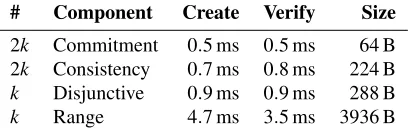
# Component Create Verify Size
2k Commitment 0.5 ms 0.5 ms 64 B 2k Consistency 0.7 ms 0.8 ms 224 B
k Disjunctive 0.9 ms 0.9 ms 288 B
k Range 4.7 ms 3.5 ms 3936 B
Table 1: Number of each proof component in a transaction forkbanks.
Size of and time to create and verify the components with 12 cores. The range proof create and verify benefit from the additional cores.
7.1
Experimental setup
Microbenchmarks. We run microbenchmarks on a 12 core Intel machine with i7-X980 3.33 GHz CPUs and 24GB of RAM, running 64-bit Linux 4.4.0 on Ubuntu 16.04.3. Each microbenchmark runs the same code a
Bankruns to create and validate transactions.
Distributed experiment. We run the distributed experi-ments on a set of 12 virtual machines each with 4 cores of Intel Xeon E5-2640 2.5 GHz processors, 24GB of RAM, and the same software setup as above. There is one au-ditor, one server providing the service of the ledger, and a varying number of banks, one per server. Servers com-municate using thenet/rpcGo package over TCP. All experiments use Go version 1.9.
7.2
Proof overhead in zkLedger
Table 1 shows the time to prove and verify the proofs in a transaction in zkLedger. There are two commitments, two consistency proofs, and one each of the disjunctive and range proofs in a transaction entry. There is a transaction entry perBank. Table 1 also shows the sizes of the various proofs, in bytes. These sizes are estimated based on the size of the underlying fields in the struct in memory; these proofs could be further compressed. Range proofs dominate the size of the transactions.
The left graph in Figure 3 shows the time it takes to create and verify a transaction varying the number of overall banks, which increases the number of entries per transaction. This indicates that as we increase the number of banks, both transaction creation and verification times per bank increase linearly, but parallelization helps. Prov-ing and validatProv-ing range proofs dominates transaction creation and verification, but this cost is also highly paral-lelizable. 12 cores gives a 2.8×speedup when creating a transaction with 20 banks; a bank can create or validate a transaction for up to 20 banks in less than 200ms.
As described in §4.1, zkLedger uses Borromean ring signatures to prove that a value is in a certain range, and supports values up to 240. Reducing the supported range of values would reduce range proof cost since that cost is linear in the number of bits in the size of the range. There are also newer proof systems, such as Bulletproofs, which
might create much smaller range proofs [13]. We plan to evaluate zkLedger with Bulletproofs in future work.
7.3
Cost of auditing ledgers
The left graph in Figure 4 shows that for certain func-tions, the time to audit is independent of the number of transactions in the ledger. This is because theAuditor
andBanksmaintain commitment caches, which already have the commitment product necessary to prove to the auditor the sum of the values in its column. The audit function is measuring the Herfindhal-Hirschman Index, so the auditor communicates with each bank.
When the auditor cannot use a commitment cache, per-haps because it was offline, it must process the whole ledger to compute the commitment product. This also applies to more complex auditing like the types described in §5, when the auditor has to verify recommitments for every row in the ledger. These costs are shown in the middle graph in Figure 4. This graph shows how long it takes the auditor to compute the Herfindahl-Hirschman Index on a ledger of varying sizes without using the com-mitment caches, so the auditor must process every row of the ledger. In these measurements, the auditor does not verify each row. As expected, this time increases linearly with the number of rows. This indicates that maintaining commitment caches is important for real-time auditing. However, even without commitment caches, auditing time is reasonable: 3.5 seconds for 100K transactions. This suggests the complex auditing queries, in which the au-ditor computes a similar set of operations per row, will also be on the order of many seconds. zkLedger currently only maintains commitment product caches per asset per bank, but could maintain more.
For a fixed size ledger, this audit function costs order the number of banks. The right graph in Figure 4 demon-strates the auditing costs of computing the Herfindahl-Hirschman Index on a ledger of 2000 transactions as we vary the number of banks, both with and without com-mitment caches. The auditor audits the banks in parallel. Auditing cost for this function grows slightly with the number of banks, since more banks increase the variabil-ity in parallel auditing and the auditor must wait for the last bank to respond before computing the final answer.
In these figures, each point is the mean of running the auditing query 20 times, with error bars representing one standard deviation from the mean.
7.4
Scaling with more banks
0 100 200 300 400 500 600
2 4 6 8 10 12 14 16 18 20
Time (ms)
number of banks verify-1
create-1 verify-12 create-12
0 200 400 600 800 1000
2 3 4 5 6 7 8 9 10
Time (ms)
number of banks complete transactions
0 2 4 6 8 10 12
2 3 4 5 6 7 8 9 10
Throughput (txns/sec)
number of banks all banks transacting one bank transacting
Figure 3: Transaction creation and verification time for one bank (left), varying the number of entries in the transaction. Single-threaded and
multi-threaded performance, with 12 threads. Time to fully process a transaction including creation, broadcast to ledger, banks and auditor, and verification by all parties (middle). Throughput (right) varying the number of banks.
0 2 4 6 8 10 12
0K 20K 40K 60K 80K 100K
Auditing time (ms)
Transactions in ledger online auditor
0 500 1000 1500 2000 2500 3000 3500
0K 20K 40K 60K 80K 100K Transactions in ledger
offline auditor
0 20 40 60 80 100 120
2 3 4 5 6 7 8 9 10 Number of banks
offline auditor online auditor
Figure 4: Time to audit ledgers of different sizes (4 banks), and with a varying number of banks (2000 row ledger). Audit time is independent of the
size of the ledger (left) thanks to commitment caches maintained by the online auditor. When commitment cache optimization is turned off (middle) the audit time is linear in the size of the ledger. Audit time grows with the number of banks (right) and is much higher without commitment caches.
described in §4.1, a bank needs to use its entry from transactionn−1 to create transactionn. So though a bank can use many cores to produce the proofs for a single transaction in parallel, multiple banks cannot produce different transactions in parallel. In zkLedger, banks start creating transactionn before seeingn−1 but the bank cannot complete the transaction untiln−1 is accepted to the ledger and verified, causing an inherent bottleneck.
The second major cost is around verification. Every bank must verify every transaction, so the more banks, the larger each transaction and thus the more work that needs to be done by each bank. The middle graph in Figure 3 measures the time it takes one bank to create and all participants in zkLedger to completely process a transaction. One bank creates a transaction and sends it to the ledger, which then broadcasts the transaction to all banks and an online auditor. The auditor and every bank verify the transaction. As we increase the number of banks, work increases quadratically; however, banks can verify transactions in parallel so the time to process transactions only increases linearly. The right graph in Figure 3 shows that as we surmised, zkLedger’s through-put worsens with more banks. The one bank transacting line in this graph is the same data as the middle graph.
Since range proofs dominate the costs of transaction creation and verification, we are optimistic that a faster range proof implementation will directly improve perfor-mance. zkLedger’s current performance is comparable to Solidus, a privacy-preserving distributed ledger which achieves 3-4 transactions per second with online valida-tion but, unlike zkLedger, does not support auditing.
8
Future work
zkLedger focuses on providing provably correct auditing over private transaction data, but zkLedger does not have a way to recover if the distributed ledger is corrupted. In this case, the parties maintaining the ledger would have to come together to recreate historical transactions. zk-Ledger also does not provide recourse if a bank commits an unintended transaction to the ledger. A future ver-sion of zkLedger might provide rectifying transactions or participant agreed-upon rollback.
9
Conclusion
zkLedger is the first distributed ledger system to provide strong transaction privacy, public verifiability, and com-plete, provably correct auditing. zkLedger supports a rich set of auditing queries which are useful to measure the financial health of a market. We developed a design using non-interactive zero-knowledge proofs to prove transac-tions maintain financial invariants and to support auditing. Our evaluation shows that zkLedger has reasonable per-formance for transaction settlement and auditing.
10
Acknowledgements
References
[1] Bank secrecy act of 1970, October 1970. 12 U.S.C. 103. [2] Package btcec implements support for the elliptic curves needed for Bitcoin., July 2017.https://godoc.org/ github.com/btcsuite/btcd/btcec.
[3] ABBE, E. A., KHANDANI, A. E., AND LO, A. W. Privacy-preserving methods for sharing financial risk ex-posures.The American Economic Review 102, 3 (2012), 65–70.
[4] ARASU, A., BLANAS, S., EGURO, K., KAUSHIK, R., KOSSMANN, D., RAMAMURTHY, R.,ANDVENKATE
-SAN, R. Orthogonal security with cipherbase. InCIDR
(2013).
[5] BAJAJ, S.,ANDSION, R. Trusteddb: A trusted hardware-based database with privacy and data confidentiality.IEEE Transactions on Knowledge and Data Engineering 26, 3 (2014), 752–765.
[6] BAUMANN, A., PEINADO, M.,ANDHUNT, G. Shielding applications from an untrusted cloud with haven. ACM Transactions on Computer Systems (TOCS) 33, 3 (2015), 8.
[7] BEN-SASSON, E., CHIESA, A., GENKIN, D., TROMER, E.,ANDVIRZA, M. SNARKs for C: Verifying program executions succinctly and in zero knowledge. InAdvances in Cryptology–CRYPTO 2013. Springer, 2013, pp. 90–108. [8] BEN-SASSON, E., CHIESA, A., GREEN, M., TROMER, E.,ANDVIRZA, M. Secure sampling of public parameters for succinct zero knowledge proofs. InProceedings of the 2015 IEEE Symposium on Security and Privacy(2015), SP ’15, pp. 287–304.
[9] BLUM, M., FELDMAN, P., AND MICALI, S. Non-interactive zero-knowledge and its applications. In Pro-ceedings of the 20th Annual ACM Symposium on Theory of Computing(1988), STOC ’88, pp. 103–112.
[10] BOGDANOV, D., TALVISTE, R.,ANDWILLEMSON, J. Deploying secure multi-party computation for financial data analysis. InInternational Conference on Financial Cryptography and Data Security(2012), Springer, pp. 57– 64.
[11] BOWE, S., GABIZON, A., ANDGREEN, M. A multi-party protocol for constructing the public parameters of the Pinocchio zk-SNARK. Cryptology ePrint Archive, Report 2017/602, 2017.
[12] BOWE, S., GABIZON, A.,ANDMIERS, I. Scalable multi-party computation for zk-SNARK parameters in the ran-dom beacon model. Cryptology ePrint Archive, Report 2017/1050, 2017.
[13] B ¨UNZ, B., BOOTLE, J., BONEH, D., POELSTRA, A.,
ANDMAXWELL, G. Bulletproofs: Short proofs for Con-fidential Transactions and more. InSecurity and Privacy (SP), 2018 IEEE Symposium on(2018), IEEE.
[14] BURKHART, M., STRASSER, M., MANY, D.,ANDDIM
-ITROPOULOS, X. Sepia: Privacy-preserving aggregation of multi-domain network events and statistics.Network 1, 101101 (2010).
[15] CASTRO, M.,ANDLISKOV, B. Practical byzantine fault tolerance. InOSDI(1999), vol. 99, pp. 173–186. [16] CECCHETTI, E., ZHANG, F., JI, Y., KOSBA, A., JUELS,
A.,ANDSHI, E. Solidus: Confidential distributed ledger transactions via pvorm.
[17] CHAIN, I. Confidential assets. https:
//blog.chain.com/hidden-in-plain-
sight-transacting-privately-on-a-blockchain-835ab75c01cb.
[18] CORRIGAN-GIBBS, H.,ANDBONEH, D. Prio: Private, robust, and scalable computation of aggregate statistics.
arXiv preprint arXiv:1703.06255(2017).
[19] COUNCIL, F. R. Developments in audit 2016/2017 full report, 2017. http://www.frc.org.uk/
getattachment/915c15a4-dbc7-4223-b8ae- cad53dbcca17/Developments-in-Audit-2016-17-Full-report.pdf.
[20] CRAMER, R., DAMGARD˚ , I., AND SCHOENMAKERS, B. Proofs of partial knowledge and simplified design of witness hiding protocols. InAdvances in Cryptology -CRYPTO ’94, 14th Annual International Cryptology Con-ference, Santa Barbara, California, USA, August 21-25, 1994, Proceedings(1994), pp. 174–187.
[21] DAGHER, G. G., B ¨UNZ, B., BONNEAU, J., CLARK, J.,
ANDBONEH, D. Provisions: Privacy-preserving proofs of solvency for Bitcoin exchanges. InProceedings of the 22nd ACM SIGSAC Conference on Computer and Com-munications Security(Denver, CO, 2015), ACM, pp. 720– 731.
[22] Corda, 2017. https://github.com/corda/
corda.
[23] Digital asset holdings, 2017.http://digitalasset. com.
[24] Regulation (EU) 2016/679 of the European Parliament and of the Council of 27 April 2016 on the protection of natural persons with regard to the processing of personal data and on the free movement of such data, and repealing Directive 95/46/EC (General Data Protection Regulation).
Official Journal of the European Union L119(May 2016), 1–88.
[25] FELDMAN, A. J., ZELLER, W. P., FREEDMAN, M. J.,
AND FELTEN, E. W. Sporc: Group collaboration us-ing untrusted cloud resources. InOSDI(2010), vol. 10, pp. 337–350.
[26] FIAT, A., AND SHAMIR, A. How to prove yourself: practical solutions to identification and signature problems. InProceedings of the 6th Annual International Cryptology Conference(1987), CRYPTO ’87, pp. 186–194. [27] GARMAN, C., GREEN, M.,ANDMIERS, I. Accountable
privacy for decentralized anonymous payments. Cryp-tology ePrint Archive, Report 2016/061, 2016. http: //eprint.iacr.org/2016/061.
[28] GREENBERG, A. Fbi says it’s seized $28.5 million in bitcoins from ross ulbricht, alleged owner of silk road.
[29] HERFINDAHL, O. C. Concentration in the steel industry. PhD thesis, Columbia University New York, 1950. [30] LAMPORT, L.,ET AL. Paxos made simple.ACM Sigact
News 32, 4 (2001), 18–25.
[31] LI, J., KROHN, M. N., MAZIERES, D.,ANDSHASHA, D. E. Secure untrusted data repository (sundr). InOSDI
(2004), vol. 4, pp. 9–9.
[32] MAHAJAN, P., SETTY, S., LEE, S., CLEMENT, A., ALVISI, L., DAHLIN, M., ANDWALFISH, M. Depot: Cloud storage with minimal trust.ACM Transactions on Computer Systems (TOCS) 29, 4 (2011), 12.
[33] MAURER, U. Unifying zero-knowledge proofs of knowl-edge.Proceedings of the 2nd International Conference on Cryptology in Africa(2009), 272–286.
[34] MAXWELL, G. Confidential transactions. https: //people.xiph.org/˜greg/confidential_ values.txt(Accessed 8/2017)(2015).
[35] MAXWELL, G., ANDPOELSTRA, A. Borromean ring signatures. https://raw.githubusercontent. com/Blockstream/borromean_paper/
master/borromean_draft_0.01_34241bb.
pdf(Accessed 6/2017)(2015).
[36] MEIKLEJOHN, S., POMAROLE, M., JORDAN, G., LEVCHENKO, K., MCCOY, D., VOELKER, G. M.,AND
SAVAGE, S. A fistful of bitcoins: characterizing payments among men with no names. InProceedings of the 2013 conference on Internet measurement conference(2013), ACM, pp. 127–140.
[37] NAKAMOTO, S. Bitcoin: A peer-to-peer electronic cash system, 2008.
[38] OBER, M., KATZENBEISSER, S.,ANDHAMACHER, K. Structure and anonymity of the bitcoin transaction graph.
Future internet 5, 2 (2013), 237–250.
[39] ONGARO, D.,ANDOUSTERHOUT, J. K. In search of an understandable consensus algorithm. InUSENIX Annual Technical Conference(2014), pp. 305–319.
[40] PAPADIMITRIOU, A., BHAGWAN, R., CHANDRAN, N., RAMJEE, R., HAEBERLEN, A., SINGH, H., MODI, A.,
AND BADRINARAYANAN, S. Big data analytics over encrypted datasets with seabed. InOSDI(2016), pp. 587– 602.
[41] PEDERSEN, T. P. Non-interactive and information-theoretic secure verifiable secret sharing. InProceedings of the 11th Annual International Cryptology Conference
(1992), CRYPTO ’91, pp. 129–140.
[42] POELSTRA, A., BACK, A., FRIEDENBACH, M., MAXWELL, G., ANDWUILLE, P. Confidential assets, 2017. 4th Workshop on Bitcoin and Blockchain Research. [43] POPA, R. A., REDFIELD, C., ZELDOVICH, N.,ANDBAL
-AKRISHNAN, H. CryptDB: protecting confidentiality with encrypted query processing. InProceedings of the Twenty-Third ACM Symposium on Operating Systems Principles
(2011), ACM, pp. 85–100.
[44] POPA, R. A., STARK, E., HELFER, J., VALDEZ, S., ZEL
-DOVICH, N., KAASHOEK, M. F.,ANDBALAKRISHNAN,
H. Building web applications on top of encrypted data using mylar. InNSDI(2014), pp. 157–172.
[45] REID, F.,ANDHARRIGAN, M. An analysis of anonymity in the bitcoin system. InSecurity and privacy in social networks. Springer, 2013, pp. 197–223.
[46] RON, D., AND SHAMIR, A. Quantitative analysis of the full bitcoin transaction graph. InInternational Confer-ence on Financial Cryptography and Data Security(2013), Springer, pp. 6–24.
[47] SASSON, E. B., CHIESA, A., GARMAN, C., GREEN, M., MIERS, I., TROMER, E.,ANDVIRZA, M. Zerocash: Decentralized anonymous payments from Bitcoin. In Se-curity and Privacy (SP), 2014 IEEE Symposium on(2014), IEEE, pp. 459–474.
[48] SCHNORR, C.-P. Efficient signature generation by smart cards.Journal of cryptology 4, 3 (1991), 161–174. [49] SCHUSTER, F., COSTA, M., FOURNET, C., GKANTSIDIS,
C., PEINADO, M., MAINAR-RUIZ, G., AND RUSSI
-NOVICH, M. Vc3: Trustworthy data analytics in the cloud using sgx. InSecurity and Privacy (SP), 2015 IEEE Sym-posium on(2015), IEEE, pp. 38–54.
[50] TU, S., KAASHOEK, M. F., MADDEN, S., ANDZEL
-DOVICH, N. Processing analytical queries over encrypted data. InProceedings of the VLDB Endowment(2013), vol. 6, VLDB Endowment, pp. 289–300.
[51] Zcash, 2017.http://z.cash.
[52] ZHENG, W., DAVE, A., BEEKMAN, J. G., POPA, R. A., GONZALEZ, J. E.,ANDSTOICA, I. Opaque: An oblivious and encrypted distributed analytics platform. In NSDI
(2017), pp. 283–298.
A
Auditing Queries
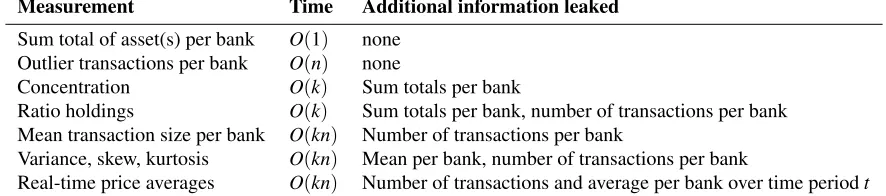
Figure 5 is a list of the types of measurements zkLedger supports, including the estimated running time and the data beyond the measurement that is leaked. For example, as described in §5, computing transaction size variance requires leaking the mean transaction size and number of transactions per bank.
B
Zero-knowledge
proofs
and
privacy
guarantees
To build our zero-knowledge protocols we rely on the following general result of Maurer (Theorem 3, [33]):
Theorem B.1. Let (H1, ?) and (H2,⊗) be two
(not-necessarily commutative) groups and f:H1→H2be a
group homomorphism: f(x?y) =f(x)⊗f(y). Let`∈Z,
u∈H1,C ⊂Zbe such that:
1. gcd(c1−c2, `) =1for all c1,c2∈C (with c16=c2),
and 2. f(u) =z`.
con-Measurement Time Additional information leaked
Sum total of asset(s) per bank O(1) none Outlier transactions per bank O(n) none
Concentration O(k) Sum totals per bank
Ratio holdings O(k) Sum totals per bank, number of transactions per bank Mean transaction size per bank O(kn) Number of transactions per bank
Variance, skew, kurtosis O(kn) Mean per bank, number of transactions per bank
Real-time price averages O(kn) Number of transactions and average per bank over time periodt
Figure 5: Types of supported auditing queries, their running time to audit based on the number of bankskand the number of rows in the ledgern,
and a description of what information is leaked to the auditor.
sisting of s rounds is proof-of-knowledge if1/|C|sis negli-gible, and zero-knowledge if|C|is polynomially bounded.
Using Theorem B.1 we can now unify the treatment of most of the zero-knowledge proofs used in our sys-tem. For example, the consistency proofsπCrely on the
following result:
Theorem B.2. Let G be an order-r cyclic group and
g,h,pk be any three elements of G. There exists a 2-extractable Σ-protocol for language Laux :={(cm,
Token):∃v,r s.t.cm=gvhr∧Token=pkr}.
Proof. ConsiderH1=Zr×Zr, defining the group
opera-tion to be component-wise addiopera-tion, and letH2=G×G, similarly defining group operation to be component-wise. Then f(x,y):= (gxhy,pky)is a group homomor-phism betweenH1andH2. Indeed, f(x1+x2,y1+y2) = (gx1+x2hy1+y2,pky1+y2) = f(x
1,y1)⊗f(x2,y2). Further-more, setting`=r andu= (0,0)we have that for all
z∈H2the following holds:z`= (1,1) =f(u). Therefore, we can apply Theorem B.1 and conclude thatLauxhas a
2-extractableΣ-protocol.
To summarize, the three proofs in zkLedger (see Sec-tion 4.3) that relate commitmentscmi:=:gvihriand audit
tokensTokeni:= (pki)ri have the following form:
• Proof of Assets (πA). This proof consists of a new
commitmentcm0i, together with an audit tokenToken0i,
and a zero-knowledge proof asserting that eithercm0iis
a re-commitment of the value incmior a recommitment
to the sum of the values in∏mj=0cmj. To create this
proof zkLedger relies on Theorem B.1 for constituent proofs; as these are Sigma-protocols we apply the stan-dard OR-composition [20] to get the final disjunctive zero-knowledge proof. To prove that the commited value is in the range we use the range proofs in Confi-dential Assets [42]. We are investigating more recent proof systems (e.g. Bulletproofs [13]) to further reduce the proof size.
• Proof of Balance (πB). In our implementation this
proof is an empty string: the prover simply chooses the
commitment randomness subject to condition∑ri=0.
With such a choice the auditor homomorphically adds the commitments and checks that this addition results in the neutral element of the group∏cmi=g∑vih∑ri= g0h0=1.
• Proof of Consistency (πC). We use two proofs derived
from Theorem B.2 to assert that the randomness used incmi andTokeniare the same, and the randomness
used incm0iandToken0iare the same.
C
Privacy in the combined system
Pedersen commitments provide information-theoretic pri-vacy. In zkLedger Pedersen commitments are published together with authentication tokens and zero-knowledge proofs. We note that zero-knowledge proofs indeed don’t spoil the information-theoretic privacy of committed val-ues: the output of the zero-knowledge proof simulator is identical to the output produced by parties in the sys-tem. However, when combining Pedersen commitments and authentication tokens, the privacy guarantees become computational as we now explain.
The commitment, audit token, and public key triple (cm,Token) is of the form (gvhr,pkr,pk) = (gvhr,hsk·r,hsk), and these three values uniquely deter-mine thev. That is, if an adversary could break the dis-crete logarithm problem, it could solve forsk, use that and value ofTokento inferr, and finally recoverv. That said, under the Decisional Diffie-Hellman (DDH) assumption, no information is leaked. Furthermore, the DDH assump-tion is widely assumed to hold in zkLedger’s elliptic curve group.
Recall, that DDH holds if no polynomially-bounded adversary can distinguish between tuples of the form (h,ha,hb,hab)and(h,ha,hb,hc)for a randomly chosen generatorhand exponentsa,b,c. Assume that a state-ful adversaryAzkL, when given input(g,h,pk)is able to
and(gv2hr,hsk·r,hsk). We now show how to useAzkLto construct an adversaryADDHbreaking the DDH
assump-tions.
After receiving its challenge(h,x,y,z), where(x,y,z) is distributed either as(ha,hb,hab)or as(ha,hb,hc), the adversaryADDHproceeds as follows. It samples a random
generatorgand callsAzkLon input(g,h,x),xnow serving
the role of the bank’s public key. When AzkL returns
two valuesv1andv2, the DDH adversaryADDHpicks a
randomk∈ {1,2}and preparescmk=gvky,Token=z
and sends(cmk,Token)toAzkL. Finally, ifAzkL’s guess
forkis correct,ADDHresponds that the DDH challenge
was of the form(h,ha,hb,hab)(i.e. a DDH quadruple), otherwise it responds that the DDH challenge was of the
form(h,ha,hb,hc)(i.e. a random quadruple).
Note that whenADDH’s challenge is a DDH
quadru-ple, the zkLedger adversaryAzkLis run on a distribution
it expects. In particular, all of its inputs are correctly formed with respect tosk=aandr=b. Whereas, when
ADDH’s challenge is a random quadruple, the inputs to AzkLhaveinformation-theoreticallyno information about
the committed value: indeed,Token=hcis unrelated to
cm=gvhb. Therefore, if the zkLedger adversaryA zkL
wins the commitment hiding game with non-negligible advantage, so doesADDHin the DDH game. Note that