© 2014, IJCSMC All Rights Reserved 689
Available Online at www.ijcsmc.com
International Journal of Computer Science and Mobile Computing
A Monthly Journal of Computer Science and Information Technology
ISSN 2320–088X
IJCSMC, Vol. 3, Issue. 7, July 2014, pg.689 – 693
RESEARCH ARTICLE
EFFECTIVE BANDWIDTH ALLOCATION
APPROACH BASED ON USERS BILLING
IN CLOUD ENVIRONMENT
A.PEDA GOPI G.KRISHNA
Computer science and engineering Computer science and engineering
KL University KL University
Vijayawada, India Vijayawada, India
[email protected] [email protected]
Y.SREELAKSHMI Dr. S.SATYANARAYANA
Computer science and engineering Computer science and engineering
KL University KL University
Vijayawada, India Vijayawada, India [email protected] [email protected]
Abstract--- Cloud computing is a new development emerging in IT environment with vast requirements of infrastructure and resources. Band width allocation and Load balancing is an important aspect of cloud computing environment. Bandwidth allocation plays a most important part in sharing the resources to the data center networks. In this paper we propose a new bandwidth allocation scheme based on unused bandwidth at passive users, allocation based on user type and also propose an algorithm to allocate bandwidth in a cloud environment.
Key terms--- bandwidth, cloud, user, billing
1. INTRODUCTION
Cloud computing refers to the delivery of computing resources over the web on demand. As an alternative of keeping data on your own hard drive or updating applications for your needs, you use a service over the web, at another location, to store your data or use its applications. Doing so possibly will give rise to certain privacy associations.
© 2014, IJCSMC All Rights Reserved 690
provisioned and released with minimal management effort or service provider interaction. This cloud model is composed of five essential characteristics, three service models, and four deployment models.
A. Essential Characteristics
a. On-demand self-service
A consumer can uniquely provision computing abilities, such as server moment in time and network storage, as considered necessary automatically without requiring human interface with each service’s provider.
b. Broad network access
Capabilities are accessible over the network and got to through standard mechanisms that support use by heterogeneous thin or thick client platforms (e.g., mobile phones, laptops, and PDAs).
c. Resource pooling
The provider’s computing assets are pooled to serve multiple consumers using a multi-inhabitant model, with distinctive physical and virtual resources alterably allotted and reassigned according to consumer request. There is a sense of independent on location in that the customer typically has no management or information over the accurate location of the provided resources however also be ready to specify location at a next higher level of abstraction (e.g., country, state, or datacenter). Samples of resources embrace storage, processing, memory, network bandwidth, information measure and virtual machines.
d. Rapid elasticity
Capabilities are often quickly and elastically provisioned, in some cases mechanically, to quickly scale out and rapidly discharged to quickly scale in. To the consumer, the capabilities offered for provisioning typically seem to be unlimited and many be purchased in any amount at any time.
e. Measured Service
Cloud systems mechanically manage and optimize resource use by leveraging a metering capability at some level of abstraction acceptable to the sort of service (e.g., storage, operating, bandwidth, and active user accounts). Resource usages are often monitored, controlled, and according providing transparency for each of the provider and consumer of the utilized service.
B. Service Models
a. Cloud Software as a Service (SaaS): The potential provided to the consumer is to use the provider’s applications operation on a cloud infrastructure. The applications are accessible from numerous client devices through a thin client interface like as a web browser (e.g., web-based email). The consumer does not manage the underlying cloud infrastructure together with network, servers, operating systems, storage, or perhaps individual application capabilities, with the potential exception of limited user-specific application configuration settings.
b. Cloud Platform as a Service (PaaS): The capability provided to the consumer is to deploy onto the cloud infrastructure consumer-created or non inheritable applications created using mistreatment programming languages and tools supported by the provider. The patron does not manage or control the underlying cloud infrastructure together with network, servers, operative systems, or storage, however has control over the deployed applications and presumably application hosting environment configurations.
c. Cloud Infrastructure as a Service (IaaS): The capability provided to the patron is to provision process, storage,
networks, anddifferent elementarycomputing resources wherever the consumer is in a position to deploy and run
whimsical software system, which might embrace operating systems and applications. The customer does not control the fundamental cloud infrastructure however has management over operating systems, storage, deployed applications, and probably limited restriction of choose networking elements (e.g., host firewalls).
C. Deployment Models
a. Private cloud: The cloud infrastructure is operated alone for an company. It’s going to be managed by the organization or a third party and should exist on premise or off premise.
b. Community cloud: The cloud infrastructure is shared by many organizations and supports a particular community that has shared considerations (e.g., mission, security needs, policy, and compliance concerns). It’s going to be managed by the organizations or a third party and can exist on premise or off premise.
c. Public cloud: The cloud infrastructure is created accessible to the overall public or a oversized industry group and is in hand by an organization promotion cloud services.
© 2014, IJCSMC All Rights Reserved 691
All these are accessed by user only when the user having enough bandwidth so In this paper we propose a new algorithm for bandwidth allocation to the user.
2. RELATED WORK
In existing methodology it is centered on expanding the execution of the server by settling it to acquire correct estimation of the complete likelihood conveyance of the solicitation reaction time and other essential execution pointers which has been depicted in novel rough diagnostically show for execution advancement of cloud server ranches.
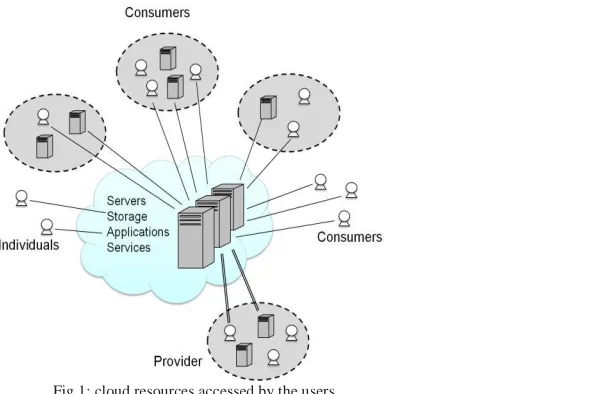
Fig 1: cloud resources accessed by the users
The model permits cloud administrators to focus the relationship between the amount of servers and information support size, on one side, and the execution markers, for example, mean number of assignments in the framework, blocking likelihood, and likelihood that an assignment will acquire prompt administration, on alternate administrations. It is key to seclude the system execution between the customers for guaranteeing reasonable utilization of the compelled and imparted system assets of the physical machine. Lamentably, the current system execution disengagement methods are not successful for distributed computing frameworks since they are hard to embraced in an expansive scale and require non-inconsequential adjustment to the system stack of a visitor OS.
3. PROPOSED SYSTEM
In the existing system, bandwidth allocation in cloud environment based on total available unused bandwidth and total number of users who are active but in our method we are giving priority to users who are need more bandwidth and pay highest amount of billing. So this is described in bellow algorithm.
Load shedding gives the maximum values of infrastructure (total bandwidth, total memory size, total software’s, etc.) at the service provider. Based on these requirements service provider allocate to the users.
Monitoring has total control on bandwidth and it gives the available bandwidth.
For allocating bandwidth we proposed 4 methods based on billing those are , per user billing ,concurrent user billing, usage of user billing and hybrid mechanism.
Per user billing, every user keep login on cloud in certain amount of time, based that time we allocate bandwidth to the users. The advantage of this method is use bandwidth efficiently within the time limits.
Algorithm:
Input: total bandwidth provided to users by vendor
Output: allocating bandwidth dynamically Userbandwidth Ub;starttime ts:endtime te; Monitor()
{
© 2014, IJCSMC All Rights Reserved 692 Return unusedbandwidth;
}
Peruserbilling() {
While(user==true) ABD(); }
Concurrentuser() {
ABD();
If(all users are active) Return 0;
Else if(some users are not using) Allocate();
Else if(bandwidth available in loadsheding) Allocate();
Else
Continue with available bandwidth }
Usageofuser() {
ABD();
If(Ub ==slr agreement) Return 0;
Elseif(Ub <slragreement ) Allocate();
Else
Contact provider }
Hybridbilling() {
ABD();
It is combination of any available approaches ; }
Loadshedding() {
What are the max services provided by the provider and their max values }
ABD() {
For(i= ts ; i< te ; i++) If(user==idle) {
Allocate(); }
Else
Return 0; }
}
Allocate() {
Assign unused Ub to avtive user; }
© 2014, IJCSMC All Rights Reserved 693
Concurrent user billing, in this method users may process their operations simultaneously. It works based on the users state. If the user is idle (not performing any operations) allocate his/her bandwidth to another active user. Otherwise, if any bandwidth available in load shedding allocate bandwidth to other users.
In usage of user billing, we maintain one agreement called service level agreement. In that they mutually agreed upon some infrastructure. So based on SLR allocate bandwidth to the user. If user is using less bandwidth then allocate remaining bandwidth to the other users.
Hybrid mechanism, It is the combination of any two process stated above. Allocate method consists the allocating bandwidth dynamically to the users.
Conclusion: We propose a new approach for bandwidth allocation in cloud environment. We are giving priority to
users who are need more bandwidth and pay highest amount of billing if the bandwidth is available i.e. the other users are not using the bandwidth who are in passive state, the bandwidth allocated to the others based on SLA agreement.
REFERENCES
[1] R Satheesh Kumar, C Sabharimuthu, C Sabharimuthu, A Jayanthi, “Dynamic Bandwidth Allocation in
Cloud Computing” IRACST – International Journal of Computer Networks and Wireless Communications (IJCNWC), ISSN: 2250-3501,Vol.3, No2, April 2013.
[2] Mrs.V.Kavitha Chandrakanth, S.Gayathri, “ examining bandwidth provisioning on cloud computing and
resource sharing via web” [ijesat] international journal of engineering science & advanced technology,
ISSN: 2250–3676 , Volume-2, Issue-5, 1372 – 1376
[3] http://csrc.nist.gov/publications/nistpubs/800-145/SP800-145.pdf
[4] Joseph Doyle, Robert Shorten, and Donal O’Mahony, “Fair-Share for Fair Bandwidth allocation in cloud
computing”, ieee communications letters, vol. 16, no. 4, april 2012
[5] J. Baker, C. Bond, J. Corbett, J.J. Furman, A. Khorlin, J.Larsonand, J.M. Leon, Y. Li, A. Lloyd, and V.
Yushprakh,“Megastore: Providing Scalable, Highly Available Storage forInteractiveServices,” Proc. Conf. Innovative Data SystemsResearch (CIDR),pp. 223-234, Jan. 2011.
[6] Hamehkhazaei, Jelenamisic, vojislav B IEEE member,“Performance Analysis of Cloud Computing centers