© 2018, IJCSMC All Rights Reserved
1
Available Online atwww.ijcsmc.com
International Journal of Computer Science and Mobile Computing
A Monthly Journal of Computer Science and Information Technology
ISSN 2320–088X
IMPACT FACTOR: 6.017
IJCSMC, Vol. 7, Issue. 12, December 2018, pg.1 – 5
A Review toward Powers of Big Data and its
Challenges, Tools and Techniques
Priyanka Tyagi
[email protected]Lalita Devi Institute of Management and Science, Mandi Road New Delhi, India
Dr. Pranav Mishra
[email protected]Lalita Devi Institute of Management and Science, Mandi Road New Delhi, India
Abstract— Big Data applies to data that can't be prepared or broke down utilizing customary procedures or devices. For decades, organizations have been settling on business choices in light of value-based information put away into relational databases. In any case, there is a potential fortune of non-conventional information got from different sources, for example, online networking, messages, emailing, online overviews, online shopping and so forth that can be dug for helpful information. With the diminishing in the expense of storage capacity and calculation, it has ended up workable for ventures to utilize this information to profit. However, the fast growth rate of such large data generates numerous challenges, such as data inconsistency and incompleteness, scalability, timeliness, and security. This paper provides a brief introduction to the Big data technology and its importance in the contemporary world and addresses various challenges and issues that need to be emphasized to present the full influence of big data.
Keywords:Big Data, characteristics, definition, challenges, Hadoop, MapReduce
I. INTRODUCTION
© 2018, IJCSMC All Rights Reserved
2
beyond its historical sweet spot of relational (performance management) to the double-digit growth rates of real-time intelligence and exploration/discovery of the unstructured worlds.
II. DEFINITION OF BIG DATA
At present, the industry does not have a bound together meaning of Big Data. It has been characterized in varying courses as takes after by different gatherings: As per McKinsey, "Enormous Data alludes to datasets whose size are past the capacity of regular database programming apparatuses to catch, store, oversee and break down". IDC characterizes Big Data advancements as another era of advances and models intended to concentrate esteem financially from substantial volumes of a wide assortment of information by empowering high speed catch, revelation and investigation. As indicated by O'Reilly, "Enormous Data will be information that surpasses the handling limit of ordinary database frameworks. The information is too huge, moves too quickly, or does not fit the structures of existing database designs. To pick up quality from this information, there must be an option approach to process it." As indicated by Wikipedia, "Huge Data for the most part incorporates datasets with sizes past the capacity of generally utilized programming apparatuses to catch, clergyman, oversee, and handle the information inside a decent slipped by time".
As indicated by Gartner, "Huge Data is high volume, high speed, and/or high assortment data resources that require new types of handling to empower improved basic leadership, knowledge revelation, and procedure enhancement". In the nutshell, efficacy of Big Data is that it is used to describe massive volumes of unstructured and structured data that are so large that it is very difficult to process this data using traditional databases and software technologies.
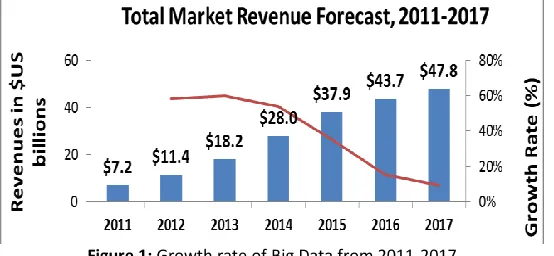
Figure 1: Growth rate of Big Data from 2011-2017
III. CHARACTERISTICS AND BENEFITS OF BIG DATA
The McKinsey Global Institute estimates that data volume is growing 40-50% per year, and will grow 44x between 2009 and 2020 [4]. However, volume of data is not the only characteristic that matters. In fact, Big Data h as four main characteristics: Volume, Velocity, Variety, and Value commonly referred to as “4V,” referencing the huge amount of data volume, fast processing speed, various data types, and low-value density.
Enormous Data coordinates both organized and unstructured information. The examination of information should be possible continuously or near ongoing, following up on full datasets instead of condensed components. The fundamental expense of the foundation to control the examination of information has fallen drastically, making it monetary to mine the data. Like customary investigation, it can likewise bolster interior business choices. The advancements and ideas driving Big Data permit associations to accomplish an assortment of goals. At the point when Big Data is refined and dissected.
© 2018, IJCSMC All Rights Reserved
3
IV. PROPERTIES OF BIG DATA
© 2018, IJCSMC All Rights Reserved
4
V. BIG DATA CHALLENGES
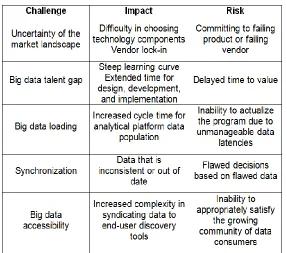
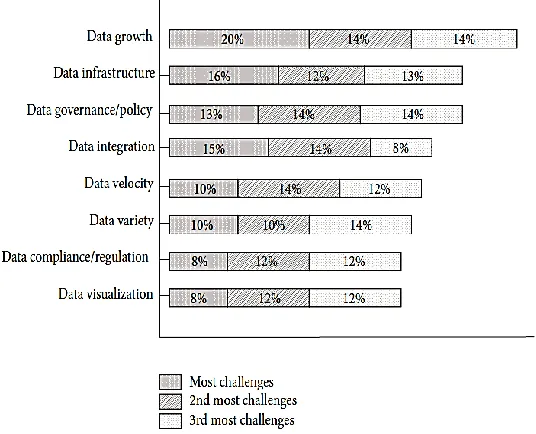
Big data due to its various properties like volume, velocity, variety, variability, value and complexity put forward many ch allenges. The Figure 3 shows various challenges in big data. Figure 2 list some of the challenges in Big data along with its impact and risks involved.
Figure 3. Challenges in Big data
VI. TECHNIQUES FOR BIG DATA HANDLING
There are many techniques available for data management. That includes Google BigTable, Simple DB, Not Only SQL (NoSQL), Data Stream Management System (DSMS), MemcacheDB, and Voldemort [7]. But these traditional approaches are only applicable to traditional data and not Big data as it cannot be stored on a single machine. The Big Data handling techniques and tools include Hadoop, MapReduce, and Big Table. Out of these, Hadoop is one of the most widely used technologies.
Hadoop
Hadoop is an Apache open source framework which is written in java. High volumes of data, in any structure, are processed by Hadoop. Hadoop allows distributed storage and distributed processing for very large data sets. The main components of Hadoop are:
1. Hadoop distributed file system (HDFS) 2. MapReduce
HDFS (Storage layer):- Hadoop has a distributed File System called HDFS, which stands for Hadoop Distributed File System. It is a File System used for storing very large files with streaming data access patterns, running on clusters on commodity hardware. There are two types of nodes in HDFS cluster, namely namenode and datanodes. The name node manages the file system namespace, maintains the file system tree and the metadata for all the files and directories in the tree. The datanode stores and retrieve blocks as per the instructions of clients or the namenode. The data retrieved is reported back to the namenode with lists of blocks that they are storing. Without the namenode it is not possible to access the file. So it becomes very important to make name node resilient to failure.
© 2018, IJCSMC All Rights Reserved
5
work to another node and cleaning up after the node that could not complete its task. It also knows how to combine the results of the computation in one place. The other core components in Hadoop architecture includes Hadoop YARN, it is a framework for job scheduling and cluster resource management. The other component is the cluster which is the set of host machines (nodes).
VII. CONCLUSION
There is most likely Big Data is the hot outskirts of today's data innovation advancement. The measure of information at present produced by the different exercises of the general public has never been so enormous, and is being created at a continually expanding speed. Through better investigation of the substantial volumes of data that are getting to be accessible, there is the potential for making speedier advances in a several disciplines and enhancing the gainfulness and accomplishment of numerous enterprises. Finally, so as to completely profit from Big Data, the above expressed difficulties should be taken care. As there are huge volumes of data that are produced every day, so such large size of data it becomes very challenging to achieve effective processing using the existing traditional techniques Big data is data that exceeds the processing capacity of conventional database systems. In this paper fundamental concepts about Big Data are presented. These concepts include Big Data characteristics, challenges and techniques for handling big data.
REFERENCES
[1]. “The Emerging Big Returns on Big Data”, A TCS 2013 Global Trend Study.
[2]. Elena Geanina Ularu, Florina Camelia Puican, Anca Apostu, Manole Velicanu, “Perspectives on Big Data and Big Data Analytics”, Database Systems Journal, Volume 3, No. 4, 2012.
[3]. Bernice M Purcell, “Big Data Using Cloud Computing”, OC13030 [4]. “Big Data for the Enterprise”, An Oracle White Paper, June 2013.
[5]. Chris Eaton, Dirk Deroos, Tom Deutsch, George Lapis, Paul Zikopoulos, ”Understanding Big Data”.
[6]. “Challenges and Opportunities with Big Data”, A Community White Paper Developed by Leading Researchers Across United States, 2012.
[7]. https://www.idc.com/prodserv/4Pillars/bigdata [8]. www.Wikibon.org
[9]. A, Katal, Wazid M, and Goudar R.H. "Big data: Issues, challenges, tools and Good practices." Noida: 2013, pp. 404 – 409, 8-10 Aug. 2013.]
[10]. Golfarelli, M., & Rizzi, S. (2009). Data warehouse design: modern principles and methodologies. Columbus: McGraw-Hill
[11]. Almeida, F., and Calistru, C, "The Main Challenges and Issues of Big Data Management", International Journal of Research Studies in Computing, 2(1), 2013, pp. 11-20.
[12]. https://www.progress.com