Available Online atwww.ijcsmc.com
International Journal of Computer Science and Mobile Computing
A Monthly Journal of Computer Science and Information Technology
ISSN 2320–088X
IMPACT FACTOR: 6.017IJCSMC, Vol. 6, Issue. 11, November 2017, pg.43 – 47
i-LEACH for Energy Efficient
Wireless Sensor Network
M.Sasikala
Assistant Professor, Department of Computer Science, KG College of Arts and Science [email protected]
Abstract: The recent developments in WSN show the need of WSN and variety of applications in this WSN improves the need of protocols with various designs to solve the design issues in the previous models. This paper proposed an energy efficient routing protocol which in turn reduces the energy consumption. The evaluation results of the proposed protocol shows the performance in lifetime improvement. The proposed protocol receives a better performance in energy dissipation and alive nodes which improves the efficiency of the network in all other aspects.
Keywords: Wireless Sensor Network, routing protocol, energy efficient, network lifetime,
performance improvement.
1. INTRODUCTION
Wireless Sensor Network (WSN) is an emerging technology in the research group because of the recent
developments in WSN. The development of technologies in IOT, RFID and so on increases the WSN
applications with the recent updates. The improvements in WSN applications such as solar equipped WSN,
rechargeable WSN and so on shows the need of WSN. In addition, applications for military, home security and
other daily using applications are in developing stage in WSN. WSN consists of sensor nodes which are grouped
to form clusters to collect and forward the data to the base station. Sensor nodes are consist of battery which is
mostly non-rechargeable, memory, processor and so on.
Grouping and forming of sensor nodes as cluster is one of the tedious task. Clustering is also a vital
task for collecting and forwarding the collected data to base station. Clustering algorithms are in developing
which shows the need of clustering. The routing protocols consider the clustering process and develops various
possibilities to achieve efficient clustering process. Not only clustering is efficient in collection of data but also
it utilise most of the energy of the sensor nodes. Therefore, the energy efficient clustering techniques are in need
This paper focused in developing an energy efficient protocol for WSN based on the Low-Energy
Adaptive Clustering Hierarchy (LEACH) protocol developed by Heinzelman et al., in 2000 [1]. This protocol is
improvised in many aspects such as, cluster head (CH) election, cluster formation and so on still the
development of WSN in all core areas shows the need of improvised form of LEACH protocol which suits to
the all kind of developed environment. LEACH follows two phases: set-up phase and steady phase. In : set-up
phase, the election of CH is followed based on the threshold function which is described in Eq. 1.
Where, T shows threshold, n shows the number of nodes, P shows probability value, r shows rounds
and finally G shows group.
First, LEACH asks the sensor nodes to choose a random number between 0 – 1. Second, the threshold
value is obtained using the threshold function of Eq. 1. Third, the sensor nodes are asked to check whether it
holds a higher value than the threshold value which is obtained sing threshold function from Eq. 1 or not.
Finally, the sensor nodes which are holds lesser value than the threshold value are declared as CH for this
round.
In steady phase, the Time Division Multiple Access (TDMA) is used to forwards the collected
information from clusters to clusters to reach base station.
The CH election of LEACH is efficient for the small group of sensor nodes with a minimum distance of data
transmission whereas, the data transmission from longer distance and for a large group of sensor nodes, the CH
becomes inefficient which makes the whole WSN meaningless.
This paper focused in electing energy efficient CH for WSN to prolong the network lifetime. Next
section details the literature survey which details the recent energy efficient protocols for WSN. In section 3, the
proposed protocol i-LEACH (improved-LEACH) is detailed. Section 4 presents the evaluation results of the
proposed protocol with the existing protocols and finally, section 5 concludes with conclusion and future work.
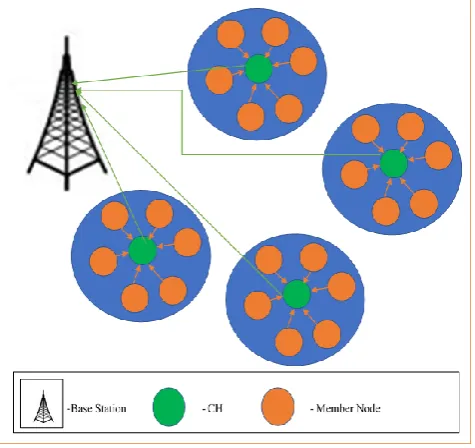
Figure 1 shows the communication structure of WSN where the member nodes forwards the data to CH and CH
receives the data, aggregates it and forwards it to BS.
2. LITERATURE SURVEY
Al-Baz and EL-Sayed proposed a new algorithm for CH selection using LEACH protocol [2]. In the
research work, the threshold function of LEACH protocol is modified with the residual energy level based CH
election. Here, the protocol elects the CH based on its residual energy. In other words, the sensor node which
holds higher energy is elected as CH. Therefore, the CH becomes more efficient than the LEACH’s CH in data
collection and forwarding. One of the major pitfall of the research work is that the sensor node is not enough
efficient to withstand for a longer period with this CH election process.
Jan et al., proposed payload-based mutual authentication scheme for WSN [3]. In the research work
PAWN, the CH election is processed using residual energy and based on the neighbors of the sensor node,
which means that the sensor node which holds high energy and more number of members is eligible to act as
CH. The scheme follows a balanced architecture which improves the performance of the network for a period in
a small scale applications. This approach becomes effortless for a large scale applications where a sensor nodes
are dynamic and congested.
Fujji et al., proposed optimal CH selection and rotation for WSN in which the CH is elected using
residual energy of a node [4]. This scheme also adds the rotation model for CH which denies the round value of
setup phase and follows its own rotation scheme. In addition, the rotation scheme follows based on the number
of alive nodes. Therefore, the network is efficient upto the percentage of alive nodes in a network. The cluster
formation and efficient clustering communication is followed in this scheme whereas the model becomes as
LEACH protocol when alive nodes percentage starts to decrease. Therefore, the network is efficient in initial
stage and becomes poorest in later stages.
Chen et al., proposed clustering energy-efficient transmission protocol for WSN using ant colony path
optimization [5]. This scheme follows ant colony optimization scheme for choosing best node as CH node
through number of neighbors. The path selection in this approach is efficient to reach the CH and BS. Therefore,
CH node is elected based the sensor node which holds more number of paths to reach BS. After the election of
CH, the CH is free to use the path from its path selection and utilise the same path for all communication. The
CH is also responsible for faster delivery of data to BS. Therefore, the CH have to choose the best optimised
path to reach BS on time or else the CH node is replaced with the other member node which have more number
of path for communication.
Neto et al., proposed a new flow network approach for WSN where the CH election is followed based
on the residual energy of the sensor node [6]. The sensor node which holds high energy is elected as CH and
remains as CH until it forwards a minimal number of data flow to BS. After, the completion of rounds a new CH
is elected. Whenever, the CH becomes less energy node then the CH asks to change the CH node. The model
works highly better in a time based network but it is not well suited for other common models.
3. PROPOSED PROTOCOL
This paper proposed i-LEACH which means improved-LEACH for WSN. Whereas, this proposed
protocol follows LEACH protocol in most of the network phases. In addition, this proposed protocol elects CH
protocol is reducing the energy consumption in electing CH for each round. Therefore, the CH is elected
whenever the CH utilises a percentage of energy for communication. First, the CH is elected based on its
residual energy and which is obtained using Eq. 2.
After obtaining the residual energy, the sensor nodes verifies the energy level with the neighbors to
identify the best residual energy node. As a result, the sensor node with maximum residual energy is found and
at last the energy level of a CH is marked and it utilises its 20% of energy for CH process. Whenever, the sensor
node reaches the utilisation of 20% then the CH asks to elect new CH for further communication. LEACH protocol’s round consideration is exempted in this protocol and which allows to elect CH at any point. Whereas, all the other process of this protocol follows the LEACH’s round concept.
Whenever, the CH election is called-off then the Eq. 3 is executed.
Where Maxenergy denotes maximum energy of a CH node, Currentenergydenotes current energy level of a CH
node.
The CH energy level is checked throughout the process using Eq. 4.
The Eq. 4 shows that the CH remains until the currentenergyis greater than the Maxenergy.
4. SIMULATION PERFORMANCE
The evaluation of the proposed protocol is simulated using NS2 [7]. The simulation parameters are
specified as 100 number of nodes, 5% of CH, initial energy as 1J and finally, 100th node is act BS node. The
performance is evaluated based energy dissipation and number of alive nodes parameter.
0 0.1 0.2 0.3 0.4 0.5 0.6 0.7 0.8 0.9 1
0 500 1000 1500 2000
En
ergy
(J)
Number of Rounds (S)
i-LEACH PAWN
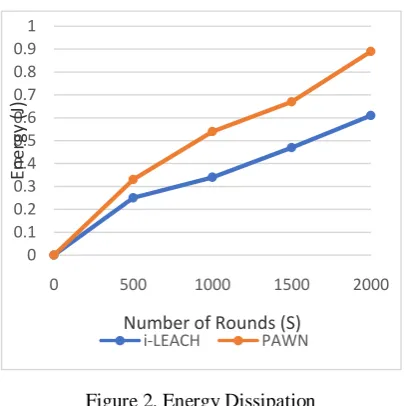
Figure 2. Energy Dissipation
The Figure 2 presents energy dissipation among the proposed i-LEACH and existing PAWN protocol.
0 100
0 500 1000 1500 2000
N
u
m
b
er
o
f N
o
d
es
(N)
Rounds (S)
i-LEACH PAWN
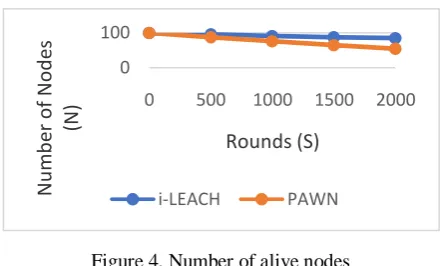
Figure 4. Number of alive nodes
Figure 4 shows the number of alive nodes between the proposed i-LEACH and existing PAWN protocol.
Whereas, i-LEACH maintains a good number of alive nodes than the existing protocol.
Through Figure 3 and 4, the performance of the proposed protocol i-LEACH is tested and evaluated. The results
shows that the proposed protocol achieves a better performance in improving network lifetime.
5. CONCLUSION
Wireless Sensor Network is one among the research work where the recent developments are improved
in a daily basis. This paper focused in energy efficient CH election for WSN and reaches the efficiency which is
proved through the evaluation results. The future enhancement in this protocol is to adding multihop
communication and IOT based cluster formation model.
References
[1] Heinzelman, W. R., Chandrakasan, A., & Balakrishnan, H. (2000, January). Energy-efficient communication protocol
for wireless microsensor networks. In System sciences, 2000. Proceedings of the 33rd annual Hawaii international
conference on (pp. 10-pp). IEEE.
[2] Al‐Baz, A., & El‐Sayed, A. (2017). A new algorithm for cluster head selection in LEACH protocol for wireless sensor
networks. International Journal of Communication Systems.
[3] Jan, M., Nanda, P., Usman, M., & He, X. (2017). PAWN: a payload‐based mutual authentication scheme for wireless
sensor networks. Concurrency and Computation: Practice and Experience, 29(17).
[4] Fujii, S., Takyu, O., Sasamori, F., Handa, S., Fujii, T., & Ohta, M. (2017, January). Optimal cluster head selection and
rotation of cognitive wireless sensor networks for simultaneous data gathering. In Information Networking (ICOIN),
2017 International Conference on (pp. 303-308). IEEE.
[5] Chen, H., Lv, Z., Tang, R., & Tao, Y. (2017, July). Clustering energy-efficient transmission protocol for Wireless
Sensor Networks based on ant colony path optimization. In Computer, Information and Telecommunication Systems
(CITS), 2017 International Conference on (pp. 15-19). IEEE.
[6] Neto, J. H. B., Júnior, J. C., & Rocha, L. S. (2017, March). A New Flow Network Approach for Improving Clustering
Protocols in Wireless Sensor Networks. In Advanced Information Networking and Applications (AINA), 2017 IEEE
31st International Conference on (pp. 285-291). IEEE.
[7] Issariyakul, T., & Hossain, E. (2011). Introduction to network simulator NS2. Springer Science & Business Media.
[8] Usha.M., Nautical based wireless sensor networks:Challenges & Requirements.in International journal of Multi