High-Performance Ideal Lattice-Based Cryptography on 8-bit
ATxmega Microcontrollers
Extended Version
Thomas P¨oppelmann, Tobias Oder, and Tim G¨uneysu
Horst G¨ortz Institute for IT-Security, Ruhr-University Bochum, Germany∗
{thomas.poeppelmann,tobias.oder,tim.gueneysu}@rub.de
Abstract. Over the last years lattice-based cryptography has received much attention due to versatile average-case problems like Ring-LWE or Ring-SIS that appear to be intractable by quantum computers. But despite of promising constructions, only few results have been published on implementation issues on very constrained platforms. In this work we therefore study and compare implementations of Ring-LWE encryption and the bimodal lattice signature scheme (BLISS) on an 8-bit Atmel ATxmega128 microcon-troller. Since the number theoretic transform (NTT) is one of the core components in implementations of lattice-based cryptosystems, we review the application of the NTT in previous implementations and present an improved approach that significantly lowers the runtime for polynomial multiplication. Our im-plementation of Ring-LWE encryption takes 27 ms for encryption and 6.7 ms for decryption. To compute a BLISS signature, our software takes 329 ms and 88 ms for verification. These results outperform imple-mentations on similar platforms and underline the feasibility of lattice-based cryptography on constrained devices.
Keywords: Ideal lattices, NTT, RLWE, BLISS, ATxmega
1 Introduction
RSA and ECC-based schemes are the most popular asymmetric cryptosystems to date, being deployed in billions of security systems and applications. Despite of their predominance, they are known to be susceptible to attacks using quantum computers [53] on which significant resources are spent to boost their further development [50]. Additionally, RSA and ECC have been shown to be quite inefficient on very small and constrained devices like 8-bit AVR microcontrollers [27,32]. A possible alternative are asymmetric cryptosystems based on hard problems in ideal lattices. The special algebraic structure of ideal lattices [40] defined in R= Zq[x]/hxn+ 1i allows a significant reduction of key and cipher-text sizes and enables efficient arithmetic using the number theoretic transform (NTT)1 [5,44,55]. To realize lattice-based public key encryption several proposals exists (see [10] for a comparison) like classical NTRU [31] (defined inZq[x]/hxn−1i), provably secure NTRU [54] (defined inZq[x]/hxn+1i), or a scheme based on the ring learning with errors (RLWE) problem [35,40] (from now on referred to as RLWEenc). From an implementation perspective, the RLWEenc scheme is currently one of the best-studied lattice-based public key encryption schemes (see [7,11,13,38,48,49,51]) and is similar to a recently proposed key exchange protocol [8,46]. Concerning signature schemes, several proposals exist likeGLP[25] (derived from [39]),BG[1],PASSSign[30], a modified NTRU signature scheme [42], or a signature scheme derived from a recently proposed IBE scheme [20]. However, so far the Bimodal Lattice Signature Scheme (BLISS) [18] seems superior in terms of signature size, performance, and security. Despite their popularity, implementation efforts so far mainly led to very efficient hardware designs for RLWEenc[11,49,51] and BLISS[47] and fast software on 32-bit microcontrollers [45] and 64-bit microprocessors [18,26] but only few works cover constrained 8-bit architectures [6,7,38]. Ad-ditionally, current works usually rely on the straightforward Cooley-Tukey radix-2 decimation-in-time
∗This work was partially funded by the European Union H2020 SAFEcrypto project (grant no. 644729), European
Union H2020 PQCRYPTO project (grant no. 645622), German Research Foundation (DFG), and DFG Research Training Group GRK 1817/1.
1
algorithm (e.g., [7,13,47,51]) to implement the NTT and thus to realize polynomial multiplication c=a·bfora,b,c∈ R asc=INTT(NTT(a)◦NTT(b)). However, by taking a closer look at works on the implementation [12,16] of the highly related fast Fourier transform (FFT) it becomes evident that the sole focus on Cooley-Tukey radix-2 decimation-in-time algorithms prevents further optimizations of the NTT, especially given the constraints of an 8-bit architecture.
Contribution. The contribution of this work is twofold. We first review different approaches and varieties ofNTT algorithms and then adapt and optimize these algorithms for the polynomial multi-plication use-case prevalent in ideal lattice-based cryptography. Improvements compared to previous work are mainly achieved by merging certain operations into the NTT itself (multiplication by n−1, powers ofψ andψ−1) and by removing the expensive bit-reversal step. In the second part we provide an efficient implementation of these NTT algorithms on the 8-bit AVR/ATxmega architecture. By using this optimized NTT we achieve high performance forRLWEencandBLISS. Our work shows that lattice-based cryptography can be used to realize the two most basic asymmetric primitives (public key encryption and signatures) on very constrained devices and with high performance. To the best of our knowledge, we provide the smallest implementation of BLISSon the AVR architecture in terms of flash consumption and also fastest implementation in terms of runtime since one signature compu-tation requires only 329 ms and verification requires 88 ms. By performing encryption in 27 ms and decryption in 6.7 ms, our implementation of RLWEenc also outperforms previous work on AVRs. To allow third-party evaluation of our results, source code and documentation is available on our website2.
Outline. In Section 2 we review the number theoretic transform (NTT), RLWEenc, and BLISS. We then show NTT algorithms that are better suited for polynomial multiplication in Section3. Our AVR ATxmega128 implementation is described in detail in Section4and we discuss our results in Section5.
2 Background
In this section we introduce the NTT and explicitly describe its application in the algorithms of the
RLWEencpublic key encryption scheme and theBLISSsignature scheme.
2.1 The Number Theoretic Transform and Negacyclic Convolutions
The number theoretic transform (NTT) [5,44,55] is similar to the discrete Fourier transform (DFT) but all complex roots of unity are exchanged for integer roots of unity and arithmetic is also carried out modulo an integerqin the fieldGF(q)3. Main applications of the NTT, besides ideal lattice-based cryptography, are integer multiplication (e.g., Sch¨onhage and Strassen [52]) and signal processing [5]. The forward transformation ˜a= NTT(a) of a lengthnsequence (a[0], . . . ,a[n−1]) to (˜a[0], . . . ,˜a[n−1]) with elements in Zq is defined as ˜a[i] = Pnj=0−1a[j]ωij modq, i = 0,1, . . . , n−1 where ω is an n-th primitive root of unity. The inverse transforma= INTT(˜a) is defined asa[i] =n−1Pn−1
j=0 ˜a[j]ω−ij mod
q, i = 0,1, . . . , n−1 where ω is exchanged by ω−1 and the final result scaled by n−1. For an n-th primitive root of unityωn it holds thatωnn= 1 modq,ω
n/2
n =−1 modq,ωn
2 =ω 2
n, andωni 6= 1 modq for any i= 1, . . . , n−1.
The main operation in ideal lattice-based cryptography is polynomial multiplication4. Schemes are usually defined in R = Zq[x]/hxn + 1i with modulus xn + 1 where n is a power of two and one can make use of the negacyclic convolution property of the NTT that allows carrying out a
2Seehttp://www.sha.rub.de/research/projects/lattice/ 3
Actually, this is overly restrictive and the NTT is also defined for certain composite numbers (nhas to dividep−1 for every prime factorpofq). However, for the given target parameter sets common in lattice-based cryptography we can restrict ourselves to prime moduli and refer to [44] for further information on composite moduli NTTs.
4
polynomial multiplication in Zq[x]/hxn+ 1i using length-n transforms and no zero padding. When a= (a[0], . . .a[n−1]) andb= (b[0], . . .b[n−1]) are polynomials of lengthnwith elements inZq,ωbe a primitiven-th root of unity inZq andψ2 =ω, then we defined= (d[0], . . .d[n−1]) as the negative wrapped convolution of a and b so that d = a·b mod xn+ 1. We then define ¯a =PowMulψ(a) = (a[0], ψa[1], . . . , ψn−1a[n−1]) as well as the inverse multiplication by powers of ψ−1 denoted as a=
PowMulψ−1(¯a). Then it holds thatd=PowMulψ−1(INTT(NTT(PowMulψ(a)◦NTT(PowMulψ(b))))) [15, 16,55], where ◦ denotes point-wise multiplication. For simplicity, we do not always explicitly apply
PowMulψ orPowMulψ−1 when it is clear from the context that a negacyclic convolution is computed.
2.2 The RLWEenc Cryptosystem
The semantically secure public key encryption scheme RLWEenc was proposed in [35,40,41] and is also used as a building block in the identity-based encryption scheme (IBE) by Ducas, Lyubashevsky, and Prest [20]. We provide the key generation procedureRLWEencgen in Algorithm 1, the encryption procedureRLWEencenc in Algorithm2, and the decryption procedureRLWEencdec in Algorithm3. All algorithms explicitly use calls to the NTT and function names used later on during the evaluation of our implementation (see Section 5). The exact placement of NTT transformations is slightly changed compared to [51], which saved one transformation compared to [48], asc2 is not transmitted in NTT form and thus removal of least significant bits is still possible (see [20,48]).
Algorithm 1 RLWEencKey Generation
Precondition: Access to global constant ˜a=NTT(a) 1: functionRLWEencgen()
2: ˜r1←NTT(SampleGaussσ())
3: ˜r2←NTT(SampleGaussσ())
4: p˜= ˜r1−a◦˜ ˜r2
5: return (pk, sk) = (˜p,˜r2) 6: end function
Algorithm 2 RLWEencEncryption
Precondition: Access to global constant ˜a=NTT(a) 1: functionRLWEencenc(˜a,p˜, µ∈ {0,1}
n
) 2: e˜1=NTT(SampleGaussσ())
3: e˜2=NTT(SampleGaussσ())
4: c1 = ˜a◦˜e1+ ˜e2 5: h˜2= ˜p◦˜e1
6: e3←SampleGaussσ()
7: c2 =INTT(˜h2) +e3+Encode(m) 8: return (c1,c2)
9: end function
Algorithm 3 RLWEencDecryption 1: functionRLWEencdec(c= [c1,c2],˜r2) 2: return Decode(INTT(c1◦˜r2) +c2). 3: end function
The main idea of the scheme is that during encryption the n-bit encoded message ¯m=Encode(m) is added to pe1+e3 (in NTT notationINTT( ˜h2) +e3) which is uniformly random and thus hides the message. Decryption is only possible with knowledge ofr2 since otherwise the large termae1r2 cannot be eliminated when computing c1r2+c2. The encoding of the message of lengthnis necessary as the noise terme1r1+e2r2+e3 is still present after calculatingc1r2+c2 and would prohibit the retrieval of the binary message after decryption. With the simple threshold encodingencode(m) = q−21mthe value
q−1
larger than|4q|in order to decrypt correctly. The probability for decryption errors is mainly determined by the tailcut τ and the standard deviation σ of the polynomials e1,e2,e3 ← DZn,σ, which follow a
small discrete Gaussian distribution (sampled bySampleGaussσ). In this context, decreasingsreduces the error probability but also negatively affects the security of the scheme [24,35]. Increasingq on the other hand increases the key size, ciphertext expansion, and reduces performance (on certain devices). To support the NTT, G¨ottert et al. [24] proposed parameter sets (n, q, s) whereσ=s/√2πdenoted as
RLWEenc-Ia(256,7681,11.31) andRLWEenc-IIa(512,12289,12.18). Lindner and Peikert [35] originally proposed the parameter setsRLWEenc-Ib(192,4093,8.87),RLWEenc-IIb(256,4093,8.35) and RLWEenc-IIIb(320,4093,8.00). The security levels of RLWEenc-IaandRLWEenc-IIb are roughly comparable and
RLWEenc-IIb provides 105.5 bits of pre-quantum security5, according to a refined security analysis by Liu and Nguyen [36] for standard LWE and the original parameter sets. The RLWEenc-IIaparameter set uses a larger dimensionnand should thus achieve even higher security than the 156.9 bits obtained by Liu and Nguyen forRLWEenc-IIIb. For the IBE scheme in [20] the parametersn= 512,q ≈223 and a trinary error/noise distribution are used.
2.3 The BLISS Cryptosystem
In this work we only consider the efficient ring-based instantiation of BLISS [18]. We recall the key generation procedure BLISSgen in Algorithm 4, the signing procedure BLISSsign in Algorithm 5, and the verification procedure BLISSver in Algorithm 6. Key generation requires uniform sampling of sparse and small polynomials f,g, rejection sampling (Nκ(S)), and computation of an inverse. To sign a message, two masking polynomials y1,y2 ← DZn,σ are sampled from a discrete Gaussian
distribution using the SampleGaussσ function. The computation of ay1 is performed using the NTT and the compresseduis then hashed together with the messageµbyHash. The binary stringc0 is used by GenerateC to generate a sparse polynomial c. Polynomials y1,y2 then hide the secret key which is multiplied with the sparse polynomials using the SparseMul function. This function exploits that only κ coefficients in c are set and only d1+d2 coefficients in s1 and s2. After a rejection sampling and compression step the signature (z1,z†2,c) is returned. The verification procedure BLISSver in Algorithm 6 just checks norms of signature components and compares the hash output withc in the signature.
In this work we focus on the 128-bit pre-quantum secureBLISS-Iparameter set which usesn= 512 and q = 12289 (same base parameters asRLWEenc-IIa). The density of the secret key isδ1 = 0.3 and
δ2 = 0, the standard deviation of the coefficients of y1 and y2 is σ = 215.73 and the repetition rate is 1.6. The number of dropped bits in z2 is d = 10, κ = 23, and p = b2q/2dc. The final size of the signature is 5,600 bits with Huffman encoding and approx. 7,680 bits without Huffman encoding.
3 Faster NTTs for Lattice-Based Cryptography
In this section we examine fast algorithms for the computation of the number theoretic transform (NTT) and show techniques to speed up polynomial multiplication for lattice-based cryptography6.
The most straightforward implementation of the NTT is a Cooley-Tukey radix-2 decimation-in-time (DIT) approach [14] that requires a bit-reversal step as the algorithm takes bit-reversed input and produces naturally ordered output (from now on referred to as NTTCTbo→no). To compute the NTT as defined in Section 2.1 the NTTCTbo→no algorithm applies the Cooley-Tukey (CT) butterfly, which
5Up to our knowledge, all security evaluations ofRLWEenc(and alsoBLISS) only consider best known attacks executed
on a classical computer. The security levels are thus denoted as pre-quantum. A security assessment that considers quantum computers is certainly necessary but is not in the scope of this paper.
6
Algorithm 4 BLISSKey Generation 1: functionBLISSgen()
2: Choosef,gas uniform polynomials with exactlyd1=dδ1neentries in{±1}andd2=dδ2neentries in{±2} 3: S= (s1,s2)t←(f,2g+ 1)t
4: if Nκ(S)≥C2·5·(dδ1ne+ 4dδ2ne)·κ then restart 5: aq= (2g+ 1)/fmodq(restartiff is not invertible)
6: Return(pk=A, sk=S) whereA= (˜a1=NTT(aq), q−2) mod 2q 7: end function
Algorithm 5 BLISSSigning 1: functionBLISSsign(µ∈{0,1}
∗
, pk=A, sk=S) 2: y1←SampleGaussσ()
3: y2←SampleGaussσ()
4: u= 2ζ·INTT(˜a1◦NTT(y1)) +y2mod 2q 5: c0←Hash(buedmodp, µ)
6: c←GenerateC(c0) 7: Choose a random bitb
8: z1 ←y1+ (−1)bSparseMul(s1,c) 9: z2 ←y2+ (−1)bSparseMul(s2,c) 10: Continuewith probability 11: 1. Mexp−kSck2
2σ2
coshhzσ,Sc2i
12: otherwiserestart
13: z†2←(bued− bu−z2ed) modp 14: Return (z1,z†2,c)
15: end function
Algorithm 6 BLISSVerification 1: functionBLISSver(µ∈{0,1}
∗
, pk=A, sk=S) 2: if k(z1|2d·z
†
2)k2> B2 then Reject 3: if k(z1|2d·z†2)k∞> B∞ then Reject
4: r←INTT(˜a1◦NTT(z1)) 5: c0=Hash
2ζ·r+ζ·q·c d+z
†
2modp, µ) 6: Acceptiffc=GenerateC(c0)
7: end function
computes a0 ← a+ωb and b0 ← a−ωb for some values of ω, a, b ∈ Zq, overall nlog22(n) times. The biggest disadvantage of relying solely on the NTTCTbo→no algorithm is the need for bit-reversal, multiplication by constants, and that it is impossible to merge the final multiplication by powers of
ψ−1 into the twiddle factors of the inverse NTT (see [51]). With the assumption that twiddle factors (powers ofω) are stored in a table and thus not computed on-the-fly it is possible to further simplify the computation and to remove bit-reversal and to merge certain steps. This assumption makes sense on constrained devices like the ATxmega, which have a rather large read-only flash.
3.1 Merging the Inverse NTT and Multiplication by Powers of ψ−1
In [51] Roy et al. use the standard NTTCTbo→noalgorithm for a hardware implementation and show how to merge the multiplication by powers of ψ (see Section 2.1) into the twiddle factors of the forward transformation. However, this approach does not work for the inverse transformation due to the way the computations are performed in the CT butterfly as the multiplication is carried out before the addition. In this section we show that it is possible to merge the multiplication by powers of ψ−1
during the inverse transformation using a fast decimation-in-frequency (DIF) algorithm [23]. The DIF NTT algorithm splits the computation into a sub-problem on the even outputs and a sub-problem on the odd outputs of the NTT and has the same complexity as the NTTCTbo→no algorithm. It requires usage of the so-called Gentlemen-Sande (GS) butterfly which computes a0←a+band b0 ←(a−b)ω
can be defined as
a[r] =ψ−r
n−1
X
`=0
A[`]ωn−r`=ψ−r
n
2−1
X
`=0
A[`]ωn−r`+
n
2−1
X
`=0
A[`+n 2]ω
−r(`+n2) n
(1)
=ψ−r n
2−1
X
`=0
A[`] +A[`+n 2]ω
−rn
2 n
ω−nr`, r= 0,1, . . . , n−1. (2)
When r is even this results in
a[2k] =
n
2−1
X
`=0
A[`] +A[`+n 2]
ω−nk`
2 (ψ
2)−k (3)
and for oddr in
a[2k+ 1] =
n
2−1
X
`=0
A[`]−A[`+n 2]ω
−` n
ω−nk`
2 ψ
−(2k+1) (4)
=
n
2−1
X
`=0
A[`]−A[`+n 2]
ψ−1ωn−`ω−nk`
2
(ψ2)−k, k= 0,1, . . . ,n
2 −1. (5)
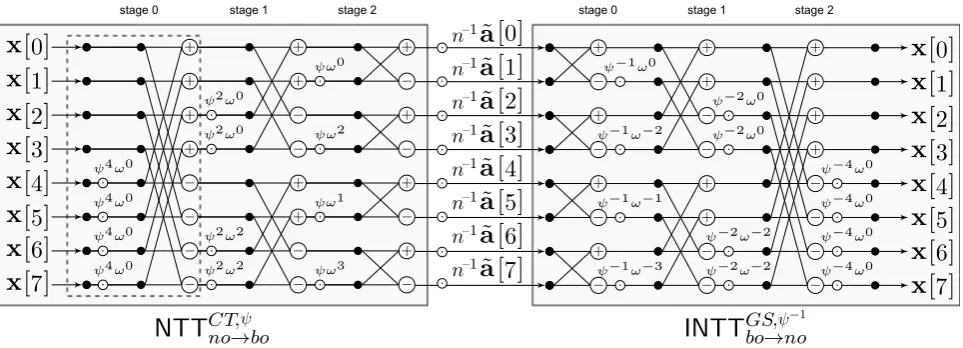
The two new half-size sub-problems where ψ is exchanged by ψ2 can now be again solved using the recursion. As a consequence, when using an in-place radix-2 DIF algorithm it is necessary to multiply all twiddle factors in the first stage by ψ−1, all twiddle factors in the second stage by ψ−2 and in general by ψ−2s for stage s ∈ {0,1, . . . ,log2(n)−1} to merge the multiplication by powers of ψ−1
into the inverse NTT (see Figure 1for an illustration). In case thePowMulψ orPowMulψ−1 operation is merged into the NTT computation we denote this by an additional superscript ψ or ψ−1, e.g., as NTTCT,ψbo→no.
3.2 Removing Bit-Reversal
For memory efficient and in-place computation a reordering or so-called bit-reversal step is usually applied before or after an NTT/FFT transformation due to the required reversed input ordering of the NTTCTbo→no algorithm used in works like [7,13,47,51]. However, by manipulation of the standard iterative algorithms and independently of the used butterfly (CT or GS) it is possible to derive natural order to bit-reversed order (no→ bo) as well as bit-reversed to natural order (bo→no) forward and inverse algorithms. The derivation of FFT algorithms with a desired ordering of inputs and outputs is described in [12] and we followed this description to derive the NTT algorithms NTTCTbo→no, NTTCTno→bo, NTTGSno→bo, and NTTGSbo→no, as well es their respective inverse counterparts. It is also possible to construct self-sorting NTTs (no→no) but in this case the structure becomes irregular and temporary memory is required (see [12]).
3.3 Tuning for Lattice-Based Cryptography
stage 0 stage 1 stage 2 stage 0 stage 1 stage 2
Fig. 1.Signal flow graph for multiplication of a polynomialxby a pre-transformed polynomial ˜a=NTTCT ,ψno→bo(a), using
theNTTCT ,ψno→boandINTT GS,ψ−1
bo→no algorithms.
constant polynomial (i.e., global constant, or public key). Thus the scaling factor n−1 can be multi-plied into the pre-computed and pre-transformed constant ˜a=n−1NTTCTno→bo(a). Taking into account that we also want to remove the need for bit-reversal and want to merge the multiplication by pow-ers of ψ into the forward and inverse transformation (as discussed in Section 3.1) we propose to use an NTTCT,ψno→bo for the forward transformation and an INTTGS,ψbo→no−1 for the inverse transforma-tion. In this case a polynomial multiplication c = a·e can be implemented without bit-reversal as c=INTTGS,ψbo→no−1
NTTCT,ψno→bo(a)◦NTTCT,ψno→bo(e)
. In Figure2 we compare the necessary blocks for the straightforward approach and our proposal and provide an example flow diagram for n = 8 in Fig-ure 1. For more details, pseudo-code of NTTCT,ψno→bo is provided in Algorithm 7 and pseudo-code of
INTTGS,ψbo→no−1 is given in Algorithm 8.
Fig. 2. Comparison of naive implementation of polynomial multiplication by a pre-computed constant using only NTTCT
bo→noand INTTCTbo→no (1) and our proposed approach (2) usingNTT
CT ,ψ
no→bo andINTT GS,ψ−1 bo→no .
4 Implementation of Lattice-Based Cryptography on ATxmega128
In this section we provide details on our implementation of the NTT as well as RLWEenc, and BLISS
not take protection against timing side channels into account which is required for most practical and interactive applications. In this work we solely focused on performance and to a lesser extent on a small memory and code footprint.
4.1 Implementation of the NTT
For the use in RLWEenc and BLISS we focus on the optimization of the NTTCT,ψno→bo and INTTGS,ψbo→no−1
transformations. We implemented both algorithms in C and optimized modular multiplication using assembly language.
Modular Multiplication. To implement the NTT according to Section3 a DIT NTTCT,ψno→bo and a DIFINTTGS,ψbo→no−1 transformation are required and the most expensive computation in both algorithms is integer multiplication and reduction moduloq (nlog2(n)
2 times per NTT). In [7] Boorghany, Sarmadi, and Jalili report that most of the runtime of their FFT/NTT is spent on the computation of modulo operations. They review modular reduction algorithms for suitability and propose an approximate variant of Barrett reduction [3] that leads to an FFT/NTT that is 1.26 times faster than one using the compiler generated modulo reduction. However, a straightforward implementation using the C-operator % with a constant modulus is quite expensive and requires around 600 cycles in our own experiments due to the generic libc modular reduction (call udivmodsi4). As a consequence, the software of the authors of [7] still consumes approx. 256754668
2 log2(256)
= 736 cycles for one FFT/NTT
butterfly.
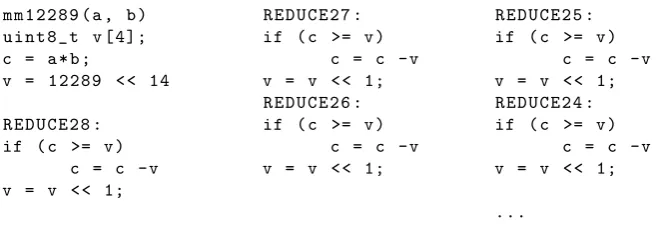
Another approach is a subtract-and-shift algorithm which loads the shifted modulus as constant and the input into a temporary register. It then continues to compare the value in the temporary register to this modulus, subtracts if the input is larger or equal to the modulus and then shifts the modules by one to the right. This continues until the shifted modulus is equal to the original modulus. The pseudo-code for this operation is shown in Figure3. The biggest improvement in assembly stems from the ability to limit the operations on the active registers. As an example, when the input is 28 bits wide the first comparisons and shifts have to be performed on four registers (REDUCE28toREDUCE25), but after four iterations all operations (comparison, subtraction, shift) have to be performed only on three registers (from REDUCE24), or two registers (from REDUCE16). This approach guarantees that one modular multiplication for q= 7681 takesat most 216 cycles. While we do not take into account constant time operation for side-channel protection, the implementation can be made trivially constant time and then always runs with the worst-case runtime.
An even more efficient implementation has been proposed by Liu et al. [38] who introduce an as-sembly optimized shifting-addition-multiplication-subtraction-subtraction algorithm (SMAS2). They achieve, for q= 7681 case, a modular multiplication in 53 clock cycles which beats the subtract-and-shift approach mentioned above. For all reductions modulo q = 7681 and q = 12289 we thus rely on the SMAS2 method7.
Extraction of Stages. As additional optimization we use specific routines for the first and the last stage of each NTT. A common optimization is to recognize that ω0 = 1 in the first stage of the NTTCTno→boso that only additions are required. As we merge the multiplication by powers ofψinto the NTT this is not the case anymore (see Figure1). However, it is still beneficial to write a specific loop that performs the first stage of the NTTCT,ψno→bo and the last stage of the INTTGS,ψbo→no−1 transformation to achieve less loop overhead (simpler address generation) and less loads and stores.
7
m m 1 2 2 8 9 ( a , b ) u i n t 8 _ t v [ 4 ] ; c = a * b ;
v = 1 2 2 8 9 < < 14
R E D U C E 2 8 : if ( c >= v )
c = c - v v = v < < 1;
R E D U C E 2 7 : if ( c >= v )
c = c - v v = v < < 1; R E D U C E 2 6 : if ( c >= v )
c = c - v v = v < < 1;
R E D U C E 2 5 : if ( c >= v )
c = c - v v = v < < 1; R E D U C E 2 4 : if ( c >= v )
c = c - v v = v < < 1;
...
Fig. 3.Efficient prime specific modular multiplication forq= 7681 andq= 12289.
Usage of Look-up Tables for Narrow Input Distributions. As discussed in Section 3.3 it is common in lattice-based cryptography to apply forward transformations mostly to values sampled from a narrow Gaussian error/noise distribution (other polynomials are usually constants and pre-computed). In this case only a limited number of possible inputs to the butterfly of the first stage of the NTTCT,ψno→bo transformation exist and it is possible to pre-compute look-up tables to speed-up the modular multiplication. The range of possible input coefficients to the first stage butterfly is rather small, since they are Gaussian distributed and bounded by [−τ σ, τ σ] for standard deviation σ and tail-cut factorτ. Additionally, we only store the result of multiplications of two positive factors. That means that for negative inputs, we invert before the look-up and again after the look-up. The same approach would also work for the binary error distribution used for the IBE scheme in [20] and it would be possible to cover even two or more stages due to the very limited input range.
4.2 Implementation of LP-RLWE
Our implementation of RLWEencenc and RLWEencdec of the RLWEenc scheme as described in Sec-tion 2.2 mainly consists of forward and inverse NTT transformations (NTT and INTT), Gaussian sampling (SampleGaussσ), and point-wise multiplication (Pointwise, also denoted as ◦). We assume that secret and public keys are stored in the read-only flash memory, but loading from RAM would also be possible, and probably even faster. Due to the usage of the NTT, theNTTCT,ψno→botransformation is only applied on the Gaussian distributed polynomials e1,e2. Thus we can optimize the transfor-mation for this input distribution and with either σ = 4.52 or σ = 4.85 it is possible to substitute approx. 99.96% of the multiplications in stage one ofNTTCT,ψno→bo by look-ups to a table of 16 entries that requires only 32 bytes of flash memory. For the sampling of the Gaussian distributed polynomials with high precision8 we use a cumulative distribution table (CDT) [17,22]. We construct the table
M with entries pz = Pr(x ≤ z : x ← Dσ) for z ∈ [0, τ σ] with a precision of λ = 128 bits. The tail-cut factorτ determines the number of lines |zt|=dτ σeof the table and reduces the output to the range x ∈ {−dτ σe, . . . ,dτ σe}. To sample a value we choose a uniformly random y from the interval [0,1) and a bit b and return the integer (−1)bz ∈ Z such that y ∈ [p
z−1, pz). Further we store only the positive half of the tables and then sample a sign bit. For this, the probability of sampling zero has been pre-halved when constructing the table. For efficiency reasons we just work with the binary expansion of the fractional part instead of floating point arithmetic as all numbers used are smaller than 1.0. The constant CDF matrix M is stored in the read-only flash memory withk =dστe rows andl=dλ/8ecolumns. In order to sample a Gaussian distributed value we perform a linear search in the table to obtainz. Another option would be binary search, however, for this table size withx←Dσ being small, the evaluation can already be stopped after only a few comparisons with high probability. The test if the random y is in the range [pz−1, pz) is performed in a lazy manner on bytes. In this
8
terms laziness means that a comparison is finished when the first bit (or byte on an 8-bit architecture) has been found that differs between two values. Thus we do not need to sample the full λ bits of y
and obtain the result of the comparisons early. Random numbers are obtained from a pseudo random number generator (PRNG) using the hardware AES-128 engine running in counter mode. The PRNG is seeded by noise from the LSB of the analog digital converter. For the state (key, plaintext) 32 bytes of statically allocated memory are necessary. The final table size is 624 bytes for q = 7681 and 660 bytes for q= 12289.
4.3 Implementation of BLISS
Besides polynomial arithmetic the most expensive operation for BLISS is the sampling of y1 and y2 from a discrete Gaussian distribution (SampleGaussσ). For the rather large standard deviation of
σ = 215.73 (RLWEenc requires only σ = 4.85) a straightforward CDT sampling approach, even with binary search, would lead to a large table with roughlyτ σ = 2798 entries of approx. 30 to 40 kilobytes overall (see [6]). Another option for embedded devices would be the Bernoulli approach from [18] implemented in [7] but the reported performance of 13,151,929 cycles to sample one polynomial would cause a massive performance penalty. As a consequence, we implemented the hardware-optimized sampler from [47] on the ATxmega. It uses the convolution property of Gaussians combined with Kullback-Leibler divergence and mainly exploits that it is possible to sample a Gaussian distributed value with varianceσ2by samplingx1,x2from a Gaussian distribution with smaller standard deviation
σ0 such that σ02+k2σ02 =σ2 and combining them as x1+kx2 (forBLISS-I k= 11 andσ0 = 19.53). Additionally, the performance of the σ0-sampler is improved by the use of short-cut intervals where each possible value of the first byte of the uniformly distributed input is assigned to an interval that specifies the range of the possible sampled values. This approach reduces the number of necessary comparisons and nearly compensates for the additional costs incurred by the requirement to sample two values (x1, x2 with σ0 = 19.53) instead of one directly (with σ = 215.73). The sampling is again performed in a lazy manner and we use the same PRNG based on AES-128 as for RLWEenc.
To implement the NTTCTno→bo we did not use a look-up table for the first stage as the input range [−στ, στ] of y1 or z1 is too large. To realize the reduction mod 2q, we create a second reduction function by simply extending the approach from Figure 3. The difference is that for the modulus 2q, vis loaded with the initial value 12289 << 16 and therefore two additional steps REDUCE30 and REDUCE29have to be inserted. Finally, we exclude the last step that subtractsqto get a result in [0,2q]. For the instantiation of the random oracle (Hash) that is required during signing and verification we have chosen the official AVR implementation of Keccak [4]. From the output of the hash function the sparse polynomial c with κ coefficients equal to one is generated by the GenerateC (see [19, Section 4.4]) routine. We store only κ indices where a coefficient ofc is one. This reduces the dynamic RAM consumption and allows a more efficient implementation of the multiplication ofc bys1 and s2 using the SparseMulroutine. By using column-wise multiplication and by ignoring all zero coefficients, the multiplication can be performed more efficiently than with the NTT.
5 Results and Comparison
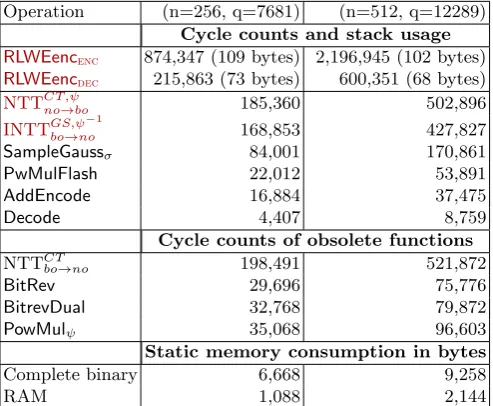
Table 1.Cycle counts and Flash memory consumption in bytes for the implementation ofRing-LWEEncrypt on an 8-bit ATxmega128 microcontroller using the NTT. The stack usage is divided into a fixed amount of memory necessary for plaintext, ciphertext, and additional components (like random number generation) and the dynamic consumption of the encryption and decryption routine. We encrypt a message ofnbits.
Operation (n=256, q=7681) (n=512, q=12289)
Cycle counts and stack usage
RLWEencenc 874,347 (109 bytes) 2,196,945 (102 bytes)
RLWEencdec 215,863 (73 bytes) 600,351 (68 bytes)
NTTCT ,ψno→bo 185,360 502,896
INTTGS,ψbo→no−1 168,853 427,827 SampleGaussσ 84,001 170,861
PwMulFlash 22,012 53,891
AddEncode 16,884 37,475
Decode 4,407 8,759
Cycle counts of obsolete functions
NTTCTbo→no 198,491 521,872
BitRev 29,696 75,776
BitrevDual 32,768 79,872
PowMulψ 35,068 96,603
Static memory consumption in bytes
Complete binary 6,668 9,258
RAM 1,088 2,144
LP-RLWE. Detailed cycle counts for the encryption and decryption as well as the most expensive operations are given in Table1. The costs of the encryption are dominated by the NTT (two calls of
NTTCT,ψno→bo and one call of INTTGSbo→no) which requires approx. 62% of the overall cycles for
RLWEenc-Ia. The Gaussian sampling requires 29% of the overall cycles which is approx. 328 (RLWEenc-Ia) or 334 (RLWEenc-IIa) cycles per sample. The reason thatNTTCT,ψno→bois slightly faster thanINTTGS,ψbo→no−1 is that we use table look-ups for the first stage of the forward transformation (see Section4.2). The remaining amount of cycles (9%) is consumed by additions, point-wise multiplications by a constant/key stored in the flash (PwMulFlash), and message encoding (Encode). In Table 1 we also list cycle counts of operations that are now obsolete, especially BitRev and PowMul. For PowMul we assume an imple-mentation where the powers of ψ are computed on-the-fly to save flash memory, otherwise the costs are the same as PwMulFlash. Decryption is extremely simple, fast, and basically calls INTTGS,ψbo→no−1, the decoding and an addition so that roughly 148 decryption operation could be performed per sec-ond on the ATxmega128. Note that we also evaluated RLWEenc-Ib,RLWEenc-IIb,RLWEenc-IIIb using classic schoolbook multiplication and Karatsuba multiplication and provide results in AppendixA.3. However, it turned out that these algorithms cannot beat the NTT and might only be advantageous when extremely small code size is required
The NTT can be performed in place so that no additional large temporary memory on the stack is needed. But storing the NTT twiddle factors for forward and inverse transforms in flash consumes 2n words = 4n bytes which is around 15% of the allocated flash memory for q = 7681 and around 22% for q= 12289.
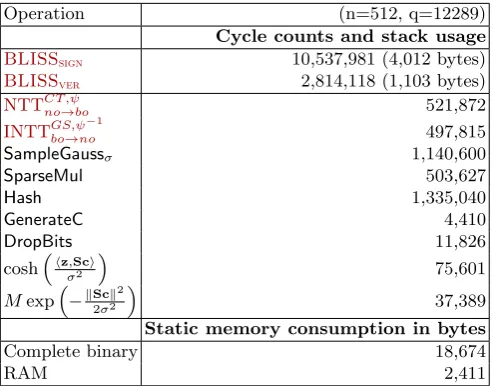
Table 2.Cycle counts and Flash memory consumption in bytes for the implementation ofBLISSon an 8-bit ATxmega128 microcontroller. The stack usage is divided into a fixed amount of memory necessary for for message, signature, and additional components (like random number generation) and the dynamic consumption of the signing and verification routine. We sign a message of n bits.
Operation (n=512, q=12289)
Cycle counts and stack usage
BLISSsign 10,537,981 (4,012 bytes)
BLISSver 2,814,118 (1,103 bytes)
NTTCT ,ψno→bo 521,872
INTTGS,ψbo→no−1 497,815
SampleGaussσ 1,140,600
SparseMul 503,627
Hash 1,335,040
GenerateC 4,410
DropBits 11,826
coshhzσ,Sc2 i
75,601
Mexp−kSc2σk22
37,389
Static memory consumption in bytes
Complete binary 18,674
RAM 2,411
cycles of one attempt. In contrast to the RLWEencimplementation we do not use a look-up table for the first stage of NTTCT,ψno→bo. Additionally, we do not implement a separate modulo reduction after the subtraction in the GS butterfly and reduce the result after the multiplication which explains the slightly better performance of INTTGS,ψbo→no−1. Hashing the compressed u and the message µ is time consuming and accounts for roughly 21% of the overall cycles during one attempt. Savings would be definitely possible by using a different hash function (see [2] for an evaluation of different functions) but Keccak appears to be a conservative choice that matches the 128-bit security target very well. The sparse multiplication takes only 503,627 cycles for one multiplication. This makes it a favorable approach on the ATxmega and overall the sparse multiplication is 3.6 times faster than an NTT multiplication approach that would require one NTTCT,ψno→bo, two INTTGS,ψbo→no−1 and two PwMulFlash
calls. The flash memory consumption includes 2nwords which equals 4n= 2,048 bytes for the NTT twiddle factors and 3,374 bytes for look-up tables of the sampler.
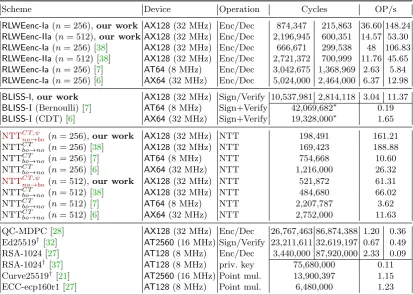
Comparison. A detailed comparison of our implementation with related work that also targets the AVR platform9 and provides 80 to 128-bits of security is given in Table 3. Our implementation of
RLWEenc-Ia encryption outperforms the software from [7] by a factor of 3.5 and results from [6] by a factor of 5.7 in terms of cycle counts. Decryption is 6.3 times and 11.4 times faster, respectively. Compared to the work by Liu et al. [38] we achieve similar results. The authors decided to use a Knuth-Yao Sampler that performs better than our CDT and are faster for theRLWEenc-Iaparameter set but slower for RLWEenc-IIa. For theRLWEenc-IIawe compensate our slower sampler by the faster NTT implementation. Since there is no sampling in the decryption, our decryption is faster for both security levels (39% forRLWEenc-Ia, 17% forRLWEenc-IIa). A faster implementation of our Gaussian sampler, e.g., by also using hash tables and binary search could provide a certain speed up but would also result in more flash consumption.
A comparison between our implementation of BLISS-I and the implementations of [7] and [6] is difficult since the authors implemented the signature as authentication protocol. Therefore they only provide the runtime of a complete protocol run that corresponds to one signing operation and
9
Table 3.Comparison of our implementations with related work. Cycle counts marked with (∗) indicate the runtime of BLISS-I as authentication protocol instead of signature scheme. ByAX128we identify the ATxmega128A1 clocked with 32 MHz, byAX64the ATxmega64A3 clocked with 32 MHz, byAT64the ATmega64 clocked with 8 MHz, byAT128the ATmega128 clocked with 8 MHz, and byAT2560the ATmega2560 clocked with 16 MHz. Implementations marked with (†) are resistant against timing attacks.
Scheme Device Operation Cycles OP/s
RLWEenc-Ia(n= 256),our work AX128(32 MHz) Enc/Dec 874,347 215,863 36.60 148.24 RLWEenc-IIa(n= 512),our workAX128(32 MHz) Enc/Dec 2,196,945 600,351 14.57 53.30 RLWEenc-Ia(n= 256) [38] AX128(32 MHz) Enc/Dec 666,671 299,538 48 106.83 RLWEenc-IIa(n= 512) [38] AX128(32 MHz) Enc/Dec 2,721,372 700,999 11.76 45.65 RLWEenc-Ia(n= 256) [7] AT64(8 MHz) Enc/Dec 3,042,675 1,368,969 2.63 5.84 RLWEenc-Ia(n= 256) [6] AX64(32 MHz) Enc/Dec 5,024,000 2,464,000 6.37 12.98
BLISS-I,our work AX128(32 MHz) Sign/Verify 10,537,981 2,814,118 3.04 11.37 BLISS-I (Bernoulli) [7] AT64(8 MHz) Sign+Verify 42,069,682∗ 0.19 BLISS-I (CDT) [6] AX64(32 MHz) Sign+Verify 19,328,000∗ 1.65
NTTCT ,ψno→bo (n= 256),our work AX128(32 MHz) NTT 198,491 161.21 NTTCT
bo→no (n= 256) [38] AX128(32 MHz) NTT 169,423 188.88
NTTCTbo→no (n= 256) [7] AT64(8 MHz) NTT 754,668 10.60
NTTCTbo→no (n= 256) [6] AX64(32 MHz) NTT 1,216,000 26.32 NTTCT ,ψno→bo (n= 512),our work AX128(32 MHz) NTT 521,872 61.31 NTTCTbo→no (n= 512) [38] AX128(32 MHz) NTT 484,680 66.02
NTTCTbo→no (n= 512) [7] AT64(8 MHz) NTT 2,207,787 3.62
NTTCT
bo→no (n= 512) [6] AX64(32 MHz) NTT 2,752,000 11.63
QC-MDPC [28] AX128(32 MHz) Enc/Dec 26,767,463 86,874,388 1.20 0.36 Ed25519†[32] AT2560(16 MHz) Sign/Verify 23,211,611 32,619,197 0.67 0.49 RSA-1024 [27] AT128(8 MHz) Enc/Dec 3,440,000 87,920,000 2.33 0.09 RSA-1024†[37] AT128(8 MHz) priv. key 75,680,000 0.11 Curve25519†[21] AT2560(16 MHz) Point mul. 13,900,397 1.15 ECC-ecp160r1 [27] AT128(8 MHz) Point mul. 6,480,000 1.23
one verification in our results, but without the expensive hashing as the sparse polynomial c is not obtained from a random oracle but randomly generated by the other protocol party. However, our implementations of BLISSsign and BLISSver still require less cycles than the implementation of
BLISS-I. The biggest improvement stems from the usage of the KL-convolution sampler from [47] which is superior (1,140,600 cycles per polynomial) compared to the Bernoulli approach (13,151,929 cycles per polynomial [7]) and the straight-forward CDT approach used in [6]. As our implementation of BLISS-I needs 18,674 bytes of flash memory, it is also smaller than the implementation of [6] that requires 66.5 kB of flash memory and the implementation of [7] that needs 25.1 kB of flash memory.
Compared with the 80-bit secure McEliece cryptosystem based on QC-MDPC codes from [28] we get 31 times less cycles for the encryption and even 402 times less cycles for decryption. Our 128-bit secure BLISS-I implementation is 2.2 times faster for signing and 11.6 faster for verification compared to an implementation of the Ed25519 signature scheme for an ATmega2560 [32]. Translating the implementation results for RSA and ECC given in [27] to cycle counts, it turns out that an ECC secp160r1 operation requires 6.5 million cycles. RSA-1024 encryption with public keye= 216+ 1 takes 3.4 million cycles [27] and RSA-1024 decryption with Chinese Remainder Theorem (CRT) requires 75.68 million cycles (this number is taken from [37]). A comparison with NTRU implementations is currently not easily possible due to lack of published results for the AVR platform10.
10
We also refer to [13] for an implementation ofRLWEenc-IaandRLWEenc-IIaon an ARM Cortex-M4 (32-bit, 168 MHz). However, as the Cortex-M4 is a 32-bit processor a comparison across architectures with different bit-widths is naturally hard.
Outlook. As previously stated, we optimized our implementation for performance and did not con-sider protection against timing attacks. A natural extension of our work would be a constant time implementation or a at least an implementation whose timing behavior is independent of the secret key or message. While a constant time NTT seems to be relatively straightforward, a constant time discrete Gaussian sampler will probably be more costly than the current implementation due to the high dependence on lazy evaluation (see [8] for an implementation of a constant time CDT sampler). Additionally, we are not aware of cryptanalysis for RLWEenc orBLISS that explicitly takes accelera-tion of attacks by quantum computers into account. In order to provide a clear picture regarding the security level of these schemes in the presence of quantum computers such analysis seems to be highly desirable.
References
1. Bai, S., Galbraith, S.D.: An improved compression technique for signatures based on learning with errors. In: Benaloh, J. (ed.) Topics in Cryptology - CT-RSA 2014 - The Cryptographer’s Track at the RSA Conference 2014, San Francisco, CA, USA, February 25-28, 2014. Proceedings. Lecture Notes in Computer Science, vol. 8366, pp. 28–47. Springer (2014),http://dx.doi.org/10.1007/978-3-319-04852-9_2 1
2. Balasch, J., Ege, B., Eisenbarth, T., G´erard, B., Gong, Z., G¨uneysu, T., Heyse, S., Kerckhof, S., Koeune, F., Plos, T., P¨oppelmann, T., Regazzoni, F., Standaert, F., Assche, G.V., Keer, R.V., van Oldeneel tot Oldenzeel, L., von Maurich, I.: Compact implementation and performance evaluation of hash functions in ATtiny devices. In: Mangard, S. (ed.) Smart Card Research and Advanced Applications - 11th International Conference, CARDIS 2012, Graz, Austria, November 28-30, 2012, Revised Selected Papers. Lecture Notes in Computer Science, vol. 7771, pp. 158– 172. Springer (2012),http://dx.doi.org/10.1007/978-3-642-37288-9_11 12
3. Barrett, P.: Implementing the Rivest Shamir and Adleman public key encryption algorithm on a standard digital signal processor. In: Proceedings on Advances in cryptology—CRYPTO ’86. pp. 311–323. Springer-Verlag, London, UK (1987),http://dl.acm.org/citation.cfm?id=36664.36688 8
4. Bertoni, G., Daemen, J., Peeters, M., Assche, G.V., Keer, R.V.: Keccak implementation overview (2012), version 3.2, seehttp://keccak.noekeon.org/Keccak-implementation-3.2.pdf 10
5. Blahut, R.E.: Fast Algorithms for Signal Processing. Cambridge University Press (2010), http://amazon.com/o/ ASIN/0521190495/ 1,2
6. Boorghany, A., Jalili, R.: Implementation and comparison of lattice-based identification protocols on smart cards and microcontrollers. IACR Cryptology ePrint Archive 2014, 78 (2014),http://eprint.iacr.org/2014/078, pre-liminary version of [7] 1,9,10,12,13,14
7. Boorghany, A., Sarmadi, S.B., Jalili, R.: On constrained implementation of lattice-based cryptographic primitives and schemes on smart cards. IACR Cryptology ePrint Archive 2014, 514 (2014),http://eprint.iacr.org/2014/514, successive version of [6] 1,2,4,6,8,9,10,12,13,14
8. Bos, J.W., Costello, C., Naehrig, M., Stebila, D.: Post-quantum key exchange for the TLS protocol from the ring learning with errors problem. IACR Cryptology ePrint Archive 2014, 599 (2014),http://eprint.iacr.org/2014/599
1,14
9. Brakerski, Z., Langlois, A., Peikert, C., Regev, O., Stehl´e, D.: Classical hardness of learning with errors. In: Boneh, D., Roughgarden, T., Feigenbaum, J. (eds.) Symposium on Theory of Computing Conference, STOC’13, Palo Alto, CA, USA, June 1-4, 2013. pp. 575–584. ACM (2013),http://doi.acm.org/10.1145/2488608.2488680 19
10. Cabarcas, D., Weiden, P., Buchmann, J.: On the efficiency of provably secure NTRU. In: Mosca, M. (ed.) Post-Quantum Cryptography - 6th International Workshop, PQCrypto 2014, Waterloo, ON, Canada, October 1-3, 2014. Proceedings. Lecture Notes in Computer Science, vol. 8772, pp. 22–39. Springer (2014), http://dx.doi.org/10. 1007/978-3-319-11659-4_2 1
11. Chen, D.D., Mentens, N., Vercauteren, F., Roy, S.S., Cheung, R.C.C., Pao, D., Verbauwhede, I.: High-speed poly-nomial multiplication architecture for Ring-LWE and SHE cryptosystems. IEEE Trans. on Circuits and Systems 62-I(1), 157–166 (2015),http://dx.doi.org/10.1109/TCSI.2014.2350431 1
12. Chu, E., George, A.: Inside the FFT Black Box Serial and Parallel Fast Fourier Transform Algorithms. CRC Press, Boca Raton, FL, USA (2000) 2,5,6
13. de Clercq, R., Roy, S.S., Vercauteren, F., Verbauwhede, I.: Efficient software implementation of Ring-LWE encryp-tion. IACR Cryptology ePrint Archive 2014, 725 (2014),http://eprint.iacr.org/2014/725 1,2,4,6,9,14
15. Crandall, R., Fagin, B.: Discrete weighted transforms and large-integer arithmetic. Mathematics of Computation 62(205), 305–324 (1994) 3
16. Crandall, R., Pomerance, C.: Prime Numbers: A Computational Perspective. Springer-Verlag, Berlin, Germany / Heidelberg, Germany / London, UK / etc. (2001) 2,3
17. Devroye, L.: Non-Uniform Random Variate Generation. Springer-Verlag (1986), http://luc.devroye.org/ rnbookindex.html 9
18. Ducas, L., Durmus, A., Lepoint, T., Lyubashevsky, V.: Lattice signatures and bimodal Gaussians. In: Canetti, R., Garay, J.A. (eds.) Advances in Cryptology - CRYPTO 2013 - 33rd Annual Cryptology Conference, Santa Barbara, CA, USA, August 18-22, 2013. Proceedings, Part I. Lecture Notes in Computer Science, vol. 8042, pp. 40–56. Springer (2013),http://dx.doi.org/10.1007/978-3-642-40041-4_3, conference version of [19]1,4,10
19. Ducas, L., Durmus, A., Lepoint, T., Lyubashevsky, V.: Lattice signatures and bimodal Gaussians. IACR Cryptology ePrint Archive 2013, 383 (2013),http://eprint.iacr.org/2013/383, full version of [19] 10,15
20. Ducas, L., Lyubashevsky, V., Prest, T.: Efficient identity-based encryption over NTRU lattices. In: Sarkar, P., Iwata, T. (eds.) Advances in Cryptology - ASIACRYPT 2014 - 20th International Conference on the Theory and Application of Cryptology and Information Security, Kaoshiung, Taiwan, R.O.C., December 7-11, 2014, Proceedings, Part II. Lecture Notes in Computer Science, vol. 8874, pp. 22–41. Springer (2014),http://dx.doi.org/10.1007/ 978-3-662-45608-8_2 1,3,4,9
21. D¨ull, M., Haase, B., Hinterw¨alder, G., Hutter, M., Paar, C., S´anchez, A.H., Schwabe, P.: High-speed curve25519 on 8-bit, 16-bit and 32-bit microcontrollers. Design, Codes and Cryptography (to appear), document ID: bd41e6b96370dea91c5858f1b809b581,http://cryptojedi.org/papers/#mu25519 13
22. Dwarakanath, N.C., Galbraith, S.D.: Sampling from discrete Gaussians for lattice-based cryptography on a con-strained device. Appl. Algebra Eng. Commun. Comput. 25(3), 159–180 (2014), http://dx.doi.org/10.1007/ s00200-014-0218-3 9
23. Gentleman, W.M., Sande, G.: Fast fourier transforms: for fun and profit. In: American Federation of Information Processing Societies: Proceedings of the AFIPS ’66 Fall Joint Computer Conference, November 7-10, 1966, San Francisco, California, USA. AFIPS Conference Proceedings, vol. 29, pp. 563–578. AFIPS / ACM / Spartan Books, Washington D.C. (1966),http://doi.acm.org/10.1145/1464291.14643525
24. G¨ottert, N., Feller, T., Schneider, M., Buchmann, J., Huss, S.A.: On the design of hardware building blocks for modern lattice-based encryption schemes. In: Prouff, E., Schaumont, P. (eds.) Cryptographic Hardware and Em-bedded Systems - CHES 2012 - 14th International Workshop, Leuven, Belgium, September 9-12, 2012. Proceed-ings. Lecture Notes in Computer Science, vol. 7428, pp. 512–529. Springer (2012),http://dx.doi.org/10.1007/ 978-3-642-33027-8_30 4
25. G¨uneysu, T., Lyubashevsky, V., P¨oppelmann, T.: Practical lattice-based cryptography: A signature scheme for em-bedded systems. In: Prouff, E., Schaumont, P. (eds.) Cryptographic Hardware and Emem-bedded Systems - CHES 2012 - 14th International Workshop, Leuven, Belgium, September 9-12, 2012. Proceedings. Lecture Notes in Computer Science, vol. 7428, pp. 530–547. Springer (2012),http://dx.doi.org/10.1007/978-3-642-33027-8_31 1
26. G¨uneysu, T., Oder, T., P¨oppelmann, T., Schwabe, P.: Software speed records for lattice-based signatures. In: Gaborit, P. (ed.) Post-Quantum Cryptography - 5th International Workshop, PQCrypto 2013, Limoges, France, June 4-7, 2013. Proceedings. Lecture Notes in Computer Science, vol. 7932, pp. 67–82. Springer (2013),http://dx.doi.org/ 10.1007/978-3-642-38616-9_5 1
27. Gura, N., Patel, A., Wander, A., Eberle, H., Shantz, S.C.: Comparing elliptic curve cryptography and RSA on 8-bit CPUs. In: Joye, M., Quisquater, J.J. (eds.) Cryptographic Hardware and Embedded Systems - CHES 2004: 6th International Workshop Cambridge, MA, USA, August 11-13, 2004. Proceedings. Lecture Notes in Computer Science, vol. 3156, pp. 119–132. Springer (2004),http://dx.doi.org/10.1007/978-3-540-28632-5_9 1,13,18
28. Heyse, S., von Maurich, I., G¨uneysu, T.: Smaller keys for code-based cryptography: QC-MDPC McEliece implementations on embedded devices. In: Bertoni, G., Coron, J. (eds.) Cryptographic Hardware and Embedded Systems -CHES 2013 - 15th International Workshop, Santa Barbara, CA, USA, August 20-23, 2013. Proceedings. Lecture Notes in Computer Science, vol. 8086, pp. 273–292. Springer (2013),http://dx.doi.org/10.1007/978-3-642-40349-1_16
13
29. Hirschhorn, P.S., Hoffstein, J., Howgrave-Graham, N., Whyte, W.: Choosing NTRUEncrypt parameters in light of combined lattice reduction and MITM approaches. In: Abdalla, M., Pointcheval, D., Fouque, P.A., Vergnaud, D. (eds.) Applied Cryptography and Network Security, 7th International Conference, ACNS 2009, Paris-Rocquencourt, France, June 2-5, 2009. Proceedings. Lecture Notes in Computer Science, vol. 5536, pp. 437–455 (2009), http: //dx.doi.org/10.1007/978-3-642-01957-9_27 13
30. Hoffstein, J., Pipher, J., Schanck, J.M., Silverman, J.H., Whyte, W.: Practical signatures from the partial Fourier recovery problem. In: Boureanu, I., Owesarski, P., Vaudenay, S. (eds.) Applied Cryptography and Network Security -12th International Conference, ACNS 2014, Lausanne, Switzerland, June 10-13, 2014. Proceedings. Lecture Notes in Computer Science, vol. 8479, pp. 476–493. Springer (2014),http://dx.doi.org/10.1007/978-3-319-07536-5_281
32. Hutter, M., Schwabe, P.: Nacl on 8-bit AVR microcontrollers. In: Youssef, A., Nitaj, A., Hassanien, A.E. (eds.) Progress in Cryptology - AFRICACRYPT 2013, 6th International Conference on Cryptology in Africa, Cairo, Egypt, June 22-24, 2013. Proceedings. Lecture Notes in Computer Science, vol. 7918, pp. 156–172. Springer (2013),http: //dx.doi.org/10.1007/978-3-642-38553-7_9 1,13
33. Hutter, M., Wenger, E.: Fast multi-precision multiplication for public-key cryptography on embedded micropro-cessors. In: Preneel, B., Takagi, T. (eds.) Cryptographic Hardware and Embedded Systems - CHES 2011 - 13th International Workshop, Nara, Japan, September 28 - October 1, 2011. Proceedings. Lecture Notes in Computer Science, vol. 6917, pp. 459–474. Springer (2011),http://dx.doi.org/10.1007/978-3-642-23951-9_30 18
34. Karatsuba, A., Ofman, Y.: Multiplication of multidigit numbers on automata. In: Soviet physics doklady. vol. 7, p. 595 (1963) 19
35. Lindner, R., Peikert, C.: Better key sizes (and attacks) for LWE-based encryption. In: Kiayias, A. (ed.) Topics in Cryptology - CT-RSA 2011 - The Cryptographers’ Track at the RSA Conference 2011, San Francisco, CA, USA, February 14-18, 2011. Proceedings. Lecture Notes in Computer Science, vol. 6558, pp. 319–339. Springer (2011), http://dx.doi.org/10.1007/978-3-642-19074-2_21 1,3,4
36. Liu, M., Nguyen, P.Q.: Solving BDD by enumeration: An update. In: Dawson, E. (ed.) Topics in Cryptology -CT-RSA 2013 - The Cryptographers’ Track at the RSA Conference 2013, San Francisco,CA, USA, February 25-March 1, 2013. Proceedings. Lecture Notes in Computer Science, vol. 7779, pp. 293–309. Springer (2013), http: //dx.doi.org/10.1007/978-3-642-36095-4_19 4
37. Liu, Z., Großsch¨adl, J., Kizhvatov, I.: Efficient and side-channel resistant RSA implementation for 8-bit avr micro-controllers. In: Proceedings of the 1st International Workshop on the Security of the Internet of Things (SECIOT 2010). IEEE Computer Society Press (2010) 13
38. Liu, Z., Seo, H., Roy, S.S., Großsch¨adl, J., Kim, H., Verbauwhede, I.: Efficient Ring-LWE encryption on 8-bit AVR processors. IACR Cryptology ePrint Archive 2015, 410 (2015), http://eprint.iacr.org/2015/410, to appear in CHES’15 1,8,12,13
39. Lyubashevsky, V.: Lattice signatures without trapdoors. In: Pointcheval, D., Johansson, T. (eds.) Advances in Cryptology - EUROCRYPT 2012 - 31st Annual International Conference on the Theory and Applications of Cryp-tographic Techniques, Cambridge, UK, April 15-19, 2012. Proceedings. Lecture Notes in Computer Science, vol. 7237, pp. 738–755. Springer (2012),http://dx.doi.org/10.1007/978-3-642-29011-4_43 1
40. Lyubashevsky, V., Peikert, C., Regev, O.: On ideal lattices and learning with errors over rings. In: Gilbert, H. (ed.) Advances in Cryptology - EUROCRYPT 2010, 29th Annual International Conference on the Theory and Applications of Cryptographic Techniques, French Riviera, May 30 - June 3, 2010. Proceedings. Lecture Notes in Computer Science, vol. 6110, pp. 1–23. Springer (2010),http://dx.doi.org/10.1007/978-3-642-13190-5_1 1,3,
16
41. Lyubashevsky, V., Peikert, C., Regev, O.: On ideal lattices and learning with errors over rings (2010), presentation of [40] given by Chris Peikert at Eurocrypt’10. Seehttp://www.cc.gatech.edu/~cpeikert/pubs/slides-ideal-lwe. pdf. 3
42. Melchor, C.A., Boyen, X., Deneuville, J., Gaborit, P.: Sealing the leak on classical NTRU signatures. In: Mosca, M. (ed.) Post-Quantum Cryptography - 6th International Workshop, PQCrypto 2014, Waterloo, ON, Canada, October 1-3, 2014. Proceedings. Lecture Notes in Computer Science, vol. 8772, pp. 1–21. Springer (2014),http://dx.doi. org/10.1007/978-3-319-11659-4_1 1
43. Monteverde, M.: NTRU software implementation for constrained devices. Master’s thesis, Katholieke Universiteit Leuven (2008) 13
44. Nussbaumer, H.J.: Fast Fourier Transform and Convolution Algorithms, Springer Series in Information Sciences, vol. 2. Springer, Berlin, DE (1982) 1,2
45. Oder, T., P¨oppelmann, T., G¨uneysu, T.: Beyond ECDSA and RSA: lattice-based digital signatures on constrained devices. In: The 51st Annual Design Automation Conference 2014, DAC ’14, San Francisco, CA, USA, June 1-5, 2014. pp. 1–6. ACM (2014),http://doi.acm.org/10.1145/2593069.2593098 1
46. Peikert, C.: Lattice cryptography for the Internet. In: Mosca, M. (ed.) Post-Quantum Cryptography - 6th Inter-national Workshop, PQCrypto 2014, Waterloo, ON, Canada, October 1-3, 2014. Proceedings. Lecture Notes in Computer Science, vol. 8772, pp. 197–219. Springer (2014),http://dx.doi.org/10.1007/978-3-319-11659-4_121
47. P¨oppelmann, T., Ducas, L., G¨uneysu, T.: Enhanced lattice-based signatures on reconfigurable hardware. In: Batina, L., Robshaw, M. (eds.) Cryptographic Hardware and Embedded Systems - CHES 2014 - 16th International Workshop, Busan, South Korea, September 23-26, 2014. Proceedings. Lecture Notes in Computer Science, vol. 8731, pp. 353–370. Springer (2014),http://dx.doi.org/10.1007/978-3-662-44709-3_20 1,2,4,6,10,13
48. P¨oppelmann, T., G¨uneysu, T.: Towards practical lattice-based public-key encryption on reconfigurable hardware. In: Lange, T., Lauter, K.E., Lisonek, P. (eds.) Selected Areas in Cryptography - SAC 2013 - 20th International Conference, Burnaby, BC, Canada, August 14-16, 2013, Revised Selected Papers. Lecture Notes in Computer Science, vol. 8282, pp. 68–85. Springer (2013),http://dx.doi.org/10.1007/978-3-662-43414-7_4 1,3
49. P¨oppelmann, T., G¨uneysu, T.: Area optimization of lightweight lattice-based encryption on reconfigurable hardware. In: IEEE International Symposium on Circuits and Systemss, ISCAS 2014, Melbourne, Victoria, Australia, June 1-5, 2014. pp. 2796–2799. IEEE (2014),http://dx.doi.org/10.1109/ISCAS.2014.6865754 1,19,20
51. Roy, S.S., Vercauteren, F., Mentens, N., Chen, D.D., Verbauwhede, I.: Compact Ring-LWE cryptoprocessor. In: Batina, L., Robshaw, M. (eds.) Cryptographic Hardware and Embedded Systems - CHES 2014 - 16th International Workshop, Busan, South Korea, September 23-26, 2014. Proceedings. Lecture Notes in Computer Science, vol. 8731, pp. 371–391. Springer (2014),http://dx.doi.org/10.1007/978-3-662-44709-3_21 1,2,3,4,5,6
52. Sch¨onhage, A., Strassen, V.: Schnelle multiplikation grosser zahlen. Computing 7(3), 281–292 (1971) 2
53. Shor, P.: Algorithms for quantum computation: discrete logarithms and factoring. In: Foundations of Computer Science, 1994 Proceedings., 35th Annual Symposium on. pp. 124–134. IEEE (1994) 1
54. Stehl´e, D., Steinfeld, R.: Making NTRU as secure as worst-case problems over ideal lattices. In: Paterson, K.G. (ed.) Advances in Cryptology - EUROCRYPT 2011 - 30th Annual International Conference on the Theory and Appli-cations of Cryptographic Techniques, Tallinn, Estonia, May 15-19, 2011. Proceedings. Lecture Notes in Computer Science, vol. 6632, pp. 27–47. Springer (2011),http://dx.doi.org/10.1007/978-3-642-20465-4_4 1
55. Winkler, F.: Polynomial Algorithms in Computer Algebra (Texts and Monographs in Symbolic Computation). Springer, 1 edn. (8 1996),http://amazon.com/o/ASIN/3211827595/ 1,2,3
A Appendix
A.1 NTT Algorithms
For a description ofNTTCT,ψno→bo see Algorithm7and for INTTGS,ψbo→no−1 see Algorithm8.
Algorithm 7 Optimized CT Forward NTT
Precondition: Storenpowers ofψin bit-reversed order inpsi∗
1: functionNTTCT ,ψno→bo(a) 2: m←1
3: k←n/2 4: whilem < ndo
5: fori= 0tom−1do
6: jF irst←2·i·k
7: jLast←jF irst+k−1 8: ψi←psi∗[m+i]
9: forj=jF irsttojLastdo
10: l←j+k
11: t←a[j] 12: u←a[l]·ψi
13: a[j]←t+u modq
14: a[l]←t−u modq
15: end for
16: end for
17: m←m·2 18: k←n/2 19: end while
20: Return a
21: end function
Algorithm 8 Optimized GS Inverse NTT
Precondition: Storenpowers ofψ−1 in bit-reversed or-der ininvpsi∗
1: functionINTTGS,ψbo→no−1(a) 2: m←n/2
3: k←1
4: whilem >1do
5: fori= 0tom−1do
6: jF irst←2·i·k
7: jLast←jF irst+k−1 8: ψi←invpsi∗[m+i]
9: forj=jF irsttojLastdo
10: l←j+k
11: t←a[j] 12: u←a[l]
13: a[j]←t+u modq
14: a[l]←(t−u)·ψi modq
15: end for
16: end for
17: m←m/2 18: k←k·2 19: end while
20: Return a
21: end function
A.2 The Atmel ATxmega128A1
In this section we briefly introduce the target device and the profiling system for runtime measurements in more detail.
The Target Device.
and the ALU is connected to 32 8-bit registers. Some registers have special purposes like R0 and R1 which are connected to an 8×8-bit multiplier or registers R26-31 which are used to address the flash, RAM or EEPROM. The microcontroller supports native AES and DES encryption but no floating point operations. The controller can be programmed directly in assembly or by using other higher level languages, e.g, C/C++ together with the popular gcc compiler framework. The ATxmega is compatible11 with the AVR instruction set which can also be found in smaller devices, e.g., from the ATmega family. Each instruction takes a fixed amount of cycles mainly depending on the type of op-eration that should be carried out. As an example, theaddinstruction just needs one clock cycle, the unsigned multiplicationmul two, the relative callrcalltwo cycles and load/store operations targeting the RAM one or two cycles.
Measurement of Performance and Resource Consumption. Atmel has published a cycle accurate simu-lator for most AVR families. However, the simusimu-lator is slow and not optimal to simulate large runtimes typical in public key cryptography. As a consequence, we implemented a profiling framework directly on our development board. For this purpose, we used the microcontroller’s capabilities to provide a 32 bit timer/counter by connecting two 16 bit timers over the event system. Thus we are able to provide cycle accurate measurements of execution times. Measurements of flash memory consumption (.text + .data + .bootloader) include program code and constants and are obtained from theavr-sizeutility. Dynamic RAM consumption (stack) which is freed after a function returns is measurement during runtime using a stack canary.
A.3 Implementation of RLWEenc using Schoolbook Multiplication
Ideal lattices are represented by ideals of the ring Zq[x]/hxn+ 1i with polynomials ofninteger coeffi-cients such that f(x) = f0+f1x+f2x2+· · ·+fn−1xn−1 ∈Zq[x]. Polynomial multiplication can be computed without expanding a temporary result by considering the special rule that xn≡ −1. This leads to the classical ”schoolbook” multiplication algorithm
ab= n−1
X
i=0 n−1
X
j=0
(−1)bi+njca[i]b[j]xi+jmodnmodq. (6)
Advantages of the algorithm are its simplicity, in-place modular reduction and that it does not depend on any parameters (e.g., n or q) of the multiplied polynomials. The time complexity of O(n2) is obviously the drawback of this method. However, for constrained platforms with multiple optimizations goals, it was demonstrated (e.g., in [27,33]) that variants of this method can still be very competitive with respect to the more efficient multiplication techniques discussed later on.
Implementation. The implementation of the RLWEenc parameter sets RLWEenc-Ib, RLWEenc-IIb, and RLWEenc-IIIb mainly requires an efficient schoolbook multiplier and the Gaussian sampler dis-cussed in Section 4.2. The core operation is modular multiplication and we realized the modular mul-tiplication and reduction modulo q= 4093 (mm4093) in assembly exploiting that 212 mod 4093 = 3. Therefore, we can split the 2 log2q wide output u of the log2q×log2q multiplier into an upper and a lower part. Thusu25..0 mod 4093≡212u25..12+u11..0= 3u25...12+u11..0 = 2u25..12+u25..12+u11..0. The maximal size of the result for two moduloq reduced coefficients is 4104 and requires at maximum one additional subsequent subtraction. The multiplication by 3 is realized by shift and addition operations. As we have chosen to representZq[x]/hxn+ 1ias a polynomial with unsigned coefficients in [0, q) we do not have to deal with more complicated signed arithmetic and reduction. By carefully assigning the available 8-bit registers according to the compiler’s calling convention we ensure that nopushand
pop instructions are necessary in mm4093. The inner loop of the polynomial multiplication routine
11
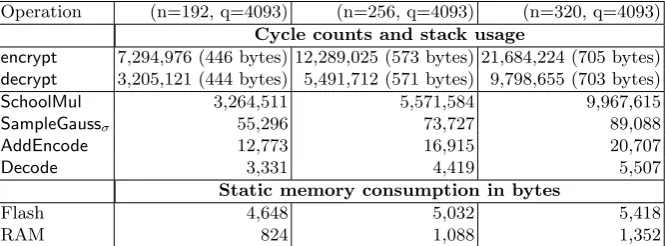
Table 4. Cycle counts and flash memory consumption for the implementation ofRLWEenc on an 8-bit ATxmega128 microcontroller using the schoolbook algorithm.
Operation (n=192, q=4093) (n=256, q=4093) (n=320, q=4093)
Cycle counts and stack usage
encrypt 7,294,976 (446 bytes) 12,289,025 (573 bytes) 21,684,224 (705 bytes) decrypt 3,205,121 (444 bytes) 5,491,712 (571 bytes) 9,798,655 (703 bytes) SchoolMul 3,264,511 5,571,584 9,967,615
SampleGaussσ 55,296 73,727 89,088
AddEncode 12,773 16,915 20,707
Decode 3,331 4,419 5,507
Static memory consumption in bytes
Flash 4,648 5,032 5,418
RAM 824 1,088 1,352
implemented in assembly mainly consist of ld and lpm instructions to read the first coefficient from RAM and the second coefficient from the flash. A subsequent call to mm4093 performs the modular multiplication and a branch determines whether i+j > n so that the result has to be subtracted or just added to the memory address i+j mod n. The implementation of the encryption procedure consists of three calls to the Gaussian sampler, two calls to SchoolMul and the threshold encoding step.
Results. Results for schoolbook multiplication given in Table 4 show that it takes more than seven million cycles for an encryption operation using the smallest parameter set n = 192. For decryption it can be seen that approx. 90 percent of the computation time is spent on the two polynomial multiplications (SchoolMul) while all other operations like addition and decoding have only a marginal impact on the runtime. Larger parameter sets turned out to be impractical, e.g., the largest variant forn= 320 already consumes more than 21.7/9.8 million cycles for encryption/decryption. The RAM consumption is mainly dominated by the need to be able to store one temporary polynomial which accounts for 2nbytes of memory on the stack. Improvements might be possible whenq is chosen as a power of two (see [9,49]) due to even simpler reduction. In our implementation the reduction modulo 4093 accounts for approx. 25 cycles inmm4093(called≈n2times), however, schoolbook multiplication still does not seem to be competitive.
A.4 Implementation of RLWEenc using Karatsuba Multiplication
Polynomial multiplication with improved complexity of O(nlog(3)) operations in Zq can be achieved with Karatsuba’s method [34]. The idea behind this method is to trade one expensive multiplication with three cheap additions by means of the divide and conquer principle. Our implementation applies the Karatsuba method up to a configurable number of iterations. In practice it is reasonable to limit the recursion to a certain degree in order to avoid too much computations due to the increasing number of additions. The remaining low-degree polynomial multiplications are then performed with the schoolbook algorithm. In case the degree of the input polynomials is not a power of two, we apply zero padding.
Implementation. Implementations of Karatsuba on constrained devices show typically the drawback of a significant memory consumption, especially, with extensive recursions. We initially aim at reducing memory allocation and thus reserve 2nwords to store the result of a multiplication andPr
i=0 2ni words
previously disposed memory as a temporary storage for further intermediate polynomials. For the modular multiplications of individual coefficients we apply the assembler implementation mm4093
introduced above. We also measure the impact of changing the parameter q from 4093 to 409612. We implement amm4096function to exploit the fact that 4096 is a power of two.
Table 5. Cycle counts and Flash memory consumption in bytes for the implementation of RLWEenc on an 8-bit ATxmega128 microcontroller using the Karatsuba algorithm. As the parameter sets are identical, cycle counts for helper functions like sampling and encoding can be obtained from Table4.
Operation (n=192, q=4093) (n=256, q=4093) (n=320, q=4093)
Cycle counts and stack usage
encrypt 2,858,803 (2,143 bytes) 4,467,168 (2,760 bytes) 6,426,197 (3,392 bytes) decrypt 1,336,957 (2,139 bytes) 2,108,398 (2,756 bytes) 3,054,861 (3,388 bytes)
Static memory consumption in bytes
Flash 5,920 6,304 6,690
RAM 826 1,090 1,354
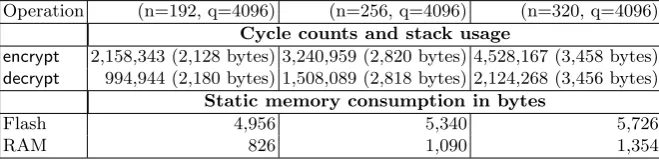
Table 6. Cycle counts and Flash memory consumption in bytes for the implementation of RLWEenc on an 8-bit ATxmega128 microcontroller using the Karatsuba algorithm with a modified parameter q=4096.
Operation (n=192, q=4096) (n=256, q=4096) (n=320, q=4096)
Cycle counts and stack usage
encrypt 2,158,343 (2,128 bytes) 3,240,959 (2,820 bytes) 4,528,167 (3,458 bytes) decrypt 994,944 (2,180 bytes) 1,508,089 (2,818 bytes) 2,124,268 (3,456 bytes)
Static memory consumption in bytes
Flash 4,956 5,340 5,726
RAM 826 1,090 1,354
Results. Table 5 and Table6 provide cycle counts for a recursive implementation of the Karatsuba algorithm. We experimentally evaluated that six levels of recursion lead to an optimal runtime for all dimensions. With roughly 2.9 million cycles for one encryption and 1.3 million cycles for decryption, this implementation outperforms schoolbook multiplication and is also able to deal with larger values of n. With q=4096 the performance is even better and also the flash memory consumption decreases since we do not need a complex modular reduction function anymore. However, the recursive nature of the Karatsuba algorithm and the need to reduce the polynomial modulo xn+ 1 after it has been completely multiplied leads to significant dynamic RAM consumption (stack usage).
12