Available Online at www.ijcsmc.com
International Journal of Computer Science and Mobile Computing
A Monthly Journal of Computer Science and Information Technology
ISSN 2320–088X
IJCSMC, Vol. 3, Issue. 1, January 2014, pg.140 – 149
RESEARCH ARTICLE
Automated Cryptanalysis of
Transposition Ciphers Using Cuckoo
Search Algorithm
1
Morteza Heydari*,
1Mahdieh Nadi Senejani
1
Department of Computer Engineering, College of Computer Science
,
Ashtian Branch,Islamic Azad University, Ashtian, Iran
*E-mail: [email protected]
Abstract
An approach of information security is Cryptography.Cryptanalysis is the science study to
break cryptography without the encryption key. The present paper shows the benefits of the
implementation of a novel genetic algorithm, the "Cuckoo Search" Algorithm (CSA) with
new fitness function for the cryptanalysis of transposition cipher. The fitness function is
evaluated based on the most common bigrams and trigrams. Results show that the algorithm
proposed in this paper is effective for cryptanalysis of transposition cipher with long key
lengths up to 30 due to its strong reliability and fast convergence speed.
1
Keywords: "Cuckoo Search" Algorithm (CSA), Cryptanalysis, Encryption key, Transposition
Cipher.
1. Introduction
There are different ways to secure information passed over the network.Cryptology is at the
heart of providing such guarantee. That is the science of building and analyzing different
encryption and decryption methods. Cryptology consists of two subfields; Cryptography &
Cryptanalysis. Cryptanalysis is the science and study of method of breaking cryptographic
techniques i.e. ciphers. The cryptanalysis can at maximum guess the key in which case a very
large number of guesses for the key to be correct can ensure the near unbreakability of the
cipher [1]. Many types of classical ciphers exist, although most fall into one of two broad
categories: substitution ciphers and transposition ciphers. A transposition cipher the plaintext
remains the same, but the order of characters is shuffled around. However, if the key is short
and the message is long, then various cryptanalysis techniques can be applied to break such
ciphers. In a simple columnar transposition cipher, the plaintext is written horizontally onto a
piece of graph paper of fixed width and the cipher text is read off vertically [2]. It works by
splitting the plain text into fixed sized blocks. The length of the key (also called the period) is
the same as the size of the block. Letters in each block are permuted according to a same
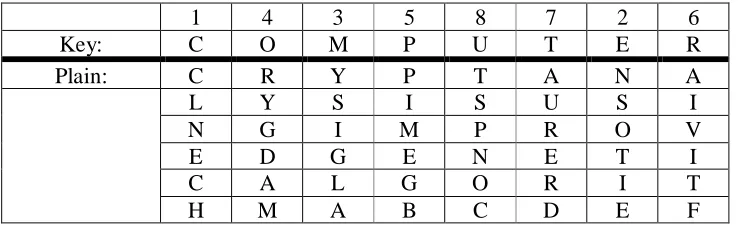
pattern (the key) [3]. In Table 1 is shown the key and the encryption process of the previously
described transposition cipher.
Table 1. Example of the transposition cipher key and encryption process
1 4 3 5 8 7 2 6
Key: C O M P U T E R
Plain: C R Y P T A N A
L Y S I S U S I
N G I M P R O V
E D G E N E T I
C A L G O R I T
Plain Text : CRYPTANALYSIS USING IMPROVED GENETIC ALGORITM
Cipher Text : CLNECHNSOTIEYSIGLARYGDAMPIMEGBAIVITFAURERDTSPNOC
Recently there has been a call for non-standard approaches, including many algorithms such
as particle swarm optimization, cuckoo search and firefly algorithm, to be applied to
cryptography problems. A newly developed algorithm described based on the breeding
behavior of cuckoo birds. The "Cuckoo Search" Algorithm (CSA) developed by Yang and
Deb [4-5], is a new meta-heuristic algorithm imitating animal behavior. In CSA, each egg in a
nest represents a solution, and a cuckoo egg represents a new solution. The aim is to use the
new and potentially better solutions (cuckoos) to replace a not-so-good solution in the nests.
In the simplest form, each nest has one egg. The algorithm can be extended to more
complicated cases in which each nest has multiple eggs representing a set of solutions [4-5].
The works of Yang & Deb [4-5], Civicioglu & Besdok [6], Rajabioun [7] and Valian et al. [8]
further confirmed that the “cuckoo search” algorithm, in its original or improved version,
proves to be very effective. The method has been successfully tested on a large number of
benchmark functions of varied dimensions and difficulty levels.
In this paper, the cryptanalysis of transposition cipher by applying CSA is presented. The
improved fitness function is used based on the most common bigrams and trigrams.
Numerical examples show that the proposed algorithm has satisfied global performance, high
convergence speed, minimum error, stable convergence performance and successful in
breaking the cipher with key lengths up to 30.
The paper is organized as follows. Section 2 presents a brief description of basic CSA
process. In section 3 is presented new method for Cryptanalysis of Transposition Cipher by
applying CSA. In this section, the assumptions used in its evaluation function algorithm is
introduced and presented. The results presented in Section 4 and finally Section 5 presents the
2. Basics of the CSA
The Cuckoo Search Algorithm (CSA) is based on the breeding behavior of the Common
Cuckoo. This species lays its eggs in foreign nests where the deceived host bird incubates the
cuckoo egg and feeds the chick. In some cases a host bird is able to distinguish between its
own and the cuckoo’s egg. In this situation, the discovered egg might be thrown off the nest,
or the nest will be abandoned completely to build a new one somewhere else. Furthermore,
some cuckoos, in anticipation of this unwelcoming reaction, evolved their parasitic behavior
by concentrating on imitating the eggs of specific host birds. An additional feature of the
Common Cuckoo’s reproduction strategy is the timing of the hatching: the cuckoo chick will
usually hatch first, and then it throws the host eggs out of the nest securing enough feeding for
it. Various studies have shown that the flight behavior of many animals and insects
demonstrates the typical characteristics of Lévy flights [4-5, 9-12]. A Lévy flight is a random
walk in which the step-lengths are distributed according to a heavy-tailed probability
distribution. After a large number of steps, the distance from the origin of the random walk
tends to a stable distribution. The CSA is mainly based on the generation of new solutions via
Lévy flights which are based on a Lévy distribution. Figure 1 illustrates the basic steps of the
Figure 1. Flow chart of the basic procedure of the CSA (based on [4] and [13])
3. The proposed method using CSA
3.1 Generating initial cuckoo habitat
The variable arrays in CSA, it is called "habitat" and sample array is defined as follows in
Equation (1):
x
ix
ix
ix
i N
habitat
1,
2,
3,...,
(1)Xi=between 1 to estimated key length
3.2 profit function
Most researchers use fitness functions which combine unigram, bigram and trigram frequency
statistics. In this research uses bigram and trigram models. Equation 2 is used as profit
function:
4 1 6 1.
β
.
α
j j j
i i i
p
C
B
D
T
F
(2)Where, Ci and Dj denotes the frequency of the bigram and trigram letters respectively, where
1<i<6 and 1<j<4. Also, Bi and Tj denotes the array of most common the bigram and trigram
letters respectively. Table 2 shows the fitness weight table used in this research.
Table 2. The fitness weight table proposed in this research
Score Trigram Score Bigram 5 THE 2 TH 5 ING 1 HE 5 AND 1 IN -5 EEE 1 ER 1 AN 1 ED
α and β allow assigning of different weights to each of the bigram and trigram types
respectively, where α + β =1. According to figure 2 the best values of α and β are 0.7 and 0.3
respectively. 0 50 100 150 200 250 300 350
α = 0.6 α = 0.7 α = 0.8 α = 0.9
R e q u ir ed t im e to b re a k ( se c
) Key length = 20
Length of cipher text=1000 character Length of cipher text=2000 character
0 50 100 150 200 250 300 350
β = 0.4 β = 0.3 β = 0.2 β = 0.1
R eq u ir e d t im e t o b re a k ( se
c) Key length = 20
Length of cipher text=1000 character Length of cipher text=2000 character
4. Results and Discussion
In this section, the performance of the proposed CSA algorithm is extensively investigated by
a large number of experimental studies. All computational experiments are conducted with
Visual C# program. Performance evaluation and analysis of this algorithm were operated on
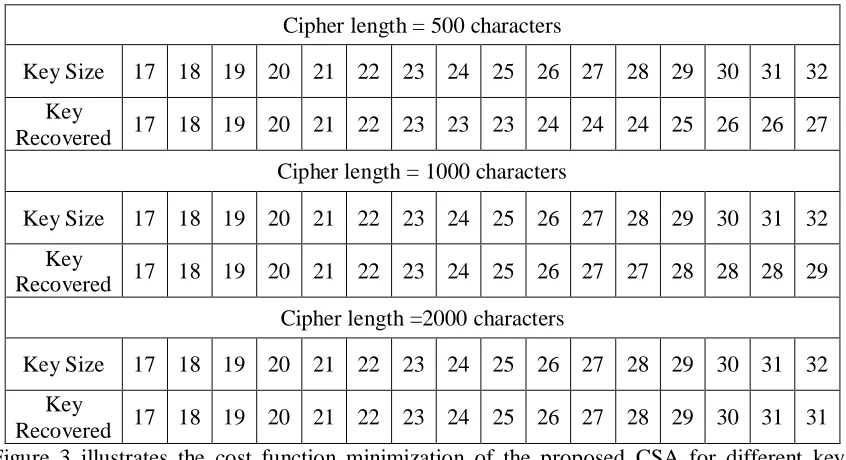
diverse texts encrypted with kinds of keys. Table 3 shows results for amounts of cipher text
ranging from 500 to 2000 characters. For each size there are some keys have been broken
fully. If the cipher text is having more size the breakable key and success rates is more,
however, the time of cryptanalysis increase.
Table 3. The amount of key recovered Versus Transposition Size Using different Cipher Text
Characters
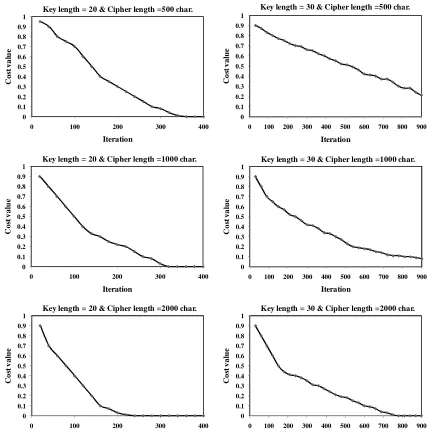
Figure 3 illustrates the cost function minimization of the proposed CSA for different key
lengths (20 and 30 keys) and different cipher text length (500, 1000 and 2000) to attack
transposition cipher.
Cipher length = 500 characters
32 31 30 29 28 27 26 25 24 23 22 21 20 19 18 17 Key Size 27 26 26 25 24 24 24 23 23 23 22 21 20 19 18 17 Key Recovered
Cipher length = 1000 characters
32 31 30 29 28 27 26 25 24 23 22 21 20 19 18 17 Key Size 29 28 28 28 27 27 26 25 24 23 22 21 20 19 18 17 Key Recovered
Cipher length =2000 characters
Figure 3. The cost function minimization comparison of algorithm with different cipher text
length and key length
Seeing from figure 3, it can be found that with increasing the amount of cipher text and same
key length, the rate of cost function minimization of algorithm increases and the speed of
convergence is high. Also, with increasing the amount of key length in same cipher text, the
numbers of iterations increases. This result shows the key length has a more impact than the
cipher text characters on accuracy and convergence proposed algorithm. This demonstrates
the importance of key length.
0 0.1 0.2 0.3 0.4 0.5 0.6 0.7 0.8 0.9 1
0 100 200 300 400
C o st v a lu e Iteration
Key length = 20 & Cipher length =500 char.
0 0.1 0.2 0.3 0.4 0.5 0.6 0.7 0.8 0.9 1
0 100 200 300 400 500 600 700 800 900
C o st v a lu e Iteration
Key length = 30 & Cipher length =500 char.
0 0.1 0.2 0.3 0.4 0.5 0.6 0.7 0.8 0.9 1
0 100 200 300 400
C o st v a lu e Iteration
Key length = 20 & Cipher length =1000 char.
0 0.1 0.2 0.3 0.4 0.5 0.6 0.7 0.8 0.9 1
0 100 200 300 400 500 600 700 800 900
C o st v a lu e Iteration
Key length = 30 & Cipher length =1000 char.
0 0.1 0.2 0.3 0.4 0.5 0.6 0.7 0.8 0.9 1
0 100 200 300 400
C o st v a lu e Iteration
Key length = 20 & Cipher length =2000 char.
0 0.1 0.2 0.3 0.4 0.5 0.6 0.7 0.8 0.9 1
0 100 200 300 400 500 600 700 800 900
C o st v a lu e Iteration
5. Conclusion
Recently introduced cuckoo search algorithm (CSA) has proven its excellent capabilities,
such as faster convergence and better global minimum achievement. In this paper, an
improvised CSA was presented for the cryptanalysis of transposition cipher with long key
lengths. The fitness weights used in fitness function CSA were 0.0 for unigrams, 0.7 bigrams
and 0.3 for trigrams. Experimental results indicated that this improved fitness function is
extremely powerful technique for an attack on transposition cipher. Amount of recovered key
in transposition cipher using this algorithm is more than the other techniques. The
performance of the algorithm is found to be better and considerably faster than exhaustive
search and other existing methods.
References
[1].Garg, P. and Sherry A.M. 2007. An Improved Cryptanalytic Attack on Knapsack Cipher
using Genetic Algorithm, International Journal of Information and Communication
Engineering, 3(6): 444-451.
[2].Sokouti, M. Sokouti, B. and S. Pashazadeh.2009. An approach in improving transposition
cipher system, Indian Journal of Science and Technology, 2(8): 9-15.
[3].Chen, J. 2010. Decrypting Classical Cipher Text Using Markov Chain Monte Carlo,
STA4000 Report.
[4].Yang, X.S., Deb, S.2009. Cuckoo search via Lévy flights, Proceeings of World Congress
on Nature & Biologically Inspired Computing, India, 210-214.
[5].Yang, X.S., Deb, S. 2010. Engineering Optimization by Cuckoo Search, Int. J.
Mathematical Modelling and Numerical Optimisation, 1(4): 330–343.
[6].Civicioglu, P. & Besdok, E. 2011. A conceptual comparison of the Cuckoo-search, particle
swarm optimization, differential evolution and artificial bee colony algorithms, Artif. Intell.
[7].Rajabioun, R. 2011. Cuckoo optimization algorithm, Applied Soft. Computing, 11, 5508–
5518.
[8].Valian, E., Mohanna, S & Tavakoli, S. 2011. Improved cuckoo search algorithm for feed
forward neural network training. International Journal of Artificial Intelligence
Applications. 2(3): 36-43.
[9].Brown, C., Liebovitch, L.S., Glendon, R. 2007. Lévy flights in Dobe Ju/hoansi foraging
patterns, Human Ecol.35: 129-138.
[10].Pavlyukevich, I. 2007. L´evy flights, non-local search and simulated annealing, J.
Computational Physics, 226: 1830-1844.
[11].Pavlyukevich, I. 2007. Cooling down L´evy flights, J. Phys. A: Math. Theor., 40:
12299-12313.
[12].Reynolds, A. M. and Frye, M. A. 2007. Free-flight odor tracking in Drosophila is
consistent with an optimal intermittent scale-free search, Plos One, 2: e354.
[13].Yang, X.S.2010. Nature-Inspired Metaheuristic Algorithms. 2nd ed. United Kingdom: