Order-Revealing Encryption: File-Injection Attack and Forward
Security
Xingchen Wang[0000−0002−7410−246X] and Yunlei Zhao[0000−0002−2623−9170] Fudan University, No.825, Zhangheng Road, Pudong New District, Shanghai, China
{xingchenwang16,ylzhao}@fudan.edu.cn
Abstract. Order-preserving encryption (OPE) and order-revealing encryption (ORE) are among the core ingredients for encrypted databases (EDBs). In this work, we study the leakage of OPE and ORE and their forward security.
We propose generic yet powerful file-injection attacks (FIAs) on OPE/ORE, aimed at the situations of possessingorder by and range queries. Our FIAs only exploit the ideal leakage of OPE/ORE (in particular, no need of data denseness or frequency). We also improve their efficiency with the frequency statistics using a hierarchical idea such that the high-frequency values will be recovered more quickly. We executed some experiments on real datasets to test the performance, and the results show that our FIAs can cause an extreme hazard on most of the existing OPEs and OREs with high efficiency and 100% recovery rate.
We then formulate forward security of ORE, which is of independent of interest, and propose a practical compilation framework for achieving forward secure ORE in order to resist the perniciousness of FIA. The compilation framework can transform most of the existing OPEs/OREs into forward secure OREs, with the goal of minimizing the extra burden incurred on computation and storage. We also execute some experiments to analyze its performance.
Keywords: Order-revealing encryption·Order-preserving encryption·File-injection attack·Forward security.
1
Introduction
Due to the increased data created in every industry moment by moment, database-as-a-service (DaaS) model has been regarded as a frontier idea with large development space. The basic DaaS model consists of the users, the clients and the server. Because of the support like thePrecise Query Protocols (PQPs) and the
bucketizationapproach, the DaaS model was designed to support the users in storing, operating and analyzing their data on the cloud.
In recent years, many property-preserving encryption (PPE) schemes and property-revealing encryption (PRE) schemes have been proposed with increased efficiency or/and security. This condition promotes the occurrence of encrypted database (EDB) systems. CryptDB [25] has been proposed by Popa et al. as the first practical EDB system for executing data manipulations on encrypted data. Because of its onion encryp-tion model and its proxy architecture, CryptDB supports most of the basic operaencryp-tions on ciphertexts with acceptable efficiency.
As a kind of PPE, order-preserving encryption (OPE) has been gaining more and more attention and studies because of its applications on EDB. OPE was first proposed for numeric data by Agrawal et al. [4], where the order of plaintexts can be obtained by comparing their ciphertexts directly. Later, order-revealing encryption (ORE) was proposed by Boneh et al. [7] as the generalization of OPE, where the ciphertexts reveal their order by a special algorithm rather than comparing themselves directly. Five formal leakage profiles of OPE/ORE were proposed and studied by Boldyreva et al. [5] and Chenette et al. [10]. Frequency-hiding OPE schemes, which achievestronger-than-ideal security, were recently proposed in [19] and [26].
several inference attacks against the deterministic encryption (DTE) and OPE in CryptDB. Durak et al. [12] showed that some ORE schemes, whose security is discussed on uniform inputs, could make the plaintext recovery of some known attacks more accurate on nonuniform data. They also proposed an attack, aiming at multiple encrypted columns of correlated data, which reveals more information than prior attacks against columns individually. Grubbs et al. [15] proposed new leakage-abuse attacks that achieve high-correctness recovery on OPE-encrypted data. They also presented the first attack on frequency-hiding OPE proposed in [19].
1.1 Our Contributions
In this paper, we first demonstrate the power of file-injection attacks (FIAs) on OPE/ORE, by developing two categories of FIA schemes (to the best of our knowledge, the first such attacks) against OPE/ORE. (The underlying assumptions and work flows of FIAs are briefly described in Section 3.1). Our FIA attacks are generic and powerful, in the sense that they only exploit the ideal leakage of OPE/ORE. Specifically, for our FIA attacks to work, the adversary only possesses the plaintext space, some oldorder by or range queries and the corresponding cipher result sets returned from EDB. In particular, the adversary does not need either the ability of comparing ciphertexts with the ORE comparison algorithm, or that of obtaining the ciphertexts outside of the result sets fororder by and range queries. After the introduction of our basic FIA schemes, we improve our basic FIAs using a hierarchical idea such that the high-frequency values will be recovered more quickly. We also discuss several approaches to further improving efficiency with some extra leakage (e.g., possessing bothorder by and range queries).
In comparison with other attacks against OPE/ORE proposed in recent years, our FIA attacks rely upon less demanding conditions, and are more effective (particularly for attacking systems, like encrypted email systems, with the function of data sharing or transferring). For example, compared with the attacks against OPE/ORE proposed in [15] and [23], our FIA attacks have the following features simultaneously: (1) no need of data denseness or frequency, and (2) generic against any OPE/ORE withideal leakage. Furthermore, as shown in Section 3.8, we compare and clarify in detail the advantages of our attacks over the chosen-plaintext attack (CPA) and the inference attack (IA).
Next, we present some experiments about our FIAs on the OPEs and OREs with ideal security. The results show that our FIAs can cause an extreme hazard on most of the existing OPE and ORE schemes with high efficiency and 100% recovery rate.
The strong security property against FIA is forward security, which ensures that the previous data manipulations do not cause any leakage of the newly inserted data. In other words, the server is infeasible to correctly response to the old queries about the newly inserted ciphertexts encrypted by a forward secure scheme. To the best of our knowledge, no OPE/ORE construction offered the forward security to thwart FIAs up to now. In this work, we give the formal definition of forward security for OPE/ORE, which might be of independent interest. Then, we propose a compilation framework for achieving forward secure ORE schemes against FIA attacks. Specifically, the compilation framework is applicable to most of the existing OPE/ORE schemes to transform them into forward secure ones. The resultant forward secure schemes leak nothing about newly inserted data that match the previous order by or range queries. Moreover, the compilation framework is constructed with the goal of minimizing the extra burden incurred on computation and storage. In particular, the compilation only uses some simple cryptographical tools like pseudo-random function (PRF), keyed hash function and trapdoor permutation (TDP). We also present two approaches to reducing the storage complexity of client. Finally, we execute some experiments to analyze the additional cost caused when applying our compilation framework to some prominent OPE/ORE schemes developed in recent year.
1.2 Related Work
were introduced. Boldyreva et al. [6] analyzed the one-wayness security of OPE, and showed that any OPE scheme must have immutable large ciphertexts if the scheme is constructed for leaking only order and frequency information. Popa et al. [24] proposed an OPE scheme in order tree structure, which is the first OPE scheme achieving the security of IND-OCPA (indistinguishability under ordered chosen-plaintext attack). Kerschbaum [19] proposed a frequency-hiding OPE scheme, which supports the security of IND-FA-OCPA (indistinguishability under frequency-analyzing ordered chosen-plaintext attack) for the first time. Later, a partial order preserving encryption (POPE), with a method for frequency-hiding, was developed by Roche et al. [26]. The POPE scheme proposed in [26] is mainly for the application scenarios where the system executes more insertion operations than order operations, and achieves even stronger security called IND-FA-POCPA (indistinguishability under frequency-analyzing partial ordered chosen-plaintext attack).
Order-revealing encryption (ORE) ORE was first generalized from OPE by Boneh et al. [7]. Their ORE scheme is built upon multilinear maps, which provides better security but at the cost of worse efficiency. Chenette et al. [10] proposed the first practical ORE, which achieves a simulation-based security w.r.t. some leakage functions that precisely quantify what is leaked by the scheme. Recently, Cash et al. [9] presented a general construction of ORE with reduced leakage as compared to [10], but at the cost of using a new type of “property-preserving” hash function based on bilinear maps.
File-injection attack on SSE As a kind of query-recovery attack, file-injection attack was named by Zhang et al. [28], but it was first proposed by Cash et al. [8] who called it the known-document attack. Islam et al. [17] initiated the study of FIA attack against searchable symmetric encryption (SSE), by showing that a curious service provider can recover most of the keywords-search queries with high accuracy. Their attack is based on the condition of possessing the plaintext space, and uses theL1 leakage named in [8] that contains the query pattern (i.e., the contents and repetition times of queries) and the file-access pattern (i.e., all the returned files as response to each query in timing order).
Cash et al. [8] further improved the power of the attack initiated in [17], by assuming less knowledge about the files of clients even in a larger plaintext space. In addition, they showed how the attack effects can be significantly improved if the adversary gets more leakages. Except the encrypted email systems like Pmail [2], they also discussed how their active attacks (e.g., query recovery attacks, partial plaintext recovery attacks, FIAs) might be used to break through other systems such as the systems in [16] and [20].
Zhang et al. [28] showed that FIA can recover the keywords-search queries with just a few injected files even for SSE of low leakage. Their attacks outperform the attacks proposed in [8] and [17] in efficiency and in the prerequisite of adversary’s prior knowledge.
2
Preliminaries
In this section we introduce some fundamental knowledge of TDP, ORE and OPE. We use standard notations and conventions below for writing probabilistic algorithms, experiments and protocols. IfDdenotes a domain,
x←− D$ is the operation of picking an element uniformly at random from D. If Sis a set, then for any k, 0≤k≤ |S| −1,S[k] denotes the (k+1)-th element inS. Ifαis neither an algorithm nor a set, thenx←α
is a simple assignment statement. If A is a probabilistic algorithm, then A(x1, x2,· · · ;r) is the result of runningAon inputs x1, x2,· · · and coinsr. We letA(x1, x2,· · ·)→y denote the experiment of pickingrat random and letting y beA(x1, x2,· · ·;r). ByP[R1;· · ·;Rn:E] we denote the probability of eventE, after the ordered execution of random processesR1,· · ·, Rn.
Definition 1 (Trapdoor Permutation). A tuple of polynomial-time algorithms (KeyGen,Π,Inv) over a domain D is a family of trapdoor permutations (or, sometimes, a trapdoor permutation informally), if it satisfies the following properties:
– KeyGen(1λ) → (I ,td). On input a secure parameter λ, the parameter generation algorithm outputs a
pair of parameters (I , td). Each pair of the parameters defines a set DI =Dtd with |I|>λ. Informally,
– KeyGen1(1λ)→I. LetKeyGen1 be the algorithm that executes KeyGen and returns I as the only result.
Then (KeyGen1,Π) is a family of one-way permutations.
– Invtd(y) → x. Inv is a deterministic inverting algorithm such that, for every pair of (I ,td) output by KeyGen(1λ) and any x∈ Dtd =DI andy =ΠI(x), it holds Invtd(y) =x. For presentation simplicity,
we also write the algorithm Invtd asΠ−1td, and denoted by
ΠkI(x) =
k TDPs
z }| {
ΠI(ΠI(· · ·ΠI(x)· · ·))
for some integer k≥1.
2.1 Definition of ORE
Definition 2 (Order-Revealing Encryption). A secret-key encryption scheme is an order-revealing en-cryption (ORE), if the scheme can be expressed as a tuple of algorithmsORE= (ORE.Setup,ORE.Encrypt,
ORE.Compare)which is defined over a well-ordered domain M.
– ORE.Setup(1λ) → (pp, sp). On input of a secure parameter λ, the setup algorithm outputs the set of
public parameters pp and the set of secret parameters sp which includes the secret key for encryption algorithm.
– ORE.Encrypt(pp, sp, m, σ1)→c. On input ofpp,spand a setσ1 of other auxiliary parameters (that are
not generated in the setup algorithm), the encryption algorithm encrypts the input plaintextm∈ {0,1}∗
to a ciphertextc that can reveal the correct order with other ciphertexts.
– ORE.Compare(pp, sp, c1, c2, σ2)→b. On input of pp,sp, two ciphertextsc1, c2, and the setσ2 of other
auxiliary parameters, the comparison algorithm returns a bit b∈ {0,1} as the result of order.
The ORE definition in other literature is simple and only remains the necessary parameters. Our definition above is more complex, and the additional parameters are used for better describing the latter framework. With the above formulation, we aim for a generic and basic definition of ORE, whereσ1andσ2may depend upon and vary with the concrete implementations of ORE. As a consequence, we do not introduce many details (that may vary with different implementations) and components like clients for interactive queries (as our FIAs are w.r.t. the generic OPE/ORE structure). In particular, we omit the decryption algorithm, because it is not an essential part of an ORE scheme. The data owners can execute some binary search over the ciphertexts with their secret key to infer the corresponding plaintexts of the ciphertexts in the result set. Leakage profiles.Theidealleakage profile, therandom order-preserving functionprofile, themost significant-differing bit profile, theRtM profile and theMtRprofile are five leakage profiles that have been proposed in the literature. The first two were described by Boldyreva et al. [5], and the else were described by Chenette et al. [10].
We remark that, in Section 3, our FIAs are generic in the sense that they are constructed only with the
ideal leakage profile. The ideal leakage profile just reveals the order and the frequency of the plaintexts. More precisely, only the leakage of order is necessary for our FIAs.
An adversary is said to be adaptive, if it is allowed to adaptively select data to be encrypted by the clients and then stored back to the server. Roughly speaking, an ORE scheme is said to beL-adaptively-secure, if any probabilistic polynomial-time (PPT) adaptive adversary cannot learn more than the leakage as described according to the leakage profileL.
2.2 Definition of OPE
Order-preserving encryption (OPE) is a simplified case of ORE. The ciphertext domainC of OPE needs to be well-ordered exactly as the plaintext domainM.
– OPE.Setup(1λ) → (pp, sp). On input of a secure parameter λ, the setup algorithm outputs the set of public parameters pp and the set of secret parameters sp which includes the secret key for encryption algorithm.
– OPE.Encrypt(pp, sp, m, σ1) → c. On input of pp, sp, and a set σ1 of other auxiliary parameters, the
encryption algorithm encrypts the input plaintext m to a ciphertext c that preserves the correct order with other ciphertexts.
3
File-injection Attacks on OPE/ORE
3.1 Assumptions and Basic Workflow
File injection attack has the following five assumptions: (1) The target system has a dependable component used for data-sharing or data-transmitting; (2) The adversary possesses the plaintext space of the target ciphertexts, and can store correct ciphertexts by sending some forged data to the client without suspicion; (3) The adversary possesses some old encrypted queries and can obtain the correct result sets from the server; (4) The adversary can only get the ciphertexts included in the result sets. (If the plaintext injected by the adversary does not match the queries, the corresponding ciphertext will not be known to it;) (5) The adversary is unable to forge queries or execute any PPE/PRE algorithm.
The basic workflow of FIA is briefly described as following:
– First, the adversary forges some data and sends them to the client from the server. After being encrypted by the client, the resultant ciphertexts of the forged data are sent back to the server for storing. – Second, the adversary replays some old queries and infers the responses from the database management
system (DBMS) with the leakage of newly inserted data.
– Third, the adversary adaptively executes the first two step repeatedly. And the data will be recovered successfully when the adversary obtains enough leakage.
In some application scenarios like encrypted email system (e.g., Pmail [2]) or the systems in [16] and [20], FIA can be easily executed. Assuming that the server has already responded many email-order requests and recorded many encrypted data manipulation statements, the adversary can forge some emails and send to the client. When the new emails are encrypted and sent back to the DBMS, the adversary can take advantage of the entire set of ciphertexts, as well as the old queries, to collect more leakage and infer the corresponding plaintexts.
Unlike the FIA attacks against SSE, our FIA attacks against OPE/ORE are data-recovery attacks, which are more powerful. Moreover, the forged data are less likely to be detected because of the smaller forged part. Furthermore, by extending the concept of FIA, with our FIA attacks files do not only represent the data elements in NoSQL database, but can also be any kind of data which fit the target system.
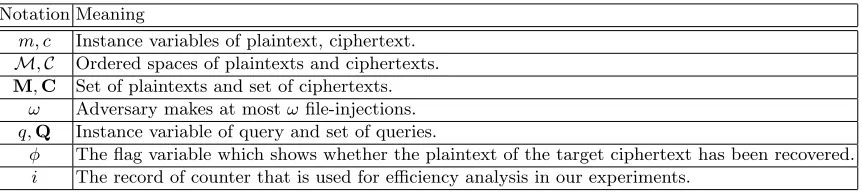
Table 1.Notations in Section 3 Notation Meaning
m, c Instance variables of plaintext, ciphertext. M,C Ordered spaces of plaintexts and ciphertexts. M,C Set of plaintexts and set of ciphertexts.
ω Adversary makes at mostωfile-injections. q,Q Instance variable of query and set of queries.
1
2
3
1
2
4 5
3
6
(a) (b)
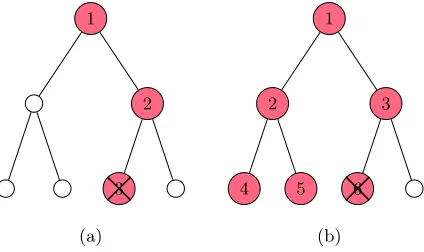
Fig. 1.Depth first binary search (a) and breadth first binary search (b).
3.2 Notations
Table 1 lists the meaning of some simple notations, which is helpful to comprehend the two FIA algorithms against ideal-secure OPEs/OREs presented in Section 3. Let Ri
q and Rq denote the result set of query q before the (i+ 1)-th file-injection and the current result set of query q. Let c ←−−−−−−−−−f ile injection m denote the process in which the adversary sends the forged plaintextm from the server to the client and the resultant ciphertextcis sent back (by client) and stored in the EDB. Letaandbdenote the indices of data which show their locations in their domains or their sets. Let mid(a, b) denote an arbitrary scheme for efficient median calculation, regardless of the round-off method. Let danddqueue denote a structural body contains two indices (a, b) and a queue of the structural body. Letmlandmr(resp.,q.clandq.cr) denote the left plaintext (resp., ciphertext) and right plaintext (resp., ciphertext) boundary values of range condition in a range query
q. We use the composite notation to represent the main part which is related to the additional part. Hence, we letmc denote the plaintext of the ciphertextc, letMa, b denote the plaintext space betweenaandb, let d.aandd.bdenote the parametersaandbin the structural bodyd. LetM[mid(a, b)] denotes the (k+1)-th element inMfork=mid(a, b).
3.3 Binary Search
Two FIA algorithms presented below have a common basis on algorithm construction – binary search. The difference between the two FIA algorithms lies in the search types they employ: one uses the traditional binary search like the depth first traversal, and another uses the breadth first traversal. The traditional binary search is a kind of (depth-first like) search algorithm, which finds the position of a target value within a sorted array by testing the order of the target value and the median value. In this work, we import the idea of breadth first traversal in the second FIA algorithm, with which we can get the relatively near data (around the target) that does not match the range condition.
We show two types of binary search in Figure 1, where the colored nodes are the passed nodes with their order marked, and the crosses mark the target nodes. For the traditional binary search as described in part (a), we need just a little time in complexityO(logN) whereN is the number of nodes in the binary tree, because we only need to find the target with a few data comparisons. But in part (b) of Figure 1, we have to traverse each data in every layer of the binary tree. Our FIA attacker, with the range query determined by (ml, mr), needs to find a valuem1 matching the range condition, and a pair of relatively near unmatched values (m2, m3) in the file-injected dataset, such thatm2< ml< m1< mr< m3. The details are presented in Section 3.5.
3.4 Basic FIA with order by Query
one of two Data Manipulation Languages (DMLs) that are based on the order of data. And the other one is the range query with relational operators like “<”, “>” and so on. In Section 3.4 and 3.5, we present the attack models and the FIA algorithms, assuming the attacker possesses these two kinds of order queries respectively. In Section 3.6, we also make some discussions about possessing the composition of these two kinds of order queries.
The attack model of basic FIA, withorder byqueries, consists of the adversarial information (i.e., leakage) and the adversarial goal. As to the adversarial information, we limit the power of adversaries in order for more practical attacks in practice. Specifically, the adversary only possesses, as adversarial information, the plaintext space M, the set Q of oldorder by queries, and the result sets of those queries with forged data. In particular, they do not have any information of the data not in the result sets of the old queries. About the adversarial goal, we partition it into two types: recovering the plaintext of a single ciphertext, and recovering the plaintexts of all the ciphertexts in the result sets. This partition facilitates the discussion of time complexity as we show later. We formalize the attack model as following:
Leakage: L(M, Q, RQ={
[
q∈Q,0≤i≤ω
Riq|ordered})
Goal: mc (c∈Rq0|ordered, q∈Q)orMC(C=
[
q∈Q Rq)
where Ri
q|ordered denotes the ordered result set for order by query q before the (i+ 1)-th file-injection, R0
q|ordered denotes the original ordered result set for order by queryq, MC (C = Sq∈QRq) denotes the plaintext set MC corresponding to the ciphertext set C in the current result sets for all the queries inQ. Here,MCcan also be expressed as a mapping relation precisely, denotedT(M,C), between all the ciphertexts inC (which includes all the original and forged data) and their corresponding plaintexts inMC.
For ease of comprehension,Algorithm 1 describes the elementary FIA based on utilizing a singleorder by query over an entire dataset. The adversary will continually detect the plaintext of the target ciphertext
cwith an old queryq by file-injections. We useComp(ci, c) to express the order result of queryq about the target ciphertextc and thei-th injected ciphertextci, where the result expresses as following:
Comp(ci, c) =
0ci =c 1ci > c −1ci < c.
Algorithm 1
mc←FIA Orderby(M, c∈R0q|ordered, q) 1: a← −1,φ←0,b← |M |
2: fori←1 to∞do 3: ci
f ile injection
←−−−−−−−−− M[mid(a, b)] 4: if (Comp(ci, c) = 0)
5: φ←1,break
6: else if (mid(a, b) =aormid(a, b) =b)break 7: else if (Comp(ci, c) = 1)
8: b←mid(a, b) 9: else a←mid(a, b) 10: end if
11: end for
12: if (φ= 1)returnmc← M[mid(a, b)] 13: else return ⊥
entire result set, the time complexity isO(Nlog|M| −NlogN) in the worst case. This means, in this case, the average time complexity of recovering a single ciphertext becomes smaller because the order of a ciphertext can be used for both sides. In other words, a file-injection for a target will reveal some order information about other target ciphertexts as well.
InAlgorithm 1, we only take advantage of the leakageL1(M, q, R0q), whereR0q =Rq\R0q is the result set after file-injections excluding the original result set. Because the leakage of the original result setR0
q is in theideal leakage profile, we can only get some order information between the target ciphertextctargetand other ciphertexts. In other words, we can rewrite the original result set as
R0q ={C−ordered, ctarget,C+ordered}
whereC−orderedis the set of ordered ciphertexts which are smaller than the target, andC+ordered is the set of ordered ciphertexts which are greater than the target. Under the assumption of knowing nothing about the original ciphertexts except their order information, we can only take advantage of |C−ordered| and|C+ordered| to curtail the plaintext space. We delete the first|C−ordered|plaintexts and the last|C+ordered|plaintexts from the ordered plaintext space M, and then we get a smaller new plaintext space M0 for the target ctarget. Thus, the time complexity of recovering a single ciphertext becomesO(log|M0|) which is even smaller now. In this way, the adversary can adaptively curtail the plaintext space according to the number of ciphertexts on both sides after each file-injection.
An improved method with hierarchical idea. Because the plaintext space may be very large, and different values may have widely different frequency distributions in different fields, we adopt the idea of hierarchical plaintext space generated through using frequency statistics. The hierarchical FIA algorithm just alters a few steps inAlgorithm 1. For presentation simplicity, we present the different steps and omit the same steps inAlgorithm 2below. In the hierarchical FIA algorithm, we divide the plaintext space into two hierarchies. The hierarchical algorithm with more hierarchies can be constructed on the analogy of this. We letMdenote the basic plaintext space that contains high-frequency plaintexts. If we cannot recover the correct plaintext of the target ciphertext fromM, we recursively execute the algorithm with lower-frequency plaintext space. Because of the assumption that the union of all the plaintext spaces contains all of the possible values, our FIA algorithm can theoretically guarantee 100% recovery rate by using the unbroken plaintext space as the auxiliary dataset.
Algorithm 2
mc←FIA2 Orderby(M, c∈R0q|ordered, q) 1: a← −1,φ←0,b← |M |
3: ci
f ile injection
←−−−−−−−−− M[mid(a, b)] 12: if (φ= 1)returnmc← M[mid(a, b)] 13: else returnmc←FIA Orderby(Ma, b, c, q)
As the distributions that most of the plaintext utilization rates follow are heterogeneous, in general we cannot analyze the target ciphertexts by directly using general frequency statistics. In this work, we propose a solution to divide the entire plaintext space into several levels, which is relatively more precise and useful compared to those based on the general statistical data of word frequency.
– First, we calculate the NGD with the plaintexts, and the target context namenor the setTof its feature tags. Fornor everyt∈T, we calculate NGD(nort, m) with every plaintextm∈ M as following:
max(log(|Rnort|),log(|Rm|))−log(|Rn ort∩Rm|) log(|R|)−min(log(|Rnort|),log(|Rm|))
where Rnort (resp., Rm) denotes the query result set of the target context (resp., each plaintext) returned by Google search engine, and |Rnort∩Rm| denotes the co-occurrence times of (n or t, m), |R| denotes the number of searchable elements in the Web. We convert this distance value NGD into similarity value p(nort, m) usingp(nor t, m) =e−2NGD(n ort, m).
– Second, we cluster the plaintexts according to their semantic correlation indicesp(nort, m). We suggest that the number of clusters should be two or three, as three hierarchies will make the plaintext space small enough in each hierarchy for even enormous plaintext space. Then we obtain several hierarchies of plaintext space, where the sub-hierarchy is divided into many parts by each plaintext in the super-hierarchy.
3.5 FIA with Range Queries
The attack model of FIA with range queries also consists of the adversarial information and the adversarial goal. As to the adversarial information, the adversary just has the plaintext spaceM, the old range queries in Q, and the result sets of those queries without inner order. In this condition, the leakage is less than that withorder by queries, because the adversary only knows the result set matching the range conditions without knowing the inner order. As to the adversarial goal, the adversary needs to recover the boundary plaintexts of the range conditions as well as all the plaintexts matching the range conditions. We formalize the attack model as following:
Leakage: L(M, Q, RQ={
[
q∈Q,0≤i≤ω Riq})
Goal: Ml, Mr, MC(C={c|q.cl< c < q.cr, q∈Q})
whereMCcan be expressed as a mapping relation precisely, denotedT(M,C), between all the ciphertexts inC (which includes all the original and forged data) and their plaintexts inMC,Riq is not ordered,MlandMr contain all the boundary plaintexts of the range queries in Q. In our construction, we design 3 steps to achieve the goal as following:
– First, the adversary must find a plaintext matching the range condition, whether its ciphertext is in the original EDB or not.
– Second, the adversary recovers the boundary plaintexts usingAlgorithm 1.
– Third, the adversary recovers all the plaintexts of the ciphertexts matching the range condition by several file-injections.
Here, to describe the FIA scheme briefly,Algorithm 3is based on utilizing a single range query without anyorder byoperation. In the following descriptions,qdenotes the range query with the boundary ciphertexts denoted q.cl andq.cr respectively.MRq denotes the plaintext set corresponding to the cipher result set Rq for queryq.
Algorithm 3
ml, mr,MRq ←FIA Rangequery(M, q) 1: a← −1,b← |M |,d←(a, b)
2: insert dinto the queuedqueue 3: while dqueue6=∅
4: take out the firstdindqueue, a←d.a, b←d.b
5: c←−−−−−−−−− Mf ile injection [mid(a, b)] 6: if |R0
q| 6=|Rq|break
7: if (mid(a,mid(a, b))6=aandmid(a,mid(a, b))6=mid(a, b)) 8: d←(a, mid(a, b)), insertdintodqueue
9: end if
10: if (mid(mid(a, b), b)6=b andmid(mid(a, b), b)6=mid(a, b)) 11: d←(mid(a, b), b), insertdinto dqueue
12: end if
13: ml←FIA Orderby(Ma,mid(a,b), q.cl, q) 14: mr←FIA Orderby(Mmid(a,b),b, q.cr, q)
15: MRq ← do file-injections from ml to mr and get their mapping table or corresponding plaintext set briefly
16: returnml, mr, MRq
Most of the boundary values are very special in practice. For instance, the numbers, which are the multiple of 10γ(γ = 0,1,2...), are frequently used for range query over numerical data; and the 26 letters are used for the same purpose over string data usually. Based on the different frequency of the plaintexts which are between every two adjacent common boundary plaintexts, the adversary may recover them more rapidly by several file-injections instead of the first step.
Time complexity. As the method of the first step is aimed at finding a plaintext matching the range condition, the time complexity of this part is just like a random search over an interval. Therefore, the time complexity of the first step isO(|M|d ), where d is the number of plaintexts that match the range condition in the entire plaintext spaceM.
Ifz is the number of file-injections in the first step, the entire time complexity is
O
|M|
d + log |M| 2blogzc +d
whereb crepresents the round down method. To be precise, the adversary actually does not need to file-inject all the plaintexts betweenml andmrin the third step, as some of them must have been file-injected during the execution of the two steps before.
The calculation of time complexity is based on the polynomial size message spaces. Just like other OPE/ORE/DET-attack works in the literature, we do not consider the scenario where the goal is recovering the plaintexts of long texts.
3.6 Discussions on FIA with both order by Queries and Range Queries
In this section, we discuss the extra leakage when bothorder by operations and range operations are com-pounded or co-occurred in the query setQ, and its impact on FIA. We consider the following three cases.
In the first case, when a query statement contains both the order by operator and the range condition, the order by operation additionally causes the leakage of inner order (particularly, the order information between every pair of inner ciphertexts). The extra leakage can be used to curtail the plaintext space when calling Algorithm 1in the second step of FIA with range queries.
discussed above may be recovered as the boundary plaintexts of the range conditions, which divide the recovering puzzle into several small puzzles with smaller plaintext spaces.
In the third case, the adversary has multiple range query statements. If their ranges do not have any intersection, they will not cause extra leakage other than dividing the puzzle to be solved by FIA into multiple irrelevant smaller puzzles. However, when they have an intersection and at least one boundary ciphertext of a range query is included in the result set of another one, the adversary will know the order of several sets of ciphertexts. In the latter case, the boundary ciphertexts can be recovered more quickly by the eigenvalue analysis over the plaintext space.
3.7 FIA against Frequency-Hiding OPE
Our FIA attacks can be applied to the frequency-hiding OPE schemes proposed in [19] and [26], but possibly with different difficulties. In this case, after a series of file-injections, the puzzle faced by the FIA attacker turns into inferring the plaintext of the target ciphertext from two adjacent plaintext candidates. In general, we can adjust our FIAs to inject more data until two frequency-hiding ciphertexts (for any one of the two plaintext candidates) are stored on the different sides of the target value.
Both the scheme in [19] and that in [26] are based on interactive encryption (but in different phases). In [19], the order between two ciphertexts (one existing and one updating) of the same value is randomly claimed by the client to the server. And in [26], a random data suffix is used for ensuring frequency-hiding. Hence, for the frequency-hiding OPE construction proposed in [26], the random space is fixed; while for that in [19], the random space will enlarge if more equivalent data are inserted. In other words, for the OPE scheme proposed in [19], the recovery difficulty will increase in case the data have a high repetitive rate; while for that in [26], the recovery difficulty with our FIAs will not increase when we continuously inject the forged data. The increased recovery difficulty will not decrease the accuracy, but more file-injections are demanded for data recovering. Here, our FIA against the frequency-hiding POPE scheme in [26] is based on the assumption that the interactive processes between the server and the client are executed automatically without client authorization. We suggest that this is the natural and more common application scenario of OPE/ORE in practice, as otherwise the client may be overburdened or cumbersome.
For space limitation, the description of our experiments is postponed to Appendix A.
3.8 Comparison among FIA and other generic attacks against OPE/ORE
Known- and chosen-plaintext attacks (CPAs) have been considered in many OPE/ORE works. To the best of our knowledge, the latest discussion of CPA is in [15]. Besides these attacks against OPE/ORE, inference attack (IA) is also a kind of powerful generic attack which has been described in [23] detailedly. In this subsection, we make brief comparisons among FIA, CPA and IA.
About the adversarial prerequisite, these three attacks all need an unbroken auxiliary dataset as the plaintext space, but only IA needs the data-frequency statistics. About the source of leakage information, CPA only utilizes the data which are chosen by the adversary and encrypted by the encryption scheme in the system; IA only utilizes the original ciphertexts in the EDB; but FIA can utilize both the main forged data (which are chosen by the adversary and encrypted by the system) and the secondary original ciphertexts in the EDB. Specially, the leakage information in FIA is obtained through old queries. In other words, the ciphertexts, which are not included in the result sets of the old queries, are not required in the adversarial prerequisite. As for the comparison algorithm, CPA and IA must use it; FIA only calls it normally through the old queries. About the performance, 100% accuracy can be achieved easily with either CPA or FIA, but it is difficult to achieve with IA. Additionally, CPA and FIA can attack the frequency-hiding OPE, but IA cannot do this without the decline of accuracy and applicability.
4
Formulating Forward Secure ORE
Forward security is a strong property of the dynamic SSE leakage profile. For a dynamic SSE scheme, its forward security means that: the previous data manipulations do not cause any leakage of the newly inserted data. Stefanov et al. [27] proposed this notion informally. Stefanov et al. [27] also proposed the concept of backward security, which ensures that the previous data manipulations do not leak any information about the newly deleted data. In this work, we extend this concept from SSE to OPE/ORE. Specifically, we give the definitions of forward security and backward security informally, as following:
Definition 4 (Forward/Backward Security). An L-adaptively-secure ORE scheme is forward (resp., backward) secure if the leakage profile, denotedLupdate, of update operation forupdate=add(resp.,update=
delete) can be described as following:
Lupdate(update,Wupdate) = (update,INDupdate)
whereadd(resp., delete) denotes the addition (resp., deletion) of data.Wupdate is the data set of the update
operations, in which the data have their own data storage structure, indices, and constraints according to the database.INDupdateis a set that only describes the modified column (in SQL database) or the document (in
NoSQL database) and the indices of updated data.
Informally, a forward secure ORE ensures that the previous data order manipulations do not leak any information about the newly inserted data. Meanwhile, the new data order manipulations can be executed normally, and can correctly leak the order information about the newly inserted data. And in a forward secure ORE scheme, Wupdate of a simple insertion can be briefly described asWadd= (m, s), wheres denotes the
order space of the related data on which order queries may be executed. For SQL databases,s can represent a column of a table. And for NoSQL databases,s can represent a set of documents.INDupdate of a simple
insertion can be briefly described as INDadd= (j, s), where the incremental timestampj is initially set to
be 0 and is shared by all the manipulations.
Letedenote the intermediate ciphertext without forward security. Letop(s) denote the order pattern of an order spaces, which lists all the timestamps of the order queries. Hist(s) contains all the data-updating histories ofs as well as the indexindexsofs. Here, we only use it to list all the data-addition histories over the time. More formally, they can be defined as:
op(s) ={j: (j, s,order)∈ListSQL}
Hist(s) ={indexs,(j,add, e) : (j, s,add, e)∈ListSQL}
whereadddenotes the addition manipulation,orderdenotes the ordering manipulation,ListSQLdenotes the list of data-manipulations. And we give the formal definition of forward secure ORE below.
Definition 5 (Forward Secure ORE).Let the algorithm tupleΓ = (ORE Setup,ORE Encrypt,ORE Compare)
be an ORE scheme. LetAdenote a PPT adaptive adversary. Define a real security gameFS-ORE-RΓA(λ), in whichAgets the public parameters output by ORE Setup(λ)and gets access to the encryption oracle and the comparison oracle adaptively. Based on the given public parameters and all the answers received from the oracles, A outputs a bit as the result of the game. Define an ideal security game FS-ORE-IAΓ,S,LΓ(λ), in which a PPT simulatorS only takes the leakage profileLΓ as input.LΓ has two parts as following:
Lupdate(add,(m, s)) = (add,(j, s)) Lcompare(c1, c2, s) = (op(s),Hist(s))
The simulatorS will output a bit as the result of the ideal game. The schemeΓ is said to be forward secure, if the following equation holds for any sufficient largeλ:
|P[FS-ORE-RΓA(λ) = 1]−P[FS-ORE-I Γ
A,S,LΓ(λ) = 1]| ≤negl(λ)
Table 2.Notations in Section 5 Notation Meaning
e Instance of intermediate ciphertext output by the original ORE or OPE scheme in EDB. Π,KeyGen, sk, pkA TDP scheme, its key-generation algorithm and its secret key, public key.
PRF,H A pseudo-random function and a keyed hash function.
OT,OT,OT Instance of order token, map of order token stored on the client and domain of order token. i The counter of order tokens, which is equal to the number of order tokens minus one.
s Instance of order space, which ensures that the data in different order spaces cannot be ordered.
5
A Compilation Framework for Forward Secure ORE
To the best of our knowledge, all the existing OPE and ORE schemes in the literature do not have forward security precisely. Here, we use “precisely” with the only special case of POPE [26] (discussed in Section 3.7) in mind. In [26], there is not any statement about whether the interactive processes need a client authorization or not. For the common application scenarios of OPE/ORE in practice, there is not any client authorization for querying. However, if the client authorization is mandated, POPE has forward security.
In the general case, the ciphertexts in EDB do not cover the entire ciphertext space. In other words, the ciphertexts in EDB are not dense usually. Thus, it is difficult to recover all the stored ciphertexts correctly with the limited leakage of OPE/ORE. However, according to our FIA constructions and experiments, FIA schemes are powerful and effective in recovering data encrypted by OPE/ORE without forward security in practice. Though forward security can be achieved with oblivious RAM (ORAM) [13, 14] in general, but it incurs massive overburden of performance [22] (large bandwidth consumption, multiple data round-trips, and/or large client storage complexity). Thus, it is desirable to have practical forward secure OPE/ORE schemes.
In this section, we present a practical compilation framework that transforms most of the existing OPE/ORE schemes into forward secure ones. To ease the understanding of the framework, we first give the meaning of some notations in Table 2.
5.1 Basic Ideas
With forward security, the add operation should leak nothing to server. In other words, the server should not distinguish between the ciphertexts output by a forward secure ORE and the ciphertexts encrypted by a perfect encryption scheme, when they are just inserted to the database before undergoing any search operation. In order to realize this goal, the ciphertexte generated by original OPE/ORE should be salted in our compilation framework. And we use TDP to link the salts to reduce the bandwidth consumption.
The salt is a hash value of an order token OT in our construction. To insert a new datum to EDB (say, the (i+1)-th insertion,i≥0), the client generates an order token OTibased on the TDP schemeΠ, its secret keysk, and the last order token OTi−1. If OTi (i= 0) is the first order token in the order space, it will be randomly selected from the domain of order tokenOT. In order to reduce the client storage, the client only stores the latest order token OTi and the corresponding counteriin our basic construction. When an order query needs to be executed, the client sends the current order token OTi and the counteri to the server. The server can then calculate all the order tokens with the public keypk, and gets the original OPE/ORE ciphertexts by desalting operations. At last, the client will receive the correct comparison result which is calculated with the comparison algorithm of the original OPE/ORE by the server.
5.2 The Compilation Framework
In our construction, we letλdenote the secure parameter. Letk0denote the main key of our compilation framework. For each order space s, the key ks of keyed hash function H is calculated by pseudo-random functionPRFk0[s]. Letadddenote the addition/insertion of data. The order tokens are calculated with TDP
one by one in sequence, and the hash values of these tokens will xor the original OPE/ORE ciphertexts to generate the final ciphertexts without extra storage consumption at the server side. The salt of the final ciphertext is of λbits, and will be desalted in the comparison algorithm. In the comparison algorithm, we let csα and csβ denote two ciphertexts to be compared in the order space s with their indices α and β respectively. We let esα and esβ denote their intermediate ciphertexts output by the original OPE/ORE respectively.
Algorithm 4Γf p
Setup(1λ)
1: (pp, sp)←ORE Setup(1λ) 2: OT←empty map 3: (sk, pk)←KeyGen(1λ) 4: k0
$
←− {0,1}λ
5: return((pk, pp),(sk, sp, k0,OT)) Encrypt(pp,(sk, sp, k0,OT), m,(add, s, σ1))
Client: 1: ks←PRFk0[s]
2: (OTi, i)←OT[s]
3: if (OTi, i) =⊥ {i← −1, OTi+1 $ ←− OT } 4: elseOTi+1←Π−1sk(OTi)
5: end if
6: OT[s]←(OTi+1, i+ 1)
7: ci+1←ORE Encrypt(pp, sp, m,(add, s, σ1))⊕H(ks,OTi+1) 8: Send ci+1 to server.
Server:
9: Insert ci+1into EDB.
Compare((pk, pp),(sp, k0,OT), csα, csβ,(s, σ2))
Client: 1: ks←PRFk0[s]
2: (OTi, i)←OT[s]
3: if (OTi, i) =⊥ ORi= 0return∅ 4: Send (OTi, i, ks) to server.
Server:
5: esα←csα⊕H(ks,Π i−α pk (OTi)) 6: esβ ←csβ⊕H(ks,Π
i−β pk (OTi))
7: b←ORE Compare(pp, sp, esα, esβ,(s, σ2)) 8: Send the resultbto client
of the remaining data by executing TDP exact times according to the interval leaked by sequence numbers. For space limitation, the analysis of storage and computational complexity is presented in Appendix B.
For batch encryptions, we can simply arrange all the elements in random order, and run the Encrypt algorithm in sequence. If batch encryptions are common in the system, we can add an extra batch index in the database for each datum, and use the same calculated order token for salting all the intermediate ciphertexts in a batch. This solution reduces the average computational complexity at the expense of leaking some information (eg. equality) of the elements in the same batch.
5.3 Analysis of Forward Security
In our framework, the ciphertexts output by the original OPE/ORE xor the one-way generated salts. Hence, the newly inserted data leak nothing to the server if they have not been queried. Once the data have been queried and desalted, the ciphertexts turn into the security level of the original OPE/ORE scheme for the adversary with continuous monitoring. Hence, the security of the composite forward secure ORE cannot be weaker than that of the original OPE/ORE. On the other hand, our compilation framework is powerful against FIAs, because the forged data will not leak any information with the old queries. The data need a new credible order query from the client to desalt. For space limitation, the formal proof of forward security is postponed to Appendix C.
5.4 Applicability and Experiments
Our compilation framework can be applied to all the OPE/ORE schemes except the OPE schemes (like the ideal-secure schemes proposed in [19] and [24]) that store the ciphertexts in order trees. These OPE schemes [19, 24] leak all the ciphertext order from the tree structure. Hence, the salting of our framework is useless in this case.
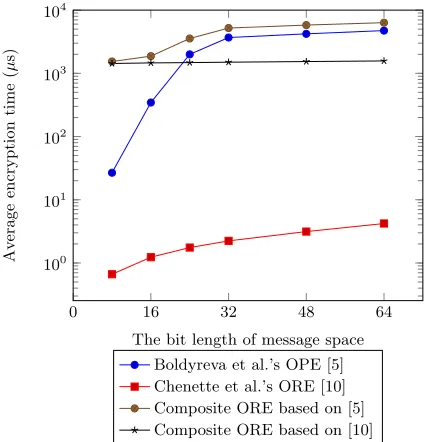
In the experiments, we combined the OPE/ORE schemes in [5] and [10] with our forward secure frame-work. The experiments are implemented in C/C++, and our experiments were performed using a single core on a machine with an Intel Pentium G2020 2.9GHz CPU and 4GB available RAM. We operate at
0 16 32 48 64
100
101 102
103 104
The bit length of message space
Av
erage
encryption
time
(
µ
s)
Boldyreva et al.’s OPE [5] Chenette et al.’s ORE [10] Composite ORE based on [5] Composite ORE based on [10]
128-bits of security. We use HMAC as the PRF and the keyed hash function, and we use the RSA imple-mentation (with 2048 bits RSA keys) in OpenSSL’s BigNum library as the TDP. We use Blake2b as the underlying hash function. For our basic implementation of Boldyreva et al.’s OPE scheme, we use the C++ implementation from CryptDB [25], and for the implementation of Chenette et al.’s ORE scheme, we use the C-implemented FastORE mentioned in [21]. We use the California public employee payroll data from 2014 [1] as the experimental plaintext sets.
Figure 2 shows the comparison results of the average encryption time between the original schemes and the composite schemes. We respectively used 100000 data for testing each of the points in Figure 2 and calculated the average results.
About the additional average encryption time, the composite forward secure ORE schemes demand about 1.5ms for each datum encryption. Moreover, as to the additional average comparison time, the composite forward secure ORE schemes demand about 47µs. Because we chose two of the most practical OPE/ORE schemes as the contrasts, the composite forward secure ORE schemes seem slower. However, the additional comparison time is still at the microsecond level. Hence, our scheme is still practical and useful for the most common systems.
6
Conclusion and Future Work
In this work, we study the leakage of OPE and ORE. We propose generic yet devastating FIA attacks which only exploit the ideal leakage of OPE/ORE. We also propose various improved methods to further boost the efficiency. Compared with existing attacks against OPE/ORE, our FIA attacks rely upon less demanding conditions, and can be more effective. We executed some experiments on real datasets to test the performance, and the results show that our FIA attacks can cause an extreme hazard on most of the existing OPE and ORE schemes with high efficiency and 100% recovery rate.
We then formulate forward-secure ORE, which may be of independent interest. In order to resist the disastrous effectiveness of FIA, we propose a practical compilation framework for transforming most existing OPE/ORE schemes into forward-secure ones. The compilation is built upon simple cryptographic tools, with the goal for (and proposed approaches to) minimizing the overburden caused in computation or storage complexity. Finally, we execute experiments on some prominent OPE/ORE schemes developed in recent years, and the results show that our compilation framework is practical and useful for most of the systems. Our compilation framework does not fit the OPE/ORE schemes which store the inserted data in order trees. Achieving forward security for these OPE/ORE schemes is an interesting direction for future research.
References
1. California public employee payroll data. http://transparentcalifornia.com/downloads/, 2014. 2. Pmail. https://github.com/tonypr/Pmail, 2014.
3. Us social security name statistics. https://www.ssa.gov/OACT/babynames/, 2017.
4. Agrawal, R., Kiernan, J., Srikant, R., and Xu, Y. Order preserving encryption for numeric data. InACM
SIGMOD International Conference on Management of Data (Paris, 2004), ACM, pp. 563–574.
5. Boldyreva, A., Chenette, N., Lee, Y., and O’Neill, A. Order-preserving symmetric encryption. In
An-nual International Conference on the Theory and Applications of Cryptographic Techniques (Heidelberg, 2009), Springer, pp. 224–241.
6. Boldyreva, A., Chenette, N., and O’Neill, A. Order-preserving encryption revisited: Improved security
analysis and alternative solutions. InAnnual Cryptology Conference(Heidelberg, 2011), Springer, pp. 578–595.
7. Boneh, D., Lewi, K., Raykova, M., Sahai, A., Zhandry, M., and Zimmerman, J.Semantically secure
order-revealing encryption: Multi-input functional encryption without obfuscation. InAnnual International Conference on the Theory and Applications of Cryptographic Techniques (Heidelberg, 2015), Springer, pp. 563–594.
8. Cash, D., Grubbs, P., Perry, J., and Ristenpart, T. Leakage-abuse attacks against searchable encryption.
9. Cash, D., Liu, F.-H., O’Neill, A., and Zhang, C.Reducing the leakage in practical order-revealing encryption. Cryptology ePrint Archive, Report 2016/661, 2016. http://eprint.iacr.org/2016/661.
10. Chenette, N., Lewi, K., Weis, S. A., and Wu, D. J. Practical order-revealing encryption with limited
leakage. InInternational Conference on Fast Software Encryption (Heidelberg, 2016), Springer, pp. 474–493.
11. Cilibrasi, R. L., and Vitanyi, P. M. The google similarity distance. IEEE Transactions on knowledge and
data engineering 19, 3 (2007), 370–383.
12. Durak, F. B., DuBuisson, T. M., and Cash, D. What else is revealed by order-revealing encryption? In
Proceedings of the 2016 ACM SIGSAC Conference on Computer and Communications Security (Vienna, 2016), ACM, pp. 1155–1166.
13. Garg, S., Mohassel, P., and Papamanthou, C.Tworam: Efficient oblivious ram in two rounds with
applica-tions to searchable encryption. InProceedings, Part III, of the 36th Annual International Cryptology Conference on Advances in Cryptology — CRYPTO 2016 - Volume 9816 (2016), pp. 563–592.
14. Goldreich, O., and Ostrovsky, R. Software protection and simulation on oblivious rams. Journal of the
ACM (JACM) 43, 3 (1996), 431–473.
15. Grubbs, P., Sekniqi, K., Bindschaedler, V., Naveed, M., and Ristenpart, T. Leakage-abuse attacks
against order-revealing encryption. In Security and Privacy (SP), 2017 IEEE Symposium on (2017), IEEE, pp. 655–672.
16. He, W., Akhawe, D., Jain, S., Shi, E., and Song, D.Shadowcrypt: Encrypted web applications for everyone.
InProceedings of the 2014 ACM SIGSAC Conference on Computer and Communications Security (Scottsdale, 2014), ACM, pp. 1028–1039.
17. Islam, M. S., Kuzu, M., and Kantarcioglu, M.Access pattern disclosure on searchable encryption:
Ramifi-cation, attack and mitigation. In19th Annual Network and Distributed System Security Symposium (San Diego, 2012), vol. 20, The Internet Society, p. 12.
18. Islam, M. S., Kuzu, M., and Kantarcioglu, M. Inference attack against encrypted range queries on
out-sourced databases. InProceedings of the 4th ACM conference on Data and application security and privacy(San Antonio, 2014), ACM, pp. 235–246.
19. Kerschbaum, F. Frequency-hiding order-preserving encryption. In Proceedings of the 22nd ACM SIGSAC
Conference on Computer and Communications Security (Denver, 2015), ACM, pp. 656–667.
20. Lau, B., Chung, S. P., Song, C., Jang, Y., Lee, W., and Boldyreva, A.Mimesis aegis: A mimicry privacy
shield-a system’s approach to data privacy on public cloud. InProceeding of the 23rd USENIX conference on Security Symposium (San Diego, 2014), USENIX Association, pp. 33–48.
21. Lewi, K., and Wu, D. J. Order-revealing encryption: New constructions, applications, and lower bounds. In
Proceedings of the 2016 ACM SIGSAC Conference on Computer and Communications Security (Vienna, 2016), ACM, pp. 1167–1178.
22. Naveed, M. The fallacy of composition of oblivious ram and searchable encryption. Cryptology ePrint Archive,
Report 2015/668, 2015. http://eprint.iacr.org/2015/668.
23. Naveed, M., Kamara, S., and Wright, C. V. Inference attacks on property-preserving encrypted databases.
InProceedings of the 22nd ACM SIGSAC Conference on Computer and Communications Security(Denver, 2015), ACM, pp. 644–655.
24. Popa, R. A., Li, F. H., and Zeldovich, N. An ideal-security protocol for order-preserving encoding. In
Security and Privacy (SP), 2013 IEEE Symposium on (San Francisco, 2013), IEEE, pp. 463–477.
25. Popa, R. A., Redfield, C., Zeldovich, N., and Balakrishnan, H. Cryptdb: protecting confidentiality
with encrypted query processing. InProceedings of the 23rd ACM Symposium on Operating Systems Principles
(Cascais, 2011), ACM, pp. 85–100.
26. Roche, D. S., Apon, D., Choi, S. G., and Yerukhimovich, A. Pope: Partial order preserving encoding. In
Proceedings of the 2016 ACM SIGSAC Conference on Computer and Communications Security (Vienne, 2016), ACM, pp. 1131–1142.
27. Stefanov, E., Papamanthou, C., and Shi, E. Practical dynamic searchable encryption with small leakage.
In21th Annual Network and Distributed System Security Symposium (San Diego, 2014), vol. 71, The Internet Society, pp. 72–75.
28. Zhang, Y., Katz, J., and Papamanthou, C. All your queries are belong to us: The power of file-injection
A
Experiments of FIAs
In this part, we detailedly present the FIA experiments against the OPE/ORE withidealleakage as well as a frequency-hiding OPE. Let us first restate precisely the environment and the datasets of these experiments. The FIA algorithms are implemented in C++, and our experiments were performed using a single core on a machine with an Intel Pentium G2020 2.9GHz CPU and 4GB available RAM. The FIA experiment with range queries relies closely upon the range widthd in reality, which is, however, not easy to be obtained or evaluated. If we regard the range width as a variable, the results will be four-dimensional and inenarrable. As a consequence, our FIA implementations are aimed at the situation of only possessingorder by queries in this paper. Moreover, the experimental results of FIA with range queries will be included and analyzed detailedly in the extended version of this paper.
Datasets selection.We used the California public employee payroll data from 2014 [1] as the target dataset. We did some preprocessing because there are some invalid data in this dataset; for example, “not provided” or a single letter in the name set, and negative values in the salary set. After the filtration, we got the valid datasets of firstname, lastname and salary, which contain 1739637 firstnames, 1736490 lastnames and 1739634 salary data respectively. We also need some public auxiliary datasets as the plaintext spaces of target data. For salary space, we do not need auxiliary dataset and just set 0 to 1000000 as the range of salary. For the firstname space and the lastname space, we select the union set of the statistics for baby names gathered by the US Social Security Administration [3] from 1951 to 1996 (so that the parties selected are of age older than 18). The union set contains 56680 unique names that have been used more than 4 times in a certain year.
Experiment results. We first executed our FIA schemes on the ideally secure OPE proposed by Popa et al. [24]. We remark that the experiment results will be the same for other OPE/ORE schemes without forward security, as we only leverage the order leakage. The results show that we got 100% recovery rate on firstname and salary datasets, but the recovery rate of lastnames is 44.96%. The reason of the lower recovery rate of lastnames is that our auxiliary dataset itself does not contain the unrecovered lastnames which are too rare to record in [3] or belong to the persons who were not born in the United States from 1951 to 1996. Because the recovery rate is only connected with the integrity of the adversarial auxiliary dataset, we judge the experiment results through the number of file-injections. Moreover, the adversary will be detected less likely with fewer number of file-injections. We mainly executed two experiments about the OPE/ORE withideal leakage profile as following:
– The first experiment is aimed at recovering every datum in the target datasets isolatedly.
– The second experiment is aimed at recovering all the data in the target datasets synchronously. (Most of the file-injections in the first experiment are repeatedly used for revealing the order information of disparate data, but they will not be executed repeatedly in the second experiment.)
According to the number of file-injections for recovering every datum, we count the number of data and draw the charts in Figure 3 and Figure 4. In other words, the x-axis means the number of injected files that we used for recovering each datum, and the y-axis means the statistical magnitude, which is the result of counting all attacked data basing on x-axis.
0 5 10 15 20 0 2 4 6 8
·105
The number of file-injections
Num b er of data Firstname Hie-Firstname Lastname Salary
Fig. 3. The number of file-injections for recovering a single datum.
0 5 10 15 20
0 0.5 1 1.5
·106
The number of nonrepetitive file-injections
Num b er of data Firstname Lastname Salary
Fig. 4. The number of nonrepeti-tive file-injections for recovering entire dataset.
0 100 200 300 400 500 600 700 0
1,000 2,000 3,000 4,000 5,000
The number of file-injections
Num b er o f data Salary
Fig. 5. The number of file-injections on frequency-hiding POPE.
and each file-injection can actually reveal some order information among all the set. Hence, the number of file-injections can be much less in the actual attack situation. Figure 4 shows the number of nonrepetitive file-injections for recovering entire dataset, where the approximate average number for recovering a firstname is 0.023, the approximate average number for recovering a lastname is 0.011, and the approximate average number for recovering a salary is 0.150.
We also executed our FIAs on the frequency-hiding POPE proposed in [26], under the assumption that the interactive processes between client and server are automatically run without client authorization (as discussed at the end of Section 3.7). To the best of our knowledge, this is the first attack against POPE with frequency-hiding. The frequency-hiding method of POPE in [26] is to add a random fractional part to each plaintext prior to encrypting. In our experiment, the random fractional part has two decimal places. We selected the first 15814 salary data as the attack target that contains values from 1 to 756351. Figure 5 is the result of this experiment, which shows that the approximate average number of file-injections against the frequency-hiding POPE in [26] are 29.220. For simplicity, not all points are drawn in this line chart. And because of the randomness of the encryption algorithm in POPE, the experiment result is not deterministic.
B
Storage and Computational Complexity
Storage complexity. Because the length of ciphertext resulted from our compilation framework is the same as that of original OPE/ORE ciphertext, our framework does not enlarge the storage complexity of the server. Because of the map OTwhich contains order tokens and counters, the storage complexity of client will increase O(|S|(log|OT |+ log|Cs|)), where |S| is the number of order spaces and|Cs| is the number of ciphertexts in every order space. We present two solutions to reduce the storage consumption as following:
– For every order spaces, we can generate the first order token OT0 by pseudo-random function PRF(s). The client only stores the counteri and calculates OTifrom OT0by TDP when the order query is going to be executed. Fortunately, it is not hard to perform TDP several times for popular TDPs like RSA. If (u, v, w) and (ψ,) are respectively the secret keys and the public keys, OTi=Π−ski(OT0) can be easily calculated as following:
f ←wi mod(u−1)(v−1), OTi ←OT f
0 modψ.
Thus, the additional storage complexity of client will decrease toO(|S|log|Cs|) in this way.
All the solutions above cause an extra burden of calculation, but they are good options for the applications with limited storage at clients. In a way, Algorithm 4 is the best construction for balancing the time complexity and the storage complexity.
Computational complexity.For most of the OPE/ORE schemes in the literatures, our compilation needs to add a salt which is a hash value of an order token for every original ciphertext. Hence, the additional com-putational complexity of the resultant ORE with forward security depends on the server storage complexity of the original OPE/ORE. For instance, if a practical OPE (like the scheme in [5]) needsO(N) storage on the server for a dataset ofN items, the additional computational complexity caused by composite encryption and that by composite comparison are bothO(N). And for ORE schemes (like those in [9]), which encrypt every plaintext intoT parts, the additional computational complexity caused by composite encryption and that by composite comparison are bothO(T N).
C
Analysis of Forward Security
In order to give the entire proof of the forward security, we derive games G and G’ for achieving the simulation-based proof. The real security game and the ideal security game just follow Definition 5. For presentation simplicity, we letA4denote Algorithm 4.
FS-ORE-R. The security model of our forward secure ORE in the real world, which is denoted by FS-ORE-RA4A (λ) w.r.t. a security parameterλ, a PPT adversaryAand our compilation framework Algo-rithm 4.
Game G. In the construction below, we generate the keys of order spaces randomly and independently, and store them in a mapKEYinstead of callingPRF. We also store all the order tokens generated by TDP Πin the mapOT. Instead of generating the salts by hash functionH, the game randomly generates the salts and stores them in the mapH.
The function H0 is used for ensuring to never generate two different salts for the inputs of the same tuple (k,OTx). The functionH0 will randomly generate the result if the mapH does not include the tuple (k,OTx). But if the order token OTx gets a collision with another order token, the flagError will be set to be 1, and the function will return the corresponding salt of the equivalent token. We label this part with a box, because it is not included in the intermediate gameG’. Another part, which is removed fromGfor the intermediate gameG’, is in theEncryptalgorithm and is also labeled with box. Specifically, the intermediate gameG0 is gotten by removing the boxed parts fromG. When the salt of a new order token exists, the flag
Error will be set to be 1. Because of this, the outputs of the functionH0in gameGand the outputs of keyed hash functionHare perfectly indistinguishable. Hence, if an adversary can distinguish betweenFS-ORE-R andG, we can construct a reduction to distinguish between PRF and a truly random function. Specifically, we can make a formal reduction with an efficient adversaryA1 as following:
|P[FS-ORE-RA4A (λ) = 1]−P[G= 1]| ≤Adv PR
PRF,A1(λ),
where PR denotes pseudo-randomness.
According to the difference betweenGandG’described above, we have: the advantage of distinguishing betweenGandG’ is smaller than the probability that the flagError is set to be 1 inG. Specifically:
|P[G= 1]−P[G0 = 1]| ≤P[Error is set to 1 inG].
Game G Setup(1λ)
1: (pp, sp)←ORE Setup(1λ) 2: OT,KEY,H←empty map 3: (sk, pk)←KeyGen(1λ) 4: Error←0
5: return((pk, pp,H),(sk, sp,OT,KEY)) Encrypt((pp,H),(sk, sp,OT,KEY), m,(add, s, σ1))
Client: 1: ks←KEY[s]
2: if ks=⊥ KEY[s]←ks $
←− {0,1}λ 3: (OT0, ... ,OTi, i)←OT[s]
4: if (OT0, ... ,OTi, i) =⊥ {i← −1, OTi+1 $ ←− OT } 5: elseOTi+1←Π−1sk(OTi)
6: end if 7: Hi+1
$
←− {0,1}λ
8: if H[ks,OTi+1]6=⊥then
9: Error ← 1, Hi+1 ←
H0(ks,OTi+1,H,OT,KEY) 10: end if
11: H[ks,OTi+1]←Hi+1
12: OT[s]←(OT0, ... ,OTi+1, i+ 1)
13: ci+1←H[ks,OTi+1]⊕ORE Encrypt(pp, sp, m,(add, s, σ1)) 14: Sendci+1 to server.
Server:
15: Insertci+1into EDB.
Compare((pp,H),(sp,OT,KEY), csα, csβ,(s, σ2))
Client: 1: ks←KEY[s] 2: if ks=⊥ return∅ 3: (OT0, ... ,OTi, i)←OT[s]
4: if ((OT0, ... ,OTi, i) =⊥ ORi= 0return∅ 5: Send ((OT0, ... ,OTi, i), ks) to server.
Server: 6: esα←csα⊕H
0(k
s,OTα,H,OT,KEY) 7: esβ ←csβ⊕H
0(k
s,OTβ,H,OT,KEY) 8: b←ORE Compare(pp, sp, esα, esβ,(s, σ2)) 9: Send the resultbto client
H ←H0(k,OTx,H,OT,KEY) 1: H ←H[k,OTx]
2: if H=⊥ then 3: H ←− {$ 0,1}λ
4: if ∃s, i s.t. OTx= OTi∈OT[s]then 5: Error←1, H←H[KEY[s],OTi] 6: end if
7: H[k,OTx]←H 8: end if
|P[G= 1]−P[G0= 1]| ≤ N ·AdvΠone,A-2wayness(λ),
whereN is the number of the data in the EDB. SimulatorS
Setup(1λ)
1: (pp, sp)←ORE Setup(1λ) 2: OT,KEY,C←empty map 3: (sk, pk)←KeyGen(1λ) 4: i← −1
5: return((pk, pp,C),(sk, sp, i,OT, KEY)) Encrypt()
Client: 1: i←i+1 2: C[i]←− {$ 0,1}λ 3: Send C[i] to server.
Server:
4: Insert C[i] into EDB.
Compare(pp,(sk, sp, i,OT,KEY),C[α],C[β],(s,op(s),
Hist(s),add, σ1, σ2))
Client: 1: ¯s←minop(s) 2: if ¯s=⊥ then 3: k¯s
$
←− {0,1}λ, KEY[¯s]←k ¯ s
4: OT0 $
←− OT, OT[¯s]←OT0 5: else{k¯s←KEY[¯s],OT0←OT[¯s]} 6: end if
7: Parse Hist(s) as [(i0,add, e0←ORE Encrypt(pp, sp, m0,(add, s, σ1))), ... ,(icounter, add,
ecounter ←ORE Encrypt(pp, sp, mcounter,(add, s, σ1)))] 8: if counter=⊥ ORcounter= 0return∅
9: Program H00 s.t.H00(k¯s,OTα←Π−skα(OT0))←C[α]⊕eαandH00(ks¯,OTβ←Πsk−β(OT0))←C[β]⊕eβ 10: Send ((OTα,OTβ, k¯s) to server.
Server: 11: esα←C[α]⊕H
00(k ¯ s,OTα) 12: esβ ←C[β]⊕H
00(k ¯ s,OTβ)
13: b←ORE Compare(pp, sp, esα, esβ,(s, σ2)) 14: Send the resultbto client
SimulatorS. We use the simulatorSand the leakage functionLA4to describe the ideal forward security of ORE constructions, whereLA4is defined inDefinition 5. Compared to the gameG’, the simulator uses the counter ¯suniquely mapped from order spaces with the leakage function. The set Cis used for storing ciphertexts on the client side. As the code for the oracleH0is useless now, it is removed from the description of the simulator. In addition, the leakage of the order information is only revealed when the ciphertexts are going to execute the algorithmCompare.
We show that the gameG’and the simulatorSare indistinguishable. For data encryption, it is immediate as the scheme is outputting a fresh random bit string for each update inG’. For data searching, using the adding historyHist, the simulator constructs the oracleH00which is subject to revealing the order correctly with the corresponding order token generated from OT0. Hence,
Conclusion.Combining all the reductions above, there exists two efficient adversariesA1, A2 such that |P[FS-ORE-RA4A (λ) = 1]−P[FS-ORE-I
A4
A,S,LA4(λ) = 1]| ≤AdvPRPRF,A
1(λ) +N ·Adv
one-wayness
Π,A2 (λ)