ISSN (Print) : 2320 – 3765 ISSN (Online): 2278 – 8875
I
nternational
J
ournal of
A
dvanced
R
esearch in
E
lectrical,
E
lectronics and
I
nstrumentation
E
ngineering
(An UGC Approved Journal)
Website: www.ijareeie.com
Vol. 6, Issue 8, August 2017
Image Steganography Using DWT and Semi
Hexadecimal Code with High Embedding
Capacity
Devki
Assistant Professor, Department of Computer Science, GGN Khalsa College, Ludhiana, Punjab, India
ABSTRACT: In this paper, a novel image steganography approach is proposed to enhance the visual quality of stego image. The cover image is decomposed using Discrete Wavelet Transform (DWT) to produce wavelet subbands and threshold value is calculated for each higher frequency wavelet subbands. Wavelet coefficients having magnitude larger than the threshold of its subband are selected to embed the secret data. Semi Hexadecimal Code (SHC) is proposed to convert pixel value of secret image into smaller equivalent value so that it distorts stego image as less as possible. Experimental results shows that maximum embedding capacity of cover image is more than 87%. Proposed approach is also compared with the existing approaches and this comparison shows that the proposed approach is better than the existing approaches.
KEYWORDS: DWT, PSNR, Correlation, EF, SHC, Threshold.
I. INTRODUCTION
Steganography is a process of hiding a secret message in an ordinary message and the extraction of secret message, whenever required. Image steganography techniques are divided into two categories: spatial domain and frequency domain steganography. In spatial domain techniques, secret message is embedded in the image pixels, while in frequency domain techniques, image is first transformed and then secret message is embedded in the transformed image. Frequency domain techniques hide messages in significant areas of cover image which make them more robust than spatial domain techniques. Several approaches have been proposed for frequency domain steganography using different transforms [1-2].
Market et al. [3] proposed a watermarking technique in which the secret image is decomposed into wavelet subbands using DWT. The watermark is embedded into largest coefficients of high and middle frequency wavelet subbands of an image. Maximum PSNR proposed by their technique is 32.7 dB which is 0.14 dB more than Hsu et al.
method [4].
Toaba et al. [5] proposed a technique in which secret message is embedded into least significant bits of wavelet coefficient of an image. Some pre-processing steps are applied on cover image to adjust saturated pixel components in order to recover the embedding message without losing cover image data. Cover image is adjusted before applying Integer Wavelet Transform followed by two levels DWT. Permutation of stego key is used to embed the bit stream of secret image after inverse IWT after that stego image is collected. Extraction process is just reverse of embedding process. Maximum PSNR offered by their technique is 73.91 dB.
Chen et al. [6] proposed a data hiding technique to hide data in high frequency wavelet sub-bands. The proposed technique is divided into two modes and three cases. The modes are fixed and varying. The cases are low embedding capacity, medium capacity and high capacity. Sequence mapping tables are used in raster scan manner to embed the data. For fix mode, 46.83 dB is the highest PSNR value and 39.00 dB is lowest. For varying mode, highest PSNR is 50.85 dB and minimum PSNR is 44.76 dB.
ISSN (Print) : 2320 – 3765 ISSN (Online): 2278 – 8875
I
nternational
J
ournal of
A
dvanced
R
esearch in
E
lectrical,
E
lectronics and
I
nstrumentation
E
ngineering
(An UGC Approved Journal)
Website: www.ijareeie.com
Vol. 6, Issue 8, August 2017
Nag et al.[8] proposed a DWT based technique for image steganography in which two dimensional (2-D) DWT
is applied on the cover image and Huffman encoding is performed on the secret message before embedding. Then each bit of Huffman code of secret message is embedded in the high frequency wavelet coefficients. Maximum hiding capacity is 24.21%.
Kumar et al. [9] proposed dual transform technique for robust steganography in which the cover image is segmented into 4×4 size blocks and DWT is applied on each block. In the resulting DWT coefficients, blocks of vertical band of 2×2 each are considered and then IWT is applied to get a single coefficient. Then secret data is embedded into these coefficients using LSB method. Maximum capacity is 25%.
Shejul et al. [10] proposed a biometrics based steganography technique. Secret data is hidden in the high frequency subbands of DWT. Two cases are considered for data embedding. First is with cropping and another is without cropping. Both the cases are compared and analyzed from different aspects. Main feature of cropping case is that this results into an enhanced security because cropped region works as a key at decoding side, while without cropping case uses embedding algorithm that preserves histogram of DWT coefficient after data embedding also by preventing histogram based attacks and leading to a more security. Maximum PSNR provided by proposed technique is 64.92 dB.
Ghasemi et al. [11] proposed a wavelet transform and genetic algorithm based steganography technique. Genetic algorithm based mapping function is used to embed data in DWT coefficients in 4×4 blocks of the cover image. The optimal pixel adjustment process is applied after embedding the message. Maximum capacity is 50%.
Bhattacharya et al.[12] proposed a DWT based steganography technique in which secret data is embedded in high frequency wavelet sub bands. An amplification factor is used to control the embedding effect. PSNR between cover image and stego image is 27.3850 dB.
Ioannidou et al.[13] proposed a novel image steganography technique to hide the data into sharp areas of image on the basis of the edges present in an image. A hybrid edge detector is used to detect the edges of the cover image. Maximum PSNR provided by the proposed technique is46.88 dB.
From this analysis, one can conclude that there is the need to have trade-off between PSNR and capacity in image steganography. In this work, an approach is proposed, which provides better PSNR and high capacity.
II. RELATED TERMS AND DWT
2.1 Related Terms
Cover file is a file which can hide information inside of it. Stego file is one in which data has been hide inside it after steganography process. Capacity is the information which is to be concealed.
2.2 DWT
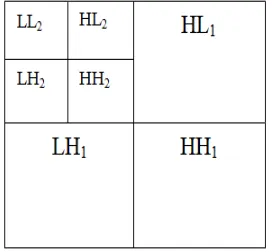
DWT is a transform used to decorrelate the image energy into few wavelet coefficients. When DWT on one level is applied on an image, combination of four sub-bands with low and high frequencies are obtained. These sub-bands are low low (LL1), low high (LH1), high low (HL1) and high high (HH1). DWT can be further applied on LL1 to get the other
four subbands which are LL2, HL2, LH2 and HH2, as shown in Figure 1.
ISSN (Print) : 2320 – 3765 ISSN (Online): 2278 – 8875
I
nternational
J
ournal of
A
dvanced
R
esearch in
E
lectrical,
E
lectronics and
I
nstrumentation
E
ngineering
(An UGC Approved Journal)
Website: www.ijareeie.com
Vol. 6, Issue 8, August 2017
III. PROPOSED APPROACH
Proposed approach is based on two observations. First, if the wavelet coefficients are transformed into smaller equivalent coefficients, the distortion in stego image is less. Second, if the secret data is embedded into selected high frequency wavelet subbands of cover image, then also distortion in stego image is less. Selection of the wavelet coefficients is performed using threshold of the wavelet subband.
3.1 Semi Hexadecimal Code
Semi Hexadecimal Codes (SHC) are used to encode the secret image. These codes reduces the pixel values of the secret image, as less quantative value is required to represent a hexadecimal code than its decimal equivalent. It is beneficial to embed smaller value rather than larger value to affect the stego image as less as possible. It is semi in the sense, in this code we are not using A, B, C, . . . , F letters for 10,11, . . ., 15. We are using their exact value but at decimal place because DWT coefficient does not support alphabet embedding.
Algorithm 3.1 (Pseudo Code)
r1=Mod(N,16) r2=Floor(N/16)) val=r2*10+r1; if(r1<10) Hx=val; else
Hx=r2+r1/100; end
Where N is the decimal number in base 10 and Hx is the equivalent SHC code. Mod operation finds the remainder of division of one number by another number. Floor function maps a real number to the largest previous integer.
For example, decimal number 26 is converted into 1.10 SHC and decimal number 200 is converted into 128 SHC.
3.2 Threshold of a Subband
After applying the DWT on cover image, threshold for each high frequency sub-bands (i.e. LH, HL and HH) is calculated using the approach proposed by Nick Method in [14] as
(1)
Where T is the threshold of a subband, is mean of particular sub-band, is a constant valued as -0.15 (Ni-black W., [14]. measured it -0.2), C is wavelet coefficient and are dimensions of sub band. Factor affects directly the threshold value and therefore capacity. Higher negative value of enhances the capacity but reduces the PSNR. In proposed work, slight lesser of than original constant proposed by Ni-black is considered.
3.3 Proposed Approach: Embedding Process
i. Apply DWT on cover image which produces four wavelet subbands, named as LL, HL, LH and HH. ii. Find the threshold T for HL, LH and HH using (1).
iii. If S(x, y) ≥ T;embed the data using
where is modified wavelet coeffient , is original wavelet coefficient, and Hx is semi hexadecimal representation of secret data which is obtained using Algorithm 3.1 and are spatial coordinate of subband. EF is the embedding factor which is used to balance the embedding effect.
iv. Apply IDWT to produce the Stego image.
ISSN (Print) : 2320 – 3765 ISSN (Online): 2278 – 8875
I
nternational
J
ournal of
A
dvanced
R
esearch in
E
lectrical,
E
lectronics and
I
nstrumentation
E
ngineering
(An UGC Approved Journal)
Website: www.ijareeie.com
Vol. 6, Issue 8, August 2017
IV. IMPLEMENTATION AND EXPERIMENTAL RESULTS
The proposed approach is implemented in MATLAB 7.0. The cover image is decomposed into two levels using Haar wavelet. Embedding Factor (EF) is used to balance the embedding effect. It is better to use the lesser value of EF, so e-n(e is base of natural logarithms) is used where n is a positive integer such as n≥2. Some of the images considered are shown in Figures 2-4.
Figure 2. (a) Original Lena cover image (512×512), (b) Original Barbara Secret image (389×389) (c) Stego Lena image that has image (b) inside it, and (d) Recover image from (c)
Figure 3. (a)Original Baboon cover image (256×256), (b) Original Secret rice image (192×192) (c) Stego Baboon image after embedding rice, and (d) Recover rice image from Baboon stego image.
ISSN (Print) : 2320 – 3765 ISSN (Online): 2278 – 8875
I
nternational
J
ournal of
A
dvanced
R
esearch in
E
lectrical,
E
lectronics and
I
nstrumentation
E
ngineering
(An UGC Approved Journal)
Website: www.ijareeie.com
Vol. 6, Issue 8, August 2017
Table 1.capacity of secret images using proposed approach
Cover image Secret image
EF Capacity (in %)
Run time for embedding (in seconds) Lena 512×512 Barbara 389×389
e-4 57.7244 3.5938
Baboon
256×256
Rice 192×192
e-7 56.2500 0.7969
Airplane
512×512
Barbara 433×433
e-5 71.5214 4.3906
Rose
256×256
Grapes 212×212
e-5 68.5791 0.7031
Cat
256×256
Grapes 198×198
e-5 59.8206 0.6875
Cat
256×256
Banana 198×198
e-5 59.8206 0.7188
Bird
256×256
Elephant
240×240
e-7 87.8906 0.8125
Theresults shown in Table 1 are the embedding capacity. Maximum capacity of the proposed approach is
87.8906%.
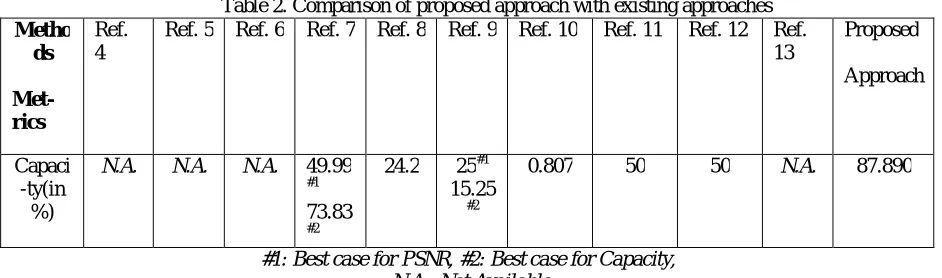
The proposed approach is compared with the existing approaches and the results of this comparison are shown in Table 2.
This comparison depicts that the proposed approach is better among existing approaches in term of capacity.
Table 2.Comparison of proposed approach with existing approaches
Metho ds Met- rics Ref. 4
Ref. 5 Ref. 6 Ref. 7 Ref. 8 Ref. 9 Ref. 10 Ref. 11 Ref. 12 Ref. 13 Proposed Approach Capaci -ty(in %)
N.A. N.A. N.A. 49.99
#1
73.83
#2
24.2 25#1 15.25
#2
0.807 50 50 N.A. 87.890
#1: Best case for PSNR, #2: Best case for Capacity, N.A.: Not Available
From this Table, one can conclude that proposed approach has high capacity than the existing approaches. Hence visual quality of stego image is better.
V. CONCLUSION
ISSN (Print) : 2320 – 3765 ISSN (Online): 2278 – 8875
I
nternational
J
ournal of
A
dvanced
R
esearch in
E
lectrical,
E
lectronics and
I
nstrumentation
E
ngineering
(An UGC Approved Journal)
Website: www.ijareeie.com
Vol. 6, Issue 8, August 2017
REFERENCES
1. Gonzalez R. C. and Woods R. E., “Digital Image Processing,” Prentice Hall, 2nd Ed, 2002.
2. Morkel T., Eloff J. H. P., and Olivier M. S., “An Overview of Image Steganography,” Proceedings of Fifth Annual Information Security South
Africa Conference, Sandton, South Africa, pp. 1-12, 2005.
3. Hsieh M. S., Tsebg D. C. and Huang Y. H., “Hiding Digital Watermark Using Multiresolution Wavelet Transform,” IEEE Transactions on
Industrial Electronics, vol. 48, no. 5, pp. 875-882, 2001.
4. Hsu and Wu, “Hidden digital watermarks in images,” IEEE Transactions on Image Processing, vol. 8, pp. 58-68, 1999.
5. Tolba M. F., Ghonemy M. A., Taha I. A. and Khalifa A. S., “Using Integer Wavelet Transform in Colored Image-Steganography,” International
Journal of Intelligent and Cooperative Information System, vol. 4 no. 4, pp. 75-85, 2004.
6. Chen P. Y., and Lin H. J., “A DWT Approach for Image Steganography,” International Journal of Applied Science and Engineering, vol. 4, no.
4, pp. 275-290, 2006.
7. Ataby A. A., and Naima F. A., “A Modified High Capacity Image Steganography Technique Based on Wavelet Transform,” The International
Arab Journal of Information Technology, vol. 7, no. 4, pp. 358-364, 2010.
8. Nag A., Biswas S., Sarkar D. and Sarkar P. P., “A Novel Technique for Image Steganography Based on DWT and Huffman Encoding,”
International Journal of Computer Science and Security, vol. 4, no. 6, pp. 561-570, 2010.
9. Kumar K. B. S., Raja K. B. and Pattnaik S., “Hybrid Domain in LSB Steganography”, International Journal of Computer Applications, vol. 19,
no. 7, pp. 35-40, 2011.
10. Shejul A. A., and Kulkarni U. L., “A Secure Skin Tone based Steganography Using Wavelet Transform,” International Journal of Computer Theory and Engineering, vol. 3, no. 1, pp. 16-22, 2011.
11. Ghasemi E., Shanbehzadeh J. and Fassihi N., “High Capacity Image Steganography using Wavelet Transform and Genetic Algorithm,” International Multiconference of Engineering and Computer Scientist, vol. 1, pp. 1-4, 2011.
12. Bhattacharya T., Dey N. and Chaudhuri S. R. B., “A Novel Session Based Dual Steganographic Technique Using DWT and Spread Spectrum,” International Journal of Modern Engineering Research, vol. 1, no. 1, pp. 157-161, 2011.
13. Ioannidou A., Halkidis S. T., and Stephanides G., “A novel technique for image steganography based on a high payload method and edge detection”, Expert Systems with Applications, Elsevier, vol. 39, pp. 11517-11524, 2012.