Multi-Objective Optimization of Improving
Voltage and Transient Stability Using
Nonlinear Equation Systems
M. Sivaranjani1, G. Sundarrajan2
PG Student [PSE], Dept. of EEE, JJ College of Engineering, Tiruchirappalli, Tamilnadu, India1
Assistant Professor, Dept. of EEE, JJ College of Engineering, Tiruchirappalli, Tamilnadu, India2
ABSTRACT: Nonlinear equation systems may have multiple optimal solutions. The main task of solving nonlinear equation systems is to simultaneously locate these optimal solutions in a single run. When solving nonlinear equation systems by evolutionary algorithms, usually a nonlinear equation system should be transformed into a kind of optimization problem. At present, various transformation techniques have been proposed. This paper presents a simple and generic transformation technique based on multiobjective optimization for nonlinear equation systems. The experimental results have demonstrated that, overall, our transformation technique outperforms another state-of-the art multiobjective optimization based transformation technique and four single-objective optimization based approaches on a set of test instances. The influence of the types of Pareto front on the performance of our transformation technique has been investigated empirically. Moreover, the limitation of our transformation technique has also been identified and discussed in this paper.
KEYWORDS: Evolutionary algorithms, multiobjective optimization, multiple optimal solutions, nonlinear equation systems, transformation technique.
I. INTRODUCTION
Power system operation problems increase with size, loading, and the complexity of the network. Restructuring in the electric power industry has further enhanced the problems of power systems related to power delivery and power quality. The deregulated electric power industry. The issue of transmission congestion is particularly prominent in deregulated and competitive markets, thus requiring an appropriate management strategy [1]. In the new competitive electric market, it is now mandatory for the electric utilities to operate in ways that make better use of existing transmission facilities, and in conjunction with maintaining the security, stability, and reliability of the supplied power. However, the transmission network, as a medium between power generation and consumption centres, has a limited capacity as well as its own security concerns. Congestion in electricity markets occurs when the transmission network is unable to accommodate all of market desired transactions due to some violations in its operating limits [2]. For congestion management purposes, some facilities such as phase shifting transformers or Flexible AC Transmission System (FACTS) devices can be used to efficiently enhance existing trans- mission networks by increasing power transfer capacity as an effective alternative to constructing new transmission lines.
The transformed problem consists of two parts: the first part is the location function that is used to determine the location of the images of the optimal solutions of a NES in the objective space, and the second part is the system function that can reflect the basic characteristics of a NES. MONES has the following features.
1. No prior knowledge (such as the number of the optimal solutions of a NES) is required. 2. All the optimal solutions of a NES are the Pareto optimal solutions of the transformed problem.
3. The images of all the optimal solutions of a NES are located on the line segment defined by y = 1–x in the objective space of the transformed problem.
4. The current MOEAs can be applied to solve the transformed problem in a straightforward manner. Therefore, multiple optimal solutions of a NES could be located simultaneously in a single run.
5. If a NES contains infinite optimal solutions, it is a natural way for the current MOEAs to find a number of representative optimal solutions, the images of which may be evenly distributed along the Pareto front in the objective space of the transformed problem.
The rest of this paper is organized as follows. Section II introduces multiobjective optimization problems and the related concepts. Section III briefly reviews the related work. In Section IV, MONES is presented in detail. Moreover, the differences between MONES and another multiobjective optimization based transformation technique called CA have been analysed. The influence of the types of Pareto front on the performance and the limitation of MONES have also been studied in this section. Finally, Section V concludes this paper.
II. CONGESTION MANAGEMENT USING SERIES FACTS DEVICES
FACTS devices have been used for several purposes including congestion management. It is a well recognized fact that the performance of FACTS devices in a power system mainly depends on its placement and tuning. investigated a simulated annealing based optimization method for placement of flexible AC transmission systems (FACTS) devices in order to relieve congestion in the transmission lines while increasing static security margin and voltage profile of a given power system [7]. It used sensitivity analysis and extended equal area criterion to find the optimal location and capability of FACTS in a power system for enhancing static voltage and transient stability. The proposed an algorithm for optimal congestion dispatch calculation with UPFC controls. A decomposition control method was introduced to solve this optimal power flow problem. Proposed a method to determine the optimal location of thyristor controlled series compensators (TCSCs) for congestion management.
III. GENERIC TRANSFORMATION TECHNIQUE
A. MONES
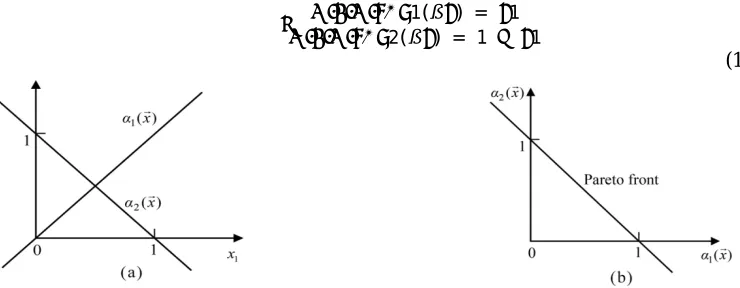
This paper presents a generic transformation technique based on multiobjective optimization for NESs called MONES, which converts a NES into a bi objective optimization problem. Inspired by [8], the transformed problem is composed of two parts: the first part is the location function that includes the location information of the images of the optimal solutions of a NES in the objective space, and the other part is the system function that includes the basic information of a NES. The location function can be formulated as
1(ß ) = 1
2(ß ) = 1 − 1
(1)
Where ß x = (x1... xD) ∈ S is the decision vector and x1 is the first decision variable of a NES. The relationship
between α1 (ß x) and α2 (ß x) has been depicted in Fig. 1. As shown in Fig. 1(a), with respect to x1, α1 (ß x) is a
strictly monotone increasing function and α2 (ß x) is a strictly monotone decreasing function. Therefore, as the two
objectives of the location function, α1 (ß x) and α2 (ß x) conflict with each other. According to the concepts introduced in Section II, it can be easily deduced that each decision vector in the decision space of a NES is a Pareto optimal solution of the location function. Moreover, as shown in Fig. 1(b), the Pareto front of the location function is a line segment defined by y =1– x in the objective space.
The system function has the form
minimize β1(ßx) = |ei(ßx)|i = 1
minimize β2(ßx) = Mmax(|e1(ßx)|. . . |eM(ßx)|) (2)
Theorem 1: All the optimal solutions of a NES are the Pareto optimal solutions of the transformed problem. ∗ Proof: Let ß x be one of the optimal solutions and ß x be a decision vector in the decision space of a NES. According ∗ to the property of the location function, ß x cannot be Pareto ∗ dominated by ß x in terms of equation. Furthermore, since β1
(ß x ) = ∗ ∗ β2(ß x ) = 0 and β1(ß x ), β2(ß x ) ≥ 0, ß x also cannot be ∗ Pareto dominated by ß x in terms. Therefore, ß x is a Pareto optimal solution of the transformed problem. Theorem 1 reflects the relationship between a NES and the transformed problem.
Theorem 2: The images of all the optimal solutions of a NES are located on the line segment defined by y =1– x in the objective space. ∗ Proof: Let ß x be one of the optimal solutions of a NES. ∗ According to Theorem 1, ß x is a Pareto optimal solution of ∗ ∗ the transformed problem. Since β1 (ß x) = β2 (ß x) = 0, is ∗ equivalent to equation under this condition. As a result, ß x is also Pareto optimal solution of the location function. As shown ∗ in Fig. 1(b), the image of ß x is located on the line segment defined by y =1– x in the objective space. Theorem 2 verifies that the location information of the images of all the optimal solutions of a NES in the objective space is determined by the location function.
MONES consists of at least two back-to-back DC-AC convert connected via a common DC link. Vi, Vj , and Vk are complex voltages at buses i, j, and k, respectively. Vl = Vl< (l = i, j, k) and Vl, are the magnitude and angle of Vl. Vsein is the complex controllable series injected voltage source, which represents the series compensation of the series converter. V is defined as V = V < (n = j, k). V and < sein are the magnitude and angle of V . The basic model of MONES, as shown in Fig. 1, consists of three buses i, j, and k [9], [10]. Two transmission lines are connected with the bus i in common. The equivalent circuit of the MONES with two converters is represented with two series injected voltage sources, as shown in Fig. 1. Z is the series transformer impedance. Pi and, Qi has given in below are the sum of the active and reactive power flows leaving the bus i. The MONES branch active and reactive power flows leaving bus n are and and the expressions are given below. Iji, Iki are the MONES branch currents of branch j–I and k–i leaving buses j and k, respectively.
= = - ∑ [ cos ( − ) + sin ( − )] + ∑ ( − ) - cos (( − )]
= − - ∑ [ cos ( − ) - sin ( − )] - ∑ [ sin( − ) - cos (( − ) = - [ cos ( − ) + sin ( − )] - [ sin( − ) - cos (( − )] = − - [ Sin ( − ) - cos ( − )] + [ sin( − ) - cos (( − )]
Where n = j; k
+ j = 1/ = ysein; + j = 1/ = =∑ . =∑ .
IV. MOEAS TO SOLVE THE TRANSFORMED PROBLEM
It is necessary to emphasize that the primary focus of this paper is the transformation technique. Since MONES belong to the same kind of transformation techniques, the performance comparison is mainly conducted between them in this paper. Essentially, the current MOEAs can be applied to solve the MOPs transformed by MONES in a straight- forward way.
Step 1 G = 0; // G is the generation number.
Step 3 Evaluate each individual in PG based on (step 7) or (step 8).
Step 4 Implement the binary tournament selection, simulated binary crossover, and polynomial mutation to generate the offspring population QG.
Step 5 Evaluate each individual in QG and HG = PG QG.
Step 6 Divide HG into several nondomination levels (denoted as ND1, ND2...) according to a fast nondominated sorting.
PG+1 = φ and i = 1.
While |PG+1| < N
PG+1 = PG+1 NDi and i = i + 1. Step 7 End While
Step 8 If the stopping criterion is satisfied, stop and out- put the final population, otherwise G = G + 1 and go to step 4.
V. RESULTS AND DISCUSSION
In this paper, five test cases (denoted as C1–C5) with different characteristics are used to investigate the effectiveness of MONES. The five test instances are designed in this paper and the remaining two test instances are real-world applications from the neurophysiology [11] and the economics modelling [12], respectively. The details of these seven test instances have been reported in Table I, including the number of the decision variables, the decision space, the number of the linear equations, the number of the nonlinear equations, and the number of the optimal solutions. These test cases can be categorized into three groups, according to the number of the optimal solutions.
C1 and C2 have two optimal solutions. C2 includes 20 decision variables and is designed to evaluate the performance of an algorithm in a high-dimensional decision space. In principle, C2 can be regarded as a generalized implementation of C1. The optimal solutions of C1 and C2 are the same in the x1 − x2 space.
C3 and C4 have more than two optimal solutions. Concretely, C3 has 11 optimal solutions and C4 has 15 optimal solutions. In these two test instances, some optimal solutions are very close to each other, which makes them very difficult for an algorithm to locate all the optimal solutions in a single run.
C5 have infinite optimal solutions. In C5, ∀k ∈ {1... D − 1}, ck = 0. For these three test instances, it is impossible to
obtain all the optimal solutions in a single run. Therefore, one has to find a set of representative optimal solutions in one run, which can well approximate the whole optimal set. Under this condition, CA will have six and 20 objectives (i.e., many-objective), respectively.
The proposed multi-objective placement of TCSC is examined on the New-England power system, a well-known test system with a standard IEEE 30 bus system was considered for analysis both with conventional load flow method and load flow incorporating voltage dependent load models. The simulations were made using MATLAB Power system toolbox known as PSAT (Power System Analysis Toolbox). The results of the simulations were plotted and analysed.
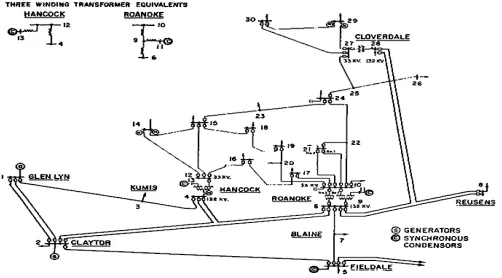
The proposed algorithm to solve the locating multi objective congestion management and improvement in voltage and transient stability problem was tested using an (Fig. 2) IEEE 30-bus system. All simulations were performed on a personal computer (i3 3.1 GHz Intel Processor and 2 GB RAM running MATLAB 13a). In practical electricity markets, the cost objective function is usually more important than the other stability related objective functions for the system operator. Then, the operator can set a higher weighting factor for the cost objective function to emphasize the cost against stability objective functions. Of course, this depends on the stability status of the power system. For example, in power systems with a high rate of transient stability problems, the system operator may assign a higher weighing factor for CTEM to enhance transient stability and to decrease the rate of outages. The proposed framework has the ability to accept desired weighting factors for different power systems.
For instance, a case is shown in Table-1 where cost is the prominent objective function. In this case, the weighting factors for the cost, VSM, and CTEM objective functions are considered as 0.6, 0.2, and 0.2, respectively. This implies that the operating cost or energy prices will be higher if higher levels of security are established for the power system. Inasmuch as it is one of the vital responsibilities of the SO to retain enough security in the power system at a reasonable cost, the right and fair decision should be made by the SO on behalf of market participants to achieve the maximum possible social welfare in the electricity market.
Table: 1 Experimental Result of MONES over 30 Independent runs on five Test cases In Terms of Two Performance Indicators
Test Case Best Mean Worst Std Dev
C1 IGD 1.47e-4 2.01e-4 3.77e-4 4.47e-5
NOF 2.00 2.00 2.00 0.00
C2 IGD 2.06e-4 4.44e-4 9.25e-4 1.95e-4
NOF 2.00 2.00 2.00 0.00
C3 IGD 1.11e-3 2.12e-3 4.45e-3 7.48e-3
NOF 1.10 1.10 1.10 0.00
C4 IGD 2.82e-3 1.06e-2 2.90e-2 7.52e-3
NOF 1.50e1 1.41 1.10 1.16
C5 IGD 1.63e-2 4.24e-2 2.12e-1 3.80e-2
NOF 5.00 3.73 2.10 7.05
VI. CONCLUSION
REFERENCES
[1] X. P. Zhang and L. Yao, “A vision of electricity network congestion management with FACTS and HVDC,” in The Third International Conference on Electric Utility Deregulation and Restructuring and Power Technologies, IEEE PES, IET, CSEE, Nanjing, China, 2008, pp. 116–121.
[2] N.G. Hingorani, L. Gyugyi, Understanding FACTS, Concept and Technology of Flexible AC Transmission Systems, NewYork, Wiley, 2000 [3] Q. Zhang and H. Li, “MOEA/D: A multiobjective evolutionary algorithm based on decomposition,” IEEE Trans. Evol. Comput., vol. 11, no.
6, pp. 712–731, Dec. 2007.
[4] K. Deb and A. Saha, “Multimodal optimization using a bi-objective evolutionary algorithm,” Evol. Comput., vol. 20, no. 1, pp. 27–62, 2012. [5] L. T. Bui, H. A. Abbass, and J. Branke, “Multiobjective optimization for dynamic environments,” in Proc. Congr. Evol. Comput. (CEC), 2005,
pp. 2349–2356.
[6] Z. Cai and Y. Wang, “A multiobjective optimization-based evolutionary algorithm for constrained optimization,” IEEE Trans. Evol. Comput., vol. 10, no. 6, pp. 658–675, Dec. 2006.
[7] F. Qian, G. Tang, and Z. He, “Optimal location and capability of FACTS devices in a power system by means of sensitivity analysis and EEAC,” in The Third International Conference on Electric Utility Deregulation and Restructuring and Power Technologies, IEEE PES IET CSEE, Nanjing China, 2008, pp. 2100–2104.
[8] H. Li and Q. Zhang, “Multiobjective optimization problems with complicated Pareto sets, MOEA/D and NSGA-II,” IEEE Trans. Evol. Comput., vol. 13, no. 2, pp. 284–302, Apr. 2009.
[9] E. Acha, C. Fuerte-Esquivel, H. Ambriz-Perez, and C. Angeles, FACTS: Modeling and Simulation in Power Networks. New York: Wiley, 2004.
[10] X. P. Zhang, “Modeling of the interline power flow controller and the generalized unified power flow controller in Newton power flow,” Transmission and Distribution, vol. 150, no. 3, pp. 268–274, May 2003.
[11] J. Verschelde, P. Verlinden, and R. Cools, “Homotopies exploiting Newton polytopes for solving sparse polynomial systems,” SIAM J. Numer. Anal., vol. 31, no. 3, pp. 915–930, 1994.