Accountable Storage
Giuseppe Ateniese
∗Michael T. Goodrich
†Vassilios Lekakis
‡Charalampos Papamanthou
§Evripidis Paraskevas
§Roberto Tamassia
¶Abstract
We introduceAccountable Storage(AS), a framework allowing a client with small local space to outsourcenfile blocks to an untrusted server and be able (at any point in time after outsourcing) to provably compute how many bits have been discarded by the server. Such protocols offer “provable storage insurance” to a client: In case of a data loss, the client can be compensated with a dollar amount proportional to the damage that has occurred, forcing the server to be more “accountable” for his behavior. The insurance can be captured in the SLA between the client and the server.
Although applying existing techniques (e.g., proof-of-storage protocols) could address the AS problem, the related costs of such approaches are prohibitive. Instead, our protocols can provably compute the damage that has occurred through an efficient recovery process of the lost or corrupted file blocks, which requires only sublinearO(δlogn)communication, computation and local space, whereδis the maximum number of corrupted file blocks that can be tolerated. Our technique is based on an extension of invertible Bloom filters, a data structure used to quickly compute the distance between two sets. Finally, we show how our AS protocol can be integrated with Bitcoin, to support automatic compensations proportional to the number of corrupted bits at the server. We also build and evaluate our protocols showing that they perform well in practice.
1
Introduction
Cloud computing is revolutionizing the entire field of information technology, but it is also posing new security and privacy challenges. On the one hand, clients expect to gain reliability and availability from having their data stored remotely, but, on the other hand, remote storage forces their data to live outside their control and protection. Organizations are therefore reluctant to outsource their databases for fear of having their data lost or damaged, but they also do not want the burden of fully managing all their data themselves. Thus, they would benefit from technologies that would allow them to manage their risk of data loss, much in the same way that insurance allows them to manage their risk of physical or financial losses, e.g., from fire or liability.
As a first step, a client needs a mechanism for verifying that a cloud provider is storing her entire database intact, even the portions rarely accessed, and, fortunately, a series of proofs-of-storageprotocols have been proposed to solve this problem. These techniques includeProvable Data Possession(PDP) (e.g., [4,11,13]) andProofs of Retrievability
(POR) [10,19,28,29,30], both conceived as a solution to the integrity problem of remote databases. A PDP/POR scheme can verify whether an untrusted server possesses the entire database originally uploaded by the client. This is achieved by having the server generate a proof in response to a challenge. In addition, a client is typically required to store a constant amount of metadata to verify the server’s proof.
Proof-of-storage schemes have witnessed remarkable improvements over the years and are now considered to be well established. Still, they leave unsettled several risk management issues. Arguably, the most important question of all is
What happens if a proof-of-storage scheme shows that a client’s outsourced database has been damaged?
Clearly, the cloud is liable for this damage, and the client should be compensated for her loss. But to assess this damage and receive compensation, two significant hurdles must be overcome:
• The client may not be able to reliably and quickly assess the damage, because she no longer stores her database locally.
• The client has no technological way to automatically receive compensation and must instead follow cumbersome legal procedures, specified in a service level agreement (SLA), in order to be compensated for her loss.
∗Department of Computer Science, Sapienza University of Rome. Email:[email protected] †Department of Computer Science, University of California, Irvine. Email:[email protected] ‡Department of Computer Science, University of Maryland College Park. Email:[email protected]
The objective of this work is to design new efficient protocols that address the above challenges. Our framework is inten-tionally modular in that we address both challenges independently and we merge the solutions only afterwards. In this way, it is possible to improve a solution to one challenge without significantly affecting the other.
1.1
Quantifying Data Loss
To be more precise, suppose a client, Alice, outsources her file blocks, b1, b2, . . . , bn, to a potentially malicious cloud
storage provider, Bob. Since Alice does not trust Bob, she wishes, at any point in time, to be able to compute the amount of damage, if any, that her file blocks have undergone, by engaging in a simple challenge-response protocol with Bob.
For instance, she may wish to quickly and verifiably compute the value of adamage metric, such as
d=
n X
i=1
||bi⊕b0i||, (1)
whereb0iis the file currently stored by Bob at the time of the challenge and ||.||denotes Hamming distance. Ifd = 0, then Alice is entitled to no dollar credit, as Bob stores Alice’s data intact. Bob can easily prove to Alice that this is the case through existing proof-of-storage protocols, as noted above. Ifd > 0, however, then Alice should receive a compensation proportional to the damaged, which should be provided automatically (proof-of-storage protocols cannot help here).
Such a quantitative protocol (one that Alice could use to compute the damaged) would force the cloud provider, Bob, to be more “accountable”, since it places a monetary liability on loss based on damage size. Moreover, such fine-grained compensation models, which work at the bit level as opposed to at the file block level, beneficially allow Alice to better manage her risk for damage even within the same file. For example, compensation for an unusable movie stored by Bob could be larger than that for an usable movie whose resolution has deteriorated by just 5%.
Note that it is imperative that a protocol for the computation of the damagedbeefficient. Alice should not need to download the entire file collection and compare it to some local or remote backup to calculate the value ofd. Moreover, computation of the damagedshould also beverifiable, so that it is computationally infeasible for Bob to persuade Alice (or a third party) that the current damage is less than the actual damage.
1.2
Our Contributions
The contributions of this work are as follows:
(1)We introduce and formally defineAccountable Storage(AS), a new framework where a client, Alice, outsourcesn
file blocks to an untrusted server, Bob, so that later Alice can provably recover up toδblocks that cannot be extracted by accessing Bob’s storage (e.g., due to random failures or malicious behavior)—see Section3. Recovering the lost blocks directly enables the client to compute the damagedas defined in Relation1. Such a framework enforces accountability for storage servers, since the client can demand a compensation proportional to the damaged.
(2)We construct an efficient AS protocol—see Section4. Our protocol runs in one round, requires Alice to store just
O(δlogn)local state, and hasO(δlogn)bandwidth, whereδis the maximum number of corrupted file blocks that can be tolerated.
(3)We provide an open-source prototype implementation of our AS construction and perform a thorough experimenta-tion at Secexperimenta-tion6. Our final system is practical: E.g., for a 4GB file system, we can process a small proof to provably locate and recover 6MB of lost data (that can be scattered in any location within the file) in about 100 seconds.
(4)We show how to integrate our AS protocol with Bitcoin [1] to enable an automatic compensation to Alice propor-tional to the damage,d. See Section5.
1.3
Related Work and Potential Approaches
We are not aware of any existing work on Accountable Storage.1 The work of Yumerefendi and Chase [34] provides
“accountability” for network storage, but only in the sense of detection, not for assessing damage. There are also some ways to use the techniques described below to achieve properties similar to those of Accountable Storage, but these result in inefficient protocols.
Using PDP.A provable data possession (PDP) protocol [4,5,11,13,31] enables a server to prove to a client that all of the client’s data is stored intact. One could design an AS protocol by using a PDP protocol only for the portion of storage
1We note here that our notion of accountability focuses on quantifying the amount of damagedthat has occurred at a remote repository. However, in
that the server possesses. This could determine the damage, d. The problem with such an approach, however, is that it requires use of PDP at the bit level, computing one tag for each bit of our file collection. PDP tags are usually 2048 bits [4]; therefore, it is impractical to keep that many extra bits for every bit of initial storage.
Using error-correcting codes.To overcome the above problem, one could use PDP at the block level, but at the same time keep some redundancy locally. Specifically, before outsourcing thenblocks at the server, the client could storeδextra check blocks locally (the check blocks could be computed with a simple error correcting code such as Reed-Solo-mon). The client could then verify through PDP that a set of at mostδblocks have gone missing and retrieve the lost blocks by executing the decoding algorithm on the remote intactn−δdata blocks and theδlocal check blocks (then the recovered blocks can be used to computed). However, this procedure would requireO(n)communication, since then−δintact blocks at the server must be sent to the client. A system that could operate along these lines, for example, is IRIS [30]. IRIS employs
O(√nlogn)client side redundancy, with whichδ = √nfile blocks can be recovered. Although IRIS is fully-dynamic (our construction supports only append-only updates), thebandwidthandcomputationfor retrieving√ncorrupted blocks islinearin the number of the file blocks, as the whole file system needs to be streamed from the server to the client. To reduce communication toO(δ)the client could send hisδcheck blocks to the server. However, this does not work either, since the server would recover the file blocks and pretend that no damage ever occured.
1.4
Overview of Our Techniques
AS construction. Our protocol for assessing the damage dfrom Relation 1 is based onrecovering the actual blocks
b1, b2, . . . , bδand subsequently“XORing” them with the corrupted blocksb10, b02, . . . , b0δreturned by the server. For recovery
(described in Section4), we use the invertible Bloom filter (IBF) data structure, introduced by Eppstein et al. [12] and Goodrich and Mitzenmacher [15]. An IBF is an array oftcells and can store a set ofO(t)elements. Unlike traditional Bloom filters [6], the elements of an IBF can be enumerated with high probability.
LetB ={b1, b2, . . . , bn}be the set of blocks outsourced by the client and letδbe the maximum number of corrupted
blocks that the client can tolerate. In the preprocessing phase, the client computes an IBFTB that hasO(δ)cells, on the
blocksb1, . . . , bn. The client storesTBlocally. ComputingTBis similar to computing a plain Bloom filter: every cell of
TBis mapped to a sum over a set of at mostnblocks, thus the local storage isO(δlogn).
To outsource the blocks, we modify the IBF specification so that the client computes homomorphic tags,Ti, for each
file block,bi. Incidentally, we use the same tags as in the original PDP scheme by Ateniese et al. [4]. The client then stores
(bi,Ti)with the cloud and deletes the blocksb1, b2, . . . , bnfrom local storage. In the challenge phase (i.e., when the client
wants to provably compute the damaged), the client asks the server to construct arandomizedIBF TK (again, ofO(δ)
cells) on the set of blocksKthat the server currently possesses. The IBFTK comprises the “proof” that the server sends to
the client.
Note that sinceδ < n, bothTBandTK “lose” information. Therefore setsB andKcannot be enumerated only by
processingTB andTK. However, one property of the IBFs is the fact that if the size of thedifferenceB−Kis at most
δ, then the client can take the algebraic differenceTL =TB−TKand, with high probability, recover the elements of the
differenceB−Kby only working withTL(note thatTL hasO(δ)cells). Recovering the blocks inB−K enables the
client to compute damagedby using Relation1.
Bitcoin protocol. We note here that in the above protocol, Bob (the server) ismaliciousand is trying to persuade Alice that the weighted damage of her file blocks isd0< d. However, the cryptographic tags that we use ensure that Bob cannot succeed in that (except with negligible probability) and therefore Alice will eventually find out the exact damage,d. After that stage, compensation proportional todmust be sent to Alice. But Bob could try to cheat again.
Specifically, Bob could try to give Alice a compensation less than required or, even worse, disappear. To deal with this problem, we develop a modified version of the recently-introduced timed commitment in Bitcoin [3]. At the beginning of the AS protocol, Bob deposits a large amount,A, of bitcoins, whereAis contractually agreed on and is typically higher than the maximum possible damage to Alice’s file blocks. The Bitcoin-integrated AS protocol of Section5ensures that unless Bob fully and timely compensates Alice for damaged, thenAbitcoins are automatically and irrevocably transferred to Alice. At the same time, if Alice tries to cheat (e.g., by asking for compensation higher than the contracted amount), our protocol ensures that she gets no compensation at all while Bob gets back allAof his bitcoins.
2
Preliminaries
Algorithm T←update(bi,T, z)
foreachj= 1, . . . , kdo Setind=hj(i);
SetT[ind].count=T[ind].count+z;
SetT[ind].dataSum=T[ind].dataSum+zbi;
SetT[ind].hashProd=T[ind].hashProd×f(bi)z;
return T;
Figure 1: Update in an IBF. The inputz∈ {−1,1}determines whether we insertbiinto or deletebifrom the IBF.
Blocksb1, b2, . . . , bndo not contain onlydata. They also encode the respective index of the block as the firstlognmost
significant bits, i.e.,bi=i||βiwhereiis the index andβiis anm-bit data block. Such representationsi||βican be viewed
asintegersbelonging to a universeU. When we refer to a blockbi, we imply that one can retrieve its index by “stripping
out” itslognmost significant bits, which we denote asi=index(bi). Therefore, the block requireslogn+mbits.
2.1
Invertible Bloom filters (IBFs)
An Invertible Bloom Filter (IBF) can be used to compactly store a set of blocks{b1, b2, . . . , bn}. Like the counting Bloom
filter [6,8], an IBF allows both insertions and deletions, and it allows the number of inserted elements to far exceed the capacity of the data structure as long as most of the inserted elements are deleted later. But, unlike the counting Bloom filter, the IBF allows the elements of the set to be enumerated. These properties make it possible to represent two large sets as small IBFs, and to quickly determine the elements in the symmetric difference of the sets. In the following, we describe the IBF data structure of Eppstein et al. [12], slightly modified to fit our setting.
IBF setup. An IBF is essentially a table (array)Toftcells, for a given parametert = (k+ 1)δ—we refer to tableTin detail in the next section. To set up and maintain an IBF, we need the following functions:(1)A set ofkhash functions,
h1, h2, . . . , hkchosen at random from a universal family of functionsH[9], which map any integer in[n](corresponding to
the index of blockbi) tokdistinct cells inT, i.e.,hi: [n]→ {1,2, . . . , t}.Functionshiare used to insert a blockbiindexed
ito the IBF, by computing the positionshj(i) (j = 1, . . . , k)inTand subsequently updating the respective fields (see
Figure1);(2)A functionf :U → {0,1}τlogδ, which maps any blockb
i ∈ U to a random value in the range{0,1}τlogδ
(recallτis the security parameter). In our work we carefully choose this function as
f(bi) =gaibi modN , (2)
whereNis an RSA modulus ofτlogδbits andai=θs(i), whereθsis a pseudorandom function that takes input a secrets.
Note that, for a specific inputbi,f(bi)depends on randomnessai=θs(i).
The table T of the IBF.As we mentioned earlier, an IBF consists of table Toft cells. Each cell of the IBF’s tableT contains the following fields:
1. count: an integer count of the number of items mapped to this cell through functionshi;
2. dataSum: a sum of all the blocksbmapped to this cell through functionshi;
3. hashProd: a product off(b)values for all blocksbmapped to this cell through functionshi.
In thedataSumfield, we employ arithmetic over the integers. In thehashProdfield, we employ arithmetic moduloN. ThehashProdfield is used to distinguish between two IBFs having a celliwith identicaldataSumvalue which however corresponds to different underlying blocks.
IBF algorithms.An IBF supports several simple algorithms for insertion, deletion, and enumeration of its contents. To build an IBFTBfor a set of blocksBwe insert each blockbi∈Bin the IBF via algorithmupdatein Figure1, i.e.,
by executingupdate(bi,TB,1)for allbi ∈B. Similarly, if we want to delete a blockbi, we can execute the same algorithm
with argumentz =−1, which employs subtractions instead of additions (for the fielddataSum) and divisions instead of multiplications (for the fieldhashProd). Note that the above algorithm is similar to the counting Bloom filters algorithms, with the difference that we also perform operations on the fieldsdataSumandhashProd.
The most interesting IBF operation (one we exploit in our setting) is thealgebraic differenceof two IBFs. Namely, we can take the algebraic difference of one IBFTA representing a set of blocksAand IBFTB representing a set of blocks
B, to produce an IBFTD representing the symmetric differenceD = A−B∪B−A. In the new IBFTD, produced
bysubtract(TA,TB)in Figure2, items inA−B have positive signs for their cell fields inTDand items inB−Ahave
Algorithm TD←subtract(TA,TB)
foreachi= 1, . . . , tdo
TD[i].count=TA[i].count−TB[i].count;
TD[i].dataSum=TA[i].dataSum−TB[i].dataSum;
TD[i].hashProd=TA[i].hashProd/TB[i].hashProd;
return TD;
Figure 2: SubtractingTAandTB. The resulting IBFTD=TA−TBencodes the symmetric differenceA−B∪B−A.
Finally, given the IBFTD, produced by asubtractoperation, we can enumerate its contents by using algorithmlistDiff
in Figure9 in the Appendix, which was presented in previous work [12]. AlgorithmlistDiffrepeatedly looks for cells TD[i]withcountfields of+1or−1and deletes these items for those cells if they pass a test for consistency. This test of
consistency, described in [12], identifies if a cell positively or negativelypure. The definition of such a cell is the following:
Definition 1 (Pure cells) LetTDbe an IBF oftcells. A cellTD[i]∈ {1,2, . . . , t}is pure iffTD[i].count=±1and
TD[i].hashProd=f(TD[i].dataSum).
Depending on whetherTD[i].countis+1or−1,TD[i]is called positively or negatively pure cell respectively.
As we will see, for algorithmlistDiffto succeed with high probability, we require the size of all the IBFs involved to be
O(δ), whereδis an upper bound on the size of the symmetric difference of setsAandB, which does not depend on the size of the setsAandB.
In the following we give an important result from [12]:
Lemma 1 (Eppstein et al. [12]) LetAandB be two sets having at mostδblocks in their symmetric difference, and let
TAandTBbe IBFs, which are constructed by algorithmupdate(bi,TA,1)for allbi ∈ Aandupdate(bj,TB,1)for all
bj ∈B. The IBFsTAandTBhavet= (k+ 1)δcells and employ the functionf :U → {0,1}Ω(τ)whereτ ≥klogδis the security parameter. Then with probabilityO(δ−k), algorithmlistDiff(T
A,TB)will outputreject, failing to recover the symmetric differenceA−B∪B−A.
2.2
Bitcoin
As we mentioned in the introduction, we enable automatic compensation to the client, after she figures out the damage,d. It turns out that an ideal way to do that is through Bitcoin [23].2
Bitcoin is a decentralized digital currency system that does not rely on financial entities. Transactions are recorded on a public ledger (the blockchain) and are verified through the collective effort ofminers. A bitcoin address is the hash of a ECDSA public key and transactions are signed and verified by anyone in the system. Transactions are all linked to each other using hash chains. LetAandBtwo bitcoin addresses. Astandardtransaction contains a signature fromAand mandates that a certain amount of bitcoins is to be transferred fromA toB. IfA’s signature is valid, the transaction is inserted into a block which is then stored in the blockchain.
But Bitcoin allows for more expressive conditions than just a signature. In particular,Acan specify a series of conditions that have to be satisfied before transferring bitcoins toB. To list such conditions,Auses the bitcoin scripting language which is a purposely-simple stack-based language that provides basic cryptographic functions, such as hashes and digital signatures, conditional statements, and operations on numbers and strings. In addition, each transaction specifies alocktime
which may contain a block number or a timestamp at which the transaction is locked (before this timestamp, even if the conditions are satisfied, the transaction is not finalized). Slightly changing the notation from [3], a transactionTxis
represented as a table:
Prev:
InputsToPrev:
Conditions:
Amount:
Locktime:
,
wherePrevrepresents the transaction (sayTy) thatTxis redeeming,InputsToPrevare inputs thatTxis sending toTyso
thatTy’s redeeming can take place,Conditionsis a program written in the Bitcoin scripting language (outputting a boolean)
controlling whetherTxcan be redeemed or not (given inputs from another transaction),Amountis the value in bitcoins,
andLocktime is the locktime. For standard transactions,InputsToPrev is just a signature with the sender’s secret key, andConditionsimplements a signature verification with the recipient’s public key. Moreover, standard transactions have locktime set to0, meaning they are locked and final.
Andrychowiczet al.[3] describe an ingenious bitcoin contract mechanism to realize timed commitments [7] through the blockchain. With timed commitments in place, they show that it is possible to run fairly any secure multi-party protocols with the stipulation that parties pay a fine in bitcoins if they cheat, that is, if all parties follow the protocol specification then a function on private inputs is computed otherwise any party that deviates from (e.g., interrupts) the protocol will inescapably pay a sum of bitcoins to the others.
3
Accountable Storage model
In this section, we introduce the AS model. As we will see below, an AS sheme does not allow the client to compute damageddirectly. Instead, it allows the client to use the server’s proof to compute the blocksLthat cannot be extracted by accessing the server’s storage (i.e., the ones that got lost). By having the server send the current blocks he stores in the position of blocks inL(in addition to the proof), computing the damagedis straightforward.
Definition 2 (δ-AS scheme) Aδ-AS schemePis the collection of six polynomial-time algorithms:
1. (pk,sk)←KeyGen(1τ)is a key generation algorithm that is run by the client to setup the scheme. It takes a security parameterτas input and returns a pair of matching public and secret keys(pk,sk);
2. Ti←TagBlock(pk,sk, bi)is an algorithm run by the client to generate verification metadata for a blockbi. It takes as inputs a public keypk, a secret keysk, and a file blockbiand returns the tagTi;
3. state←GenState(pk, B, δ)is an algorithm run by the client to generate local statestate. Its inputs are a public key
pk, a set of file blocksB={b1, b2, . . . , bn}and the parameterδ. It returns the local state; 4. chal←GenChal(1τ)is an algorithm run by the client to generate a challenge for the server;
5. V ←GenProof(pk, B,Σ,chal)is run by the server in order to generate a proof of accountability. It takes as inputs a public keypk, an ordered collectionB of blocks and an ordered collectionΣwhich is the verification metadata corresponding to the blocks inB. It returns a proof of accountabilityVfor the blocks inB;
6. {reject,L} ←CheckProof(pk,sk,state,V,chal)is run by the client. It takes as inputs a public keypk, a secret key
skand a proof of accountabilityV. It returns a list of blocksLorreject.
An AS protocol between a client and a server can be constructed from aδ-AS scheme as follows. First, the client has blocksB={b1, b2, . . . , bn}in local storage, runs{pk,sk} ←KeyGen(1τ)and stores the pair(sk,pk). Then he computes:
1. The tagsTi←TagBlock(pk,sk, bi)∀i= 1, . . . , n;
2. The statestate←GenState(pk, B, δ).
The client sendspk, B,Σ = (T1,T2, . . . ,Tn) to the server and may delete the blocksB and the verification metadata
Σ—but he locally stores the statestate.
During the challenge phase, the client generateschal ← GenChal(1τ)and sends it to the server which runsV ←
GenProof(pk, B,Σ,chal) and returns the proof of accountability V. The client can check the proof V by executing,
{reject,L} ← CheckProof(pk,sk,state, V,chal)the client checks the proofV. If the algorithm CheckProof does not reject, thenLis the set of blocks that cannot be extracted by accessing the server’s storage, which can be used to compute
dand define the compensation.
AS correctness and security. LetBbe the set ofninitial blocks andL ⊂B be another set of at mostδ < nblocks. A
δ-AS scheme is correct if algorithmCheckProof, on input a proofVoutput by algorithmGenProofthat executes correctly on the set of blocksB− Loutputs the blocksL. We now formalize this:
Definition 3 (δ-AS scheme correctness) LetPbe aδ-AS sche-me consisting of the algorithms of Definition2.Piscorrect
if for allτ ∈N, for all{pk,sk}output byKeyGen(1τ), for all sets of blocksB, for all sets of tagsΣoutput byTagBlock whereΣ ={Tj ←TagBlock(pk,sk, bj) :bj ∈B}, for all statesstateoutput byGenState(pk, B, δ), for all set of blocks L ⊂B such that|L| ≤ δ, for all challengeschaloutput byGenChal(1τ), for all proofsV output byGenProof(pk, B− L,Σ,chal), the probability thatL ←CheckProof(pk,sk,state,V,chal)is1−1/poly(δ).
To define the security of aδ-AS scheme, we introduce a game between a challengerCand an adversaryA. The game is set up in such a way so that the adversary asks the challenger to compute tags on a set of blocksB of his liking. After the adversary gets access to the tags, his goal is to output a proofV, so that ifLis output by algorithmCheckProof, where
|L| ≤δ, then (a) eitherLisnota subset of the original set of blocksB; (b) or the adversary doesnotstore all remaining blocks inB− Lintact.
Such a proof is invalid since it would allow the verifier to either recover thewrongset of blocks (e.g., a set of blocks whose Hamming distance from the corrupted blocks is a lot smaller) or to accept a corruption of more thanδfile blocks (i.e., the file blocks inB− L).
Definition 4 (δ-AS scheme security) LetP be a correctδ-AS scheme consisting of the algorithms of Definition2,Abe a PPT adversary andCbe a challenger. Consider the followingδ-AS game betweenAandC:
1. Initialization.Cruns{pk,sk} ←KeyGen(1k), sendspktoAand keepssksecret;
2. Query. Forj= 1, . . . , n,Achooses a blockbjand sends it toC.Ccomputes the tagTjoutput by
TagBlock(pk,sk, bj)and sendsTjtoA.Astores(bj,Tj)andCstores the blockbj;
3. Computing local state. LetB ={b1, b2, . . . , bn}be the set of blocks that were chosen by the adversary above. Then Ccomputes the
local statestate←GenState(pk, B, δ);
4. Challenge. Coutputschal←GenChal(1k)and requestsAto provide a proof of accountability for challengechal; 5. Forge. Acomputes a proof of accountabilityVand returnsV.
The adversaryAwins theδ-AS game if
L ←CheckProof(pk,sk,state,V,chal).
We say that theδ-AS schemeP issecureif for any PPT adversary Athe probability thatAwins theδ-AS game is negligibly close to the probability that (i)L ⊂Band(ii) the challenger can extractall the remaining file blocksinB− L by means of a PPT knowledge extractorE, where where|L| ≤δ.
Note here that if the setLis empty, then the above definition is equivalent with the original PDP security definition [4].
4
Our construction
We first give an infomal overview of our construction: Suppose the client wishes to outsource to the server blocksb1,
b2, . . . , bn. At setup phase the client computes the tagTifor each blockbi. Then he produces the local state as apartial
IBF of these blocks. We call this IBF partial because it does not store thehashProdfield. ThehashProdfield is changing every time the client challenges the server and is computed by using the proof returned by the server.
After the end of the setup phase, the server stores the blocks and the tags. At the challenge phase, the client picks a randomk-bit integersand sends it to the server. To generate a proof of accountability (see Figure4), the server partitions the set of indices[n] ={1,2, . . . , n}into two sets, the setKeptof blocks that the server stores and the setLostof blocks that the server has lost. The server then computes a partial IBFTKon the set of blocks{bi:i∈Kept}, along with a proof
of data possession [4] on the same set of blocks. For the computation of the PDP proof, the server uses randomness derived from the challenges.3
The goal of the client is to output the blocks{bi : i ∈ Lost}, after he verifies possession of blocks{bi : i ∈ Kept}.
To achieve that, the client takes the differenceTL =TB−TK and executes algorithmrecoverfrom Figure5, which is a
modified version oflistDifffrom Figure9in the Appendix.
However, the IBF TL = TB−TK is still partial, being the difference of two partial IBFsTL andTK. Recall now
that in order to enumerate the elements ofTL, we require access to thehashProdfield, which is now absent. To confront
this issue, the proof generated by the server also contains the necessary information (e.g., a few combined tags) that will allow the client to recover the fieldhashProdof the IBFTL, without having to explicitly divide thehashProdfields of
the individual IBFsTBandTK—it only requires access to the tags of thelostblocks, and not the blocks themselves. The
detailed algorithms of our construction are in Figure3.
Finally, we note here that as we mentioned before, algorithmrecover(Figure5) is a slight modification of algorithm
listDifffrom Figure9. The main difference is that algorithmrecoverdoes not check for negatively pure cells. This is because we know ahead of time that the setK−B (that is created through negatively pure cells in Figure9) is always empty since, before executing algorithmrecover, we have already verified thatK ⊆B, through a PDP-style verification (see Relation5). Therefore, Lemma1holds for algorithmrecoveras well.
Alg.(pk,sk)←KeyGen(1τ). LetN=pqbe an RSA modulus,e, dbe primes such thated= 1 modφ(N),gbe a generator of
QRN
andvbe aτ-bit string chosen randomly. Also, a setHofkrandom hash functionsH = {h1, h2, . . . , hk}such thathi : N → [t] t = (k+ 1)δ], a PRFθs : {0,1}τ × {0,1}logn → {0,1}k and a random oracleh : {0,1}∗ → QRN, are initialized. Output
pk= (N, g,H, h, θs)andsk= (e, d, v).
Alg.Ti←TagBlock(pk,sk, bi). Parse pkas(N, g,H, h, θs), skas (e, d, v). For blockbi setWi = v||iand compute tagTi =
h(Wi)gbi
d
modN. Note that we use the same tags as in the original work of Ateniese et al. [4].
Alg.state←GenState(pk, B, δ). Parsepkas(N, g,H, h, θs)andBas{b1, b2, . . . , bn}. Compute the partial IBFTB on the set of
blocksBby executingupdate(bi,TB,1)for allbi(see Figure1) and by settingTB[j].hashProd = 1for allj = 1, . . . , t. Output
state=TB.
Alg.chal←GenChal(1k). Pick a randoms∈ {0,1}kand outputchal=s.
Alg.V ←GenProof(pk, B,Σ,chal). Parsepkas(N, g,H, θs),B as{b1, b2, . . . , bn},ΣasT1,T2, . . . ,Tnandchal=s∈ {0,1}k.
LetKeptbe a set of at leastn−δindices corresponding to blocks inB(it is to the best interest of the server to makeKeptas large as possible—ideally,Keptcontains all indices). SetLost= [n]−Kept. Compute a combined tagTalong with a combined sumSas
T= Y
i∈Kept
Tai
i andS=
X
i∈Kept
aibi, whereai=θs(i)is the randomness corresponding to blocki. (3)
Following, compute the partial IBFTK on the set of blocks{bi : i ∈ Kept}by executingupdate(bi,TK,1)for alli ∈ Kept(see
Figure1) and by settingTK[i].hashProd= 1fori= 1, . . . , t, i.e., the output IBF uses only fieldscountanddataSum.
Finally, consider thetsets of indicesQr, forr= 1, . . . , t, where
Qr={i∈Lost:∃j∈[k] :hj(i) =r}. (4)
These sets represent the positions of the lost blocks in the IBF (for an illustrative example, see Figure 4). Compute t com-bined tags L1,L2, . . . ,Lt (t is the size of the IBF) such that Lr = Qi∈QrT
ai
i forr = 1, . . . , t. The proof V is the tuple
{Lost,T, S,TK,L1, . . . ,Lt}.
Alg.{reject,L} ←CheckProof(pk,sk,state,V,chal). Parsepkas(N, g,H, θs),skas(e, d, v),stateasTB and the proofVasV =
{Lost,T, S,TK,L1, . . . ,Lt}. Accept (and output the set of blocksL) if all of the following tests are true:
• Lostis a subset of[n]of size at mostδ;
• It is
Te Q
i∈Kepth(Wi)ai =g
S
, whereai=θs(i). (5)
• (recovering the lost blocks) For the final test, we have: Forr= 1, . . . , tcompute
lostSumr=
Ler
Q
i∈Qrh(Wi)
ai. (6)
Note that the setsQrcan be easily computed given the set of indicesLost(see Equation4). Then computeTL=TB−TKand
setTL[r].hashProd=lostSumrfor allr= 1, . . . , t. Then execute algorithmrecover(TL,Lost,H)from Figure5. If it does not
reject, output the set of blocksLand accept.
Figure 3: Ourδ-AS scheme construction.
Correctness, security and efficiency. Our proof of security is in the random oracle and is based on the RSA assumption (see Definition6in the Appendix). Due to space limitations, detailed proofs of correctness and security are given in the Appendix.
The local state that the client must keep is an IBF oft= (k+ 1)δcells. Each cell stores a counter (which can be at most
n) and the sum of at mostn m-bit blocks. Therefore the asymptotic size of the state isO((k+1)δ(logn+m)) =O(δlogn). For the size of the proofV, the tagThas sizeO(1), the sumShas sizeO(logn+m), the partial IBFTKhas sizeO(δlogn)
and the tagsLr(r = 1, . . . , t) have sizeO(t) = O(δk)since each tag Lr is of constant size. Overall, the size ofV is
O(δlogn).
For the proof computation, note that algorithmGenProofmust first accessn−δblocks in order to compute the PDP proof and then compute an IBF over the remaining blocks, therefore the time isO(n+δlogn). Likewise, the verification algorithm needs to verify a PDP proof for a linear number of blocks and to process a proof of sizeO(δlogn), thus its computation time is againO(n+δlogn)(note that algorithmrecovertakes timeO(δ), however computing the difference TB−Tktakes timeO(δlogn)).
b1 b2 b3 b4 b5 b6 b1 b4 b6
TB
2
1 b1+b3+b4+b5+b6
b1+b2+b5
3 b2+b3+b4+b6
TK
2
1 b1+b4+b6
b1
3 b4+b6
b2 b3 b5
TB – TK
2
1 b3+b5
b2+b5
3 b2+b3
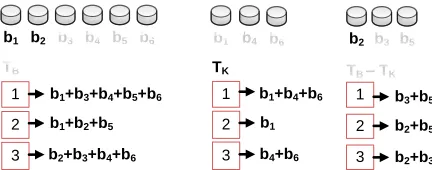
Figure 4: (Left) On input six blocksb1, b2, . . . , b6, the client outputs an IBFTBof three cells, i.e.,t= 3. For this example,
we use two hash functionsh1andh2. (Middle) The server loses blocksb2, b3andb5, i.e.,Lost={2,3,5}. To provide a
proof of accountability, the server computesTKon blocksb1, b4, b6. (Right) The client receivesTKand computesTB−TK
which gives an IBF that enables him to recover the lost blocksb2, b3, b5.
Algorithm{L,reject} ←recover(TL,Lost,H)
whilethere is a positively pure cellTL[i](i≤t)do
val=TL[i].dataSum;
ind=index(TL[i].dataSum);
ifind /∈Lostthen returnreject; addvaltoL;
calldelete(val,TL);
Lost:=Lost− {ind}; fori= 1, . . . , tdo
if TL[i].count6= 0or
TL[i].dataSum6= 0or
TL[i].hashProd6= 1or
then returnreject;
ifLostis not emptythen returnreject; returnL;
Figure 5: Recovering the lost blocks.
correct according to Definition3; (2) It is secure in the random oracle model based on the RSA assumption and according to Definition4; (3) The proof has sizeO(δlogn)and its computation at the server takesO(n+δlogn)time; (4) Verification at the client takesO(n+δlogn)time and requires local state of sizeO(δlogn); (5) The space at the server isO(n).
Streaming and appending blocks.We note here that our construction assumes the client has all the blocks available in the beginning, computes the local state and then outsources the blocks to the server. This is not necessary. Our construction applies to a streaming setting as well (e.g., [27]), where the blocksbiare coming one at a time, the client easily updates its
local state with algorithmupdate(bi,T,1)from Figure1, computes the new tagTiand sends the pair(bi,Ti)to the server
for storage. This also means that our construction is partially-dynamic, supporting append-only updates. Modifying a block is not so straightforward due to replay attacks. However techniques from various fully-dynamic PDP schemes could be potentially used for this problem (e.g., [13]).
4.1
An optimized construction
In the previous construction, the server and client run inO(n+δlogn)time. In this section we present two algorithmic optimizations that can be used to eventually reduce the server and client performance toO(δlogn).
Randomized PDP checking.Recall that the main overhead of algorithmsCheckProofandGenProofis due to a verification of a PDP proof that has been computed overn−δblocks. To reduce this overhead, we can use randomized block checking as proposed by Ateniese et al. [4] in their original work. To incorporate this optimization, our protocol must be modified in the following ways:
1. Setλ= 2·max{δ, τ}, whereτis the security parameter;
2. The algorithmGenChal, apart from the challenges∈ {0,1}k(that is used to produce randomnessa
i) outputs another
indices;
3. The server runs algorithmGenProofas before. However, instead of computing the PDP proof over all the blocks in
Kept(see Relation3), the server computes the PDP proof on the blocks in a smaller set, i.e., the setY =R ∩Kept, whereRwas produced by the challenges0picked at random by the client. Note that, by the way thatλis computed in Item1, it is alwaysτ ≤ |Y| ≤2·max{δ, τ}.
4. Finally, the client runs the verification algorithm as is, with the difference that he checks the PDP proof only for the blocks inY = R ∩Kept. Namely, instead of computing the product over all the blocks inKeptQ
i∈Kepth(Wi) ai,
he now needs to compute the productQ
i∈Yh(Wi)aiwhich takes timeO(τ+δ)(instead ofO(n)). Given thatτ is a
constant (i.e., not dependent onn), the verification now takes timeO(δlogn+τ+δ) =O(δlogn).
However, the theoretical guarantees of such an approach are not that good. This is because, it could be the case, that the index of some block that has been tampered withandbelongs to the setKeptisnotincluded in the set of random indicesY. If the setKeptcontainsfsuch blocks, the probabilitypfthat all indices inY“land” in locations different than the locations
of thef tampered file blocks (which will cause the PDP verification to accept) is at most
pf =
n−δ−f
n−δ
|Y| ≤
n−δ−f
n−δ
τ
,
since|Y|= Ω(τ)and(n−δ−f)/(n−δ)<1, for anyf >0. As such, the probabilitypf is a lot larger thanneg(τ).
However, for all practical purposes, Ateniese et al. [4] showed that the guarantees of such an approach can be acceptable. For example, one can always adjust this probability if one increases the number ofλ, even in the case of smallf—and of course the best guarantees are achieved whenf is a constant fraction ofn.
Segment tree. The technique we described in the previous section allows the server to compute the PDP proof (which is part of the accountability proof) a lot faster. However, apart from the PDP proof, an accountability proof contains the IBFTK over the blocks with indices inKept. Unfortunately, computing the IBFTKrequires accessingn−δblocks and
therefore the server time remains still linear. In this section, we show how to compute the IBFTK inO(δlogn)time, by
using a data structure called segment tree [26].
A segment treeTBis a binary search tree that stores a setBofnkey-value pairs(i, bi)at the leaves of the tree, ordered
by the key. Letvbe an internal node of the treeTB. Denote withcover(v)the set of keys that are included in the leaves
of the subtree rooted on nodev. Every internal nodev of the tree has a labellabel(v)that stores thesum of the values
corresponding to the keys incover(v). Namelylabel(v) = P
i∈cover(v)bi. By using the segment tree, one can compute
the sumSof any subsetof n−αvalues (blocks) inO(αlogn)time (instead of takingO(n−α)time): To see that, if
i1, i2, . . . , iαare the indices of the omittedαblocks, the desired sum can be written as
X
i6={i1,i2,...,iα}
bi= i1−1
X
i=1
bi+ i2−1
X
i=i1+1
bi+. . .+ n X
i=iα+1
bi
and each one of the above partial sums can be computed inO(logn)time by accessing a logarithmic number of internal nodes of the segment tree.
We modify our protocol in order to use the above data structure as follows. First, the server maintainsone segment tree
Tlper IBF celll = 1, . . . , t. Namely, whenever the client uploads a blockbj, the server insertsbjto theksegment trees
Thi(j)fori= 1, . . . , k. Note that such an operation (i.e., updating the segment tree) takesO(logn)time.
The server can now use the segment trees to compute the IBFTK, i.e., for each celliofTKthe server uses the segment
treeTito compute the sum over a set ofn−αiblocks (specifically this is the subset of the blocks inKeptthat map to cell
i), wherei= 1, . . . , tandPt
i=1αi=δk. This task takes time t
X
i=1
αilogn= logn t X
i=1
αi=O(δlogn).
This optimization, combined with the previous one, brings the computation of the server down toO(δlogn).
5
Bitcoin Integration
the server transfersdbitcoins to the client before a given deadline. Here, the amountAis a parameter that is contractually established by the client and server and is meant to be larger than the maximum damage that can be incurred by the server. Specifically, we have designed a variation of the AS protocol integrated with bitcoin that, upon termination, achieves one of the following outcomes within an established deadline:
• If both the server and the client follow the protocol, the client gets exactlydbitcoins from the server and the server gets back hisAbitcoins.
• If the server does not follow the protocol (e.g., he tries to give fewer thandbitcoins to the client, fails to respond in a timely manner, or tries to forge an AS proof), the client getsAbitcoins from the server automatically.
• If the client does not follow the protocol (e.g., she requests more thandbitcoins from the server), the server receives allAdeposited bitcoins back and the client receives nothing.
To guarantee the above outcomes, we implement the security deposit ofAbitcoins by the server via a special Bitcoin transactionsafeGuard(x, t), and the related transactionsretBtcs andfuse, described in Section 5.3and depicted with a diamond in Figure6. This transaction is based on the timed commitment over Bitcoin recently introduced by Andrychowicz et al. [3], wherexis the committed value andtis the bitcoin locktime.
The functionality associated with safeGuard(x, t) guarantees the following: (1) if x is known by the server then
safeGuard(x, t)can be opened and the server (and only the server) can get his A bitcoins back; (2) after timet all A
bitcoins will go to the client. Namely, until eitherxis revealed orthas passed, the bitcoins of the cloud in the transaction
safeGuard(x, t)are effectively frozen. We emphasize here that thesafeGuardtransaction we are implementing has an im-portant difference from the one introduced in [3]: the committed valuexis chosen by the verifier (client) and not by the committer (server).
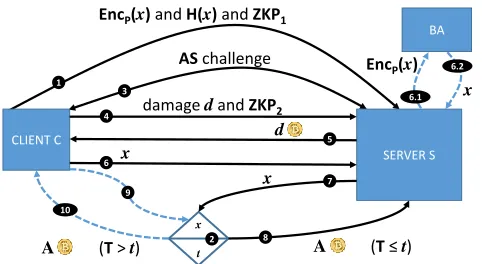
We now describe our protocol in detail, as depicted in Figure6. LetSdenote the server andCthe client. Our protocol involves a trusted “Bitcoin Arbitrator” (BA). However, we note that the BA is only contacted bySand never by the client
C(more on this later). For each stepi = 1, . . . ,7, there is a deadline,ti, to complete the step, where timelockt >> t7.
We also assume neither the client nor the sever can forge the timestamped transcript of the protocol, which can be verified by BA. This can be accomplished via standard techniques: all messages are inside a single authenticated session where messages are signed by both parties, and contain nonces and a summary (typically a hash) of all previous messages to avoid tampering.
• Step 1: C picks a random secretxand sends the following items toS: (i) an encryptionEncP(x)ofxunder BA’s
public key,P; (ii) a cryptographic hash ofx,H(x); and (iii) a zero-knowledge proof,ZKP1, thatH(x)andEncP(x)
encode the same secretx. IfZKP1does not verify,Saborts the protocol.
• Step 2:Sposts bitcoin transactionsafeGuard(x, t)forAbitcoins with timelockt, as done in [3]. If this transaction is not posted within timet2(the server is not following the protocol),Caborts the protocol.
• Step 3:SandCrun the AS protocol from the previous section, which results inCcomputing the damage,d. If the AS protocol rejects orSdelays it past timet3,Cjumps to Step 9.
• Step 4:CnotifiesSthat the damage isdand sends a zero-knowledge proof,ZKP2, toSfor that. IfCfails to do so
by timet4orZKP2does not verify,Sjumps to Step 6.
• Step 5:Ssendsdbitcoins toC. IfShas not done so by timet5,Cjumps to Step 9.
• Step 6:Csends secretxtoS. IfShas not receivedxbyt6,Scontacts BA and sends the timestamped transcript of
the protocol up to that moment. BA checks the transcript and if it is valid, BA sendsxtoS. Note that the transcript must be tamper-proof and should contain the encryption ofxandall messages exchanged up to that moment.
• Step 7:IfShas secretx,Sposts transactionretBtcs(i.e.,Sopens the timed commitment usingx).
• Step 8:If transactionretBtcsis valid,SreceivesAbitcoins before timelockt.
• Step 9:Cwaits until timetand posts transactionfuse.
• Step 10:If transactionfuseis valid,CreceivesAbitcoins.
It is easy to see that when the above protocol terminates, one of the three outcomes described at the beginning of this section is achieved. Also, we note here that for the zero-knowledge proofsZKP1andZKP2, we can use a SNARK with
zero-knowledge [25], that was recently implemented and shown to be practical.
5.1
Global safeGuard
CLIENT C
SERVER S BA
x
t
EncP(x)and H(x) and ZKP1
x damagedandZKP2
d x
1
7 4
5 6
A (T> t) 8 A (T≤ t)
EncP(x) x 6.1
6.2
2 AS challenge
3
9 10
Figure 6: Integration of the AS protocol with Bitcoin to enable an automatic compensation of the client in the case of data loss.
as the per-challenge safeGuard transaction and can be handled by the same BA. The only significant difference is that now the BA must mediate and interact with both the client and the server before returning any bitcoins to the server and, in case, reinitiate a new global safeGuard transaction between the client and the server.
5.2
Removing the Bitcoin Arbitrator
Even though the client never communicates with the BA as per our goal, it is preferable to remove it completely. Unfor-tunately, this seems impossible to achieveefficientlygiven the limitations of the Bitcoin scripting language. However, it is possible to remove the BA, at least in theory, via a secure two-party protocol. In a secure two-party protocol (2PC), partyA
inputsxand partyBinputsyand they want to computefA(x, y)andfB(x, y)respectively, without learning each other’s
input other than what can be inferred from the output of the two functions. Yao’s seminal result [33] showed that oblivious transfer implies 2PC secure against honest-but-curious adversaries. This result can be extended to generically deal with malicious adversaries through zero-knowledge proofs at each stage of the 2PC or more efficiently via thecut-and-choose
method of Lindell and Pinkas [20] or LEGO and MiniLEGO by Nielsen and Orlandi [24] and by Frederiksen et al. [14] (other efficient solutions have been proposed by Woodruff [32] and Jarecki and Shmatikov [18]).
To remove the BA, it is enough to create a symmetric version of our original scheme where both parties create a safeGuard transaction and then exchange the secrets of both commitments through a fair exchange protocol embedded into a 2PC. The secrets must be verifiable in the sense that the fair exchange must ensure that the secrets open the initial commitments or fail (as in “committed 2PC” by Jarecki and Shmatikov [18]). Unfortunately, generic techniques for 2PC results in quite impractical schemes and this is the reason why we prefer a practical solution with an arbiter. An efficient 2PC protocol with Bitcoin is proposed in [22] but it does not provide fairness as it is claimed since the 2PC protocol can be interrupted at any time by one of the parties. In the end, since this generic approach is too expensive in practice, we will not elaborate on it any further in this paper.
5.3
The safeGuard transaction
In this section, we describe thesafeGuard(x, t)is detail. The scheme is set up so thatsafeGuard(x, t)is created bySbut wherexis known only toC—S only knowsh= H(x). This is feasible to achieve through the first step on the protocol described in Figure6. We now describe the bitcoin transactions using the notation in Section2.2. SinceS knowsh, he makes the following Bitcoin transaction, which we callsafeGuard:
Prev: aTransaction
InputsToPrev: sigS([safeGuard])
Conditions:
body, σ1, σ2, x:
H(x) =h∧verS(body, σ1)
∨
verS(body, σ1)∧verC(body, σ2)
Amount: AB
Locktime: 0
The above transaction redeems a transaction calledaTransactionthat has at leastABas value and can be redeemed by transactions whoseInputsToPrevare of the typebody, σ1, σ2, x(i.e., two signatures on the same transaction and an integer
x) and satisfy the conditions specified.
Once the client revealsxto the server, the server posts the following transactionretBtcsto recover hisAbitcoins.
Prev: safeGuard
InputsToPrev: [retBtcs],sigS([retBtcs]),⊥, x
Conditions: body, σ:
verS(body, σ)
Amount: AB
Locktime: 0
.
If the server does not cooperate (e.g., see Step 5 in the protocol description), the client publishes the transactionfuse
after timetand receives a compensation ofAbitcoins from the server.
Prev: safeGuard
InputsToPrev: [fuse],sigS([fuse]),sigC([fuse]),⊥
Conditions: body, σ:
verC(body, σ)
Amount: AB
Locktime: t
.
It is very important to notice here that the locktime of the above transaction ist, meaning that if the transaction is posted earlier thant, it is not going to be accepted. This is what enablesABto be transferred toC if the server does not know
x(whichCcontrols!). Finally we note that the transactionFuseis possible only because clientChas already the server’s signaturesigS([fuse]on the body[fuse], which includes the locktimet. We can assume that this signature is obtained in the
beginning of the protocol.
6
Evaluation
0 500 1000 1500 2000 2500 3000 3500 4000
100 1000 10000 100000 500000
Time (sec)
Number of blocks 1K
2K 4K 8K
0 0.5 1 1.5 2 2.5
100 0 2 4 6 8 10 12 14
1000
0 20 40 60 80 100 120
10000
(a) Tag Generation. (b) Local IBF Generation.
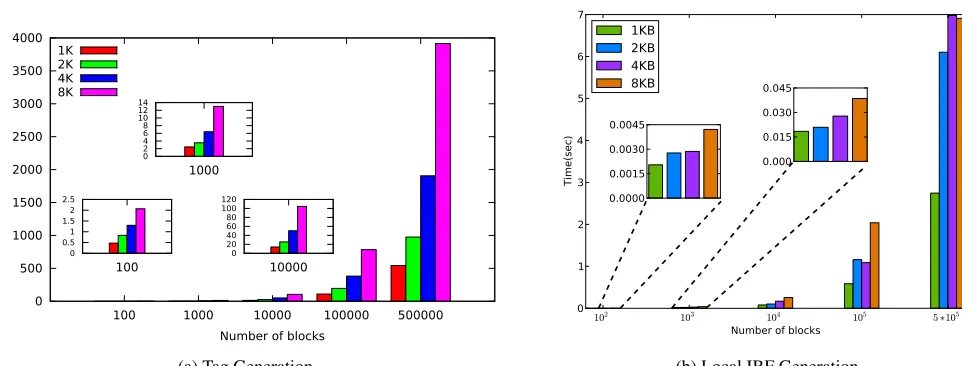
Figure 7: Preprocessing overheads.
We prototyped the proposedδ-AS scheme in Python 2.7.5. Our implementation consists of 4K lines of source code. We use the pycrypto library 2.6.1 [21] and an RSA modulusNof size 1024 bits. We serialize the protocol messages using Google Protocol Buffers [16] and performed all the modulo exponentation operations using GMPY2 [17], which is a C-coded Python extension module that supports fast multiple precision arithmetic (the use of GMPY2 gave us 60% speedup in exponentiations in comparison with the regular python arithmetic library).
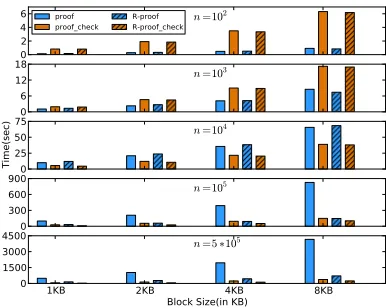
Figure 8: Proof Generation and Recover time.
Table 1: Memory Footprint of theδ-AS Scheme (KB)
n Tag Size (KB) Proof Size (KB) 1KB 2KB 4KB 8KB 102 49 578 1140 2254 4515
103 409 1787 3526 7003 13955
104 4375 4111 8114 16118 32125
105 42206 12983 25629 50913 101482
5∗105 204910 29047 57328 113904 227029
data structure to produce and verify proofs. Our prototype uses parallel computing via the Python multiprocessing module to carry out many of the heavy, but independent, cryptographic operations simultaneously. We used asingle-producer, many-consumersapproach to divide the available tasks in a pool of [8-12] processes-workers. The workers use message passing to coordinate and update the results of their computations. This approach significantly enhanced the performance of preprocessing as well as the proof generation and checking phase of the protocol. Our parallel implementation provides an approximate 5x speedup over a sequential implementation.
Experimental Setup:Our experimental setup involves two nodes, one implementing a server and another implementing a client functionality. The two nodes communicate through a Local Area Network (LAN). The two machines are equipped with an Intel 2.3 Ghz Core i7 processor and have 16 GB of RAM.
Our data are randomly generated filesystems. Every file-system includes different number of equally-sized blocks. The number of blocks ranges from 100 to 500000. The total filesystem size varies from 100
KByte to 4.1 Gbyte. Our experiments consist of 10 trials of challenge/proof exchanges between the client and the server for different filesystems. Throughout the evaluation we report the average values over these 10 trials.
Preprocessing Overheads:We first examine the memory overhead of the preprocessing phase, which is shown in Table1. The first column describes the available number of blocks in a filesystem and the second represents the total size of the tags needed. The preprocessing memory overhead is proportional to the number of blocks in a filesystem.
Figure7shows the CPU-time-related overheads of the preprocessing of the protocol. These overheads are divided to tag generation and the creation of the client state represented by the partial IBFTB. The tag generation time (Figure7a)
increases linearly with both the available number of blocks. While this cost is significant for large file systems, it is an operation that client performs only once. On the other hand, the cost of construction of the partial IBF (Figure 7b) is negligible; the IBF construction of our biggest filesystem only takes 7 seconds. The construction cost does not significantly increase with the number of blocks because it does not involve any cryptographic operations.
Challenge-proof Overheads:We now examine memory and CPU related overheads for the challenge-proof exchange and the recovery phase. The last four columns show the proof sizes (in KB) forδ=√n, which increase proportionally to the block size (unlike the tags size).
increase the time-overhead of challenge-proof exchange due to the expensive modulo exponentiations that are dominant in this stage of the protocol.
Figure8demonstrates an important trade-off between efficiency and performance. The baseline version of the protocol produces and verifies a proof by scanning all the available blocks in a filesystem. This provides low probability of PDP proof failure; this approach, however, is quite expensive.
One way to mitigate the cost of the baseline scheme is to reduce the amount of data scanned during the proof gener-ation/check steps of the protocol, as we explain in Section4.1. The randomized PDP checking (Section4.1) serves this purpose. The hatched parts in Figure8show the performance of this randomized approach, which consistently outperforms the baseline version, especially for larger filesystems. We noticed a speedup of 9×in the proof generation for the case of 5∗105blocks with 8KB of block sizes. It achieves that by examining a random subsetλof the available blocks. Figure8
shows the performance of the randomized approached whenλ= 15%of the available blocksn. Despite its efficiency, this approach comes with a higher probability of PDP proof failure. For example, forδ= 13,n= 10,000andf = 10then the probabilitypffor PDP proof failure is0.12.
The good performance properties of the randomized sche-me makes the scheme appealing for real-life applications. For example, in a cloud based scenario, a client may use it to verify, in real time, if the cloud provider meets the SLA guarantees.
δ-tolerance:To examine the actual effect of the parameterδon our implementation, we experimented with a larger value ofδon both the baseline and the randomized version of the protocol. Table2reports the average values over 10 trials of challenge/proof exchange for three important steps of the protocol. The parameterδaffects only the recovery process of the
δ-AS scheme. This is expected, since the other two parts (proof check and proof generation) operate over the total number of available blocks in the filesystem. The same principles hold for the memory related overheads.
Table 2: Effect ofδforn= 500,000and Block size 8KB for baseline (B) and randomized (R) versions ofδ-AS scheme.
δ= 18 δ= 707
Proof Proof Proof Proof Size (KB) Recovery (sec) Size (KB) Recovery (sec) B 5799.0 2.6 227029.0 Kb 107.2 R 5591.0 2.2 209011.0 Kb 100.13
7
Conclusions
In this paper we put forth the notion of accountability in cloud storage. Unlike existing work such as proof-of-storage schemes and verifiable computation, we design protocols that respond to a verification failure, enabling the client to assess the damage that has occurred in a storage repository. We also present a protocol that enables automatic compensation of the client, based on the amount of damage, and is implemented over Bitcoin. Our implementation shows that our system can be used in practice.
References
[1] https://bitcoin.org/bitcoin.pdf.
[2] Locks.http://www.coindesk.com/coinapult-launches-locks-tool-eliminate-bitcoin-price-volatility/.
[3] M. Andrychowicz, S. Dziembowski, D. Malinowski, and L. Mazurek. Secure multiparty computations on bitcoin. In
IEEE SSP, 2014.
[4] G. Ateniese, R. Burns, R. Curtmola, J. Herring, L. Kissner, Z. Peterson, and D. Song. Provable data possession at untrusted stores. InACM CCS, pages 598–609, 2007.
[5] G. Ateniese, R. Di Pietro, L. V. Mancini, and G. Tsudik. Scalable and efficient provable data possession. In Se-cureComm, pages 9:1–9:10, 2008.
[6] B. H. Bloom. Space/time trade-offs in hash coding with allowable errors. Comm. ACM, 13:422–426, 1970.
[7] D. Boneh and M. Naor. Timed commitments. InCRYPTO, pages 236–254, 2000.
[9] I. L. Carter and M. N. Wegman. Universal classes of hash functions. InACM STOC, pages 106–112, 1977.
[10] D. Cash, A. K¨upc¸¨u, and D. Wichs. Dynamic proofs of retrievability via oblivious ram. InEUROCRYPT, pages 279–295, 2013.
[11] R. Curtmola, O. Khan, R. C. Burns, and G. Ateniese. MR-PDP: Multiple-replica provable data possession. InICDCS, pages 411–420, 2008.
[12] D. Eppstein, M. T. Goodrich, F. Uyeda, and G. Varghese. What’s the difference?: efficient set reconciliation without prior context. InSIGCOMM, pages 218–229, 2011.
[13] C. Erway, A. K¨upc¸¨u, C. Papamanthou, and R. Tamassia. Dynamic provable data possession. InACM CCS, pages 213–222, 2009.
[14] T. K. Frederiksen, T. P. Jakobsen, J. B. Nielsen, P. S. Nordholt, and C. Orlandi. Minilego: Efficient secure two-party computation from general assumptions. InEUROCRYPT, pages 537–556. 2013.
[15] M. T. Goodrich and M. Mitzenmacher. Invertible Bloom Lookup Tables.ArXiv e-prints, January 2011.
[16] Google. Google protocol buffers.https://developers.google.com/protocol-buffers/.
[17] C. V. Horsen. Gmpy2: Mupltiple-precision arithmetic for python. https://gmpy2.readthedocs.org/en/ latest/intro.html/.
[18] S. Jarecki and V. Shmatikov. Efficient two-party secure computation on committed inputs. InEUROCRYPT, pages 97–114. 2007.
[19] A. Juels and J. Burton S. Kaliski. PORs: proofs of retrievability for large files. InACM CCS, pages 584–597, 2007.
[20] Y. Lindell and B. Pinkas. An efficient protocol for secure two-party computation in the presence of malicious adver-saries. InEUROCRYPT, pages 52–78. 2007.
[21] D. C. Litzenberger. Pycrypto - the python cryptography toolkit. https://www.dlitz.net/software/ pycrypto/.
[22] D. M. Marcin Andrychowicz, Stefan Dziembowski and L. Mazurek. Fair two-party computations via the bitcoin deposits. InFC. 2014.
[23] S. Nakamoto. Bitcoin: A peer-to-peer electronic cash system. https://bitcoin.org/bitcoin.pdf.
[24] J. B. Nielsen and C. Orlandi. LEGO for two-party secure computation. InTheory of Cryptography, pages 368–386. 2009.
[25] B. Parno, J. Howell, C. Gentry, and M. Raykova. Pinocchio: Nearly practical verifiable computation. In IEEE Symposium on Security and Privacy, pages 238–252, 2013.
[26] F. P. Preparata and M. I. Shamos.Computational Geometry: An Introduction. Springer-Verlag, 3rd edition, Oct. 1990.
[27] D. Schr¨oder and H. Schr¨oder. Verifiable data streaming. InACM CCS, pages 953–964, 2012.
[28] H. Shacham and B. Waters. Compact proofs of retrievability. InASIACRYPT, pages 90–107, 2008.
[29] E. Shi, E. Stefanov, and C. Papamanthou. Practical dynamic proofs of retrievability. InACM CCS, pages 325–336, 2013.
[30] E. Stefanov, M. van Dijk, A. Oprea, and A. Juels. Iris: A scalable cloud file system with efficient integrity checks. In
ACSAC, 2012.
[31] Q. Wang, C. Wang, J. Li, K. Ren, and W. Lou. Enabling public verifiability and data dynamics for storage security in cloud computing. InESORICS, pages 355–370, 2009.
[32] D. P. Woodruff. Revisiting the efficiency of malicious two-party computation. InEUROCRYPT, pages 79–96. 2007.
[33] A. C.-C. Yao. How to generate and exchange secrets. InSFCS, pages 162–167, 1986.
Appendix
Definition 5 (Negligible function) Functionλ:N→Risneg(τ)iff for any nonzero polynomialp(τ)there isNsuch that for allτ > N it isλ(τ)<1/p(τ).
The security of our construction is based on the RSA assumption and holds in the random oracle model. The RSA assumption is stated as follows:
Definition 6 (RSA assumption) LetN = pqbe an RSA modulus, wherepandqare twoτ-bit primes. GivenN,eand
y, whereyis randomly chosen fromZ∗N andeis a a prime ofΘ(τ)bits, there is no PPT algorithm that can outputy
1/e
modN, except with negligible probabilityneg(τ).
Algorithm{(D+, D−),reject} ←listDiff(TA,TB)
TD=subtract(TA,TB);
whilethere is a pure cellTD[j](j= 1, . . . , t)do
Setbi=TD[j].dataSum; (iis the block index)
if TD[j]is positively purethen
addbitoD+;
calldelete(bi,TD);
else
add−bitoD−;
callinsert(−bi,TD);
forj= 1, . . . , tdo if TD[j].count6= 0or
TD[j].dataSum6= 0or
TD[j].hashProd6= 1
then returnreject; return(D+, D−);
Figure 9: Listing the data blocks that are contained in the symmetric differenceA−B∪B−A. For example, ifA =
{b1, b2, b3}andB ={b2, b5}, it isD+=A−B={b1, b3}andD−=B−A=b5.
Proof of correctness
We prove correctness by contradiction. Suppose there exist ak∈N, a pair{pk,sk}output byKeyGen(1k), a set of blocks
B, a set of tagsΣoutput by algorithmTagBlock, i.e.,Σ ={Tj←TagBlock(pk,sk, bj) :bj ∈B}, a statestateoutput by
algorithmGenState(pk, B), a setL ⊆Bthat contain at mostδblocks, a challengechaloutput by algorithmGenChal(1k), a proofVoutput by algorithmGenProof(pk, B− L,Σ,chal), such that the probability that
L0←CheckProof(pk,sk,state,V,chal)∧ L
*L0is greater thanneg(k). Note that algorithmGenProofexecutes of the set
of blocksB− L, therefore, by insepcting the code ofGenProof, setLostalways contains a superset of the indices of the blocks inL. Let nowV ={Lost,T, S,TK,L1, . . . ,Lt}be the proof that algorithmGenProofoutputs, where
1. T=Q i∈KeptT
ai
i ;
2. S=P
i∈Keptaibi;
3. TK is the partial IBF on the set of blocks{bi : i ∈ Kept}which is computed by executinginsert(bi,TK)for all
i∈Kept(see Figure1). SetTK.hashProd= 1, i.e., the output IBF uses only fieldscountanddataSum;
4. Lr=Qi∈QrTiaiforr= 1, . . . , t, whereQris defined in Relation4.
Note now that if one takes the differenceTL=state−TKand then set
TL[r].hashProd=
Ler Q
i∈Qrh(Wi)
ai,
it is easy to see thatTL corresponds to the IBF representing blocks inLost, namely a set of blocksL0 ⊇ L. Executing
algorithmrecover(TL,Lost,H)will produce that set of blocksL0, with probability at least1−neg(k), by Lemma1. This
Proof of security
To prove security, we play the game given in Definition4between a challengerCand the adversaryA. Eventually, we show how the challenger will break the RSA assumption with the help of the adversary. The challengerCsimulates a PDR environment forAas follows:
Initialization. C computesg = y2 modN ∈
QRN, picks a set ofkrandom hash functionsHand sets the public key
pk= (N, g,H, h, θs). Note thath(.)is modeled here as a random oracle, which is programmed by the challenger. Finally Cgenerates a random secret valuev∈ {0,1}kand a large secret primee.
Query. CanswersA’s tagging queries using a random oracle as follows. WhenCreceives a tagging query for a blockb
indexed1≤i≤n, in the case that a previous tagging query for that block has occurred before,Cretrieves the stored tuple (b, i, ri,Wi)and returnsTi =ri. Otherwise, the challengerCpicks a randomri ∈QRN, computesWi =v||i, stores the
tuple(b, i, ri,Wi)and returnsTi = ri. Also, when hash queries for inputxare made for the first time byA,C picks a
random valueωx ∈QRN and returnsh(x) =ωx. He also stores the tuple(x, ωx)so that he can answer consistently the
next time he is asked to returnh(x). Finally,Cprograms the random oracleh()such that, on inputWiit gives
h(Wi) =reig−
bi modN ,
wherebiis the block indexedichosen by the adversary.
Computing local state.After all the tagging queries for blocksB={b1, b2, . . . , bn}have been made,Cstores all the blocks
B={b1, b2, . . . , bn}. Finally,Ccomputes the statestate=TBas in algorithmGenState.Ckeeps the statestatelocally. Challenge.CrequestsAto provide a proof of data recovery for blocksb1, b2, . . . , bnand sends a challengechal, which is
a randoms∈ {0,1}k.
Forge.Acomputes a proof of data recoveryVand returnsV. ParseVas{Lost,T, S,TK,L1, . . . ,Lt}. Suppose algorithm
CheckProofaccepts. This means that algorithmrecover(TL,Lost,H)also accepts, outputting a set of blocksL. Suppose
for contradiction thatL * B. This means there exists at least one blockbj ∈ Lsuch thatbj ∈/ B. Since the blocks in Lhave indices in[n](this is due to the fact that algorithmrecoveronly adds toLblocks with indices inLostandLostis always a subset of[n]), this means that there exists a blockb0j ∈Bsuch thatb0j 6=bj. Namely setBcontains a block with
indexj(i.e., the correct index) but different valueb0j.
Letz∈ {1, . . . , t}be an index of the IBF such thatjmaps toz, i.e., there isufor someu= 1, . . . , ksuch thath(j) =z.
Consider the remaining block indicesi1, i2, . . . iwmapping that indexzand defineQzas
Qz={i1, i2, . . . iw, j}.
By the verification Equation6, it needs to hold
lostSumz=
Lez Q
i∈Qzh(Wi)
ai =
Lez Q
i∈Qzr
e ig−aibi
. (7)
However, forrecoverto accept,lostSumz should be equal to1at the end of the algorithm. SincelostSumz is updated
throughdelete, the initial value oflostSumzis
lostSumz=g
¯
S, whereS¯= w X
u=1
aiub
0 iu+ajb
0 j,
where{b0i
1, b 0 i2, . . . , b
0 iw, b
0
j} ⊆ L. Therefore Equation7can be written as
gS¯= L
e z Q
i∈Qzr
e ig−aibi
⇔gS¯−S = L
e z Q
i∈Qzr
e i
, (8)
whereS = Pw
u=1aiubiu +ajbj and{bi1, . . . , biw, bj} are theoriginal blocks. But we know thatbj 6= b
0
j therefore the
probability ofS¯=Sis negligible (since theai’s are picked at random). Therefore it isS¯6=Sand Equation8can be written
as
gS¯−S = L
e z Q
i∈Qzr
e i
= Q Lz
i∈Qzri
!e
=Ze.
Therefore we haveZe=gS¯−S =y2( ¯S−S). Now, note that it isgcd(e,2( ¯S−S)) = 1with overwhelming probability (since
eis a large prime unknown toA). Therefore we can apply “Shamir’s trick”, and use the extended Euclidean algorithm to find integersαandβsuch thatα×e+β×2( ¯S−S) = 1. This givesy1/e=yαZβ, breaking the RSA assumption.