Study of Various Downlink Systems with
Multi Antenna Users
Musthkeem Unissa1, A.R Hemanth Kumar 2
PG Student [DEC], Dept. of ECE, Bangalore Institute of Technology, Bengaluru, Karnataka, India1
Professor, Dept. of ECE, Bangalore Institute of Technology, Bengaluru, Karnataka, India2
ABSTRACT: The multiplexing gain for many users in downlink multi-antenna transmission system is only limited by
the number of transmit antennas N and use of these antennas. In this paper we try to answer the question if the N data streams should be divided among few users (many streams per user) or many users (few streams per user, enabling receive combining).The prime work done in this paper is comparing the two SDMA strategies i.e ZFC (receive combing) and BD (multi-stream multiplexing). While contradicting observations on this topic have been reported in prior works, we show that selecting many users and allocating one stream per user (i.e., exploiting receive combining) is the best candidate under realistic conditions. This is explained by simulating results for Average Sum Rate and BER parameter. We also show that use of DFE method over MMSE method produces much better results, reducing the BER and increase the data rate. This fundamental result has positive implications for the design of downlink systems as it reduces the hardware requirements at the user devices and simplifies the throughput optimization.
KEYWORDS: Block-diagonalization, Decision feedback equalizer, MMSE algorithm, multi-user MIMO, zero forcing
I.INTRODUCTION
Wireless communication has been the subject of interest and active research over the past two decades. The performance of downlink wireless communication systems can be improved by multi-antenna techniques, which enable efficient utilization of spatial dimensions. In this paper we assume N is the number of base station antennas, and each user has M≥1 antennas. Fortunately, the maximal multiplexing gain of N can be achieved by linear spatial division multiple access (SDMA) strategies [1], such as block-diagonalization (BD) [2], [3] and zero-forcing with combining (ZFC) [4], [5]. Such SDMA strategies transmit N simultaneous data streams, but can divide them among the users in different ways; the system can select between [N /M] and N users to be active and allocate from 1 to M streams to each of them. This raises a fundamental design question: how should the receive antennas at each user be used to maximize the system throughput?
II.RELATED WORK
The authors of [5] claim that transmitting at most one stream per user is desirable when there are many users in the system. They justify this statement by using asymptotic results from [6] having many users. This argumentation ignores some important issues:1) asymptotic optimality can also be proven with multiple streams per user; 2) the performance at practical values on K is unknown; and 3) the analysis implies an unbounded asymptotic multi-user diversity gain, which is a modelling artefact of fading channels [7].Low-complexity algorithms have been proposed in [8]-[11], among others, by successively allocating data streams to users in a greedy manner. Simulations have indicated that fewer than N streams should be used when SNR and users are small, and that spatial correlation makes it beneficial to divide the streams among many users. Simulations in [9] indicates that the probability of allocating more than one stream per user is small when users grows large, but [9] only considers users with homogeneous channel conditions. Despite the similar terminology, our problem is fundamentally different from the classic works on the diversity-spatial multiplexing tradeoff (DMT) in [12], [13]. The DMT brings insight on how many streams should be transmitted in the high-SNR regime, while we consider how a fixed number of streams should be divided among the users. The authors of [3], [4] arrive at a different conclusion when they compare BD and ZFC under quantized CSI. Their simulations reveal a distinct advantage of BD (i.e., multi-stream multiplexing), but are limited to uncorrelated channels and neither include user selection nor interference rejection. We show that their results are misleading, because single-user transmission greatly outperforms both BD and ZFC in the scenario that they simulate. The author of [14] have used MMSE equalizer method at the receiver to show ZFC is better than BD by considering the average sum rate parameter. In this paper we show enhanced results for average rate parameter in addition to the reduction of errorrate byapplying DFEnonlinear equalization method at the receiver.
III. PROPOSED METHODOLOGY
The use of multiple antennas at base stations and user devices is a key component in the design of cellular communication systems that can meet the capacity demands of tomorrow. Without affecting the multiplexing gain and for any given number of data streams, the system has the choice between allocating these streams to many users or few users. This trade off is investigated in this paper. The analysis is based on ZFC and BD precoding techniques, which represent the two extremes. ZFC only sends one data stream per scheduled user, thus each user can combine the received signals on its antennas to achieve receive diversity and interference rejection (i.e., an effective channel with better properties). BD selects fewer users than ZFC but multiplexes M streams to each of them, which relaxes the interference mitigation and enables joint/iterative detection of each user’s streams. In other words, ZFC exploits receive combining and BD exploits multistream multiplexing.
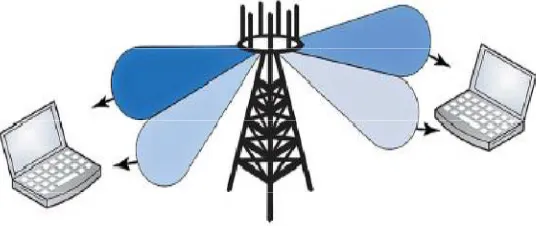
Fig. 1 ZFC enables receive combining-1 stream per user
Fig. 2 BD exploits multi multiplexing-2 stream per user
IV.SIMULATIONS AND DISCUSSONS
The outcomes are acquired by simulating the code in MATLAB. In this section we evaluate through simulations the performance of average sum rate and bit error rate. The bit error ratio is the number of bit errors divided by the total number of transferred bits during a studied time interval. Average sum rate is the system throughput or sum of the data rates that are delivered to all terminals in a network. Understanding the performance measure of BER and average sum rate parameter is very significant in better design of multi user MIMO system.
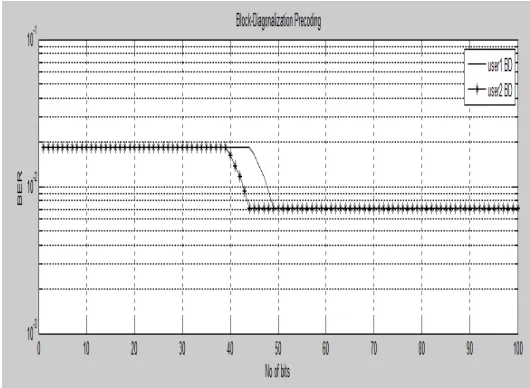
Fig. 3 BER compared with No:of data bits using BD-MMSE scheme
Fig 3 depicts the simulation using BD precoding MMSE technique for user1 and user2. The BER for user1 and user2 is observed to be 10-24 against the No:of data bits from 1 to 100. As we have already discussed ZFC precoding outperforms the BD precoding method, we can see from the below diagram how BER is reduced.
Fig. 4 BER compared with No:of data bits using ZFC-MMSE scheme
fig 4.
Fig. 5 BER compared with No:of data bits using BD-DFE technique
Fig 5 shows the simulation of BD with DFE method for user1 and user2 having BER value of 10-4 and 10-8 respectively which when compared with fig 3 shows reducing of error rate level.
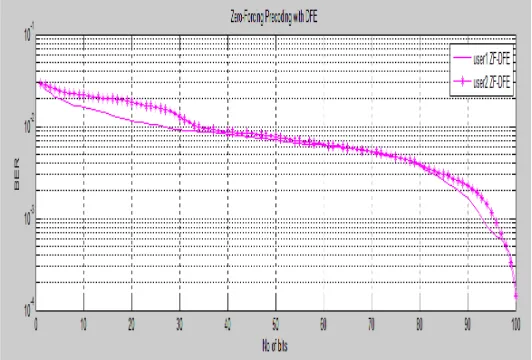
Fig. 6: BER compared with No:of data bits using ZFC-DFE technique
Fig 6 shows BER value of user1 and user2 as 10-4 against the No:of data bits from 1 to 100.From the above simulation figures, it can be depicted that application of DFE(nonlinear equalizer method) technique at the receiver side reduces the error rate to a level which is lower what can be achieved using MMSE technique (linear equalizer method).
Fig. 7: Average sum rate compared against No: of users using MMSE technique.
Fig 7 shows the simulation of average sum rate against the number of users. From the graph it can be depicted that as the number of users are increased, the average sum rate is also increased for users using ZFC and BD precoding methodsusing MMSE technique at the receiver side. Further it can also been seen that users using ZF precoding have greater sum rate compared to the user using BD precoding method, as explained in previous discussion.
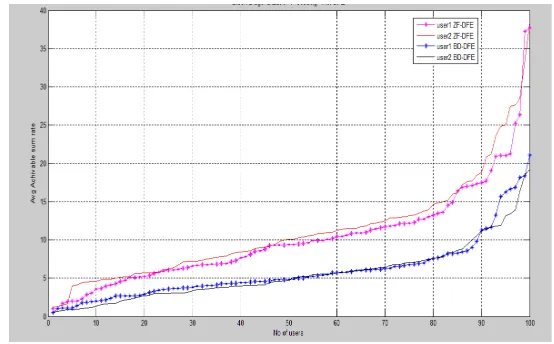
Fig. 8: Average sum rate compared against No: of users using DFE technique
Fig 8 shows the simulation of average sum rate against number of users. This simulation result when compared to Fig 7 shows that users have greater increase in average sum rate with the implementation of DFE at the receiver side.
Parameter
BD-MMSE
ZFC-MMSE
BD- DFE
ZFC-DFE
BER-User1
10-24 10-28 10-24 10-3.95
BER-User2
10-24 10-29 10-28 10-3.95
Average sum rate-User1(bps)
18 32 21 39
Average sum rate-User2(bps)
Table 1 tabulates the results from all the simulations discussed above. The simulation results when compared against each other reveal that Zero forcing combining precoding method is better than Block diagonalization precoding scheme. Further the implementation of a type of nonlinear equalization method called Decision feedback equalizer (DFE) at the receiver side reduces the Bit error rate (BER) and enhances the average sum rate with the increase in number of users. This simulation is quite better than the implementation of a type oflinear equalization method called Minimum mean square error estimator (MMSE) technique for users using ZFC and BD precoding method.
V.CONCLUSION
This paper analysed how to divide data streams among users in a downlink system with many multi-antenna users; should few users be allocated many streams, or many users be allocated few streams? New and generalized analytic results were obtained to study this tradeoff. The main conclusion is that sending one stream per selected user and exploiting receive combining is the best choice under realistic conditions i.e ZFC precoding method is better than BD precoding scheme. This is good as it reduces the hardware requirements at the users, compared with multi-stream multiplexing, and enables computationally efficient resource allocation. Further we have simulated the results for BER and Average sum rate parameter using Linear Equalizer method (MMSE) and Non Linear Equalizer method (DFE) separately. Comprehensive analysis of simulations reveal that implementation of DFE method reduces the error rate and enhances the average sum rate in comparison to the implementation of MMSE method at the receiver side.
ACKNOWLEDGMENT
I acknowledge with gratitude the support rendered by Dr.A.G.Nataraj, Principal of BIT, Bangalore. With immense pleasure I express my gratitude to Dr.K.V.Prasad , Head of the Department, and my guide Dr. A.R Hemanth Kumar, Dept of ECE ,for guiding me in creating a ground for this project work and for being an inspiration to come out successfully with this work. Finally I am grateful to my family and friends for their support during the course of my studies.
REFERENCES
[1] R. Roy and B. Ottersten, “Spatial Division Multiple Access Wireless Communication Systems,” U.S. Patent 5515378, 1991. [2] Q. Spencer, A. Swindlehurst, and M. Haardt, “Zero-forcing methods for downlink spatial multiplexing in multiuser MIMO channels,”
IEEE Trans. Signal Process.,vol. 52, no. 2, pp. 461–471, 2004.
[3] N. Ravindran and N. Jindal, “Limited feedback-based block diagonalization for the MIMO broadcast channel,” IEEE J. vol. 26, no. 8, pp. 1473–1482, 2008.
[4] N. Jindal, “Antenna combining for the MIMO downlink channel,” IEEE Trans. Wireless Commun.,vol. 26, no. 8, pp. 1473–1482, 2008. [5] M. Trivellato, F. Boccardi, and H. Huang, “On transceiver design and channel quantization for downlink multiuser MIMO systems withlimited feedback,”IEEE J. Sel. Areas Commun., vol. 26, no. 8, pp.1494–1504, 2008.
[6] A. Bayesteh and A. Khandani, “On the user selection for MIMO broadcast channels,”,IEEE Trans. Inf. Theory, vol. 54, no. 3, pp. 1086– 1107,2008.
[7] M. Dohler, R. Heath, A. Lozano, C. Papadias, and R. Valenzuela,“Is the PHY layer dead,”IEEE Commun. Mag., vol. 49, no. 4, pp. 159–165, 2011.
[8] A. TölliandM. Juntti, “Scheduling for multiuser MIMO downlink with linear processing,” in Proc. IEEE PIMRC, 2005, pp. 156–160. [9] F. Boccardi and H. Huang, “A near-optimum technique using linear precoding for the MIMO broadcast channel,” in Proc. IEEE
ICASSP,2007, vol. 3, pp. 17–20.
[10] R. Chen, Z. Shen, J. Andrews, and R. Heath, “Multimode transmission For multiuser MIMO systems with block diagonalization,” IEEE Trans.Signal Process., vol. 56, no. 7, pp. 3294–3302, 2008.
[11] C. Guthy, W. Utschick, R. Hunger, and M. Joham, “Efficient weighted sum rate maximization with linear precoding,” IEEE Trans. Signal Process., vol. 58, no. 4, pp. 2284–2297, 2010.
[12] L. Zheng and D. Tse, “Diversity and multiplexing: A fundamental tradeoff in multiple-antenna channels,” IEEE Trans. Inf. Theory, vol. 49, no. 5, pp. 1073–1096, 2003.
[13] A. Lozano and N. Jindal, “Transmit diversity vs. spatial multiplexing in modern MIMO systems,” IEEE Trans. Wireless Commun., vol. 9,no. 1, pp. 186–197, 2010.
[14] E. Björnson, M. Bengtsson, and B. Ottersten“Receive combining vs. multistream multiplexing in multiuser MIMO systems,”