Performance Study of LTE Scheduling
Algorithms in Vehicular and Pedestrian
Mobility
Mahesha .S.N1, C.Y. Gopinath2, Hemanth Kumar .A.R3, Eshwar.N.Kumar4
PG Student [DEC], Dept. of ECE, Bangalore Institute of Technology, Bengaluru, Karnataka, India1 Associate Professor, Dept. of ECE, Bangalore Institute of Technology, Bengaluru, Karnataka, India2
Professor, Dept. of ECE, Bangalore Institute of Technology, Bengaluru, Karnataka, India3 Student [EC], Dept. of ECE, Bangalore Institute of Technology, Bengaluru, Karnataka, India4
ABSTRACT: Future generation cellular networks are expected to provide ubiquitous broadband access to a continuously growing number of mobile users. LTE (Long Term Evolution commonly marketed as 4G LTE) represents an emerging and promising technology for providing mobile internet access to next generation multimedia services. The scope of LTE network is to improve the system performance in terms of data rate, latency, throughput, coverage and cost. Even with the increased data rate in the current LTE system, it is necessary to improve Quality-of–Service (QoS) to the users under various mobility scenarios especially during handover. The performance of network varies with the scheduling algorithm used by scheduler. Performance of scheduling algorithms is also affected by the handover. Hence, the performance of the scheduling algorithms (RR, PF, MT,BET) in a multi cell network is evaluated to study the impact of handover on performance of scheduling algorithms.
KEYWORDS: LTE, Round Robin, Proportional Fair, Maximum Throughput, Blind Equal Throughput, UDP.
I.INTRODUCTION
LTE as standardized by Third Generation Partnership Project (3GPP) is a cellular standard based packet switching network architecture, that supports a high data rate of 100 Mbps in Downlink and 50 Mbps in Uplink direction[12]. LTE is Internet Protocol (IP) based architecture with all IP based communication including Voice-over-IP (VoIP), video streaming, online gaming and Transport Control Protocol (TCP) based services. LTE radio access network, based on Orthogonal Frequency Division Multiple Access (OFDMA), is expected to support wide range of multimedia and internet services, even at high mobility of users. The OFDMA technology divides the available bandwidth into multiple subcarriers and the downlink scheduler allocates a group of subcarriers (Resource Block) to a user based on its QoS requirements. Hence, the design of efficient resource allocator is important for effective use of radio resources to meet the system performance targets.
A defining feature of cellular networks is the ability of users to roam in the coverage area of the network without losing their end-to-end connectivity. LTE is capable of providing satisfactory services to mobile users with high mobility. When a user is moving from coverage area of one cell to coverage area of another cell, user switches from serving eNB to target eNB and this procedure is called as “Handover” [12]. Even though the handover procedure in LTE is designed to have low latency, still certain users may have high handover latency. During handover, the source eNB forwards the user data in its buffer to destination eNB over the X-2 interface. However this forwarding of user data may cause out of order delivery of packets and might also result in discarding of packets due to increased delay. In this work we use ns-3 and different mobility scenarios in multi cell network to simulate realistic LTE network across a wide range of network conditions in terms of throughput and delay.
II. LTE ARCHITECTURE
In order to support wide variety of applications, LTE network is designed with challenging requirements that overtakes the features of 3G networks [7]. The main goal in the design of LTE network is to provide high data rate, spectrum efficiency, and QoS support without any disruption to end users applications during mobility. The high level architecture of LTE is comprised of the following three components- The User Equipment (UE), Evolved UMTS Terrestrial Radio Access Network (E-UTRAN) and Evolved Packet Core (EPC) as depicted in Fig-1.
Fig.1 High Level LTE network architecture.
User Equipment (UE): As the name suggest the User Equipment is the hand held device that allows user access to the voice and data services. UE is identical to the one used by UMTS and GSM.
E-UTRAN (Evolved Universal Mobile Telecommunications systems Terrestrial Radio Access Network): The LTE Radio Access Network, E- UTRAN simply consists of a network of eNodeB’s, which is used to provide transmission and reception of signals (S1-MME) and user data (S1-U) over the radio interface. The E- UTRAN provides connection between UEs and the Evolved Packet Core.
Evolved Packet Core (EPC):The EPC acts as the inter-mediate gateway between the eNB and external data network. Functionalities of EPC include, charging and rate policing, end-to-end connection setup, mobility management and authentication etc.
III.RADIO RESOURCEALLOCATION IN LTE
OFDM is well known technique which is used by LTE system for transmission of data from eNB to the user equipment. The necessities of the LTE network such as increasing the peak data rate and improving the spectral efficiency is enhanced by OFDM technology. With OFDMA, each scheduled user occupies a number of resource
eNB eNB
U E U E
U E
MME HSS
S-GW P-GW
PCRF
X2
S1-U
IP
NETWORK
SGi
EPC E-UTRAN
S1-MME
S11
S5
Time Interval of 1ms. During every TTI scheduling decision is made depending on the Channel Quality Indicator (CQI) value reported by UE. Ten consecutive TTIs of 1ms form a LTE frame.
IV. HANDOVER IN LTE
LTE is capable of providing the satisfactory services to users with high mobility. In LTE, the handover (HO) procedure is controlled by the network but it is assisted by the User Equipment (UE). In LTE network, only Hard Handover is considered (i.e., break before connect).
Typical handover process involves four stages measurement control, HO preparation, HO execution and HO completion. fig-2 shows the complete handover process and the steps involved in handover[5].
Fig.2. A typical Hard HO procedure in LTE.
Currently user is served by source eNB A, and moving towards target eNB B (UE sends the RSS measurements to both eNBs). Whenever the RSS of source eNB A becomes less than the RSS of target eNB B, then the source eNB A initiates the handover process [6].
The service quality experienced by the end user during handover is affected by: the Interruption time (Detach time) during which UE is not connected to the system and the delay of forwarded packets. In this paper we evaluate the effect of handover on performance of downlink scheduling algorithms.
UE Source eNB A Target eNB B MME/SGW
1. Measurement Report
HO Decision
2.HO Request
3. HO Request ACK
4.HO Command
Detach from Old cell
5. HO Confirmation
6. Path Switching Request
7. Path Switching Request ACK
8.Resource Release Request
Flush Buffer and continue delivering in-transit packets Data forwarding Over X2
V. PACKET SCHEDULING ALGORITHMS IN LTE
Scheduling algorithms are mainly concerned with allocating the available radio resource among the active users based on the metrics like channel condition, Quality of Service requirement of users etc. The LTE standard does not impose any restriction on the type of scheduler to be used at the MAC layer of eNB. Hence, the choice of different scheduling algorithms such as Round Robin (RR), Proportional Fair (PF), Maximum Throughput(MT) and Blind Equal Throughput (BET) scheduler leads to different level of system performance.
1. Round Robin(RR)
Round Robin scheduling algorithm can be considered as the simplest scheduler. In RR scheduling algorithm, the available resources are shared among various users one after the other without any priority. The scheduling only based on the available resource blocks (RBS) during scheduling process [9].
2. Proportional Fair (PF)
Proportional Fair (PF) scheduler works by scheduling a user when its instantaneous channel quality is high relative to its own average channel condition over time [7]. The PF scheduler uses the scheduling metric as in (1)
, = ( )
( ) (1)
The factor d (t) is the average throughput that can be achieved by the ith user using the kth Resource block (RB).
( ) represents the past average throughput that was achieved by the ith user up to the time t.
3. Maximum Throughput (MT) Scheduler
Maximum Throughput scheduler aims to maximize the overall throughput of eNB. It allocates each RB to user that can achieve maximum achievable rate in current TTI [7]. The scheduling metric to which RB K is assigned at time t is determined as in (2)
, = ( ) (2)
4. Blind Equal Throughput (BET) Scheduler
Blind Equal Throughput scheduler aims to provide equal throughput to all UE under eNB. The working of this scheduling method is opposite to the MT scheme. The scheduling metric of BET scheduler expressed as in (3)
, = 1
( ) (3)
( ) represents the past average throughput achieved by the users and it can be calculated using the equation (4)
( ) = ( ) ( −1) + (1− ) ( ) (4)
The factor β lies between 0 and 1. ( −1) represents the achievable throughput at time t-1. If ( ) is low it implies that the previous average throughput of the UEs are very low and they are in bad channel conditions or edge of the cell. The corresponding metric value , is high for these UEs and they will be given service first. In this way this
scheduler provides service to the UEs at the edge of the cell whose past throughput is less.
VI. RESULTS AND DISCUSSION
allocates the radio resources to flow based on the scheduling metric. Various parameters used in the simulation are summarized in table 1.
Table. 1 Simulation parameters
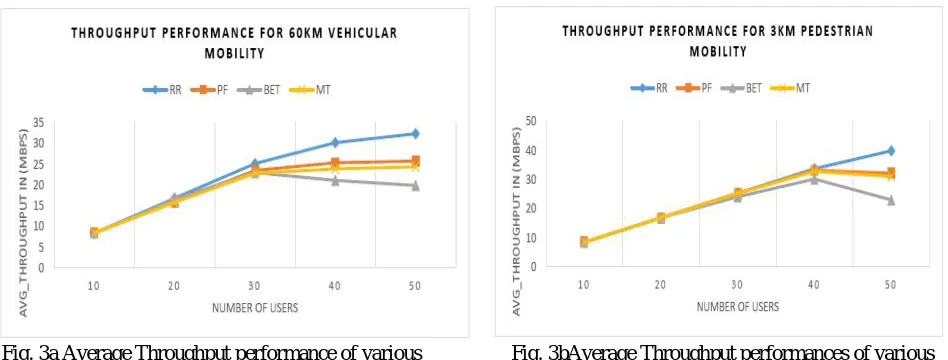
Initially simulation is carried out for RR scheduling algorithm with 10 UEs by providing pedestrian and vehicular mobility. The same simulation is repeated for PF, BET and MT scheduling algorithms by varying number of UEs in steps of 10 UEs up to 50 UEs.
Fig. 3a Average Throughput performance of various Fig. 3bAverage Throughput performances of various Scheduling Algorithms inVehicular mobility. Scheduling Algorithms in pedestrian mobility. The average throughput performance of the scheduling algorithms under vehicular and pedestrian mobility are shown in Fig.3a and Fig.3b. From the plots it is observed that in both scenarios RR algorithm achieves higher system throughput than the other algorithms considered.
Parameter Value
Simulation-Time 50 sec
Number of macro cells 7 (Each site has 3 sectors) Inter eNB distance 1000m
Number of UEs 10,20,30,40,50 Tx power of eNB 46dbm
Bandwidth 5MHz
UE mobility model Steady state Random waypoint mobility Fading Model Pedestrian, Vehicular
Fig 4 a. Average delay in Vehicular mobility. Fig. 4 b. Average delay in Pedestrian mobility.
From the Fig.4a and Fig.4b it is observed that in both scenarios RR algorithm achieves least delay than the other algorithms considered.
VII.CONCLUSION
The simulation is carried out for user mobility in vehicular and pedestrian environment. The throughput of all scheduling algorithms in vehicular mobility is quite less compared to pedestrian mobility. This is because, at higher mobility, the deviation in UE received signal power increases leading to degradation of system performance. Based on the simulation results, we conclude that in a multi cell network with user handover RR scheduling algorithm provides least latency and higher system throughput compared to other scheduling algorithms.
REFERENCES
[1] Narges Shojaedin, Majid Ghaderi, Ashwin Sridharan“Effect of Handover on the Performance of Scheduling algorithms in LTE Network”. Wireless Communications and Networking Conference (WCNC), IEEE 2015.
[2] Samia Dardouri, Ridha Bouallegue “Comparative Study of Downlink Packet Scheduling for LTE Networks” Wireless Pers Commun (2015) 82: 1405-1418.
[3] Salman a. AlQahtani, Mohammed Alhassany “Comparing Different LTE Scheduling Schemes”, 978-1-4673-2480-9/13- 2013 IEEE.
[4] F. Capozzi, G. Piro, L.A. Grieco, G Boggia, P. Camarda “Downlink Packet Scheduling in LTE Cellular Networks: Key Dessign Issuse and Survey” IEEE Communications Surveys and Tutorials, Vol. 15, no. 2, pp.678-700, 2013.
[5] K. Bheemrao, C.Y.Gopinath, N.M.Mohankumar, J.T. Devaraju “Performance analysis of Different scheduling algorithms in LTE Systemfor Jitter Constraints”, 2015, IJSRD
[6] Dizhi Zhou and Wei Song, Nicola Baldo and Macro Miozzo “Evaluation of TCP Performance with LTE Downlink Schedulers in a Vehicular Environment” IEEE.
[7] 3GPP, Technical Specification Group Radio Access Network; Evolved Universal Terrestrial Radio Access Network (E-UTRAN); Overall Description: Stage 2 (Release 8), 3GPP TS 36.3000.
[8] ns-3 model library, release ns-3.24, January 28, 2016.
[9] D. Astely, E. Dahlman, A. Furuskar, Y. Jading, M. Lindstrom, S.Parkvall,“LTE- The Evolution of Mobile Broadband”, IEEE Commun. Mag., Vol. 47, No. 4, April 2009, pp. 44-51.
[10] Swetha, Mohan kumar N M , Devaraju J T , “Performance Evaluation of Round Robin and Proportional Fair Scheduling Algorithms for constant Bit Rate Traffic in LTE” International Journal of Computer Networks and Wireless Communications (IJCNWC), Vol, 3 (1), 2013. [11] Andras Racz, Ericsson Research H-1117 Budapest, Irinyi 4-2o “Handover Performance in 3GPP Long Term Evolution (LTE) Systems”. [12] E. Dahlam, H.E kstrom, A.Furuskar, Y.Jading, J.Karlsson, M.Lundevall, S.Parkvall “The 3G Long Term Evolution-Radio interface concepts
BIOGRAPHY
Mahesha S.N received his B.E degree in E&C from Visvesvaraya Technological University, Belgaum, India. Currently he is pursuing M.Tech in Digital Electronics and Communication Engineering at BIT, Bangalore. His area of interest includes Wireless Communication, Embedded Systems and Computer Communication Networks.
C.Y. Gopinath received his B.E in E&C from U.V.C.E, Bangalore, in 1985.He specialized in Industrial Electronics from S.J.C.E, Mysore in 1989. He is presently working as Associate Professorin the Department of Electronics and Communication Engineering at BIT, Bangalore. He is currently research Scholar in Visvesvaraya Technological University. His area of interest includes Computer Architecture, Wireless Communication and Coding Techniques. He has published 5 international papers in various indexed journals, and national conference.
Hemanth Kumar A. R is presently working as Professor & Principal Investigator R&D ECE, at BIT, Bangalore. He completed his B.E in E&C from Manipal Institute of Technology in the year 1999. He specialized in Digital Communication from B.M.S College of Engineering in 2003 and received his PhD from Manipal University in 2011. His area of interest includes MANETS, Clustering the network, Path Planning and Routing algorithms. He has published 28 international papers in various indexed journals, and national conference in India, Singapore, and Thailand.