1
DTLS-HIMMO: Efficiently Securing a
Post-Quantum World with a
Fully-Collusion Resistant KPS
Oscar Garcia-Morchon, Ronald Rietman, Sahil Sharma, Ludo Tolhuizen and Jose Luis
Torre-Arce, Philips Group Innovation, Research, Eindhoven, The Netherlands;
e-mail:
{
oscar.garcia, ronald.rietman, sahil.sharma, ludo.tolhuizen,
jose.luis.torre.arce
}
@philips.com
F
Abstract
The future development of quantum-computers could turn many key agreement algorithms used in the Internet today fully insecure, endangering many applications such as online banking, e-commerce, e-health, etc. At the same time, the Internet is further evolving to enable the Internet of Things (IoT) in which billions of devices deployed in critical applications like healthcare, smart cities and smart energy are being connected to the Internet. The IoT not only requires strong and quantum-secure security, as current Internet applications, but also efficient operation. The recently introduced HIMMO scheme enables lightweight identity-based key sharing and verification of credentials in a non-interactive way. The collusion resistance properties of HIMMO enable direct secure communication between any pair of Internet-connected devices. The facts that attacking HIMMO requires lattice techniques and that it is extremely lightweight make HIMMO an ideal lightweight approach for key agreement and information verification in a post-quantum world.
Building on the HIMMO scheme, this paper firstly shows how HIMMO can be efficiently implemented even in resource-constrained devices enabling combined key agreement and credential verification one order of magnitude more efficiently than using ECDH-ECDSA. while being quantum secure. We further explain how HIMMO helps to secure the Internet and IoT by introducing the DTLS-HIMMO operation mode. DTLS, the datagram version of TLS, is becoming the standard security protocol in the IoT, however, it is very frequently discussed that it does not offer the right performance for IoT scenarios. Our design, implementation, and eval-uation show that DTLS-HIMMO operation mode achieves the security properties of DTLS-Certificate security suite while being quantum secure and exhibiting the overhead of symmetric-key primitives.
1
I
NTRODUCTIONThe advent of quantum computers can mean that most of the algorithms used for key agreement or information verification are not secure any more. This would have severe consequences for the Internet and all the applications, e.g., e-banking, e-commerce, or e-health, that depend on its security protocols TLS and IPSec. At the same time, the Internet of Things (IoT) is connecting billions of smart devices deployed in critical applications like healthcare, distributed control systems, smart cities and smart energy. The not only IoT needs strong and post-quantum secure solutions, as today’s Internet, but also efficient approaches to secure the data between smart devices, and between smart devices and the Internet.
Several schemes have been proposed in the last years and are believed to be quantum secure since they rely on methods for which quantum computers do not provide any significant advantage. Example of these schemes are NTRU, public-key systems based on the Learning With Errors problem. The limitation of these schemes is that they very frequently involve higher computational costs, longer keys or both. NTRU has excellent performance, but requires rather long keys [14]. Schemes based on the LWE problem, e.g. [1], perform worse than existing public-key solutions.
secure the IoT since it is required by many Machine to Machine standards such as OneM2M, OMA LWM2M, etc. However, with the advent of quantum computers most of the cipher suites of (D)TLS will become insecure. Furthermore, already today, it is very frequently discussed that DTLS and its cipher suites are too heavy for many IoT use cases. Thus, there is a need for a (D)TLS cipher suite that is post-quantum secure, efficient, scalable, and simple to use.
It is estimated that currently 70 % of the IoT devices have security risks and are often poorly managed1. Having such a (D)TLS cipher suite would help to address these issues in an efficient
post-quantum secure way. In some cases, IoT scenarios are not secure due to the resource limitations (e.g., memory or energy) of end devices that may not be able to support the standard algorithms. In other cases, the large number of devices and lack of user interface make the managing of large amounts of credentials for all those devices extremely complex. In some situations, bandwidth consumption plays a role since the devices are managed over a cellular connection and each extra byte costs money. The availability of quantum computers would make the situation even worse since most existing cipher-suites would be broken and most quantum resistant alternatives are relatively expensive resource-wise.
The HIMMO scheme [6], [7] is a fully-collusion resistant key pre-distribution scheme that enables lightweight identity-based key sharing and verification of credentials between devices in a single message,which is ideal for real time IoT interactions. With HIMMO, a device can directly generate a common key with another device based on its identity in a very efficient way. We believe that HIMMO is a good candidate in a post-quantum world since existing attacks require lattice techniques that are not known to be efficiently implementable in quantum computers. Finally and very importantly, HIMMO is extremely efficient so that it can enable secure communication links even in IoT scenarios.
This paper builds on the HIMMO scheme by showing how HIMMO can be efficiently imple-mented leading to an operation that is around one order of magnitude faster than public-key based solutions based on ECDH and ECDSA. We further put HIMMO in the context of the IoT and describe the design, implementation, and evaluation of the (D)TLS-HIMMO operation mode as a lightweight quantum-secure alternative to existing public-key based solutions. This new operation mode for (D)TLS allows us to achieve security properties of a (D)TLS-certificate exchange – key agreement, mutual authentication of client and server, and verification of credentials – with the resource needs of symmetric-key primitives while being post-quantum secure.
The rest of this paper is organized as follows. Section 2 describes the features of IoT scenarios, security needs, and reviews important IoT security standards. Section 3 reviews the HIMMO scheme and extensions. Section 4 discusses why HIMMO is a good candidate in a post-quantum world. Section 5 presents an efficient algorithm for key agreement and performance results. Section 6 introduces the (D)TLS-HIMMO operation mode. In Section 7, we compare DTLS-HIMMO with existing (D)TLS alternatives. Section 8 concludes this paper and discusses future work.
2
S
ECURITYS
TANDARDS IN THEI
NTERNET(
OFT
HINGS)
The Internet is protected by two main standard protocols, the Internet Protocol Security (IPSec) and the Transport Layer Security (TLS). IPSec offers security at network layer while TLS protects exchange of information between applications at transport layer. Both IPSec and TLS have an initial phase enabling authentication of peers, agreement on a session key, negotiation on the cipher-suite, etc. Afterwards, the data flow can be secured in the sense of confidentiality, authenticity, integrity and freshness by making use of the agreed session keys.
The TLS protocol runs on top of TCP and is used to secure our HTTP Internet connections when we access the bank online, to do the tax computation, or when we access some healthcare services. The Internet is further evolving to connect many smart objects creating the Internet of Things (IoT) comprising smart meters, healthcare devices, etc. In a typical use case, devices
communicate end-to-end with a back-end server, reporting information such as energy con-sumption, maintenance data, etc by means of protocols such as OneM2M or LWM2M that are protected by Datagram Transport Layer Security (DTLS), the equivalent of TLS running on UDP. Note that DTLS builds on TLS, and therefore both protocols are very similar, the only differences are a few extensions ensuring that protocol can run on UDP.
There are more than 200 known cipher-suites for TLS2. OpenSSL is one of the most common
and used libraries implementing TLS and most of its different cipher-suites. For the Internet of Things, other libraries such as CyaSSL are also popular due to their smaller footprint and simple API 3 supporting more that 70 cipher-suites including different modes for the key
agreement such as ECDH, ECDHE, ECDSA, ECDSA, RSA, PSK, several hash functions used in the generation of a message authentication code, e.g.,SHA, MD5, SHA256, SHA384as well as several encryption algorithms, e.g., RC4, 3DES, AES128, AES256, Camellia128, Camellia256
that can be configured in several block cipher modes such asCCM, GCM.
If quantum computers were introduced today, all the cipher suites available for key agreement based on ECC and RSA would become insecure since Shor’s algorithm [17] (or modification of it) allow for efficient integer factorization on a quantum computer [12]. ECC algorithms would be potentially easier to attack than RSA since computers with a lower number of qubits are required in practice. For instance,”A 160 bit elliptic curve cryptographic key could be broken on a quantum computer using around 1000 qubits while factoring the security-wise equivalent 1024 bit RSA modulus would require about 2000 qubits.” [12]. On the other hand, it is also likely that once a quantum computer of 1000 qubits is available, it is only a matter of a few months until the number of available qubits doubles.
The advent of the Internet of Things puts further pressure on available schemes since these smart devices that rely on DTLS to communicate with each other and with back-end systems have limited resources from a point of view of CPU, energy and bandwidth. This requires efficient cryptographic schemes due to several reasons. First, resource-constrained devices have a relatively constrained CPU and have to run on batteries for many years: the usage of com-putationally hungry solutions require more powerful devices and decrease the device lifetime. Second, back-end systems will have to manage millions of devices: the usage of expensive cryptographic solutions means that back-end systems will require many more resources. Third, communication often happens over resource-constrained networks such as IEEE 802.15.4/6LoW-PAN that are lossy, have a low-data rate (250 kbits/sec) and have a limited message size ( 127 B): long keys or certificates are not recommended since they need to be fragmented leading to a considerable decrease in performance. Fourth, data communication often happens over cellular connections that are not free of charge: if long keys or certificates are involved, then the cost of exchanging a few bytes of information can easily increase several times due to this additional overhead.
2.1 DTLS-PSK
The Pre Shared Key (PSK) is an authentication and key exchange algorithm used in cipher suites, both in TLS [2] and DTLS. Although not in common use on the Internet, (D)TLS- PSK is widely employed by devices that are part of the Internet of Things since it has very low resource needs. We will also use this mode to enable DTLS-HIMMO. The ciphersuite TLS PSK WITH AES 128 CCM 8 [10], for instance, uses PSK as the authentication and key exchange algorithm.
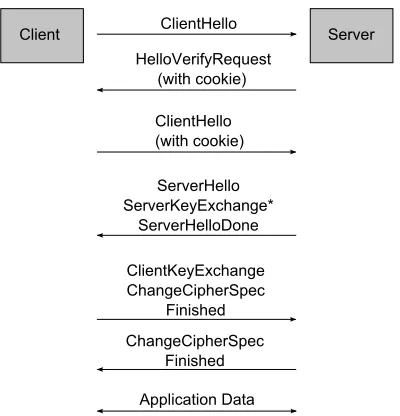
Figure 1 illustrates PSK based authentication [3], as applied to the DTLS handshake. Since both clients and servers may have pre-shared keys with different parties, the client indicates which key to use with the PSK-identity in theClientKeyExchangemessage. The server may help the client in selecting the identity to use with the PSK-identity-hint in the ServerKeyExchange
message. For IoT devices, the PSK identity can be based on the domain name of the server and, thus, the PSK-identity-hint need not be sent by the server [18], so the ServerKeyExchange
DDDDDDD
Client ClientHello Server
HelloVerifyRequest DDDDD(withDcookie)
ClientHelloD (withDcookie)
ServerHello ServerKeyExchange*
ServerHelloDone
ClientKeyExchange ChangeCipherSpec
Finished ChangeCipherSpec
Finished ApplicationDData
Figure 1. A DTLS PSK exchange (with cookies)
is optional (marked with *). The credentials (the pre shared keys themselves) are stored as part of hardware modules, such as SIM cards, and sometimes, on the firmware of resource-constrained devices themselves. The session keys for the DTLS record session are derived from the PSK using the TLS Pseudo Random Function (PRF) as defined in [2]. The cookie exchange is used to prevent denial of service attacks on the server. The Constrained Application Protocol (CoAP) [15] mandates the use of TLS PSK WITH AES 128 CCM 8 for the use with shared secrets [18].
3
HIMMO
ANDHIMMO E
XTENSIONSThe concept of Key Pre-Distribution Schemes (KPS) was introduced by Matsumoto and Imai in 1987 [9]. However, there was no known KPS that is both efficient and not prone to efficient attacks of multiple colluding (or compromised) nodes. The HIMMO scheme solves this problem. This section reviews the operation of the HIMMO scheme that enables any pair of devices in a system to directly agree on a common symmetric-key based on their identifiers and a secret key generating polynomial. Furthermore, we describe two protocol extensions of the HIMMO scheme as introduced in [6], [7]. The underlying security principles on which HIMMO relies have been analyzed in [4] and [5].
We use the following notation: for each integerxand positive integerM, we denote byhxiM the unique integery∈ {0,1, . . . , M−1} such thatx≡ymodM.
3.1 HIMMO operation
Like any KPS, HIMMO requires a trusted third party (TTP), and three phases can be distin-guished in its operation [9].
variable. For1≤i≤m, thei-th root keying polynomial R(i)(x, y)is written as
R(i)(x, y) =
α X
j=0 α X
k=0
Rj,k(i)xjyk
with 0≤R(j,ki) =Rk,j(i) ≤qi−1.
In the keying material extraction phase, the TTP provides each node ξ in the system, with
0≤ξ <2B, the coefficients of the key generating polynomialG ξ:
Gξ(y) = α X
k=0
Gξ,kyk (1)
where
Gξ,k=
m X
i=1
h
α X
j=0
R(j,ki)ξjiqi
N. (2)
In thekey generation phase, a nodeξwishing to communicate with nodeηwith0≤η <2B, computes:
Kξ,η =
hGξ(η)iN
2b (3)
It can be shown thatKξ,η andKη,ξ need not be equal. However, as shown in Theorem 1 in [6], for all identifiersξ andη with0≤ξ, η≤2B,
Kξ,η ∈ {hKη,ξ+jNi2b |0≤ |j| ≤2m}
In order to perform key reconciliation , i.e. to make sure that ξ and η use the same key to protect their future communications, the initiator of the key generation (say nodeξ) sends to the other node, simultaneously with an encrypted message, information onKξ,η that enables node η to select Kξ,η from the candidate set C = {hKη,ξ +jNi2b | 0 ≤ |j| ≤ 2m}. No additional communication thus is required for key reconciliation. The key Kξ,η will be used for securing future communication betweenξ and η. As an example of information used for key reconciliation, nodeξ sends to nodeη the number r=hKξ,ηi2s, wheres=dlog2(4m+ 1)e. Node η can efficiently obtain the integer j such that |j| ≤ 2m and Kξ,η ≡Kη,ξ+jN mod 2b by using thatjN≡Kξ,η−Kη,ξ≡r−Kη,ξmod 2s. AsN is odd, the latter equation allows for determination ofj. Asrreveals thesleast significant bits ofKξ,η, only theb−smost significant bitsKξ,η, that is, the numberb2−sKξ,ηc, should be used as key.
3.2 Implicit certification and verification of credentials
Implicit certification and verification of credentials is further enabled on top of the basic HIMMO scheme. A node that wants to register with the system provides the TTP with its credentials, e.g., device type, manufacturing date, etc. The TTP, which can also add further information to the node’s credentials such as a unique node identifier or the issue date of the keying material and its expiration date, obtains the node’s identity asξ=H(credentials), whereH is a public hash function. When a first node with identity ξ wants to securely send a message M to a second node with identityη, the following steps are taken.
• Step 1: Nodeξ computes a common keyKξ,η with nodeη, and uses Kξ,η to encrypt and authenticate its credentials and messageM, saye=EKξ,η(credentials|M).
• Step 2: Nodeξ sends(ξ, e)to node η.
• Step 3: Node η receives (ξ0, e0). It computes its common key Kη,ξ0 with ξ0 to decrypt e0
obtaining the messageM and verifying the authenticity of the received message. Further-more, it checks whether the credentials’ in e0 correspond with ξ0, that is, it validates if
ξ0=H(credentials’).
enough, e.g., 256 bits, the input (i.e., the credentials) contains a unique node identifier, andifH is a secure one-way hash function, then it is infeasible for an attacker to find any other set of credentials leading to the same identityξ. The fact that credential verification might be prone to birthday attacks motivates the choice for the relation between identifier and key sizes, namely, B= 2b. In this way, the scheme provides an equivalent security level for credential verification and key generation. The capability for credential verification enables e.g. the verification of the expiration date of the credentials (and the keying material) of a node, or verification of the access roles of the sender nodeξ.
3.3 Enhancing privacy by using multiple TTPs
Using multiple TTPs was introduced by Matsumoto and Imai [9] for KPS and can also be elegantly supported by HIMMO [6]. In this scheme, a number of TTPs provide a node with keying materials linked to the node’s identifier during the keying material extraction phase. Upon reception, the device combines the different keying materials by adding the coefficients of the key generating polynomials modulo N. Key generation is performed as usual. This scheme enjoys two interesting properties without increasing the resource requirements of the nodes. First, privacy is enhanced since a single TTP cannot eavesdrop the communication links. In fact, all TTPs should collude to monitor the communication links. Secondly, compromising a sub-set of TTPs does not break the overall system.
4
HIMMO
IN A POST-
QUANTUM WORLDIn a collusion attack on the HIMMO scheme, multiple nodes collaborate in emulating the key generation process (3) of a node under attack, using their own pairwise keys with the node under attack as input. In [6], it is shown that this attack amounts to solving a close vector problem in a certain lattice, and that the minimum required number of nodes, and thus the lattice dimension, is(α+1)(α+2)/2. Ifαis large enough,α >20, an approximate solution of this close vector problem, using the default LLL [11] implementation of Sage [13], and Babai’s nearest plane algorithm, fails to give a good result, while the lattice dimension becomes too large for exact methods, for which the running time and memory requirements grow exponentially in the lattice dimension. While it is quite likely that more elaborate approximate classical algorithms would give better results, thus increasing the minimum required value ofαsomewhat, currently no quantum algorithm exists that would speed up the approximate lattice methods, nor is it foreseen that the quantum speed-ups in the exact lattice algorithms, which use enumeration techniques, are sufficient to crack HIMMO for these values ofα.
5
I
MPLEMENTATION AND PERFORMANCEHIMMO has been designed keeping in mind that we want to achieve very good performance. In this section, we explain how the key generation algorithm in Equation 3 can be implemented in a very efficient way.
As we see in Equation 3, the key generation consists of the evaluation of a polynomial module Nand taking thebLSBs. A good choice forN is2B(α+1)+b−1because this simplifies the imple-mentation of modular reductions on the devices. In Algorithm 1 we show the key generation algorithm whose underlying method is the well-known Horner’s Rule. Each intermediate value is computed as follows
htempjiN =htempj+1×η+Gξ,jiN
forj =α−1, . . . ,0. To perform the modular reduction we take advantage ofN’s specific form,
2B(α+1)+b−1 and the small size of η. Thus, htemp
jiN = htempHj ×2(α+1)B+b+tempLjiN ≈ tempH
j +tempLj where tempHj and tempLj are b and (α+ 1)B+b bits long, respectively. That this is an approximation is because there might be a carry in the addition oftempH
0 100 200 300 400 500 600 700
64 96 128 160 192 224 256
msec
b=B
0 100 200 300 400 500 600
18 22 26 30 34 38 42
msec
α 0
2,000 4,000 6,000 8,000 10,000 12,000 14,000 16,000 18,000
18 22 26 30 34 38 42
Bytes
α
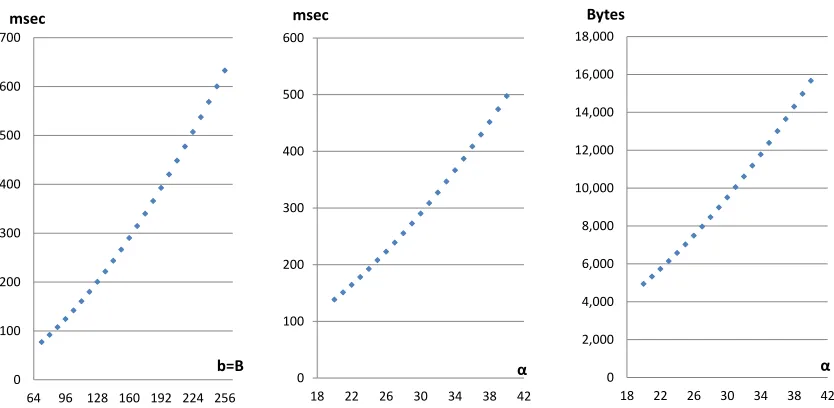
Figure 2. HIMMO Performance: on the left, performance forα= 26as a function ofb=B; in the middle and right, performance forb=B= 128as a function ofα.
needed at most once during the calculation, and ignoring it leads to a difference of one(mod 2b)
between the wanted key and the value returned by the algorithm, so that
hh
α X
j=0
Gξ,jηjiNi2b ∈ {key,hkey+ 1i2b}.
The modular reduction happens when the value ofkey is updated with the contribution of the MSB stored intempafter being shifted(j+ 2)B bits and added tokey(Line 8).
Algorithm 1Optimized key generation
1: INPUT: B,b,α,η,Gξ,j with j∈ {0, . . . , α}
2: OUTPUT: key 3: key← hGξ,αi2b
4: temp← bGξ,α 2b c
5: forj=α−1 to0 do
6: temp←temp×η+b2(α−Gξ,j1−j)B+bc
7: key← hkey×ηi2b+hGξ,ji2b
8: key← hkey+b temp 2(j+2)Bci2b
9: temp← bhtempi2(j+2)B
2B c
10: end for
11: return key
From Algorithm 1 it is also clear that part of the coefficients Gξ,j with j∈ {0, . . . , α}are not used in the key generation process. This is because of the smaller size of the HIMMO identifiers (B bits) compared with the relatively long coefficients ((α+ 1)B bits). This allows for a further optimization in which only the required parts of the coefficients are stored, namely theb least significant bits and thejB most significant bits of each coefficientGξ,j.
Figure 2 provides a brief summary of the performance of the HIMMO scheme on the 8-bit CPU ATMEGA128L. The first graph shows the key generation time for α= 26 as a function ofb =B. In the next two figures, we see – as a function ofα and for b=B = 128 – the key generation time and the size of the key generating function.
two nodes: a first node ξ wants to send in a secure way information to η, and η wants to securely receive the message fromξ and verify its credentials. The first two protocols involve communicating before nodeξ can send an encrypted message, whereas HIMMO allows node ξto directly compute the key with η based on its identifier and send the encrypted message. Also, notice that ECDH only provides key agreement, to get key agreement and verification of credentials, it is needed to use also ECDSA, increasing the resource requirements. The results are based on an implementation on the ATMEGA128L running at 8 MHz and illustrate the performance when this protocol is implemented with ECDH only, ECDH and ECDSA for a security level of 80 bits and HIMMO using security parameters α = 26 and 2b = B = 160. In Table 1, CPU refers to the overall computing needs, the memory refers to the amount of information that needs to be stored in flash, RAM is the RAM memory needs, exchanged data refers to the amount of data exchanged betweenξ and η, round trips are the number of interactions between both nodes, and finally, the security properties illustrate the features of the security protocols.
Table 1
HIMMO performance and comparison with ECDH and ECDH+ECDSA.
CPU time Key material RAM Exchanged Security properties
+ code data
ECDH [8] 3.97s 16018B 1774B 480B Key agreement ECDH 11.9s 35326B 3284B 704B Key agreement and
+ECDSA [8] credential verification
HIMMO 0.290s 7560B 1220B 448B Key agreement and credential verification
6
(D)TLS-HIMMO
TLS and DTLS are two of the protocols to protect the Internet today, while DTLS is becoming the standard for the IoT. Existing (D)TLS operational modes have pros and cons. PSK is efficient and quantum secure, but it does not scale. Raw-public key scales well but does not offer authentication, is prone to man-in-the-middle attacks, and most of existing schemes would be broken with quantum computers. Certificate-based schemes are too expensive in some scenarios, in particular Internet of Things related, and most of those schemes would also be broken with quantum computers.
This motivates our research in a new (D)TLS cipher suite based on HIMMO that:
• is resilient to quantum computers,
• has the low operational cost of DTLS-PSK,
• enables mutual authentication and credential verification as with certificate-based schemes,
• and is scalable like solutions based on public-key cryptography and infrastructure.
To this end, we take the DTLS-PSK mode that is based on identities, and we extend – without need of changing the standard – so that it can work with HIMMO. The main difference from the usual PSK profile lies in using identities to generate a pairwise symmetric key and, then, deriving the session keys from the pairwise symmetric key. A TTP provisions keying material to client nodes and the server as shown in Equation 1 during an initial setup (eg. manufacture stage). HIMMO can be directly used in (D)TLS-PSK mode by exchanging HIMMO’s identifiers in theClientKeyExchangeand ServerKeyExchangemessages.4
6.1 DTLS-HIMMO Configurations
The existing PSK profile, such as the one used in TLS PSK WITH AES 128 CCM 8, involves the exchange of two fields, thePSK identityandPSK identity hint, in theClientKeyExchangeand
ServerKeyExchangemessages respectively. Instead of sending a PSK identifier, we use these fields, which can be up to 128 bytes long [18], to exchange HIMMO information.
Table 2 illustrates these fields of information with exemplary lengths. First, we find an identifier/flag indicating the use of DTLS-HIMMO. Next, we find a DTLS-HIMMO message type to indicate which properties are enabled by HIMMO. The third and fourth field refer to the number of TTPs as well as their identifiers. These are the TTPs associated with generating and distributing the key material of the client and server. These two fields are followed by an identifier. Next, we optionally find the HIMMO credentials length as well as the credentials themselves. Finally, a field that contains the key reconciliation data is present.
Table 2
Exemplary format of the PSK-identity-hint and PSK-identity fields enabling DTLS-HIMMO
HIMMO Message Number TTP Identifier HIMMO HIMMO Reconci-flag Type of ID Credentials Credentials lliation
TTPs length data
Length(Bytes) 2 1 1 1/ # TTP B 1 0. . .(122−B) 1
Mandatory (M)/ M M M M M O O O
Optional (O)
This message format is used in thePSK-identity-hintandPSK-identityfields of the ServerKeyEx-change and ClientKeyExchange messages. With these fields we can enable different ways of using HIMMO with DTLS-PSK. If only the HIMMO identifier is exchanged in the identifier field, then only mutual authentication is achieved between client and server. Alternatively, the client, or server, or both of them might exchange their credentials. The credentials could be any information that today is exchanged in regular digital certificates and, for IoT scenarios, information such as manufacturer, device type, date of manufacturing, etc. In this case, the exchange enables unilateral or mutual implicit credential verification of the parties. We note that in this case, the identifier field does not contain the HIMMO identifier but a unique random value that concatenated with the information in the HIMMO credentials length and
HIMMO credentialsis hashed to obtain the HIMMO identifier. The reason for this construction was explained in Section 3.2. Finally, we note that the reconciliation data is only exchanged in theClientKeyExchange message since it is the server the one performing this operation.
These two different options gives rise to four (two each for client and server) different combinations. These combinations, required computations and properties are shown in Table 3.
6.2 (D)TLS-HIMMO Handshake
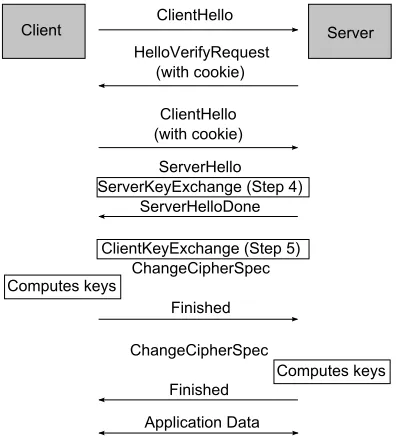
The HIMMO enabled PSK message exchanges are shown in Figure 6.2, with the respective steps explained below:
• Step 1: The client sends aClientHellomessage to the server indicating use of the PSK mode,
such as the TLS PSK WITH AES 128 CCM 8.
• Step 2: The usualHelloVerifyRequestmessage, with a cookie, is sent from the server to the
client.
• Step 3: The client replies back withClientHelloalong with the cookie.
• Step 4: The server replies withServerHello,ServerKeyExchangeandServerHelloDone. The
PSK-identity-hintof theServerKeyExchangecontains the DTLS-HIMMO fields as in the exemplary format shown in Table 2.
• Step 5: The client sends the ClientKeyExchange with the PSK-identity field containing the
DTLS-HIMMO fields as shown in Table 2. It also sends the usual ChangeCipherSpec and
Finishedmessages to the server.
• Step 6: The Server would send back the usualChangeCipherSpec andFinished messages to
the client.
Table 3
Modes of operation of DTLS-HIMMO profile
Client sends HIMMO’s ID Client sends HIMMO’s credentials Messages exchanged
Server sends HIMMO’s ID ClientKeyExchange: Client ID ClientKeyExchange: Clients credentials and Reconciliation data and Reconciliation data
ServerKeyExchange: Server ID ServerKeyExchange: Server ID Computations
Two HIMMO evaluations in total Two HIMMO evaluations in total One hash evaluation
Properties
Mutual authentication Mutual authentication
Verification of client’s credentials Messages exchanged
Server sends HIMMO’s credentials ClientKeyExchange: Client ID ClientKeyExchange: Clients credentials and Reconciliation data and Reconciliation data
ServerKeyExchange: Servers credentials ServerKeyExchange: Servers credentials Computations
Two HIMMO evaluations in total Two HIMMO evaluations in total One hash evaluation Two hash evaluations
Properties
Mutual authentication Mutual authentication
Verification of server’s credentials Verification of the credentials of client and server
• Step 1: If the server sent its credentials, as indicated in the DTLS-HIMMO fields, compute
ID-Server=H(Server Identifier||
Server HIMMO Credentials Length|| Server HIMMO-credentials)
In case the server sent the HIMMO identifier then setID-Server=Server HIMMO-Identifier.
• Step 2: If the client is also using credentials, compute
ID-Client=H(Client Identifier||
Client HIMMO Credentials Length||
Client HIMMO-credentials)
Otherwise, setID-Client=Client HIMMO-Identifier.
• Step 3: Compute the pairwise keyKID-Client, ID-Server as shown in Equation 3.
Similarly, the server, upon receipt of the ClientKeyExchange message computes the pairwise key as:
• Step 1: Depending upon whether the client sent its credentials or its HIMMO identifier,
computeID-Clientas shown in the steps followed by the client before. In the same manner, depending upon whether the server uses credentials or its’ HIMMO identifier, compute
ID-Server.
• Step 2: Compute the pairwise keyKID-Server, ID-Clientusing the key reconciliation data sent by the client to arrive at the symmetric pairwise key.
the successful completion of theFinished message implies that the credentials it provided are correct and, thus, authenticates the credentials of the peer.
4444444
Client Server
ClientHello
HelloVerifyRequest4 44444(with4cookie)
ClientHello4 (with4cookie)
ServerHello ServerKeyExchange4(Step44)4
ServerHelloDone
ClientKeyExchange4(Step45) ChangeCipherSpec
Finished
ChangeCipherSpec
Finished
Application4Data Computes4keys
Computes4keys
Figure 3. A DTLS-HIMMO exchange
6.3 Privacy protection
Protecting the privacy of the communication links is fundamental. HIMMO and its extensions can be used to ensure the privacy of the involved communication parties.
A first aspect to consider refers to the protection of the exchanged credentials that might contain some private information that is not wished to be exposed to the other party, if not authenticated before, or to any passive eavesdropper. The fact that HIMMO allows for identity-based key agreement allows for a simple extension of the DTLS-handshake. The credentials can be encrypted with the pairwise key shared with the other party. For instance, in the DTLS-HIMMO exchange, the client can protect its credentials by encrypting them with the DTLS-HIMMO key shared with the server and that is computed after the reception of the ServerKeyExchange
message. Thus, the ClientKeyExchange could contain the Client’s HIMMO identifier and the encrypted client’s HIMMO credentials. The server can use the HIMMO identifier to obtain the common pairwise key, and decrypt the client’s credentials. Neither a fake server nor an attacker eavesdropping the communication will be able to learn the client’s credentials.
TTP 1
TTP 2
TTP t
Server 1 Server 2 Server s
Client 1 Client 2 Client c
Figure 4. TTP infrastructure for privacy-protection in DTLS-HIMMO
6.4 TTP Infrastructure
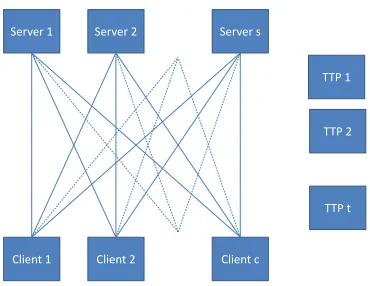
The introduction of an infrastructure of TTPs (see Figure 4) for the DTLS-HIMMO profile would mean the creation of an alternative to today’s PKI. As outlined above, each entity in the system would register with a number of TTPs receive the corresponding key generating polynomials, each linked to the same or related credentials. Each entity would store these information either combined, as explained in Section 3.3, or independently. In this case, the TTP identifiers can be exchanged between client and server during a DTLS-HIMMO handshake as indicated in Figure 2. In a first step, the server provides in theServerKeyExchangemessage the TTP identifiers from which it received its key generating polynomials. In a second step, the client answers with common or chosen TTPs in theClientKeyExchangemessages.
Such an infrastructure brings new challenges but also advantages. Today, if a CA is com-promised, then it is not possible to easily recover. Certificates are often not signed by more of a CA, and if they are, this rapidly increases the bandwidth and computational requirements. The usage of such a TTP Infrastructure as described above overcomes the problem of a TTP being compromised (and therefore the whole system being insecure) without almost any effect on bandwidth or computational resources.
7
DTLS-HIMMO
AND COMPARISON WITH EXISTING(D)TLS
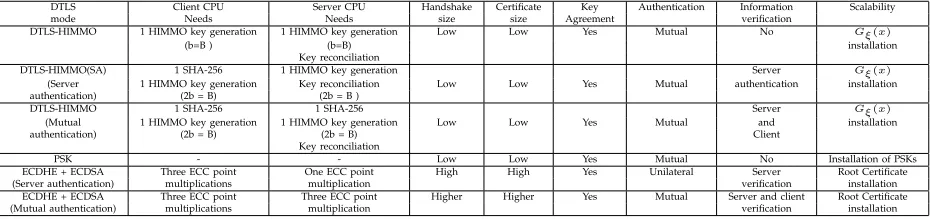
ALTERNATIVES We have implemented the DTLS-HIMMO operation mode in the CyaSSL library (version 3.0.0) such that the client and server run on a Intel Core i5-3437U @ 1.90 GHz with Windows 7 Enterprise. The DTLS-HIMMO extension is carried out by using DTLSv1.2 in PSK mode as starting point as explained in Section 6. The HIMMO-based DTLS operation modes include: (i) HIMMO enabling mutual authentication, (ii) HIMMO enabling mutual authentication and server verification, and (iii) HIMMO enabling mutual authentication and client and server veri-fication. We compare DTLS-HIMMO with (iv) DTLS in PSK mode, (v) DTLS certificates enabling sever verification only and (vi) DTLS certificates with both server and client verification. Both modes are implemented using the ECDHE and ECDSA on NIST secp256r1 curve. All of the analyzed DTLS operation modes rely on a 128-bit AES in CCM operation mode to secure the DTLS record layer.Table 4 provides the reader with a qualitative comparison of the above DTLS modes of operation against their performance and security properties. Performance-wise we discuss the resource requirements on the client and server and the communication overhead. Security-wise we consider the capability of the handshakes for key agreement, authentication, information verification, and scalability.
Table 4
Qualitative comparison of the HIMMO based PSK profile with other algorithms
DTLS Client CPU Server CPU Handshake Certificate Key Authentication Information Scalability
mode Needs Needs size size Agreement verification
DTLS-HIMMO 1 HIMMO key generation 1 HIMMO key generation Low Low Yes Mutual No Gξ(x)
(b=B ) (b=B) installation
Key reconciliation
DTLS-HIMMO(SA) 1 SHA-256 1 HIMMO key generation Server Gξ(x)
(Server 1 HIMMO key generation Key reconciliation Low Low Yes Mutual authentication installation authentication) (2b = B) (2b = B )
DTLS-HIMMO 1 SHA-256 1 SHA-256 Server Gξ(x)
(Mutual 1 HIMMO key generation 1 HIMMO key generation Low Low Yes Mutual and installation
authentication) (2b = B) (2b = B) Client
Key reconciliation
PSK - - Low Low Yes Mutual No Installation of PSKs
ECDHE + ECDSA Three ECC point One ECC point High High Yes Unilateral Server Root Certificate
(Server authentication) multiplications multiplication verification installation
ECDHE + ECDSA Three ECC point Three ECC point Higher Higher Yes Mutual Server and client Root Certificate
(Mutual authentication) multiplications multiplication verification installation
of information requires several scalar ECC point multiplications while in the case of HIMMO only a polynomial evaluation is involved.
This qualitative comparison is supported by the experimental results in which we have measured (i) the elapsed time, (ii) the amount of data exchanged, and (iii) the ratio between data exchanged and payload in three different scenarios for different DTLS modes of operation:
• the DTLS connection is established and 1 KB of data are exchanged,
• the DTLS connection is established and 10 KB of data are exchanged, and
• the DTLS connection is established and 100 KB of data are exchanged.
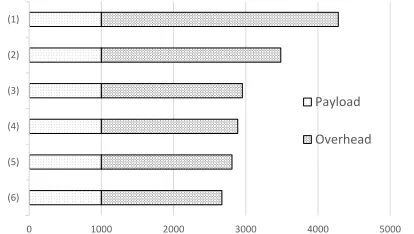
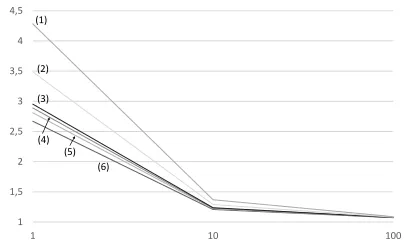
Figure 5 shows the required time to establish a secure connection and send the data for different cipher suites. We observe that DTLS-PSK is the fastest followed by DTLS-HIMMO without cre-dential verification capabilities. DTLS-HIMMO with crecre-dential verification capabilities becomes slightly more expensive sinceB needs to be2b in this case. We also observe that the usage of a small or high security parameter αdoes not heavily impact the performance of the scheme remaining around a factor 8 faster than the ECC alternative. A value ofαof 26 and 50 implies than an attacker has to deal with lattices of dimensions 405 and 1377 for the HI problem [5]. It is also worth noting that in all cases the cryptographic operations involved in the transfer of data are negligible compared with the DTLS handshake. Figure 6 depicts the total amount of exchanged data for all the cipher suites. This includes the headers of the underlying protocols (UDP, IP, etc) as well as the transfer of 1 KB of data. Figure 7 shows the ratio between the required bandwidth and the exchanged payload making clear that the usage of schemes relying on long keys might not be the best solution for use cases in which little payload needs to be exchanged.
These figures together with Figure 1 show several advantages of HIMMO compared with other alternatives. The first one is that Internet of Things applications that involve the exchange of little data, frequently under 10 KB, can profit from HIMMO since it offers a better ratio between the amount of transmitted payload and the overall amount of transmitted data. This is due to HIMMO’s identity based nature that does not require the exchange of public-keys or long certificates. As a result, the underlying constrained networks are less overloaded, thus enabling IoT applications with less costs to network operators. The second one is that same back-end can handle many more clients with the same resources. This prevents potential DoS attacks and decreases again the price to enable those applications. Finally, Figures 5 and 7 show the performance of the DTLS handshake between two powerful devices. In a real world Internet of Things scenario one of those devices will have much lower capabilities. However, HIMMO can be still implemented in a very efficient way as illustrated in Figure 2.
0 50 100 150 200 (6)
(5) (4) (3) (2) (1)
ms
Handshake 1 KB
9 KB 90KB
Figure 5. DTLS connection time. From top to bottom: (1) ECDH-ECDSA with mutual authentica-tion, (2) ECDH-ECDSA with server authenticaauthentica-tion, (3) HIMMO with mutual verification of client’s and server’s credentials (B = 256, b= 128, α= 50), (4) HIMMO with mutual verification of client’s and server’s credentials (B = 256, b = 128, α = 26), (5) HIMMO with mutual authentication
(B = 128, b= 128, α= 26) and (6) PSK.
0 1000 2000 3000 4000 5000
(6) (5) (4) (3) (2) (1)
Payload
Overhead
Figure 6. Total KB exchanged for 1 KB payload. From top to bottom: (1) ECDH-ECDSA with mutual authentication, (2) ECDH-ECDSA with server authentication, (3) HIMMO with mutual verification of client’s and server’s credentials, (4) HIMMO with verification of server’s credentials, (5) HIMMO with mutual authentication and (6) PSK.
numbers are not directly comparable with ours since they are based on different CPUs and different software, it indicates that HIMMO should operate much faster than R-LWR since HIMMO is faster than ECC, and ECC is faster than the R-LWE scheme. PKC schemes based on NTRU have been investigated to secure Internet of Things scenarios [16]. NTRU is a fast scheme. However, the public-keys are long: a security level of 128-bits require 6743 bit long keys [14]. This also indicates that HIMMO and its identity-based nature can improveon NTRU communication overhead, very important in Internet of Things applications, while providing high speed performance.
8
C
ONCLUSIONSThe HIMMO scheme is the first Key Pre-distribution scheme that is simultaneously efficient and secure (in terms of collusion resistance). HIMMO is post-quantum secure as known attacks involve solving a close vector problem in a lattice for which currently no quantum algorithm exists that would speed up the approximate lattice methods, nor is it foreseen that the quantum speed-ups in the exact lattice algorithms, which use enumeration techniques, are sufficient to crack HIMMO.
1 1,5 2 2,5 3 3,5 4 4,5
1 10 100
(5) (4) (3) (2) (1)
(6)
Figure 7. Ratio between total exchanged data and payload. From top to bottom: (1) ECDH-ECDSA with mutual authentication, (2) ECDH-ECDH-ECDSA with server authentication, (3) HIMMO with mutual verification of client’s and server’s credentials, (4) HIMMO with verification of server’s credentials,(5) HIMMO with mutual authentication and (6) PSK.
the standards, but offering a significantly improved performance security trade-off while be-ing quantum secure. In fact, the DTLS-PSK mode can be extended with HIMMO to achieve functionality that today is only possible with public-key cryptography and a public-key in-frastructure, but at the speed and memory requirements of a symmetric-key handshake. The DTLS-HIMMO handshake offers mutual authentication of client and server, implicit verification of their credentials costing a single hash computation, client’s privacy-protection by sending its credentials in encrypted format, and support of multiple TTPs.
R
EFERENCES[1] J.W. Bos, C. Costello, M. Naehrig, and D. Stebila. Post-quantum key exchange for the TLS protocol from the ring learning with errors problem. Cryptology ePrint Archive, Report 2014/599, 2014. http://eprint.iacr.org/. [2] T. Dierks and E. Rescorla. The Transport Layer Security (TLS) Protocol Version 1.2. RFC 5246 (Proposed Standard),
August 2008. Updated by RFCs 5746, 5878, 6176.
[3] P. Eronen and H. Tschofenig. Pre-Shared Key Ciphersuites for Transport Layer Security (TLS). RFC 4279 (Proposed Standard), December 2005.
[4] O. Garc´ıa-Morch ´on, D. G ´omez-P´erez, J. Guti´errez, R. Rietman, and L. Tolhuizen. The MMO problem. InProc. ISSAC’14, pages 186–193. ACM, 2014.
[5] O. Garc´ıa-Morchon, R. Rietman, I.E. Shparlinski, and L. Tolhuizen. Interpolation and approximation of polynomials in finite fields over a short interval from noisy values.Experimental mathematics, 23:241–260, 2014.
[6] O. Garc´ıa-Morch ´on, R. Rietman, L. Tolhuizen, D. G ´omez-P´erez, and J. Guti´errez. HIMMO - A Lightweight, Fully Colluison Resistant Key-Predistribution Scheme. Cryptology ePrint Archive, Report 2014/698, 2014. http://eprint. iacr.org/.
[7] O. Garcia-Morchon, L. Tolhuizen, D. Gomez, and J. Gutierrez. Towards full collusion resistant ID-based establishment of pairwise keys. InExtended abstracts of the third Workshop on Mathematical Cryptology (WMC 2012) and the third international conference on Symbolic Computation and Cryptography (SCC 2012)., pages 30–36, 2012. [8] A. Liu and P. Ning. Tinyecc: A configurable library for elliptic curve cryptography in wireless sensor networks.
InProc. 7th Int. Conf. on Information Processing in Sensor Networks, IPSN ’08, pages 245–256, Washington, DC, USA, 2008. IEEE Computer Society.
[9] T. Matsumoto and H. Imai. On the key predistribution system: a practical solution to the key distribution problem. In C. Pomerance, editor,Advances in Cryptology – CRYPTO’87, LNCS 293, pages 185–193. Springer, 1988. [10] D. McGrew and D. Bailey. AES-CCM Cipher Suites for Transport Layer Security (TLS). RFC 6655 (Proposed
Standard), July 2012.
[11] Ph.Q. Nguyen and B. Vall´ee, editors.The LLL Algorithm - Survey and Applications. Springer, 2010.
[12] J. Proos and C. Zalka. Shor’s discrete logarithm quantum algorithm for elliptic curves. In http://arxiv.org/abs/quantph/0301141, 2003.
[13] Sage. http://www.sagemath.org.
[14] J. Schanck, 2014. https://github.com/NTRUOpenSourceProject/ntru-crypto/.
[15] Z. Shelby, K. Hartke, and C. Bormann. The Constrained Application Protocol (CoAP). RFC 7252 (Proposed Standard), June 2014.
[16] J.-R. Shih, Y. Hu, M.-C. Hsiao, M.-S. Chen, W.-C. Shen, B.-Y. Yang, A.-Y.Y Wu, and C.-M. Cheng. Securing m2m with post-quantum public-key cryptography. IEEE Journal on Emerging and Selected Topics in Circuits and Systems, 3(1):106–116, March 2013.
[17] P.W. Shor. Polynomial-Time Algorithms for Prime Factorization and Discrete Logarithms on a Quantum Computer. SIAM Journal on Computing, 26(5):1484–1509, 1997.
A
PPENDIXA
P
ROOF OF CORRECTNESS OF OPTIMIZED ALGORITHMLetb, B, α be positive integers and let N := 2(α+1)B+b−1. For0≤i≤α, let0≤Gi ≤N−1, and let0≤η≤2B−1. We are interested in obtaining the key K, defined as
K:=hh
α X
i=0
GiηiiNi2b. (4)
For0≤i≤α−1, we write
Gi=γi2(α−i−1)B+b+δi with 0≤δi≤2(α−i−1)B+b−1. (5) We rewrite Algortihm 1, where we added indices to the variables that will be useful in the analysis the algorithm:
kα:=hGαi2b;τα:=bGα2bc;
for j:=α−1 downto0 do beginσj :=τj+1×η+γj;
kj:=hkj+1×η+hGji2b+b σj 2(j+2)Bci2b; τj :=b
hσji2(j+2)B 2B c
end; key:=k0
In this appendix we prove the following theorem.
Theorem A.1. Ifα <2B, then eitherK=key orK=hkey+ 1i 2b.
For proving the above theorem, we define Λα,Λα−1, . . . ,Λ0 as
Λα:=Gα
and for 0≤j≤α−1,
Λj:=ηΛj+1+Gj− b
σj
2(j+2)BcN. By induction onj, it is easy to see that for 0≤j≤α,
Λj ≡
α X
i=j
Giηi−jmodN.
Note that Pα
i=jGiηi−j is the j-th iterate of the evaluation of P α
i=0Giηi using Horner’s algo-rithm.
We will show below (Proposition 2) that for eachj,
0≤Λj−τj2(α−j)B+b≤(α−j+ 1)2(α−j)B+b. As a consequence, if α < 2B, then 0 ≤ Λ
0−τ02αB+b < N. The algorithm implies that 0 ≤ τ0 ≤2B−1, and so 0≤τ0 ≤Λ0 < N+ 2B−1. AsP
α
j=0Gjηj ≡Λ0modN, we conclude that
hPα
j=0GjηjiN =hΛ0iN ∈ {Λ0,Λ0−N}, and so
K∈ {hΛ0i2b,hΛ0+ 1i2b}. (6)
In Proposition 3, we show thatΛj ≡kj for 0 ≤j ≤α. Combining this result with (6) proves the theorem.
For 0≤j ≤α, we define
rj:= Λj−2(α−j)B+bτj.
Proposition 1. For0≤j≤α−1, we have that rj= 2(α−j−1)B+bhσji2B+ηrj+1+δj+b σj 2(j+2)Bc
ProofLet 0≤j≤α−1. From the definitions ofΛj,Λj+1, rj rj+1 and σj we readily find that rj= 2(α−1−j)B+b(σj−2Bτj) +ηrj+1+ηδj− b
σj
Writingσj=b2(j+2)Bσj c2
(j+2)B+hσ
ji2(j+2)B, and using that N= 2(α+1)B+b−1, we obtain that rj= 2(α−1−j)B+b(hσji2(j+2)B−2Bτj) +b
σj
2(j+2)Bc+ηrj+1+ηδj. The proposition now follows from observing that
hσji2(j+2)B= 2Bb
hσji2(j+2)B
2B c+hhσji2(j+2)Bi2B = 2 Bτ
j+hσji2B.
Proposition 2. For0≤j≤αwe have thatrj ≤(α−j+ 1)2(α−j)B+b−1.
ProofBy induction onj. Asrα=hGαi2b ≤2b−1, the proposition is true forj=α.
Now let 0 ≤ j ≤ α−1. The algorithm immediately implies that τj+1 ≤ 2(j+2)B −1 (make distinctions forj=α−1and j < α−1for showing this). Moreover,
γj =b Gj
2(α−j−1)Bc ≤
Gj
2(α−j−1)B+b ≤
N−1 2(α−j−1)B+b ≤2
(j+2)B−1.
We conclude that
σj=τj+1η+γj <2(j+2)B(η+ 1)<2(j+3)B, and so
b σj
2(j+2)Bc ≤2
B−1. (7)
According to (5), we have thatδj ≤2(α−1−j)B+b−1, and we clearly have thathσji2B ≤2B−1. Combining these inequalities with (7) and Proposition 2, we infer that
rj ≤2(α−j−1)B+b(2B−1) + (2(α−1−j)B+b−1) +ηrj+1+ (2B−1)
= 2(α−j)B+b+ηrj+1+ 2B−2<2(α−j)B+b+ 2B(rj+1+ 1). According to the induction hypothesis,rj+1≤(α−j)2(α−j−1)B+b−1, and so
rj ≤(α−j+ 1)2(α−j)B+b−1.
Proposition 3. For0≤j≤α, we have that kj=hΛji2b.
ProofBy induction onj. The proposition is true forj =α. Now let0≤j≤α−1. The definition ofΛj implies that
Λj=ηΛj+1+Gj− b
σj
2(j+2)Bc(2
(α+1)B+b
−1)≡ηhΛj+1i2b+hGji2b+b σj
2(j+2)Bc (mod 2
b).