primitive sequences modulo square-free odd integers
Qun-Xiong Zheng, Wen-Feng Qi and Tian Tian
yAugust 21, 2011
Abstract
Let M be a square-free odd integer and Z=(M) the integer residue ring modulo
M. This paper studies the distinctness of primitive sequences overZ=(M)modulo 2. Recently, for the case of M =pq, a product of two distinct prime numbers p and q, the problem has been almost completely solved. As for the case thatM is a product of more prime numbers, the problem has been quite resistant to proof. In this paper,
a partial proof is given by showing that a class of primitive sequences of order2k+ 1
overZ=(M)is distinct modulo 2. Besides as an independent interest, the paper also involves two distribution properties of primitive sequences overZ=(M), which related closely to our main results.
Keywords: integer residue rings, linear recurring sequences, primitive
polynomi-als, primitive sequences, modular reduction
This work was supported by NSF of China under Grant No. (61070178, 60833008).
yQun-Xiong Zheng, Wen-Feng Qi and Tian Tian are with the department of Applied Mathematics,
Zhengzhou Information Science and Technology Institute, Zhengzhou 450002, China. (e-mail:
1
Introduction
LetZ=(M)denote the integer residue ring moduloM for any integerM 2. If a sequence
a= (a(t))t 0 over Z=(M) satis…es
a(i+n) (cn 1a(i+n 1) + +c1a(i+ 1) +c0a(i)) modM; i 0 (1)
with constant coe¢ cients c0; c1; : : : ; cn 1 2 Z=(M), then a is called a linear recurring
se-quence of order n over Z=(M) generated by f(x) = xn +c
n 1xn 1 + +c0 (or a is a
sequence of order n overZ=(M)in short) andf(x)is called a characteristic polynomial of
a. For convenience, the set of sequences generated byf(x)overZ=(M)is generally denoted
byG(f(x); M).
Letpbe a prime number ande a positive integer. A monic polynomialf(x)of degreen
overZ=(pe)is called aprimitive polynomialof degreen if the period off(x)overZ=(pe),
denoted byper(f(x); pe), is equal tope 1(pn 1), that ispe 1(pn 1)is the minimal positive
integer P such that xP 1 is divisible by f(x) in Z=(pe)[x]. A sequence a = (a(t)) t 0
over Z=(pe) is called a primitive sequence of order n if a is generated by a primitive
polynomial of degree n overZ=(pe)and amodp= (a(t) modp)
t 0 is not an all 0sequence.
The period of a primitive sequenceaof ordern overZ=(pe), denoted asper(a; pe), is equal
tope 1(pn 1), see [1].
Every elementu2Z=(pe)has a uniquep-adic expansion asu=u
0+u1 p+ +ue 1 pe 1,
whereui 2 f0;1; : : : ; p 1gand can be naturally seen as an element inZ=(p). Similarly, a
sequence a overZ=(pe) has a unique p-adic expansion asa =a
0+a1 p+ +ae 1 pe 1,
where ai is a sequence overf0;1; : : : ; p 1g and can be naturally seen as a sequence over
Z=(p). The sequenceai is called the ith-level sequenceof a for 0 i e 1 and ae 1
is also called the highest level sequenceof a.
Letabe a sequence overZ=(pe)with thep-adic expansion asa=a
0+a1 p+ +ae 1 pe 1
and '(x0; : : : ; xe 1)an e-variable function over Z=(p). Then
is a sequence over Z=(p) and is called a compressing sequence derived from a. When a
is a primitive sequence over Z=(pe), many cryptographical properties of such compressing
sequence have been studied during the last 20 years [2]-[17], in particular the distinctness of
compressing sequences, that is,a=bif and only if '(a0; : : : ; ae 1) = '(b0; : : : ; be 1), where
a and b are two primitive sequences generated by a primitive polynomial overZ=(pe).
Ob-viously, for a given primitive polynomial f(x) overZ=(pe), if the compressing sequences of
all primitive sequences generated by f(x) are pairwise distinct, then there is a one-to-one
correspondence between primitive sequences and their compressing sequences, which
im-plies that every compressing sequence preserves all the information of its original primitive
sequence. Thus such compressing sequences are thought to be a good type of nonlinear
sequences available for the design of stream cipher.
Recently, modular reduction, another compressing method of primitive sequences over
Z=(pe), was proposed and has attracted much attention. For example, the well known l
-sequences, i.e., maximal length FCSR -sequences, introduced by A. Klapper and M. Goresky
in [20], are in fact modulo 2 reductions of primitive sequences of order 1 over Z=(pe). In
[19], the distinctness of modular reductions of primitive sequences over Z=(pe) has been
completely solved. It was shown that if a and b are two primitive sequences generated by
a primitive polynomial of degreen 1 overZ=(pe), then a=b if and only if a bmodm,
where m is a positive integer with a prime factor other than p. It can be seen that
the operation of modm destroys the inherent structure of sequences over Z=(pe), and in
particular for m= 2, the compression ratio is very large and easy to implement.
Let M be an integer greater than 1 and M =pe1 1 p
e2
2 perr the canonical factorization
of M. As a natural generalization of the de…nitions of primitive polynomials and primitive
sequences overZ=(pe), a monic polynomialf(x)of degreen overZ=(M)is called a
primi-tive polynomialand a sequencea= (a(t))t 0 of ordernoverZ=(M)is called aprimitive
sequence,if for everyi2 f1;2; : : : ; rg, f(x) modpei
i is a primitive polynomial of degree n
over Z=(pei
i ) and amodp ei
i is a primitive sequence of order n over Z=(p ei
i ), respectively. It
of a primitive sequence of ordern overZ=(M) are both equal to
lcm pe1 1 1 (p
n
1 1); p
e2 1 2 (p
n
2 1); : : : ; p
er 1
r (p n
r 1) :
For convenience, the set of primitive sequences generated by a primitive polynomial f(x)
over Z=(M) is generally denoted by G0(f(x); M).
IfM has at least two di¤erent prime factors, there indeed exist many primitive sequences
of order1 overZ=(M)such that their modular reductions are the same [21]. It is long not
clear, however, whether the modular reductions of primitive sequences of order n 2 over
Z=(M) are distinct. Let p and q be two distinct prime numbers. In [21], the authors
…rst studied the distinctness of primitive sequences over Z=(pq)modulo 2, and a su¢ cient
condition was given for (n; p; q) such that primitive sequences of order n over Z=(pq) are
distinct modulo2. Then in [18] based on a new result on the element distribution property
of primitive sequences overZ=(pq), the set of primitive sequences that can be proved to be
distinct modulo2 is greatly enlarged and almost includes all primitive sequences.
Inspired by the methods of [18], this paper studies a much more general modulus M
which is a product of three or more distinct prime numbers. A class of primitive sequences
of ordern= 2k+ 1overZ=(M)is shown to be distinct modulo2, wherek 1is an integer.
The number of primitive sequences proved to be distinct modulo2 has close relations with
two distribution properties of primitive sequences over Z=(M). One is given s 2 Z=(M)
and a primitive sequence a of order n 2 over Z=(M) whether there is an integer t 0
such that a(t) = s. The other is given a primitive sequence a of order 1 over Z=(M)
whether there is an integert 0such thata(t) is an even number. Based on the estimates
of exponential sums over integer residue rings and number theoretical functions, su¢ cient
conditions of primitive sequences over Z=(M) satisfying the two properties are obtained,
respectively, and corresponding experimental data are provided to show the validity of the
su¢ cient conditions.
The paper is organized as follows. Section 2 presents some necessary preliminaries.
Section 4 is largely devoted to the proof of our main result. Finally, conclusions are drawn
in Section 5.
Throughout the paper, we assume that M is a square-free odd integer and M =
p1p2 pr is the canonical factorization ofM, where r 2and pi is an odd prime number
for 1 i r. We choose f0;1; : : : ; M 1g as the complete set of representatives for the elements of the ringZ=(M). Thus a sequenceaoverZ=(M)is usually seen as an integer
se-quence overf0;1; : : : ; M 1g. Moreover, for an integerxand a positive integerm, we denote the nonnegative minimal residue of x modulo m as [x]modm and [a]modm = ([a(t)]modm)t 0
for a sequencea= (a(t))t 0 over Z=(M).
2
Preliminaries
An element 2 Z=(M) is called a primitive element of Z=(M) if [ ]modp
i is a primitive
element of Z=(pi) for every i 2 f1;2; : : : ; rg, i.e., the multiplicative order of [ ]modpi in
Z=(pi) is equal to pi 1. It can be seen that the multiplicative order of any primitive
element inZ=(M) is equal tolcm (p1 1; p2 1; : : : ; pr 1).
Typical primitive polynomials over integer residue rings were …rst proposed and studied
in [22]. The authors of [22] gave the following equivalent conditions, each of which de…nes
a typical primitive polynomial.
Lemma 1 ([22]) Let f(x) be a primitive polynomial of degree n over Z=(M). Then the
following are equivalent:
(1) f(x) divides xS for some positive integer S and some primitive element of
Z=(M);
(2) there exists a primitive element of Z=(M) such that x M modf(x) holds over
Z=(M), where M = lcm pn
1 1
p1 1;
pn
2 1
p2 1; : : : ;
pn r 1
(3) gcd pipj; p
n
i 1 = pn
i 1
pi 1 for any pair of distinct prime divisors pi and pj of M,
where pipj = lcm
pn i 1
pi 1;
pn j 1
pj 1 :
Remark 2 The conditions (1), (2) and (3) correspond to De…nition 4 , Lemma 5 and
formula (9) of [22], respectively.
De…nition 3 ([22]) A monic polynomial f(x) of degree n over Z=(M) is called a typical
primitive polynomial of degreenoverZ=(M)iff(x)is primitive and satis…es the equivalent
conditions of Lemma 1.
It can be seen from the condition (3) of Lemma 1 that the existence of typical primitive
polynomials of degree n over Z=(M) only depends on the arithmetic properties of M and
n. Thus, for convenience we call (M; n) a typical primitive pair if M and n satisfy the
condition (3) of Lemma 1.
To prove the distinctness of primitive sequences over Z=(M) modulo2 in Section 4, we
need another concept named “a distinguishable pair”, and we make its de…nition explicit
in the following statement.
De…nition 4 Let n be a positive integer. Then (M; n) is called a distinguishable pair if
gcd p
n i 1
pi 1
; pnj 1 = 1 (2)
for any pair of distinct prime divisors pi and pj of M.
Remark 5 (1) If (M; n) is a distinguishable pair, then it is necessary that n is an odd
number. This is because if n is an even number, then both pni 1
pi 1 =
Pn 1
k=0p
k
i and pnj 1 are
even numbers, and so gcd pni 1
pi 1; p
n
j 1 26= 1.
(2) If (M; n) is a distinguishable pair, then (M; n) is a typical primitive pair, but the
reverse is not true. For example, it can be veri…ed that (77;3) is a typical primitive pair,
(3) Experimental data show that the proportion of distinguishable pairs (M; n) is about
61:148% when M runs through all possible values between 1 and 10;000;000 and n runs
through all odd integers between 3 and 19.
Finally we recall the estimates of some classical exponential sums over integer residue
rings. Let m be a positive integer greater than 1, and let em( ) be the canonical additive
character overZ=(m)given byem(a) = e2 ia=m, whereais an integer. First it is well-known
that the complete sum
m 1
X
a=0
em(ca) = 8 < :
m; if mjc;
0; otherwise,
for any integer c. Second the following estimates are proved in [23].
Lemma 6 [23, Lemma 8.80] For any positive integer H we have
mX1
a=0
HX1
x=0
em(ax) <2m
lnm
+ 1
5 +H,
where ln ( ) is the natural logarithm. In particular, we have
mX1
a=1
H 1
X
x=0
em(ax) <2m
lnm
+1
5 .
3
Distribution Properties of Primitive Sequences over
Z
=
(
M
)
Let a be a periodic sequence over Z=(M) with period T. For any given element s 2 Z=(M), we say that the element s occurs in the sequence a if there exists an integer
t 2 f0;1; : : : ; T 1g such that a(t) = s. Let N aT; s denote the number of element s
occurring in a complete period of the sequencea, that is,
In this section, we discuss two distribution problems of primitive sequences overZ=(M),
which will be shown to be useful in Section 4. The …rst problem is whether every element
of Z=(M) occurs in a complete period of a primitive sequence of order n over Z=(M). In
Subsection 3.1, we shall show that the answer is positive for su¢ ciently large n. It is clear
that the answer is negative for n = 1. The second problem is whether there exists an
even number ofZ=(M)occurs in a complete period of a primitive sequence of order1 over
Z=(M). In Subsection 3.2, we shall show that the answer to this problem is positive for
almost all M’s. The main results of this section are based on the estimates of exponential
sums over integer residue rings.
3.1
Estimates for the number of a given element occurring in a
primitive sequence over
Z
=
(
M
)
Lemma 7 Letf(x) =xn (cn 1xn 1+ +c1x+c0)be a primitive polynomial overZ=(M)
with period T and d= (1;0; : : : ;0)2(Z=(M))n. Then d Ah
6
=d Ak for 0 h < k < T,
where
A=
2 6 6 6 6 6 6 6 6 6 6 6 6 4
0 1 0 0 0
0 0 1 0 0
0 0 0 1 0
..
. ... ... ... . .. ...
0 0 0 0 1
c0 c1 c2 c3 cn 1
3 7 7 7 7 7 7 7 7 7 7 7 7 5
. (3)
(Here we mean that A= [c0] if n = 1.)
Proof. Suppose there exist two integers hand k,0 h < k < T, such thatd Ah =d Ak.
Then we have
Note that
d Aj = (0; : : : ;0
| {z } j
;1;0; : : : ;0);0 j n 1;
and so (4) implies that
Ah =Ak. (5)
Let d= (d(t))t 0 be a primitive sequence generated byf(x) overZ=(M), and let
dt= (d(t); d(t+ 1); : : : ; d(t+n 1))
be the t-th state of the sequence d for any integer t 0. It follows from (1) that
dt =At d0,
where dt is the transpose ofdt. Then by (5) we have
dh =Ah d0 =Ak d0 =dk,
and so the period of d is not greater thank h < T, a contradiction to the fact that the
period of d is equal toT. Therefore we get thatd Ah 6=d Ak for 0 h < k < T. The following lemma is an analogy of Theorem 8.78 of [23].
Lemma 8 Let a be a primitive sequence of order n overZ=(M) with period
T = lcm (pn1 1; pn2 1; : : : ; pnr 1).
Then
T 1
X
t=0
eM(a(t)) M
n
2.
Proof. For any vectorb= (b0; b1; : : : ; bn 1)2(Z=(M))
n
, let
(b) =
T 1
X
t=0
Note that
eM(b0a(0) +b1a(1) + +bn 1a(n 1))
= eM(b0a(T) +b1a(T + 1) + +bn 1a(T +n 1)),
and so we obtain
(b) =
T 1
X
t=0
eM (b0a(t+ 1) +b1a(t+ 2) + +bn 1a(t+n)). (7)
Assume f(x) =xn (c
n 1xn 1+ +c1x+c0) is a characteristic polynomial of a. Then
we have
a(t+n) c0a(t) +c1a(t+ 1) + +cn 1a(t+n 1) modM; t 0. (8)
Hence, (7) and (8) yield
j (b)j =
T 1
X
t=0
eM(b0a(t+ 1) +b1a(t+ 2) + +bn 1a(t+n))
=
T 1
X
t=0
eM b0a(t+ 1) +b1a(t+ 2) + +bn 1
n 1
X
k=0
cka(t+k) !!
= j ((bn 1c0; b0+bn 1c1; : : : ; bn 2+bn 1cn 1))j
= j (b A)j,
whereA is ann nmatrix over Z=(M)of the form described in (3). Recursively, we have
j (b)j=j (b A)j= b A2 = = b AT 1 . (9)
Let d = (1;0; : : : ;0) 2 (Z=(M))n and = fd At
j0 t T 1g. On one hand, it can be seen from (6) that
T
T 1
X
t=0
eM(a(t))
2
=T j (d)j2: (10)
On the other hand, since Lemma 7 implies that the number of elements in equals T, it
follows from (9) that
T j (d)j2 =
T 1
X
t=0
dAt 2 =X
b2
j (b)j2 X
b2(Z=(M))n
Thus, (10) and (11) yield
T
T 1
X
t=0
eM (a(t))
2
X
b2(Z=(M))n
j (b)j2. (12) Note that
X
b2(Z=(M))n
j (b)j2 = X
b2(Z=(M))n
(b) (b)
= X
0 s;t T 1
0
@ X
b02Z=(M)
eM(b0(a(s) a(t)))
1 A
0
@ X
bn 12Z=(M)
eM(bn 1(a(s+n 1) a(t+n 1)))
1
A: (13)
Since
(a(s); : : : ; a(s+n 1)) = (a(t); : : : ; a(t+n 1)) if and only if s tmodT;
it follows from (13) that
X
b2(Z=(M))n
j (b)j2 =T Mn. (14) Finally combining (12) and (14), we get
T 1
X
t=0
eM(a(t)) M
n
2.
Remark 9 Note that r is assumed to be greater than 1. But Theorem 8.78 of [23] implies
that Lemma 8 is also true if r= 1.
Lemma 10 Let p be a prime number and a a primitive sequence of order n over Z=(p).
Then for any integer s we have
Ep(s) = pn 2
X
t=0
p 1
X
h=0
ep(h (a(t) s)) = 8 < :
pn p; if s 0 modp;
Proof. Since the exponential sum
1
p
pn 2
X
t=0
p 1
X
h=0
ep(h (a(t) s))
counts the number of the element smodpoccurring in a complete period of a, (15)
imme-diately follows from the element distribution properties of m-sequences over …nite …elds.
Let a be a primitive sequence of ordern over Z=(M), and let
T =per(a; M) = lcm(pn1 1; pn2 1; : : : ; pnr 1):
Given an element s2 Z=(M), it can be seen that
N aT; s = 1
M
T 1
X
t=0
pX1 1
h1=0
ep1(h1 (a(t) s))
pXr 1
hr=0
epr(hr (a(t) s))
!
.
Fori= 1;2; : : : ; r; let us denote
Di = pi 1
X
hi=1
epi(hi (a(t) s)):
Then
N aT; s = 1
M T 1 X t=0 r Y i=1
(Di+ 1)
= 1 M T 1 X t=0 1 + r X i=1 Di+
r X
k=2
X
1 i1< <ik r
Di1Di2 Dik
! = T M + 1 M r X i=1 T 1 X t=0 Di+
1 M T 1 X t=0 r X k=2 X
1 i1< <ik r
Di1Di2 Dik: (16)
Note that fori= 1;2; : : : ; r, we have that
T 1
X
t=0
Di = T 1
X
t=0
pi 1
X
hi=1
epi(hi (a(t) s))
=
T 1
X
t=0
pi 1
X
hi=0
epi(hi (a(t) s)) T
= T pn i 1 pn i 2 X t=0
pi 1
X
hi=0
It follows from Lemma 10 that
T 1
X
t=0 Di =
T Epi(s)
pn i 1
T; i= 1;2; : : : ; r: (17)
Taking (17) into (16) yields
N aT; s T
M 1 r+
r X
i=1
Epi(s)
pn i 1 ! = 1 M r X k=2 X
1 i1< <ik r
T 1
X
t=0
Di1Di2 Dik
1 M r X k=2 X
1 i1< <ik r
pi1 1
X
hi1=1
pik 1
X
hik=1
T 1
X
t=0
epi1 (hi1(a(t) s)) epik (hik(a(t) s))
= 1 M r X k=2 X
1 i1< <ik r
pi1 1
X
hi1=1
pik 1
X
hik=1
T 1
X
t=0
epi1 (hi1a(t)) epik(hika(t)) . (18)
For given1 i1 < i2 < < ik r, set
gid =
Q
1 j kpij
pid
; d= 1;2; : : : ; k.
Then it can be seen that
epi1 (hi1a(t))epi2 (hi2a(t)) epik(hika(t)) = epi1pi2 pik((
k X
d=1
gidhid) a(t)).
Since
k X
d=1
gidhid 6 0 modpij;1 j k;
the sequence
(
k X
d=1
gidhid) a = ((
k X
d=1
gidhid) a(t))t 0
is a primitive sequence over Z=(pi1pi2 pik)with periodlcm p
n
i1 1; p
n
i2 1; : : : ; p
n ik 1 .
Then by Lemma 8 we have
T 1
X
t=0
epi1 (hi1a(t))epi2 (hi2a(t)) epik (hika(t))
T (pi1pi2 pik)
n=2
lcm pn
i1 1; p
n
i2 1; : : : ; p
n ik 1
for all 1 hid pid 1,1 d k. Combining (18) and (19) yields
N aT; s T
M 1 r+
r X
i=1
Epi(s)
pn i 1 ! T M r X k=2 X
1 i1< <ik r
Qk
j=1 pij 1 p
n=2
ij
lcm pn
i1 1; p
n
i2 1; : : : ; p
n ik 1
.
Therefore, it is clear that N aT; s >0if
1 r+
r X
i=1
Epi(s)
pn i 1 > r X k=2 X
1 i1< <ik r
Qk
j=1 pij 1 p
n=2
ij
lcm pn
i1 1; p
n
i2 1; : : : ; p
n ik 1
.
This leads to the following theorem.
Theorem 11 Let a be a primitive sequence of order n over Z=(M). For a given element
s2Z=(M), the element s occurs in the sequence a if
1 r+
r X
i=1
Epi(s)
pn i 1 > r X k=2 X
1 i1< <ik r
Qk
j=1(pij 1)p
n=2
ij
lcm pn
i1 1; p
n
i2 1; : : : ; p
n ik 1
.
In particular, every invertible element in Z=(M) occurs in the sequence a if
1 + r X i=1 1 pn i 1 > r X k=2 X
1 i1< <ik r
Qk
j=1(pij 1)p
n=2
ij
lcm pn
i1 1; p
n
i2 1; : : : ; p
n ik 1
, (20)
and every element in Z=(M) occurs in the sequence a if
1
r X
i=1
pi 1
pn i 1 > r X k=2 X
1 i1< <ik r
Qk
j=1(pij 1)p
n=2
ij
lcm pn
i1 1; p
n
i2 1; : : : ; p
n ik 1
. (21)
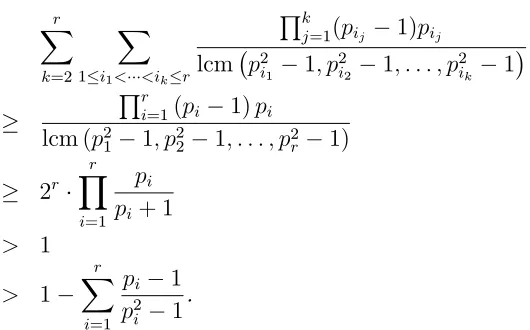
Remark 12 It is trivial that (21) is not true for n = 1. Next we shall show that (21) is
not true for n= 2 either. Since p2
i 1 mod 4 for all 1 i r, it can be seen that
lcm p21 1; p22 1; : : : ; p2r 1
Qr i=1(p
2
i 1)
4r 1
Qr i=1(p
2
i 1)
Thus we have
r X
k=2
X
1 i1< <ik r
Qk
j=1(pij 1)pij
lcm p2
i1 1; p 2
i2 1; : : : ; p 2
ik 1
Qr
i=1(pi 1)pi
lcm (p2
1 1; p22 1; : : : ; p2r 1)
2r
r Y
i=1 pi
pi+ 1
> 1
> 1
r X
i=1
pi 1
p2
i 1
.
This shows that (21) is not true for n= 2.
Table 1 The proportions ofM’s satisfy (21) of Theorem 11
n 1000000 5000000 10000000 n 1000000 5000000 10000000
3 76:347% 76:669% 76:811% 12 99:999% 99:999% 99:999%
4 67:918% 69:891% 70:482% 13 100% 100% 100%
5 99:998% 99:998% 99:998% 14 100% 100% 100%
6 95:964% 96:164% 96:204% 15 100% 100% 100%
7 100% 100% 100% 16 100% 100% 100%
8 100% 100% 100% 17 100% 100% 100%
9 100% 100% 100% 18 100% 100% 100%
10 100% 100% 100% 19 100% 100% 100%
11 100% 100% 100% 20 100% 100% 100%
To show the validity of Theorem 11, we did some experiments on the proportions of
M’s satisfying (21) of Theorem 11 and we list our results in Table 1 where the notation k
denotes the range of M, k 2 f1000000;5000000;10000000g. For example, if n = 3, then the proportion of M’s satisfying (21) of all possible values M between 1 and 1000000 is
76:347%. It can be seen from Table 1 that for n >6, the proportions of M’s satisfying (21)
of Theorem 11 are close to100%. In theory, the best result we can prove is that (21) holds
Theorem 13 For each square-free odd integer M, there exists an integer NM such that
(21) holds if n > NM. Therefore, if a is a primitive sequence of order n > NM over
Z=(M), then every element of Z=(M) occurs in the sequence a.
Proof. See Appendix A.
3.2
Estimates for the number of even numbers occurring in a
primitive sequence of order
1
over
Z
=
(
M
)
TheCarmichael’s -function (denote as “ ( )”) [25] will be frequently used in this
subsec-tion, and so we …rst make its de…nition explicit here. TheCarmichael’s -function of mis
de…ned as the universal exponent for the group of residues modulo m that are coprime to
m, i.e.,
(m) = lcm(qe1 1
1 (q1 1); q2e2 1(q2 1); : : : ; qvev 1(qv 1))
ifm =qe1 1 q
e2
2 qevv is the canonical factorization ofm. In particular, sinceM =p1p2 pr,
we have (M) = lcm (p1 1; p2 1; : : : ; pr 1), which is equal to the period of primitive
sequence of order 1over Z=(M).
Lemma 14 Let a be a primitive sequence of order 1 over Z=(M) with period T = (M).
Set v = [a]mod 2. Then for s 2 f0;1g we have
N vT; s T (Hs+ 1) M <
2T M
X
djM d>1
d3=2
(d)
lnd
+1
5 ,
Proof. Since
N vT; s =
T 1 X t=0 Hs X x=0 1 M
MX1
h=0
eM(h(a(t) 2x s)) !
= 1
M
MX1
h=0
eM( hs) T 1
X
t=0
eM(ha(t)) Hs
X
x=0
eM( 2hx) !
= T (Hs+ 1)
M +
1
M
MX1
h=1
eM( hs) T 1
X
t=0
eM(ha(t)) Hs
X
x=0
eM( 2hx) !
,
it follows that
N vT; s T (Hs+ 1) M
1
M
MX1
h=1
T 1
X
t=0
eM(ha(t)) Hs
X
x=0
eM( 2hx)
= 1
M
X
djM d>1
X
1 h M 1 gcd(h;M)=M=d
T 1
X
t=0
eM(ha(t)) Hs
X
x=0
eM( 2hx)
= 1
M
X
djM d>1
X
1 h d 1 gcd(h;d)=1
T 1
X
t=0
ed(ha(t)) Hs
X
x=0
ed( 2hx) : (22)
Note that given a divisor d > 1 of M, [ha]modd is a primitive sequence over Z=(d) with
period (d)for every integerhcoprime withd, and so it follows from Lemma 8 and Remark
9 that
T 1
X
t=0
ed(ha(t)) =
T
(d)
(d) 1
X
t=0
ed(ha(t))
T d1=2
Combining (22) and (23) yields
N vT; s T (Hs+ 1) M
1
M
X
djM d>1
X
1 h d 1 gcd(h;d)=1
T d1=2
(d)
Hs
X
x=0
ed( 2hx)
= T
M
X
djM d>1
d1=2
(d)
X
1 h d 1 gcd(h;d)=1
Hs
X
x=0
ed( 2hx)
T M
X
djM d>1
d1=2
(d)
d 1 X h=1 Hs X x=0
ed( 2hx) . (24)
Since gcd (2; d) = 1, we get
d 1 X h=1 Hs X x=0
ed( 2hx) = d 1 X h=1 Hs X x=0
ed(hx) . (25)
Applying Lemma 6 to the right-hand side of (25) we obtain
d 1 X h=1 Hs X x=0
ed( 2hx) <2d
lnd
+ 1
5 , (26)
and so the result follows from (24) and (26).
The following Theorem 15 immediately follows from Lemma 14.
Theorem 15 Let a be a primitive sequence of order 1 over Z=(M). Then there exists an
even number occurring in a if
M + 1 4
X
djM d>1
d3=2
(d)
lnd
+1
5 . (27)
Experiments show that there are about 69:720%, 75:862%, 80:787%, 87:459% and
90:619% of M’s satisfying (27) among all M’s less than 100;000, 300;000, 1;000;000,
10;000;000 and 50;000;000, respectively. It can be seen that the percentage increases as
In fact, our experiments even indicate the following conjecture which has been veri…ed
for all M’s less than 300;000.
Conjecture 16 For every primitive sequence a of order 1 over Z=(M), there exists an
even number occurring in a.
Remark 17 Conjecture 16 implies that for every primitive element 2 Z=(M), there exists an integer t 0 such that t modM is a positive even number.
Remark 18 If Conjecture 16 is true, then for every typical primitive polynomial f(x)
over Z=(M), there always exist a positive integer S and a positive even number C < M
such that xS Cmodf(x) holds over Z=(M). This is because by Lemma 1, if f(x) is
a typical primitive polynomial over Z=(M), then xS0 modf(x) holds over Z=(M) for
some positive integer S0 and some primitive element in Z=(M), and so it follows from
Remark 17 that there exists an integer t 0such thatC = t
M is a positive even number.
Thus we get xS0t t Cmodf(x) holds over Z=(M).
Although we could not completely prove Conjecture 16 by now, we obtain a asymptotic
result as follows.
LetI be a set of positive integers andS a subset ofI. For any positive integern, denote
In =fm 2I jm ng and Sn =fm2S jm ng.
The asymptotic density of S is the following limit (if it exists)
(S) = lim
n!1
#Sn
#In
,
where #Sn and #In are the number of elements in Sn and In, respectively.
Theorem 19 Let I be the set of all square-free odd integers. There is a subset S of I with
4
The distinctness of primitive sequences over
Z
=
(
M
)
modulo
2
This section is mainly devoted to the proof of Theorem 20.
Theorem 20 Let f(x) be a typical primitive polynomial of degreen = 2k+ 1 over Z=(M)
with k 1. If
(1) Conjecture 16 is true; and
(2) for any sequence z 2 G0(f(x); M), there exist two nonnegative integers t1 and t2
such that z(t1) = 0 and z(t2)2 f1; M 1g; and
(3) (M; n) is a distinguishable pair,
then for a; b2G0(f(x); M), a=b if and only if [a]
mod 2= [b]mod 2.
We …rst give some necessary lemmas.
Lemma 21 Let f(x) be a typical primitive polynomial of degree n = 2k+ 1 over Z=(M)
with k 1, and let a; b2G0(f(x); M) with [a]
mod 2 = [b]mod 2. If
(1) Conjecture 16 is true; and
(2) for any sequence z 2 G0(f(x); M), there exists a nonnegative integer t such that
z(t)2 f1; M 1g,
then there is a divisor R >1 of M such that
[a]modR = [b]modR
but
[a]modq 6= [b]modq
Proof. Setc= [a b]modM. It is clear thatc2G(f(x); M). We claim thatc =2G0(f(x); M).
Otherwise, by assumption there is an integer t 0 such that c(t)2 f1; M 1g. If c(t) = 1, i.e., [a(t) b(t)]modM = 1. Then [a(t)]mod 2= [b(t)]mod 2 implies that
a(t) = 0 and b(t) = M 1.
Since f(x) is a typical primitive polynomial over Z=(M), it follows from Remark 18 that
there exist a positive integer S and a positive even number C < M such that xS
Cmodf(x) holds overZ=(M), and so we get
a(t+S) = [C 0]modM = 0 and b(t+S) = [C (M 1)]modM =M C,
which yield
[a(t+S)]mod 2 = [6 b(t+S)]mod 2, a contradiction to the assumption that [a]mod 2 = [b]mod 2.
Similarly, it can be shown that [a]mod 2 6= [b]mod 2 if c(t) =M 1.
Therefore, we get that c =2G0(f(x); M). This implies that there at least exists a prime
divisor p of M such that a bmodp. Let R be the largest divisor of M such that
a=bmodR. Then R is the desired divisor.
Lemma 22 Let f(x) be a typical primitive polynomial of degree n = 2k+ 1 over Z=(M)
with k 1 and a; b2G0(f(x); M). Then [a]mod 2 6= [b]mod 2 if
(1) Conjecture 16 is true; and
(2) a(t ) = 0 and b(t ) =M R for some nonnegative integer t and some divisor R
of M with 1< R < M.
Proof. Since f(x) is a typical primitive polynomial over Z=(M), there exist a positive
integer S and a primitive element of Z=(M) such that xS modf(x) holds over
Z=(M). ApplyingxS modf(x) toa and b, respectively, we get
and
b(t +k S) = b(t ) k modM =M R k modM=R
for any integerk 0. By Remark 17 there is an integerk 0such that k modM=R is a
positive even number. Note that k modM=R 6= 0, and so we get
[a(t +k S)]mod 2= 0 6= 1 = [b(t +k S)]mod 2:
This implies that [a]mod 26= [b]mod 2.
Lemma 23 Let a and b be two positive integers with gcd (a; b) = 1. Then for any two
nonnegative integers t1 and t2, there exist two integers k1 and k2 such that t1 +k1 a =
t2+k2 b.
Proof. Sincegcd (a; b) = 1, by the extended Euclidean algorithm there exist two integersu
and v satisfyingu a+v b= 1. Then we get(t2 t1) u a+ (t2 t1) v b=t2 t1, i.e.,
t1+ (t2 t1) u a=t2+ (t1 t2) v b, and so the lemma follows by settingk1 = (t2 t1) u
and k2 = (t1 t2) v.
Lemma 24 Let f(x) be a primitive polynomial over Z=(M), and let d > 1 be a divisor
of M, and let s be a given element in Z=(M). If for any sequence z 2 G0(f(x); M), the
element s occurs in z, then for any sequence m 2 G0(f(x); d), the element [s]
modd occurs
in m.
Proof. Since m can be lifted to be a sequence z in G0(f(x); M) such that m = [z]
modd, it
is easy to see that the lemma holds.
With the above preparations, now we are ready to prove Theorem 20.
Proof of Theorem 20. Since the necessary condition is trivial, in the following, we only
If a; b 2 G0(f(x); M) and [a]
mod 2 = [b]mod 2, then Lemma 21 (Note that f(x) here is
a typical primitive polynomial over Z=(M) since (M; n) is a distinguishable pair) implies
that there is a divisorR >1 of M such that
[a]modR = [b]modR
but
[a]modq 6= [b]modq
for any prime divisor q of M=R. Hence it su¢ ces to show that R =M.
Suppose R < M. Let us denote Q =M=R. Note that M is a square-free odd integer,
and so R and Q are square-free odd integers and gcd(R; Q) = 1. Since [a]modR = [b]modR,
by the Chinese Remainder Theorem, a and b can be written as
a= [Q m1+R m2]modM and b= [Q m1+R m3]modM, (28)
where
m1 2G0(f(x); R) and m2; m3 2G0(f(x); Q):
Since [a]modq 6= [b]modq for any prime divisor q of Q and a b R (m2 m3) modM, it follows that [m2]modq 6= [m3]modq for any prime divisor q of Q, which implies that
[m2 m3]modQ 2G0(f(x); Q).
Firstly, since m1 2 G0(f(x); R) and [m
2 m3]modQ 2 G0(f(x); Q), it follows from the
condition (2) of Theorem 20 and Lemma 24 that there exist two positive integerst1 and t2
such that
m1(t1) = 0 (29)
and
[m2(t2) m3(t2)]modQ = 1 or Q 1. (30)
Secondly, suppose R=r1r2 ru and Q=q1q2 qv are the canonical factorizations of
R and Q, respectively. Set
R= lcm
rn
1 1 r1 1
; : : : ;r
n u 1
ru 1
and TQ = lcm (qn1 1; : : : ; q
Since (M; n) is a distinguishable pair, it follows that
gcd p
n i 1
pi 1
; pnj 1 = 1
for any pair of distinct prime divisorspi and pj of M. In particular, we have
gcd r
n i 1
ri 1
; qnj 1 = 1
for all 1 i u and all1 j v, and so we get gcd ( R; TQ) = 1.
Thirdly, since gcd ( R; TQ) = 1, by Lemma 23 there exist two integers k1 and k2 such
that
t1+k1 R=t2+k2 TQ:
Set
t =t1+k1 R=t2+k2 TQ. (31)
Note that f(x) is also a typical primitive polynomial of degree n over Z=(R), and so by
(2) of Lemma 1, there exists a primitive element Rof Z=(R)such thatx R
Rmodf(x)
holds overZ=(R). Applying x R
Rmodf(x) to m1 we can get
m1(t1+k1 R) = h
m1(t1) ( R) k1i
modR
= 0. (32)
Since TQ is the period ofm2 and m3, we have
m2(t2+k2 TQ) = m2(t2) and m3(t2+k2 TQ) =m3(t2). (33)
Then (28), (31), (32) and (33) yield
a(t ) = [Q m1(t ) +R m2(t )]modM
= [Q m1(t1+k1 R) +R m2(t2+k2 TQ)]modM
= R m2(t2) (34)
and
b(t ) = [Q m1(t ) +R m3(t )]modM
= [Q m1(t1+k1 R) +R m3(t2+k2 TQ)]modM
Finally, if [m2(t2) m3(t2)]modQ = 1, then we get
8 < :
0< m2(t2) =w < Q
m3(t2) =w 1
or
8 < :
m2(t2) = 0
m3(t2) =Q 1
.
If 8
< :
0< m2(t2) =w < Q,
m3(t2) = w 1,
then (34) and (35) together with the fact thatR is an odd integer give
[a(t )]mod 2 = [R w]mod 2= [w]mod 26= [w 1]mod 2 = [R (w 1)]mod 2 = [b(t )]mod 2, a contradiction to the assumption that [a]mod 2 = [b]mod 2. If
8 < :
m2(t2) = 0,
m3(t2) =Q 1,
then (34) and (35) yield
a(t ) = 0 and b(t ) =M R.
By Lemma 22 we get [a]mod 26= [b]mod 2, a contradiction.
Similarly, we can show [a]mod 26= [b]mod 2 if [m2(t2) m3(t2)]modQ =Q 1.
Therefore, we have that R =M. This completes the proof.
The following Corollary 25 immediately follows from Theorem 11 and Theorem 20.
Corollary 25 Letf(x)be a typical primitive polynomial of degree n= 2k+ 1 over Z=(M)
with k 1. If
(1) Conjecture 16 is true; and
(2) 1 Pri=1 pi 1
pn i 1
>Prk=2P1 i
1< <ik r Qk
j=1(pij 1)pn=ij2
lcm pn i1 1;p
n i2 1;:::;p
n ik 1
; and
(3) (M; n) is a distinguishable pair,
then for a; b2G0(f(x); M), a=b if and only if [a]
Remark 26 Experiment shows that there are about 61:148% of (M; n)’s satisfying
condi-tions (2) and (3) of Corollary 25 when M runs through all possible values between 1 and
10;000;000 and n runs through all odd integers between 3 and 19.
Note that Conjecture 16 naturally holds for the case of prime numbers, and so we can
immediately get the following Corollary 27 by replacing the condition (1) of Corollary 25
with the estimate of Theorem 15.
Corollary 27 Letf(x)be a typical primitive polynomial of degree n= 2k+ 1 over Z=(M)
with k 1. If
(1) Q+14 P
djQ d>1
d3=2 (d)
lnd+1
5 for every nonprime divisor Q of M; and
(2) 1 Pri=1 pi 1
pn i 1
>Prk=2P1 i
1< <ik r Qk
j=1(pij 1)pn=ij2
lcm pn
i1 1;pni2 1;:::;pnik 1
; and
(3) (M; n) is a distinguishable pair,
then for a; b2G0(f(x); M), a=b if and only if [a]
mod 2= [b]mod 2.
Remark 28 Experiment shows that there are about38:403%of(M; n)’s satisfying the
con-ditions of Corollary 27 whenM runs through all possible values between 1and 10;000;000
and n runs through all odd integers between 3 and 19.
5
Conclusion
Letmbe an integer greater than1. This paper studies the distinctness problem of primitive
sequences overZ=(m) modulo 2. For the case ofm =pe, a prime power, the problem was
completely solved in [19]. For the case ofm=pq, a product of two distinct prime numbers,
[21] …rst gave a partial answers, and then [18] almost completely solved it with the help
any square-free modulus and a class of primitive sequences of order 2k+ 1 is proved to be
distinct modulo 2. It is not surprising to …nd that as the number of prime factors of the
modulusm increases, the problem becomes more and more resistant to be solved. Thus to
improve the results of this paper and to completely solve this problem for general modulus
will rely on more profound results in number theory.
Appendix A: Proof of Theorem 13
As a preparation, we …rst introduce a result of Bugeaud, Corvaja and Zannier [24].
Lemma 29 ([24, Theorem 1]) If a < b are two integers greater than 1 which are
multi-plicatively independent (that is, the only integer solution (x; y) of the equation axby = 1 is
(x; y) = (0;0)), then for any given real number " >0, there exists an integer N" such that
gcd (an 1; bn 1)< an" for all integers n > N".
Proof of Theorem 13. Since the left-hand side of (21) is equal to 1 as n ! 1, it su¢ ces to show that the right-hand side of (21) is equal to0 asn ! 1, i.e.,
lim
n!1
r X
k=2
X
1 i1< <ik r
Qk
j=1(pij 1)p
n=2
ij
lcm pn
i1 1; p
n
i2 1; : : : ; p
n ik 1
= 0. (36)
Recall thatM =p1p2 pris the canonical factorization ofM with3 p1 < p2 < < pr.
Given a real number " >0. For any 1 i < j r, it follows from Lemma 29 that there
exists an integer N"(i;j) such that
gcd pni 1; pnj 1 < pn"i for all integers n > N"(i;j).
Set
N" = maxf
lnpi
lnp1
N"(i;j) j1 i < j rg,
where dae denotes the smallest integer greater than or equal to a. Then it is clear that
Let2 k r and 1 i1 < < ik r. It follows from (37) that if n > N", then
lcm pni
1 1; p
n
i2 1; : : : ; p
n ik 1
Qk j=1(p
n ij 1)
Q
1 j<s kgcd(p n
ij 1; p
n is 1)
p1k2n"=2 Yk
j=1(p
n ij 1)
p1r2n"=2 Yk
j=1(p
n ij 1):
Consequently, we have
Qk
j=1(pij 1)p
n=2
ij
lcm pn
i1 1; p
n
i2 1; : : : ; p
n ik 1
pr12n"=2 Yk
j=1
pij 1 p
n=2
ij
pn ij 1
< pr12n"=2 Yk
j=1p 1 n=2
ij
pr12n"=2 M Yk
j=1p
n=2
ij . (38)
Note thatk 2 and pij > p1 for 1 j k, and so (38) yields
Qk
j=1(pij 1)p
n=2
ij
lcm pn
i1 1; p
n
i2 1; : : : ; p
n ik 1
< pr12n"=2 M p1nk=2 pr12n"=2 M p1n=M p
n
2 (2 r 2")
1 .
Hence it can be seen that
r X
k=2
X
1 i1< <ik r
Qk
j=1(pij 1)p
n=2
ij
lcm pn
i1 1; p
n
i2 1; : : : ; p
n ik 1
<2r M p
n
2 (2 r 2")
1 .
Then choosing " < r 2, we get
0
r X
k=2
X
1 i1< <ik r
Qk
j=1(pij 1)p
n=2
ij
lcm pn
i1 1; p
n
i2 1; : : : ; p
n ik 1
<2r M p1n=2. (39)
Since r, M and p1 are all …xed integers with p1 3, then 2r M p
n=2
1 is equal to 0 as n! 1, and so (36) follows from (39).
Appendix B: Proof of Theorem 19
Lemma 30 ([26, Theorem 2]) Let N+ be the set of all positive integers. There is a subset
S of N+ with asymptotic density 1 such that, for m 2S,
where A= 0:2269688: : : and " >0 is …xed but arbitrarily small.
Let I be the set of all square-free odd integers. Note that the asymptotic density of I
inN+ is 42 6= 0 (see [27, Theorem 1]), and so by Lemma 30 we can easily get the following
Corollary 31.
Corollary 31 LetI be the set of all square-free odd integers. There is a subsetS of I with
asymptotic density 1 such that, for m2S,
(m) =m=(lnm)ln ln lnm+A+O((ln ln lnm) 1+"),
where A= 0:2269688: : : and " >0 is …xed but arbitrarily small.
As usual, for an integer m 1 we denote by (m) the number of distinct positive
integer divisors of m. We will make use of the following estimate of (m) :
ln (m) =O lnm
ln ln(m+ 2) ; (40)
see [28, Theorem 5.2].
With the above preparations, we now can prove Theorem 19.
Proof of Theorem 19. By Theorem 15, it su¢ ces to prove that there is a subset S of I
with asymptotic density 1such that the inequality
m+ 1 4
X
djm d>1
d3=2
(d)
lnd
+ 1
5 (41)
holds for m2S.
Let m be a square-free odd integer andd >1 a divisor ofm. Note that
(m) = lcm( (m=d); (d)) (m=d) (d);
and
and so
d3=2
(d)
m3=2
(m). (42)
Applying (42) to the right-hand side of (41) we get
X
djm d>1
d3=2
(d)
lnd
+1
5
X
djm d>1
m3=2
(m)
lnm
+ 1
5
< (m) m
3=2
(m)
lnm
+1
5
< C (m) m
3=2
(m) lnm,
where C is some absolute constant. Hence the inequality (41) holds if
m
4 C (m)
m3=2
(m) lnm. (43)
It follows from Corollary 31 that there is a subset S0 of I with asymptotic density 1 such
that for m2S0,
(m) = m=(lnm)ln ln lnm+A+O((ln ln lnm) 1+"), (44)
where A = 0:2269688: : : and " > 0 is …xed but arbitrarily small. Note that (m) =
O m1=ln ln(m+2) , and so the right-hand side of (43) is
O m12+ 1
ln ln(m+2)(lnm)ln ln lnm+1+A+O((ln ln lnm) 1+")
. (45)
It can be seen that (45) is m1=2+o(1) as m
! 1. Therefore there exists an integer N such that the inequality (43) holds for m2S0 and m N. Set
S =fm2S0 jm Ng.
Then S is also a subset of I with asymptotic density 1 and the inequality (41) holds for
m2S. This completes the proof.
References
[1] M. Ward, “The arithmetical theory of linear recurring series,”Trans. Amer. Math.
[2] M. Q. Huang, “Analysis and cryptologic evaluation of primitive sequences over an
integer residue ring,”Ph.D. dissertation, Graduate School of USTC, Academia Sinica,
Beijing, China, 1988.
[3] M. Q. Huang and Z. D. Dai, “Projective maps of linear recurring sequences with
maximal p-adic periods,”Fibonacci Quart.,vol. 30, pp. 139-143, 1992.
[4] Z. D. Dai, T. Beth and D. Gollman, “Lower bounds for the linear complexity of
sequences over residue ring,”inAdvances in Cryptology — EUROCRYPT’90, Lecture
Notes in Computer Science. Berlin, Germany: Springer-Verlag, 1991, vol. 473, pp.
189-195.
[5] Z. D. Dai, “Binary sequences derived from ML-sequences over rings I: periods and
minimal polynomials,”J. Crypt., vol. 5, pp. 193-207, 1992.
[6] A. S. Kuzmin and A. A. Nechaev, “Linear recurring sequences over Galois ring,”
Russian Math. Surv., vol. 48, pp. 171-172, 1993.
[7] A. S. Kuzmin, G. B. Marshalko and A. A. Nechaev, “Reconstruction of a linear
recur-rence over a primary residue ring,”Memoires in Discr. Math., vol. 12, pp. 155-194,
2009. (in Russian)
[8] D. N. Bylkov and A. A. Nechaev, “An algorithm to restore a linear recurring sequence
over the ring R =Zpn from a linear complication of its highest coordinate sequence,”
Discr. Math. Appl., vol. 20, no. 5-6, pp. 591-609, 2010.
[9] A. S. Kuzmin, “Lower estimates for the ranks of coordinate sequences of linear
recur-rent sequences over primary residue rings of integers,”Russian Math. Surv., vol. 48,
pp. 203-204, 1993.
[10] W. F. Qi, J. H. Yang and J. J. Zhou, “ML-sequences over ringsZ=(2e),”inAdvances in
Cryptology — ASIACRYPT’98, Lecture Notes in Computer Science. Berlin, Germany:
[11] W. F. Qi and X. Y. Zhu, “Compressing mappings on primitive sequences over Z=(2e)
and its Galois extension,”Finite Fields Appl., vol. 8, pp. 570-588, 2002.
[12] X. Y. Zhu and W. F. Qi, “Compression mappings on primitive sequences overZ=(pe),”
IEEE Trans. Inf. Theory, vol. 50, pp. 2442-2448, 2004.
[13] X. Y. Zhu and W. F. Qi, “Further result of compressing maps on primitive sequences
modulo odd prime powers,”IEEE Trans. Inf. Theory, vol. 53, pp. 2985-2990, 2007.
[14] X. Y. Zhu and W. F. Qi, “Uniqueness of the distribution of zeroes of primitive level
sequences overZ=(pe),”Finite Fields Appl., vol. 11, pp. 30-44, 2005.
[15] X. Y. Zhu and W. F. Qi, “Uniqueness of the distribution of zeroes of primitive level
sequences overZ=(pe)(II),”Finite Fields Appl., vol. 13, pp. 230-248, 2007.
[16] T. Tian and W. F. Qi, “Injectivity of compressing maps on primitive sequences over
Z=(pe),”IEEE Trans. Inf. Theory, vol. 53, pp. 2966-2970, 2007.
[17] Q. X. Zheng and W. F. Qi, “Distribution properties of compressing sequences derived
from primitive sequences overZ=(pe),”IEEE Trans. Inf. Theory, vol. 56, pp. 555-563,
2010.
[18] Q. X. Zheng and W. F. Qi, “A new result on the distinctness of primitive sequences
over Z=(pq)modulo 2,”Finite Fields Appl., vol. 17, pp. 254-274, 2011.
[19] X. Y. Zhu and W. F. Qi, “On the distinctness of modular reductions of maximal length
sequences modulo odd prime powers,”Math. Comp., vol. 77, pp. 1623-1637, 2008.
[20] A. Klapper and M. Goresky, “2-Adic shift registers,” in Fast Software Encryption,
Lecture Notes in Computer Science. Berlin, Germany: Springer-Verlag, 1993, vol. 809,
pp. 174-178.
[21] H. J. Chen and W. F. Qi, “On the distinctness of maximal length sequences over
[22] T. Tian and W. F. Qi, “Typical primitive polynomials over integer residue rings,”
Finite Fields Appl., vol. 15, pp. 796-807, 2009.
[23] R. Lidl and H. Niederreiter, Finite Fields.Cambridge, U.K.: Cambridge Univ. Press,
1983.
[24] Y. Bugeaud, P. Corvaja and U. Zannier, “An upper bound for the G.C.D. of an 1
and bn 1,” Math. Z., vol. 243, pp. 79-84, 2003.
[25] R. D. Carmichael, “On composite numbers p which satisfy the Fermat congruence
ap 1 1 modp,”Amer. Math. Monthly, vol. 19, pp. 22-27, 1912.
[26] P. Erd½os, C. Pomerance and E. Schmutz, “Carmichael’s lambda function,”Acta Arith.,
vol. 58, pp. 363-385, 1991.
[27] G. J. O. Jameson, “Even and odd square-free numbers,” Math. Gazette, vol. 94, pp.
123–127, 2010.