Differentially Private Linear Algebra in the Streaming Model
Jalaj Upadhyay University of Waterloo. [email protected]
Abstract
The focus of this paper is a systematic study of differential privacy on streaming data using sketch-based algorithms. Previous works, like Dworket al.(ICS 2010, STOC 2010), explored random sampling based streaming algorithms. We work in the well studied streaming model of computation, where the database is stored in the form of a matrix and a curator can access the database row-wise or column-wise. Dworket al. (STOC 2010) gave impossibility result for any non-trivial query on a streamed data with respect to the user level privacy. Therefore, in this paper, we work with the event level privacy. We provide optimal, up to logarithmic factor, space data-structure in the streaming model for three basic linear algebraic tasks in a differentially private manner: matrix multiplication, linear regression, and low rank approximation, while incurring significantly less additive error.
The mechanisms for matrix multiplication and linear regression can be seen as the private analogues of known non-private algorithms, and have some similarities with Blockiet al.(FOCS 2012) and Upad-hyay (ASIACRYPT 2013) on the superficial level, but there are some subtle differences. For example, they perform an affine transformation to convert the private matrix in to a set of{p
w/n,1}nvectors for some appropriatew, while we perform a perturbation that raises the singular values of the private matrix. In order to get a streaming algorithm for low rank approximation, we have to reuse the random Gaussian matrix in a specific way. We prove that the resulting distribution also preserve differential privacy. We do not make any assumptions, like singular value separation, as made in the earlier works of Hardt and Roth (STOC 2013) and Kapralov and Talwar (SODA 2013). Further, we do not assume normalized row as in the work of Dworket al. (STOC 2014). All our mechanisms, in the form presented, can also be computed in the distributed setting of Biemel, Nissim, and Omri (CRYPTO 2008).
Table of Contents
1 Introduction 1
1.1 Problem statements and our contributions. . . 2
1.2 Our Techniques. . . 4
1.3 Useful Facts Used in the Paper . . . 7
2 Differentially Private Sketch Generation 9 3 Applications of Private Sketch Generation 13 3.1 Matrix Multiplication . . . 13
3.2 Linear Regression . . . 14
3.3 Low Rank Approximation . . . 16
3.3.1 Tightness of Bounds and Comparison with Earlier Works . . . 20
1
Introduction
In the setting of large data analysis, one of the desired goals is to design a sub-linear space data-structure to perform computation while receiving the data online. There are many non-private algorithms in this setting. Such algorithms are calledstreaming algorithms. However, these data often contain sensitive information and privacy is as important as correct computation. Considering these two issues, a natural problem that a database curator faces is to generate a data structure that could be used to provide useful information without leaking sensitive information about an individual. The focus of this paper is space restricted streaming algorithms for answering linear algebraic queries in a private manner.
For an input matrix A, the standard techniques used in (non-private) streaming algorithms either does random samplingor compute asketch, which has the formΩAfor some choice of random matrixΩ. Dwork et al.[19] gave a private analogue of streaming algorithms that usessampling based approachfor various statistical queries, and gave an impossibility result for private analogues ofsketch based approaches for specific “statistical queries.” This raises doubts over the applicability of sketch based approach in privacy. These doubts, if true, would be unfortunate because sketch generation is one of the major techniques (and often provide better utility guarantee) in the non-private setting. In this paper, we show the first set of positive results for sketch based approach. We deviate from the traditional mechanisms of differential privacy: instead of perturbing the output of the query by adding noise, we reversibly perturb the input and then multiply noise (analogous to [5,6,59]). We give almost optimal (in terms of space required by the data-structure) differentially private sketch based streaming algorithms for three basic algorithmic problems in linear algebra.
A natural question one might ask is, why should one care about private streaming algorithms for linear algebra? To answer this, let us consider the following scenario. A large database is streamed to the curator such that, unless we store the data, it is irretrievably gone. On the other hand, the curator has limited memory and it cannot store the whole database, but expects queries on the streamed data. In such a setting, the curator would like to store a data-structure with enough information about the database to (approximately) answer the queries. This idea has been used in the streaming model without any privacy concern. However, if a curator is handling a confidential data-base, it has to store a data-structure that, in addition to providing useful information to the query-maker, does not leak any information about the individual entry of the database as per the specific requirements of a robust privacy guarantee.
The scenario mentioned above is not an artificial problem. An n×dreal-valued matrix is a natural structure for storing data aboutnentities described bydfeatures. For example, Hardt and Roth [33,34] motivated the problem of differentially private low-rank approximation (LRA) by citing the Netflix compe-tition. In addition to the Netflix type scenario, there are many other areas of large data analysis that have natural privacy concerns, like, genetics engineering finance. Computations in financial market often use var-ious linear algebraic tasks as subroutine, like matrix multiplication or linear regression. Likewise, in genetic engineering, it is common to perform a procedure that computes a full or partial singular value decompo-sition (SVD) of the covariance matrix corresponding to the input data matrix, and then appeal to standard statistical model selection criterion, like getting the top half of the spectrum of the matrix, to quantify its significance.
PRIVACY MODEL USED IN THIS PAPER. In this paper, we consider differential privacy in the streaming model where the data is streamed either row-wise or column-wise and the space available to the curator is sub-linear in the size of the dataset. There are two notions of differential privacy: event level privacy, where guarantees are at the granularity of individual records in the datasets, anduser level privacy, where guarantees are at the granularity of each user whose data is present in the dataset. Dworket al.[18] showed that it is impossible to obtain any non-trivial result with respect to the user level privacy on a streamed data. Therefore, in this paper, we restrict our attention to the event level privacy, i.e.,D1andD2areneighbouring ifkD1 −D2k ≤ 1(see [33, 34] for the motivation of this notion).We work with the following notion of privacy.
Definition 1.A randomized mechanismKgives(ε, δ)-differential privacy, if for all neighbouring data-sets
D1 andD2, and all rangeS ⊂ Range(K), Pr[K(D1) ∈ S] ≤ exp(ε)Pr[K(D2) ∈ S] + δ,where the probability is over the coin tosses ofK. Whenδ= 0, we get the traditional definition ofdifferential privacy.
1.1 Problem statements and our contributions.
In this section, we give the formal description of the problems we investigate in this paper. We also state the best known space lower bounds for non-private streaming algorithms and present our results. We note that stronger space lower bounds are achievable for each of the problems considered because of the non-zero additive error; however, the bounds stated below are presently the best known lower bounds that we can use to make any sort of optimality comparison.
We reserve the letter nfor the number of rows anddfor the number of columns of a private matrix. We assume d < n. The performance of a streaming algorithm is measured by three basic factors: the number of passes over the data stream, the space used by the data-structure, and the time taken to update the data-structure. All our private mechanisms for performing linear algebraic tasks are single-pass, achieve almost optimal space bound for one-pass algorithms, and almost linear update time. Jumping ahead, we generate linear sketch, so our mechanisms extends naturally to turnstile updates. Forbit complexity, we use the convention of Clarkson-Woodruff [12]–the entries of a matrix can be represented byκ = log(nd)-bit integers.
MATRIX MULTIPLICATION. The first problem we consider is matrix multiplication of two conforming matrices. It is one of the most important tools in numerical analysis (for example, every linear differential equations solver uses matrix product), and, therefore, wherever private data are analyzed numerically.
Problem 1.((α, β, τ)-MAT-MULT). Ann×d1matrixAandn×d2 matrixB are given. Output a matrix C so thatkATB−Ck
F ≤αkAkF · kBkF +τ with probability at least1−β.
Theorem 1.[12] Suppose n ≥ cκ/α2 for an absolute constant c > 0. Then any randomized one-pass algorithm which solves(α, β,0)-MAT-MULTwith probability at least4/5usesΩ(max{d1, d2}α−2κ)bits of space.
Kane and Neilson [39, Theorem 6.2] used the Minkowski inequality to prove the following.
Theorem 2.Given α, β > 0, and conforming matrices A and B presented column-wise. There is an
r =O(1/α2)so that ford= max{d1, d2}large enough, there is data structure which maintains a sketch of size O(rdlog(1/β) logκ+ log(1/α))andO(r)˜ update time and solve(α, β,0)-MAT-MULTfor input matrixAandB.
Theorem 22 gives a data-structure which maintains a sketch of sizeO dα−2κlog (1/β)and provides
(ε, δ)-differential privacy withτ =O(α√n). If we are ready to pay for space, then using Theorem 27, we haveO(n)˜ update time at a cost ofO dα−2κlog (1/β) logn
space data-structure.
example iscapital asset pricing modelwhich is used to predict demands [14] and investment [23].
Problem 2.((α, β, τ)-LIN-REG). Given an n×dmatrix A and a m set of n×1 column vectors B = {b1,· · · ,bm}, output a set of vectors X = {x1,· · ·xm} so that for alli ∈ [m], kAX −bikF ≤ (1 +
α) minY∈Rd×mkAY −bikF +τ with probability at least1−β/m.
LIN-REGhas also been studied in online learning model [37], which, though a different model, is closest to ours if one wishes to make any comparison. Jain, Kothari, and Thakurta [37] gave a private learning algorithm for LIN-REGwith a bound of O˜ (R6log(1/δ)√nlog1.5T)/√εα3
, where R is the maximum
2-norm of query input and T is the number of training data set. We better this bound by factor ofα4√ε
in Theorem 24.
Theorem 3.[12]Supposen≥κd/36αanddis sufficiently large. Then any randomized one-pass algorithm which solves the(α, β, τ)-LIN-REGproblem with probability at least7/9needs(d2α−1κ)bits of space.
Kane and Neilson [39, Theorem 6.5] showed the following in the non-private setting.
Theorem 4.There is a one-pass streaming algorithm for(α, β,0)-LIN-REGwhere one maintains a sketch of sizeO(d2α−1log(1/β) log(nd)). Processing each update requiresO(d+pd/αlog(1/β))computations.
Theorem 22 gives a data-structure that usesO d2α−1κlog (1/β) bits of space and provides(ε, δ) -differential privacy withτ =O(α√n). If we are ready to pay for space, then using Theorem 27, we have
˜
O(n)update time at a cost ofO d2α−1κlog (1/β) lognspace data-structure.
LOW-RANKAPPROXIMATION. The last problem we consider is low rank approximation[15]. A partial list of its applications includes principal component analysis [35], fast multipole methods [26], and H -matrices [25].
Problem 3.((α, β, τ)-LRA). Given an n×dmatrixA and a target rank k, construct a matrixΨwith k
orthonormal columns such thatkA−ΨΨTAk ≤(1 +α) minrank(Ak)≤kkA−Akk+τ with probability at
least1−βfor both Frobenius and spectral norm.
Theorem 5.[12]Supposen≥ck/for an absolute constantc >0, . Then any randomized 1-pass algorithm which solvesk-rank approximationwith probability at least5/6usesΩ(nkα−1)bits of space.
Clarkson and Woodruff [12] gave a (non-private) one-pass algorithm forLRA. They used Rademacher matrices, i.e., matrices with entries±1with probability1/2, to produce the sketch and an observation that theprojectionstep can be emulated by the information gathered during the first stage if one uses Rademacher matrices. Using their idea, Kane and Neilson [39, Theorem 6.6] showed the following in the non-private setting.
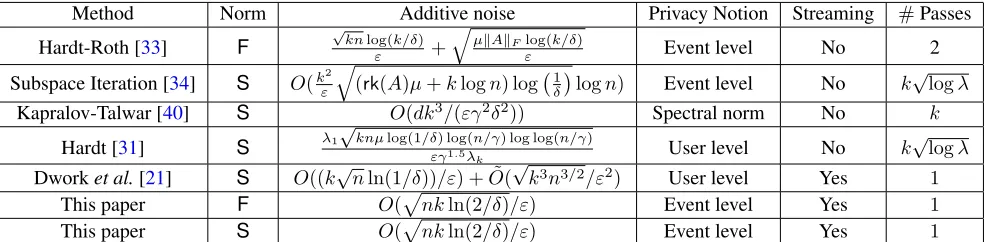
Theorem 6.There is a one-pass streaming algorithm for approximateLRA with respect to the Frobenius norm with row/column-wise updates where one maintains a sketch of sizeO(kα−1(n+d) log(1/δ) log(nd)). Processing each update requiresO(k+pk/αlog(1/β))amortized operations per entry of the input matrix. We do not know a way to prove differential privacy using [12], except to use additive noise mechanisms, much like Hardt and Roth [33]. In that case, when we try to emulate the second step, a simple analysis shows an error bound of orderk3/2. In this paper, we show how to emulate the projection step when using random Gaussian matrices. We give anO(kε−1(n+d)κ) bits data structure (Theorem 26) that could be used to publish(ε, δ)-differentially privatek-rank approximation of ann×dprivate matrix in a single pass withτ ≤O(kpnln(2/δ)/ε)for the Frobenius andτ ≤O(pnkln(2/δ)/ε)for the spectral norm.
Method Norm Additive noise Privacy Notion Streaming #Passes
Hardt-Roth [33] F
√
knlog(k/δ)
ε +
q
µkAkFlog(k/δ)
ε Event level No 2
Subspace Iteration [34] S O(k2 ε
q
(rk(A)µ+klogn) log 1 δ
logn) Event level No k√logλ Kapralov-Talwar [40] S O(dk3/(εγ2δ2)) Spectral norm No k
Hardt [31] S λ1
√
knµlog(1/δ) log(n/γ) log log(n/γ) εγ1.5λ
k User level No k
√ logλ Dworket al.[21] S O((k√nln(1/δ))/ε) + ˜O(√k3n3/2/ε2) User level Yes 1
This paper F O(pnkln(2/δ)/ε) Event level Yes 1
This paper S O(pnkln(2/δ)/ε) Event level Yes 1
Table 1: Comparison Between our Mechanism and Previous Mechanisms fork-Rank Approximation of an n×d matrix A.µdenotes the coherence ofA,γ= (λk/λk+1)−1,Sstands for spectral norm andFfor Frobenius norm.
Space Bound on the Data-Structure
Lower Bound [12] Non-private [39] Private Additive Noise
(α, β, τ)-MAT-MULT Ω dα−2κ O˜(dα−2κ) O˜(dα−2κ) O(√nα)
(α, β, τ)-LIN-REG Ω d2α−1κ ˜
O d2α−1κ ˜
O d2α−1κ
O(√nα)
Frobenius(α, β, τ)-LRA Ω(nk/α) O˜(kα−1(n+d)κ) O(kα−1(n+d)κ) O(kp
nln(2/δ)/ε)
Spectral(α, β, τ)-LRA − − O(kα−1(n+d)κ) O(p
nkln(2/δ)/ε)
Table 2: Our Results with Respect to the Best Known Space Bounds in Non-private Setting (O˜hideslog(1/β)term).
other hand, as we discuss later, we use perturbation theory along the line of [21,30].
Letλ1,· · ·, λrank(A)be the singular values of a matrixA. We compare our results with the earlier known results in Table 1 and 2. In Table 1, we compare our result forLRA with the previous works. We do not make any assumptions, like singular-value separation, normalized rows, etc, on the input matrix to compute LRAas in the previous works [21,34,40]. If we do not make any coherence assumption, one should set
µ=nin Table 1. A detail comparison is done in Section 3.3.1 taking into account the difference in privacy model and the assumptions. In Table 2, we give the best known lower bound for the space required for each of the problems, the space required by the structures in the non-private setting and by our private data-structures. The other parameters used in the tables are as defined above. Note that, we explicitly requireΩ
to be stored for the mechanism ofLRA; in the other two cases,Ωcan be picked from the distribution on the fly.
Our mechanism forLRAcan be easily compiled to give differentially privateprincipal component analy-sisusing standard algorithms that useLRAin the first step. Another important application of our mechanism for private sketch generation is in manifold learning. We do not formally state these mechanisms as there are standard algorithms for these applications that only use private matrix for one of the problems stated above and rest of the steps are deterministic function of these computations. One can also implement our mecha-nismsas distributed algorithms, a desirable feature as argued by [3]. This is because every operations used in our mechanism have efficient distributed algorithms–Jacobi method for singular value decomposition [42, Chapter 4], Cannon’s algorithm for multiplication [10], and GMRES for residual method [53].
1.2 Our Techniques.
In order to get a better utility bound, we use an idea analogous to Blockiet al.[5,6] and Upadhyay [59]. We devise a private-sketch generation (PSG) mechanism to generate a private sketch of the private matrix, where the privacy depends on the spectral property of the input matrix. At a high level, all our mechanisms use this basic mechanism while maintaining the spectral property of the input matrix (to guarantee privacy). If we use affine transformation as in [5, 59], we would end up with τ dependent onkAkF. Therefore, we use different method to maintain the required spectral property. If we instantiate PSG with random Gaussian matrix, we get the same bound on the space used by the data-structure as achieved by Clarkson and Woodruff [12].
Due to its generic construction, we can instantiatePSGwith other known projection matrices that pre-serves privacy. For example, we can use fast-Johnson-Lindenstrauss transform [1], the diagonal matrix based construction or circulant matrix based construction, which were proven to preserve privacy in [59,58,60], respectively. In this paper, we explicitly use the last two constructions, wherein, the author proved two con-structions of the formP W D, whereW is the Walsh-Hadamard matrix,Dis a diagonal Rademacher matrix, andP chosen appropriately, preserves privacy. For example, letg := (g1,· · ·,gn) beni.d.d. Gaussian
samples. Then if we useP = Π1..rC, whereC be a circulant matrix corresponding tog, i.e, fori ∈ [n],
Ci: = (gi,· · ·,gn,g1,· · · ,gi−1)andΠ1..r is a permutation matrixΠtruncated torrows, we get the
con-struction in [60]. On the other hand, if we useP = Π1..rDiag(g)Π, we get the construction in [58]. The
proof of privacy when using these constructions requires an entirely different analysis than [5,59]. This is because the published matrix is notr-independent multi-variate Gaussian due to subtle correlations between the rows of the published matrix.
At a high level, our mechanisms for(α, β, τ)-MAT-MULTand(α, β, τ)-LIN-REGare private analogues of Clarkson-Woodruff [12]. For the privacy proof to go through, we need to lift the singular value of the input matrix. Our choice to lift the singular values is constrained by keeping a check onτas well as to keep the mechanism one-pass. Once we find an optimal choice, the utility proof follows by considering the effect of our perturbation in the analysis of Kane and Neilson [39] (combined with our bound in Theorem 27 for projection matrices for mechanisms in Section 4 and Gaussian matrices bound stated in Theorem 18 for Section 2 and 3). Note that we cannot use the variance bound for4-wise independent matrices used by other non-private algorithms [12, 54] as privacy would not necessarily hold for random matrices with dependent entries in its row.
The mechanism for LRA is more complicated and markedly different from the recent private mech-anisms [21, 31, 33, 34,40] (the online version of Dwork et al. [21] uses binary tree technique [18] and assumes a lower bound condition on the optimal value, see [21, Theorem 8]) as well as the non-private algorithms [12,54]. All the previous works perturb the output by adding noise to it, while we perturb the input matrix and then multiply noise matrix. We follow the general prototype to compute aLRA, i.e., first computes a projection matrix (range findingstep) followed by the computation of aLRAby operating the projection matrix on the input matrix (projectionstep). In the most naive form, both the steps require the input matrix.
Clarkson and Woodruff [12] have shown how to emulate the projection step by using the matrices formed in the range finding step, without reusing the input matrix. Unfortunately, it only works for Rademacher matrices, while our projection matrices are generated using random Gaussian variables.
spectral and Frobenius norm. However, we have to use a different method than used in matrix multiplication and linear regression to lift the singular value to keepαin check.
The analysis forLRAused in this paper differs a lot from the analyses of Clarkson and Woodruff [12] and Sarlos [54], and is more align with perturbation theory based approach of [21,30]. The non-private algorithms in [12,54] use the trick that a good bound on matrix multiplication allows a bound onLRA. This limits its applicability to the case when the approximation metric is the Frobenius norm. In this paper, we are also concerned with the spectral norm. Moreover, the algorithm of Sarlos [54] perform two-passes over the private input matrix. The proof of Theorem 26 presented here use perturbation theory, which allows us to give bounds for both the norms in an unified manner. We note that all the previous proofs were tailored for specific norm.
RELATED WORKS. The first formal definition of Differential Privacy was given by Dworket al. [17]. They used Laplacian distribution to guarantee differential privacy for boundedsensitivity query functions. The Gaussian variant of this basic sanitizer was proven to preserve differential privacy by Dworket al.[16] in a follow-up work. Since then, many mechanisms for preserving differential privacy have been proposed in the literature [8,20,27,28,41,32,33,44,51]. All these sanitizers have a common theme: they perturb the output before responding to queries. Blockiet al.[5,6] and Upadhyay [59] took a complementary approach. They perturb the input reversibly and then perform a random projection of the perturbed matrix.
There are some recent works on differentially private low-rank approximation and differentially private streaming algorithm for statistical queries. Blumet al.[7] first studied this problem and gave a simple “input perturbation” algorithm that adds noise to the covariance matrix, an approach also taken recently by Dwork et al.[21]. This was improved by Hardt and Roth [33] who studied the low rank approximation in Frobenius norm under the low coherence assumption. Kapralov and Talwar [40] and Chaudharyet al. [11] studied the spectral low rank approximation of a matrix by giving a matching upper and lower bounds for privately computing the topkeigenvector of a matrix. Hardt and Roth [34] improved their noise bound by proposing robust private subspace iteration mechanism. All these works [11,34,40] uses some eigenvalue separation assumption. Recently, Dworket al.[21] revisited randomized mechanism to give a tighter bound. They also gave an online learning version of their mechanism under a normalized row assumption.
The literature of performing (non-private) linear algebra using streaming algorithms, started by Munro and Paterson [47], is so extensive that we cannot hope to cover it in any detail here. In the private set-ting, Dworket al.[19] studiedpan-privacy, where the internal state is known to the adversary, to answer various counting tasks, like estimating distinct elements, cropped means, number of heavy hitters, and fre-quency counts. All these mechanisms uses private version of various sampling based streaming algorithms. Subsequently, there have been some works on online differential privacy [21,37] for various tasks.
NOTATIONS AND BASICPRELIMINARIES We reserve the lettersAandB for private input matrices,
Ωfor a random projection matrix (Gaussian or the one defined in Section 2). For ann×dmatrixA, we letAdenotencopies ofAstack row-wise,Ai:to denote thei-th row ofA,A:j to denote thej-th column
ofA, andA0 to denote the symmetric matrix
0 A AT 0
corresponding toA. We letAtdenote the matrix
received afterttime epochs. When we wish to refer to both the Frobenius as well as the spectral norm, we overload the symbolk · kand drop the subscript. We lete1,· · · ,eddenote the standard basis vectors inRd. We use bold face symbols to denote vectors and0nto denote ann-dimensional0-vector. For a matrixM,
1.3 Useful Facts Used in the Paper
In the course of this paper, we use many standard results from linear algebra, random matrices, perturbation theory, and differential privacy literature.
LINEARALGEBRA. Our analysis make extensive use of linear algebra and statistical properties of Gaus-sian distribution. We give an exposition to the level required to understand this paper. LetAbe ann×d
matrix. The singular value decomposition (SVD) ofAisA = VΛUT, where U andV are left and right eigenvectors ofA, andΛis a diagonal matrix. The entries ofΛare called thesingular valuesofA. Since
U andV are unitary matrices, one can writeAi =VΛiUTfor any real valuei. We letrank(A)denotes the rank of the matrixAandλi(A)its singular values. Where it is clear from context, we simply writeλi for
the singular values.
We use various matrix norm. We use the notationk · kF for Frobenius norm. A Frobenius norm for a
matrixA= (aij)i∈[n],j∈[d]is defined as followingkAkF =Pij|aij|2. For a matrixA, we letkAk2denote the2-norm, i.e.,maxx∈RdkAxk2/kxk2. We use the symbolk · kwhen we wish to refer to both Frobenius as well as2-norm. We explicitly or implicitly use the fact that matrix norms are Lipschitz. We lete1,· · · , en
denote the standard basis vectors inRn. We denote bya|bthe vector formed by appending the vectorsaand b. A matrixM ispositive semi-definiteif all its eigenvalues are non-negative, i.e., if for allx∈Rn, we have
xTMx≥0. For twon×nmatricesM andN, we denote byM N ifM−N is a positive semi-definite matrix. We writeM 0if all its eigenvalues are positive. We note few of the key lemmata of linear algebra used in this paper.
Lemma 7.If matrixAandBare conforming, thenkABkF ≤ kAk2kBkF.
Lemma 8.[29]. LetAandBbe Hermittian matrices with only0,1entries. Then Tr(AB) ≤Tr(A)Tr(B). Moreover, ifkA−Bk ≤1, then Tr(ATA)−Tr(BTB)≤2.
Lemma 9.For matricesA, B, C, D, E, andXof appropriate dimensions, we have
1. vec(AXB) = (BT⊗A)vec(X),
2. Tr(CXB) = (vec(CT))T(Iq⊗X)vec(B),
3. Tr(DXTEXB) = (vec(X))T(DTBT⊗E)(vec(X)) = (vec(X))T(BD⊗ET)vec(X).
STATISTICALMODELSELECTION ANDPROBABILITY THEORY. One of the main methods to prove concentration inequalities is the following two step process: control the moment generating function of a random variable and then minimize the upper bound resulting from the Markov’s inequality. Though simple, it is extremely powerful. In this paper, we use the result by Birge-Massart [4] stated by Corollary 14, but we need some concepts in statistical model selection to understand the result.
Letζbe a real valued centered random variable, then the log-moment generating function is defined as
ψζ(λ) := ln(E[exp(λζ)]),∀λ ∈ R+,and theCramer’s transformis defined asψζ∗(x) := supλ∈R+(λx− ψζ(λ).Thegeneralized inverseofψ∗at a pointtis defined byψ∗−1(f) := inf{x≥0 :ψ∗(x)> f}.
The log generating function for centered random variable has some nice properties. It is continuously differentiable in a half-open intervalI = [0, b), where0< b ≤ ∞, and bothψζ and its differentiation at0
equals0. There is a nice characterization of the generalized inverse in the form of following lemma. Lemma 10.Letψbe a convex continuously differentialable function onI. Assume thatψ(0) =ψ0(0) = 0. Thenψ∗is non-negative non-decreasing convex function onR+. Moreover, its generalized inverse can be written asψ∗−1= inf
This lemma follows from the definition and basic calculus. In the area of model selection, Lemma 10 is often used to control the expectation of the supremum of a finite family of exponentially integrable variables. Pisier [48] proved the following fundamental lemma.
Lemma 11.(Pisier [48]) Let{ζf}f∈F be a finite family of random variables andψbe as in Lemma 10. Let
EA[ζ] =E[ζχA]/Pr[A]for a non-zero measurable setA. Then, for any non-zero measurable setA, we have
EAsupf∈F ζf
≤ψ∗−1(ln (|F|/Pr[A])).
If we take A = (ζ ≥ φ(x)) and applying Markov’s inequality, then using the property thatφ is an increasing function, this immediately gives us thatx≤ln(1/Pr[A]). This gives the following key lemma. Lemma 12.Let A be a set with non-zero measure and ζ be a centered random variable. Let φ be an increasing function on positive reals such thatEA[ζ]≤φ(ln(1/Pr[A])).ThenPr[ζ ≥φ(x)]≤exp(−x).
We refer the interested readers to the book by Massart and Picard [43]. In this paper, we use the following result by Birge and Massart [4] for this purpose.
Theorem 13.(Birge-Massart [4]) Let(ζf)F be a finite family of random variable andψbe a convex and
continuously differentiable function on [0, b) with 0 ≤ b ≤ ∞ such that ψ(0) = ψ0(0) = 0 and for everyu ∈ [0, b)andf ∈ F, we have log(E[exp(uζf)]) ≤ψ(u).IfN denotes the cardinality ofF.Then
Esupf∈Fζf
≤ψ∗−1(lnN),whereψ∗is the Cramer’s transformation.
Using Lemma 12 and Talagrand inequality, the authors also proved the following corollary to Theo-rem 13.
Corollary 14.(Birge-Massart [4]) Let0 < λ < 1/b for someb. Ifζ be a real valued integrable variable, andaandbbe constants such thatlog(E[exp(λζ)])≤ aλ
2
2(1−bλ). ThenPr
ζ ≥√2aτ +bτ≤exp(−τ).
A random variable,X, distributed according to a Gaussian distribution has the probability density func-tion,PDFX(x) = √21πσexp
−(x2−σµ2)2
.We denote it byX ∼ N(µ, σ2). The Gaussian distribution is invariant under affine transformation, i.e., ifX ∼ N(µx, σx)andY ∼ N(µy, σy), thenZ =aX+bY has
the distributionZ ∼ N(aµx+bµy, aσ2x+bσy2).
The multivariate Gaussian distribution is a generalization of univariate Gaussian distribution. Given a
mdimensional multivariate random variable, X ∼ N(µ,Σ), thePDFof a multivariate Gaussian is given byPDFX(x) := √ 1
(2π)rank(Σ)Det(Σ)exp − 1 2xTΣ
†x
with meanµ∈Rmand covariance matrixΣ =E[(X− µ)(X −µ)T]. If Σhas a non-trivial kernel space, then the PDFis undefined. However, in this paper, we only need to compare the probability distribution of two random variables which are defined over the same subspace. Therefore, wherever required, we restrict our attention to the (sub)space orthogonal to the kernel space ofΣ. Multivariate Gaussian distribution maintains many key properties of univariate Gaussian distribution. For example, any (non-empty) subset of multivariate Gaussians is a multivariate Gaussian and linear functions of multivariate Gaussian random variables are multivariate Gaussian random variables, i.e., ify=Ax+b, whereA∈Rn×nis a non-singular matrix andb∈
Rn, theny∼ N(Aµ+b, AΣAT). We use the following properties of Gaussian matrices, a proof could be found in Tao [57] or Muir-head [46].
Lemma 15.[57]. LetΩbe a Gaussian matrix. ThenE[kAΩBk2] ≤ kAk2kBkF +kAkFkBk2 for fixed matricesAandB.
Lemma 16. [46]. LetΩbe an×(k+p)Gaussian matrix. Then
E[kΩ−1k2F] =
s k
p−1 and E[kΩ −1k
2]≤
e√k+p p .
On input a streamed vectorv, parametersr,˜n, the mechanism samples anr×2˜nrandom matrixΩ, and Variant 1: ComputeYv= Ωv, and returnYv.
Variant 2: ComputeYv= ΩTΩv, and returnYv.
Figure 1: Private Sketch Generation (PSG) Algorithm
Theorem 18.(Johnson-Lindenstrauss lemma)Fix anyη <1/2and letmbe a positive integer. LetΩbe a
k×nmatrix with entries picked from a Gaussian distributionN(0,1), wherek≥4(α2/2−α3/3)−1lnm. Then for anymunit vector setSinRn
∀x∈S,PrM[kΩxk2∈(1±α)kxk2]≥1−2 exp(−α2k/8).
DIFFERENTIALPRIVACY. We use the following in our analysis explicitly or implicitly.
Theorem 19.(Composition Theorem [20]). Letε, δ ∈ (0,1), and δ0 > 0. If K1,· · ·,K` are each(ε, δ)
-differential private mechanism, then the mechanismK(D) := (K1(D),· · · ,K`(D))releasing the concate-nation of each algorithm is(ε0, `δ+δ0)-differentially private forε0 <p2`ln(1/δ0)ε+ 2`ε2.
Lemma 20.LetM(D)be a(ε, δ)-differential private mechanism for a databaseD, and lethbe any func-tion, then any mechanismM0:=h(M(D))is also(ε, δ)-differentially private for the same set of queries.
2
Differentially Private Sketch Generation
We study differential privacy in the well known streaming model of computation [2,47]. We present it at the level required to understand this paper (a more formal definition appears in Alonet al.[2]). This model has three entities: a stream generator or database ownerS, a (database) curatorK, and a query makerQ. S
starts the process at timet= 0and the curator initializes its data structure toD0. Thereafter, the curator is allowed only one-pass over the input matrix, i.e., it can access any entry of the data-base during exactly one time epoch, and update its data structure toDtusingDt−1and the newly accessed data-points of the matrix. At certain time,t, the query makerQmakes a queryq. The curator responds withq(Dt).
The streaming model has a resource bound on the curator. A curator is only allowed to use total polyno-mial in the size of the data basetime to construct the data structure and the size of data-structuresub-linear in the size of the data base. Fordifferential privacy, we further require that the response ofKto the query ofQshould satisfy Definition 1 with the two neighbouring streams differing in at most one entry of norm1. Researchers have also studied differential privacy on streaming data in private learning theory model [37], where the emphasis is on learning about the streamed input–one bears a regret on a hypothesis evaluated against a data point which is not yet streamed. Due to lack of space, we do not delve into the detail compar-ison of the two models.
We give the generic construction of PSG in Figure 1. If we use random Gaussian matrix as Ω, then the first variant has some resemblance to the mechanism of Blockiet al.[5] and Upadhyay [59], while the second variant can be seen as its extension in the sense that two successive application of a Gaussian matrix in a defined form also preserve privacy. However, the analogy ends here. For example, [5,59] perform an affine transformation to convert the private matrix in to a set of{p
w/n,1}nvectors, while we perform the
streaming algorithms for computing theSVD[50,56] (see [5, Algorithm 3]). Our first observation is that we do not need to subtract the entries of the matrix because of the type of queries we are dealing with. We prove the following for the mechanism in Figure 1 when initiated by random Gaussian matrices.
Theorem 21.If the singular values of the streamed matrix to the first variant of thePSGalgorithm are at least σmin :=
4prlog(2/δ) log(r/δ)/ε and for second variant are at least σmin := (4rlog(r/δ))/ε.
ThenPSGusingr×2nGaussian matrix preserves(ε, δ)-differential privacy.
The proof of the first variant follows the idea of Blockiet al.[5] taking into account the subtle differences mentioned above; however, the proof of variants 2 is more involved. We show that, for a streamed matrix
A, the probability density function of the published matrix when using the second variant is
exp(−Tr((ATA)−1Φ)/2)∆(Φ)(n−r−1)/2 2rn/2πr(r−1)/4∆(ATA)r/2Qr
i=1Γ((n−i+ 1)/2)
, (1)
where ∆(A) is the product of the singular values of A andΦ = Pr
i=1|aiihai|for n-variate Gaussians,
a1,· · ·,ar. This is the technical part of the proof; rest of the proof follows by evaluating the pdf for
neighbouring matrices. The detail proof follows.
Proof. We now prove that the second variant preserves privacy if the singular values of the streamed matrix follows the hypothesis of the theorem. In this section, we use Dirac notation to denote vectors, i.e.,|·ifor column andh·|for row vector. We start by computing the probability density function when the underlying multivariate Gaussian distribution is N(0,I). The case for arbitrary positive definite covariance matrix follows like the transition from identity to arbitrary positive definite covariance matrices in the multivariate Gaussian distribution. Letg1,· · · ,gr be i.i.d. N(0,I)ber multivariate Gaussian distribution, i.e.,gij ∼
N(0,1)for1 ≤ i ≤ r,1 ≤ j ≤ n. The distribution we are interested in isΦ = Pr
i=1|giihgi|. We use
the notationPDF(Φ;I)to denote the probability density function ofΦwhen each random variable is picked using a normal distribution, i.e., when the covariance matrix of the random variables isI.
Using the chain rule, the joint distribution of the entries ofΦis as follows.
PDF(Φ;I) =PDF(hg1,g1i;I)PDF((hg2,g1i,hg2,g2i)|hg1,g1i;I)· · ·
PDF((hgr,g1i,· · · hgr,gri)|Φ[r−1];I). (2) There are r(r + 1)/2 distinct entries, hg1,g1i,(hg2,g1i,hg2,g2i),· · ·,(hgr,g1i,· · · hgr,gri). Our aim
is to compute each individual term in the product form of the above chain rule. For this, we use the facts we first analyze the distribution of hTi−1 = (hgi,g1i,· · · ,hgi,gi−1i). Then we use the fact that there is a transformation of Jacobian one from
hgi,g1i,· · · ,hgi,g(i−1)i,hgi,gii −hTi−1Φ
−1 [i−1]hi−1
to
hgi,g1i,· · ·,hgi,g(i)i
to compute each term in the chain rule [46,49].
Distribution ofhi−1. We first prove thathi−1is(i−1)variate Gaussian distribution. Since the covariance matrix isI,andg11,· · ·,g1n,· · · ,gr1,· · ·,grnare i.i.d. N(0,1), from the elementary property of linear
functions of normal variables, conditional ongkj for1≤k≤i−1and1≤j≤n,hi−1 is(i−1)-variate Gaussian distribution with
Φ[i]=
hg1,g1i · · · hg1,gii
..
. . .. ...
hgi,g1i · · · hgi,gii
Nowg11,· · · ,grn, for everyj= 1,· · ·, nare mutually independent; therefore, we have
COV(hi−1,gij) =
COV(hgi,g1igij),· · ·,COV hgi,g(i−1)igij
andE[|hi−1ihhi−1||gkj] = Φ[i−1]for1≤j < i. This implies
COVhhi−1,gij −hTi−1Φ[−i−11](g1j,· · ·gi−1,j)
T|g
kj
i
= 0 ∀1≤k≤i−1, (3)
as the left hand side equals(g1j,· · ·gi−1,j)T−Φ[i−1]Φ−[i−11](g1j,· · ·gi−1,j)
T.
Therefore, hi−1 is independent of Pkj=1
gij −(g1j,· · · ,gi−1,j)TΦ−[i−11](g1j,···,gi−1,j) 2
. Rao [49] proved that
k
X
j=1
gij −(g1j,· · · ,gi−1,j)TΦ[−i−11](g1j,· · ·,gi−1,j) 2
∼χ2n−i+1, (4)
the standardχ2distribution with(n−i+ 1)degrees of freedom.
Computing every term in the chain rule. From the fact thathi−1is a(i−1)-variate Gaussian distribu-tion, equation (26), equation (4), and the identity
∆(Φ[i]) = ∆(Φ[i−1])
k
X
j=1
gij−(g1j,· · ·,gi−1,j)TΦ[−i−11](g1j,· · ·,gi−1,j)
2 ,
where∆(·)denotes the determinant, we first calculate the joint pdf of
hgi,g1i,· · · ,hgi,g(i−1)i,hgi,gii − hhi−1|Φ−[i−11]|hi−1i T
= exp
−12 hgi,g1i,· · · ,hgi,g(i−1)i T
Φ−[i−11] hgi,g1i,· · · ,hgig(i−1)i
(2π)(i−1)/2∆(Φ [i−1)1/2
× exp
−hgi,gii−h T i−1Φ
−1 [i−1]hi−1 2
hgi,gii −hTi−1Φ
−1 [i−1]hi−1
(n−i+1)/2−1
2(n−i+1)/2Γ((n−i+ 1)/2)
= exp −h T i−1Φ −1 [i−1]hi−1
2
∆(Φi)(n−i−1)/2
2m/2π(i−1)/2Γ((n−i+ 1)/2)∆(Φ
[i−1])(n−i)/2
=PDF((hgi,g1i,· · · ,hgi,gi−1i,hgi,gii)|Φ[i−1]), (5)
where the last step uses the fact that the transformation from
hTi,hgi,gii −hTi−1Φ
−1 [i−1]hi−1
to
hgi,g1i,· · ·,hgi,g(i)i
is one-to-one with Jacobian1.
Computing the joint distribution ofΦ. A simple arithmetic followed by plugging equation (5) in equa-tion (2) gives the closed formed expression of the pdf ofΦas
exp(−Tr(Φ)/2)∆(Φ)(n−r−1)/2 2rn/2πP
i(i−1)/2Qr
i=1Γ((n−i+ 1)/2) ×
r
Y
i=1
∆(Φ[i])(n−i−1)/2 ∆(Φ[i−1])(n−i)/2
!
= exp(−Tr(Φ)/2)∆(Φ)
(n−r−1)/2 2rn/2πn(n−1)/4Qr
i=1Γ((n−i+ 1)/2) .
transformation for multivariate Gaussian distribution. It is easy to verify that it does not matter if we mul-tiplyAfrom right or left of vectorsg1,· · ·,gr, i.e.,Pri=1A|giihgi|andPri=1|giihgi|AThave the same
distribution. More concretely, forPr
i=1A|giihgi|, the distribution is
PDF(Φ;ATA) =PDF(Φ;I)PDF
(hg1,· · ·,gri;ATA)
PDF(hg1,· · ·,gri;I) =
exp(−Tr((ATA)−1Φ)/2)∆(Φ)(n−r−1)/2 2rn/2πr(r−1)/4∆(ATA)r/2Qr
i=1Γ((n−i+ 1)/2) .
We can now prove the privacy guarantee. Letδ0 =δ/r. LetAandA˜be the matrix such thatA−A˜= E =|vihei|for an unit vector|viand somei. The published matrices corresponding to the two neighboring
matrices have the following probability density function
PDF(Φ;ATA) = exp(−Tr((A
TA)−1Φ)/2)∆(Φ)(n−r−1)/2 2rn/2πn(n−1)/4∆(ATA)r/2Qr
i=1Γ((n−i+ 1)/2)
=Cexp(−Tr((A
TA)−1Φ)/2) ∆(ATA)r/2 ,
PDF(Φ; ˜ATA) =˜ exp(−Tr(( ˜A
TA)˜ −1Φ)/2)∆(Φ)(n−r−1)/2 2rn/2πn(n−1)/4∆( ˜ATA)˜ r/2Qr
i=1Γ((n−i+ 1)/2)
=Cexp(−Tr(( ˜A
TA)˜ −1Φ)/2) ∆( ˜ATA)˜ r/2 , whereC= ∆(Φ)(n−r−1)/2/ 2rn/2πn(n−1)/4Qr
i=1Γ((n−i+ 1)/2)
. As in Blockiet al.[5], it is straight-forward to see that combination of the following proves differential privacy of the published matrix:
exp(−ε/r)≤ s
˜ ∆(ATA)
˜
∆( ¯ATA)¯ ≤exp(ε/r) and Pr
h
|Tr(ATA)−1−( ˜ATA)˜ −1Φ| ≤εi≥1−δ.
(6)
Letσ1 ≥ · · ·,≥σd ≥σmin be the singular values ofA. Letλ1,≥ · · ·,≥ λd ≥ σminbe the singular
value forA¯. Since the singular values ofA−A¯andA¯−Aare the same,P
i∈G(σi−λi)≤1using Linskii’s
theorem, whereGis the set of indices for whichσi > λi. The first bound follows similarly as in Blockiet
al.[5]. For the second bound required for the privacy, we first bound the following
Tr(ATA)−1−( ˜ATA)˜ −1Φ=Tr(ATA)−1( ˜ATA)( ˜˜ ATA)˜ −1−( ˜ATA)˜ −1Φ =Tr
(ATA)−1(A+E)T(A+E)( ˜ATA)˜ −1−( ˜ATA)˜ −1Φ =Tr
(ATA)−1(ATE+ETA)( ˜˜ ATA)˜ −1
Φ
.
Using the singular value decomposition ofA =UΣVTandA˜= ˜UΛ ˜VT, and the fact thatE =|vihei|
for somei, we can further solve the above expression.
Tr(ATA)−1−( ˜ATA)˜ −1Φ=TrVΣ−1UT|eiihv|V˜Λ−2V˜T+VΣ−2VT|vihei|U˜Λ−1V˜TΦ =Tr
VΣ−1UT|eiihv|V˜Λ−2V˜TΦ
+Tr
VΣ−2VT|vihei|U˜Λ−1V˜TΦ
=
r
X
j=1 Tr
hgj|VΣ−1UT|eiihv|V˜Λ−2V˜T|gji
+
r
X
j=1 Tr
hgj|VΣ−2VT|vihei|U˜Λ−1V˜T|gji
.
Fix aj. We bound the following.
|Trhgj|VΣ−1UT|eiihv|V˜Λ−2V˜T|gji
+Trhgj|VΣ−2VT|vihei|U˜Λ−1V˜T|gji
We now look at each term in the above expression.hgj|VΣ−2VT|viis distributed asN(0,kVΣ−2VT|vik2),
hv|V˜Λ−2V˜T|g
jiasN(0,khv|V˜Λ−2V˜Tk2),hgj|VΣ−1UT|eiiasN(0,kVΣ−1UT|eiik2), andhei|U˜Λ−1V˜T|gji
asN(0,khei|U˜Λ−1V˜Tk2). Sincev andei are unit vectors, the norm of the above four quantities are less
than1/σmin2 ,1/σmin2 + 1/σ3min,1/σmin,and1/σmin+ 1/σ2min, respectively.
Therefore, from the concentration inequality of Gaussian distribution, we have
Pr
(7)≤2
1 σ2
min
+ 1 σ3
min
ln(4/δ0)≤ε
≥1−δ0.
Taking union bound, we have with probability1−δ,−ε≤Tr(ATA)−1−( ˜ATA)˜ −1Φ≤ε.
3
Applications of Private Sketch Generation
Our mechanisms assume that the matrixAis provided as the symmetricrank(A)matrixA0corresponding toA (note the update steps in Figure 2 and 3), and stop updating the data structure once all the columns ofAare streamed. This simplifies the presentation as well as the analysis. By the argument of Hardt and Roth [33, Fact 2.8], this leads to a depreciation of the privacy guarantee by half (bothεandδ). The utility proof does not change for MAT-MULTand LIN-REGif we useAorA0. However, the analysis for utility gets more complicated in the case ofLRAbecause the right and the left singular vectors of the original matrix might be different. Keeping this in mind, we present its analysis in the most general form by working with itsSVD.
We need more care to design the mechanism for MAT-MULT and LIN-REG. For example, consider MAT-MULT. If we just feed the streamed vector (after making an affine transformation) inPSG, we end up getting an additive error proportional to the Frobenius norm of input matrices. On the other hand, after the transformation toA0 andB0 of any conforming matricesAandB, respectively, we can use the iden-tity, I A0 I B0T = I+A0B0T, to perturb the input matrix with a careful choice of parameters. Intuitively,τ is due to the identity term of the published matrix. The utility bound follows from either the application of Theorem 18 or one of its corollary. We use the same idea for LIN-REG as well. To prove
the privacy of MAT-MULTand LIN-REG, we use the first variant, while forLRA, we need both the variants defined in Figure 1.
We note that this is not the only method that could be used for the first two problems. For example, one could compute the SVDusing one of the standard streaming algorithms [50, 56]–by say, setting the target rank in the algorithm of [50] to berank(A), and then concatenateetto the matrix. The privacy proof
remains the same, but this makes the mechanisms more complicated. Moreover, in disguise, this is also an affine transformation, so leads to an added utility loss. We do not explore this idea any further.
3.1 Matrix Multiplication
Our mechanism for MAT-MULT(Figure 2) lifts the singular values of the input matrices above the threshold
of the first variant of Theorem 21 and Theorem 27, while not introducing error independent of Frobenius norm.
Theorem 22.LetΩbe the random matrix used byPSG. Then, the data-structure generated by mechanism stated in Figure 2 uses O(dα−2κlog(1/β)) bits of space, and on input conforming matrices A and B, computes(α, β, τ)-MAT-MULTwithτ ≤
√
nαadditive error and(ε, δ)-differential privacy.
The space requirement of the data-structure is straightforward by the choice of r. The privacy guar-antee follows becauseA¯A¯T U(16rln(2/δ)/ε) ln(16r/δ)2IUT = σ2minI, i.e., the singular values of the
Initialization. On input parametersα, β, ε, δ, setr = O(log(1/β)/α2). Sets =p16rln(2/δ)ε−1ln(16r/δ). Set the intial sketches ofAandBto be all zero matricesYA0 andYB0.
Data-structure Update. On input a columnaof ann×d1matrixAand columnbof ann×d2 matrixBat time epocht, setd= max{d1, d2},A¯:a=s ea 0n+d A:a
andB¯:b=s eb 0n+d B:b
. Invoke variant 1 of
PSGwith inputs( ¯A:a, r, n+d)and( ¯B:b, r, n+d). Update the sketches by replacing the columnsaofYAt−1
andbofYBt−1by the respective returned sketches to get the sketchYAt, YBt.
Answering Matrix Product: On request to compute the matrix product at timet, compute the productYT
AtYBt/s 2.
Figure 2: The Mechanism for(α, β, τ)-MAT-MULT
variance bound onkATΩTΩB−ABk2
F by Kane and Neilson [39], boundingkΩTΩ−Ik2that results from
taking in to account the perturbation made to the input streams in Step 1, and norm inequalities. The details follow.
Proof. The proof of the utility of mechanism in Figure 2 follows readily from Lemma 23, which is the bound computed by Kane-Neilson [39].
Lemma 23.LetΩbe ak×dmatrix as constructed in Section 2 with every entries picked from the distribution
N(0,1), then for a set ofmvectors,v1,· · ·,vm ∈ Rn, with probability at least1−2 exp(−kα2/8), for any pairvi,vj, we have|hΩvi,Ωvji − hvi,vji| ≤αkvik · kvjk.
We need to upper bound the quantitykATB−A¯TΩTΩ ¯B/s2k
F. First note that
¯
ATΩTΩ ¯B=s2 I 0 0 ATΩTΩ I 0 0 BTT=s2(IΩTΩI+ATΩTΩB).
Therefore,
kATB−A¯TΩTΩ ¯B/s2kF =kATB−ATΩTΩB−IΩTΩIkF ≤ kATB−ATΩTΩBkF+kI−ΩTΩkF. (8)
To bound the first term, let random variableXijdenote(ATB)ij−(ATΩTΩB)ij. Then, with probability
at least1−2 exp(−kα2/8), we have|X
ij| ≤αkA:ik2· kB:jk2. Using Lemma 23, this results in
kATB−ATΩTΩBk
F
2
=X|Xij|2 ≤X
α2kAi:k2
2kB:jk22 ≤α2kAk2FkBk2F. (9)
For the second term, we need to bound the variance on unitaries. This follows from the following set of inequalities.
kU1TΩTΩU2−U1U2k2=kU1(ΩTΩ−I)U2k2=kΩTΩ−Ik2
=
maxx
T(ΩTΩ−
I)x hx, xi
≤((1 +α)−1) =α, (10)
where the inequality follows from Theorem 18 and noting thatrstill satisfies the theorem requirement. The result follows by adjusting the value ofαafter plugging this and equation (28) in equation (8), using the fact thatkXk2≤ kXkF ≤√nkXk2for anyn×nmatrixX.
3.2 Linear Regression
Our mechanism for LIN-REG(Figure 3) lifts the singular values of the input matrices above the threshold
Initialization. On input parametersα, β, ε, δ, setr =O(dlog(1/β)/α),s=p16rln(2/δ)ε−1ln(16r/δ), andYA0 to be all zero matrix.
Data-structure Update. On input a columncof ann×dmatrixAat time epocht, setA¯:c =s ec 0n+d A:c
, and invoke variant 1 ofPSGwith inputs( ¯A:c, r, n+d). Update the sketch ofAby replacing the columncof YAt−1by the returned sketches to get the sketchYAt.
Answering Queries. On being queried with a vectorbi, setb¯i= ei 0n+d bi
, and invokePSGwith input matrix
(¯bi, r, n+d)to get the sketchYbi. Compute a vectorxisatisfyingminxkYAtxi−Ybik. Figure 3: The Mechanism for(α, β, τ)-LIN-REG
Theorem 24.LetΩbe r×2(n+d)matrix used by PSG, wherer = O(dlog(1/β)/α). Then the data-structure generated in the mechanism of Figure 3 requires O(d2α−1κlog(1/β))bits and allows to solve
(α, β, τ)-LIN-REGproblem in an(ε, δ)-differentially private manner withτ ≤O(√nα).
The utility bound for LIN-REGfollows from taking in to account the changes made to the input matrices by our mechanism and a straightforward application of the result of Kane and Nelson [39] to the proof idea of Sarlos [54]. Sarlos [54] observed that the utility guarantee for LIN-REGis provided as long asΩprovides MAT-MULTwith multiplicative errorpα/d, andΩis anO(d)-space embedding. The latter follows from the standard result on any Johnson-Lindenstrauss transform withr =O(rank(A) + log(1/β)/α2). Using Indyk and Motwani [36], we only needr=O(d2α−1log(1/β))as in Theorem 24. The details follow. Proof. The formal proof of Theorem 24 is identical to Clarkson and Woodruff [12] modulo the analysis to consider the lift of singular value and using the bound of Kane and Neilson [39]. We present it next. LetB
be the matrix formed by the set of queries{b1,· · ·,bm}. Since the columns ofU is a set of orthonormal
vectors, we haveU UTU =U andkUTU Ck
F =kU CkF for any matrixC. Therefore, it suffices for the
utility bound to prove a bound onkUTA( ¯¯ X−X∗)k. For this, we first prove thatUTΩTΩ ¯A( ¯X−X∗)has
a small norm. We have
UTΩTΩ ¯A( ¯X−X∗) =UTΩTΩ ¯A( ¯X−X∗) +UTΩTΩ(B−A¯X)¯ =UTΩTΩ(B−AX¯ ∗).
This is becauseUTΩTΩ( ¯AX¯ −B) = ¯ATΩTΩ( ¯AX¯ −B) = 0.Therefore, from Theorem 22 withα0 = p
α/d(since we choserin Theorem 22 which differs by a factor ofαand1/dwith respect to that in The-orem 24), we have
kUTΩTΩ ¯A( ¯X−X∗)k
F =kUTΩTΩ(B−AX¯ ∗)kF
≤√αkB−AX∗kF +√τ
From the sub-additivity of the norm and property of conforming matrices, we have
kUTA( ¯X−X∗)kF ≤ kUTΩTΩ ¯A( ¯X−X∗)kF +kUTΩTΩ ¯A( ¯X−X∗)−UTA( ¯¯ X−X∗)kF
≤√αkB−AX∗kF +
√
τ +kUTΩTΩU −Ik2· kUTA( ¯¯ X−X∗)kF
To move forward, we need the following lemma, an equivalent for equation (10) with this value ofr. Lemma 25.(Kane and Neilson [39])Given r = O(dlog(1/β)/α). Let U be any unitary matrix. If Ω
satisfies the Johnson-Lindenstrauss bound, then with probability at least1−β, we havekUΩTΩUT−Ik2≤ α.
Now rearranging the terms, we getkUTA( ¯¯ X−X∗)k
F ≤2
√
On input parametersα, β, ε, δ, the target rankk, setw = ckε−1ln(2/δ)
for a global constantc. Pick a2n×k standard Gaussian matrixΩ. On input ann×nmatrixAof rankr, the mechanism does the following:
Range Finding. ComputeYA= wI AΩby computing wei Ai:
Ωfor all streamsAi:,1≤i≤nand append-ing them row-wise. LetΠYA= ΨΨ
Tbe the projection matrix corresponding to the range ofYA.
Projection: When the whole matrix is streamed, the curator does the following:
1. Let the (unknown) matrixB = ΨTAtΨ.
2. Use the minimal residual method to find a solution toBΨTtΩ = ΨTtYt.
3. Compute the decomposition ofBt= ¯UtΛtU¯tT, form the productUtˆ = ΨtUt, and publish¯ Utˆ ΛtUˆtT. Figure 4: The Mechanism fork-rank Approximation
on the norms. More concretely, with probability at least1−2β
kAX¯ −Bk2F =kAX∗−Bk2F +kA( ¯X−X∗)k2F ≤(1 + 4α)kAX∗+BkF +τ.
Adjusting and renaming the values ofαandβ, we get the claim of the theorem.
3.3 Low Rank Approximation
We use the prototype mentioned in [30], which was also used by Hardt and Roth [33] to improve the worst-case lower bound under alow coherenceassumption. The main prototype in [30] constructs a low-dimensional subspace that captures the action of the matrix (range-finding), and then restrict the matrix to that subspace to compute the required factorization (projection). More concretely, range finding finds a measurement matrix Y = AΩ, where Ωis a Gaussian matrix and computes the orthonormal projection matrixΠY corresponding to the range defined byY; projection then computes a rankkmatrixB = ΠYA.
From this exposition, it seems that privacy preserving algorithms are required for both the stages; however, we show that the two-step prototype mentioned in [30] can be replaced by a two-step algorithm in which the input matrix is explicitly needed only in the first step at the expense of privacy proof requiring both the variants ofPSG. We first note that ifΨΨTAis aLRAofA, i.e.,kA−ΨΨTAk ≤η, then so isΨΨTAΨΨT. This is becausekA−ΨΨTAΨΨTk=kA−ΨΨTA+ ΨΨTA−ΨΨTAΨΨTk ≤ kA−ΨΨTAk+kΨΨTA−
ΨΨTAΨΨTk ≤ 2η.The crucial observation now for the single passLRAwhenΩis a Gaussian matrix is thatΩ,Y, and the basis for the range ofY contains enough information to compute the matrixB. The range-finding is private as in Theorem 22 and 24, but as we are reuseΩ, we have to rely on privacy of the second variant ofPSGalgorithm to prove the privacy of projection step. In order to simplify the presentation, we state our mechanism for symmetric matrices in Figure 4 ([34,40] also made this assumption) to compute a LRAof theSVDofA.
Theorem 26.Letλ1 ≥ · · · ≥λrk(A)be the singular values ofA. Then for an over-sampling parameterp, there is a single-pass mechanism that computeLRA usingO(k(n+d)α−1log(nd))bits while preserving
(ε, δ)-differential privacy such that
kA−Ak¯ F ≤
1 + k p−1
1/2 min
rk(A0)<kkA−A
0k
F +
2k ε
s
(n+d) ln(2/δ)
p , and (11)
kA−Ak¯ 2 ≤
1 + k p−1
1/2
λk+1+ e
q
(k+p)P
j>kλ2j
p +
2pk(n+d) ln(2/δ)
ε . (12)
the first step pushes the singular values above the threshold of Theorem 21. Since rest of the computations are deterministic, privacy follows from Lemma 20, Theorems 21 and 19, and our choice ofw. The space guarantee is also straightforward. Now,ΠY has a decompositionΨΨTfor some orthonormal basisΨ, which
also forms an orthonormal basis for the approximated matrixA¯after the run of the algorithm. Therefore,B
must satisfyBΨTΩ≈ΨTY. This is what step 2 does. Therefore,A¯t= ΠYAtfor the projection operator
ΠY with the same range asΨ. The rest of the utility proof relies heavily on the fact that Tr(ΩΩT)−1 is
bounded, left singular vectors of A does not play any essential role in the concentration bound, and the rotational invariance of Gaussian vectors. We bound the norm of k(I−ΠY)Akfor both the spectral and
Frobenius norm. Once we have the bound onk(I−ΠY)Ak, we use standard results in random matrix theory
to get the final bounds.
The proof is very different from the proof of Sarlos [54]’s two-pass algorithm and Clarkson-Woodruff [12]’s one-pass algorithm, wherein the authors use the error bound computed in the estimate of MAT-MULT. Here we use perturbation theory, more aligned with [21,30]. The details proof follow.
Proof. The space complexity is easy to follow as we need to store the matrixΩand the sketch. The pri-vacy guarantee follows from Theorem 21 and noting that all the singular-values of the matrix on whichΩ
is operated from the right is greater than the threshold required for the statement of the Theorem 21, and the distribution ofΨTΩis the same as that of the second variant as we reuse Ω[9]. Now, it follows from
the proof of the second variant (Theorem 21) that it does not matter if we multiplyA (or AT) from left (or right, respectively) of vectorsg1,· · · ,gr, i.e.,
Pr
i=1A|giihgi| = AΦ and
Pr
i=1|giihgi|AT = ΦAT
have the same distribution. Combining all these arguments, we have the distribution of the second step of projection stage is identical to the second variant in Figure 1, modulo some deterministic computation. Since, any arbitrary post-processing preserves differential privacy, we can now complete the proof by in-voking Theorem 21. The privacy guarantee due to Theorem 21 requires the minimum singular value to
be greater than 4
√
klog(2/δ) log(k/δ)
ε for the first variant and
klog(k/δ)
ε for the second variant. By our choice
ofw, the singular values of the streamed matrix to the algorithm for PSG are at least the eigenvalues of
√ w2
I+ATA, which are all greater than 16kln(2ε /δ). Since 4 √
klog(2/δ) log(k/δ)
ε 16
klog(k/δ)
ε , the privacy
guarantee follows from Theorem 21.
In more detail, it follows from Bura and Pfeiffer [9]1 and the proof in Theorem 21 that, for Φ = Pr
i=1|giihgi|and large enoughn, the distribution ofΨTΩis
exp(−Tr((ATA)−1(D−1R)(D−1R)TΦ)/2)∆(Φ(D−1R)(D−1R)T)(n−r−1)/2 2rn/2πn(n−1)/4∆(ATA)r/2Qr
i=1Γ((n−i+ 1)/2)
.
The proof for the first expression of equation (6) is as before. Following the rest of the steps of Theo-rem 21, using Lemma 8, we compute for fixedj ∈ [k+p], instead of equation (7), the second expression in equation (6) is bounded by the following expression
Tr
VΣ−1UT|eiihv|V˜Λ−2V˜T|αjihαj|+VΣ−2VT|vihei|U˜Λ−1V˜T|αjihαj|Tr(D−1R)(D−1R)T .
Using the fact that Tr((DTD)−1) = Tr((ΩTΩ)−1), Lemma 17 with p = k+ 1, and following the remaining steps of Theorem 21, we have the privacy result for computingB. The complete proof follows from the discussion stated at the start of this proof.
Remark1. We take the liberty to diverge a little to understand the intuition behind Bura and Pfeiffer [9]. One may skip this part without effect the readability of the rest of the section. The result of Bura and Pfeiffer [9]
1
uses advance statistical tools, but the intuition can be argued using some basic statistics. On the other hand, it is well known that the singular values of random matrices are notoriously hard to compute (see Rudelson and Vershynin [52]). The basic reasoning behind their proof is the following line of argument. Since the entries of ann×rmatrixΩisN(0,1), then for any orthogonal matricesG∈Rn×nandR ∈
Rr×r, the entries of GΩRTis also i.d.d. normal. This can be seen by translating to the vector form of the matrix, i.e.,v=vec(V)
representrnvector with entriesvi+nj =Vij. Thenvec(GΩRT) = (G⊗R)vec(Ω)using Lemma 9. Now
G⊗Ris also an orthogonal matrix, and multivariate Gaussian distribution is preserved if one multiply by an orthogonal matrix. Therefore, the distribution of the left singular vectors ofΩ is the same asGΩRT. Consequently, for large enoughn, the distribution of each singular vector is also spherically distributed.2
UTILITY GUARANTEE. In Section 3.3, we showed that the mechanism for symmetric matrices does what [30, Section 1.2] prototype algorithm achieves. To construct a mechanism for non-symmetric matrices, we construct two sketchesYtandYˆtcorresponding toA1andA2 using a single pass overAand using two Gaussian matrices Ω andΩˆ of appropriate dimension, where A1 = wI A andA2 = AT wI for appropriate dimension identity matrices in bothA1 andA2. Basically, we do the following using a single pass over the matrixA:
Y
ˆ Y
=
wIn A
AT wId
Ω ˆ Ω
,
whereInis ann×nidentity matrix.
Since Y YˆTcorresponds to a symmetric matrix, we can use the steps used in the projection stage in Figure 4. Note that Clarkson and Woodruff [12] computeATAin a single-pass over the matrixA.
Keeping the most general case in mind, we first show that the left singular vectors have hardly any role to play in bounding the perturbation. We assume that we performSVD. Let theSVDofAbeUΣVT. In the following discussion, we compute the approximation of wI A and denote it byA. This is because wI Ais more manageable and any upper bound on the approximation of this matrix is an upper bound on the approximation of the original matrix. The actual bound as computed in Figure 4 can be obtained by simply performing the computation on the singular value decomposition as performed in the last step of mechanism and using the sub-additivity of norms. From the discussion above, we know thatA¯ = ΠYA;
therefore, we need to boundk(I−ΠY)Ak, where, unless specified, in this sectionk · krefers to both the
Frobenius as well as the spectral norm. From the H¨older’s inequality on the second moment, we have
E[k(I−ΠY)AkF]≤ Ek(I−ΠY)Ak2F
1/2
. (13)
We now boundk (I−ΠY)Ak. LetΛ =
√
Σ2+w2. LetΛ
1 denote the diagonal matrix formed by the firstksingular values andΛ2 be the diagonal matrix for the rest of the singular values. We decomposeVT similarly. Let the matrix formed by the firstkrows ofVTbeV1Tand by the rest of the rows beV2T.
Left singular vectors have essentially no role in the approximation bound. Recall thatΩis an2n×k
matrix; therefore,Y =AΩ =U Λ1V1TΩ Λ2V2TΩ T
.It would be useful to consider the firstkrows ofY
to be the one that mimics the action ofAand the rest of the rows ofY as a small perturbation that we wish to bound. We first prove that the left singular vectors have essentially no role to play in bounding the error. LetA0 =U A, then the following chain of equalities are straightforward.
k(I−ΠY)Ak=kUT(I−ΠY)Ak=kUT(I−ΠY)U A0k=kIA0−UTΠYU A0k. (14)
Therefore,kA0−UTΠ
YU A0k = k(I−ΠUTY)A0k.A useful way to understand the above expression
is to view this geometrically and recall that unitary are just rotation in the space: projection by an unitary, followed by any projection operator, followed by the inverse of unitary brings us to the same space as projection by an operator followed by the inverse of the unitary.
Finding and bounding an appropriate perturbed matrix. We now use the identity that, for two op-eratorsO1 andO2, if the range of O1 is a subset of the range of O2, then the projection of any matrix using O1 will have all its norm smaller than the projection by O2. More concretely, we find a matrix C such that its range is a strict subset of the range ofUTY. We obtain this matrix by flattening out the first
k rows of UTY. This is in correspondence with our earlier observation that the first k rows mimic the action of A and other rows are the perturbation that we wish to bound. Since the first k rows ofUTY
is Λ1V1TΩ, let C := UTYΩ−1V1Λ−11. The rows corresponding to the perturbation are Λ2V2Ω. Thus, C= I Λ2V2TV1Λ−11
T .
Let us denote byS = Λ2V2TV1Λ1−1.It is not difficult to see thatrange(C)⊂ range(UTY). Moreover, ΠC I, ΠUTYΠCΠUTY ΠUTY. This follows from the fact that range(C) ⊂ range(UTY) and the
following derivation
ΠUTY ΠUTYΠCΠUTY = ΠCΠUTY = (ΠUTYΠC)T= ΠC.
An immediate result of the above is the following:
k(I−ΠUTY)A0k ≤ k(I−ΠC)A0k. (15)
Since,ΠC =C(CTC)−1CT, we have the following set of derivations.
ΠC =
I
S I S
T
I S
−1
I ST=
I S
I+STS−1 I ST
=
I(I+STS)−1 S(I+STS)−1
I ST=
(I+STS)−1 (I+STS)−1ST S(I+STS)−1 S(I+STS)−1ST
(I−STS) (I+STS)−1ST S(I+STS)−1 0
,
where the last inequality uses the fact thatI−STS (I+STS)−1andS(I+STS)−1ST0. Therefore,
I−ΠC
STS I−(I+STS)−1ST I−((I+STS)−1ST)T I
.
ConjugatingI−ΠCwithΛ, and applying the fact that for every positive definite matrix,P =
X Y YT Z
,
we havekPk ≤ kXk+kZk, we get
k(I−ΠC)A0k ≤ kSTSA0k+kA0k (16)
for any norm. From here on, it is easy arithmetic to show that
k(I−ΠC)A0k ≤
q kΛ0
ERROR BOUND FORFROBENIUS NORM We now exploit the rotational invariance of a Gaussian distri-bution. An important point to note is that(ΩΩT)−1 exists and has a well defined trace. The first part of the right hand side of equation (17) is immediate. Thus, if we boundE[kΛ02VT2Ω(V1Ω)−1k], we are done. This could be accomplished as below.
E[kΛ2VT2Ω(V1Ω)−1k]≤ v u u u tE
X
ij
|(Λ2)0ijΠij(V1Ω−1)jj|
≤ q
kΛ02kFkΩ−1kF
= r
kΛ0
2kFTr
(ΩΩ−1)T=qkΛ0
2kFTr(ΩΩT)−1 ≤
q
Tr(ΩΩT)−1 min
rk(A0)≤kkA−A
0k
F +
q
(n+d)wTr(ΩΩT)−1.
The utility guarantee follows by plugging this value in equation (17), and combining equation (13) and the fact that(ΩΩT)−1has a well defined tracek/(p−1)[46].
ERROR BOUND FOR SPECTRAL NORM In order to bound the second term, we use few well known
facts in the theory of random matrices to simplify equation (17). In particular, using Lemma 15 and 16, and Holder’s inequality, the statement of the theorem for the spectral norm follows. The utility bound then follows using the same arithmetic of representingΛ0 in terms ofΛas done in the case of Frobenius norm. In more details, we first bound
E h
kΛ02V2TΩ(V1TΩ)−1ki≤ kΛ02kEhk(V1TΩ)−1k2Fki1/2+kΛ02kF
E
h
k(V1TΩ)−1ki ≤ kΛ02k E
kΩ−1k2Fk1/2+kΛ02kF E
kΩ−1k ,
and then invoke Lemma 16 followed by the sub-additivity of norms. Making these substitution and on simplification, we get the bound stated in equation (12) of Theorem 26.
(17)≤
1 + k p−1
1/2
kΛ2k2+
eq(k+p)P
j>kλ2j
p +
2pk(n+d) ln(2/δ)
ε .
3.3.1 Tightness of Bounds and Comparison with Earlier Works
We compare our results with the best possible results in the non-private setting. Eckart and Young [22] have shown that the quantityminrk(A0)<kkA−A0kF in the first term of equation (11) is optimal. Likewise, Mirsky [45] proved thatλk+1 is the minimum spectral error for k-rank approximation. The second term in equation (12) shows that we also pay for the Frobenius norm error when doing a unified analysis. How-ever, when the oversampling parameterp ≈ k, then the factor on λk+1 is constant and that on the second term is of orderk−1/2. In fact, on closer analysis,
kA−Ak¯ 2 ≤ 1 + k p−1 +
e(p(k+p) min{d, n} −k) p
!
λk+1+
2pk(n+d) ln(2/δ)