The Hash Function “Fugue”
Shai Halevi William E. Hall Charanjit S. Jutla IBM T.J. Watson Research Center
Abstract
We describe Fugue, a hash function supporting inputs of length upto 264
−1 bits and hash outputs of length upto 512 bits. Notably, Fugue isnot based on a compression function. Rather, it is directly a hash function that supports variable-length inputs.
The starting point for Fugue is the hash function Grindahl, but it extends that design to protect against the kind of attacks that were developed for Grindahl, as well as earlier hash functions like SHA-1. A key enhancement is the design of a much stronger round function which replaces the AES round function of Grindahl, using better codes (over longer words) than the AES 4×4 MDS matrix. Also, Fugue makes judicious use of this new round function on a much larger internal state.
Contents
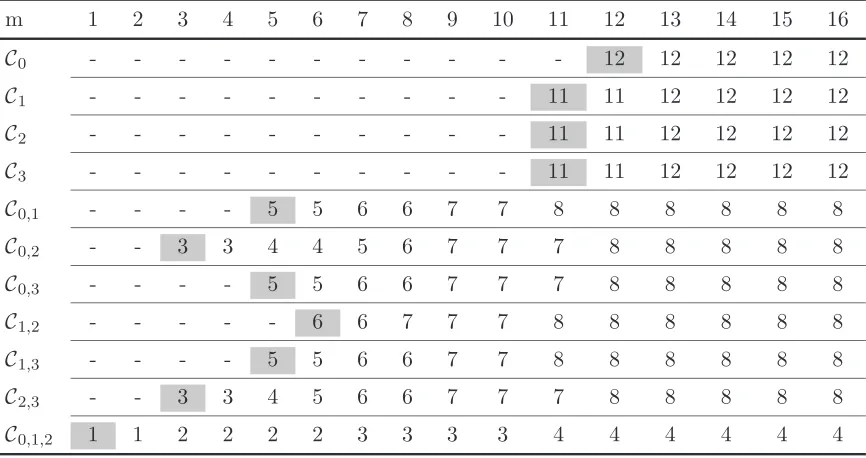
1 Introduction 5
1.1 Speed estimates . . . 6
1.2 Statement of Expected Strength . . . 6
1.3 Statement of Advantages and Limitations . . . 7
1.4 Main Idea . . . 7
1.5 Super-Mix Transformation . . . 11
I Specification of Fugue 14 2 Basic Conventions 14 3 Galois Field GF(28) 15 4 Specification of Fugue-256 15 4.1 Substitution Box . . . 15
4.2 Super-Mix . . . 16
4.3 The Hash Function F-256 . . . 18
4.3.1 The Round Transformation R. . . 18
4.3.2 The Final Round G . . . 20
4.3.3 Initial State . . . 20
4.3.4 Hash Output . . . 20
4.3.5 Complete Specification of the Hash Function F-256 . . . 21
4.4 The Hash Function Fugue-256 . . . 21
4.5 Pseudo-Random Function PR-Fugue-256 . . . 22
4.6 Compression Function C-Fugue-256 . . . 22
4.7 Other Modes of Operation . . . 23
5 Specification of Parameterized Fugue 23 5.1 The parameterized functionF[n, k, s, r, t] . . . 24
5.1.1 A Complete Specification of F[n, k, s, r, t] . . . 26
5.2 Parameter Specifications for Different Output Lengths . . . 27
5.3 Fugue-224 and related functions . . . 27
5.5 Fugue-512 and related functions . . . 29
5.6 A Weaker Version of Fugue-256 . . . 31
II Implementation 32 6 Software and Hardware Efficiency 32 6.1 Implementing Fugue on 32-bit Machines . . . 32
6.2 Implementing Fugue on 64-bit Machines . . . 32
6.3 Implementing Fugue on 8-bit Architectures . . . 32
6.4 Hardware Implementations of Fugue . . . 34
6.5 Other Implementations of Fugue . . . 35
III Security Analysis 36 7 The Super-Mix Matrix and Related Linear Codes 36 7.1 Linear Codes . . . 36
7.2 Linear Codes Related to the Super-Mix Matrix N . . . 37
7.3 Implications for the Differential Properties of SMIX . . . 38
8 Diffusion Properties of Fugue-256 41 8.1 Diffusion of input bytes . . . 41
8.2 Diffusion of state bytes . . . 43
8.3 Diffusion in the TIX-less roundsG1 . . . 43
8.4 Diffusion in the entire final transformation G . . . 46
9 Properties of the S-Box 46 10 Differential Analysis of Fugue-256: Internal Collisions 48 10.1 Backward Evolution of the Internal State . . . 48
10.1.1 Round Zero . . . 49
10.1.2 Introducing Tables 8 and 9 . . . 50
10.1.3 Round −1 . . . 53
10.1.4 Round −2 . . . 53
10.1.6 Round −4 . . . 54
10.1.7 Summing it up . . . 54
10.2 Differential Attacks . . . 56
10.2.1 Pure differential Attacks . . . 56
10.2.2 More Realistic Differential Attacks . . . 60
10.2.3 Beyond Random Initial State . . . 62
10.2.4 The Length-Padding in Fugue-256 . . . 63
10.3 A Tighter Analysis for Theorem 10.2 . . . 64
11 Differential Analysis of Fugue-256: External Collisions 65 12 Various other Properties of Fugue-256 69 12.1 Pre-Image Resistance of Fugue-256 . . . 69
12.2 Second Pre-Image Resistance of Fugue-256 . . . 69
12.3 Strength of MD-Mode usage of C-Fugue-256 . . . 71
12.4 Analysis of PR-Fugue-256 as a PRF . . . 71
12.4.1 Linear Cryptanalysis . . . 72
12.4.2 Differential Cryptanalysis . . . 72
12.5 PR-Fugue-256 as a Universal Hash Function . . . 74
13 Other Security Considerations 77 13.1 A Meet-in-the-Middle Attack on Fugue . . . 77
13.2 Side-channel Cryptanalysis Attacks . . . 78
14 Cryptanalysis of wFugue-256 78 15 Strength of Fugue-224, Fugue-384 and Fugue-512 81 15.1 Collision Resistance of F-224 . . . 81
15.2 Collision Resistance of F-384 . . . 81
15.3 Collision Resistance of F-512 . . . 82
1
Introduction
Most hash functions to date are designed using the Merkle-Damgard paradigm [14, 6]: one first designs a compression function for fixed-length messages, and then extends it to variable-length messages by iterating the compression function for every block of the input.
This style of design has some drawbacks however: The most obvious problem is the message extension property of Merkle-Damgard, and over the years we have seen many other “generic” attacks, such as Joux’s multi-collisions attack [8], Herding attacks [12], etc. At the heart of all these attacks lies the fact that the Merkle-Damgard paradigm is “wasteful” by design: having worked hard on hashing one block of the message, the design throws out all the internal state that was developed and leaves only the compressed output as a chaining variable for the next iteration.
A different approach for designing hash functions is to keep a larger evolving internal state, and to insert a “block” of the message into the state per iteration while applying a round function, and then keeping the entire state. After the whole message is processed, an extensive final transformation is applied to the state, and finally a part of the end state is used as the output.
One example of this style of design is the Grindahl hash function by Knudsen et al. [13]. For example, Grindahl-256 maintains an internal state in the form of a 4×13 matrix of bytes, and for each four-byte word of the input it first uses the input word to replace one of the columns, and then applies a transformation to the entire state. The transformation in Grindahl consists of essentially applying the round function of AES to the 13-column state. By relying on the AES round function, Grindahl inherits the efficiency and implementation flexibility of AES. Also the significant cryptanalytical effort that was invested in AES and its round function can be brought to bear on the security of Grindahl.
However, there are significant differences between block ciphers and hash functions, and the latter admit many new types of attacks. Indeed, many new types of attacks were introduced in the last few years for hash functions, including “message modification” [22, 23], “control/neutral bits” [3], “auxiliary differentials” [9], etc.. In particular, recent cryptanalysis of Grindahl due to Peyrin [20] suggests that the security of Grindahl is not as high as intended.
In Fugue we adopted the Grindahl approach of maintaining a large evolving state and using AES-like primitives to evolve it. To counter the risk of having to consider all the new types of attacks, we adopted in Fugue a proof-based approach to its design. That is, we designed the various components of Fugue to allow proofs of security. The main tools that we use in Fugue are the following:
• A larger state. For example, Fugue-256 uses a 4×30 matrix for its internal state.
a 16-byte vector by a 16×16 matrix, and we show that this matrix induces a number of MDS or nearly-MDS codes.
• Judicious use of the round function. In Fugue we do not apply the round function uniformly to the entire state. Rather, in each iteration we only apply the round function to select areas of the state, using cheap XOR operations to mix some other parts of the state, and yet other parts are left alone and not modified at all. We used a proof-guided approach to the decision of where to apply the round function and what parts of the state to mix using XORs. That is, we applied whatever operation was needed for the security claims to beprovable.
As a result, Fugue is not only very secure, but quite efficient as well. The performance of Fugue-256 on contemporary machines is on par with SHA-256 (but Fugue can utilize parallelism much better than SHA-256). At the same time, we can prove that current attack techniques (in-cluding the techniques of Peyrin) do not apply to Fugue. Namely, we prove that using differential cryptanalysis with message modification and control/neutral byte analysis cannot be used to find collisions in Fugue any faster than a trivial birthday attack. We emphasize here that the proof is not based on ruling out certain possible attack scenarios by brute force search, but by a rigorous proof encompassing a whole range of strategies.
1.1 Speed estimates
The estimated (or measured) performance of Fugue-256 on 32-bit platforms, 64-bit platforms, 8-bit platforms and hardware platforms are given in Part II of this document (Page 29). In all cases, the performance of Fugue-256 is on par with that of SHA-256. The speed of Fugue-224 is the same as Fugue-256, while the speed of Fugue-348 is about 66% of Fugue-256, and the speed of Fugue-512 is about 50% of Fugue-256. The speed of a weak variant of Fugue-256, called wFugue-256, is about twice that of Fugue-256.
1.2 Statement of Expected Strength
We expect that the best attacks against Fugue are the generic ones. That is, the best collision attack against Fugue-X will have work factor of 2X/2, and the best pre-image and second-pre-image attacks will have work factor of 2X. Also, we expect that the best distinguishing attack
against PR-Fugue-X will have work factor 2X. A detailed analysis of the security of Fugue is provided in Part III of this document (Section 7).
1.3 Statement of Advantages and Limitations
Fugue inherits the flexible implementation profile of AES, so we expect that it can be implemented in many different environments. It can also be used with essentially any output size of upto 512 bits (in multiples of 32 bits), although in this document we only specified the required output sizes of 224, 256, 384 and 512. Another advantage of Fugue is the ability to share sub-components with AES (since we are using the same S-box).
But the biggest advantage of Fugue is its security. As we said before, Fugue comes with a proof of security, showing that current attack techniques cannot be used against it.
1.4 Main Idea
Since there is no secret key in a hash construct, in order to achieve a collision, an adversary can follow the development of the state for two different inputs and stop early, or backtrack and modify the inputs adaptively. In fact, since the initial state is fixed, it might even be able to pre-compute a strategy for this backtracking in a table. Further, since not all of the input can be consumed into the state at one time, the input is incorporated into the state incrementally, which gives the adversary another adaptive strategy to choose the later inputs as a function of the current state(s).
The problem of starting from a fixed initial state is much easier to handle, as from a hash func-tion design perspective one could make the state transformafunc-tions non-linear enough, so that such initial strategies either require huge tables, say of size greater than 296bits, or are computationally in-effective, beyond a few rounds of initial input blocks.
However, the second problem of countering a multi-input-block adaptive collision attack is more difficult, as partial collisions obtained in the previous round can be used to adaptively choose inputs in the next round to achieve even better partial collisions, till one actually finds a full collision.
In the design of Fugue, our aim is to prove that no matter how good a partial collision is obtained, finding a full collision, even with adaptive input control, is an extremely low probability event. A key design feature is a new maximum distance separable (MDS) linear code, which is extremely efficient to encode. Recall that even AES’s mixing is based on an MDS code, though the length of that code is only 8 bytes (in standard form it has 4 message bytes, and 4 parity bytes), and its minimum distance is 5. Our MDS code has length 16 bytes, and has minimum distance 13.
Before we explain how these codes are used, we give a simple overview of Fugue-256 in Fig 1. The internal state is of size 30 words (each word being 32 bits). Further, it has two types of rounds: the input rounds, and the final round. In each input round, only one word of input is consumed. After all the inputs are iteratively consumed, a final extensive round of non-linear transformations is performed, before outputting a subset of the state as the hash value.
Initial State (30 Words)
Process
Next State
Iterate
Final Internal State
Final Stage
Output
M1
Mi
Figure 1: Fugue-256 Structure
the subset of the state that is output at the end of the final round, in which case it is called an external collision.
In this introduction, we will mainly focus on internal collisions, as the choice of input words in each input round may allow one to converge on an internal collision, and hence it may seem as a simpler problem than finding external collisions. Further, we will consider a simplified version of Fugue for the moment, so as to illustrate the collision resistance property of Fugue. This simplified version is shown in Fig 2, where we consider a differential trail, i.e. all quantities shown in the figure are differentials. A round begins by replacing the first column of the 30 column state by an input word. Next, the 30 column state is rotated to the right by three columns. After that, the processing focuses on just the left four columns, and just as in AES, replaces all 16 bytes using an (invertible, but non-linear) S-Box substitution. This is followed by an invertible linear transformation on these four columns over GF(28).
transformation corresponding to the right three columns. Then, the four left columns in state (d) form acodeword in this code.
The linear transformation we use in Fugue has the property that this code is an MDS code, and hence has minimum distance 13 (note that the dimension of the code is 16−12, as it has 12 linearly independent parity check equations, and hence its maximum possible minimum distance is 16−(16−12)+1 = 13). Thus, in state (d) there were at least 13 non-zero byte differences, which means that at least 13 S-Box substitutions in state (c) were on pairs of bytes whose differences were non-zero, and hence assuming that the S-Box had good differential properties, achieving internal collision has low probability.
Notice that, this implies that the linear transformation we use is not the same as the AES linear transformation (which is built out of AES’s MixColumn and Row Rotations), as the AES linear transformation does not have this MDS property over 16 byte length codes. In the next sub-section we describe how our linear transformation is built and how it remains highly efficient. One might wonder, if we can extend the above argument of using an MDS code to modify, say, eight columns of the state. If such an MDS code can be obtained, then that would imply a minimum distance of 32 - (32-28)+1 = 29. However, finding MDS codes of such large length, i.e. much more than 16 bytes, is a difficult task, especially since we want the codes to be extremely efficient to encode. However, what we do show is that for eacht≥0, there is an efficient linear code of length (4+3t)×4, such that it has dimension four, and minimum distance (4+3t)×4−(t+1)×3 = 13 + 8t.
Before, we describe how this is accomplished, we remark that we use these codes to scale security against internal collisions, as well as external collisions, both within a fixed hash output length, and through different hash lengths. So, as an example, we consider the case t= 1. Thus, we want a code of length 28 bytes (or elements of GF(28)). We build this code by composition. Thus, we start with a linear transformation of 16 bytes to 16 bytes, given by a 16×16 matrixN
of GF(28) elements, which transforms a 16 byte (column) vectoru tou′ by multiplication on the left, i.e.
u′ =N·u
The subset of vectors u, which under the linear transformation N result in vectors with the last 12 bytes zero, form a linear code, whose parity check equations are given by the last 12 rows of
N. Suppose, this 12×16 sub-matrix has the property that all its 12×12 sub-matrices are non-singular, then a simple application of linear algebra shows that the linear code is MDS. Hence, every non-zero vector u in this subset can have at most three zero bytes.
If we start with vectors of 28 bytes, denotedu[0..27], we first apply the linear transformation
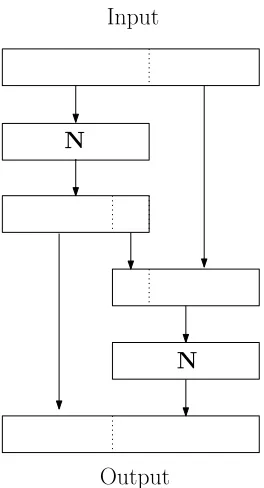
Nto 16 bytesu[12..27], say resulting in u′[12.27]. Next, we apply the same transformation Non 16 bytes u[0..11], u′[12..15], say resulting inu′′[0..15]. Now consider the linear transformationN
which takes 28 bytesu[0..27] to 28 bytes u′′[0..15], u′[16..27]. Then,N has the desired property.
First note that the transformation is invertible, and hence if its input is non-zero, then so is it’s output. If we are considering non-zero inputs which lead to outputs with all but the first four bytes zero, then the first four bytes of the output must be non-zero, i.e. u′′[0..3] is non-zero, and
∆a0 0 0 0 ∆a1 0 0 0 ∆a2 0 0 0
∆a3 0 0 0
0 0 ∆u0 ∆v0 ∆w0
0 0 ∆u1 ∆v1 ∆w1
0 0 ∆u2 ∆v2 ∆w2
0 0 ∆u3 ∆v3 ∆w3
∆x0 0 0 0
∆x1 0 0 0
∆x2 0 0 0
∆x3 0 0 0
0 0 ∆u0 ∆v0 ∆w0
0 0 ∆u1 ∆v1 ∆w1
0 0 ∆u2 ∆v2 ∆w2 0 0 ∆u3 ∆v3 ∆w3
0 0 0 0 0 0 0 0 0 0 0 0 0 0 0 0 0 0 0 0 ∆u0 ∆v0 ∆w0 ∆x0
∆u1 ∆v1 ∆w1 ∆x1
∆u2 ∆v2 ∆w2 ∆x2
∆u3 ∆v3 ∆w3 ∆x3
0 0 0 0 0 0 0 0 0 0 0 0 0 0 0 0 0 0 0 0 ∆˜u0 ∆˜v0 ∆ ˜w0 ∆˜x0
∆˜u1 ∆˜v1 ∆ ˜w1 ∆˜x1
∆˜u2 ∆˜v2 ∆ ˜w2 ∆˜x2
∆˜u3 ∆˜v3 ∆ ˜w3 ∆˜x3
Replace first column with input word
Rotate to the right by three columns
S-Box substitution on left 4 columns
linear transformation on left 4 columns
0 0 0 0 0 0 0 0 0 0 0 0 0 0 0 0 0 0 0 0 ∆b0 0 0 0
∆b1 0 0 0
∆b2 0 0 0
∆b3 0 0 0
0 0 0 0 0 0 0 0 0 0 0 0 0 0 0 0 0 0 0 0 0 0 0 0
0 0 0 0 0 0 0 0 0 0 0 0
Replace first column with input word
(a) (b) (c) (d) (e) (f)
Input
Output
N
N
Figure 3: The composite linear transformationN
at most three bytes zero amongst u[0..11] and u′[12..15] combined. Thus, u′[12..15] is non-zero. Moreover,u′[16..27] is zero, and hence again by the MDS property ofN, it follows that there areat most three bytes zeroinu[12..27]. Thus, there are at most 6 bytes zero inu[0..27]. Thus, the linear code whose parity check equations are the (28−4) rows of the 28×28 matrix representing the linear transformationN, has minimum distance 28−6 = 22. The composite linear transformation is illustrated in Figure 3.
We now describe how an efficient linear transformation likeN is obtained.
1.5 Super-Mix Transformation
If the linear transformationNis implemented by just the (left) matrix multiplication byN, it is likely to be extremely in-efficient, unless it is very sparse. Even if it is sparse, one may need to store GF(28) multiplication tables corresponding to all the different entries in N. Finally, there remains the question of determining such a sparse matrix with the required MDS property. A brute force search over such matrices seems intractable.
M
00M
10M
20M
30M
01M
11M
21M
31M
02M
12M
22M
32M
03M
13M
23M
33
⊗
u
0v
0w
0x
0u
1v
1w
1x
1u
2v
2w
2x
2u
3v
3w
3x
3
=
T
0[
u
0]+
T
1[
u
1]+
T
2[
u
2]+
T
3[
u
3]
T
0[
v
0]+
T
1[
v
1]+
T
2[
v
2]+
T
3[
v
3]
T
0[
w
0]+
T
1[
w
1]+
T
2[
w
2]+
T
3[
w
3]
T
0[
x
0]+
T
1[
x
1]+
T
2[
x
2]+
T
3[
x
3]
T
2[
v
2]
AES:
Fugue (
hint
):
Fugue (
detail
):
T
0[
u
0]
T
1[
u
1]
T
2[
u
2]
T
3[
u
3]
T
0[
v
0]
T
1[
v
1]
T
2[
v
2]
T
3[
v
3]
T
0[
w
0]
T
1[
w
1]
T
2[
w
2]
T
3[
w
3]
T
0[
x
0]
T
1[
x
1]
T
2[
x
2]
T
3[
x
3]
The AES 4×4 transformation however has a nice property that it can be implemented with four 8-bit to 32-bit tables. Thus, let v be a four byte column vector hv0, v1, v2, v3i. LetM’s four columns be calledM0,M1,M2, and M3. Then,
M·v=v0·M0 + v1·M1 + v2·M2 + v3·M3
Thus, if we pre-compute a 32-bit value table T0, with 256 entries indexed byi, corresponding to
i·M, and similarly pre-compute T1,T2 and T3, then
M·v=T0[v0] + T1[v1] + T2[v2] + T3[v3]
which is implemented with four table lookups and three 32-bit exclusive-or operations.
In Fugue, the 16 byte to 16 byte linear transformation is obtained as follows (see figure 4). The 16 bytes are first viewed as a 4×4 matrix of bytes V, which is same as how the 16 byte state is represented in AES. In other words, the AES mixing transformation can be seen as a matrix multiplication, i.e. V′ = M·V. However, as noticed above, that mixes the columns in V independently. Instead, in Fugue, the contribution of each byte in the input matrix V to the output matrix V′ is to both its column, and its row (except for the diagonal entries, which continue to affect only their columns). Thus, using the alternate interpretation of the previous paragraph, the contribution of a byte v2 in a column of V is not onlyT2[v2] to its column in the output, but also T2[v2] transposed, to its row in the output. The row in this case is row two, as
v2 is from row two of V.
Although, one can derive some intuition of why this leads to good mixing, it is not true that all matrices M yield the 16 byte transformation N as desired, namely with the MDS property mentioned above. Indeed, the AES mixing matrix does not satisfy this property. However, a straightforward brute force search over all circulant 4×4 matrices yield many such matrices which result in an MDSN. However, we picked the first one with some more desirable properties, as will become clear later. We later indicate in Section 16 the exact criterion used.
Part I
Specification of Fugue
2
Basic Conventions
Bits, Bytes, and Numbers. This document is mostly stated in terms of bytes, which are represented in hexadecimal notation (e.g., 80 is a byte corresponding to the decimal number 128). A sequence of bytes is always denoted with the first byte on the left, for example00 01 80
is a sequence of three bytes, with the first being00, the second 01, and the last 80.
When considering bits, we follow the big-endian convention set by NIST and consider the most-significant bit as the first bit in a byte. (For example, the byte 80 represents a single 1 bit followed by seven 0 bits.) In a few places we need to talk also about multi-byte integers, and in these cases we also use big endian convention, namely the first byte in a representation of an integer is the most significant byte. (For example, a three-byte representation of the decimal number 384 = 256 + 128 is the same sequence00 01 80from above.)
Matrices, Columns, and Words. Throughout this document we view the internal state of the hash function Fugue as a matrix with byte entries. We use the following notations for matrices: For anm×nmatrixM, the rows are numbered 0 tom−1 (and displayed top to bottom), and the columns will be numbered 0 ton−1 (and displayed left to right). Thei-th row ofM is denoted
Mi, and thej-th column ofM is denotedM
j. The element in thei-th row andj-th column ofM
(which is a byte) is denotedMji. A sub-sequence of columns of a matrix M, numberedithrough
j, will be denoted byMi..j.
Very often in this document we view a column in a matrix as a fundamental unit, and we call it aWord. Since the state-matrices that we consider have four rows, then a word in this document is always a four-byte entity.
We view the bytes in a matrix in column order, where in each columns the bytes are ordered from top (index 0) to bottom (indexm−1). For example, the following 4×3 matrix
A=
00 04 08 01 05 09 02 06 0a 03 07 0b
3
Galois Field GF(
2
8)
The Galois Field GF(28), is the finite field of 256 elements, whose elements are represented as bytes and have one to one correspondence with degree-7 binary polynomials. The mapping from bytes to binary polynomials is given by considering the least significant bit of the byte as representing the free coefficient, and in general thei’th least-significant bit as the coefficient ofxi. For example, the byte 13 (corresponding to the bit sequence 00010011) represents the polynomialx4+x+ 1, and the byte3c (binary 00111100) represents the polynomialx5+x4+x3+x2.
The additive unity of the field is the zero polynomial, i.e. 00, and the multiplicative unity of the field is the polynomial 1, i.e. 01. Throughout this specification, the field multiplication will be polynomial multiplication modulo the irreducible polynomial
x8+x4+x3+x+ 1.
As an example, when multiplying the byte corresponding to 8-bit binary numbera7a6...a0 (or the polynomiala7x7+a6x6+...+a0) by the byte02(i.e. the polynomialx), we get the polynomial
a6x7+a5x6+a4x5+ (a3⊕a7)x4+ (a2⊕a7)x3+a1x2+ (a0⊕a7)x+a7, where⊕is the exclusive-or operation. (In other words, multiplying a byte a by 02 in GF(28), we get 2×a when a < 80, and (2×a)⊕1botherwise.)
Below and throughout the document we use “·” to denote field multiplication in GF(28), and “+” to denote field addition in GF(28)(which is the same as exclusive-or). The same symbols will be used to denote multiplication and addition of matrices or vectors over GF(28), as well as scalar multiplication of field elements with matrices or vectors over GF(28). As is common in many programming languagesx+ =y will denote the assignmentx=x+y.
4
Specification of Fugue-256
The main component in the hash function Fugue (called “SMIX” below) is a mapping from 16 bytes to 16 bytes, which resembles the round functions of the block cipher AES [16]. As in AES, it is sometimes convenient to view the 16 bytes as a 4×4 matrix (but we will also view them just as a column vector of 16 bytes). Also as in AES, the SMIX mapping is a permutation, consisting of byte-substitution followed by a linear transformation. (However, in Fugue we never need to compute the inverse map.)
4.1 Substitution Box
(over GF(2)).
1 0 0 0 1 1 1 1 1 1 0 0 0 1 1 1 1 1 1 0 0 0 1 1 1 1 1 1 0 0 0 1 1 1 1 1 1 0 0 0 0 1 1 1 1 1 0 0 0 0 1 1 1 1 1 0 0 0 0 1 1 1 1 1
x0 x1 x2 x3 x4 x5 x6 x7 + 0 1 1 0 0 0 1 1
The S-box is explicitly given in the appendix in Table 12.
4.2 Super-Mix
Similarly to the AES round function, the SMIX transformation in Fugue takes a 4×4 matrix of bytes, passes each byte through the S-box transformation, and then applies a linear transformation to the result. This linear transformation is called the “Super-mix” transformation. A major difference between Fugue and AES is that in AES each column of the matrix is mixed separately (via the Column Mix transformation), whereas in Fugue there is cross-mixing between the column. As described later in this document, the Super-Mix in Fugue utilizes stronger codes (over longer words) than the 4-byte MDS code of AES, thus providing better diffusion and better protection against differential attacks (at a modest cost).
The linear transformation in Fugue is called the “Super-Mix”. It can be viewed as putting the 16 bytes in one column vector and multiplying it by the 16×16 matrix N that is specified in Equation 3 below. To better understand this transformation, it helps to see how it can be built from a simpler 4×4 matrix (denotedM). Like in AES, the matrixMwill be acirculantmatrix, but Fugue uses a different matrix than the 4×4 Column Mix matrix of AES. Specifically, we use
M=
01 04 07 01 01 01 04 07 07 01 01 04 04 07 01 01
(1)
As a warm-up, consider the procedure that one would use to implement an AES-like Column Mix transformation, and later we explain how to modify this procedure to get the Super-Mix of Fugue. Let us denote the input 4×4 matrix by U. Given the input matrix U and the mixing matrix M, the AES Column Mix procedure is just V = M·U, i.e. a straightforward matrix multiplication over GF(28). Thus, the j-th column of V can be obtained from the j-th column of U as the sum
Vj = U0j ·M0 + U1j ·M1 + U2j ·M2 + U3j·M3 = 3
X
i=0
In Super-Mix, each of the terms Uij ·Mi is not only added to the output column Vj, but if
i6=jthen it is also transposed and added to the output row Vi. Then (again similarly to AES), we apply a “row shift” operation to the matrix, in which the i-th row is rotated to the left by
ipositions. Namely, given a 4×4 input matrix Uwe compute:
Super-Mix(U) =ROL
M·U +
P
j6=0U0j 0 0 0
0 P
j6=1U1j 0 0
0 0 P
j6=2U2j 0
0 0 0 P
j6=3U3j
·MT (2) where
• MT is the transpose of the matrixM, i.e. (MT)ij =Mji,
• the transformation “ROL” takes a 4×4 matrix, and rotates the i-th row to the left by i
bytes, i.e. ROL(W)i
j =Wi(j−i)mod4
In other words, if W denotes the intermediate matrix before the “ROL” transformation in Super-Mix(U), then
Wij =X
k
(Mik·Ukj) +Mji ·( X
k∈[0..3],k6=i
Uik)
Equivalently, the Super-Mix transformation is given by (left) multiplication by the following 16×16 matrix N, when the 4×4 matrix of input (and output) is considered as a 16-byte column vector, with the (i+ 4j)-th byte of the vector corresponding to the byte in the i-th row and the
j-th column of the matrix (i.e. the input and output matrices are scanned column-wise).
N=
1 4 7 1 1 0 0 0 1 0 0 0 1 0 0 0
0 1 0 0 1 1 4 7 0 1 0 0 0 1 0 0
0 0 1 0 0 0 1 0 7 1 1 4 0 0 1 0
0 0 0 1 0 0 0 1 0 0 0 1 4 7 1 1
0 0 0 0 0 4 7 1 1 0 0 0 1 0 0 0
0 1 0 0 0 0 0 0 1 0 4 7 0 1 0 0
0 0 1 0 0 0 1 0 0 0 0 0 7 1 0 4
4 7 1 0 0 0 0 1 0 0 0 1 0 0 0 0
0 0 0 0 7 0 0 0 6 4 7 1 7 0 0 0
0 7 0 0 0 0 0 0 0 7 0 0 1 6 4 7
7 1 6 4 0 0 7 0 0 0 0 0 0 0 7 0
0 0 0 7 4 7 1 6 0 0 0 7 0 0 0 0
0 0 0 0 4 0 0 0 4 0 0 0 5 4 7 1
1 5 4 7 0 0 0 0 0 4 0 0 0 4 0 0
0 0 4 0 7 1 5 4 0 0 0 0 0 0 4 0
0 0 0 4 0 0 0 4 4 7 1 5 0 0 0 0
N−1 =
15 49 16 bc bf ca 76 f5 a5 2f 2b 57 b2 3c 3d 45
9c be 59 df 56 a9 de fe 26 f5 8c fb 77 c0 2a 39
e2 15 45 16 96 1f a6 3b 4d f7 f4 91 4b f4 a1 c1
5e fd 69 6f ca 2a 3e f6 9f a7 c6 5b cf cf 62 31
6f 5e fd 69 f6 ca 2a 3e 5b 9f a7 c6 31 cf cf 62
bc 15 49 16 f5 bf ca 76 57 a5 2f 2b 45 b2 3c 3d
df 9c be 59 fe 56 a9 de fb 26 f5 8c 39 77 c0 2a
16 e2 15 45 3b 96 1f a6 91 4d f7 f4 c1 4b f4 a1
45 16 e2 15 a6 3b 96 1f f4 91 4d f7 a1 c1 4b f4
69 6f 5e fd 3e f6 ca 2a c6 5b 9f a7 62 31 cf cf
16 bc 15 49 76 f5 bf ca 2b 57 a5 2f 3d 45 b2 3c
59 df 9c be de fe 56 a9 8c fb 26 f5 2a 39 77 c0
be 59 df 9c a9 de fe 56 f5 8c fb 26 c0 2a 39 77
15 45 16 e2 1f a6 3b 96 f7 f4 91 4d f4 a1 c1 4b
fd 69 6f 5e 2a 3e f6 ca a7 c6 5b 9f cf 62 31 cf
49 16 bc 15 ca 76 f5 bf 2f 2b 57 a5 3c 3d 45 b2
Figure 5: The matrix N−1
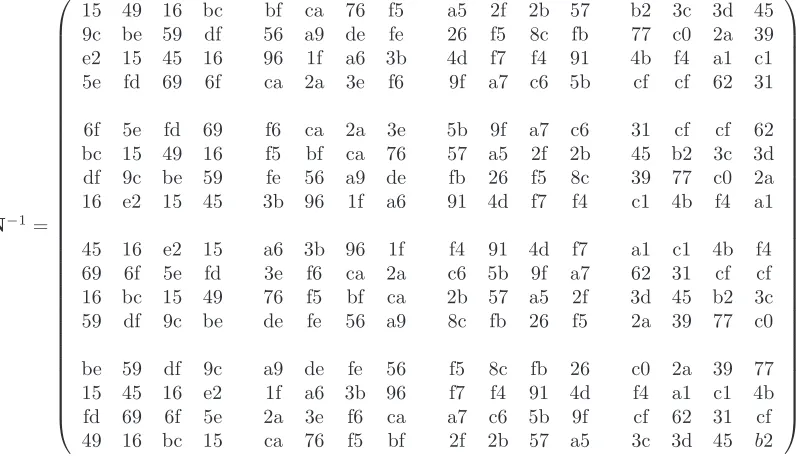
The Super-Mix transform is invertible, as verified by a computer program that yielded the inverse forN as described in Figure 5.
4.3 The Hash Function F-256
In this section we specify the hash functionF-256 that underlies Fugue-256. The functionF-256 takes as input a byte string of length multiple of four bytes, and an initial vector (IV) of 32 bytes, and outputs a hash value of 32 bytes. The hash functionF-256 maintains astateof 30 four byte columns, starting with an initial state, which is set using the IV.
The input stream of 4m bytes (m ≥ 0) is parsed as m four-byte words, and fed one word at a time into a round transformation R that modifies the state. After all the input has been processed, the state undergoes another transformation by a final round G. Subsequently, eight columns of the state are used as the output of F-256.
4.3.1 The Round Transformation R
The transformation R is best specified by the way it modifies the state S using the input word I. It consists of the following sequence of steps (all of which are described below):
TIX(I);ROR3;CMIX;SMIX;ROR3;CMIX;SMIX;
• The stepTIX(I) (short for xor, truncate, insert and xor) stands for the following sequence of steps:
S10+ =S0;
S0=I (i.e.,Si0 =Ii fori= 0,1,2,3);
S8+ =S0;
S1+ =S24.
• The step ROR3 just rotates the state to the right by three columns, i.e. simultaneously setSi =Si−3, where the subscript subtraction is performed modulo 30.
• The stepCMIX, which stands for column mix, is
S0+ =S4; S1+ =S5; S2+ =S6;
S15+ =S4;S16+ =S5; S17+ =S6;
• The stepSMIX, just operates on the first four columns of the state, which can be viewed as a 4×4 matrix W. First, each byte of the matrixWundergoes an S-box substitution. Next, the resulting matrix undergoes the Super-Mix linear transformation. Thus, if S-Box[W] denotes the matrix obtained by substituting each byte Wij by S-box[Wij], then SMIX
stands for
S0..3 = Super-Mix(S-box[S0..3]).
4.3.2 The Final Round G
The final round G takes a 30 column state S and produces a final 30 column state. It is best described by how it affects the stateS, which is as follows.
repeat 5 times {
ROR3;CMIX;SMIX ROR3;CMIX;SMIX
}
repeat 13 times {
S4+ =S0;S15+ =S0;ROR15;SMIX;
S4+ =S0;S16+ =S0;ROR14;SMIX; }
S4+ =S0;S15+ =S0;
whereRORnstands for rotating the stateSto the right byncolumns, i.e. simultaneously setting
Si =Si−n for all i= 0..29, and the subtraction in the subscript is modulo 30.
4.3.3 Initial State
The state S is initialized by setting its first 22 columns to zero, and the last 8 columns to the given IV. That is, the 32-byte IV is parsed as 8 four-byte words IV0, . . . ,IV7, and for all j= 0...7 we set S22+j = IVj. (In matrix notations, we set S0..21= 0 andS22..29=IV.)
4.3.4 Hash Output
After the final roundG, the following stream of eight words of the state S is output as thehash value.
S1 S2 S3 S4 S15 S16S17 S18.
Note that the first word in the output is S1, and not S0. For example, if the final state begins with the five columns below
00 04 08 0c 10 01 05 09 0d 11 02 06 0a 0e 12 . . . 03 07 0b 0f 13
then the first 16 bytes of the output would be
4.3.5 Complete Specification of the Hash Function F-256
On input a stream of 4m bytes (m≥0) that are parsed as m four-byte wordsP1,P2,...,Pm, and
the initial vector of 32 bytes (parsed as 8 four-byte words IV0, IV1,...,IV7), the hash function
F-256 operates as follows.
for j= 0..21, Sj = 0;
for j= 0..7, SetS(22+j) = IVj.
for i= 1..m
{ TIX(Pi);
repeat 2 times {ROR3;CMIX;SMIX;} }
repeat 10 times {ROR3;CMIX;SMIX;} repeat 13 times
{ S4+ =S0;S15+ =S0;ROR15;SMIX;
S4+ =S0;S16+ =S0;ROR14;SMIX; }
S4+ =S0;S15+ =S0;
Output S1 S2 S3 S4 S15 S16 S17 S18.
4.4 The Hash Function Fugue-256
The hash function Fugue-256 takes as input bit sequences of arbitrary length, upto 264−1 bits, and returns a 256-bit output. It computes the output by padding the input with zeros to a multiple of 32-bits (four bytes), parsing it as a sequence of bytes, appending an 8-byte representation of the original input length, and applyingF-256 to the result, along with a fixed initial vector (IV). The fixed IV that is used by Fugue-256 is defined (in matrix notations) as
IV256 =
e9 66 e0 d2 f9 fb 91 34 52 71 d4 b0 6c f9 49 f8 bd 13 f6 b5 62 29 e8 c2 de 5f 68 94 1d de 99 48
That is, the first word in IV256 is IV2560 = e9 52 bd de, the second word is IV2561 =
66 71 13 5f, and so on upto the last word IV2567 = 34 f8 c2 48. This fixed IV was ob-tained by runningF-256 with an all-zero IV and the one-word input00 00 01 00 (representing the decimal number 256).
a multiple of 32 then append nothing, otherwise append 32−(nmod 32) zero bits.1
Let the resulting (possibly padded) string of bits be denotedX′, and we viewX′ as a sequence ofm bytes (in big-endian convention), X′ =B0B1. . . Bm−1, wherem is a multiple of four. Next, the length n is represented as an eight-byte integer (in big-endian convention) and appended to
X′, to form the encoded stream X′′ (of length m+ 8 bytes). Then, F-256 is applied to the input
X′′ and the fixed IV value IV256 from above, returning a 32-byte output. This output is viewed as a 256-bit value (using again big-endian convention) and returned as the output of Fugue-256.
Example. Consider the 35-bit input
X= 10101001 10111000 11000111 11010110 010
We append to it 29 zero bits to form a 64-bit padded stream
X′ = 10101001 10111000 11000111 11010110 01000000 00000000 00000000 00000000
which is viewed as an 8-byte stream X′ = a9 b8 c7 d6 40 00 00 00. Next, the bit-length 35 (hexadecimal23) is represented as an eight-byte integer and appended toX′ to form the encoded
stream
X′′=a9 b8 c7 d6 40 00 00 00 00 00 00 00 00 00 00 23
and F-256 is applied toX′′.
4.5 Pseudo-Random Function PR-Fugue-256
The function PR-Fugue-256 takes as input a binary string of length between 0 and 264−1, and a key of length 32 bytes, and produces as output a 32 byte value. Just as in Fugue-256, the input is first padded with zero bits to a length multiple of 32 bits, then the length of the original input is appended as an 8-byte integer, before running F-256 on the resulting encoded stream. The only difference between PR-Fugue-256 and Fugue-256 is that PR-Fugue-256 calls the underlying functionF-256 using the 32-byte key as the IV value, instead of the fixed IV value IV256.
4.6 Compression Function C-Fugue-256
We define the compression function C-Fugue-256 as a backward-compatibility mode for applica-tions that must use a compression function in a Merkle-Damgard mode. We stress that this is not the optimal way of using Fugue (from both performance and security perspectives), but it still offers an appropriate drop-in substitution for applications that need it.
1
The function C-Fugue-256 takes as input a binary string of length exactly 512 bits and an initial vector of 32 bytes, and produces an output of 32 bytes. The input is treated as a stream of 64 bytes, and the output of C-Fugue-256 is just the output of F-256 on this input and the given initial vector. (Note that the input is not padded, as it is already of the correct length.)
4.7 Other Modes of Operation
Fugue-256 can be used as a drop-in replacement for SHA-256 in many other modes of operation, in-cluding HMAC [17] and randomized hashing [18], without resorting to the backward-compatibility mode C-Fugue-256. For example, HMAC-Fugue-256 takes an inputX and keyK, and computes
HMAC-Fugue-256(K, X) = Fugue-256(K⊕opad |Fugue-256(K⊕ipad|X) )
We note that when the key is 32-byte long, then PR-Fugue-256 is a more efficient way of using Fugue to get a pseudo-random function.
5
Specification of Parameterized Fugue
The hash function Fugue-256 that was defined in the previous section is just once instance of a parameterized design. In this section we present this parameterized design, and call out the specific parameter setting for Fugue-224, Fugue-256, Fugue-384, and Fugue-512, as required by NIST (as well as a weakened version of Fugue-256 that may be more amenable to cryptanalysis). In its most generic form, an instance of Fugue depends on the following five parameters:
Output size n: the number of four-byte words in the output of Fugue, which is also the number of four-byte words in the IV. In this document we assume thatn≤16 (i.e., the output size can be at most 512 bits).2 For example, for Fugue-256 we haven= 8.
Work load k: the number of sub-rounds per round transformation. Recall that for every four-byte input word we apply a round transformation consisting of several sub-rounds (where the main component of a sub-round is the nonlinear SMIX permutation). Hence the parameterk
specifies the word-load factor, i.e., how many SMIX-es we apply per four-byte input word. In Fugue-256 we have k= 2.
State size s: the number of four-byte columns in the internal state. We require thatsbe divisible by 3 and by ⌈n/4⌉, and moreover that s≥max(6k,2n). In Fugue-256 we haves= 30.
TIX-less rounds r: the number of rounds in the first phase of the final transformationG. These rounds are the same as the round-transformationRthat is used to process the inputs, except that they contain no TIXstep. In Fugue-256 we have r = 5.
2
Final rounds t: the number of rounds in the second phase of the final transformation G. In Fugue-256 we havet= 13.
5.1 The parameterized function F[n, k, s, r, t]
The parameterized hash functionF[n, s, k, r, t] takes an input stream of 4mbytes (for somem≥0) and an IV of 4nbytes. Just likeF-256, it begins by initializing a 4×sstate matrixSusing the IV, then applies one round transformation Rfor every four-byte input word (in order), then applies a final transformation G (which itself consists of two transformations — G1 and then G2), and finally outputs part of the resulting final state. Below we denote the mfour-byte input words by
P0, P1, . . . , Pm−1 and thenIV words by IV0,IV1, . . . ,IVn−1.
Initialize State.
Forj= 0 to s−1−n, setSj = 0.
Forj= 0 to n−1, set Ss−n+j = IVj.
The Round Transformation R[s,k](P):
TIX[s, k](P); Repeatk times:
{ ROR3;CMIX[s];SMIX;} where
• The stepSMIXis same as that defined for F-256, and is independent of the parameters.
• ROR3is same as before, i.e. simultaneously setSi =Si−3, for alli= 1 to (s-1). In general
RORnwill stand for simultaneously settingSi=Si−n, for alli= 1 to (s-1). All arithmetic
of the column indices of the state Sis done modulo s.
• The stepTIX[s, k](P) takes one four-bytes work of inputP, and is defined as follows:
S6k−2+ =S0;
S0 =P;
S8+ =S0;
For i= 0 to k−2 step 1 :
S3i+1+ =Ss−3k+3i
• The definition of CMIX[s] is:
S0+ =S4; Ss/2 + =S4;
S1+ =S5; Ss/2+1+ =S5;
S2+ =S6; Ss/2+2+ =S6;
The final transformation G consists of a first phase G1 followed by second phase G2. The first phase consists just of r rounds of TIX-less round transformations, namely:
• G1[k,s,r]: Repeat rk times: {ROR3;CMIX[s];SMIX;}
The second phase needs some more explanation: Recall that F[n, k, s, r, t] needs to produce 4n
bytes of output, which it does by usingnof the columns in the final state. These n columns are partitioned into groups of four, and each group is taken from a different part of the state. Below we denote the number of groups of four columns by N =⌈n/4⌉ (and recall that we require that the number of columnssis divisible by N).
If we need only four (or less) columns (N = 1) then we take S1..4 or a prefix of them. If we need 5-8 columns (N = 2) then we take S1..4Ss
2..
s
2+3 or a prefix of them. Similarly to get 9-12 columns (N = 3) we takeS1..4Ss
3..
s
3+3S 2s
3.. 2s
3+3 (or a prefix), etc.
Roughly speaking, a round of G2 applies SMIX to each of the above groups (with some additional mixing), and rotates the entire state by one columns to the left.3 The additional mixing roughly takes the leftmost column that resulted from the previous SMIX and adds it to one columns in each of these groups. A more accurate description follows:
• G2[n,s,t]: Denote the number of groups as above byN =⌈n/4⌉, and also denotep=s/N:
– If N = 1 then:
Repeat t times: { S4 += S0;ROR(s−1);SMIX;}
S4 += S0;
– If N = 2 then:
Repeat t times: { S4 += S0; Sp += S0; ROR(p); SMIX;
S4 += S0; Sp+1+= S0; ROR(p−1);SMIX;}
S4 += S0; Sp += S0;
– If N = 3 then:
Repeat t times: { S4 += S0; Sp += S0; S2p += S0; ROR(p); SMIX;
S4 += S0; Sp+1+= S0; S2p += S0; ROR(p); SMIX;
S4 += S0; Sp+1+= S0; S2p+1+= S0; ROR(p−1);SMIX;}
S4 += S0; Sp += S0; S2p += S0;
3
– If N = 4 then: Repeat t times:
{ S4 += S0; Sp += S0; S2p +=S0; S3p += S0; ROR(p); SMIX;
S4 += S0; Sp+1+= S0; S2p +=S0; S3p += S0; ROR(p); SMIX;
S4 += S0; Sp+1+= S0; S2p+1+= S0; S3p += S0; ROR(p); SMIX;
S4 += S0; Sp+1+= S0; S2p+1+= S0; S3p+1+= S0; ROR(p−1); SMIX; }
S4 += S0; Sp += S0; S2p += S0; S3p += S0;
Output. After the transformation G2, the output of F[n, k, s, r, t] consists of the columns
S1..4Sp..p+3S2p..2p+3 ... Namely, if n≤4 then we just output S1..n, and ifn >4 then we output
as follows:
OutputS1..4 ;
For i= 1 to N−2, OutputSip .. ip+3 ;
Output as many of the columnsSs−p .. s−p+3 as needed
5.1.1 A Complete Specification of F[n, k, s, r, t]
With the above description, the complete specification of F[n, k, s, r, t] is as follows: On input consisting of m four-byte words (m ≥ 0), denoted P0, P1, . . . Pm−1, and an initial vector of n four-byte words, denoted IV0,IV1,...,IVn−1, the hash function F[n, s, k, r] maintains a 4×s state matrixS and operates as follows:
Forj= 0..(s−n−1), Sj = 0;
Forj= 0..(n−1), S(s−n+j)= IVj.
Fori= 1..m
{TIX[s, k](Pi);
Repeat ktimes : {ROR3;CMIX[s];SMIX;} }
G1[k, s, r];
G2[n, s, t];
If n≤4 then OutputS1..n;
else
OutputS1..4;
For i= 1..(N −2){Output Sip .. ip+3;}
5.2 Parameter Specifications for Different Output Lengths
For the output lengths that are required by NIST, we specify the following setting of parameters:
• F-224 is F[n= 7, s= 30, k= 2, r= 5, t= 13].
• F-256 is F[n= 8, s= 30, k= 2, r= 5, t= 13].
• F-384 is F[n= 12, s= 36, k= 3, r= 6, t= 13].
• F-512 is F[n= 16, s= 36, k= 4, r= 8, t= 13].
In general, we recommend state size s= 30 for n≤8, ands= 36 forn∈[9,16]. In addition, we define a weak version ofF-256 (denoted wF-256) asF[n= 8, s= 30, k= 1, r= 5, t= 5]. Note that the size of the state remains the same, but the work-load (i.e., number of SMIX-es per input word) is cut to just one rather than two. The number of rounds in the second phase of the final transformation Gis also reduced to 5 from 13.
5.3 Fugue-224 and related functions
The functionF-224 is exactly the same as the functionF-256, except that the output is truncated to the first 28 bytes. In other words, instead of outputtingS1..4S15..18, the output ofF-224 is only
S1..4S15..17.
The hash function Fugue-224 does the padding on the given input just as Fugue-256 does, but uses a different fixed initial value. Specifically, the fixed initial value IV224 is defined (in matrix notations) as
IV224 =
f4 62 ee e0 a1 9a bd c9 86 39 74 12 43 8d 12 f7 e0 e3 7c d2 67 0d 57 1c cb 62 15 9a
That is, the first word in IV224 is IV2240 = f4 c9 12 0d, the second word is IV2241 =
62 86 f7 57, and so on upto the last word IV2247 = bd 8d 67 9a. This IV was obtained by runningF-224 with an all-zero IV and the one-word input00 00 00 e0(representing the decimal number 224).
5.4 Fugue-384 and related functions
1. TIX(I) is the following sequence of steps:
S16+ =S0;
S0 =I;
S8+ =S0;
S1+ =S27; S4+ =S30;.
2. The transformation CMIXis
S0+ =S4; S1+ =S5; S2+ =S6;
S18+ =S4;S19+ =S5; S20+ =S6;
On input of a stream of m 4-byte words (m ≥ 0) P1, P2. . . , Pm, and an initial vector of 12
four-byte words IV0,IV1,...,IV11, the hash functionF-384 operates as follows.
Forj= 0..23, setSj = 0;
Forj= 0..11, set S(24+j) = IVj.
Fori= 1..m
{ TIX(Pi);
Repeat 3 times : {ROR3;CMIX;SMIX;} }
Repeat 18 times : {ROR3;CMIX;SMIX;} Repeat 13 times:
{
S4+ =S0; S12+ =S0; S24+ =S0; ROR12; SMIX;
S4+ =S0; S13+ =S0; S24+ =S0; ROR12; SMIX;
S4+ =S0; S13+ =S0; S25+ =S0; ROR11; SMIX; }
S4+ =S0; S12+ =S0; S24+ =S0;
Output S1..4S12..15S24..27
The function Fugue-384 takes as input a binary string of length between zero and 264−1, and outputs a stream of 48 bytes. The input string is padded and length-encoded just as for Fugue-256 (see Section 4.4), and the function F-384 is invoked on the encoded stream of bytes (of length multiple of 4), and the following fixed initial vector IV384:
IV384 =
aa 31 a0 00 21 74 fa 47 e5 a9 bc 5c 61 25 1d 60 5e 1b 69 3e 02 9c 95 10 ec 2e b4 09 f4 5e 3e b0 ae 25 51 95 0d 1f c7 85 4a 9c 9a 40 8a e0 7c a1
This fixed IV was obtained by running F-384 with an all-zero IV and the one-word input
00 00 01 80(representing the decimal number 384).
The function PR-Fugue-384, takes as input a binary string of length between 0 and 264−1, and a key of length 48 bytes, and produces as output a 48 byte value. The input is first padded and length-encoded, just as for Fugue-384, and then the functionF-384 is invoked on this encoded input, along with the given key as the 48 byte IV. The output of this invocation of F-384, is the output of PR-Fugue-384.
The function C-Fugue-384, takes as input a binary string of length exactly 512 bits, and an initial vector of 48 bytes, and produces an output of 48 bytes. The input is treated as a stream of 64 bytes, and the output of C-Fugue-384 is same as the output ofF-384 on this input, and the given initial vector. Note that the input is not padded, as it is already of the correct length.
5.5 Fugue-512 and related functions
Recall that the function F-512 was defined as F[16,36,4,8,13]. Below we provide an explicit specification for this function: F-512 takes as input a stream of 4m bytes (for some m≥0) and an initial vector IV of 64 bytes, and produces an output of 64 bytes, using a 4×36 internal state matrix. The the relevant basic transformations of the state are as follows:
1. TIX(I) is the following sequence of steps:
S22+ =S0;
S0 =I;
S8+ =S0;
S1+ =S24; S4+ =S27; S7+ =S30;
2. The transformation CMIXis
S0+ =S4; S1+ =S5; S2+ =S6;
On input of a stream of m 4-byte words (m ≥ 0) P1, P2. . . , Pm, and an initial vector of 16
four-byte words IV0,IV1,...,IV15, the hash functionF-512 operates as follows.
For j= 0..19, setSj = 0;
For j= 0..15, set S(20+j)= IVj.
For i= 1..m
{ TIX(Pi);
Repeat 4 times : {ROR3;CMIX;SMIX;} }
Repeat 32times : {ROR3;CMIX;SMIX;} Repeat 13 times:
{
S4+ =S0; S9 + =S0; S18+ =S0; S27+ =S0; ROR9; SMIX;
S4+ =S0; S10+ =S0; S18+ =S0; S27+ =S0; ROR9; SMIX;
S4+ =S0; S10+ =S0; S19+ =S0; S27+ =S0; ROR9; SMIX;
S4+ =S0; S10+ =S0; S19+ =S0; S28+ =S0; ROR8; SMIX; }
S4+ =S0; S9+ =S0; S18+ =S0; S27+ =S0;
Output S1..4S9..12S18..21S27..30
The function Fugue-512 takes as input a binary string of length between zero and 264−1, and outputs a stream of 64 bytes. The input string is padded and length-encoded just as for Fugue-256 (see Section 4.4), and the function F-512 is invoked on the encoded stream of bytes (of length multiple of 4), and the following fixed initial vector IV512:
IV512 =
88 e6 c5 ac d9 b6 06 4a aa dd ca 43 25 95 da e1 07 16 d3 9a 15 ee e8 92 c6 b2 e6 7f ea 1f 6e 3e a5 af e4 b0 f1 cc 02 ef e2 13 58 20 78 dd d1 35 7e 75 db 27 17 54 0b d1 c9 98 38 3f e7 d6 1d 67
This fixed IV was obtained by running F-512 with an all-zero IV and the one-word input
00 00 02 00(representing the decimal number 512).
The function PR-Fugue-512, takes as input a binary string of length between 0 and 264−1, and a key of length 64 bytes, and produces as output a 64 byte value. The input is first padded and length-encoded, just as for Fugue-384, and then the functionF-512 is invoked on this encoded input, along with the given key as the 64 byte IV. The output of this invocation of F-512, is the output of PR-Fugue-512.
of 64 bytes, and the output of C-Fugue-512 is same as the output of F-512 on this input, and the given initial initial vector. Note that the input is not padded, as it is already of the correct length.
5.6 A Weaker Version of Fugue-256
Recall that the function wF-256 was defined as F[8,30,1,5,5]. Below we provide an explicit specification for this function: F-256 takes as input a stream of 4m bytes (for some m ≥0) and an initial vector IV of 32 bytes, and produces an output of 32 bytes, using a 4×30 internal state matrix. The the relevant basic transformations of the state are as follows:
1. TIX(I) is the following sequence of steps: S4+ =S0; S0=I; S8+ =S0;.
2. The transformation CMIXis: S0..2+ =S4..6;S15..17+ =S4..6;
On input of a stream of m 4-byte words (m ≥ 0) P1, P2. . . , Pm, and an initial vector of 8
four-byte words IV0,IV1,...,IV7, the hash functionF-256 operates as follows.
For j= 0..21, setSj = 0;
For j= 0..7, set S(22+j)= IVj;
For i= 1..m
{ TIX(Pi);
ROR3;CMIX;SMIX; }
Repeat 5times : {ROR3;CMIX;SMIX;} Repeat 5 times:
{
S4+ =S0; S15+ =S0; ROR15; SMIX;
S4+ =S0; S16+ =S0; ROR14; SMIX; }
S4+ =S0; S15+ =S0;
Part II
Implementation
6
Software and Hardware Efficiency
6.1 Implementing Fugue on 32-bit Machines
The main construct in Fugue is the SMIX step. It itself is composed of the non-linear S-Box, and the Super-Mix linear transformation. Fugue has been designed, with ideas from AES to get a fast implementation on 32-bit machines. Indeed, the S-Box substitution followed by the linear transformation can be pre-computed in four 32-bit tables of 256 entries each. From the high level description of the Super-Mix transformation in Section 1.5, it should be clear how these four tables can be used to implement a highly optimized version of Fugue.
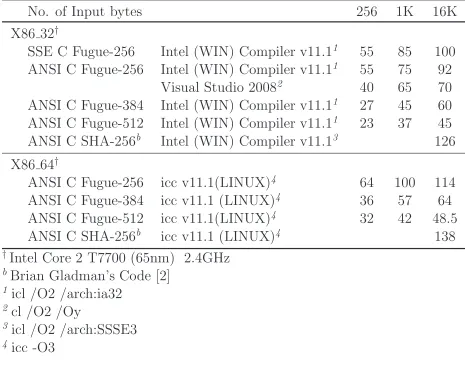
Moreover, since Fugue over different hash lengths, can be defined in a parameterized fashion, with the same underlying building blocks, and namely SMIX, the optimized implementations scale nicely. The performance figures for 32-bit Intel Machines are shown in Table 1, and compared with Brian Gladman’s highly optimized SHA-2 implementations [2].
One of the main limitations on Intel’s 32-bit machines is the limited availability of general purpose registers. Therefore, an assembly inline C code, which instructs the machine to reserve registers for specific tasks in the Super-Mix transformation can lead to a much better implemen-tation than just an ANSI C implemenimplemen-tation in older machines.
6.2 Implementing Fugue on 64-bit Machines
Our optimized implementation of Fugue for 32-bit Intel Architectures, runs fairly well on the 64-bit Intel Architectures. We have not yet capitalized on the 64-64-bit word size, although we suspect that the ANSI C implementation does take advantage of the extra general purpose registers.
6.3 Implementing Fugue on 8-bit Architectures
Implementing Fugue on an 8-bit processor is rather straightforward. We can use more or less the same implementation as for AES, with only small changes to account for the differences between the AES round function and the SMIXof Fugue.
The RAM requirements include the 120-byte state of Fugue-256 or Fugue-224 (or a 144-byte state for Fugue-384 and Fugue-512), a few more counters and indexes, and 16-20 bytes for scratch calculations, all of which should fit comfortably in under 200 bytes of RAM.
Table 1: Various Software Implementation Speeds (MBytes/sec)
No. of Input bytes
256
1K
16K
X86 32
†SSE C Fugue-256
Intel (WIN) Compiler v11.1
155
85
100
ANSI C Fugue-256
Intel (WIN) Compiler v11.1
155
75
92
Visual Studio 2008
240
65
70
ANSI C Fugue-384
Intel (WIN) Compiler v11.1
127
45
60
ANSI C Fugue-512
Intel (WIN) Compiler v11.1
123
37
45
ANSI C SHA-256
bIntel (WIN) Compiler v11.1
3126
X86 64
†ANSI C Fugue-256
icc v11.1(LINUX)
464
100
114
ANSI C Fugue-384
icc v11.1 (LINUX)
436
57
64
ANSI C Fugue-512
icc v11.1(LINUX)
432
42
48.5
ANSI C SHA-256
bicc v11.1 (LINUX)
4138
†
Intel Core 2 T7700 (65nm) 2.4GHz
bBrian Gladman’s Code [2]
1
icl /O2 /arch:ia32
2cl /O2 /Oy
different multiples are xor-ed into four different bytes. InSMIX, each byte is multiplied by 1,4, and 7 and these different multiples are usually xor-ed into seven different bytes (except the bytes on the diagonal that are only xor-ed into four bytes). Fugue has some additional overhead since one may need to explicitly perform the row-shift (at least occasionally), we need also to implement theCMIXoperation (which consists of 24 byte-xors) and theTIXoperation (consisting of four byte movements and 12 to 24 byte-xors), and we also need some index manipulation to implement the column-rotate operations. (On the other hand, we do not have the key-add operation that takes 16 byte-xors in AES and of course we do not have to implement key-scheduling.)
All in all, comparing an implementation of Fugue to an AES implementationthat pre-computes the key-schedule, we believe that a sub-round of Fugue should take less that twice the cycles of an AES round function. Hence the final transformation G of Fugue-256 and Fugue-224 (which consists of 5 + 13×2 = 36 applications of SMIX) should take about the same time as AES-256 encryption of five blocks (using an implementation that pre-computes the key-scheduling), and the round transformation (that consists of two SMIX-es) should take about 25% of the time of one AES-256 encryption. Using these estimates, we conclude that computing the underlying
F-256 on a 16-byte message will be about six times slower than computing AES-256 on the same message, whereas for long messages the speed ofF-256 will approach that of AES-256.
In [11] it was reported that an implementation of AES-128 on the 8-bit 6805 CPU core would take about 15000 cycles to encrypt one block, including the time for key-setup. Assuming that without the key-schedule we will have 10000 cycles for 128 encryption (or 14000 for AES-256 encryption), and using our estimate from above for the relative speed of Fugue vs. AES, we estimate that hashing a 128-bit message with Fugue-256 would take about 84000 cycles on the same 6805 CPU core. For longer messages, the performance of Fugue will improve to less than 20000 cycles per sixteen bytes of message.
6.4 Hardware Implementations of Fugue
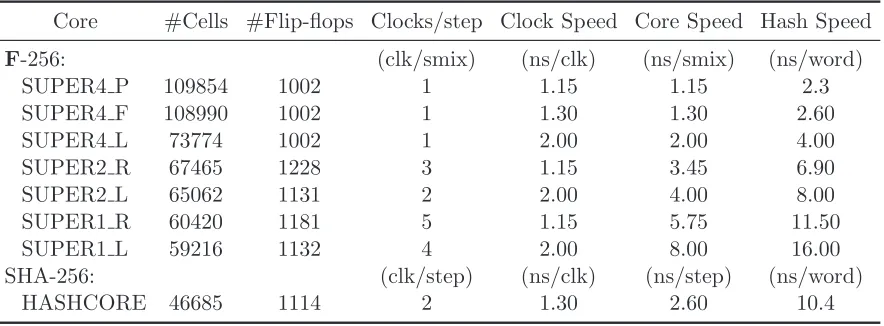
We implemented Fugue-256 in the Hardware Design Language Verilog, and optimized the im-plementation for three different memory-speed tradeoffs. The Verilog code can be complied into gates using various synthesis tools. In our case, we targeted the IBM Standard Cell Library for IBM’s Copper (Cu-8, 90nm, bulk silicon) technology. We then used approximation tools to esti-mate the actual cell count required to implement these various tradeoffs. For comparison sake, we also implemented SHA-256 with the same library and for the same technology.
Table 2: Hardware Estimates for Various Fugue-256 and SHA-256 Implementations
Core #Cells #Flip-flops Clocks/step Clock Speed Core Speed Hash Speed
F-256: (clk/smix) (ns/clk) (ns/smix) (ns/word)
SUPER4 P 109854 1002 1 1.15 1.15 2.3
SUPER4 F 108990 1002 1 1.30 1.30 2.60
SUPER4 L 73774 1002 1 2.00 2.00 4.00
SUPER2 R 67465 1228 3 1.15 3.45 6.90
SUPER2 L 65062 1131 2 2.00 4.00 8.00
SUPER1 R 60420 1181 5 1.15 5.75 11.50
SUPER1 L 59216 1132 4 2.00 8.00 16.00
SHA-256: (clk/step) (ns/clk) (ns/step) (ns/word)
HASHCORE 46685 1114 2 1.30 2.60 10.4
with a different tradeoff. The suffix “ L” refers to a composite field arithmetic implementation of the AES S-Box [21]. The suffix “ R” refers to a pipelined implementation of the composite field implementation.
6.5 Other Implementations of Fugue
We expect Fugue implementations to benefit from many of the current trends in computer archi-tectures. Specifically, below we comment briefly about the inherent parallelizability of Fugue and the potential for significant speedup using Multi-media extension to common architectures.
Parallelism. Just like the AES round function, the FugueSMIXoperation consists of sixteen nearly-independent threads. Namely, each of the sixteen bytes that are involved can be used independently to compute a 16-byte vector (with upto seven non-zero bytes) and the result of the
SMIXtransformation is just the xor of all these sixteen vectors. A multi-threaded architecture can take advantage of this inherent parallelism by assigning different input bytes to different threads.
Advanced byte-manipulation. Fugue implementations will also benefit from architectures such as AltiVec or SSE that allow parallel lookups and byte permutations in vectors. Using these tools was reported to allow an order of magnitude improvement for the software performance of the AES-based Whirlpool [7], and the performance gains for Fugue should similar. In fact, Fugue stands to benefit even more from byte-permutation instructions than AES, since the SMIX
Part III
Security Analysis
7
The Super-Mix Matrix and Related Linear Codes
The 16×16 matrixNrepresenting the Super-Mix linear transformation is associated with some linear codes that will be useful in the analysis of Fugue. Specifically, viewing (some of) the rows of N as parity check equations leads to linear codes that are either MDS or close to it. Recall that a linear code of dimensionkand lengthn(i.e., an [n, k]-code) has a minimum distance of at mostn−k+ 1, and a linear code that attains this minimum distance is calledmaximum distance separable, or MDS code. Below we provide some background on linear codes and then discuss the codes that are associated with the Super-Mix matrixN.
7.1 Linear Codes
An [n, k] linear code over a field F is given by n−k linearly independent parity check equations over F inn variables. Representing these equations by a (n−k)×nparity check matrixH, the corresponding code C consists of all the column vectors c of length nsuch that H·c= 0. Since the rank ofH is at mostn−k, there must exist a non-zero column vector cof weight n−k+ 1 (or less) such thatH·c= 0. Hence the minimum distance ofCis at most n−k+ 1. (We remind the reader that the weight of a vector is the number of non-zero entries in it, and for linear codes the minimum distance of a code is same as the minimum weight of its non-zero codewords.) Moreover, if H has any (n−k)×(n−k) sub-matrix of less than full rank, then there is a non-zero vectorc
of weight at mostn−ksuch thatH·c= 0. It follows that the minimum distance ofCisn−k+ 1 if and only if every (n−k)×(n−k) sub-matrix of H is of full rank. As we mentioned above, such codes are called MDS.
Below we will also be interested in codes that are not MDS, butalmost-MDS, i.e. where the minimum distance is close to n−k+ 1. Recalling that the minimum distance of C equals the size ofthe smallest non-empty set of columns that are NOT linearly independent, motivates the following definitions:
Definition 7.1 Fix an[n, k]linear codeCwith a parity-check matrixH, and an integerm≤n−k. Themin-rankm of C is the minimum rank among all (n−k)×m sub-matrices of H. We further
define maxmin-rank(C) as the largest m for which min-rankm=m.
Observing thatmin-rankm =m if and only if every size-m subsets of columns ofH is linearly
independent, we have the following lemma:
Below we will sometimes find it useful to consider also min-rankm for integers m larger than
the minimum distance of C. Specifically, we use it to bound the number of codewords in C with certain specified indexes fixed to zero.
Lemma 7.3 Let C be a [n, k]-code, let I be some fixed subset of the indexes 1 through n, and denote m=n− |I|. Then the dimension of the linear subspace L={c∈ C : ci= 0 for all i∈I} is at most m−min-rankm(C).
Proof: Below we denote by cI the vector c restricted to the indexes in I, and by cI¯ the vector
c excluding all the indexes inI. Consider nowH, the (n−k)×nparity-check matrix of C. We denote by HI the sub-matrix of H consisting only of the columns corresponding to indexes in I,
and by HI¯we denote the sub-matrix obtained by excluding all these columns.
Clearly for every vectorcwe haveH·c=HI·cI +HI¯·cI¯, which means that whencI = 0 then
H·c=HI¯·cI¯. Hence we can re-write our linear subspace as L={c: cI = 0 and HI¯·cI¯= 0}. Moreover, since the entries corresponding toI must be fixed to zero, then this space has the same dimension as its projection on ¯I, namely
dim(L) = dimncI¯: HI¯·cI¯= 0
o
Now, HI¯ is an (n−k)×m sub-matrix ofH, so it has rank at least min-rankm(C), which means
that its null space has dimension at most m−min-rankm(C).
7.2 Linear Codes Related to the Super-Mix Matrix N
Recall that we view the input (and output) of the Super-Mix transformation alternatively as a 4×4 matrix or a 16-element column vector (which is left-multiplied by the 16×16 matrix N). The mapping between these representations is done by scanning the 4×4 matrices column-wise. One of the key properties of the Super-Mix is that if a non-zero output has three zero columns, then the corresponding input has very few zeroes among its 16 bytes. This can be phrased as a coding property by using sub-matrices of the Super-Mix matrixNas parity check matrices. More generally, we look at linear codes corresponding to the output of the Super-Mix having one, two, or three zero columns.
Three zero columns. We first define four length-nlinear codes over GF(28), each correspond-ing to one of the four columns in the output of the Super-Mix becorrespond-ing zero. Specifically, for
m = 0,1,2,3 we denote by ¯Im the indexes corresponding to all bytes except the ones in column
m, when scanning the 4×4 output matrix column-wise. ¯
I0 = {4,5,6,7, 8,9,10,11, 12,13,14,15} ¯
I1 = {0,1,2,3, 8,9,10,11, 12,13,14,15} ¯
I2 = {0,1,2,3, 4, 5, 6, 7, 12,13,14,15} ¯