Efficient Hidden Vector Encryption
with Constant-Size Ciphertext
Tran Viet Xuan Phuong, Guomin Yang, and Willy Susilo⋆
Centre for Computer and Information Security Research School of Computer Science and Software Engineering
University of Wollongong, Australia
Email: [email protected],{gyang, wsusilo}@uow.edu.au
Abstract. A Hidden Vector Encryption (HVE) scheme is a special type of anonymous identity-based encryption (IBE) scheme where the attribute string associated with the ciphertext or the user secret key can contain wildcards. In this paper, we introduce two constant-size ciphertext-policy hidden vector encryption (CP-HVE) schemes. Our first scheme is constructed on composite order bilinear groups, while the second one is built on prime order bilinear groups. Both schemes are proven secure in a selective security model which captures plaintext (or payload) and attribute hiding. To the best of our knowledge, our schemes are the first HVE constructions that can achieve constant-size ciphertext among all the existing HVE schemes.
Keywords: Hidden vector encryption, Ciphertext policy, Constant-size ciphertext, Vi`ete’s For-mulas
1
Introduction
Embedding policy-based access control into modern encryption schemes is an interesting but challenging task that has been intensively studied by the cryptologic research community in recent years. Typical examples of such encryption schemes include Attribute-based Encryption (ABE) [1–4] and Predicate Encryption [5, 6] schemes, which can be treated as special instances of a more general notion called Functional Encryption which was formalized by Boneh, Sahai, and Waters [7].
As a special type of functional encryption, Hidden Vector Encryption (HVE) schemes [5, 6, 8, 9] allow wildcards to appear in either the encryption attribute vector associated with a ciphertext or the decryp-tion attribute vector associated with a user secret key. Similar to ABE schemes, we name the former Ciphertext Policy (CP-) HVE schemes and the latter Key Policy (KP-) HVE schemes. The decryption will work if and only if the two vectors match. That is, for each position, the two vectors must have the same letter (defined in an alphabetΣ) unless a wildcard symbol ‘⋆’ appears in one of these two vectors at that position. In this paper, we focus on the construction of CP-HVE schemes.
Related Works. All the recent development on functional encryptions can be traced back to the earlier work on identity-based encryption which was introduced by Shamir [10] and first realized by Boneh and Franklin [11] and Cocks [12]. One important extension of IBE is hierarchical IBE (HIBE) [13], which allows users at a level to issue keys to those on the level below.
The notion of Anonymous IBE was introduced by Boneh et al. [14] and later formalized by Abdalla et al. [15]. Compared with the normal IBE, anonymous IBE supports the additional feature of iden-tity/attribute hiding. That is, except the user holding the correct decryption key, no one is able to link a ciphertext with the identity string used to create that ciphertext.
In [16], Abdalla et al. also proposed another extension of IBE called Wildcarded IBE (or WIBE for short). WIBE is closely related to CP-HVE except that the former does not consider the property of identity/attribute hiding when it was introduced in [16]. Abdalla et al. proposed several WIBE construc-tions based on the Waters HIBE [17], the Boneh-Boyen HIBE [18], and the Boneh-Boyen-Goh HIBE [13]. Recently, to address the identity hiding problem, Abdalla et al. also proposed an anonymous WIBE in [19].
In a predicate encryption system [5, 6] for a (polynomial-time) predicateP, two inputs (besides some public parameters) are required in the encryption process, one is the message M to be encrypted, and
the other one is an index stringi. A decryption key is generated based on a master secret and a key index
k. The decryption key can successfully decrypt a valid encryption of (i, M) if and only ifP(k, i) = 1. IBE can be treated as a special type of predicate encryption where the predicate function simply performs an equality test, while for HVE the predicate function will ignore the positions where wildcard symbols ‘⋆’ have occurred when doing an equality test.
After the notion of hidden vector encryption was first proposed by Boneh and Waters in [5], several HVE schemes [6, 20–22, 8, 23, 9] have been proposed, most of which are key policy based (i.e., the wild-cards ‘⋆’ appear in the decryption attribute vector). One common drawback in many early HVE schemes (e.g. [5, 6, 21, 22]) is that the ciphertext size and the decryption key size are large (linear in the length of the vector). In [8], Sedghi et al. proposed an HVE scheme that has constant decryption key size and short (but still not constant-size) ciphertext. In [9], Hattori et al. introduced a formal definition for CP-HVE and proposed a CP-HVE scheme based on the anonymous HIBE proposed in [24] and the wildcarded IBE proposed in [16]. Hattori et al.’s CP-HVE scheme also has a linear cipertext size. To the best of our knowledge, there is no HVE scheme proposed in the literature that can achieve constant-size ciphertext. Our Contributions.We propose two ciphertext policy hidden vector encryption schemes with constant-size ciphertext.
• Our first proposed scheme (CP-HVE1) is constructed on bilinear groups with a composite order
n =pq where p, q are prime numbers. The security of the scheme is proven in the standard model under three complexity assumptions: the Decisional L-composite Bilinear Diffie-Hellman Exponent (L-cBDHE) assumption, the L-composite Decisional Diffie Hellman (l-cDDH) assumption, and the Bilinear Subspace Decision (BSD) assumption.
• Additionally, we also construct our second scheme (CP-HVE2), which is built on bilinear groups with a prime order. We note that our second scheme is more efficient compared to the scheme converted from CP-HVE1 by applying the conversion tool from a composite order to a prime order bilinear group. Our second scheme is proven under the Decisional L-Bilinear Diffie-Hellman Exponent (L -BDHE) assumption.
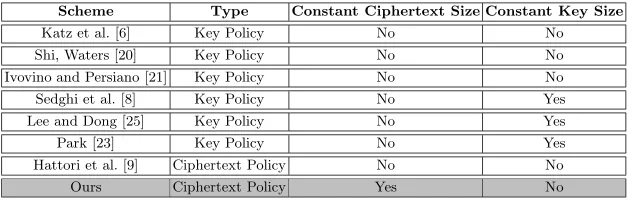
We highlight the differences between our schemes and the previous HVE schemes in Table 1. A more detailed comparison among these schemes is given in Sec. 7.
Table 1.A Comparison on Ciphertext Size and Key Size among HVE Schemes
Scheme Type Constant Ciphertext Size Constant Key Size
Katz et al. [6] Key Policy No No
Shi, Waters [20] Key Policy No No
Ivovino and Persiano [21] Key Policy No No
Sedghi et al. [8] Key Policy No Yes
Lee and Dong [25] Key Policy No Yes
Park [23] Key Policy No Yes
Hattori et al. [9] Ciphertext Policy No No
Ours Ciphertext Policy Yes No
2
Preliminaries
2.1 Bilinear Map on Prime Order Groups
Let Gand GT be two multiplicative cyclic groups of same prime order p, and g a generator of G. Let
e:G×G→GT be a bilinear map with the following properties:
1. Bilinearity :e(ua, vb) =e(ub, va) =e(u, v)ab for allu,v ∈Ganda,b ∈Z p. 2. Non-degeneracy :e(g, g)6= 1
Decision L-BDHE Assumption. The Decision L-BDHE problem in Gis defined as follows: Let G be a bilinear group of prime order p, and g, h two independent generators of G. Denote −→yg,α,L = (g1, g2, . . . , gL, gL+2, . . . , g2L) ∈ G2L−1 where gi = gα
i
for some unknown α ∈ Z∗p. We say that the
L-BDHE assumption holds inGif for any probabilistic polynomial-time algorithmA
|Pr[A(g, h,−→yg,α,L, e(gL+1, h)) = 1]−Pr[A(g, h,−→yg,α,L, T) = 1]| ≤ǫ(k)
where the probability is over the random choive of g, hin G, the random choice α∈Z∗p, the random choiceT ∈GT, and ǫ(k) is negligible in the security parameterk.
2.2 Bilinear Map on Composite Order Groups
Let p, q be two large prime numbers and n = pq. Let G,GT be cyclic groups of order n, We say
e:G×G→GT is bilinear map on composite order groups ife satisfies the following properties: 1. Bilinearity :e(ua, vb) =e(ub, va) =e(u, v)ab.for allu,v ∈Ganda,b ∈Z
p. 2. Non-degeneracy :e(g, g)6= 1
Let Gp and Gq be two subgroups of G of order pand q, respectively. Then G = Gp×Gq, GT = GT,p×GT,q. We use gp and gq to denote generators of Gp and Gq, respectively. e(hp, hq) = 1 for all elementshp∈Gp andhq ∈Gq sincee(hp, hq) =e(gpa, gbq) =e(gqa, gpb) =e(g, g)pqab= 1 for a generator
g ofG.
Below are three complexity assumptions defined on composite order bilinear groups: the decisional
L-composite bilinear Diffie-Hellman exponent (L-cBDHE) assumption, theL-composite Decisional Diffie-Hellman (L-cDDH) assumption, and the bilinear subspace decision (BSD) assumption.
The DecisionalL−cBDHE assumption:
Letgp, h R
←−Gp, gq ←R−Gq, α←R−Zn
Z = (gp, gq, h, gαp, . . . , gα
L
p , gα
L+2 p , . . . , gα
2L
p ),
T =e(gp, h)α
L+1
, andR←GT,p
We say that the decisionalL−cBDHE assumption holds if for any probabilistic polynomial-time algorithm
A
|Pr[A(Z, T) = 1]−Pr[A(Z, R) = 1]| ≤ǫ(k) whereǫ(k) denotes an negligible function ofk.
The L−cDDH assumption:
Letgp R
←−Gp, gq, R1, R2, R3←R−Gq, α, β←R−Zn
Z= (gp, gq, gpα, . . . , gα
L
p , gα
L+1 p R1, gα
L+1β p R2)
T =gβ
pR3, andR←G
We say that theL−cDDH assumption holds if for any probabilistic polynomial-time algorithmA
|Pr[A(Z, T) = 1]−Pr[A(Z, R) = 1]| ≤ǫ(k)
whereǫ(k) denotes an negligible function ofk.
The BSD assumption:
Letgp←Gp, gq ←Gq
Z= (gp, gq)
T ←GT,p, and R←GT,p
We say that the BSD assumption holds if for any probabilistic polynomial-time algorithmA
|Pr[A(Z, T) = 1]−Pr[A(Z, R) = 1]| ≤ǫ(k)
2.3 The Vi`ete’s formulas
Both of our schemes introduced in this paper are based on the Vi`ete’s formulas [8] which is reviewed below. Consider two vectors −→v = (v1, v2, . . . , vL) and −→z = (z1, z2, . . . , zL). Vector v contains both alphabets and wildcards, and vectorzonly contains alphabets. LetJ ={j1, . . . , jn} ⊂ {1, . . . , L}denote the positions of the wildcards in vector−→v. Then the following two statements are equal:
vi=zi∨vi=∗fori= 1. . . L L
P
i=1,i /∈J
vi Q j∈J
(i−j) = PL i=1
zi Q j∈J
(i−j). (1)
Expand Q j∈J
(i−j) = n P
k=0
akik, whereak are the coefficients dependent onJ, then (1) becomes:
L P
i=1,i /∈J
vi Q j∈J
(i−j) = n P
k=0
ak L P
i=1
ziik (2)
To hide the computations, we choose random group elemenHi and put vi, zi as the exponents of group elements:Hvi
i , Hizi. Then (2) becomes: L
Q
i=1,i /∈J
Hvi
Q
j∈J(i−j)
i =
n Q
k=0 (
L Q
i=1
Hziik
i )ak (3)
Using Vi`ete’s formulas we can construct the coefficientak in (2) by:
an−k= (−1)k
X
1≤i1<i2<...<ik≤n
ji1ji2. . . jik, 0≤k≤n. (4)
wheren=|J|. If we haveJ ={j1, j2, j3}, the polynomial is (x−j1)(x−j2)(x−j3), then:
a3= 1
a2=−(j1+j2+j3)
a1= (j1j2+j1j3+j2j3)
a0=−j1j2j3.
3
Ciphertext-Policy Hidden Vector Encryption
A ciphertext-policy hidden vector encryption (CP-HVE) scheme consists of the following four probabilis-tic polynomial-time algorithms:
• Setup(1k, Σ, L): on input a security parameter 1k, an alphabetΣ, a vector-lengthL, the algorithm outputs a public key P K and master secret keyM SK.
• Encryption(P K,−→v , M): on input a public key P K, a message M, a vector v ∈ Σ∗
L where Σ∗ denotesΣ∪ {∗}, the algorithm outputs a ciphertextCT.
• KeyGen(M SK,−→x): on input a master secret keyM SK , a vector−→x ∈ΣL, the algorithm outputs a decryption keySK.
• Decryption(CT, SK): on input a ciphertextCT and a secret keySK, the algorithm outputs either a messageM or a special symbol⊥.
Security Model.The security model for a CP-HVE scheme is defined via the following game between an adversaryAand a challengerB.
• Init: The adversaryAchooses two target patterns,
− →
v0∗= (v0,1, v0,2, . . . , v0,L) and
− →
v∗1= (v1,1, v1,2, . . . , v1,L)
• Setup: The challengerB runSetup(k, Σ, L) to generate theP K andM SK.P K is then passed to
A.
• Query Phase 1:A adaptively issues key queries for−→σ = (σ1, . . . , σL)∈ΣL under the restriction that −→σ does not match−→v∗
0 or
− →
v∗
1. That is, there existi, j∈ {1, . . . , L} such thatv0,i∗ 6=∗ ∧v∗0,i6=σi, and v∗
1,j 6= ∗ ∧v∗1,j 6= σj. The challenger runs KeyGen(M SK,→−σ) and returns the corresponding decryption key toA.
• Challenge:Aoutputs two equal-length messagesM∗
0, M1∗.Bpicksβ ← {0,1}and runs Encrypt(P K,
− →
v∗
β,
M∗
β) to generate a challenge ciphertextC∗.B then passesC∗ toA.
• Query Phase 2: same as Learning Phase 1.
• Output:A outputs a bitβ′ as her guess forβ.
Define the advantage ofAas
AdvCPA−HVE(k) = Pr[β′=β]−1/2.
4
CP-HVE Scheme 1
In this section, we present our first CP-HVE under composite order bilinear groups. Let−→v denote the attribute vector associated with the ciphertext and −→z the attribute vector associated with the user secret key. The expression of these two vectors is designed based on the idea The Vi`ete’s formulas. To
do encryption, we represent each component of the vector−→v by (gvi)
Q
j∈J
(i−j)
where J denotes all the
wildcard positions and is attached to the ciphertext. Notice that Q j∈J
(i−j) = Pn k=0
akik according to the Vi`ete’s formulas. In the decryption process, based on J, the decryptor can reconstruct the coefficients
ak, and generate Q j∈J
gziikak = (gzi)
Q
j∈J
(i−j)
for each component of −→z. In this way, whether vi =zi will not affect the decryption ifi∈J.
◮ Setup(1k, Σ, L): The setup algorithm first chooses N << L where N is the maximum number of
wildcards that are allowed in an encryption vector. It then picks large primesp, q, generates bilinear groups G,GT of composite order n = pq, and selects generators gp ∈ Gp, gq ∈ Gq. After that, it selects random elements:
g, f, v, v′, h
1, . . . , hL, h′1, . . . , h′L, w∈Gp,
Rg, Rf, Rv, Rv′, Rh
1, . . . , RhL, Rh′1, . . . , Rh′L ∈Gq,
and computes :
G=gRg, F =f Rf, V =vRv, V′=v′Rv′, H1=h1Rh1, . . . , HL=hLRhL,
H′
1=h′1Rh′
1, . . . , H
′
L=h′LRh′
L,
E=e(g, w).
Then it creates the public key and master secret key as:
P K ={gp, gq, G, F, V, V′,(H1, . . . , HL),(H1′, . . . , HL′), E},
M SK ={p, q, g, f, v, v′,(h1, . . . , hL),(h′1, . . . , h′L), w}.
◮ Encrypt(P K, M,−→v = (v1, . . . , vL)∈ΣL∗): Suppose that−→v containsτ ≤N wildcards which occur
at positions J={j1, . . . , jτ}. The encryption algorithm first chooses:
s∈RZn, andZ1, Z2, Z3, Z4∈R Gq.
Using formulas (3) and (4), computeak fork= 1,2,· · ·, τ, andt=a0. Then set:
C0=M·Es, C1=G
s
tZ1, C2=FsZ2,
C3= (( L Q
i=1
V Hvi
i )
τ
Q
k=1 (i−jk)
)st ·Z3, C4= ((
L Q
i=1
V′(H′
i)vi)
τ
Q
k=1 (i−jk)
)st ·Z4,
J ={j1, j2, . . . , jτ},
◮ KeyGen(M SK,−→z = (z1, . . . , zL)∈ΣL): The key generation algorithm choosesr1, r′1, r2 randomly
in Zn, and computes:
K1=gr1, K2=gr
′
1, K 3=gr2,
K4,0= w( L Q
i=1
hzi
i v)r1( L Q
i=1 (h′
i)ziv′)r
′
1fr2,
K4,1= ( L Q
i=1
hzi
i v)ir1( L Q
i=1 (h′
i)ziv′)ir
′
1,
. . .
K4,N = ( L Q
i=1
hzi
i v)i
Nr
1( L Q
i=1 (h′
i)ziv′)i
Nr′
1 .
The secret key is SK={K1, K2, K3, K4,0, . . . , K4,N}.
◮ Decrypt(CT, SK): The decryption algorithm first applies the Vi`ete’s formulas to compute
aτ−k = (−1)k
X
1≤i1<i2<...<ik≤τ
ji1ji2. . . jik,0≤k≤τ
and then outputs:
M =e(K1, C3)·e(K2, C4)·e(K3, C2)
e( τ Q
k=0
Kak
4,k, C1)
·C0.
Correctness:
e(K1, C3) =e(gr1,(( L Q
i=1
V Hvi
i )
τ
Q
k=1 (i−jk)
)as0 ·Z3)
= L Q
i=1
e(g, v)
sr1
τ
Q
k=1 (i−jk)
a0 ·e(g, hi)
sr1
τ
Q
k=1 (i−jk)vi a0 .
e(K2, C4) =e(gr
′
1,(( L Q
k=1
V′(H′)vi
i )
τ
Q
k=1 (i−jk)
)as0 ·Z4)
= L Q
i=1
e(g, v′)
sr′1 Qτ k=1
(i−jk)
a0 ·e(g, h′ i)
sr′1 Qτ k=1
(i−jk)vi a0 .
e(K3, C2) =e(gr2, FsZ2) =e(g, f)r2s.
e( τ Q
k=0
Kak
4,k, C1) =e(wa0( τ Q k=0 L Q i=1
vika khziikak
i vi
ka k)r1(
τ Q k=0 L Q i=1 (h′
i)zii
ka
kv′ikak)r′1fr2a0, G
s a0Z1)
=e(g, w)saa00 ·e(g, f)
sr2a0
a0 · L Q
i=1
e(g, hi)
sr1
τ
Q
k=1 (i−jk)zi a0 e(g, v)
sr1Pτk=0ik ak
a0
·
L Q
i=1
e(g, h′
i)
sr′1 Qτ k=1
(i−jk)zi a0 e(g, v′)
sr′1Pτk=0ik ak a0
=e(g, w)s·e(g, f)sr2· L Q
i=1
e(g, v)
sr1
τ
Q
k=1 (i−jk)
a0 ·e(g, hi)
sr1
τ
Q
k=1 (i−jk)zi a0
·
L Q
i=1
e(g, v′)
sr′1 Qτ k=1
(i−jk)
a0 ·e(g, h′ i)
sr′1 Qτ k=1
Then we have
e(K1, C3)·e(K2, C4)·e(K3, C2)
= L Q
i=1
e(g, v)
sr1
τ
Q
k=1 (i−jk)
a0 ·e(g, hi)
sr1
τ
Q
k=1 (i−jk)vi a0 ·
L Q
i=1
e(g, v′)
sr′1 Qτ k=1
(i−jk)
a0 ·e(g, h′ i)
sr′1 Qτ k=1
(i−jk)vi a0 ,
e( τ Q
k=0
Kak
4,k, C1)
= L Q
i=1
e(g, v)
sr1
τ
Q
k=1 (i−jk)
a0 ·e(g, hi)
sr1
τ
Q
k=1 (i−jk)zi
a0 · L Q
i=1
e(g, v′)
sr′1 Qτ k=1
(i−jk)
a0 ·e(g, h′ i)
sr′1 Qτ k=1
(i−jk)zi
a0
·e(g, w)s·e(g, f)sr2, and can recover messageM by:
e(K1, C3)·e(K2, C4)·e(K3, C2)
e(
τ Q k=0
Kak
4,k, C1)
·C0=
e(g, f)r2s·M·e(g, w)s
e(g, w)s·e(g, f)sr2 =M.
Theorem 1. Our CP-HVE Scheme 1 is secure if the DecisionalL−cBDHE assumption, theL−cDDH assumption, and the BSD assumption hold.
We prove Theorem 1 by the following sequence of games.
Game0: [C0, C1, C2, C3, C4]
Game1: [C0·Rp, C1, C2, C3, C4]
Game2: [R0, C1, C2, C3, C4]
Game3: [R0, C1, C2, R3, C4]
Game4: [R0, C1, C2, R3, R4],
whereRpis a randomly chosen fromGT,p,R0is uniformly distributed inGT, andR0, R3, R4are uniformly distributed inG.
We will prove the following Lemmas. Notice that in Game4 the challenge ciphertext is independent of the message and the encryption vector, which means the adversary has no advantage in winning the game over random guess.
Lemma 1. Assume that the DecisionalL−cBDHE assumption holds, then for any PPT adversary, the difference between the advantages inGame0 andGame1 is negligible.
Lemma 2. Assume that the BSD assumption holds, then for any PPT adversary, the difference between the advantages inGame1 andGame2 is negligible.
Lemma 3. Assume that the L−cDDH assumption holds, then for any PPT adversary, the difference between the advantages in Game2 andGame3 is negligible.
Lemma 4. Assume that the L−cDDH assumption holds, then for any PPT adversary, the difference between the advantages in Game3 andGame4 is negligible.
4.1 Proof of Lemma 1
Assume that the Decisional L−cBDHE assumption holds, then for any PPT adversary, the difference between the advantages inGame0 andGame1is negligible.
We assume that adversaryA’s advantage has a differenceǫbetweenGame0andGame1. The simulator
B will use A to solve the Decisional L−cBDHE problem. B is given a challenge instance Z, T′ of the
problem, where Z = (gp, gq, h, gαp, . . . , gα
L
p , gα
L+2 p , . . . , gα
2L
p ) andT′ is either T =e(gp, h)α
L+1
or R ∈R GT,p.
In the rest of the proof, we denote W(−→v) = {1 ≤i≤L|vi=∗} andW(−→v) ={1≤i≤L|vi 6=∗}, andW(−→v)|k
• Init:A declares two challenge alphabet vectors−→v0∗ = (v∗0,1, . . . , v0,L∗ ) and
− →
v1∗= (v1,1∗ , . . . , v1,L∗ ) under the restriction thatW(−→v∗
0) =W(
− →
v∗
1).
• Setup: In this phase,B generates:
γ, y, y′, ψ,{u
i, u′i}i∈|L|
R
←−Zn, Rg, Rf, Rv, Rv′, Rh1, . . . , RhL, Rh′
1, . . . , Rh′L
R
←−Gq ThenB flips a coinµ∈ {0,1}and sets:
G=gpRg, F =gψpRf, E=e(gαp, gα
L
p gγp), V =gpy Q
i∈W(−v→∗
µ)
gα
L+1−iv∗
µ,i
p Rv, V′ =gy
′
p Rv′,
{Hi =gui−α
L+1−i
p Rh,i}i∈W(−v→∗
µ),{Hi =g
ui
p Rh,i}i∈W(−v→∗
µ),{H
′
i=gpuiRh′,i}Li=1.
Then the corresponding elements of the master secret key are:g=gp, f=gpψ,{hi=gui−α
L+1−i
p }i∈W(−v→∗
µ)
,{hi=
gui
p }i∈W(−v→∗
µ)
,{h′
i=g u′
i
p }Li=1, v′ =gy
′
p , v=gyp Q
i∈W(−v→∗µ)
gα
L+1−iv∗
µ,i
p .
The master key component w is gαL+1+αγ
p . Since B does not have gα
L+1
p , B cannot compute w directly.
• Query Phase 1: A queries the user secret key for −σ→u = (σ1, σ2, . . . , σu) that does not match the challenge patterns. Let k∈W(−v→µ∗) be the smallest integer such thatσk6=vµ,k∗ .
B needs to simulate the user key generation process. We start from K4,i.
K4,0=w( L Q
i=1
hσi
i v)r1(v′ L Q
i=1 (h′
i)σi)r
′
1fr2
=gαL+1+αγ
p (
Q
W(−v→∗µ)|k1
g(ui−αL+1−i)σi
p · Q
W(−v→µ∗)|k1 (gui
p )σi·g y+ P
i∈W(−v→∗µ)
αL+1−iv∗
µ,i
p ·)r1(v′ L Q
i=1 (h′
i)zi)r
′
1fr2. def
= gαL+1+αγ
p (gXp )r1(v′ L Q
i=1 (h′
i)zi)r
′
1fr2 where
X= X
W(−v→∗
µ)
αL+1−ivµ,i∗ +y+ X
W(−v→∗
µ)|k1
(ui−αL+1−i)σi+ X
W(−v→∗
µ)|k1
uiσi.
Since
X
W(−v→∗
µ)|k1
(ui−αL+1−i)σi+ X
W(−v→∗
µ)|k1
uiσi= X
W(−v→∗
µ)|k1
(−αL+1−iσi) + k X
i=1
uiσi
and recallσi=vµ,i∗ fori∈W(
− →
v∗
µ)|k1−1 andσk 6=vµ,k∗ .Hence, we have
X =αL+1−k∆
k+PW(−v→∗
µ)|Lk+1
αL+1−iv∗
µ,i+ Pk
i=1xiσi+y where ∆k =v∗µ,k−σk. Then we chooser′1,rˆ1, r2 randomly in Zn, and set r1= −α
k
∆k + ˆr1.K4,0 can
be represented as
K4,0
=gαL+1 +αγ p ·g−α
L+1
p ·g
P
i∈W(−v→∗µ)|L k+1
−αL+1−i+k v∗µ,i ∆k
p ·g
ak(−Pki=1xiσi+y.
∆k )
p ·(v
k Y
i=1
hσi
i )rˆ1(v′ L Y
i=1 (h′
i)σi)r
′
1·fr2
=gpαγ·g
P
i∈W(−v→∗µ)|L k+1
−αL+1−i+k v∗
µ,i ∆k
p ·g
ak(−Pki=1xiσi+y.
∆k )
p ·(v
k Y
i=1
hσi
i )rˆ1·(v′ L Y
i=1 (h′i)σi)r
′
For ˆk= 1 toN, we compute
K4,ˆk= (( Y
W(−v→∗
µ)|k
−1 1
(gui−αL+1−i
p )σi· Y
W(−v→∗
µ)|k
−1 1
(gui
p )σi·g y+ P
i∈W(−v→∗µ)
αL+1−iv∗
µ,i
p )
−αk iˆk ∆k + ˆr1i
ˆ
k
·(v′
L Y
i=1 (h′i)σi)r
′
1i ˆ
k
.
Other elements in the key can also be simulated:
K1=grp1 = (gα
k
p )−1/∆k·grpˆ1, K2=gr
′
1
p , K3=gpr2.
• Challenge:Asends to messageM0, M1 toB.BgeneratesZ1, Z2, Z3, Z4 R
←−Gq and then sets using Vi`ete’s formulas
aτ−k= (−1)k
X
i≤i1<i2<...<ik≤τ
ji1ji2. . . jik,0≤k≤τ.
Lett=a0. It creates ciphertext as:
C0=Mb·T′·e(gαp, h)γ, C1=h1/t·Z1, C2=hψ·Z2,
C3= ((h y+PL
i=1 uiv∗µ,i
)
τ
Q
k=1 (i−jk)
)1t ·Z3, C4= ((h
y′+PL
i=1 u′
iv
∗
µ,i
)
τ
Q
k=1 (i−jk)
)1t ·Z4.
IfT′ =T =e(g
p, h)α
L+1
, whereh=gc
p for some unknownc∈Zp, then
C0=Mb·e(gp, gcp)α
L+1
·e(gpα, gpc)γ =Mb·e(gp, gα
L+1
p )c·e(gαp, gpγ)c =Mb·Ec,
C1= (gpc)1/t·Z1=Gc/t·Z1′, C2= (gpc)ψ·Z2=Fc·Z2′,
C3= ((g y+PL
i=1 uiv∗µ,i
p )
τ
Q
k=1 (i−jk)
)ct ·Z
3= ((V L Y
i=1
Hvi
i )
τ
Q
k=1 (i−jk)
)st ·Z′
3,
C4= ((g y′+PL
i=1 u′
iv
∗
µ,i
p )
τ
Q
k=1 (i−jk)
)ct ·Z4= ((V′
L Y
i=1 (Hi′)vi)
τ
Q
k=1 (i−jk)
)st ·Z′
4.
Hence,A is inGame0. Otherwise, if T′=Rp=e(gp, h)α
L+1
·R′
p for some randomR′p ∈GT,p, then
A is inGame1.
• Query Phase 2: Repeat Phase 1.
• Guess:Aoutputb′∈ {0,1}. Ifb′=b thenB outputs 1; otherwiseB outputs 0.
LetAdvB(k) be the advantage ofB to solve the L−wDBDHI problem, andAdvAGame0(k),Adv Game1 A (k) be the advantages ofAinGame0 andGame1. Then we have
AdvB(λ) =|Pr[B→1|T′=T]−Pr[B →1|T′=Rp]| =|Pr[B→1|Game0]−Pr[B→1|Game1]| =|(12+AdvGame0
A (k)−( 1 2+Adv
Game1 A (k))| =ǫ.
4.2 Proof of Lemma 2
Assume that the BSD assumption holds, then for any PPT adversary, the difference between the advan-tages inGame1 andGame2 is negligible.
We assume that adversaryA’s advantage has a differenceǫbetweenGame1andGame2. The simulator
B is given a challenge instanceZ, T′ of the BSD problem, whereZ = (g
p, gq) andT′is eitherT R
←−GT,p orR←R−GT.B simulates the game forAas follows.
• Setup:B follows the setup algorithm and creates the public key and master secret key usinggpand
gq.
• Query Phase 1: A queries the user secret key for −→σ. B simulate the key generation algorithm honestly by using the master secret key.
• Challenge: A sends to message M0, M1 to B. B flips a coin b ←R− {0,1} and returns a normal ciphertext of Mb, with the exception thatC0 is multiplied byT′. If T′ =T
R
←− GT,p thenA is in
Game1; otherwise, ifT′=R R
←−GT, thenAis inGame2.
• Query Phase 2: Repeat Phase 1.
• Guess:Aoutputb′∈ {0,1}. Ifb′=b thenB outputs 1; otherwise,B outputs 0.
Let AdvB(k) be the advantage ofB to solve the BSD problem, and AdvAGame0(k), AdvGameA 1(k) be the advantages ofAin Game1andGame2. Then we have
AdvB(k) =|Pr[B→1|T′=T]−Pr[B →1|T′=R]| =|Pr[B→1|Game1]−Pr[B→1|Game2]| =|(12 +AdvGame1
A (k))−( 1 2+Adv
Game2 A (k))| =ǫ.
4.3 Proof of Lemma 3
Assume that the L−cDDH assumption holds, then for any PPT adversary, the difference between the advantages inGame2andGame3 is negligible.
We assume that the adversaryAhas difference ǫin the advantages betweenGame2andGame3. We useAto solve theL−cDDH problem. The simulatorB is given a challenge instanceZ, T′of theL-cDDH
problem, whereZ= (gp, gq, h, gpα, . . . , gα
L
p , gα
L+1 p ·R1, gα
L+1 b
p ·R2) andT′ is eitherT =gpb·R3 orR←G.
B simulates the game forAas follows:
• Init:A declares two challenge alphabet vectors−→v∗
0 = (v∗0,1, . . . , v0,L∗ ) and
− →
v∗
1 = (v1,1∗ , . . . , v1,L∗ ) under the restriction thatW(−→v∗
0) =W(
− →
v∗
1).
• Setup: In this phase,B generates:
γ, y, y′, ψ,{ui, u′i}i∈|L|
R
←−Zn,
w←R−Gp,
Rg, Rf, Rvˆ, Rv′, Rh1, . . . , RhL, Rh′
1, . . . , Rh′L ∈Gq.
ThenB flipsµ∈ {0,1}and sets:
G=gpRg, F =gψpRf, E=e(gαp, gα
L
p gγp),
V = (gαL+1 p R1)·gyp
Q
i∈W(−v→∗
µ)
gα
L+1−iv∗
µ,i
p Rˆv=gα
L+1 p ·gyp
Q
i∈W(−v→∗
µ)
gα
L+1−iv∗
µ,i
p Rv,
V′=gy′
p Q
i∈W(−v→∗µ)
gα
L+1−iv∗
µ,i
p Rv′,
{Hi=gui−α
L+1−i
p Rh,i}i∈W(−v→∗
µ)
,{Hi=gupiRh,i}i∈W(−v→∗
µ)
,
{H′
i =g u′
i−α L+1−i
p Rh′,i}
i∈W(−v→∗
µ)
,{H′
i=g u′
i
p Rh′,i}
i∈W(−v→∗
µ)
.
The corresponding master secret key components are: g = gp, f = gpψ, {hi = gui−α
L+1−i
p }i∈W(−v→∗
µ)
,
{hi = gupi}i∈W(−v→∗
µ)
,{h′
i = g u′
i−α L+1−i
p }i∈W(−v→∗
µ)
,{h′
i = g u′
i
p }i∈W(−v→∗
µ)
, v = gαL+1+y p
Q
i∈W(−v→∗
µ)
gα
L+1−iv∗
µ,i
p ,
v′ =gy′
p Q
i∈W(−v→∗µ)
gα
L+1−iv∗
µ,i
p . Notice that the master key componentv isgα
L+1+y p
Q
i∈W(−v→∗µ)
gα
L+1−iv∗
µ,i
p .
SinceB does not havegαL+1
• Query Phase 1: A queries the user secret key for −σ→u = (σ1, σ2, . . . , σu) that does not match the challenge patterns. Let k∈W(−v→∗
µ) be the smallest integer such thatσk6=vµ,k∗ .
B first simulates K4,i as follows.
K4,0=w( L Q
i=1
hσi
i v)r1( L Q
i=1 (h′
i)σiv′)r
′
1fr2
=w(( Q W(−v→µ∗)|k1
g(ui−αL+1−i)σi
p · Q
W(−v→∗µ)|k1 (gui
p )σi·g αL+1
+y+ P
W(−v→∗µ)
αL+1−iv∗
µ,i
p ·)r1
·(( Q W(−v→∗
µ)|k1
g(u′i−αL+1−i)σi
p · Q
W(−v→∗
µ)|k1 (gu′i
p )σi·g y′+PL
i=1α
L+1−iv∗
µ,i
p )r
′
1fr2 def
= w(gX
p )r1(gpY)r
′
1fr2 where
X=αL+1+y+ X i∈W(−v→∗
µ)
αL+1−iv∗µ,i+ X
W(−v→∗
µ)|k1
(ui−αL+1−i)σi+ X
W(−v→∗
µ)|k1
uiσi
and
Y =y′+ X
i∈W(−v→µ∗)
αL+1−iv∗
µ,i+ X
W(−v→∗µ)|k1 (u′
i−αL+1−i)σi+ X
W(−v→µ∗)|k1
u′
iσi. Since
X
W(−v→∗
µ)|k1
(ui−αL+1−i)σi+ X
W(−v→∗
µ)|k1
uiσi= X
W(−v→∗
µ)|k1
(−αL+1−iσi) + k X
i=1
uiσi,
and
X
W(−v→∗
µ)|k1
(u′i−αL+1−i)σi+ X
W(−v→∗
µ)|k1
u′iσi= X
W(−v→∗
µ)|k1
(−αL+1−iσi) + k X
i=1
u′iσi,
and recallσi=vµ,i∗ fori∈W(
− →
v∗
µ)| k−1
1 andσk 6=vµ,k∗ . Hence,
X =αL+1+αL+1−k∆
k+PW(−v→∗
µ)|Lk+1
αL+1−iv∗
µ,i+ Pk
i=1uiσi+y,
Y =αL+1−k∆
k+PW(−v→∗
µ)|Lk+1
αL+1−iv∗
µ,i+ Pk
i=1u′iσi+y′. where ∆k =vµ,k∗ −σk. B then randomly choosesr1,rˆ′1, r2 in Zn, sets r′1 = −α
kr
1 ∆k + ˆr
′
1. Hence, we have:
K4,0=w(gpX)r1(gpY)
−αk r1
∆k + ˆr
′
1·fr2 =w(gX+
−Y αk ∆k
p )r1(gYp) ˆ r′
1·fr2 =w(g
αL+1−k∆
k+PW(−v→∗
µ)|Lk+1
αL+1−iv∗
µ,i+
Pk
i=1uiσi+y
p g
− P
W(−v→∗µ)|L k+1
αL+1−i+k v∗µ,i
∆k −
(Pk
i=1u′i σi+y′)αk ∆k
p )r1
·(v′ QL i=1
(h′
i)σi) ˆ r′
1·fr2. Also, for ˆk= 1 to N,B sets
K4,ˆk= (g
αL+1−k∆
k+PW(−v→∗
µ)|Lk+1
αL+1−iv∗
µ,i+
Pk
i=1uiσi+y
p g
− P
W(−v→∗µ)|L k+1
αL+1−i+k v∗µ,i
∆k −
(Pki=1u′i σi+y′)αk ∆k
p )r1i
ˆ k ·( L Q i=1 (h′
i)σiv′) ˆ r′ 1i ˆ k .
And other elements can also be simulated as follows:
K1=grp1, K2=g r′
1 p =g
−αk ∆k r1+ ˆr′1
• Challenge: Asends two messageM0, M1to B. ThenB generatesR0←R−GT, Z1, Z2, Z3, Z4←R−Gq and sets using Vi`ete’s formulas:
aτ−k= (−1)k
X
i≤i1<i2<...<ik≤τ
ji1ji2. . . jik,0≤k≤τ.
Lett=a0.B creates ciphertext as:
C0=R0, C1=T′1/t·Z1, C2=T′ψ·Z2,
C3= (((gα
L+1b p R2)(T
′y+PL
i=1 uiv∗µ,i
))
τ
Q
k=1 (i−jk)
)1t ·Z3, C4= ((T
′y′+PL
i=1 u′ iv ∗ µ,i ) τ Q k=1 (i−jk)
)1t ·Z4.
IfT′ =gb
pgqc some unknownc∈Zq, then we have
C1= (gbpgcq)1/t·Z1=Gb/t·Z1′,
C2= (gbpgcq)ψ·Z2=Fb·Z2′, ,
C3= (((gα
L+1b
p R2)(gbpgqc) y+
L
P
i=1 uivµ,i∗
))
τ
Q
k=1 (i−jk)
)1t ·Z3
= ((gαL+1gy+
L
P
i=1 uiv∗µ,i
)
τ
Q
k=1 (i−jk)
)bt ·((R2g
c(y+PL
i=1 uiv∗µ,i)
q )
τ
Q
k=1 (i−jk)
)1t ·Z3
= ((V
L Y
i=1
Hvi
i )
τ
Q
k=1 (i−jk)
)st ·Z′
3,
C4= (((gpbgqc) y′+PL
i=1 u′ iv ∗ µ,i ) τ Q k=1 (i−jk)
)1t ·Z
4
= (((gp) y′+
L
P
i=1 u′iv
∗ µ,i ) τ Q k=1 (i−jk)
)bt ·(((gc
q) y′+
L
P
i=1 u′iv
∗ µ,i ) τ Q k=1 (i−jk)
)1t ·Z4
= ((V′
L Y
i=1 (Hi′)vi)
τ
Q
k=1 (i−jk)
)st ·Z′
4.
and CT is inGame2. Otherwise, ifT′=R=gb
′
pgc
′
q for some b′∈Zp, c′∈Zq, then
C1= (gb
′
pgc
′
q )1/t·Z1=Gb
′/t
·Z1′′,
C2= (gb
′
pgc
′
q )ψ·Z2=Fb
′
·Z′′
2,
C3= (((gα
L+1b p R2)(gb
′
pgc
′ q) y+ L P i=1 uivµ,i∗
))
τ
Q
k=1 (i−jk)
)1t ·Z3,
= ((gpαL+1) δ
τ
Q
k=1 (i−jk)
)1t((g
αL+1 +y+
L
P
i=1 uiv∗µ,i
p )
τ
Q
k=1 (i−jk)
)bt′ ·((R2g
c′(y+
L
P
i=1 uiv∗µ,i)
q )
τ
Q
k=1 (i−jk)
)1t ·Z3
= ((gαL+1
p )
δ
τ
Q
k=1 (i−jk)
)1t ·((V
L Y
i=1
Hvi
i )
τ
Q
k=1 (i−jk)
)st ·Z′′
3,
C4= (((gb
′
pgc
′
q ) y′+PL
i=1 u′ iv ∗ µ,i ) τ Q k=1 (i−jk)
)1t ·Z4
= (((gp) y′+PL
i=1 u′
iv∗µ,i
)
τ
Q
k=1 (i−jk)
)b
′
t ·(((gc
′
q ) y′+PL
i=1 u′
iv∗µ,i
)
τ
Q
k=1 (i−jk)
)1t ·Z4
= ((V′
L Y
i=1 (Hi′)vi)
τ
Q
k=1 (i−jk)
)st ·Z′′
4,
where δ=b−b′ is uniformly distributed inZ
n forR chosen randomly fromG, and henceCT is in
Game3.
• Query Phase 2: Repeat Phase 1.
LetAdvB(k) be the advantage ofB in solving the L−cDDH problem, andAdvGameA 2(k), Adv Game3 A (k) be the advantage ofAinGame2 andGame3, respectively. Then we have
AdvB(k) =|Pr[B→1|T′=T]−Pr[B →1|T′=R]| =|Pr[B→1|Game2]−Pr[B→1|Game3]| =|(1
2 +Adv Game2
A (k))−(12+Adv Game3 A (k))| =ǫ.
4.4 Proof of Lemma 4
The proof for Lemma 4 is almost the same as that for Lemma 3, where we generateV′ as the role ofV
in Lemma 3. We omit the details of the proof here.
5
CP-HVE Scheme 2
One straightforward approach to obtain a new CP-HVE scheme under prime-order bilinear groups is to apply the conversion technique introduced by Lewko [26]. In this section, we present a new prime-order CP-HVE scheme that is more efficient than the converted scheme.
◮ Setup(1k, Σ, L): The setup algorithm chooses N << L to be the maximum number of wildcards
that are allowed in an encryption vector. Then it generates other system parameters including:
e:G×G→GT,
L+ 1 random elements V, H1, . . . , HL∈RG, Then chooses randomly generatorg, w, f ∈G,
Y =e(g, w).
The public key and master secret key are set as:
P K= (Y, V,(H1, . . . , HL), g, f, p,G,GT, e),
M SK=w.
◮ Encrypt(P K, M,−→v = (v1, . . . , vL)∈ΣL∗): Assume that−→v = (v1, . . . , vL) containsτ≤N wildcards
which occur at positionsJ ={j1, . . . , jτ}. The encryption algorithm choosess∈RZp, and computes using Viete’s formulas t=a0. It then computes:
C0=M Ys, C1=g
s
t, C2=fs, C3= (
L Q
i=1
V Hvi
i )
Qτ
k=1 (i−jk)s
t ,
and set the ciphertext CT = (C0, C1, C2, C3, J ={j1, j2, . . . , jτ}).
◮ Key Generation(M SK,−→z = (z1, . . . , zL) ∈ ΣL): given a key vector −→z = (z1, . . . , zL), the key
generation algorithm choosesr, r1∈RZp, then it creates secret keySK as:
K1=gr, K2=gr1,
K3,0=w( L Q
i=1 (Hzi
i V)rfr1
K3,1= ( L Q
i=1
Hzi
i V)ir
. . .
K3,N = ( L Q
i=1
Hzi
i V)i
Nr
.
◮ Decrypt(CT, SK): The decryption algorithm first applies the Viete formulas on J ={j1, . . . , jτ}
included in the ciphertext to compute:
aτ−k= (−1)k
X
1≤i1<i2<...<ik≤τ
and then outputs:
M = e(K1, C3)·e(K2, C2)
e(Qτ k=0
Kak
3,k, C1)
·C0.
Correctness
e(K1, C3) =e(gr,(( L Q
i=1
V Hvi
i )
τ
Q
k=1 (i−jk)
)as0)
= L Q
i=1
e(g, V)
sr Qτ k=1
(i−jk)
a0 ·e(g, Hi)
sr Qτ k=1
(i−jk)vi
a0 .
e(K2, C2) =e(gr1, fs) =e(g, f)r1s
e(Qτ k=0
Kak
3,k, C1) =e(wa0( τ Q
k=0 L Q
i=1
Hziikak
i Vi
ka
k)rfr1a0, gas0)
=e(g, w)saa00 ·e(g, f)
sr1a0
a0 · L Q
i=1
e(g, V)
sr Qτ k=1
(i−jk)
a0 e(g, Hi)
sr Qτ k=1
(i−jk)zi
a0
=e(g, w)s·e(g, f)sr1· L Q
i=1
e(g, V)
sr Qτ k=1
(i−jk)
a0 ·e(g, Hi)
sr Qτ k=1
(i−jk)zi a0 .
Then we have:
e(K1,C3)·e(K2,C2)·C0 e(Qτ
k=0 Kak3,k,C1)
=
M·e(g,w)s·QL i=1
e(g,V)
sr Qτ k=1
(i−jk)
a0 ·e(g,Hi) sr Qτ
k=1 (i−jk)vi
a0 ·e(g,f)r1s
e(g,w)s·e(g,f)sr1·QL
i=1 e(g,V)
sr Qτ k=1
(i−jk)
a0 ·e(g,Hi) sr Qτ
k=1 (i−jk)zi a0
=M.
6
Security Proof of CCP-HVE2 Scheme
Theorem 2. Assume decisionL-BDHE assumption holds inG, then our CP-HVE Scheme 2 is secure.
Proof. Suppose that there exists an adversary A which can attack our scheme with non-negligible ad-vantageǫ, we construct another algorithmB which usesA to solve the decisionL-BDHE problem. On input (g, h,−→yg,α,L= (g1, g2, . . . , gL,
gL+2, . . . , g2L), T), wheregi=gα
i
and for some unknownα∈Z∗p. The goal ofBis to determine whether
T =e(gL+1, h) or not.
In the rest of the proof, we denoteW(−→v) ={1 ≤i≤L|vi=∗}andW(−→v) ={1≤i≤L|vi 6=∗}, and
W(−→v)|k
j as {i∈W(−→v)|j ≤i≤k}.
B simulates the game forAas follows:
• Init: A declares two challenge alphabet vectors−→v∗
0 ∈ ΣL∗ and
− →
v∗
1 ∈ ΣL∗ under the restriction that
W(−→v∗
0) =W(
− →
v∗
1).B flips a coinµ∈ {0,1}. For simplicity we denote
− →
v∗
µ= (v∗1, v2∗,· · · , v∗L).
• Setup:B choosesN << L, and random valuesγ, y, ψ, u1, . . . , uL∈RZpand sets
Y =e(gα, gαL
gγ), f=gψ,
V =gy Q
i∈W(−v→∗
µ)
gαL+1−iv∗
µ,i
{Hi=gui−α
L+1−i
}i∈W(−→
v∗
µ),{Hi=g
ui}
i∈W(−v→∗
µ).
The master key component w is gαL+1+αγ
. Since B does not have gαL+1
, B cannot compute w
• Query Phase 1: A queries the user secret key for −σ→u = (σ1, σ2, . . . , σu) that does not match the challenge patterns. Let k∈W(−v→∗
µ) be the smallest integer such thatσk6=vµ,k∗ .
B needs to simulate the user key generation process. We start from K3,i.
K3,0=w( L Q
i=1
Hσi
i V)rfr1 =gαL+1+αγ
( Q
W(−v→∗µ)|k1
gui−αL+1−i· Q
W(−v→µ∗)|k1
(gui))σi·g
y+ P
W(−v→∗µ)
αL+1−iv∗
µ,i
)rfr1. def
= gαL+1+αγ
(gX)rfr1 where
X= X
W(−v→∗
µ)
αL+1−ivµ,i∗ +y+ X
W(−v→∗
µ)|k1
(ui−αL+1−i)σi+ X
W(−v→∗
µ)|k1
uiσi.
Since
X
W(−v→∗
µ)|k1
(ui−αL+1−i)σi+ X
W(−v→∗
µ)|k1
uiσi= X
W(−v→∗
µ)|k1
(−αL+1−iσi) + k X
i=1
uiσi
and recallσi=vµ,i∗ fori∈W(
− →
v∗
µ)|k1−1 andσk 6=vµ,k∗ .Hence, we have
X =αL+1−k∆
k+PW(−v→∗
µ)|Lk+1
αL+1−iv∗
µ,i+ Pk
i=1xiσi+y where ∆k = vµ,k∗ −σk. Then we choose ˆr, r1 randomly in Zn, and set r = −α
k
∆k + ˆr. K3,0 can be
represented as
K3,0
=gαL+1+αγ·g−αL+1·g
P
i∈W(−v→µ∗)|L k+1
−αL+1−i+k v∗
µ,i ∆k
·gak(− Pk
i=1xiσi+y.
∆k )·(V
k Y
i=1
hσi
i ) ˆ r·fr1
=gαγ·g
P
i∈W(−v→∗µ)|L k+1
−αL+1−i+kv∗µ,i ∆k
·gak(− Pk
i=1xiσi+y.
∆k )·(V
k Y
i=1
Hσi
i )rˆ·fr1.
For ˆk= 1 toN, we compute
K3,ˆk= (g y+ P
W(−v→µ∗)
αL+1−iv∗
µ,i
·( Q
W(−v→∗
µ)|k
−1 1
gui−αL+1−i· Q W(−v→∗
µ)|k
−1 1
(gui)σi)
−αk iˆk ∆k +ˆri
ˆ
k
.
Other elements in the key can also be simulated:
K1=gr= (gαk)−1/∆k·grˆ, K2=gr1.
• Challenge:A sends to messageM0, M1toB, then sets using Viete formulas
aτ−k= (−1)k
X
i≤i1<i2<...<ik≤τ
ji1ji2. . . jik,0≤k≤τ.
Lett=a0. It creates ciphertext as:
C0=Mb·T·e(gα, h)γ, C1=h1/t, C2=hψ, C3= ((h y+PL
i=1 uiv∗µ,i
)
τ
Q
k=1 (i−jk)
)1t
IfT =e(g, h)αL+1
• Query Phase 2: Same Phase 1.
• Guess:Aoutputb′∈ {0,1}. Ifb′=b thenB outputs 1, otherwise outputs 0.
Ifb′= 0, then the simulation is the same as in the real game. Hence,Awill have the probability 12+ǫto guess bcorrectly. If b′ = 1, then T is random in G, thenA will have probability 1
2 to guessb correctly. Therefore,B can solve the decisionL-BDHE assumption also with advantageǫ.
7
Performance Comparison
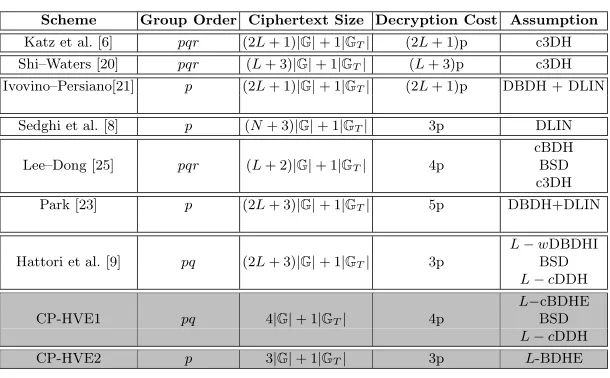
We give a detailed comparison among all the HVE schemes in Table 2. The schemes are compared in terms of the order of the underlying group, ciphertext size, decryption cost, and security assumption. In the table, p denotes the pairing operation,L the length of the vector, andN denotes the maximum number of wildcards.
Table 2.Performance Comparison
Scheme Group Order Ciphertext Size Decryption Cost Assumption
Katz et al. [6] pqr (2L+ 1)|G|+ 1|GT| (2L+ 1)p c3DH
Shi–Waters [20] pqr (L+ 3)|G|+ 1|GT| (L+ 3)p c3DH
Ivovino–Persiano[21] p (2L+ 1)|G|+ 1|GT| (2L+ 1)p DBDH + DLIN
Sedghi et al. [8] p (N+ 3)|G|+ 1|GT| 3p DLIN
cBDH Lee–Dong [25] pqr (L+ 2)|G|+ 1|GT| 4p BSD
c3DH Park [23] p (2L+ 3)|G|+ 1|GT| 5p DBDH+DLIN
L−wDBDHI Hattori et al. [9] pq (2L+ 3)|G|+ 1|GT| 3p BSD
L−cDDH
L−cBDHE
CP-HVE1 pq 4|G|+ 1|GT| 4p BSD
L−cDDH
CP-HVE2 p 3|G|+ 1|GT| 3p L-BDHE
Remark: In Table 2, we do not count the wildcard positions when measuring the ciphertext size. To indicate those wildcard positions, a naive way is to use an L-bit string, which has the same size as several group elements when Lis linear in the security parameter. When N ≪L, then a more efficient way is to use the index for the first wildcard position and the offsets for the remaining wildcard positions.
8
Conclusion
We proposed two efficient ciphertext policy Hidden Vector Encryption schemes in this paper. Both of our encryption schemes can achieve constant ciphertext size, which forms the major contribution of this work. We proved the security of our schemes in a selective security model which captures both plaintext and attribute hiding properties. One of our future work is to extend our schemes so that they can achieve adaptive security.
References
1. Goyal, V., Pandey, O., Sahai, A., Waters, B.: Attribute-based encryption for fine-grained access control of encrypted data. In: Proceedings of the 13th ACM conference on Computer and communications security. CCS ’06, New York, NY, USA, ACM (2006) 89–98
3. Waters, B.: Ciphertext-policy attribute-based encryption: An expressive, efficient, and provably secure real-ization. In: Public Key Cryptography. (2011) 53–70
4. Lewko, A.B., Waters, B.: New proof methods for attribute-based encryption: Achieving full security through selective techniques. In: CRYPTO. (2012) 180–198
5. Boneh, D., Waters, B.: Conjunctive, subset, and range queries on encrypted data. In: Proceedings of the 4th conference on Theory of cryptography. TCC’07, Berlin, Heidelberg, Springer-Verlag (2007) 535–554
6. Katz, J., Sahai, A., Waters, B.: Predicate encryption supporting disjunctions, polynomial equations, and inner products. In: Proceedings of the theory and applications of cryptographic techniques 27th annual international conference on Advances in cryptology. EUROCRYPT’08, Berlin, Heidelberg, Springer-Verlag (2008) 146–162
7. Boneh, D., Sahai, A., Waters, B.: Functional encryption: Definitions and challenges. In: TCC. (2011) 253–273 8. Sedghi, S., Liesdonk, P., Nikova, S., Hartel, P., Jonker, W.: Searching keywords with wildcards on encrypted data. In Garay, J., Prisco, R., eds.: Security and Cryptography for Networks. Volume 6280 of Lecture Notes in Computer Science., Springer Berlin Heidelberg (2010) 138–153
9. Hattori, M., Hirano, T., Ito, T., Matsuda, N., Mori, T., Sakai, Y., Ohta, K.: Ciphertext-policy delegatable hidden vector encryption and its application to searchable encryption in multi-user setting. In Chen, L., ed.: Cryptography and Coding. Volume 7089 of Lecture Notes in Computer Science., Springer Berlin Heidelberg (2011) 190–209
10. Shamir, A.: Identity-based cryptosystems and signature schemes. In: Advances in Cryptology – CRYPTO. (1984) 47–53
11. Boneh, D., Franklin, M.K.: Identity-based encryption from the weil pairing. In: Advances in Cryptology – CRYPTO. (2001) 213–229
12. Cocks, C.: An identity based encryption scheme based on quadratic residues. In: IMA Int. Conf. (2001) 360–363
13. Boneh, D., Boyen, X., Goh, E.J.: Hierarchical identity based encryption with constant size ciphertext. In: EUROCRYPT05. (2005) 440–456
14. Boneh, D., Crescenzo, G.D., Ostrovsky, R., Persiano, G.: Public key encryption with keyword search. In: Advances in Cryptology – EUROCRYPT. (2004) 506–522
15. Abdalla, M., Bellare, M., Catalano, D., Kiltz, E., Kohno, T., Lange, T., Malone-Lee, J., Neven, G., Paillier, P., Shi, H.: Searchable encryption revisited: Consistency properties, relation to anonymous ibe, and extensions. J. Cryptology21(3) (2008) 350–391
16. Abdalla, M., Catalano, D., Dent, A., Malone-Lee, J., Neven, G., Smart, N.: Identity-based encryption gone wild. In Bugliesi, M., Preneel, B., Sassone, V., Wegener, I., eds.: Automata, Languages and Programming. Volume 4052 of Lecture Notes in Computer Science., Springer Berlin Heidelberg (2006) 300–311
17. Waters, B.: Efficient identity-based encryption without random oracles. In: Advances in Cryptology – EUROCRYPT. (2005) 114–127
18. Boneh, D., Boyen, X.: Efficient selective-id secure identity based encryption without random oracles. In: Proceedings of Eurocrypt 2004, volume 3027 of LNCS, Springer-Verlag (2004) 223–238
19. Abdalla, M., De Caro, A., Phan, D.H.: Generalized key delegation for wildcarded identity-based and inner-product encryption. Information Forensics and Security, IEEE Transactions on7(6) (2012) 1695–1706 20. Shi, E., Waters, B.: Delegating capabilities in predicate encryption systems. In: Proceedings of the 35th
international colloquium on Automata, Languages and Programming, Part II. ICALP ’08, Berlin, Heidelberg, Springer-Verlag (2008) 560–578
21. Iovino, V., Persiano, G.: Hidden-vector encryption with groups of prime order. In: Proceedings of the 2nd international conference on Pairing-Based Cryptography. Pairing ’08, Berlin, Heidelberg, Springer-Verlag (2008) 75–88
22. Blundo, C., Iovino, V., Persiano, G.: Private-key hidden vector encryption with key confidentiality. In Garay, J., Miyaji, A., Otsuka, A., eds.: Cryptology and Network Security. Volume 5888 of Lecture Notes in Computer Science., Springer Berlin Heidelberg (2009) 259–277
23. Park, J.H.: Efficient hidden vector encryption for conjunctive queries on encrypted data. IEEE Trans. on Knowl. and Data Eng.23(10) (October 2011) 1483–1497
24. Seo, J., Kobayashi, T., Ohkubo, M., Suzuki, K.: Anonymous hierarchical identity-based encryption with constant size ciphertexts. In: Public Key Cryptography – PKC 2009. Volume 5443 of Lecture Notes in Computer Science., Springer Berlin Heidelberg (2009) 215–234
25. Lee, K., Lee, D.H.: Improved hidden vector encryption with short ciphertexts and tokens. Des. Codes Cryptography58(3) (March 2011) 297–319