M E T H O D O L O G Y
Teaching Medical Students About Attention De
fi
cit
Hyperactivity Disorder (ADHD): The Design And
Development Of An E-Learning Resource
This article was published in the following Dove Press journal: Advances in Medical Education and Practice
Gill Salmon1 Michal Tombs 2 Katy Surman 3
1Neurodevelopmental Disorders Team,
Neath Port Talbot Hospital, Port Talbot SA12 7BX, UK;2C4ME, School of Medicine, Cardiff University, Cardiff CF14 4YS, UK;3Medical Student, University of Cambridge, School of Clinical Medicine, Addenbrookes Hospital, Cambridge CB2 OSP, UK
Abstract: In this paper, we describe how an e-learning resource on Attention Deficit Hyperactivity Disorder (ADHD) for medical students was designed and developed. The aim of the resource was to provide students with essential knowledge and understanding about ADHD prior to their attendance at a classroom teaching session as well as to serve as a revision tool. The paper focuses on the way in which instructional design, educational and multimedia principles were used to inform the development of the resource. It also reports results of a small-scale evaluation of students’satisfaction with the resource and the way in which they believed it impacted knowledge acquisition of ADHD related concepts and principles. In addition, we consider ways in which the resource could be further utilized and evaluated, for example as part of aflipped classroom approach to learning, and whether this would be a useful model to use when teaching other aspects of Child and Adolescent Psychiatry.
Keywords: ADHD, ADDIE, PACT analysis, instructional design, multimedia principles,
flipped classroom
Introduction
The increased complexity of medicine requires medical schools to review and revise
the undergraduate medical curriculum, often resulting in addition of new topics.1
However, the time available for teaching is limited and educators may struggle to
cover important topics within an increasingly constrained timeframe.2In an attempt to
address this issue, educators have looked for teaching techniques that will help them maximize the use of teaching time to ensure the ever-expanding curriculum is covered. E-learning resources are being increasingly used as teaching aids in medical education. Such resources have many advantages for medical students such as enabling them to
engage in independent and individualised learning,3,4as well as offering students the
flexibility to study at a time that suits them and at their own pace.5High rates of student
satisfaction with e-learning have been reported, with manyfinding it an effective way
of learning.6,7It is interesting to note however, that many medical students do not
anticipate e-learning completely replacing traditional teaching methods,8viewing it
more as a tool to complement them in a“blended”or“flipped classroom”approach.9
Moreover, e-learning has been shown to be at least as effective as traditional lecturing
in many medical disciplines, and across many stages of medical education.4,5,10
The importance of using well established and robust educational principles when
designing e-learning resources has been discussed extensively in the literature.7
Correspondence: Michal Tombs C4ME, School of Medicine, Cardiff University, Neuadd Meirionnydd, Heath Park, Cardiff CF14 4YS, UK
Tel +442920687431 Email [email protected]
Advances in Medical Education and Practice
Dove
press
open access to scientific and medical research
Open Access Full Text Article
Advances in Medical Education and Practice downloaded from https://www.dovepress.com/ by 118.70.13.36 on 19-Aug-2020
However, newcomers into this area mayfind it difficult to decide which theory or framework to use. This paper adds to the current literature on e-learning and the teaching of under-graduate Child and Adolescent psychiatry (CAP) by describ-ing how instructional design, educational, and multimedia principles were used in grounding the design and
develop-ment of an e-learning resource (https://xerte.cardiff.ac.uk/
play.php?template_id=1501) to teach the principles of
ADHD to medical students. It also reports preliminary
eva-luation by considering students’satisfaction and the impact
of the online resource on their knowledge of ADHD. Consideration is given to how the resource could be evalu-ated more extensively and rigorously in order to identify its educational value and impact on knowledge and skill acquisition.
Background
The amount of time devoted to teaching CAP to under-graduate medical students in medical schools across the world is, on average, small and there is limited agreement
about appropriate curriculum content.11Given the increase
in prevalence in Child and Adolescent mental health pro-blems, calls have been made to increase the amount of teaching of associated topics and to prioritise teaching
CAP clinical skills over CAP knowledge.12–14For
exam-ple, in a recent Delphi study of undergraduate curriculum content in CAP, participants gave a high priority to appli-cation of knowledge and to clinical skills such as inter-viewing parents and taking a child and adolescent
psychiatric history.15In an attempt to help educators
max-imize the use of available CAP teaching time, an e-learn-ing resource for medical students on ADHD was developed as it was thought this might be a useful adjunct to classroom approaches to teaching ADHD knowledge or related clinical skills.
Overview Of Design And Development
Principles
The design and development of the ADHD e-learning resource were based upon a range of instructional design, educational and multimedia principles. A literature search revealed the ADDIE model (Analysis; Design;
Development; Implementation and Evaluation) for
designing and implementing training to be particularly popular amongst educators, instructional designers and
training developers.16,17 This is because the clearly
defined stages help organize teaching content and aid
the implementation of teaching tools. However, ADDIE
is an instructional design methodology that is not specific
to e-learning. This is where Overbaugh’s18guidelines for
development of computer-based instruction can prove
particularly useful, as they address more e-specific issues
that ADDIE may miss.
In the ADDIE model, the development of instructional materials usually starts by analyzing the requirements of
the resource.16,17Developers of e-learning resources need
to understand the People the resource is targeting, what they need to know, what their level of pre-existing knowl-edge and skills are, their preferred way of learning, what the learning outcomes of the resource will be and how the
resource will be delivered.19 A useful framework which
can be used at this stage is the PACT (People; Activities;
Contexts and Technologies).20 This framework aids the
development of clearly defined learning objectives that
reflect what the students should be able to do after
com-pleting the resource; the conditions under which they need
to perform them and the acceptable standard,16,21 before
relevant learning activities and assessments are designed.22
Learning activities are defined by Beetham23as“a specific
interaction of learners(s) with others using specific tools
and resources, oriented towards a specific outcome” (p.
28) and are considered to be of primary importance with
supporting materials taking a secondary place.23,24Context
refers to the physical and social environments for the learning activities as well as the support available and
the learner’s personal circumstances. Finally, technologies
need to be considered with the internet clearly having a central role in providing information and ways for e-lear-ners to interact.
In the design phase of the ADDIE model, a systematic approach should be taken by considering lesson planning, instructional methods, learning objectives, learning activ-ities, content, use of multimedia and the assessment
meth-ods to be used.17 Resources should be designed with
learning theories in mind, viewing learning as a behavior,
as a construction of knowledge and as a social practice25
with cognitive aspects playing a central role, given that the
focus on e-learning is usually on individual learners.19
In the development phase, instructional materials and proposed learning content are then further developed and assembled and additional details such as the font to be
used, colour and use of graphics are considered.16,17 If
using illustrations or pictures obtained off the internet it is important that the correct permissions have been obtained or to those available under a creative commons
Advances in Medical Education and Practice downloaded from https://www.dovepress.com/ by 118.70.13.36 on 19-Aug-2020
license have been used. The resource then needs to be tested and amended in response to the feedback.
Useful to consider during the development phase of the
ADDIE model are Overbaugh’s18guidelines for the
devel-opment of computer-based learning, which are based on
Gagné’s26nine events of instruction framework. Overbaugh
grouped the nine events into three domains and added a fourth domain for issues unique to computer-based teaching.
Thefirst domain in Overbaugh’s18guidelines for the
devel-opment of computer-based learning is known as instructional set and aims to help the learner to engage with the informa-tion that is going to be presented. This domain draws on the
first three of Gagné’s nine events of instruction and includes
gaining learner attention, informing learners of the learning objectives, and stimulating learner recall.26,27The second of
Overbaugh’s18 domains considers teaching strategies and
draws on Gagné’s fourth,fifth and ninth events of instruction, that is, presenting the content, providing learner guidance
and eliciting performance.26,27 This includes ensuring that
the way the teaching stimulus is presented that is the text, the colour and the graphics are distinctive, providing learner guidance and considering the use of strategies which will facilitate the retention and transfer of new knowledge. The third domain considers eliciting student performance, provid-ing feedback and assessprovid-ing performance which are also
stages six, seven and eight of Gagné’s nine events of
instruction18,26,27 whereas the fourth domain considers
other design issues such as learner control and teaching
tools, e.g., to reduce anxiety and direct learner attention.18
The development phase in the ADDIE model is
fol-lowed by implementation.17 At this stage, any training
required to use the e-learning resource is prepared and checks are made to ensure that it is fully functional before it is shared with the learners. In order to reduce the impact of any problems at this stage, an initial pilot run with a small number of learners is advisable so that any teething issues can be addressed before the resource is made avail-able to the wider intended audience. Evaluation is central to the ADDIE process and should be considered at every
stage.17 For example, in the early stages, it can help
determine if the prototype is fit for purpose.28 It is also
important to test for both usefulness and usability as these
are the main components of effective learning.29
Pedagogical theories appropriate to e-learning should also be considered and e-resources for adult learners should be based on the principles of adult learning theory
or andragogy.30 The overarching assumption is that
lear-ners are self-directed and independent in their approach to
learning, with a preference forflexibility and autonomy in
their learning environment. Of relevance to the
develop-ment of e-learning resources are Mayer’s principles of
multimedia instructional design.31,32 These principles
were developed from learning theory and based on
evi-dence and have been shown to improve students’retention
of knowledge33 and their ability to apply what they have
learnt in new situations.34 The way in which the
under-pinning educational and design principles, including
Mayer’s multimedia principles32were applied when
devel-oping the resource is described in detail.
Putting Theory Into Practice During
The Design And Development Of
The Resource
A PACT analysis20 was conducted to analyse the
require-ments of the ADHD e-learning resource. The people that the resource was being developed for are medical students. As undergraduates, they will be at least aged 18 when they start the medical course, and are likely to be both
intelli-gent as well as computer literate. Being of the“net
gen-eration” they are likely to have a preference for learning
environments that are multimedia rich and to enjoy a
self-directed inquiry approach.35The learning outcomes for the
ADHD resource are shown inBox 1. These represent the
lower levels of knowledge, comprehension and application
in the cognitive domain of Bloom’s taxonomy, which is
used to consider learning outcomes in terms of their com-plexity and specificity.36
The learning activities in the ADHD resource all relate to
the learning objectives in Box 1. Additional materials on
ADHD were sourced from books, clinical guidelines, reputa-ble websites, online ADHD teaching resources and YouTube. It was envisaged that the context of ADHD resource was that it would be able to be used anywhere and at any time the student had access to a computer and the internet and would be accessible to people with different operating systems and browsers. The resource takes approximately 15 mins to com-plete, more if a number of the hyperlinks are used. It is suitable
Box 1Learning Outcomes Of The Online ADHD Resource
After completing this resource you should:
● Know the clinical features andDSM-Vdiagnostic criteria of ADHD in children and adolescents
● Know how ADHD in children and adolescents is assessed
● Know the appropriate evidence-based treatments for ADHD according to a child or young person’s age and clinical presentation
Advances in Medical Education and Practice downloaded from https://www.dovepress.com/ by 118.70.13.36 on 19-Aug-2020
for individual study, for example, as preparation for a teaching session about ADHD but also for individuals wishing to acquire knowledge about ADHD as well as to aid revision of the topic. It is for continuous use but can also be stopped and restarted at any point. It does not require any tuition/demon-stration or for a manual to be read before use. The technology used by ADHD resource is Xerte Online Toolkits (XOT), which is a free open source tool developed for educational
purposes by the University of Nottingham.37Xerte allows the
designer to achieve a high level of interactivity and is also user friendly and suitable for use by non-programmers and those without any specialist IT knowledge or skills. The designer does, however, need to have expertise in relation to the page content and the underlying educational theory behind the lesson design. Once published, the learning resource can be amended either by the author, the learners, or by others as it is a shared resource. XOT is accessed via a web browser (Firefox is recommended) but does need Adobe Flash Player to run.
Using the second stage of the ADDIE model,16,17 the
resource was then designed to meet the needs of the lear-ners. After the learning outcomes had been determined (see
Box 1), the instructional methods and media as well as the
strategy for instruction were chosen. Tutorials, examples and page templates available on the Xerte Project website
were then examined.37 The “flexible” XOT page template
was chosen as this allowed for different content on the slides. A colleague had given permission for cartoons he had drawn to be used to illustrate some of the slides. To enhance student learning, a combination of conceptual
scaf-folding as well as procedural scafscaf-folding was used.38 The
former helps to focus the students on particular aspects of ADHD (e.g. symptoms/diagnosis, assessment and treat-ment) whilst the latter helps them use the resource. Thus, in the resource, symbols were used to differentiate tasks which need to be completed (§) from additional
informa-tion/resources that students may wish to access (⌘).
Continuing to follow the ADDIE model,16,17during the
development phase of the ADHD resource, Overbaugh’s18
guidelines were used in conjunction with Meyer’s32
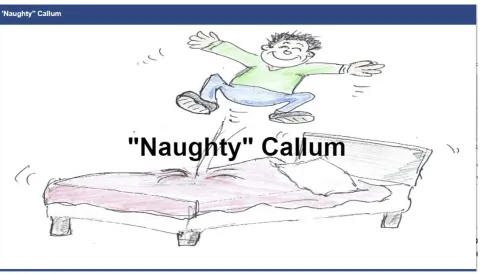
multi-media principles. Student attention is gained through the
title“Naughty Callum”, which also indicates the intention
to use a case study. Strategies to facilitate maximum sensa-tion are utilized by placing the title in the centre of the slide and using a cartoon picture as a background. By presenting
them close together, Mayer’s32 spatial contiguity principle
is used, which helps reduce cognitive load (seeFigure 1).
The orientation slide at the start of the ADHD resource states the learning outcomes (seeBox 1). Mayer’s32 pre-train-ing principle is used to ensure that students have the necessary prior knowledge about the names and characteristics of the
Figure 1ADHD resource Slide 1 showing use of Mayer’s spatial contiguity principle.
Advances in Medical Education and Practice downloaded from https://www.dovepress.com/ by 118.70.13.36 on 19-Aug-2020
main concepts they are to be taught about by offering them hyperlinks to pre-requisite knowledge about ADHD. The pro-vision of anonymous access to remedial materials is also known to relieve information anxiety, that is the gap between what the student knows and what they think they should
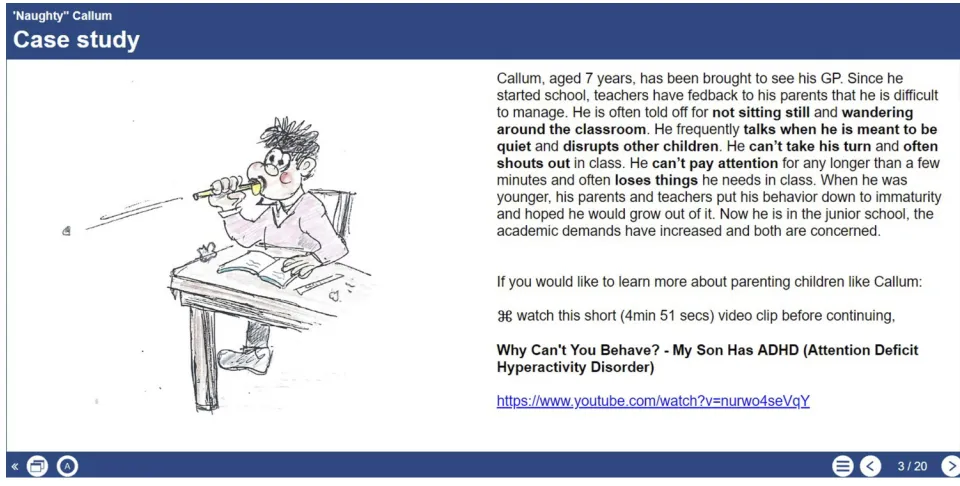
know.39 An overview slide (see Figure 2) is then provided
using a case study of a child (“Callum”) presenting with
symptoms suggestive of ADHD. A Case-Based Learning approach (CBL) is used as this presents the learning in an
authentic“story-like”manner and enables learners to
remem-ber concepts, events, and processes and to recall information.40
Maier and Warren41suggest that the cases selected are either
historically important, unusual or, as chosen for the ADHD resource, are representative of the condition. The case study is
used as an advance organizer,42 introducing the topic of
ADHD, providing a structure for student thinking and acting as a bridge between their prior knowledge about ADHD and the new information they are about to learn which will help it
to be more easily remembered. Meyer’s signaling principle32
is used to highlight important words in bold where it is not possible to delete extraneous material. Signaling helps guide
the student’s attention toward the essential material and
reduces the processing of unnecessary information. After the ADHD case study, a hyperlink is then offered to a video clip of
a similar case. Using Meyer’s32 multimedia principle that
explanations are better presented in words and pictures than just words, alone a cartoon picture is then used to illustrate the text (seeFigure 2).
Thefirst few slides of the ADHD resource stimulate recall
of the student’s prior knowledge by using pre-questions and
supplying missing prerequisites via hyperlinks to additional resources. This acts to bring the students up to the same level, as well as catering for their different needs. Interactive
for-mats, e.g., quiz, drag and drop answers (see Figure 3) or
writing free text are used.
The different learning styles of the students are catered for by providing similar information using a variety of media, e.g., diagrams or video links on some of the slides. Cartoon graphics, interactive exercises and links to multi-media resources are used throughout the resource to
main-tain the student’s interest. Learner guidance is offered by
returning to the case study at different points throughout
the resource and elaborating on Callum’s progress. The
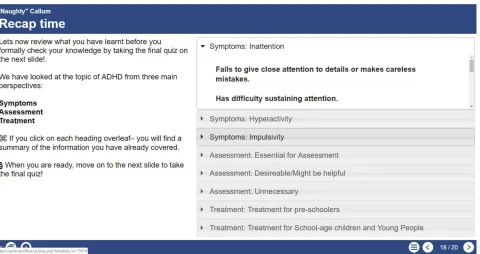
material covered is then reviewed at the end of the resource as this has the effect of enhancing retention,
particularly as it is done prior to thefinal assessment and
also aids transfer to practice43(seeFigure 4).
Interactive exercises are provided throughout the resource to elicit performance and provide feedback which is immedi-ate, as this is the most effective, and explanatory, with
hyper-links to remedial information to increase motivation.44
Assessments that are designed to measure student perfor-mance against the learning outcomes occur throughout the ADHD resource. Students are provided with a pre-test before the main learning section, as well as interactive learning
activities and self-test items throughout. Afinal quiz at the
Figure 2ADHD resource Slide 3 showing use of Mayer’s multimedia principle.
Advances in Medical Education and Practice downloaded from https://www.dovepress.com/ by 118.70.13.36 on 19-Aug-2020
end of the resource assesses performance and whether the learning outcomes have been met. This consists of ten
ques-tions. Thefirst seven questions test the student’s memory of
what they have learnt (i.e. their recall) and the final three
questions test their understanding (i.e. whether they can
apply their new knowledge to a different situation). A hyper-link is then given to a humorous video on ADHD.
Throughout the resource, Meyer’s personalization
principle32 is adopted, where a conversational rather than
a formal style is used to present the material as this is
Figure 3ADHD resource Slide 7 showing use of Interactive formats to stimulate student recall of prior knowledge.
Figure 4ADHD resource Slide 18 showing review of learning materials to enhance retention.
Advances in Medical Education and Practice downloaded from https://www.dovepress.com/ by 118.70.13.36 on 19-Aug-2020
thought to create a sense of social partnership and result in students trying harder to understand. Other principles of
multimedia instructional design32 were also considered
during the development phase of the ADHD resource.
For example, Meyer’s segmenting principle32 that offers
learner-paced segments in a logical and organized struc-ture, allowing students to proceed when they are ready,
thus reducing the risk of cognitive overload and Mayer’s
coherence principle32 keeping the content of the ADHD
resource simple whilst still being meaningful, relevant and interesting, and avoiding the use of unnecessary words, pictures or sounds.
Keller’s45 ARCS (Attention, Relevance, Confidence,
Satisfaction) model to motivate students to learn was also considered during the development phase of the
resource. The students’ Attention is captured by the use
of the case study and illustrative cartoons. The Relevance of the resource is made clear as students are informed at
the beginning that“This is a teaching resource on ADHD
for medical students”. Student Confidence is raised by
informing them of the session outcome and student Satisfaction is increased by providing opportunities for self-testing with feedback, enabling students to check their progress.
Using the ADDIE model, during the implementation phase of the e-learning resource, it was important to ensure that the resource that had been designed and developed was actually functional. A number of limitations were encountered with XOT. For example, although advised it would run on Firefox, this was not the case, and another browser (Chrome) had to be installed. Using Chrome, XOT was still unstable, and kept losing connection, having to be frequently restarted with the loss of any unsaved work. Text size had to be the same on all slides which led
to problems with “drag and drop”tasks. The background
colour is published as, and reverts back, to blue. The ADHD resource is however still accessible to those with
visual impairment or colour blindness i.e. difficulty
distin-guishing between certain colours, as users can alter the text size or background colour themselves.
The ADHD resource needed to be“published”either as
Flash or Html to create the necessary hyperlink for it to become operational. The former was chosen, which unfor-tunately does mean that it cannot be run on a tablet or smartphone as both lead to major changes in the format-ting, e.g., loss of bullet points, and bold type, and changes in background colour and slide layout which is clearly a limitation.
The final phase of the ADDIE model is evaluation
although in practice, this should occur throughout the devel-opment of a learning resource, and not just at the end. With this in mind, the ADHD e-learning resource was evaluated at a number of stages. For example, informal feedback on the format and content was initially sought from an academic child and adolescent psychiatry colleague who had a special
interest in ADHD. A brief 12-item“usability”questionnaire
was then developed taking one item from each of the areas in
Zaharias and Poylymenakou’s4664-item usability
question-naire for e-learning applications. These areas are: navigation, learnability, accessibility, consistency, visual design, interac-tivity, content and resources, media use, learning strategies design, instructional feedback and assessment and learner guidance and support. Although this approach would be inadequate for a research study, given that this was a small-scale evaluation and not research, it was considered to repre-sent a compromise and could be replicated by others wishing to develop similar online resources for use within their own institutions.
In thefirst pilot of the resource, ten medical students were
offered teaching on ADHD using the resource whilst attend-ing a teachattend-ing day on CAP. They were then asked to
com-plete the 12-item“usability”questionnaire. Even though the
sample size was small, this was considered sufficient as it has
been found that 95% of usability problems can be discovered
in a sample of justfive to six people.47Further revisions to
the ADHD resource were made in accordance with the
students’feedback at this stage. For example, a new
instruc-tion was written for users on how to change the font size on a drag and drop exercise to facilitate completion of the exercise and then how to change it back before continuing (as font size has to be the same throughout the resource when using XOT), some information was re-presented as bullet points rather than a paragraph of text and additional information was given in the quiz section about why the answers given were correct/incorrect.
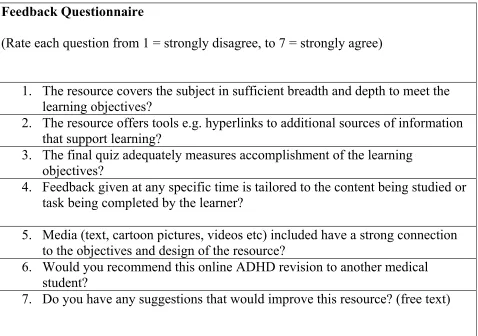
The ADHD resource is designed to collect ongoing user feedback via a SurveyMonkey link on the last XOT slide. This comprises of 5 questions from the 12 questions in the original usability questionnaire asking users to indi-cate their agreement with a number of statements relating to the resource, one question asking if students would recommend the resource to other medical students and an additional free text question asking for suggestions on how
to improve the resource (seeFigure 5).
In the second pilot, medical students were given a link to the ADHD e-learning resource and asked to look at it prior to
Advances in Medical Education and Practice downloaded from https://www.dovepress.com/ by 118.70.13.36 on 19-Aug-2020
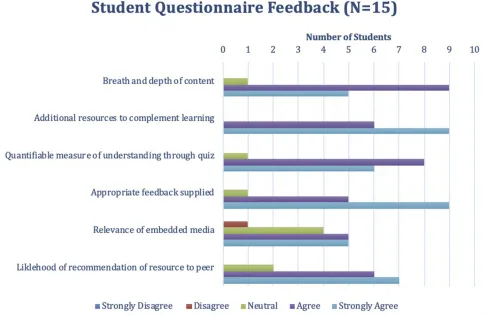
attending a small group teaching session on ADHD. Fifteen students also completed the SurveyMonkey feedback ques-tionnaire at the end of the resource. As can be seen in Figure 6, for all 6 questions, at least 75% of the students agreed or strongly agreed with the statements related to the ADHD resource. Notably, of the 15 students who completed the feedback, 14 students indicated that they agreed or strongly agreed that the resource covers the subject
(ADHD) in sufficient breadth and depth to meet the learning
objectives. 87% indicated that they would be likely to recom-mend the online resource to another medical student. Free text comments made by students were positive, also
indicat-ing areas that could benefit from further development. Some
useful comments on how the resource could be further improved were also offered, e.g., offering additional expla-nation when an incorrect answer was selected.
Conclusion And Future Directions
This paper describes the design and development of an e-learning resource for teaching ADHD to undergraduate medical students and demonstrates how educational theory,instructional models and principles can benefit the
develop-ment of e-learning resources.16–18 Using well-established
theories and models aided in the organization of content and in designing a learner-centered resource. Moreover,
pre-liminary evaluation revealed that students were satisfied with
the resource and felt it helped them acquire knowledge prior to the teaching session. With this in mind, the resource
developed may be suitable for use in a flipped classroom
approach to teaching ADHD knowledge to medical students.
The flipped classroom approach to education is being
increasingly considered to be a useful way to deliver essential
content to students48Students are provided with material to
gain a baseline level of understanding prior to attending a teaching session. This facilitates deeper understanding of concepts and allows in-class teaching time for addressing
questions and concerns.49This method is gaining momentum
in undergraduate teaching as it relieves classroom time of purely didactic teaching, and allows for the information gained prior to attending the teaching session to be applied
(e.g. in a role play clinical scenario).50This moves students
away from passive learning towards more active learning
Feedback Questionnaire
(Rate each question from 1 = strongly disagree, to 7 = strongly agree)
1. The resource covers the subject in sufficient breadth and depth to meet the
learning objectives?
2. The resource offers tools e.g. hyperlinks to additional sources of information
that support learning?
3. The final quiz adequately measures accomplishment of the learning
objectives?
4. Feedback given at any specific time is tailored to the content being studied or
task being completed by the learner?
5. Media (text, cartoon pictures, videos etc) included have a strong connection
to the objectives and design of the resource?
6. Would you recommend this online ADHD revision to another medical
student?
7. Do you have any suggestions that would improve this resource? (free text)
Figure 5Survey Monkey Feedback Questionnaire At End Of ADHD E-Learning Resource.
Advances in Medical Education and Practice downloaded from https://www.dovepress.com/ by 118.70.13.36 on 19-Aug-2020
methods, which have been shown to increase the perfor-mance of students as well as giving them autonomy over
their own learning.51 Materials used prior to attendance at
flipped classroom sessions can take a number of forms but
increasingly, e-learning resources are being used.35Further
evaluation of use of the ADHD resource in that context would now be helpful.
The resource could also provide pre-requisite infor-mation on ADHD prior to a clinical skills session for example, where students practice interviewing a parent concerned that their child might have ADHD. In addition, it could act as a revision aid as the interactive sessions can give real-time feedback, through quizzes and end of topic tests with use of active recall. Given the shortage of available teaching hours for undergraduate medical stu-dents in CAP, the development of similar e-learning resources may also offer a way to increase time teaching CAP clinical skills related to other disorders whilst pro-viding students with access to self-directed teaching resources to increase their associated knowledge. For those who may consider developing such resources, this paper demonstrates the value of using well-established
educational theories and design principles to guide the process.
It is important to note that the evaluation presented in this paper forms part of routine teaching evaluation and cannot be regarded as evaluation research. At present we can only
reflect upon some elements of Kirkpatrick’s52 lower level
of evaluation, but this could be expanded upon by
consider-ing students’perceptions of their engagement and their
inter-action with content. In addition, further evaluation could expand to examine learning, changes in behavior and long-term impact through longitudinal studies. This will provide a more robust and comprehensive evaluation of the educa-tional value and the impact of this teaching intervention on knowledge and skill acquisition.
Ethics Approval And Informed
Consent
Ethical approval was not required as the evaluation of the online ADHD resource was an audit and formed part of the resource development and not a formal research study. No personal data were collected.
Figure 6ADHD online resource: Results of the feedback questionnaire.
Advances in Medical Education and Practice downloaded from https://www.dovepress.com/ by 118.70.13.36 on 19-Aug-2020
Acknowledgement
Thank you to Richard Barratt for drawing the cartoons in the ADHD e-learning resource and giving his permission for them to be used.
Disclosure
The authors report no conflicts of interest regarding this
work.
References
1. Kopelman P. The future of UK medical education curriculum–what type of medical graduates do we need?Future Hosp J.2014;1(1):41– 46. doi:10.7861/futurehosp.14.011
2. Velthuis F, Varpio L, Helmich E, Dekker H, Jaarsma A. Navigating the complexities of undergraduate medical curriculum change: change lea-ders’perspectives.Acad Med.2018;93(10):1503–1510. doi:10.1097/ ACM.0000000000002165
3. Gill P, Kitney L, Kozan D, Lewis M. Online learning in paediatrics: a student-led web-based learning modality.Clin Teach.2010;7(1):53– 57. doi:10.1111/tct.2010.7.issue-1
4. McGready J, Brookmeyer R. Evaluation of student outcomes in online vs. campus biostatistics education in a graduate school of public health. Prev Med.2013;56:142–144. doi:10.1016/j.ypmed.2012.11.020 5. May L, Acquaviva K, Dorfman A, Posey L. Medical student
percep-tions of self-paced, web-based electives: a descriptive study. Am J Distance Educ.2009;23:212–223. doi:10.1080/08923640903332120 6. Gibbons A, Fairweather P. Computer-based instruction. In: Tobias S,
Fletcher J, editors.Training & Retraining: A Handbook for Business, Industry, Government, and the Military. New York: Macmillan Library Reference;2000:410–442.
7. Chumley-Jones HS, Dobbie A, Alford CL. Web-based learning: sound educational method or hype? A review of the evaluation literature. Acad Med. 2002;77(10 suppl):S86–S93. doi:10.1097/ 00001888-200210001-00028
8. Warnecke E, Pearson S. Medical students’ perceptions of using e-learning to enhance the acquisition of consulting skills.Australas Med J.2011;4:300–307. doi:10.4066/AMJ.2011.73
9. Ruiz JG, Mintzer MJ, Leipzig RM. The impact of e-learning in medical education. Acad Med. 2008;81(3):207–212. doi:10.1097/ 00001888-200603000-00002
10. Beale EG, Tarwater PM, Lee VH. A retrospective look at replacing face-to-face embryology instruction with online lectures in a human anatomy course.Anat Sci Educ.2014;7:234–241.
11. Sawyer MG, Giesen F, Walter G. Child psychiatry curricula in under-graduate medical education.J Am Acad Child Adolesc Psychiatry.
2008;47(2):139–147. doi:10.1097/chi.0b013e31815cd9e0
12. Kay J. Child psychiatry and the undergraduate curriculum. J Psychiatr Educ.1983;7(2):126–137.
13. Worrall-Davies AE. Teaching child and adolescent psychiatry to medical undergraduates. Adv Psychiatr Treat. 1998;4(3):172–176. doi:10.1192/apt.4.3.172
14. Lempp T, Heinzel-Gutenbrunner M, Bachmann C. Child and adoles-cent psychiatry: which knowledge and skills do primary care physi-cians need to have? A survey in general practitioners and paediatricians.Eur Child Adolesc Psychiatry.2016;25(4):443–451. doi:10.1007/s00787-015-0757-6
15. Salmon G, Tombs M. Teaching undergraduate medical students Child and Adolescent Psychiatry (CAP): a Delphi study on curriculum con-tent.BMC Med Educ.2018;18(1):315. doi:10.1186/s12909-018-1427-4
16. Dick W, Carey L, Carey JO.The Systematic Design of Instruction. 6th ed. Boston: Allyn & Bacon;2005.
17. Allen WC. Overview and evolution of the ADDIE training system. Adv Dev Hum Resour.2006;8(4):430–441. doi:10.1177/1523422306 292942
18. Overbaugh RC. Research-based guidelines for computer-based instruction development. J Res Comput Educ. 1994;27(1):29–47. doi:10.1080/08886504.1994.10782114
19. Sandars J. E-learning. In: Walsh K, editor. Oxford Textbook of Medical Education. Oxford, UK: Oxford;2013:174–175.
20. Beynon D.Designing Interactive Systems. 2nd ed. Harlow: Pearson;
2010.
21. Molenda M, Pershing JA, Reigeluth CM. Designing instructional systems. In: Craig R, editor.The ASTD Training and Development Handbook: A Guide to Human Resource Development. 4th ed. New York: McGraw-Hill;1996:266–293.
22. Biggs J.Teaching for Quality Learning at University. Buckingham: Society for Research in Higher Education and Open University Press;
1999.
23. Beetham H. An approach to learning activity design. In: Beetham H, Sharpe R, editors.Rethinking Pedagogy for a Digital Age. Abingdon: Routledge;2007:26–38.
24. JISC. Effective practice in a digital age: a guide to technology enhanced learning and teaching. 2009. Available from: https:// library.educause.edu/resources/2009/6/effective-practice-in-a-digital-age-a-guide-to-technologyenhanced-learning-and-teaching. Accessed June 11, 2019.
25. Mayes T, de Freitas S. Learning and e-learning: the role of theory. In: Beetham H, Sharpe R, editors. Rethinking Pedagogy for a Digital Age. Abingdon: Routledge;2007:13–25.
26. Gagné R.The Conditions of Learning. 4th ed. New York, NY: Holt, Rinehart Winst;1985.
27. Gagné RM, Wager WW, Golas KC, Keller JM, Russell JD.Principles of Instructional Design. 5th ed. Belmont, CA: Thomson Wadworth;
2005.
28. Sandars J, Lafferty N. Twelve tips on usability testing to develop effective e-learning in medical education. Med Teach. 2010;32 (12):956–960. doi:10.3109/0142159X.2010.507709
29. Davis FD. Perceived usefulness, perceived ease of use, and user acceptance of information technology. MIS Q. 1989;13:319–340. doi:10.2307/249008
30. Knowles M. Self-Directed Learning: A Guide for Learners and Teachers. New York: Assoc. Press;1975.
31. Association of American Medical Colleges. Effective use of educational technology in medical education. Colloquium on Educational Technology: Recommendations and Guidelines for Medical Educators;
2007. Available from:https://members.aamc.org/eweb/upload/Effective %20Use%20of%20Educational.pdf. Accessed June 11, 2019.
32. Mayer RE. Applying the science of learning: evidence-based princi-ples for the design of multimedia instruction.Am Psychol.2008;63 (8):760–769. doi:10.1037/0003-066X.63.8.760
33. Issa N, Schuller M, Santacaterina S, et al. Applying multimedia design principles enhances learning in medical education. Med Educ.2011;45(8):818–826. doi:10.1111/j.1365-2923.2011.03988.x 34. Issa N, Mayer RE, Schuller M, Wang E, Shapiro MB, DaRosa DA.
Teaching for understanding in medical classrooms using multimedia design principles. Med Educ. 2013;47(4):388–396. doi:10.1111/ medu.2013.47.issue-4
35. Tapscott D. Growing up Digital: How the Net Generation Is Changing Your World. New York: McGraw-Hill;2009.
36. Bloom BS, Engelhart MD, Furst EJ, Hill WH, Krathwohl DR.Taxonomy of Educational Objectives: The Classification of Educational Goals. Handbook 1: Cognitive Domain. New York: David McKay Company;
1956.
Advances in Medical Education and Practice downloaded from https://www.dovepress.com/ by 118.70.13.36 on 19-Aug-2020
37. Xerte Online Toolkits [homepage on the internet]. Nottingham: Nottingham University. Available from:https://www.nottingham.ac. uk/xerte/toolkits.aspx. Accessed May 28, 2019.
38. Hill J, Hannafin M. Teaching and learning in digital environments. The resurgence of resource- based learning.Edu Technol Res Dev.
2001;49(3):37–52. doi:10.1007/BF02504914
39. Grunwald T, Corsbie-Massay C. Guidelines for cognitively efficient multimedia learning tools: educational strategies, cognitive load, and interface design. Acad Med. 2006;81(3):213–223. doi:10.1097/ 00001888-200603000-00003
40. Riesbeck CK, Schank RC.Inside Case-Based Reasoning. Hillsdale, NJ, USA: L. Erlbaum Associates Inc.;1989.
41. Maier P, Warren A.Integrating Technology in Learning and Teaching: A Practical Guide for Educators. London: Kogan Page;2000.
42. Ausubel D. The Psychology of Meaningful Verbal Learning. New York: Grune & Stratton;1963.
43. Jonassen DH, Hannum WH. Research-based principles for designing computer software.Instructional Technol.1987;27(12):7–14. 44. Schimmel BJ. Providing meaningful feedback in courseware. In:
Jonassen D, editor. Instructional Designs for Microcomputer Software. Hillsdale, NJ: Lawrence Erlbaum;1988:183–196.
45. Keller JM. Motivational design of instruction. In: Reigeluth CM, editor.Instructional Design Theories and Instruction: An Overview of Their Current Status. Hillsdale, NJ: Lawrence Erlbaum;1983. 46. Zaharias P, Poylymenakou A. Developing a usability evaluation method
for e-learning applications: beyond functional usability. Intl J Hum Comput Int.2009;25(1):75–98. doi:10.1080/10447310802546716 47. Nielsen J.Usability Engineering. San Francisco: Elsevier;1994. 48. Mazur A, Brown B, Jacobsen M. Conception d’apprentissage à l’aide
de l’instruction en classe inversée [Learning designs usingflipped classroom instruction].Can J Learn Technol Rev Can l’apprentissage la Technol.2015;41(2):1–26.
49. Tucker B. The flipped classroom: online instruction at home frees class time for learning.Educ Next.2012;12(1):82–84.
50. Amini R, Laughlin BS, Smith KW, Siwik VP, Adamas-Rappaport WJ, Fantry GT.“Flipped classroom”for academic and career advis-ing: an innovative technique for medical student advising.Adv Med Educ Pract.2018;9:371. doi:10.2147/AMEP.S162504
51. Freeman S, Eddy SL, McDonough M, et al. Active learning increases student performance in science, engineering, and mathematics.Proc Natl Acad Sci.2014;111(23):8410–8415. doi:10.1073/pnas.1319030111 52. Kirkpatrick DL, Kirkpatrick JD.Evaluating Training Programs: The Four
Levels. 3rd ed. San Francisco, CA: Berrett-Koehler Publishers;2006.
Advances in Medical Education and Practice
Dove
press
Publish your work in this journal
Advances in Medical Education and Practice is an international, peer-reviewed, open access journal that aims to present and publish research on Medical Education covering medical, dental, nursing and allied health care professional education. The journal covers undergraduate education, postgraduate training and continuing medical education
including emerging trends and innovative models linking education, research, and health care services. The manuscript management system is completely online and includes a very quick and fair peer-review system. Visit http://www.dovepress.com/testimonials.php to read real quotes from published authors.
Submit your manuscript here:http://www.dovepress.com/advances-in-medical-education-and-practice-journal
Advances in Medical Education and Practice downloaded from https://www.dovepress.com/ by 118.70.13.36 on 19-Aug-2020