The Implementation of Distance Enhancing Grid Routing In
Wireless Sensor Networks
Preetinder Kaur, Simarpreet kaur
Electronics and Communication Engineering, Baba Banda Singh Bahadur Engineering College, Fatehgarh Sahib, Punjab, India
Electronics and Communication Engineering, Baba Banda Singh Bahadur Engineering College, Fatehgarh Sahib, Punjab, India
Abstract – A virtual Grid-based dynamic routes adjustment scheme (virtual grid routing) for mobile sink-based wireless sensor networks was introduced in recent times. The proposed implementation of distance enhancing grid routing (DE-Grid Routing) in wireless sensor networks is an integral concern of this paper. The approach of efficient data delivery using communication of distance priority is used, avoiding the technique of previous virtual grid routing scheme that is straight line communication. Our method aims to reduce the routes reconstruction cost of sensor nodes while maintaining nearly most favorable routes to mobile sink’s recent location. Energy model for reducing energy consumption of nodes is used in this approach. It will improve lifetime and reduces cost consumption.
Index terms- wireless sensor networks, distance priority, energy model, mobile sink, routes reconstruction, distance enhancing grid routing.
1. Introduction: Wireless sensor network (WSN) comprises of nodes with calculation, sensing and communication capabilities.
These nodes are capable of communicating with each other or directly to an external mobile sink.
WSN has been generally used in different environments. E.g. in system of Disaster management, a rescuer will be able to check for any survivor in the region of the affected area using a PDA device. In an intelligent transport system (ITS), sensor nodes positioned at various places e.g. in car parks, area admitting to falling rocks, can give early warnings to drivers (mobile sink) at a time prior to their physical approach. In
an 32Tarea32T 32Twhere32T a 32Tbattle32T is 32Tfought, a
commander can get the information
regarding trespass of enemies, attacks etc through field sensor on the move.
The method of selecting best paths in a network is called routing. Routing is executed for many types of networks, which includes the0T0Ttelephone network0T (0Te.g. circuit
switching),0T0Telectronic data networks
(e.g.0T0TInternet), and0T0Ttransportation networks.
Routing in electronic data networks with packet switching0T0Ttechnology is basic
concern of this paper. Routing conducts0T0Tpacket forwarding0T0Tin packet
switching networks i.e. the transfer of logically addressed0T0Tnetwork packets0T0Tfrom
their source in the direction of their final destination, through intermediate0T0Tnodes.
Intermediate nodes are generally the
network hardware devices e.g.0T0Trouters,0T gateways0T, 0Tbridges0T, 0Tfirewalls0T,
switches. The routing process typically directs forwarding on the base of0T0Trouting
tables0T0Tthat maintain a record of the routes to
different network destinations. Thus, creating routing tables, which are occupied in the router's0T0Tmemory, is vital for efficient
routing. The majority of routing algorithms make use of only one network path at a time.0T0TMultipath routing0T0Ttechniques allows
the use of multiple alternative paths.
There are various routing schemes such as, unicast0T0Trouting scheme which delivers a
message to a single specific node, broadcast0T0Trouting scheme delivers a message
to every node in the network, multicast0T0Trouting scheme delivers a message
to a set of nodes that have shown interest in receiving the message, anycast0T0Trouting
scheme delivers a message to anyone out of a set of nodes, usually the one nearest to the source, geocast0T0Trouting scheme delivers a
message to a geographic area. Unicast0T0Trouting scheme is the main form of
message delivery on the Internet. This article concentrates on unicast routing algorithms.
32T
In this approach, dynamic network topology is used because the mobile sink keep on changing its position thus for efficient data delivery, nodes must keep the track of latest position of mobile sink. In virtual structure, just a set of nodes covered in the sensor field
participate in creating a track of mobile sink’s location. Collisions are reduced by this scheme and retransmissions similar in other data dissemination protocols e.g. Directed Diffusion are also reduced.
32T
The sensor field is divided into k equal sized cells. Nodes that are close to centers of the cells are selected as cell headers. These cell headers make ups virtual backbone network. The ambition of this virtual structure is to lessen energy consumption by minimizing the routes re-adjustment cost. With DE-Grid Routing scheme, just a small group of cell headers participates in routes readjustment according to the latest location of mobile sink, which reduces the communication cost.
32T
2. Related Work: Different data
dissemination protocols based on virtual structure have been introduced in WSN. We will talk about some of the formerly introduced protocols and compare them with our proposed approach. The uncontrolled sink mobility is considered in this paper which means that the speed and/or direction of the mobile sink is not controlled. Sink forms its next move openly in terms of direction and speed in this type of sink mobility, whereas the speed and/or direction of the sink is managed and controlled by an external observer in controlled sink mobility scheme.
32T
Virtual Circle Combined Straight Routing (VCCSR) scheme, which is the converge-cast tree algorithm, was suggested by Chen et al. [1]. It builds a virtual structure which includes virtual circles and straight lines. A set of nodes are selected as cluster heads along with these virtual circles and straight
lines, which builds a virtual backbone network. VCCSR scheme decreases the routes reconstruction cost in directing the sink mobility because of its set of communication rules, but, the cluster-head as a centerpiece in routes re-adjustment process, decrease its energy much earlier. Further scheme called Hexagonal cell-based Data Dissemination (HexDD) was suggested in [2] that builds a hexagonal grid structure for real-time data delivery. The dynamic situations of multiple mobile sinks are considered in this. It results in high energy consumption mainly at higher sink’s speeds but it makes early hot-spot problem.
32T
Oh et al. suggested a scheme based on data dissemination known as Backbone-based Virtual Infrastructure (BVI) in [3], which
makes use of single-level multi-hop
clustering and points to reduce the total number of clusters. It employs HEED [4] for clustering in which main concern is given to residual energy level of nodes for electing the CH nodes. The multi-hop clustering is a fine approach to reduce the number of clusters, on the other hand, the root node which is the focus in routes adjustments generates early energy depletion which reduces the lifetime of network.
32T
Multiple Enhanced Specified-deployed Sub-sinks (MESS) in [5], creates a virtual strip in the centre of sensor field. The same approach has been proposed in Line-Based Data Dissemination (LBDD) [6] that makes
a vertical line by dividing the sensor field
into two equal sized blocks. Along with this, another similar approach was found in [7],
which points a virtual rail (RailRoad) in the
middle of the sensor field. The main
drawback of MESS, LBDD, and RailRoad is the early energy depletion of nodes close to the virtual structure.
32T
Quadtree-based Data Dissemination (QDD) scheme was suggested by Mir and Ko in [8], it also results in early energy depletion of nodes, same as in the above schemes. This method also reduces the overall network
lifetime. A further approach called32T 32TVirtual
grid based Two-Tier Data Dissemination (TTDD) in [9] dedicatedly forms a uniform per source node virtual grid structure
approaching the complete sensor field.
TTDD prevents the flooding of the sink’s
topological updates but the per source virtual grid construction reduces the network lifetime.
32T
Geographical Cellular-like Architecture (GCA) in [10] creates a cellular-like hierarchical hexagonal virtual structure for handling sink mobility. GCA however
prevents flooding of location information of
sink, however there is increase in latency and packet loss ratio because of non-ideal data delivery paths. Hierarchical Cluster-based Data Dissemination (HCDD) in [11] approaches a hierarchical cluster architecture in which the second level cluster-heads of the mobile sink are selected as routing agents which are responsible for maintaining the track on most recent location of mobile sink. In high sink mobility, nodes that are using HCDD experiences high energy consumption. In
32T32T
this approach, the data delivery paths are not optimal which results in high latency.
Virtual Grid based Dynamic Routes Adjustment (virtual grid routing) in [12],
builds a virtual backbone network and uses straight line communication but in our proposed approach, distance priority communication is used, which will decrease the energy consumption and improves the network lifetime. It also improves data delivery performance.
Figure 1 shows the straight line
communication which is used in VGRDA. Figure 2 shows the communication based on distance priority which is used in our distance enhancing grid routing approach.
Figure 1.Straight line communication in
virtual grid routing approach
Figure 2. The selection of cluster head on
the basis of shortest distance in Distance Enhancing Grid Routing scheme
3. The Proposed Scheme:
In this section, detailed methodology of proposed scheme is discussed, including how to build an area and how to keep fresh routes towards the most recent location of the mobile sink. The area is designed by
dividing the sensor field into equal sized
cells. A group of nodes near to middle of the cells are chosen as cell-headers which are responsible for keeping track of the most recent location of the mobile sink and relieve the remaining of member nodes from participating in the routes re-adjustment. Nodes apart from the cell-headers associate themselves with the nearest cell-headers and give information of the observed data to
their cell-headers. The methodology of our proposed technique is described below:
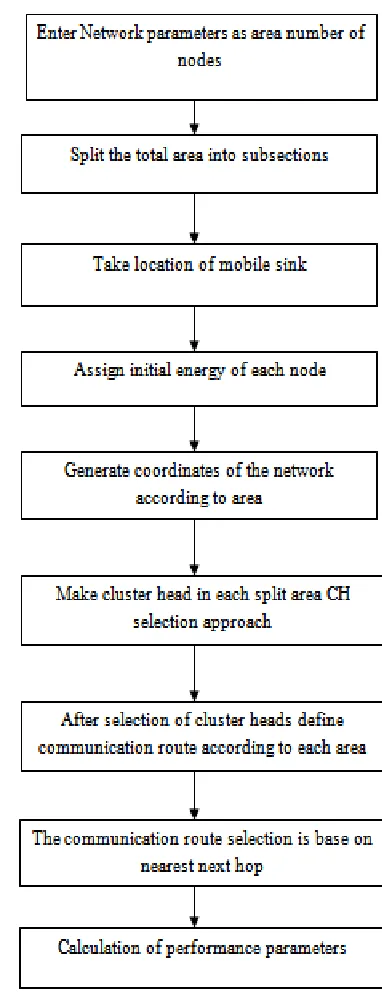
Step 1: The first step is defining the area of the network in which the nodes are to be created. So, before anything we would first enter the area of the network.
Step2: The next need for the approach is the nodes. Numbers of nodes are required for selecting the best path for communication and the quality of service parameters of the network also depend on the number of nodes. So in the second step numbers of nodes in each cluster are entered.
Step 3: Now, the total area is to be divided into parts.
Step 4: After dividing area into number of parts, the mobile sink is to be targeted. In this step the location of mobile sink is taken.
Step 5: There are number of nodes in the network, and each node need some amount of energy and this is what is done in this step. Each node is assigned an initial energy.
Step 6: Each divided area have a unique cluster head. The cluster heads are elected on the basis of minimum area from the centre of the whole area.
Step 7: As the cluster heads are selected, and then the communication route will be chosen on the basis of these cluster heads selected. After the selection of cluster heads,
the communication route is decided
according to each area, then nearest node is chosen as the next node and the path is decided on the basis of these nearest located nodes.
Step 8: The communication route selection is on the basis of next nearest hop.
Step 9: Now, the energy of each node is used to calculate the energy of the network.
These are the main steps taken for our proposed scheme which will reduce the routes reconstruction cost of sensor nodes. Energy model is used for reducing energy consumption of nodes. It will also improve lifetime and reduces cost consumption. Figure 3 is flow chart which follows the steps of our technique. In the end, performance parameters are calculated and
compared with the Grid Routing scheme.
Figure 3.Flow Chart of methodology
4. Problem Formulation:
The normally used communication was line communication in which the selection of cluster heads was completed in a line and then the energy was given to each node. On the basis of shortest hop to hop distance, path selection was done. This usual technique of communication had various disadvantages as the technique of choosing cluster head was not efficient and the network lifetime did not improved. The nodes became dead early which degrades system’s performance. In this proposed approach, network’s area is divided into number of parts and each part has its independent cluster head. The mobile sink revolves around the entire area and then the communication route is selected on the basis of nearest hop. The nearest hop is selected for choosing the best path for communication. This type of method for selecting communication route increases and improves the quality of service parameters like network lifetime, energy consumption by nodes etc. As the cluster heads are placed at a minimum distance from the centre of the area so the lifetime of each node will be improved as this will enhance the network lifetime as the network lifetime completely depends on the lifetime of nodes present in it. This technique decreases energy consumption by each node as the nodes situated nearby will consume lesser amount of energy for communication and this will result in decreasing the energy consumption by the nodes which in turn will reduce the energy consumption of the entire network. So, this new method of dividing the area into number of parts will improve the
quality of service parameters of the complete network i.e. network lifetime will improve, also the energy consumption will decrease, and the last dead node will be at higher time rate than the previous technique.So, it can be said that the proposed technique is far better than the previous technique in terms of efficiency and work.
5. Simulation and Results:
In this section, we present the simulation results using Mat lab 7.10.0.499(R2010a) version. The area of 200*200 dimensions is taken with 15 nodes in each cluster. Area is divided into 16 equal sized clusters and 1500 rounds are taken. A mobile sink moves around the sensor field counter clockwise. Initially all the sensor nodes have uniform energy reserve of 1 mJ. We considered the energy model being used in [13]. In addition, we considered energy consumption of nodes in transmission (Tx) and receiving (Rx) modes which are computed using following Equation 1 and 2 respectively.
Tx = (Eelect ×K) + (Eamp×K ×d*d) (1)
Rx = Eelect ×K (2)
In Equation 1 and 2, K is message length, Eelect is energy dissipation of nodes and Eamp is energy dissipation by the transmitter amplifier to control the channel noise. In our technique, we took Eelect =50 nJ, and Eamp =10 nJ/bit/m2 and K =8 bits.
Our proposed technique ie distance
enhancing grid routing is compared with virtual grid routing scheme in which three different criteria are used to evaluate the performance of our approach against virtual
grid routing scheme under the same network dynamics which are energy, distance, lifetime with number of nodes.
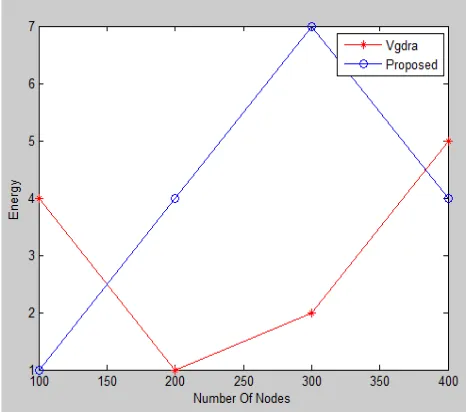
Figure 4 shows the comparison of energy of our proposed scheme i.e. distance enhancing grid routing with virtual grid routing scheme for different no. of nodes and it can be seen that at the end, energy consumption of number of nodes is less than the virtual grid routing scheme. As in this approach, the energy model is used for reducing energy consumption of nodes.
Figure 4.Comparing energy with number of
nodes
Figure 5 shows the comparison of distance of our proposed scheme with virtual grid routing scheme for different no. of nodes and it is clear from the figure that distance of our proposed scheme is very less than the virtual grid routing scheme because communication of distance priority is used in our proposed approach.
Figure 6 shows the comparison of lifetime of our proposed scheme with virtual grid routing scheme for different no. of nodes. The lifetime of our proposed approach is improved with use of small no. of nodes, as compared to the virtual grid routing scheme. As a result, lifetime is improved with the use of our proposed approach which also reduces the cost consumption.
Figure 5. Comparing distance with number
of nodes
Figure 6. Comparing lifetime with number of nodes
Figure 7 shows the comparison of first dead node of our proposed scheme with virtual grid routing scheme for 200 nodes and it can be seen from the figure that first dead node of old result i.e. virtual grid routing is earlier than our new results i.e.by using distance enhancing grid routing scheme which means that by using our approach the nodes will become dead after more rounds as compare to virtual grid routing approach.
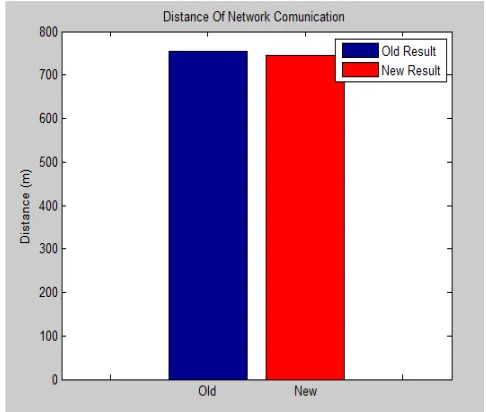
Figure 8 shows the comparison of distance of our proposed scheme with virtual grid routing scheme for 200 nodes and it is clear from the figure that distance of our proposed scheme is less than the virtual grid routing scheme.
Figure 9 shows the comparison of energy of our proposed scheme with virtual grid routing scheme for 200 nodes. It is shown that energy consumption in our proposed scheme is very less than the virtual grid routing scheme because of improvement in distance of network communication.
Figure 7. Comparing first dead node
Figure 8. Comparing distance of network communication
Figure 9. Comparing energy of network communication
6. Conclusion and Future Scope
Firstly we introduced a virtual grid routing design and implementation in matlab in [14], and also a review of our proposed approach was given in [15]. In this paper, the implementation of distance enhancing
grid routing scheme is introduced in which, the selection of cluster head is based on shortest distance between next clusters choose to communication or nearest cluster. The energy model is considered to reduce energy dissipation which will improve the energy consumption and data delivery performance. Lifetime of the network will also be improved. Our technique divides the area into equal number of cells. A mobile
sink while moving around the sensor field
keeps on changing its location and connects with the nearest border-line cell-header for data collection. By using a set of communication rules, only a limited number of the cell headers participate in the routes reconstruction process which reduces the overall communication cost. In future work, we aim to improve the performance of our proposed scheme by using the swarm based algorithms. Various optimization algorithms can also be used for improving the performance of distance enhancing grid routing scheme.
REFRENCES
[1] Chen.T, Tsai.H, Chang.Y and Chen.T, “Geographic converge cast using mobile sink in wireless sensor networks,” Comput. Commun., vol. 36, no. 4, pp. 445–458, Feb. 2013.
[2] Erman.A, Dilo.A, and Havinga.P, “A virtual infrastructure based on honeycomb tessellation for data dissemination in multi-sink mobile wireless sensor networks,” EURASIP J. Wireless Commun. Netw., vol. 2012, no. 17, pp. 1–54, 2012.
[3] Oh.S, Lee.E, Park.S, Jung.J, and Kim.S, “Communication scheme to support sink mobility in multi-hop clustered wireless sensor networks,”
in Proc. 24th IEEE Int. Conf. Adv. Inf. Netw. Appl., Apr. 2010, pp. 866–872.
[4] Younis.O and Fahmy.S, “HEED: A hybrid, energy-efficient, distributed clustering approach for ad hoc sensor networks,” IEEE Trans. Mobile Comput., vol. 3, no. 4, pp. 366–379, Oct. 2004.
[5] Tang.B, Wang.J, Geng.X, Zheng.Y, and Kim.J, “A novel data retrieving mechanism in wireless sensor networks with path-limited mobile sink,” nt. J. Grid Distrib. Comput., vol. 5, no. 3, pp. 133–140, 2012.
[6] Hamida.E and Chelius.G, “A line-based data dissemination protocol for wireless sensor networks with mobile sink,” in Proc. IEEE Int. Conf. Commun., May 2008, pp. 2201–2205.
[7] Shin.J and Park.D, “A virtual infrastructure for large-scale wireless sensor networks,” Comput. Commun., vol. 30, nos. 14–15, pp. 2853–2866, Oct. 2007.
[8] Mir.Z and Ko.Y, “A quadtree-based data dissemination protocol for wireless sensor networks with mobile sinks,” in Proc. Personal Wireless Commun., 2006, pp. 447–458.
[9] Luo.H, Ye.F, Cheng.J, Lu.S, and Zhang.L, “TTDD: Two-tier data dissemination in large-scale wireless sensor networks,” Wireless Netw., vol. 11, nos. 1–2, pp. 161–175, Jan. 2005.
[10] Chen.X and Xu.M, “A geographical cellular-like architecture for wireless sensor networks,” in Proc. Mobile Ad-Hoc Sensor Netw., 2003, pp. 249–258.
[11] Buttyán.L and Schaffer.P, “Position-based aggregator node election in wireless sensor networks,” Int. J. Distrib. Sensor Netw., vol. 2010, pp. 1–15, 2010.
[12] Khan.A, Abdullah.A, Razzaque, and Javed .M, Bangash.I, “GRID ROUTING: A Virtual Grid-based dynamic routes adjustment scheme for mobile sink-based wireless sensor networks,
Ieee Sensors Journal, Vol. 15, No. 1, January 2015.
[13] Heinzelman.W, Chandrakasan.A, and Balakrishnan.H, “Energyefficient communication protocol for wireless microsensor networks,” in Proc. 33rd Annu. Hawaii Int. Conf. Syst. Sci., Jan. 2000.
[14] kaur.P,kaur.S, “a virtual grid routing design and implementation in matlab” IJMTER vol 2, issue 7, july 2015, pageno. 231-237.
[15] kaur.P,kaur.P “a review on proposed implementation of VGDRA and its comparative analysis” IJRITCC volume 3, issue 6,June 2015, page no. 4198-4200.