Available online:
http://edupediapublications.org/journals/index.php/IJR/
P a g e | 1533A Novel HMM Based Integrated Technique for
Recognizing Clothes Patterns and Colors
K. Kavitha
& Dr. P. Abdul Khayum
1PG Student, Department of ECE, G. Pullareddy Engineering College (Autonomous), Kurnool,
Andhrapradesh, India
2Professor,M. Tech., (Ph. D), Department of ECE, G. Pullareddy Engineering College (Autonomous),
Kurnool, Andhrapradesh, India
[email protected] & [email protected]2
A
bstract
There is need to develop such system which will give automatically the pattern of cloth and the color of the cloth, which is selected for recognition. The image acquired by the camera and is further processed for recognizing color and pattern. First we have to get the features of image that we selected for recognition and after that apply the Support vector Machine algorithm for further processing. In this implementation we used total three descriptors. To extract the statistical features we used Random signature descriptor in which there is use of DWT (Discrete Wavelet Transform) for calculating the global features of the cloths we selected. The obtained global features are then combined with local features which are calculated by the scale invariant feature transform to recognize the complex pattern of cloths. After getting the features we used SVM (support vector machine) to classify the images or pattern. In this we used CCNY dataset for recognizing cloth pattern. With the help of this method the physically impaired person can easily recognize the pattern of cloths as well as color of cloth. The MATLAB execution results show the performance of the system developed. Random Signature is used to capture the global directionality features statistical descriptor (STA) to extract the global statistical features on wavelet sub-bands and Scale Invariant Feature Transform (SIFT) to represent the local structural features. The combination of multiple feature channels provides complementary information to improve recognition accuracy. The collection of dataset on clothing
pattern recognition including four-pattern categories of plaid, striped, pattern less, and irregular, the method also provides new functions to improve the life quality for blind and visually impaired people. The obtained results are improved to great extent with the help of HMM (Hidden Markov Models).
Keywords- SVM algorithm, CCNY dataset, Radon
signature descriptor, SIFT (scale invariance feature transform).
I.
I
NTRODUCTION
Based on statistics from the World Health Organization (WHO), there are quite 161 million visually impaired people round the world, and thirty seven million of them are blind [1]. therefore in keeping with the World Health Organization (WHO), low vision is outlined as acuity of 20/200 or less within the higher eye with best correction potential (WHO. 2004). At an equivalent time, or so 100% of the male population in Europe suffers from some kind of vision deficiency (blindness), the foremost usual case being Associate in Nursing inability to tell apart between sure (e.g. red/green, blue/yellow). In extreme things, solely reminder gray scale can be distinguishable. Color plays a very important role within the daily life of a unremarkably keen-sighted person. Unremarkably keen-sighted folks use because the basis of variety of everyday tasks, as an example of matching socks, selecting between totally different garments.
Available online:
http://edupediapublications.org/journals/index.php/IJR/
P a g e | 1534perpetually correspond utterly to those according by a person's observer.
Secondly, shadows and wrinkles could also be confused as a part of the feel patterns or mental imagery of the vesture and therefore cause errors. Thirdly, the photographs of garments are often imaged from discretional viewing directions. Strategies of matching patterns need the input try of pictures should be pattern rotation-invariant. Lastly, several garments have styles with advanced patterns and multiple colours that increase problem of identifications. A system that overcomes these problems, might offer blind folks larger independence as they might be ready to do bound tasks that they're presently unable to perform unaided.
II.
L
ITERATURE
S
URVEY
There are different techniques developed to know the pattern as well as color. There are separate development for pattern recognition and separate development of color recognition. Compared to proposed work these methods are having less accuracy as well as time required is more. Assistive systems of different kinds are being developed for the visually impaired people to improve the life quality and safety of such people including indoor navigation and way finding, display reading,
banknote recognition, rehabilitation, and many more. In [2] developed a system for blind people to select
clothes based on cloth pattern and colors in a cloth shop independently. This is a camera based system that can recognize clothing patterns into four categories (plaid, stripped, pattern-less, and irregular) and identify 11 colors: red, orange, yellow, green, cyan, blue, purple, pink, black, grey and white. In [3] proposed a system to automatically recognize banknote of any currency to assist visually impaired people. This is also a camera based computer vision technology. This system has features like high accuracy, robustness, high efficiency, ease of use. This system is robust to conditions like occlusion, rotation, scaling, cluttered background, illumination change, wrinkled bills, and also eliminating false recognition and can guide the user to properly and correctly focus at the bill to be recognized using Speed Up Robust Features (SURF). In [4] developed a vision substitution system for travel aid for blind. Out of the three main categories of navigation systems (Electronic Travel Aids, Electronic Orientation systems, Position Locator Aids), they focus on Electronic Travel Aids. In all these works, the needs of blind people are considered. But, the main area where a color blind person faces a problem other than the traffic signals is in a cloth shop for selecting clothes of desired colors and patterns without the help of another
person. The proposed assistive system here depicts the same.
III.
T
RAINING AND
T
ESTING
I
MAGES
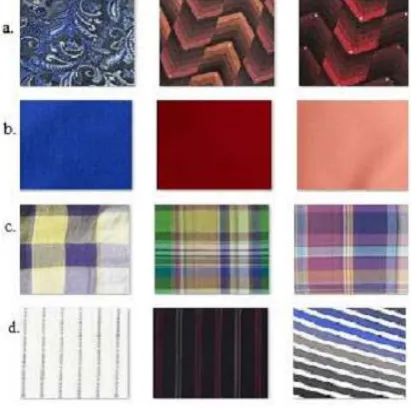
The general categories of the cloths are studied as, A. Irregular
B. Pattern less C. Plaid D. Stripe
These all the patterns are used to train the system, which are given below,
Fig. 1 Dataset used for training images
We used training and testing dataset as CCYN dataset. Each one pattern has its own directionality, intensity and lighting variation. If the test image of stripe pattern the image patches are horizontal direction and but in the training set the image patches are in vertical direction. This can be matched by rotation, illumination changes. Both global and local features are combined in this project. This adjustment can be done only by extracting the global features like energy, entropy, variance, uniformity.
Available online:
http://edupediapublications.org/journals/index.php/IJR/
P a g e | 1535combined together using the classifier. In this project the classifier used is SVM (Support vector Machine).
IV.
P
ROPOSED
W
ORK
Clothing colour identification relies on the normalized colour bar chart of every covering image within the HSI colour house. The key plan is to quantize colour house supported the relationships between hue, saturation, and intensity. The proposed work is given for automatic recognition of cloths pattern and color of cloths. The proposed system is capable of real time recognizing the patterns and colors. Choosing the appropriate pattern and color of the clothes is important to assist the blind people to make decisions.
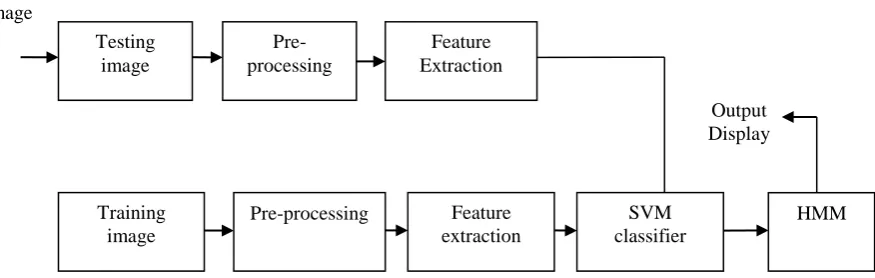
Fig.2. Block Diagram of Proposed Work
The clothing patterns of plaid and striped are both anisotropic. In distinction, the wear patterns within the classes of pattern less and Irregular Square measure isotropic. To form use of this distinction of directivity, we have a tendency to propose a completely unique descriptor, i.e., the Radon Signature, to characterize the directivity feature of wear patterns. Radon Signature (Radon Sig) relies on the atomic number 86remodelthatis usually wont to discover the principle orientation of a picture. The proposed work is having important steps, they are preprocessing and feature extraction they are required to implement a system to recognize the different patterns. For that the training algorithm called support vector machine are used. Following figure 2 will give us block diagram of proposed work,
Below block diagram will give us the proposed work in detail. There are two important steps first we have to train the system and further we can check the testing. This system can handle clothes with complex patterns and recognize clothing patterns of four categories they are plaid, striped, pattern less, and irregular. This system is also able to identify 11 colors are red, orange, yellow, green, cyan, blue, purple, pink, black, grey, and white.
In the case of multiple colors in the colors, the first several dominant colors are spoken to users. In order to handle the large intraclass variations the combination of global and local image features significantly outperforms the state-of-the-art texture analysis methods for clothing pattern recognition. Extracting the feature is the important method of classifying the patterns. Each image has its own characteristics.
To analysis this characteristics the features are used. These features can be extracted using the following algorithms.
A. Statistical (STA) feature extraction B. Scale Invariance feature transform (SIFT) C. Recurrence Quantification Analysis (RQA) All these three feature extraction techniques are integrated to get the better results. Statistical feature extraction is done using the wavelet transform. The STA is used to decompose the image pixel into low pixels. STA have 4 features like variance, energy, uniformity and entropy. Using these features the images can be classified. SIFT is the local feature extraction. To perform easier recognition, it is important that the global and local features extracted from the training image be identified even under changes in image scale, noise and illumination, as the name mentioned it is invariant to the scale. The Testing
image
Pre-processing
Feature Extraction
Feature extraction Pre-processing
Training image
SVM classifier Input
Image
Output Display
Available online:
http://edupediapublications.org/journals/index.php/IJR/
P a g e | 1536feature extracted is points, patches in the image. Recurrence Quantification Analysis (RQA) is also a local feature extractor. Mainly it is used to increase accuracy in the SVM classifier. The final feature combined in this way has a low dimension but more discerning power. It represents the accuracy of prediction output based on a particular feature. The Support Vector Machines (SVM) is used as the classifier in clothes pattern recognition system. SVM finds a maximum margin hyper-plane in the feature space.
A.
Support Vector Machine Algorithm
(Svm)
SVM algorithms are used in classification. This classification can be viewed as the task of separating classes in the feature space. This classification can be used in many applications like bioinformatics, text and image recognition. This can be the fast algorithm for identifying the Support Vectors of a given set of points.
B. Classification using Support Vector Machines (SVM) has gained conspicuity in the field of machine learning and pattern classification. Classification is achieved by realizing a linear or non-linear separation surface in the input space. In Support Vector classification, the separating function can be expressed as a linear combination of kernels associated with the Support Vectors as
Where xi denotes the training patterns, yi 2 {+1,−1} denotes the corresponding class labels and S denotes the set of Support Vectors.
C. STEPS INVOLVED IN SVM ALGORITHM
Given the two classes X1 and X2, let us assume X1 are the positive class and X2 are the negative class.
Step 1: Find the support vector class, to get the optimum boundary. Let us assume 3 input support vector set.
Step 2: Compute this support vector set with the bias 1:
Step 3: Finding the 3 parameters α1, α2, α3
Step 4: The hyper plane that discriminates the position class from the negative class is given by:
Step 5: The separating hyper plane equation formula is
y=wx+b
Step 6: Plot the line according to the value. If the value is greater than the augmented value it belongs to the class positive and if it is lesser than the augmented value it belongs to the class negative.
V.
E
XECUTION
R
ESULTS
A.
Proposed Work
a) Training
First we have to train the system by same procedure as mentioned in proposed work.
Fig.3 system is processing for training
b) Testing
Select the image for testing from dataset.
Available online:
http://edupediapublications.org/journals/index.php/IJR/
P a g e | 1537Fig. 4 select the image from available dataset
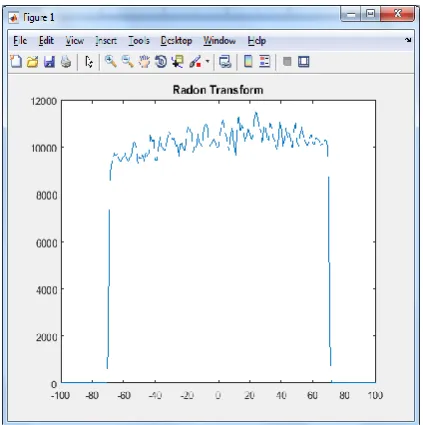
Fig. 5 Radon transform for the proposed work
Fig.6 Detected pattern of the cloth.
Fig. 7 The color of selected cloth for proposed output
B. Results for HMM as extension
Fig.8 system is processing for training using HMM
Available online:
http://edupediapublications.org/journals/index.php/IJR/
P a g e | 1538Fig. 10 Detected pattern of the cloth using extension method
Fig.11 The color of selected cloth for extension output
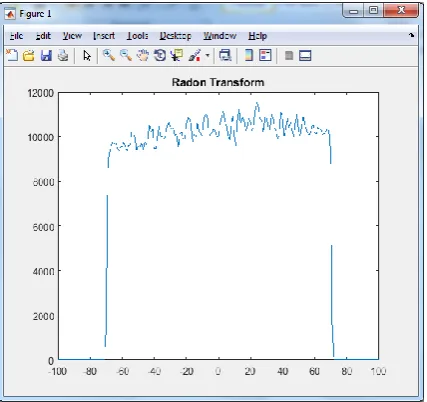
Fig.12 Radon transform for the extension work
Fig.13 Local feature for irregular image (RQA)
Table I. Recurrence Quantification Analysis of Recurrence Plots
Proposed work
Extension work
Recurrence rate
0.0097 0.1747
Determinism
0.3526 0.9595
Entropy
0.4260
1.7556
Averaged diagonal line
length L
2.2333 6.7125
Recurrence rate RR, The percentage of recurrence points in an RP Corresponds to the correlation sum. Determinism DET, The percentage of recurrence points which form diagonal lines.
Entropy ENTR, The Shannon entropy of the probability distribution of the diagonal line lengths p(l).
Available online:
http://edupediapublications.org/journals/index.php/IJR/
P a g e | 1539VI.CONCLUSION
We analyzed the proposed system by MATLAB execution results. Finally it will gives the results which are extremely efficient than existing techniques used. Assistive devices are a key aspect in wearable systems for biomedical applications, as they represent potential aids for people with physical and sensory disabilities that might lead to improvements in the quality of life. Globally, an estimated 40 to 45 million people are totally blind, 135 million have low vision and 314 million have some kind of visual impairment. In most industrialized countries, approximately 0.4% of the population is blind while in developing countries it rises to 1%. It is estimated by the World Health Organization (WHO) that 87% of the world's blind live in developing countries. Here, a system is proposed to recognize clothing patterns and colors to help visually impaired people in their daily life. Random Signature is used to capture the global directionality features statistical descriptor (STA) to extract the global statistical features on wavelet sub-bands and Scale Invariant Feature Transform (SIFT) to represent the local structural features. The combination of multiple feature channels provides complementary information to improve recognition accuracy. The collection of dataset on clothing pattern recognition including four-pattern categories of plaid, striped, pattern less, and irregular, the method also provides new functions to improve the life quality for blind and visually impaired people. The obtained results are improved to great extent with the help of HMM (Hidden Markov Models).
VII.FUTURE SCOPE
Future scope of the proposed work will focus on handling large occlusions by using more discriminative features like door knobs and other hardware, Detecting and recognizing more types of indoor objects and icons on signage, in addition to text for indoor way finding aid, to assist blind people travel independently.
R
EFERENCES
[1] Jarbas Joaci de Mesquita Sa, Andre Ricardo Backes,Paulo Cesar Cortez (2013) “Texture analysis and classification using shortest paths in graphs”, Elsevier, pattern recognition, 1314–1319.
[2] Xiaodong Yang, YingLi Tian (2013) “Texture representations using subspace
embeddings”, Elsevier, pattern recognition, 1130-1137.
[3] Christopher sentelle, Georgios anagnostopoulos, Michael georgiopoulos (2011) “Efficient revised simplex method for SVM training”, IEEE transactions on neural networks, 22(10), 1650-1661.
[4] Yuntao Qian, Minchao Ye, Jun Zhou (2012) “Hyper-spectral Image Classification Based on Structured Sparse Logistic Regression and Three-dimensional Wavelet Texture Features”, IEEE transactions on geo-science and remote sensing, 51(4), 2276-2291.
[5] Sandro cumani, Pietro Laface (2012) “Analysis of large-scale SVM training algorithms for language and speaker recognition”, IEEE transactions on audio, speech, and language processing, 20(5), 1585- 1596.
[6] ShiftXingming Zheng, Ningzhong Liu, (2012), “Colour Recognition of Clothes Based on KMeans and Mean”, IEEE transaction on pattern recognition, 49-53.
[7] Alberto Jard´on Huete, Juan G. Victores, Santiago Mart´ınez, Antonio Gim´enez, and Carlos Balaguer, (2012), “Personal Autonomy Rehabilitation in Home Environments by a Portable Assistive Robot”, IEEE transactions on systems, man, and cybernetics, 42(4), 561-569.
[8] Faiz M. Hasanuzzaman, Xiaodong Yang, and YingLi Tian (2012) “Robust and Effective Component Based Banknote Recognition for the Blind”, IEEE transaction on system, man and cybernetics, 1024- 1033.
[9] Chucai Yi, YingLi Tian, Aries Arditi ( 2011) “Portable Camera-based Assistive Text and Product Label Reading from Hand-held Objects for Blind Persons”, IEEE Transactions on Mechatronics, 1-10.