Available Online atwww.ijcsmc.com
International Journal of Computer Science and Mobile Computing
A Monthly Journal of Computer Science and Information Technology
ISSN 2320–088X
IMPACT FACTOR: 6.017
IJCSMC, Vol. 6, Issue. 6, June 2017, pg.89 – 95
IoT BASED SURGICAL STRIKE
Shashank
1, Nidhi Bansal
2Assistant Professor1, Student2
Department of Electronics and Communication Engineering, IEC College Of Engineering and Technology, AKTU, Lucknow
[email protected], [email protected]
ABSTRACT – This proposed work is an attempt to design a tracking unit that uses the global positioning system to determine the precise location of an object, person or other asset to which it is attached and using GSM modem this information can be transmit to remote user. It can provide tele-monitoring system for inter-cities transportation vehicles such as taxis and buses. This system contains single-board embedded system that is equipped with GPS and GSM modems along with AVR controller that is installed in the vehicle. During object motion, its location can be reported by SMS message. A software package is developed to read, process, analyze and store the incoming SMS messages. The use of GSM and GPS technologies allows the system to track object and provides the most up-to-date information about ongoing trips. This system finds its application in real time traffic surveillance.
I.
INTRODUCTION
report quickly. It is completely integrated so that once it is implemented in all vehicles, then it is easy to track vehicles any time.
Proposed design is cost-effective, reliable and has the function of accurate tracking. When large object or vehicles were spread out over ground, the owner corporations often found it difficult to keep track of what was happening. They required some type of system to determine where each object was at any given time and for how long it travelled. GSM and GPS based tracking system will provide effective, real time location, and reporting. A GPS- GSM based tracking system will inform where your vehicle is and where it has been, how long it has been. The system uses geographic position and time information from the Global Positioning Satellites. The system has an "On- Board Module" which resides in the vehicle to be tracked. The On-Board module consists of GPS receiver, a GSM modem and ARM processor.
II.
IoT BASICS
We can understand it with the expression of two words one is internet and other one is things. where Internet can be defined as the world-wide network of interconnected computer networks, based on a standard communication protocol, the Internet suite (TCP/IP), while Thing is an object not precisely identifiable Therefore, semantically, Internet of Things means a world-wide network of interconnected objects uniquely addressable, based on standard communication protocols.
III.
ARCHITECTURE OF IoT
The system will likely be an example of event-driven architecture, bottom-up made (based on the context of processes and operations, in real-time) and will consider any subsidiary level.
Therefore, model driven and functional approaches will coexist with new ones able to treat
exceptions and unusual evolution of processes (multi-agent systems, B-ADSc, etc.).
able to address every context or use: some actors (services, components, avatars) will
accordingly be self-referenced and, if ever needed, adaptive to existing common standards
(would be no more than defining a "global finality" for everything that is just not possible with
any of the current top-down approaches and standardizations).
First things first, let’s define some terms:
Thing: An object of our everyday life placed in our everyday environment. A thing can be a
car, fridge but can also be abstracted to a complete house or city depending on the use case.
Device: A sensor, actuator or tag. Usually the device is part of a thing. The thing processes the devices’ context information and communicates selected information to other things.
Furthermore, the thing can pass actions to actuators.
IV.
GSM ARCHITECTURE
GSM (Global System for Mobile communications: originally from GROUPE Spécial Mobile) is the most popular standard for mobile phones in the world. Its promoter, the GSM Association, estimates that 80% of the global mobile market uses the standard. GSM is used by over 3 billion people across more than 212 countries and territories
V.
HARDWARE
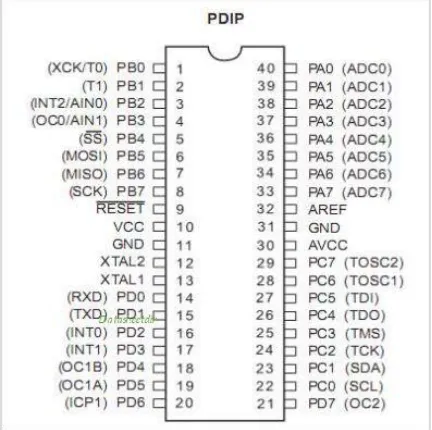
Heartbeat Module:
GSM Module:
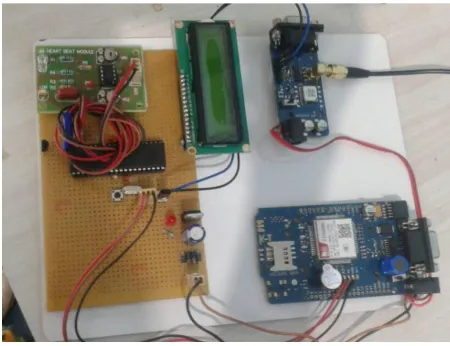
Fig. 1 Hardware components used Microcontroller:
VI.
BLOCK DIAGRAM OF IoT BASED SURGICAL STRIKE
Fig. 3 Block diagram
The basic block of this application contains the GPS for altitude tracking, communication is carried out using the GSM module. The controller coordinates between the sensors and the GSM module for response.
VII.
OUTPUT
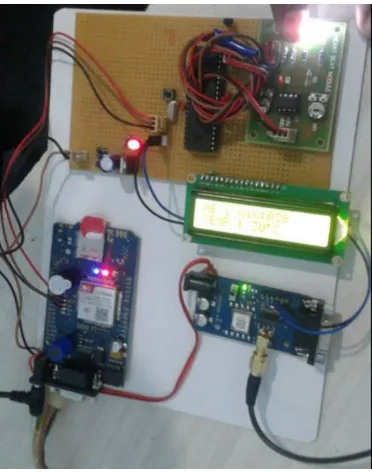
The output of working project is given below:
Fig. 5 Output at the server created
Fig. 7 Output at the hardware
VIII.
CONCLUSION –
A wireless health monitoring system is designed, developed andIX.
FUTURE SCOPE –
The Internet of Things will change our society, and will bring seamless 'anytime, anywhere' personalized healthcare and monitoring over fast reliable and secure networks. This implies that we are approaching the end of the divide present between digital, virtual and physical worlds
REFERENCES -
1. Luigi Atzori et al, “The Internet of Things: A survey”, Computer Networks, Vol.54, pp. 2787-2805, 2010. Eleonora Borgia, “The Internet of Things vision: Key features, application and open issues”, Computer Communication, Vol.54, pp. 131, 2014.
2. Gennaro Tartarisco, Giovanni Baldus, Daniele Corda, Rossella Raso, Antonino Arnao, Marcello Ferro, Andrea Gaggioli, Giovanni Pioggia, “Personal Health System architecture for stress monitoring and support to clinical decisions”, Computer
Communications Vol.35, pp.1296–1305, 2012.
3. Franca Delmastro, “Pervasive communications in healthcare”, Computer Communications Vol.35, pp.1284–1295,2012.
4. Mohammed Riyadh Abdmeziem, Djamel Tandjaoui, “An end-to-end secure key management protocol for e-health applications”, Computers and Electrical Engineering Vol.44, pp.184-197, 2015.
5. Eleonora Borgia, “The Internet of Things vision: Key features, applications and open issues”, Computer Communications Vol .54 ,pp. 1–31, 2014.
6. M. Brian Blake, “An Internet of Things for Healthcare”, IEEE Internet Computing, pp.4-6,2015
7. Long Hu, Meikang Qiu, Jeungeun Song, M.Shamim Hossain and Ahmed Ghoneim, “Software Defined Healthcare Networks”, IEEE Wireless Communications, Vol. 22 No.
6, pp. 67-75, December 2015.
8. http://ieeexplore.ieee.org/xpl/articleDetails.jsp?arnumber=7454565&newsearch=true&qu eryText=iot%20health