NLP
A
LGORITHMS
I
N
OOP
F
OR
P
ROCESSING
T
HE
T
EXT
B
ASED
D
OCUMENTS
I
N
R
USSIAN
L
ANGUAGE
I
N
M
ACHINE
L
EARNING
.
N. Urmanov
1, Bektemyssova G.U
2, Kouros Basiri
31
International University of Informational Technology, 050040,Almaty, Kazakhstan
[email protected]
2
International University of Informational Technology, 050040,Almaty, Kazakhstan
[email protected]
3
International University of Informational Technology, 050040,Almaty, Kazakhstan
[email protected]
A
BSTRACTThe purpose of this article is to guide in natural language processing algorithms in Object-Oriented Programming for processing Russian text documents in machine learning. In this work, we describe some NLP algorithms and tools, and how to apply and use best practice Object-Oriented Programming for refine Russian text in machine learning.
K
EYWORDSNatural language processing; sentiment analysis; machine learning; tokenization; word frequency; tf-idf; Word2Vec; stemming; lemmatization.
1.
I
NTRODUCTIONIn every second the volume of data in worldwide increase significantly, which consist information such as photos, videos, comments in social networks, reviews in internet shops, articles, books and etc.
Human physically cannot process and monitor such capacity of information. For example, nowadays in Facebook work around 7 500 content moderators, to review information which is located in one social network. In addition, some kind of information consist forbidden content, which can be harmful to psychology of the person.
Therefore was developed set of algorithms which applied by computer which allows to process large volume of information.
Natural language processing (Natural
Language Processing, NLP) - the general direction of an artificial intelligence, mathematical linguistics and machine learning. It studies problems of the computer analysis and synthesis of natural languages.
The purpose of NLP is processing and "understanding" of a natural language for the translation of the text to machine language and the response to questions.
The quality of understanding depends on a set of factors: from language, from national culture, from the interlocutor etc.
The main directions of natural language processing include such as extraction of the facts, sentiment analysis, responses to questions, information search, generation of the text, translation, etc. In this article, we will cover algorithms in Object-oriented language, which applied in sentiment analysis in Russian language.
2.
Natural language processing –
algorithms and tools
Semantic analysis - extremely heavy operation from the point of view of use by
developers: most often the deep
NLP in semantic analysis include next algorithms, which covered in this work:
• Tokenization
• Word frequency in text
• Stemming
• Stop-listing
• Lemmatization
• TF-IDF matrix
• Word2Vec
Those algorithms of NLP is common and widely used in semantic analysis.
2.1. Tokenization
Token - the object which is created from a lexeme in the course of lexical analysis. Token in lexeme is the minimum unit of language making independent sense. There are following types of lexemes. In other words, in semantic analysis token can be single word, sentences or paragraph. In this work we will use token as a single word.
The first step in NLP is to identify tokens, or those basic units which need not be decomposed in a subsequent processing. The entity word is one kind of token for NLP, the most basic one. Our concern, however, is with using the computer to recognize those tokens without distinct delimiters, such as Chinese words, English
idioms and fixed expressions [4]
2.2. Word frequency in text
In semantic analysis often use word counter algorithm, to find frequency of each word in given text. Why this technique need? It need if your task is find keywords or unique terms, to classify large documents corpus, to find corpus similarity and etc.
The distribution of word frequencies is a fundamental phenotype of a language. Statisticians and linguists have studied Word frequency distributions since the statistics of word usage yield valuable insights into the language, its construction,
and its evolution. These distributions have been long-studied outside of statistics and linguistics as well. [3]
2.3. Transformed Term-Frequency
Matrix
The entries in the term-document matrix are often transformed to weight them by their estimated importance in order to better mimic the human comprehension process.
For language simulation, the best
performance is observed when frequencies are cumulated in a sublinear fashion within cells (typically log(freqij+1), where freqij is the frequency of term i in document j), and inversely with the overall occurrence of the term in the
collection (typically using inverse
document frequency or entropy measures). (Figure 1) [1]
Figure 1 Term-by-document matrix.
2.4. Stop-listing and stemming
In stemming, conversion of morphological forms of a word to its stem is done assuming each one is semantically related. The stem need not be an existing word in the dictionary but all its variants should map to this form after the stemming has been completed. There are two points to be considered while using a stemmer:
• Morphological forms of a word are
assumed to have the same base meaning and hence should be mapped to the same stem
• Words that do not have the same
These two rules are good enough as long as the resultant stems are useful for our text mining or language processing applications. Stemming is generally considered as a recall-enhancing device. For languages with relatively simple morphology, the influence of stemming is less than for those with a more complex morphology. Most of the stemming experiments done so far are for
English and other west European
languages.[2]
Stop-listing is applied to delete stop words and single symbols which is appear in text document, and probably frequency of stop words can be more than other key words in this text. That’s why this step is necessary to use for get more clear result in machine learning.
2.5. Lemmatization
Lemmatization is transformation of words into a lemma, that is, into their original vocabulary form. First of all, lemmatization is used by search engines. It helps them to accelerate indexing and request processing and also to increase relevance of the delivery. This is exact process with use of a lexicon and morphological analysis of words as a result of which only the inflectional terminations are removed and returns the main, or dictionary, the word form called by a lemma. For example, in “saw” lexeme during stemming can turn into letter “s” while lemmatization will return either the word “see”, or the word “saw “depending on whether the lexeme is a verb or a noun. The important distinction consists that usually stemming "sticks together" derivative cognate words, and
lemmatization "sticks together" only
inflected forms of one lemma. Stemming and lemmatization are often carried out by
means of the additional program
components which are built in indexing process.
As proposed in, each word is labeled by a
class label, that represents the
transformation that should be applied to get the normalized form of the word. To determine this class, a stem should be found first. It is the part the two words (the word and its normalized form) have in common. The words property and properties have both the stem “propert” in common. Or in Slovene, the words “BRESKEV” and
“BRESKVAH” have “BRESK” in
common. Then we can see that we should
remove the suffix “VAH” from
“BRESKVAH” and add the suffix “EV” to get the normalized form “BRESKEV”. Thus we assign the class label “VAHtoEV” to the word “BRESKVAH” [5]
2.6. Word2Vec
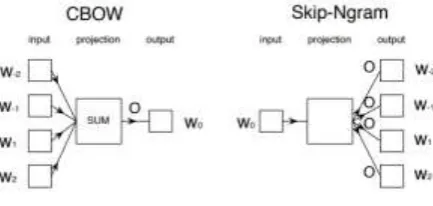
Word2Vec is a tool (a set of algorithms) for calculation of vector representations of words, implements two main architecture — Continuous Bag of Words (CBOW) and Skip-gram. As a input define text corpus or word, and output will be represent as vector variables (coordinators in vector space).
Continuous Bag of Words (CBOW) and Skip-gram illustrated in Figure 2.
The skip-gram model’s objective function is to maximize the likelihood of the prediction of contextual words given the center word. More formally, given a document of T words, we wish to maximize (1)
(1)
Where c is a hyperparameter defining the
window of context words. [6]
The CBOW model predicts the center word
wo given a representation of the surrounding
words w−c, ..., w−1, w1, wc. Thus, the output
vector ow−c,...,w−1,w1,wc is obtained from
the product of the matrix O ∈ R|V|*d w with the sum of the embeddings of the context words (2) [6]
Figure 2. Skip-gram and Continuous Bag-of-Word (CBOW) models illustration
The principle of set of algorithms is finding of relations between contexts of words according to the assumption that the words that are in similar contexts tend to mean similar things, i.e. to be semantic close.
More formally: maximizing cosine
proximity between vectors of words (a scalar product of vectors) which appear next to each other, and minimization of cosine proximity between vectors of words which do not appear the friend near the friend. Next to each other in this case means in familiar contexts.
Word2Vec can be applied perfectly to different problems of natural language processing, somehow:
Word clustering by the principle of
their semantic similarity
Identification of semantic similarity
of words (for example to what a word the cat — is semantic closer to food or space pirates)
For the analysis of tonality,
however, not successfully. That is, quite successfully, but after all not really.
3. Experimental part
In this part we will describe how to apply mentioned above algorism for Russian language. It will include some description, pseudocode and examples in object-oriented programming.
3.1. Applying Tokenization
In object oriented programming many example of how to apply tokenization in text input. In this work, we will use technique that is applicable for machine learning and can be reusable.
The basic of tokenization is to use
Iterator<Template> object, which is
available in java.util library.In text-based document Template should be as a String. In machine learning generally, take as input whole file, which is text-based document, which converted to streamed object. For example, in java language input file converted to BufferReader.
To convert file to Iterator, which can be reusable in program, you should apply next algorithm:
1. Read text line by line. In each OOP language document can be read line by line by function readline().
2. Divide each object in line by whitespacing.
Each object as string should be saved in Iterator<Template> object, where store each word, symbol or a single char. After this we can apply different algorithms, like stemming, word counting, lemmatization to each single object, which stored in Iterator<Template> object. Tokenization pseudocode in Algorithm 1.
Algorithm 1: Tokenization Algorithm
1. t:=f(u,X)∣∣[X¯]n2
2. c:=E(K,t)
5. if check(token)=True, then u:=u+1 and go back to step 1 6. return token
3.2. Applying stop listing
This technique very easy to apply, but very
important step in natural language
processing. This step important, because it delete noises in machine learning and improve result of learning or analysis.
One if example of using stop listing is to download stop words list file which is
available in internet for free and for every language and compare each word in text to each word in stop words list. If they are equal, just ignore these noises. Each word can be retrieved from tokenization, which is described above. Example of usage in OOP code in Example 1.
Example 1: Stop listing usage example
If (Stop Words List.contains(token)) Skip;
3.3. Applying stemming
The problem of text analysis, is that there are appear one word with different affix. For example in English: user – 3 times, users – 4 times. In other word NLP will consider this word as a different. To obtain this situation we use stemming algorithms.
To write own stemming algorithm very hard. It needs full morphological analysis of
language. The easiest way is to use available tools. In Russian language available very strong tool Snowball
stemming. It include methods and
algorithms, which will cut Russian endings. For you it only need declare Snowball Russian stemmer object and send as argument each token, which means each word. Example of usage in OOP code in Example 2.
Example 2: Stemming algorithm example
RussianStemmer stemmer = new RussianStemmer(); stemmer.setCurrent(token);
stemmer.stem();
Pseudocode for stemming “word” string in Algorithm 2.
Algorithm 2: Stemming Algorithm
Input: a text token and a dictionary Rules:
If token length < 4 return token If token is number return token If token is acronym return token
If token in dictionary return the stored stem If token ends in s’
strip the ’ and return stripped token If token ends in ’s
If token ends in “is”, “us”, or “ss” return token If token ends in s
strip s, check in dictionary, and return stripped token if there If token ends with es
strip es, check in dictionary, and return stripped token if there If token ends in ies
replace ies by y and return changed token If token ends in s
strip s and return stripped token
If token doesn’t end with ed or ing return token If token ends with ed
strip ed, check in dictionary and return stripped token if there If token ends in ied
replace ied by y and return changed token If token ends in eed
remove d and return stripped token if in dictionary If token ends with ing
strip ing (if length > 5) and return stripped token if in dictionary If token ends with ing and length ≤ 5 return token
// Now we have SS, the stripped stem, without ed or ing and it’s // not in the dictionary (otherwise algorithm would terminate) If SS ends in doubling consonant
strip final consonant and return the changed SS if in dictionary If doubling consonant was l return original SS
If no doubled consonants in SS
add e and return changed SS if in dictionary
If SS ends in c or z, or there is a g or l before the final doubling consonant add e and return changed SS
If SS ends in any consonant that is preceded by a single vowel add e and return changed SS
return SS
Note that in Russian language uses UTF-8 encoding for cutting endings.
Disadvantages of stemming algorithm is not all the words can be stemmed to their right root word, which leads to not properly natural language processing and less accurate machine learning result.
3.3. Applying lemmatization
Lemmatization is moderate form of stemming. This algorithm can find right roots of word than stemming algorithm. For example: am, are and is after lemmatization converts to be.
To write own lemmatization algorithm will be very hard, harder than stemming. Because lemmatization need some lexical database, which need large of time to create own database. In other word for use lemmatization in machine learning and not spent time, is to use available API. In Russian language there are available SpaCy tools or info.semanticanalyzer library. To use this tools is similar to stemming, send as argument each token. Example of OOP code in Example 3.
MorphAnalyzer analyzer = MorphAnalyzerLoader.load(new MorphAnalyzerConfig(New Properties()));
MorphDesc morphDescription =analyzer.analyzeBest(token); morphDescription.getLemma();
Pseudocode of lemmatization in Algorithm 3.
Algorithm 3: Lemmatization Algorithm
1. check the presence of X in the list of lemmas; if “yes” then return X itself and stop 2. check the presence of X in the list of guides;
if “yes” then return the lemma of guide X and stop 3. repeat the following:
3.1. look for a guide Y with the same ending as the ending of X (as long as it can be) 3.2. derive the (probably) lemma X′′ of X by comparing with the (known)
lemma of Y (details beneath)
3.3. check the presence of X′′ in the list of lemmas; if “yes” then return X′′ and stop
3.3. Applying word frequency in text
Word frequency is just counting how many times word appears in text. It seems quite easy, but in NLP, which applied in machine, should be complex and reusable. In other word frequency number of each
word should stored in object for further processing.
Word counting should be represented as Map variable, which stored as a key String word, and value as Integer – number of frequency, in Example 4.
Example 4: Word frequency object example
Map<String, Integer>
OOP code example in Example 5.
Example 5: Word frequency usage example
public int count(T obj, int count) { if (count < 1)
throw new IllegalArgumentException("Count must be positive: " + count); int objIndex = (allowNewIndices)
? objectIndices.index(obj) : objectIndices.find(obj); if (objIndex < 0)
return 0;
return curCount + count; }
Pseudocode in Algorithm 4.
Algorithm 4: Word frequency counting Algorithm
void Map (key, value){ //key – word
//value – word frequency get key index; if index not find create index; value+1; }
3.3. Applying TF-IDF
TF-IDF is statistics which are used mainly for estimation of importance (weightiness) of a concrete word (term) in the context of all document entering the general collection (base)
There are 2 method should be applied:
Term-Frequency(TF) - the relation of number of occurrence of the concrete term to a total mere verbiage in the studied text
(document). To show this reflects
importance (weightiness) of a word within certain article / publication - tf(t,d) = word
frequency/total number of word in
document
Inverse document frequency (IDF) - it is inversion of rate with which a certain word appears in a collection of texts (documents). Thanks to this indicator it is possible to reduce weightiness of the most widely used words (pretexts, the unions, the general terms and concepts). For each term within a certain base of texts only the unique IDF value is provided - idf(t,d) = log(word
frequency/total number of document
containing word)
For computing TF, we need word frequency and number of words in documents. This information can retrieve from word
frequency, which described above.
Pseudocode of algorithm is in Algorithm 5.
Algorithm 5: Term-frequency Algorithm
ComputeTF(Map<key, Value>){ tf = value/Map.length; return tf;
}
Example of code in OOP in Example 6.
ComputeTF (MAP[key, value] of Object.entries(TFVals)){ TFVals = TFVals[value] / Map.length;
}
IDF computing additional need number if documents which contain key (word). Pseudocode in Algorithm 6.
Algorithm 6: Inverse document frequency Algorithm
document count = 0;
ComputeIDF(Map<key, Value>){
idf = log(value/ ComputeDocuments()); Return idf;
}
ComputeDocuments(Map<key, Value>,documents){ For each document:
if documents contain key count++;
return count; }
Finally, to get tf-idf information, we just multiply them. Algorithm 7 is pseudocode.
Algorithm 7:TF-IDF Algorithm
ComputeTFIDF(Map<key, value>, documents){ Foreach term:
termTF = ComputeTF(Map<key, value>);
termIDF = ComputeIDF(Map<key, value>, documents); tf-idf = termTF*termIDF;
retrun tf-idf; }
3.3. Applying Word2Vec
Word2Vec also include two main algorithms, which described in theory part. Word2Vec algorithm described in Algorithm 8.
Algorithm 8:Word2Vec Algorithm
Input: data /* the input document*/ windows /*windows size*/
vDim /* dimensionality of the word vector */ nSample /* samples that selected randomly */ Output: updated sync /* word vectors */
// read a sentence from train data senE] = ReadWords(data); foreach tWord e sen // feed forward
foreach wWord e sideWords(tWord, windows) for d=0 to vDim
neu1[d] = neu1[d] + syn0[wWo:d][d]; // negative sampling
foreach sample e (nSample || tWOrd) if sample == tWord then label = true else // sample 6 negative samples label = false
for d=0 to vDim do f += neu1[d] *syn1[samp1e][d]; g = getGradient(f, label);
for d=0 to vDim do neu1e[d] += 9*syn1[samp1e][d]; for d=0 to vDim do syn1[samp1e][d] += 9 * neu1[d]; // backpzopagation
foreach wWord e sideWords(tWord, windows) for d=0 to vDim do syno[wWord][d] += neu1e[d];
Example in object oriented code in Example 7.
Example 6: Term-frequency example
Word2Vec vec = new Word2Vec.Builder() .minWordFrequency(5)
.iterations(1) .batchSize(250) .layerSize(100) .lookupTable(table)
.stopWords(new ArrayList<String>()) .vocabCache(cache)
.seed(42)
.learningRate(0.025) .minLearningRate(0.001) .sampling(0)
.windowSize(5)
.modelUtils(newBasicModelUtils<VocabWord>()) .iterate(iter)
.tokenizerFactory(t) .build();
assertEquals(new ArrayList<String>(),vec.getStopWords()); vec.fit();
// WordVectorSerializer.writeWordVectors(vec, pathToWriteto);
File tempFile = File.createTempFile("temp", "temp");
tempFile.getAbsolutePath());
Collection<String> lst = vec.wordsNearest("day", 10);
3.
C
ONCLUSIONSThe work presented in this paper give information about NLP techniques, which can be applied to Russian language based text documents. Given algorithms and examples described for object-oriented programming. This techniques can be used for different goal, but common way is to use this techniques to semantic analysis in machine learning.
A
CKNOWLEDGEMENTSI would like to thank all my teachers from International University of Information Technology for giving a lot of experience and knowledge in master degree courses.
R
EFERENCES[1] [1] Scholarpedia, Latent Semantic
Analysis, Available:
http://www.scholarpedia.org/article/Latent_se mantic_analysis [ Accessed: 4 March. 2017 ]
[2] Ms. Anjali Ganesh Jivani (2011), «A Comparative Study of Stemming Algorithms.», IJCTA (2011), pp. 1930-1938
[3] Flavio Chierichetti, Ravi Kumar, Bo Pang (2017), «On the Power Laws of Language: Word Frequency Distributions.», SIGIR’17 (August 7-11, 2017,), pp. 385-394
[4] Jonathan J. Webster, Chunyu Kit (1992), « TOKENIZATION AS THE INITIAL PHASE IN NLP», COLING '92 Proceedings of the 14th conference on Computational linguistics - Volume 4, pp. 1106-1110
[5] Joël Plisson, Nada Lavrac, Dunja Mladenic (2004) « A Rule based Approach to Word Lemmatization», Plisson et al., 2004
[6] Wang Ling, Chris Dyer, Alan Black, Isabel Trancoso (2015) « Two/Too Simple Adaptations of Word2Vec for Syntax Problems», Human Language Technologies: