Security Pattern Classifiers for Adversarial Applications
Mr. Eswaraiah Puttu & Ms.Darsi Mounika#1 Associate Professor,Dept of CSE, PBR Visvodaya Institute Of Technology And Science,Kavali,India #2Studnet,Dept of Master of Computer Application (MCA), PBR Visvodaya Institute Of Technology
And Science ,Kavali,India Abstract: Pattern classification systems are
commonly used in adversarial applications, like biometric authentication, network intrusion detection, and spam filtering, in which data can be purposely manipulated by humans to undermine their operation. As this adversarial scenario is not taken into account by classical design methods, pattern classification systems may exhibit vulnerabilities, whose exploitation may severely affect their performance, and consequently limit their practical utility. In this paper, we address one of the main open issues: evaluating at design phase the security of pattern classifiers, namely, the performance degradation under potential attacks they may incur during operation. We propose a framework for empirical evaluation of classifier security that formalizes and generalizes the main ideas proposed in the literature, and give examples of its use in three real applications. Reported results show that security evaluation can provide a more complete understanding of the classifier’s behavior in adversarial environments, and lead to better design choices
Keywords: Data Mining; Java Technology; UML Diagrams; Data Flow Diagram;
1.INTRODUCTION:
PATTERN classification systems based on machine learn-ing algorithms are commonly used in security-related applications like biometric authentication, network intrusion detection, and spam filtering, to discriminate
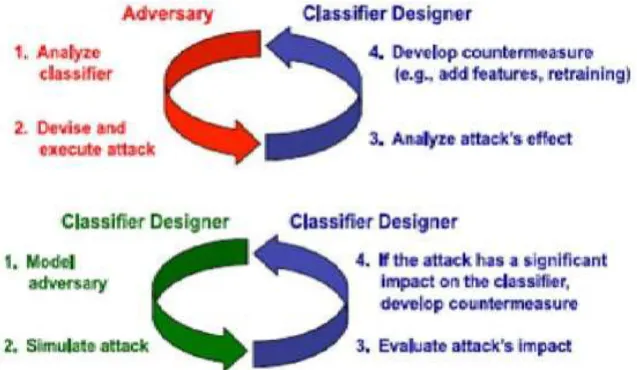
Fig. 1. A conceptual representation of the arms race in adversarial classification. Left: the classical “reactive” arms race.
The designer reacts to the attack by analyzing the attack’s effects and developing countermeasures. Right: the “proactive” arms race advocated in this paper. The designer tries to anticipate the adversary by simulating potential attacks, evaluating their effects, and developing countermeasures if necessary In particular, three main open issues can be identified: (i) analyzing the vulnerabilities of classification algorithms, and the corresponding attacks (ii) developing novel methods to assess classifier security against these attacks, which is not possible using classical performance evaluation methods (iii) developing novel design methods to guarantee classifier security in adversarial environments Although this emerging field is attracting growing interest, the above issues have only been sparsely addressed under different perspectives and to a limited extent. Most of the work has focused on application-specific issues related to spam filtering and network intrusion detection while only a few theoretical models of adversarial classification problems have been proposed in
the machine learning literature however, they do not yet provide practical guidelines and tools for designers of pattern recognition systems. Besides introducing these issues to the pattern recognition research community, in this work we address issues (i) and (ii) above by developing a framework for the empirical evaluation of classifier security at design phase that extends the model selection and performance evaluation steps of the classical design cycle of [9].
2.SPAM FILTERING:
training emails.
A set D of legitimate and spam emails is available for this purpose. We assume that the designer wants to evaluate not only classifier accuracy in the absence of attacks, as in the classical design scenario, but also its security against the well-known bad word obfuscation (BWO) and good word insertion (GWI) attacks. They consist of modifying spam emails by inserting “good words” that are likely to appear in legitimate emails, and by obfuscating “bad words” that are typically present in spam [6]. The attack scenario can be modeled as follows. Attack scenario. Goal. The adversary aims at maxi-mizing the percentage of spam emails misclassified as legitimate, which is an indiscriminate integrity violation. Knowledge. As in [6], [10], the adversary is assumed to have perfect knowledge of the classifier, i.e.,: (k.ii) the feature set, (k.iii) the kind of decision function, and (k.iv) its parameters (the weight assigned to each feature, and the decision threshold). Assumptions on the knowledge of (k.i) the training data and (k.v) feedback from the clas-sifier are not relevant in this case, as they do not provide any additional information. Capability. We assume that the adversary: (c.i)
(exploratory attack); (c.ii) cannot modify the class pri-ors; (c.iii) can manipulate each malicious sample, but no legitimate ones; (c.iv) can manipulate any feature value (i.e., she can insert or obfuscate any word), but up to a maximum number nmax of features in each spam email [6], [10].
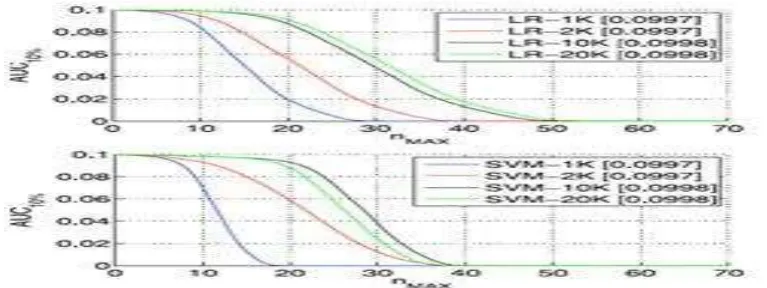
This allows us to evaluate how gracefully the classifier performance degrades as an increasing number of features is modified, by repeating the evaluation for increasing values of nmax. Attack strategy. Without loss of general-ity, let us further assume that x is classified as legitimate if gðxÞ ¼ Pn i¼1 wixi þ w0 < 0, where gð_Þ is the discriminant function of the classifier, n is the feature set size, xi 2 f0; 1g are the feature values (1 and 0 denote respectively the presence and the absence of the corresponding term), wi are the feature weights, and w0 is the bias. The SVM and LR classifiers perform very similarly when they are not under attack (i.e., for nmax ¼ 0), regardless of the fea-ture set size; therefore, according to the viewpoint of clas-sical performance evaluation, the designer could choose any of the eight models. However, security evaluation.
and 20,000 (20K) features. The AUC10 percent value for nmax ¼ 0, corresponding to classical performance evaluation, is also reported in the legend between square brackets highlights that they exhibit a very different robustness to the considered attack, since their AUC10 percent value decreases at very different rates as nmax increases; in particular, the LR classifier with
20,000 features clearly outperforms all the other ones, for all nmax values. This result suggests the designer a very different choice than the one coming from classical performance evaluation: the LR classifier with 20,000 features should be selected, given that it exhibit the same accuracy as the other ones in the absence of attacks, and a higher security under the considered attack
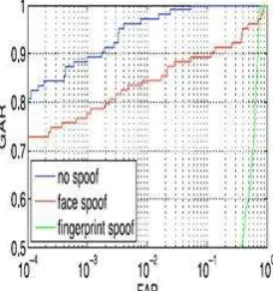
Fig. 3. ROC curves of the considered multimodal biometric system, under a simulated spoof attack against the fingerprint or the face matcher.
3.CONCLUSION
In this paper we focused on empirical security
evaluation of pattern classifiers that have to be
deployed in adversarial environments, and
proposed how to revise the classical
performance evaluation design step, which is
not suitable forth is purpose. Our main
contribution is a framework for empirical
security evaluation that formalizes and
generalizes ideas from previous work, and can
be applied to different classifiers, learning
algorithms, and classification tasks. It is
grounded on a formal model of the adversary,
and on a model of data distribution that can
represent all the attacks considered in previous
work; provides a systematic method for the
generation of training and testing sets that
enables security evaluation; and can
accommodate application-specific techniques
for attack simulation. An intrinsic limitation of
our work is that security evaluation is carried
out empirically, and it is thus data dependent; on
the other hand, model-driven analyses [12],
[10]require a full analytical model of the
problem and of the adversary’s behavior, that
may be very difficult to develop for real-world
applications. Another intrinsic limitation is due
application-guidelines for simulating attacks. Indeed,
detailed guidelines require one to take into
account application-specific constraints and
adversary models.
References
[1]. R.N. Rodrigues, L.L. Ling, and V. Govindaraju, “Robustness ofMultimodal Biometric Fusion Methods against Spoof Attacks,”J. Visual Languages and Computing, vol. 20, no. 3, pp. 169-179, 2009.
[2]. P. Johnson, B. Tan, and S. Schuckers, “Multimodal Fusion Vulnerabilityto Non-Zero Effort (Spoof) Imposters,” Proc. IEEE Int’lWorkshop Information
[3]. Forensics and Security, pp. 1-5, 2010.
[4]. P. Fogla, M. Sharif, R. Perdisci, O. Kolesnikov, and W. Lee,“Polymorphic Blending Attacks,” Proc. 15th Conf. USENIX SecuritySymp., 2006.
[5]. G.L. Wittel and S.F. Wu, “On Attacking Statistical Spam Filters,”Proc.First Conf. Email and Anti-Spam, 2004.
[6]. D. Lowd and C. Meek, “Good Word Attacks on Statistical SpamFilters,” Proc. Second Conf. Email and Anti-Spam, 2005.
[7]. A. Kolcz and C.H. Teo, “Feature Weighting for Improved ClassifierRobustness,” Proc. Sixth Conf. Email and Anti-Spam, 2009.
[8]. D.B. Skillicorn, “Adversarial Knowledge Discovery,” IEEE
2009.
[9]. D. Fetterly, “Adversarial Information Retrieval: The Manipulationof Web Content,” ACM Computing Rev., 2007.
[10]. R.O. Duda, P.E. Hart, and D.G. Stork, Pattern Classification.Wiley-Interscience Publication, 2000.
[11]. N. Dalvi, P. Domingos, Mausam, S. Sanghai, and D. Verma,“Adversarial Classification,” Proc. 10th ACM SIGKDD Int’l Conf.Knowledge Discovery and Data Mining, pp. 99-108, 2004.
[12]. M. Barreno, B. Nelson, R. Sears, A.D. Joseph, and J.D. Tygar, “Can Machine Learning be Secure?” Proc. ACM Symp. Information, Computer and Comm. Security (ASIACCS), pp. 16-25, 2006.
[13]. A.A. C_ardenas and J.S. Baras, “Evaluation of Classifiers: Practical Considerations for Security Applications,” Proc. AAAI Workshop Evaluation Methods for Machine Learning, 2006.
[14]. P. Laskov and R. Lippmann, “Machine Learning in Adversarial Environments,” Machine Learning, vol. 81, pp. 115-119, 2010.
[15]. L. Huang, A.D. Joseph, B. Nelson, B. Rubinstein, and J.D. Tygar, “Adversarial Machine Learning,” Proc. Fourth ACM Workshop Artificial Intelligence and Security, pp. 43-57, 2011.
[17]. D. Lowd and C. Meek, “Adversarial Learning,” Proc. 11th ACM SIGKDD Int’l Conf. Knowledge Discovery and Data Mining, pp. 641- 647, 2005.
Author’s Profile
Eswaraiah Puttu has received his M.Tech (CS) Degree from JNTU Anathapur. Now He is pursuing Ph.D at SV University in DATA WAREHOUSING. He is dedicated to teaching field
from the last 21 years. He has Guided 30 P.G and 80 U.G students. At present he is working as Associate Professor in PBR Visvodaya Institute of Technology & Science, Kavali, and Andhra Pradesh, India.
Darsi mounika, pursuing master of computer applications (MCA) from PBR Visvodaya Institute of Technology and science, kavali,