Attacking Reduced Round SHA-256
Somitra Kumar Sanadhya⋆ and Palash Sarkar Applied Statistics Unit,
Indian Statistical Institute, 203, B.T. Road, Kolkata,
India 700108.
somitra [email protected], [email protected]
Abstract. The SHA-256 hash function has started getting attention recently by the cryptanalysis community due to the various weaknesses found in its predecessors such as MD4, MD5, SHA-0 and SHA-1. We make two contributions in this work. First we describe message modification techniques and use them to obtain an algorithm to generate message pairs which collide for the actual SHA-256 reduced to 18 steps. Our second contribution is to present differential paths for 19, 20, 21, 22 and 23 steps of SHA-256. We construct parity check equations in a novel way to find these characteristics. Further, the 19-step differential path presented here is constructed by using only 15 local collisions, as against the previously known 19-step near collision differential path which consists of interleaving of 23 local collisions. Our 19-step differential path can also be seen as a single local collision at the message word level. We use a linearized local collision in this work. These results do not cause any threat to the security of the SHA-256 hash function.
1 Introduction
Cryptanalysis of hash functions has been an area of intense interest to the research community since past decade and a half. Many hash functions were broken in this time, most notable among them are MD4, MD5, SHA-0 and theoretical break of SHA-1. This has directed the attention of the cryptology community to the SHA-2 family of hash functions.
Known Results for the SHA-2 Family: Gilbert and Handschuh (GH) [7] were the first to study local collisions in the SHA-2 family. They reported a 9-round local collision and estimated the probability of the differential path to be 2−66
. This probability estimate was later improved by [13] and [8]. Sanadhya and Sarkar [19] recently presented 16 new 9-round local collisions for SHA-2 family of hash functions. The message expansion of SHA-256 was studied by Mendel et al. [13], who mentioned an 18-step collision for SHA-256 which was recently corrected in [14]. The work [13] also provided a differential path for 19-step near collision for SHA-256. An earlier work [12] studied a very simplified variant of SHA-256. The encryption mode of SHA-256 is analyzed in [25] and is not relevant to collision search attacks. Recently, at FSE ’08, Nikoli´c and Biryukov [16] reported 21-step collisions for SHA-256 using a nonlinear differential path.
Our Contributions: We make two independent contributions in this work :
1. We construct a 18-step collision characteristic using one of the local collisions from [19]. We describe message modification techniques to find messages following this differential characteristic. Using these techniques, we provide an algorithm to generate pairs of messages which collide for 18 step SHA-256 with the standard IV. We show two such pairs of messages.
collisions start in the same word and therefore this differential path can also be seen as consisting of a single local collision with the starting word difference having a weight of 15 bits. In addition there are no impossible conditions caused by thefIF and fM AJ functions for the differential paths reported here. Therefore the search for actual colliding message pairs following these paths is likely to be easier. We also show that neutral bit technique may not be of much help in finding actual colliding pair of messages while message modification methods seem to hold much more promise.
Note that these results do not cause any threat to the security of the SHA-256 hash function since it has 64 steps per block.
2 Notation
In this paper we use the following notation:
– mi ∈ {0,1}32
,Wi ∈ {0,1}32
,W′
i ∈ {0,1}
32
for anyi.
– The colliding message pair is:{m0,m1, m2, . . .m15}and {m′0,m′1,m′2, . . .m′15}. – The expanded message pair is:{W0,W1,W2, . . .W63}and {W0′,W1′,W2′, . . .W63′ }. – ⊕: bitwise XOR.
– +: addition modulo 232
.
– ∆Wi=Wi⊕Wi′
– ROTRn(x): Right rotation of a 32 bit quantity xby nbits.
– SHRn(x): Right shift of a 32 bit quantity x byn bits.
3 The SHA-256 Hash Function
The newest members of SHA family of hash functions were standardized by US NIST in 2002 [20]. There are 2 differently designed functions in this standard: the SHA-256 and SHA-512. In addition, the standard also specifies a truncated version of SHA-512, namely the SHA-384. The number in the name of the hash function refers to the length of message digest produced by that function. In this work we are interested in reduced round collision attacks against SHA-256. Next we briefly describe SHA-256. For details refer to [20].
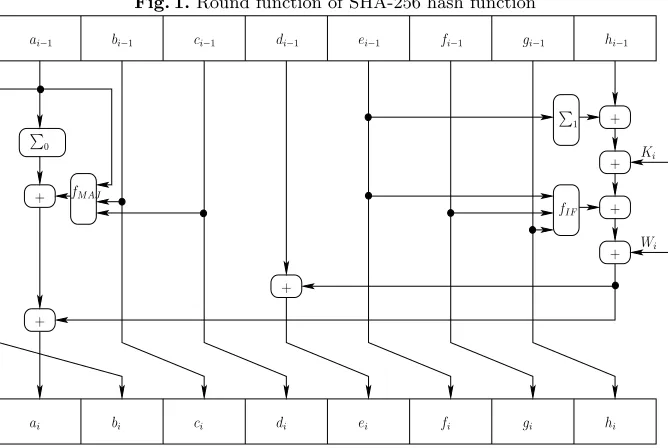
The round function of SHA-256 hash function is shown in Figure 1. Eight registers are used in the evaluation of SHA-256. The initial value in the registers is specified by an 8x32 bit IV. In Step i, the 8 registers are updated from (ai−1, bi−1, ci−1, di−1, ei−1, fi−1, gi−1, hi−1) to (ai, bi, ci, di, ei, fi, gi, hi)
according to the following equations:
ai =Σ0(ai−1) +fM AJ(ai−1, bi−1, ci−1) +Σ1(ei−1)
+fIF(ei−1, fi−1, gi−1) +hi−1+Ki+Wi bi =ai−1
ci =bi−1
di =ci−1
ei =di−1+Σ1(ei−1) +fIF(ei−1, fi−1, gi−1)
+hi−1+Ki+Wi
fi =ei−1
gi =fi−1
hi=gi−1
(1)
The fIF and thefM AJ are three variable boolean functions defined as:
fIF(x, y, z) = (x∧y)⊕(¬x∧z)
Fig. 1.Round function of SHA-256 hash function
+
+
+
+
+
+ +
ai−1 bi−1 ci−1 di−1 ei−1 fi−1 gi−1 hi−1
ai bi ci di ei fi gi hi
P 0
P 1
fIF
Ki
fM AJ
Wi
The functions Σ0 and Σ1 are defined as:
Σ0(x) =ROT R2(x)⊕ROT R13(x)⊕ROT R22(x)
Σ1(x) =ROT R6(x)⊕ROT R11(x)⊕ROT R25(x)
Roundiuses a 32 bit word Wi which is derived from the message and a constant word Ki. There are 64 rounds in all. The hash function operates on a 512 bit message specified as 16 words of 32 bits. Given the message wordsm0,m1, . . .m15, theWi ’s are computed using the equation:
Wi=
(
mi for 0≤i≤15
σ1(mi−2) +mi−7+σ0(mi−15) +mi−16 for 16≤i≤63
(2)
The functions σ0 andσ1 are defined as:
σ0(x) =ROT R7(x) ⊕ROT R18(x)⊕SHR3(x)
σ1(x) =ROT R17(x)⊕ROT R19(x)⊕SHR10(x)
The IV = (a−1, b−1, c−1, d−1, e−1, f−1, g−1, h−1) is defined as (6a09e667, bb67ae85, 3c6ef372,
a54ff53a,510e527f,9b05688c,1f83d9ab,5be0cd19). All additions in Equations 1 and 2 are modulo 232.
The output hash value of a one block (512 bit) message is obtained by chaining the IV with the register values at the end of the final round as per the Merkle-Damg˚ard construction [6, 15]. A similar strategy is used for multi-block messages, where the IV for next block is taken as the hash output of the previous block.
4 Collision Attacks Against Hash Functions
The aim of a hash function attack is to produce two different messages both of which map to the same hash output. This is done by employing differential attack against the hash function in question. First a suitable difference of messages is found such that a pair of messages having that difference is likely to collide to the same hash value with high probability. For example, if a given message differential {∆W0, ∆W1, . . . ∆W15}
is likely to generate colliding pairs with probability 1
28 then one needs to try roughly 2
8
different pairs
However, the probability of the specified differential to generate a collision is likely to be very low for most of the practical hash functions. Hence some sophisticated methods are used to search for the right (colliding) pair, rather than generating them at random. Message modification techniques [24, 22] and neutral bit technique [1] are the two widely used methods to find colliding message pairs.
We next describe some terms and techniques used in the differential attack on hash functions.
4.1 Linearized Local Collision
To analyze a hash function, it is advantageous to consider its linearized version. That is, all the non-linear components in the hash function design are first replaced by their linear approximations. Since the resulting design is linear, we have h(x)⊕h(x⊕∆x) = h(∆x) where h is one step of the hash function evaluation. Therefore we can look at the behavior of the differential of the messages∆xon the linearized hash function rather than considering a pair of messages xandx⊕∆xoperated on by a step of linearized hash function, and then taking their differential.
The simplified version of the hash function is then analyzed for a small number of steps. The technique is to introduce a small perturbation in the message at the first step and then correct it by suitable differences in the messages in next few steps. After introducing some message differences for few rounds it is possible to completely cancel the effect of the original perturbation. A sequence of message word differences which cancel their own effect locally are said to construct a “local collision”. All the message words are considered to be unrestricted during the search for local collisions. Finally many local collisions are interleaved to obtain (reduced round) colliding pair of messages.
Attacks on the SHA-0 and SHA-1 hash functions use the 5-step local collision obtained by Chabaud and Joux [4]. For SHA-256, a 9-step local collision by Gilbert and Handschuh [7] and sixteen 9-step local collisions by Sanadhya and Sarkar [19] are known. We discuss the case of SHA-256 local collisions in more detail.
4.2 Linearized Local Collisions in SHA-256
Let the first step in SHA-2 be denoted by Step 0. If a 9-step local collision is started at step i, it defines the 9 word differences Wj ⊕Wj′ fori≤j≤i+ 8. We use two types of local collisions in the present work. The first is due to Gilbert and Handschuh [7] and the second is one of the 16 local collisions presented in [19]. From among the 16, we choose the 5th local collision because of the following two reasons :
1. It is one of the 4 which are suitable for getting 18-step collision, as explained later (the others being 7th, 14th and 16th).
2. It has the highest probability among these 4.
We call the two local collisions the GH local collision and the SS5 local collision respectively. The other
three local collisions from [19] are denoted by SS7, SS14 and SS16.
The following approximations are used in these local collisions : 1. Operator + is approximated by⊕.
2. In GH, fIF and fM AJ are approximated by zero function. This causes certain impossible conditions while searching for the message pair following this differential path, as has been observed in [13]. 3. In SS5,fIF andfM AJ are approximated by their middle arguments. These linear approximations avoid
two types of impossible conditions encountered when using GH local collision. See [19] for details on other local collisions.
All the local collisions mentioned above are:
• GH :{x, Σ0(x)⊕Σ1(x),Σ0(Σ1(x)), 0,x,Σ0(x)⊕Σ1(x), 0, 0, x}
• SS7 :{x, x⊕Σ0(x)⊕Σ1(x),Σ0(x)⊕Σ0(Σ1(x)), x⊕Σ0(x)⊕Σ1(x), 0, x⊕Σ0(x)⊕Σ1(x), 0, 0, x}
• SS14 :{x, x⊕Σ0(x)⊕Σ1(x), x⊕Σ1(x)⊕Σ0(Σ1(x)), Σ1(x), Σ0(x)⊕Σ1(x), Σ0(x)⊕Σ1(x), 0, 0, x}
• SS16:{x, Σ0(x)⊕Σ1(x),Σ0(x)⊕Σ1(x)⊕Σ0(Σ1(x)), x⊕Σ1(x),x⊕Σ0(x)⊕Σ1(x),x⊕Σ0(x)⊕Σ1(x),
0, 0,x}
Note that in all the above local collisions,Σ0 and Σ1 are used as operators on 32 bit quantities, andx
is any 32 bit message word difference. Once a starting message difference x is chosen, next 8 words must have the difference in accordance with the local collision.
4.3 Differential Path
The introduction of the message differentials causes the internal registers of hash function to differ too. The propagation of the differences in the registers creates a “differential path”. For SHA-256, the differential path for k steps can be completely specified by differences in the 8 registers for these k steps along with thek message differences corresponding to the same steps. The term “linear characteristic” is also widely used in literature to refer to the differential path. We also use it interchangeably with differential path.
If the differential path includes steps in which the message expansion is involved, then the message words for some steps are computed on the basis of previous message words. In such a case, the message expansion is also linearized. If the register differences are all zero at the last step of the differential path then such a path is said to be a “colliding differential path”. The differential of the messages for a colliding differential path are called as “colliding message differential”.
The differential path holds for the linearized version of the hash function with probability 1, but with much less probability for the actual hash function.
5 Attacking 18 rounds of SHA-256
It is possible to get up to 18 step reduced round collisions for SHA-256 using a single local collision. Such an idea has already been used in [13] and mentioned in [19]. We describe this for clarity of exposition.
First of all, note that any local collision under consideration spans 9 steps and the message expansion of SHA-256 does not play any role in the first 16 steps. Therefore if a local collision spans from Step i to Step (i+ 8), and if we take ∆W0 =∆W1 = . . . =∆Wi−1 =∆Wi+9 =∆Wi+10= . . . =∆W15= 0, we get
a differential path for 16-step collision for SHA-256.
The issue of message expansion is not considered in obtaining the 16 step colliding differential path described above. Next we tackle two steps of the message expansion.
Message expansion rule forW16 and W17 are given by :
W16=σ1(W14) +W9 +σ0(W1) +W0 (3)
W17=σ1(W15) +W10+σ0(W2) +W1 (4)
Let a local collision L start at Step 3 and hence end at Step 11. This local collision defines the 9 word differences ∆W3, ∆W4, . . . ∆W11. The first step of the local collision corresponds to∆W3 and the 9th
step corresponds to ∆W11. Taking the differentials of all the message words outside the span of the local
collision to be zero, the differential path forL will have ∆W0 =∆W1 =∆W2 =∆W12 =∆W13 =∆W14
= ∆W15 = 0.
Note that ∆Wi = 0 means that Wi = W′
i. Since ∆W0 = ∆W1 = ∆W14 = 0 for L, from Equation 3,
W16 and W16′ may be different only due to the differences inW9 and W9′.
∆W9 corresponds to the 7th step word difference for L. If L is chosen such that it’s 7th step word
difference is zero, then W9 = W9′. Therefore even after the message expansion recursion is used, we will
have W16 =W16′ . This results in a 17-step differential path for SHA-256.
Similarly, if the 8th message word difference for Lis zero, then by Equation 4,W
17 =W17′ . This results
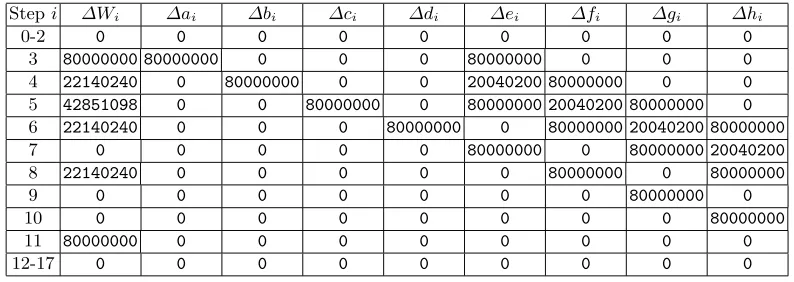
Both the 17 and the 18 Step paths discussed above use just one local collision. To increase the probability of this differential path for the case of real SHA-256, we can take starting messages differing in only 1 bit. All the local collisions listed in the previous section have the 7th and the 8th message word differences zero. Therefore any one of them can be used to obtain the 18 step colliding differential path for SHA-256. We list one of these differential paths in Table 1. This 18-step colliding path is also a 17-step colliding path for SHA-256.
Further, it can be seen that it is not possible to obtain a differential path for 19 or more steps with a single local collision where the weight of the perturbation in first word is just 1-bit. This impossibility arises due to the message expansion of SHA-256, and because there are no local collisions in which 3 consecutive word differences are zero. We discuss the case of more than 18 steps in later sections.
Table 1.18 step linear characteristic for SHA-256. Only 1 SS5 local collision is used to build this path.
Stepi ∆Wi ∆ai ∆bi ∆ci ∆di ∆ei ∆fi ∆gi ∆hi
0-2 0 0 0 0 0 0 0 0 0
3 80000000 80000000 0 0 0 80000000 0 0 0
4 22140240 0 80000000 0 0 20040200 80000000 0 0
5 42851098 0 0 80000000 0 80000000 20040200 80000000 0
6 22140240 0 0 0 80000000 0 80000000 20040200 80000000
7 0 0 0 0 0 80000000 0 80000000 20040200
8 22140240 0 0 0 0 0 80000000 0 80000000
9 0 0 0 0 0 0 0 80000000 0
10 0 0 0 0 0 0 0 0 80000000
11 80000000 0 0 0 0 0 0 0 0
12-17 0 0 0 0 0 0 0 0 0
6 Message Modification Techniques for SHA-256
We have used XOR differences for registers and message words in the differential path for reduced round SHA-256. The differential path in Table 1 is obtained by using linearized SHA-256. However our aim is to obtain a pair of messages which follows this differential path for real SHA-256. The probability for this to happen for random messages is 2−49
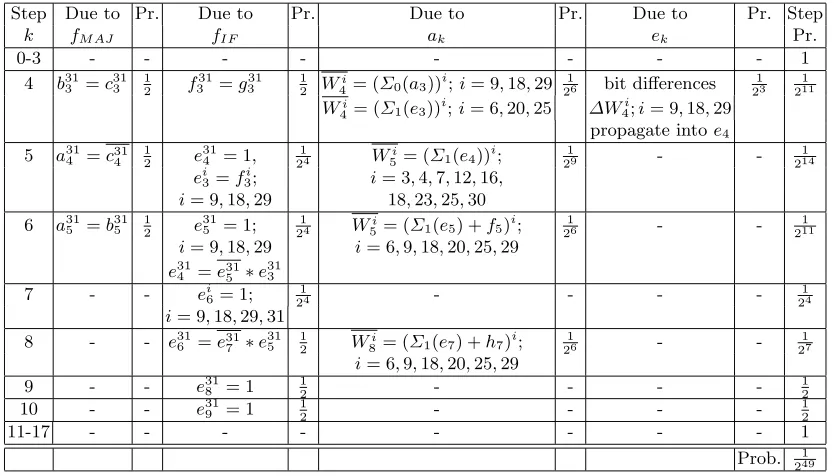
for 18-step SHA-256. If the message-pair satisfies certain conditions then the probability of the differential path can be increased significantly. We list conditions on the registers and the message words which help in finding messages following the 18 step differential path shown in Table 1 when actual SHA-256 is used. These conditions try to ensure that the functions fIF and fM AJ both behave like their middle arguments, and that + behaves like ⊕. These conditions are shown in Table 2. Sufficient conditions for 9 step SHA-256 collision have also been given in [9], Table 3. We next highlight the advantages of our conditions with those in [9].
1. The conditions in [9] are for only 9-step collision in SHA-256. Our conditions are for 18-step collision in SHA-256.
2. The GH local collision is used in [9] whereas we use SS5 local collision. Further, no explanation is
provided in [9] on how these conditions are derived whereas we provide complete details about our conditions. It is now possible to use the method described in this work to derive conditions for 18-step SHA-256 collision using any other local collision.
Table 2.Conditions for the 18 step differential path in Table 1.xidenotesithbit of a 32 bit quantityx.xdenotes the bitwise negation ofxwhich can be a 32 bit or a 1 bit quantity. Operator + is addition modulo 232 and operator * is multiplication
of 2 single bits. Both these operators are used in steps 6 and 8.
Step Due to Pr. Due to Pr. Due to Pr. Due to Pr. Step
k fM AJ fIF ak ek Pr.
0-3 - - - 1
4 b31
3 =c
31 3
1
2 f
31
3 =g
31 3
1
2 W
i
4 = (Σ0(a3))
i;i= 9,18,29 1
26 bit differences 1 23
1 211 Wi
4= (Σ1(e3))
i;
i= 6,20,25 ∆W4i;i= 9,18,29
propagate intoe4
5 a31
4 =c314
1
2 e
31
4 = 1,
1
24 W5i= (Σ1(e4))
i; 1
29 -
-1 214 ei3 =f
i
3; i= 3,4,7,12,16,
i= 9,18,29 18,23,25,30 6 a31
5 =b
31 5
1
2 e
31
5 = 1;
1
24 W5i= (Σ1(e5) +f5)
i; 1
26 -
-1 211 i= 9,18,29 i= 6,9,18,20,25,29
e31
4 =e315 ∗e
31 3
7 - - ei
6= 1;
1
24 - - -
-1 24 i= 9,18,29,31
8 - - e31
6 =e317 ∗e
31 5
1
2 W
i
8 = (Σ1(e7) +h7)
i; 1
26 -
-1 27 i= 6,9,18,20,25,29
9 - - e31
8 = 1
1
2 - - -
-1 2
10 - - e31
9 = 1
1
2 - - -
-1 2
11-17 - - - 1
Prob. 1 249
6.1 Explanation of Conditions in Table 2
∆Wk = 0 for stepsk=0, 1 and 2 and hence there are no restrictions due to these steps. In Step 3, although ∆W3 6= 0, the difference is only in the most significant bit. The + and⊕behave the same with probability
1 for a difference in MSB, so even Step 3 does not impose any restrictions. Hence conditions are needed to tackle the proper differential behavior for the message pair only from Step 4 onwards.
Conditions Due tofM AJ andfIF : In Step 4,fM AJ has inputsa3, b3 andc3 with∆a3= 0x80000000. In
SS5local collisionfM AJ is approximated by it’s middle argument, which will happen ifb313 =c 31
3 . Similarly
the fIF function having argumentse3, f3 and g3 will behave like it’s middle argument if f331=g 31 3 . Conditions Due to Register a4 : Once the two boolean functions are approximated by their middle
arguments, register a4 is evaluated for both the messages as follows :
a4 =Σ0(a3) +b3+Σ1(e3) +f3+h3+K4+W4 and
a′
4 =Σ0(a′3) +b′3+Σ1(e3′) +f3′ +h′3+K4+W4′
Registersa3 and a′3 (resp.e3 and e′3) differ in their MSB, and the operatorΣ0 (resp.Σ1) expands this
difference to 3 bit positions 6, 20 and 25 (resp. 9, 18 and 29). The word difference ∆W4 at this step has
been chosen to differ in these 6 bit positions (namely 6, 20, 25, 9, 18 and 29) with the aim of cancelling these differences.
The cancellation will happen as desired if :
1. The difference of words W4 and W4′ is opposite to the difference in words Σ0(a3) and Σ0(a′3) on bit
positions 9, 18 and 29. For example, if (Σ0(a3))i = 1 and (Σ0(a′3))i = 0, then we would like (W4)i = 0
and (W′
4)i = 1 so that W4+Σ0(a3) andW4′+Σ0(a′3) are equal at theith bit position;i= 9, 18 and 29.
2. Similarly, (W4)i and (W4′)i have difference opposite to the difference in (Σ1(e3))i and (Σ1(e′3))i at bit
All the 6 bit differences will be cancelled if the conditions shown in Table 2, Step 4, columnak are met. Note that this is not a necessary way of cancelling the differences, other possibilities exist when the sum of the terms in a4 and a′4 may behave as desired. In particular, we do not use bit carries in addition modulo
232 to cancel these type of differences like Wang et. al do for SHA-1 [23]. We use XOR differences only,
unlike [23] where modular differences are used.
Conditions due to register e4 : Having cancelled the 6 bit differences to obtain ∆(a4) = 0, it can be
seen that 3 bits from ∆(W4) will certainly propagate into∆(e4) because there is noΣ0 term in calculating
e4ande′4. If the differential path is to be followed, then these 3 differing bits inW4andW4′ should not carry
forward to other positions. Carry propagation to other bits will cause problems in adjusting the register differences in next steps since any single bit difference in aor eregister is expanded into 3 bit differences by the operatorsΣ0 andΣ1. We have chosen the word differences in next steps considering these positions
by following the linear (XOR) characteristics. It is possible to allow some bit carries here but it seems that it will only reduce the probability of the differential path.
To complete the analysis of step 4, we finally look at the difference∆(e4). The registers e4 and e′4 are
computed as follows:
e4 =d3+Σ1(e3) +fIF(e3, f3, g3) +h3+K4+W4,
and e′
4 =d′3+Σ1(e3′) +fIF(e′3, f3′, g′3) +h′3+K4+W4′.
In these two computations, bits 6, 20 and 25 corresponding to Σ1 rotations of the differing bit 31 in
e3 have already been taken care of while considering a4. Bit numbers 9, 18 and 29 are the places where
W4 and W4′ differ and these differences are required to be propagated to∆e4. Since d3 =d′3,h3=h′3 and
fIF(e3, f3, g3) =fIF(e′3, f3′, g′3);
if we write rest=Σ1(e3) +fIF(e3, f3, g3) +h4+K4,
then e4 =rest+W4,
and e′
4 =rest+W4′.
If theith bit of restis 0 and there is no carry into theith bit while addition withW4 takes place, then
the XOR difference W4 ⊕W4′ will propagate into e4⊕e′4 as desired. Alternately, if the ith bit of rest is
1 and there is a carry into the ith bit while addition with W4 takes place, then too the XOR difference
W4⊕W4′ will propagate intoe4⊕e′4.
Thus either we would like no carry propagation ine4 and e′4 at bits 6, 20 and 25 if rest is 0 at these
bit positions or we would like carry propagation in both these registers if restis 1 at these bits. We do not have a deterministic way to ensure this since we do not have complete freedom to choose the registers and the message words as desired at this stage. However, the probability of the carries to happen as desired can be increased if we we set other free bits of W4 and W4′ according to the following conditions :
1. if rest9
is 0 then W7 4 =W
8 4 = 0.
2. if rest9 is 1 then W7 4 =W
8 4 = 1.
3. if rest18 is 0 thenW410=W 11
4 =. . .=W 17 4 = 0.
4. if rest18
is 1 thenW10 4 =W
11
4 =. . .=W 17 4 = 1.
5. if rest29 is 0 thenW26 4 =W
27 4 =W
28 4 = 0.
6. if rest29 is 1 thenW426=W 27 4 =W
28 4 = 1.
6.2 Method to Satisfy Conditions in Table 2
First 4 words in the differential path are free and hence we choose them randomly. Thereafter, many conditions in Table 2 are easy to fulfill as they depend only on word Wk in step k. Some of the conditions on registers can be tackled by suitably choosing the wordWk at that step which we can choose as desired. However, there may be instances when a previously selected message word causes impossible condition at a later step. As an example, we may not get the bit carry conditions for register e4 as described previously.
Also we wish to have e31
6 following a particular pattern at step 8 whereas this bit has been set at step 6
itself. In such contradicting cases, we choose another message word randomly at the previous step where the condition was breaking down. Then we apply message modification techniques from that step onwards and continue the search process for further steps. We search incrementally proceeding further only when all the conditions at a step are fulfilled and the differential path is as desired. The differential path in Table 1 holds with probability 2−49, but with the procedure described above, we are able to get a much
higher probability. In fact, Steps 0 to 7 become very easy to fulfill with the message modification and we are able to satisfy all the conditions till Step 7 in about a minute on an ordinary PC. The only difficult conditions are those imposed due to a8. We could find a colliding message pair following exact differential
characteristic in time varying from about 40 minutes to a couple of hours on an ordinary PC. Repeatedly running the program we could generate many such pairs. We show two such colliding pairs of messages.
6.3 Colliding Message Pairs for 18-Step SHA-256
Tables 3 and 4 show the message pairs found using the techniques described previously. All 18 words of the messages are given in the tables. First 16 words can be used to compute the last two words using the message expansion of SHA-256. Similar method can be used for finding 9-round pseudo collisions for SHA-256 as well. Since we can already find message pairs colliding for 18-step SHA-256 with the standard IV, the only utility for such an exercise would be to see how easy it becomes to find these pseudo collisions due to the benefits of relaxing the IV conditions. However, we found that the time required to find a 9-round pseudo collision is only marginally less than the time required to find an 18-step collision. We give an example of such a pseudo collision in Section A.
Table 3.Colliding message pair for 18 step SHA-256 with standard IV. These two messages follow the differential path given in Table 1.
M1 0-7 ccea5c17 53ad1a2d 141db23c b6acfaa8 5ee7fe4d 53c5b764 2bf20d44 87d63bf6
8-1563a07869 f305fdea 26ee271f b973b91c d0f87828 b724a487 a295fa2a 0a67c97a
M2 0-7 ccea5c17 53ad1a2d 141db23c 36acfaa8 7cf3fc0d 1140a7fc 09e60f04 87d63bf6
8-1541b47a29 f305fdea 26ee271f 3973b91c d0f87828 b724a487 a295fa2a 0a67c97a
Table 4.Another colliding message pair for 18 step SHA-256 with standard IV. These two messages also follow the differential path given in Table 1.
M1 0-7 ed919421 aa75e4fe 8548d0e0 9c1888f7 1da3fc3d a11f7a02 bb463b64 e9b28365
8-15323ecf28 8097e497 4343b78b dc484e91 bf588b4b 8401140a 42499da1 f88a3e2e
M2 0-7 ed919421 aa75e4fe 8548d0e0 1c1888f7 3fb7fe7d e39a6a9a 99523924 e9b28365
8-15102acd68 8097e497 4343b78b 5c484e91 bf588b4b 8401140a 42499da1 f88a3e2e
7 Using Coding Theoretic Methods to Find Linear Differential Paths for Reduced Round SHA-256
In [18] and [17] coding theoretic techniques were used to search for differential paths in SHA-1. Extension to SHA-2 was mentioned in [13]. We describe a new way of forming parity check equations and then find low weight codewords for the corresponding generator matrix. Each of these codewords can be used to build a differential characteristic for reduced round SHA-256. This method results in tackling up to 23-step reduced SHA-256.
7.1 A New Way of Constructing Parity Check Equations
Tackling message expansion in SHA-2 can be a problem. A non-zero value of ∆Wi fori≥16 necessitates tackling the recursion for message expansion. So one way to avoid this is to ensure that∆Wi= 0 fori≥16. Clearly, this cannot work for full SHA-2. But, for reduced round versions, one can find differential paths using this approach, as we describe below.
The technique described below assumes a local collision L. The description is not for any particular local collision. It holds for any local collision. Obtaining a particular local collision requires certain linear approximations of the constituents of the SHA-256 round function. This converts the round function into a linear map based on which we define our linear code. We note that the linear code is not straightforwardly obtained from the linear map.
A message consists of 16 32-bit words for a total of 512 bits. We use the Chabaud-Joux [4] type disturbance vector approach. Let DV = {d0,d1, d2, . . . , d255} be a 256-bit disturbance vector. If di = 1 then the two initial messages differ in theirith bit, and further message bits differ as per the local collision. We do not consider a 512-bit DV for the following reason. A local collision defines the differences of 9 words of messages and only the first 16 words of SHA-256 are unrestricted. Thereafter the message words are calculated using the message expansion recurrence. This implies that a local collision can not be started after first 8 steps without affecting the message expansion.
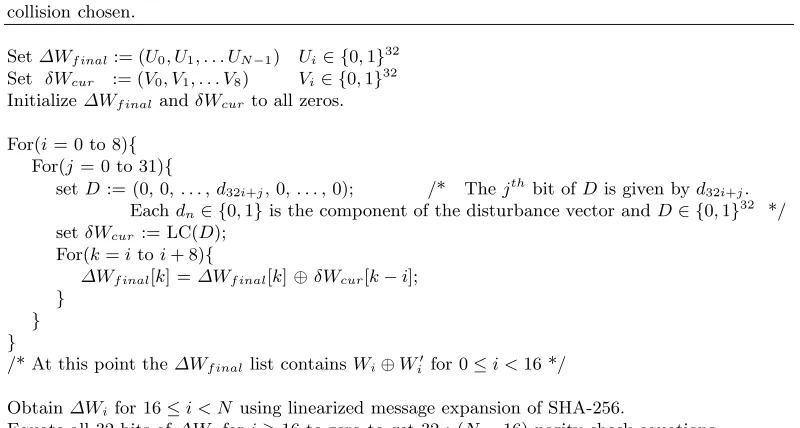
Let us now describe the linear code that we require. This is done in two steps. In the first step, we express∆Wi (i≥16) in terms ofd0, . . . , d255. In the second step, we define the parity check equations for
the code by setting ∆Wi = 0 for i ≥ 16. Thus, any DV (d0, . . . , d255) which satisfies these parity check
equations is a codeword. Our task then is to look for a low weight codeword as this gives a differential path with a small number of local collisions.
It is clear that such codes can be formed as long as there are less than 256 parity check equations. If we apply this procedure up toN rounds (corresponding to stepN−1), then we will obtain 32(N−16) parity check equations. Thus, the maximum N that we can use with this method isN = 23. The minimum value of N is clearly 17. Since we already report 18-round collision, we do not consider N = 17 and 18. Instead we report differential paths from 19 to 23 rounds.
The first task is to express∆Wi(i≥16) in terms ofd0, . . . , d255. We describe how this is done. For any
local collision L, the first word determines the next eight words. Consider the 32-bit vector (d0,0, . . . ,0),
where d0 is treated as a (binary) variable. Then Ldefines the next 8 32-bit words. At this point, the first
9 words have been defined. The rest 7 are taken to be zero. For i≥ 16, ∆Wi is now obtained using the message recursion. This expresses all the ∆Wis (i≥16) as linear function ofd0. Next consider the 32-bit
vector (0, d1,0, . . . ,0); useLto obtain the next eight words and the message expansion recursion to express
∆Wis (i≥16) as linear function of d1. Now, for the 32-bit vector (d0, d1,0, . . . ,0), we can express ∆Wis
(i≥16) as linear function ofd0 and d1 by XORing the separate linear functions corresponding to d0 and
d1. Clearly, the procedure can be extended to the entire DV (d0, . . . , d255). The exact details are given in
Table 5.
Table 5.Algorithm for generating parity check equations for linearizedN step SHA-256.
externalLC(x) : accepts a 32 bit inputxand returns 9 words of 32 bits conforming to the local collision chosen.
Set∆Wf inal:= (U0, U1, . . . UN−1) Ui∈ {0,1}32 Set δWcur := (V0, V1, . . . V8) Vi∈ {0,1}32 Initialize∆Wf inalandδWcurto all zeros.
For(i= 0 to 8){ For(j= 0 to 31){
setD:= (0, 0, . . . ,d32i+j, 0, . . . , 0); /* Thejthbit ofD is given byd32i+j. Eachdn∈ {0,1}is the component of the disturbance vector andD∈ {0,1}32 */ setδWcur := LC(D);
For(k=itoi+ 8){
∆Wf inal[k] =∆Wf inal[k]⊕δWcur[k−i]; }
} }
/* At this point the∆Wf inallist containsWi⊕Wi′ for 0≤i <16 */
Obtain∆Wifor 16≤i < N using linearized message expansion of SHA-256.
Equate all 32 bits of∆Wifori≥16 to zero to get 32∗(N−16) parity check equations.
8 Results and Comparison to Previous Work
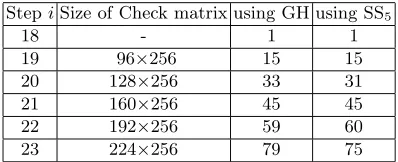
Low weight disturbance vectors are searched for reduced round SHA-256 by using the probabilistic methods described in [3], [10] and [21]. The minimum weights of codewords found are listed in Table 6. For 19-step SHA-256 the weight of the codeword found is 15 for both GH and SS5 local collision. This means that 15
local collisions are interleaved to obtain the 19-step characteristic. Interestingly, all the 15 local collisions start at the same word for both GH and SS5. Thus the case of 19-step characteristic can be considered as
consisting of a single local collision starting at Step 3 where the initial message difference is a word with weight 15 bits. There is no colliding differential path known before this work using the linearized local collision. Using this technique, the best known 19-step differential path is for a near collision consisting of 23 GH local collisions [13]. As has already been noted in [13], the GH local collision causes certain impossible conditions in the search for actual colliding pairs. The use of SS5 local collision ensures that we
do not face two types of impossible conditions.
For 20 to 23 steps, no differential path using a linearized local collision is known so far. We provide the first differential paths for these cases using the linearization technique. For 23-step SHA-256, the size of the corresponding generator matrix is 32×256, i.e. there are only 32 codewords of length 256. It is possible to do exhaustive search on this size, hence we did not use the probabilistic methods for this case. For the 23-step case, the reported codeword weight is actually the best possible. All these differential paths are reported in Section C.
Acknowledgements
We would like to thank Christian Rechberger for carefully reading an earlier version of this paper and giving helpful suggestions. He also mentioned that analysis similar to ours appears in [11].
References
Table 6.Summary of results. Least weight of the codeword found using different local collisions. For 23 step case, the codeword weight is obtained by exhaustive search. For all other cases, methods described in [3], [10] and [21] are used.
StepiSize of Check matrix using GH using SS5
18 - 1 1
19 96×256 15 15
20 128×256 33 31
21 160×256 45 45
22 192×256 59 60
23 224×256 79 75
2. Gilles Brassard, editor. Advances in Cryptology - CRYPTO 1989, 9th Annual International Cryptology Conference, Santa Barbara, California, USA, August 20-24, 1989, Proceedings, volume 435 ofLecture Notes in Computer Science. Springer, 1990.
3. Anne Canteaut and Florent Chabaud. A New Algorithm for Finding Minimum-Weight Words in a Linear Code: Appli-cation to McEliece’s Cryptosystem and to Narrow-Sense BCH Codes of Length 511. IEEE Transactions on Information Theory, 44(1):367–378, 1998.
4. Florent Chabaud and Antoine Joux. Differential Collisions in SHA-0. In Hugo Krawczyk, editor,Advances in Cryptology -CRYPTO 1998, 18th Annual International Cryptology Conference, Santa Barbara, California, USA, August 23-27, 1998, Proceedings, volume 1462 ofLecture Notes in Computer Science, pages 56–71. Springer, 1998.
5. Ronald Cramer, editor. Advances in Cryptology - EUROCRYPT 2005, 24th Annual International Conference on the Theory and Applications of Cryptographic Techniques, Aarhus, Denmark, May 22-26, 2005, Proceedings, volume 3494 of
Lecture Notes in Computer Science. Springer, 2005.
6. Ivan Damg˚ard. A Design Principle for Hash Functions. In Brassard [2], pages 416–427.
7. Henri Gilbert and Helena Handschuh. Security Analysis of SHA-256 and Sisters. In Mitsuru Matsui and Robert J. Zuccherato, editors,Selected Areas in Cryptography, 10th Annual International Workshop, SAC 2003, Ottawa, Canada, August 14-15, 2003, Revised Papers, volume 3006 ofLecture Notes in Computer Science, pages 175–193. Springer, 2003. 8. Philip Hawkes, Michael Paddon, and Gregory G. Rose. On Corrective Patterns for the SHA-2 Family. Cryptology eprint
Archive, August 2004. Available athttp://eprint.iacr.org/2004/207.
9. Marko H¨olbl, Christian Rechberger, and Tatjana Welzer. Finding Message Pairs Conforming to Simple SHA-256 Char-acteristics. In Stefan Lucks, Ahmad-Reza Sadeghi, and Christopher Wolf, editors, Preliminary Proceeding Records of WEWoRC 2007 - Western European Workshop on Research in Cryptology, July 4-6, 2007, Bochum, Germany, pages 21–25, 2007. Available athttp://www.hgi.rub.de/weworc07/PreliminaryConferenceRecord.pdf.
10. Jeffrey S. Leon. A Probabilistic Algorithm for Computing Minimum Weights of Large Error-Correcting Codes. IEEE Transactions on Information Theory, 34(5):1354–1359, 1988.
11. Krystian Matusiewicz. Analysis of Modern Dedicated Cryptographic Hash Functions. PhD thesis, Macquarie University, August 2007. Available athttp://www.ics.mq.edu.au/~kmatus/Matusiewicz-PhDthesis.pdf.
12. Krystian Matusiewicz, Josef Pieprzyk, Norbert Pramstaller, Christian Rechberger, and Vincent Rijmen. Analysis of simplified variants of SHA-256. In Christopher Wolf, Stefan Lucks, and Po-Wah Yau, editors,WEWoRC 2005 - Western European Workshop on Research in Cryptology, July 5-7, 2005, Leuven, Belgium, volume 74 of LNI, pages 123–134. GI, 2005.
13. Florian Mendel, Norbert Pramstaller, Christian Rechberger, and Vincent Rijmen. Analysis of Step-Reduced SHA-256. In Matthew J. B. Robshaw, editor, Fast Software Encryption, 13th International Workshop, FSE 2006, Graz, Austria, March 15-17, 2006, Revised Selected Papers, volume 4047 ofLecture Notes in Computer Science, pages 126–143. Springer, 2006.
14. Florian Mendel, Norbert Pramstaller, Christian Rechberger, and Vincent Rijmen. Analysis of Step-Reduced SHA-256.
Cryptology eprint Archive, March 2008. Available athttp://eprint.iacr.org/2008/130. 15. Ralph C. Merkle. One Way Hash Functions and DES. In Brassard [2], pages 428–446.
16. Ivica Nikoli´c and Alex Biryukov. Collisions for Step-Reduced SHA-256. In Kaisa Nyberg, editor,Fast Software Encryption 2008, volume Pre-proceedings version ofLecture Notes in Computer Science, pages 1–16. Springer, 2008.
17. Norbert Pramstaller, Christian Rechberger, and Vincent Rijmen. Exploiting Coding Theory for Collision Attacks on SHA-1. In Nigel P. Smart, editor,Cryptography and Coding, 10th IMA International Conference, Cirencester, UK, December 19-21, 2005, Proceedings, volume 3796 ofLecture Notes in Computer Science, pages 78–95. Springer, 2005.
18. Vincent Rijmen and Elisabeth Oswald. Update on SHA-1. In Alfred Menezes, editor,Topics in Cryptology - CT-RSA 2005, The Cryptographers’ Track at the RSA Conference 2005, San Francisco, CA, USA, February 14-18, 2005, Proceedings, volume 3376 ofLecture Notes in Computer Science, pages 58–71. Springer, 2005.
20. Secure Hash Standard. Federal Information Processing Standard Publication 180-2. U.S. Department of Commerce, National Institute of Standards and Technology(NIST), 2002. Available athttp://csrc.nist.gov/publications/fips/
fips180-2/fips180-2withchangenotice.pdf.
21. Jacques Stern. A Method for Finding Codewords of Small Weight. In G´erard D. Cohen and Jacques Wolfmann, editors,
Coding Theory and Applications, 3rd International Colloquium, Toulon, France, November 2-4, 1988, Proceedings, volume 388 ofLecture Notes in Computer Science, pages 106–113. Springer, 1988.
22. Xiaoyun Wang, Xuejia Lai, Dengguo Feng, Hui Chen, and Xiuyuan Yu. Cryptanalysis of the Hash Functions MD4 and RIPEMD. In Cramer [5], pages 1–18.
23. Xiaoyun Wang, Yiqun Lisa Yin, and Hongbo Yu. Finding Collisions in the Full SHA-1. In Victor Shoup, editor,Advances in Cryptology - CRYPTO 2005: 25th Annual International Cryptology Conference, Santa Barbara, California, USA, August 14-18, 2005, Proceedings, volume 3621 ofLecture Notes in Computer Science, pages 17–36. Springer, 2005.
24. Xiaoyun Wang and Hongbo Yu. How to Break MD5 and Other Hash Functions. In Cramer [5], pages 19–35.
25. Hirotaka Yoshida and Alex Biryukov. Analysis of a SHA-256 Variant. In Bart Preneel and Stafford E. Tavares, editors,
Selected Areas in Cryptography, 12th International Workshop, SAC 2005, Kingston, ON, Canada, August 11-12, 2005, Revised Selected Papers, volume 3897 ofLecture Notes in Computer Science, pages 245–260. Springer, 2005.
A 9-round Pseudo Collision for SHA-256
This is a 9 round pseudo-collision for SHA-256.
Table 7.IV and the messages for the 9 round pseudo collision. These two messages follow the differential path given in Table 1 starting from Step 3 till Step 11 (i.e. Step 3 in Table 1 is Step 1 for this message pair).
registers a b c d e f g h
IV 1b309331 1d07d226 190c04e9 0b413baf 7c11cf34 2d035d09 76e27935 0fb234e2
M1 0-85ce03f69 a36bfc0b f99332c1 590db302 7c1cd4df 163c2f4b 2077b003 29ab9330 efb8306e
M2 0-8dce03f69 817ffe4b bb162259 7b19b142 7c1cd4df 34282d0b 2077b003 29ab9330 6fb8306e
B Using Neutral Bits to Search for the Colliding Pairs
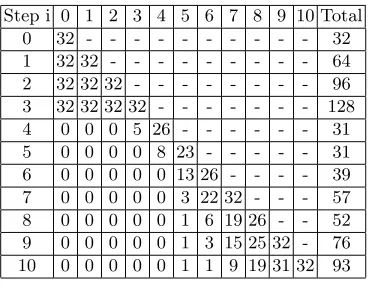
Once a linear differential path is obtained, message modification or neutral bit technique are used to find message pairs following that characteristic. It is suggested in [13] that using neutral bits will bring the probability of finding the message pairs to close to 1. We have used message modification technique to find the message pairs, since the number of neutral bits was too low for random messages pairs that were generated during the search for the right pair. To see the usefulness of neutral bit technique for this 18 step case, we next detail the number of 1-neutral bits and their distribution in various words of the message pairs for the two colliding message pairs shown in Tables 3 and 4. This distribution is shown in Tables 8 and 9. The entry in the jth column of theith row in the two tables denotes the number of 1-neutral bits for the jth message word at step i. The entry ‘-’ means that the particular message word is not available at that step.
As can be expected, all the bits in the first 4 words in both the tables are 1-neutral. However, as soon as the fifth word is chosen, the number of 1-neutral bits comes down to about 30 and surprisingly almost all the bits of first 4 words do not remain 1-neutral anymore. If we assume that :
(1) All the 1-neutral bits are also 2-neutral. And
(2) The set of neutral bits is about 1/8th the size of the set of 2-neutral bits (as in SHA-0),
Then we are likely to get about 10 neutral bits at step 4. The probability of success of this step is 2−11
. Similarly the next two steps are also likely to have about 10 neutral bits whereas the probability of success of these steps is 2−14
and 2−11
Table 8.Count of 1-neutral bits and their distribution for the message pair shown in Table 3. Steps 11 to 15 are not shown here since they do not put any restrictions on the messages and hence have all bits neutral.
Step i 0 1 2 3 4 5 6 7 8 9 10 Total
0 32 - - - 32
1 32 32 - - - 64
2 32 32 32 - - - 96
3 32 32 32 32 - - - 128
4 0 0 0 5 23 - - - 28
5 0 0 0 0 4 23 - - - 27
6 0 0 0 0 0 15 26 - - - - 41
7 0 0 0 0 0 2 23 32 - - - 57
8 0 0 0 0 0 0 3 21 26 - - 50
9 0 0 0 0 0 0 2 12 23 32 - 69 10 0 0 0 0 0 0 1 7 17 30 32 87 However, note that both the assumptions about the neutral bits made above are not likely to hold for SHA-256. In particular, the number of 2-neutral bits are going to be much less than the number of 1-neutral bits and the size of the neutral set is likely to be smaller than that in the case of SHA-0. Further, the set of 1-neutral bits shown are for the messages which are actually colliding at 18 step. When we started the search from random message pairs, in most of the cases we could not get even these many 1-neutral bits. This suggests that the application of neutral bits alone in SHA-256 may not help us finding colliding message pairs. A combination of message modification and neutral bit technique may be required to attack longer number of rounds in SHA-2 family. Table 9.Count of 1-neutral bits and their distribution for the message pair shown in Table 4. Steps 11 to 15 are not shown here since they do not put any restrictions on the messages and hence have all bits neutral. Step i 0 1 2 3 4 5 6 7 8 9 10 Total 0 32 - - - 32
1 32 32 - - - 64
2 32 32 32 - - - 96
3 32 32 32 32 - - - 128
4 0 0 0 5 26 - - - 31
5 0 0 0 0 8 23 - - - 31
6 0 0 0 0 0 13 26 - - - - 39
7 0 0 0 0 0 3 22 32 - - - 57
8 0 0 0 0 0 1 6 19 26 - - 52 9 0 0 0 0 0 1 3 15 25 32 - 76 10 0 0 0 0 0 1 1 9 19 31 32 93
C Differential Paths for Reduced Round SHA-256
Differential paths for 19, 20, 21, 22 and 23 step SHA-256 are provided in Table 10 to Table 19. All the differential paths have been obtained by using two different local collisions, namely the GH and the SS5
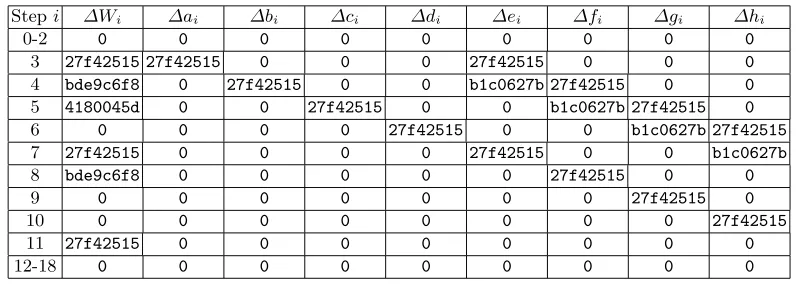
Table 10.19 step linear characteristic for SHA-256. There are 15 SS5 local collisions. This characteristic can also be seen as
a single SS5local collision in which weight of∆W3 is 15 bits.
Stepi ∆Wi ∆ai ∆bi ∆ci ∆di ∆ei ∆fi ∆gi ∆hi
0-2 0 0 0 0 0 0 0 0 0
3 27f42515 27f42515 0 0 0 27f42515 0 0 0
4 bde9c6f8 0 27f42515 0 0 b1c0627b 27f42515 0 0
5 4180045d 0 0 27f42515 0 27f42515 b1c0627b 27f42515 0
6 bde9c6f8 0 0 0 27f42515 0 27f42515 b1c0627b 27f42515
7 0 0 0 0 0 27f42515 0 27f42515 b1c0627b
8 bde9c6f8 0 0 0 0 0 27f42515 0 27f42515
9 0 0 0 0 0 0 0 27f42515 0
10 0 0 0 0 0 0 0 0 27f42515
11 27f42515 0 0 0 0 0 0 0 0
12-18 0 0 0 0 0 0 0 0 0
Table 11.19 step linear characteristic for SHA-256. There are 15 GH local collisions. This characteristic can also be seen as a single GH local collision in which weight of∆W3is 15 bits. Note that this characteristic differs from the one in Table 10 at several places. For example in message words and registers at 7thstep.
Stepi ∆Wi ∆ai ∆bi ∆ci ∆di ∆ei ∆fi ∆gi ∆hi
0-2 0 0 0 0 0 0 0 0 0
3 27f42515 27f42515 0 0 0 27f42515 0 0 0
4 bde9c6f8 0 27f42515 0 0 b1c0627b 27f42515 0 0
5 4180045d 0 0 27f42515 0 0 b1c0627b 27f42515 0
6 0 0 0 0 27f42515 0 0 b1c0627b 27f42515
7 27f42515 0 0 0 0 27f42515 0 0 b1c0627b
8 bde9c6f8 0 0 0 0 0 27f42515 0 0
9 0 0 0 0 0 0 0 27f42515 0
10 0 0 0 0 0 0 0 0 27f42515
11 27f42515 0 0 0 0 0 0 0 0
12-18 0 0 0 0 0 0 0 0 0
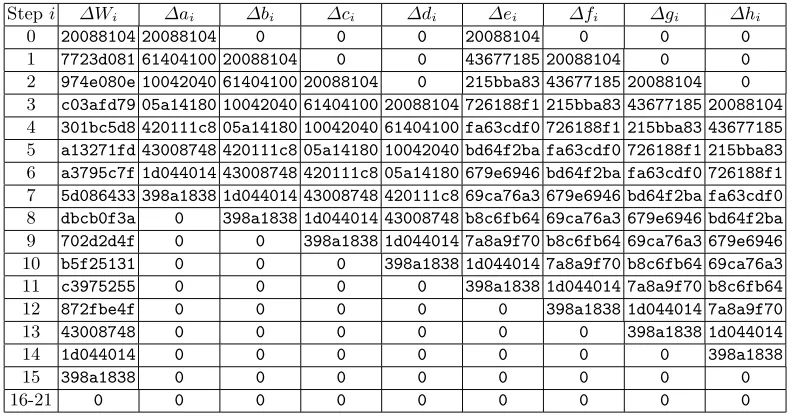
Table 12.20 step linear characteristic for SHA-256. There are 31 SS5 local collisions.
Stepi ∆Wi ∆ai ∆bi ∆ci ∆di ∆ei ∆fi ∆gi ∆hi
0 00210808 00210808 0 0 0 00210808 0 0 0
1 f4ec270b 0100c000 00210808 0 0 c568a30a 00210808 0 0
2 fd5cb0fc 00000204 0100c000 00210808 0 0361320e c568a30a 00210808 0
3 0f1c9c64 12080000 00000204 0100c000 00210808 0320d081 0361320e c568a30a 00210808
4 e38e0ddb 40080208 12080000 00000204 0100c000 64ab980c 0320d081 0361320e c568a30a
5 91de6968 00040600 40080208 12080000 00000204 3344e7c2 64ab980c 0320d081 0361320e
6 552353b0 00006000 00040600 40080208 12080000 601161ac 3344e7c2 64ab980c 0320d081
7 9b7f2ad2 26239208 00006000 00040600 40080208 35af8c0b 601161ac 3344e7c2 64ab980c
8 694d62fd 0 26239208 00006000 00040600 5789970e 35af8c0b 601161ac 3344e7c2
9 3c97a984 0 0 26239208 00006000 26279408 5789970e 35af8c0b 601161ac
10 85cea813 0 0 0 26239208 00006000 26279408 5789970e 35af8c0b
11 13b8198f 0 0 0 0 26239208 00006000 26279408 5789970e
12 27dcb927 0 0 0 0 0 26239208 00006000 26279408
13 00040600 0 0 0 0 0 0 26239208 00006000
14 00006000 0 0 0 0 0 0 0 26239208
15 26239208 0 0 0 0 0 0 0 0
Table 13.20 step linear characteristic for SHA-256. There are 33 GH local collisions.
Stepi ∆Wi ∆ai ∆bi ∆ci ∆di ∆ei ∆fi ∆gi ∆hi
0 11000200 11000200 0 0 0 11000200 0 0 0
1 921ea8c4 46110000 11000200 0 0 525988c4 11000200 0 0
2 71813ea9 01000002 46110000 11000200 0 54867192 525988c4 11000200 0
3 d8d10826 60a14800 01000002 46110000 11000200 e0f14804 54867192 525988c4 11000200
4 b9f28f71 1e420280 60a14800 01000002 46110000 d2495608 e0f14804 54867192 525988c4
5 8f9b9016 00a00200 1e420280 60a14800 01000002 5d2b70c9 d2495608 e0f14804 54867192
6 6d415897 00004084 00a00200 1e420280 60a14800 91204504 5d2b70c9 d2495608 e0f14804
7 c7276fd3 000000a0 00004084 00a00200 1e420280 65834883 91204504 5d2b70c9 d2495608
8 0b152ad9 0 000000a0 00004084 00a00200 1b4082a8 65834883 91204504 5d2b70c9
9 08044ede 0 0 000000a0 00004084 00a00200 1b4082a8 65834883 91204504
10 8123d10c 0 0 0 000000a0 00004084 00a00200 1b4082a8 65834883
11 65230b89 0 0 0 0 000000a0 00004084 00a00200 1b4082a8
12 8f40d2aa 0 0 0 0 0 000000a0 00004084 00a00200
13 00a00200 0 0 0 0 0 0 000000a0 00004084
14 00004084 0 0 0 0 0 0 0 000000a0
15 000000a0 0 0 0 0 0 0 0 0
16-19 0 0 0 0 0 0 0 0 0
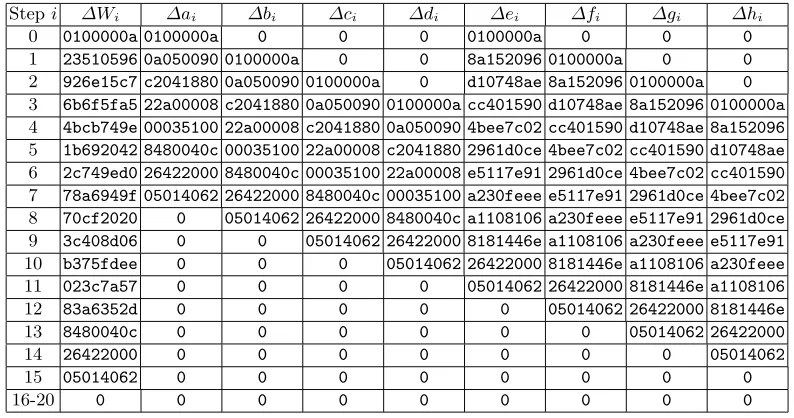
Table 14.21 step linear characteristic for SHA-256. There are 45 SS5 local collisions.
Stepi ∆Wi ∆ai ∆bi ∆ci ∆di ∆ei ∆fi ∆gi ∆hi
0 0100000a 0100000a 0 0 0 0100000a 0 0 0
1 23510596 0a050090 0100000a 0 0 8a152096 0100000a 0 0
2 926e15c7 c2041880 0a050090 0100000a 0 d10748ae 8a152096 0100000a 0
3 6b6f5fa5 22a00008 c2041880 0a050090 0100000a cc401590 d10748ae 8a152096 0100000a
4 4bcb749e 00035100 22a00008 c2041880 0a050090 4bee7c02 cc401590 d10748ae 8a152096
5 1b692042 8480040c 00035100 22a00008 c2041880 2961d0ce 4bee7c02 cc401590 d10748ae
6 2c749ed0 26422000 8480040c 00035100 22a00008 e5117e91 2961d0ce 4bee7c02 cc401590
7 78a6949f 05014062 26422000 8480040c 00035100 a230feee e5117e91 2961d0ce 4bee7c02
8 70cf2020 0 05014062 26422000 8480040c a1108106 a230feee e5117e91 2961d0ce
9 3c408d06 0 0 05014062 26422000 8181446e a1108106 a230feee e5117e91
10 b375fdee 0 0 0 05014062 26422000 8181446e a1108106 a230feee
11 023c7a57 0 0 0 0 05014062 26422000 8181446e a1108106
12 83a6352d 0 0 0 0 0 05014062 26422000 8181446e
13 8480040c 0 0 0 0 0 0 05014062 26422000
14 26422000 0 0 0 0 0 0 0 05014062
15 05014062 0 0 0 0 0 0 0 0
Table 15.21 step linear characteristic for SHA-256. There are 45 GH local collisions.
Stepi ∆Wi ∆ai ∆bi ∆ci ∆di ∆ei ∆fi ∆gi ∆hi
0 0002009c 0002009c 0 0 0 0002009c 0 0 0
1 ee6bb675 80090000 0002009c 0 0 8cebf037 0002009c 0 0
2 a91c7e24 00201514 80090000 0002009c 0 0426575c 8cebf037 0002009c 0
3 e2c68750 42816080 00201514 80090000 0002009c 6a7d34c5 0426575c 8cebf037 0002009c
4 ecac961f 4e100262 42816080 00201514 80090000 5f324fdf 6a7d34c5 0426575c 8cebf037
5 13c4cbce 40000200 4e100262 42816080 00201514 0096fb20 5f324fdf 6a7d34c5 0426575c
6 c742bbcf 6c113420 40000200 4e100262 42816080 6c3b20b4 0096fb20 5f324fdf 6a7d34c5
7 4a23a824 04240100 6c113420 40000200 4e100262 b872cdb1 6c3b20b4 0096fb20 5f324fdf
8 8f8f731c 0 04240100 6c113420 40000200 d71d2312 b872cdb1 6c3b20b4 0096fb20
9 a701e563 0 0 04240100 6c113420 40000200 d71d2312 b872cdb1 6c3b20b4
10 2d32209c 0 0 0 04240100 6c113420 40000200 d71d2312 b872cdb1
11 b5551b71 0 0 0 0 04240100 6c113420 40000200 d71d2312
12 e50db794 0 0 0 0 0 04240100 6c113420 40000200
13 40000200 0 0 0 0 0 0 04240100 6c113420
14 6c113420 0 0 0 0 0 0 0 04240100
15 04240100 0 0 0 0 0 0 0 0
16-20 0 0 0 0 0 0 0 0 0
Table 16.22 step linear characteristic for SHA-256. There are 60 SS5 local collisions.
Stepi ∆Wi ∆ai ∆bi ∆ci ∆di ∆ei ∆fi ∆gi ∆hi
0 20088104 20088104 0 0 0 20088104 0 0 0
1 7723d081 61404100 20088104 0 0 43677185 20088104 0 0
2 974e080e 10042040 61404100 20088104 0 215bba83 43677185 20088104 0
3 c03afd79 05a14180 10042040 61404100 20088104 726188f1 215bba83 43677185 20088104
4 301bc5d8 420111c8 05a14180 10042040 61404100 fa63cdf0 726188f1 215bba83 43677185
5 a13271fd 43008748 420111c8 05a14180 10042040 bd64f2ba fa63cdf0 726188f1 215bba83
6 a3795c7f 1d044014 43008748 420111c8 05a14180 679e6946 bd64f2ba fa63cdf0 726188f1
7 5d086433 398a1838 1d044014 43008748 420111c8 69ca76a3 679e6946 bd64f2ba fa63cdf0
8 dbcb0f3a 0 398a1838 1d044014 43008748 b8c6fb64 69ca76a3 679e6946 bd64f2ba
9 702d2d4f 0 0 398a1838 1d044014 7a8a9f70 b8c6fb64 69ca76a3 679e6946
10 b5f25131 0 0 0 398a1838 1d044014 7a8a9f70 b8c6fb64 69ca76a3
11 c3975255 0 0 0 0 398a1838 1d044014 7a8a9f70 b8c6fb64
12 872fbe4f 0 0 0 0 0 398a1838 1d044014 7a8a9f70
13 43008748 0 0 0 0 0 0 398a1838 1d044014
14 1d044014 0 0 0 0 0 0 0 398a1838
15 398a1838 0 0 0 0 0 0 0 0
Table 17.22 step linear characteristic for SHA-256. There are 59 GH local collisions.
Stepi ∆Wi ∆ai ∆bi ∆ci ∆di ∆ei ∆fi ∆gi ∆hi
0 40200502 40200502 0 0 0 40200502 0 0 0
1 91474f60 10034314 40200502 0 0 280d4a54 40200502 0 0
2 01ac1d4e 0c800345 10034314 40200502 0 1d2c03da 280d4a54 40200502 0
3 c8319061 14021803 0c800345 10034314 40200502 4d0768e0 1d2c03da 280d4a54 40200502
4 41c0f00e 12111224 14021803 0c800345 10034314 5f493d66 4d0768e0 1d2c03da 280d4a54
5 29db56e8 41122608 12111224 14021803 0c800345 80fd2155 5f493d66 4d0768e0 1d2c03da
6 f592f204 82031028 41122608 12111224 14021803 e61db37a 80fd2155 5f493d66 4d0768e0
7 caaa1ee6 a0340814 82031028 41122608 12111224 19b2660d e61db37a 80fd2155 5f493d66
8 cb37951b 0 a0340814 82031028 41122608 aa994301 19b2660d e61db37a 80fd2155
9 aac397a4 0 0 a0340814 82031028 41122608 aa994301 19b2660d e61db37a
10 8f02dd86 0 0 0 a0340814 82031028 41122608 aa994301 19b2660d
11 bf223e6e 0 0 0 0 a0340814 82031028 41122608 aa994301
12 e0899ff0 0 0 0 0 0 a0340814 82031028 41122608
13 41122608 0 0 0 0 0 0 a0340814 82031028
14 82031028 0 0 0 0 0 0 0 a0340814
15 a0340814 0 0 0 0 0 0 0 0
16-21 0 0 0 0 0 0 0 0 0
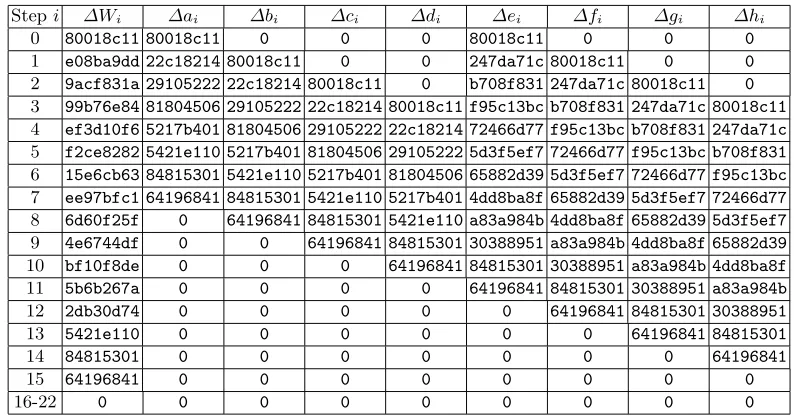
Table 18.23 step linear characteristic for SHA-256. There are 75 SS5 local collisions.
Stepi ∆Wi ∆ai ∆bi ∆ci ∆di ∆ei ∆fi ∆gi ∆hi
0 80018c11 80018c11 0 0 0 80018c11 0 0 0
1 e08ba9dd 22c18214 80018c11 0 0 247da71c 80018c11 0 0
2 9acf831a 29105222 22c18214 80018c11 0 b708f831 247da71c 80018c11 0
3 99b76e84 81804506 29105222 22c18214 80018c11 f95c13bc b708f831 247da71c 80018c11
4 ef3d10f6 5217b401 81804506 29105222 22c18214 72466d77 f95c13bc b708f831 247da71c
5 f2ce8282 5421e110 5217b401 81804506 29105222 5d3f5ef7 72466d77 f95c13bc b708f831
6 15e6cb63 84815301 5421e110 5217b401 81804506 65882d39 5d3f5ef7 72466d77 f95c13bc
7 ee97bfc1 64196841 84815301 5421e110 5217b401 4dd8ba8f 65882d39 5d3f5ef7 72466d77
8 6d60f25f 0 64196841 84815301 5421e110 a83a984b 4dd8ba8f 65882d39 5d3f5ef7
9 4e6744df 0 0 64196841 84815301 30388951 a83a984b 4dd8ba8f 65882d39
10 bf10f8de 0 0 0 64196841 84815301 30388951 a83a984b 4dd8ba8f
11 5b6b267a 0 0 0 0 64196841 84815301 30388951 a83a984b
12 2db30d74 0 0 0 0 0 64196841 84815301 30388951
13 5421e110 0 0 0 0 0 0 64196841 84815301
14 84815301 0 0 0 0 0 0 0 64196841
15 64196841 0 0 0 0 0 0 0 0
Table 19.23 step linear characteristic for SHA-256. There are 79 GH local collisions.
Stepi ∆Wi ∆ai ∆bi ∆ci ∆di ∆ei ∆fi ∆gi ∆hi
0 06410482 06410482 0 0 0 06410482 0 0 0
1 5a5956e6 4310a0e6 06410482 0 0 e282dbd7 06410482 0 0
2 936b23d5 22053aa0 4310a0e6 06410482 0 f7709310 e282dbd7 06410482 0
3 c4c16eb1 9421149d 22053aa0 4310a0e6 06410482 5d4bca94 f7709310 e282dbd7 06410482
4 50e078c8 b50c2248 9421149d 22053aa0 4310a0e6 f6fbb4b5 5d4bca94 f7709310 e282dbd7
5 d0d250ef 01606240 b50c2248 9421149d 22053aa0 4dff4081 f6fbb4b5 5d4bca94 f7709310
6 ce2982f4 4036003e 01606240 b50c2248 9421149d f1e22908 4dff4081 f6fbb4b5 5d4bca94
7 6cb9d29e 8bc0502c 4036003e 01606240 b50c2248 561e3c0e f1e22908 4dff4081 f6fbb4b5
8 e3a3f08f 0 8bc0502c 4036003e 01606240 17d8da6e 561e3c0e f1e22908 4dff4081
9 540feff8 0 0 8bc0502c 4036003e 01606240 17d8da6e 561e3c0e f1e22908
10 09d6a48d 0 0 0 8bc0502c 4036003e 01606240 17d8da6e 561e3c0e
11 b3d6fdee 0 0 0 0 8bc0502c 4036003e 01606240 17d8da6e
12 404eb561 0 0 0 0 0 8bc0502c 4036003e 01606240
13 01606240 0 0 0 0 0 0 8bc0502c 4036003e
14 4036003e 0 0 0 0 0 0 0 8bc0502c
15 8bc0502c 0 0 0 0 0 0 0 0