Scratch, Click
&
Vote: E2E voting over the Internet
Mirosław Kutyłowski?and Filip Zagórski??
Institute of Mathematics and Computer Science Wrocław University of Technology
[email protected] [email protected]
Abstract. We presentScratch, Click&Voteremote voting scheme. The scheme is end-to-end verifiable and allows for voting over the Internet. It guarantees secu-rity against malicious hardware and software used by a voter; a voter’s computer does not get any knowledge about the voter’s choice. Moreover, it can blindly change the voter’s ballot with a small probability only.
Keywords:Internet voting, e-voting, E2E, verifiable voting scheme, ThreeBallot, Punchscan
1 Introduction
There are two main scenarios of e-voting: advanced voting procedures at polling places and remote electronic voting.
Polling station voting Recently it has became evident that badly designed e-voting machines can be extremely dangerous to a e-voting process [1, 9, 13]. For-tunately, a number of end-to-end auditable voting systems (E2E) has been pre-sented recently. Interestingly, some recent designs implementelectronic voting without any electronic voting machines [2, 6, 5, 4]. Moreover, for these schemes each voter gets a receipt, which may be used to check if the voter’s ballot has been included in the tally. It is also possible to verify correctness of the results. On the other hand, the receipt cannot be used even by the voter to prove how she voted. So they cannot help to sell or buy votes.
Internet voting The Internet voting has not much in common with polling sta-tion scenario. At the polling stasta-tion it is relatively easy to preserve voter’s pri-vacy; coercion and vote buying is hard to hide. Another source of problems is that a voter must use some electronic device. There is no convincing argument why a voter should blindly trust this device. Malware can endanger integrity of the elections as well as privacy of the voter.
?Partially supported by Polish Ministry of Science and Higher Education, grant N206 2701 33 ??Partially supported by Foundation of International Education (FEM), programme Lower
In case of remote voting one has also to deal with remote voter identifica-tion. Fortunately, it can be solved in many ways, depending on a situaidentifica-tion. For national elections one can use advanced electronic signatures, especially if sup-ported by personal, government-issued ID cards, or a novel technique described in [3]. For other elections logins and passwords seem to serve well their purpose. In this paper we are concerned with anE2Esystems for remote voting over electronic networks. We assume that the electronic devices used by a voter might be infected by malicious code, and that voter’s privacy and election integrity must be guaranteed in a verifiable way.
1.1 Related Work
Three important ideas concerningE2Evoting systems have been presented dur-ing the last few years: Prêt à Voter, Punchscan, ThreeBallot (and related schemes). All of them are dedicated to paper-based elections at polling stations. Recently, Punchscan and Prêt à Voter have been adjusted to mail-in voting [15]. Since these methods are closely related to our scheme, we recall them briefly.
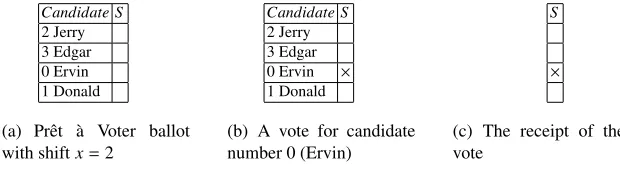
Prêt à Voter [6]. A voter, say Alice, obtains a ballot which consists of two parts. The left part contains the official list of the candidates, altered by applying a circular shift by x positions, where x depends on the ballot. The right part contains boxes where Alice can put the ×-mark. In order to vote, she puts the
×-mark in the row that contains the name of her favorite candidate on the left side. On the right side there is a kind of ballot serial numberS that is used for decoding Alice’s vote (namely, for reconstructing the shift value x). The serial number is also included in the voting receipt obtained by Alice. After making
Candidate S
2 Jerry 3 Edgar 0 Ervin 1 Donald
(a) Prêt à Voter ballot with shiftx=2
Candidate S
2 Jerry 3 Edgar 0 Ervin ×
1 Donald
(b) A vote for candidate number 0 (Ervin)
S
×
(c) The receipt of the vote
Fig. 1.Ballot example for Prêt à Voter scheme
Punchscan [2]. The original ballot design of Punchscan is quite different from
Prêt à Voter, however it has been shown in [19] that the crucial mechanisms of Punchscan can be used together with Prêt à Voter ballot layout.
The key issue is that Punchscan offers a complete back-end to perform E2E verifiable elections. Similar back-end is also used in Scantegrity [5] and Scantegrity II [4]. The values that are used in the ballot construction are com-mitted and can be verified. The verification process is twofold and consists of a pre-election audit and a post-election audit. If the authority responsible for preparing ballots passes both audits, then with an overwhelming probability the integrity of the elections is guaranteed.
ThreeBallot [16]. This scheme, presented by R. Rivest, is particularly appeal-ing despite of certain privacy weaknesses [7]. A voter, Alice, obtains a sheet of paper consisting of four parts. The leftmost column contains the list of candi-dates (no shift is used). The next three columns are used to mark her choice. If she wants to vote for a candidateV, then she puts two marks×in the row con-taining the name ofV, while she puts exactly one×mark in all remaining rows. After Alice makes her choice, all three columns (ballots) are separated and cast
Candidate A B C
0 Ervin 1 Donald 2 Jerry 3 Edgar
(a) An empty ballot
Candidate A B C
0 Ervin × ×
1 Donald ×
2 Jerry ×
3 Edgar ×
(b) A vote for Ervin
A ×
×
(c) Exemplary receipt
Fig. 2.The ThreeBallot scheme
into a ballot box. As a receipt Alice obtains a copy of one of the columns/ballots of her choice (but the system does not know which one).
1.2 Our Contribution
Design goals. The main goal behind design ofSC&Vis to get anE2Escheme that would be acceptable for casting votes over Internet. Unlike in the previous works, we demand all key requirements to be satisfied. In particular, the scheme must be secure without assuming that the voter’s PC or any of its components is trustworthy. We present the scheme which is:
human verifiable: a receipt obtained by a voter is human-readable and easy to examine by a moderately educated voter,
voter friendly: a voter needs not to perform any complicated (and hard to un-derstand by an average voter) operations like: re-encryption, getting a blind signature, executing oblivious transfer protocol etc.
malware immune: integrity of the elections and privacy of votes do not rely on any assumption on trustworthiness of the equipment used by the voter,
efficient: computational overhead as well as communication volume are low.
Scheme design. In the next sections we provide a full description ofSC&V. The scheme can be described as a layered design in which we combine a number of techniques/tricks:
Version 1: We start from a straightforward Internet-version of the ThreeBallot: a voter needs to fill in a voting card using an application run on her PC. The filled ballot is then sent to a voting server (Proxy).
Version 2: In order to balance the number of×marks in the columns (in order to make the scheme immune against Strauss’-like attacks [7, 10, 17, 18]) we add another column and another×-mark (“FourBallot”).
Version 3: Since the voter’s PC knows exactly the voter’s choice – we intro-duce a coding card which is prepared by aProxy(see the diagram below). The coding card hides from the PC the meaning of the voter’s choices (every candidate is “clicked” exactly once). Moreover coding card is constructed in a way that the possibility of modification of voter’s choice by her PC is reduced.
Version 4: Since Proxy still knows the voter’s choice, we introduce another server – Election Authority (EA), which is responsible for preparation of ballots. In this wayProxy does not know the choice, while Election Author-ity does not know who voted.
Under the assumption that Proxy and Election Authority do not collude,
SC&V offers verifiable Internet voting with unconditional integrity and full
privacy of a voter.
2 Ideas Overview
2.1 Ballots and coding cards
The voting process is a combination of paper based protocols. In order to vote one has to get additional information that remains hidden from the computer used for vote casting. This information might be obtained by the voter during voter’s in-person registration, mailed to her home address or sent over an inde-pendent electronic link. In case of small scale elections or elections of limited importance one can use emails with CAPTCHA to sent information readible for a human voter, but hard to read by the voter’s computer. Vote casting is done via electronic networks.
There is an Election Authority (EA) and a Proxy. EA prepares the bal-lots whileProxy preparescoding cards. There is anAuditorwhich is responsi-ble for pre- and post-election audits.
In this section we describe the scheme from the point of view of a voter Al-ice. For the sake of simplicity of exposition we assume that there is a single race where the voter has to choose one out of mcandidates (the pictures presented below depict the case ofm=4).
Ballot layout. In order to cast a vote, Alice needs aballotand acoding card.
CandidateA B C D
2 Jerry 3 Edgar 0 Ervin 1 Donald
Sl
Fig. 3. A ballot with
π(i)=i+2
The ballot is prepared by EA, it consists of the following values covered by a scratch surface:
– list of candidates permuted with some random permuta-tionπ. Later we shall representπ= π0◦π00 whereπ0, π00 are random.
– ballot serial number Sl,
– four confirmation tokens: A,B,C,D – one per column. They are prepared in a special way that will be described below.
n Y n n n Y n n Y n n n n n n Y
Sr
Fig. 4.A coding card
Thecoding cardis prepared byProxy and consists of:
– four columns. In each row there is exactly one markY standing for YES, and 3 marksnstanding for NO. The placement of Yin each row is random and independent from the other choices.
2.2 Voter’s Point of View
Alice obtains both: the ballot and the coding card1. Alice lays them side by side and thus obtains a complete ballot. Let us note that Alice gets exactly one ballot, but she is allowed to have as many coding cards as she likes. Moreover, we assume that there are many Proxies in the system2, so Alice can easily find one she trusts and gets coding cards from this Proxy. A complete ballot (which Alice may put on her desk) may look as follows:
complete ballot PC screen ballot matrix receipt Candidate A B C D
2 Jerry n Y n n 3 Edgar n Y n n 0 Ervin Y n n n 1 Donald n n n Y
Sl Sr
Sr
× ×
× ×
× × ×
× ×
Sl
C,
×
× ×
,c
Alice visits an election website operated by theProxy. She authenticates herself with appropriate authentication method (login/password pair, electronic signature etc). She clicks on the screen in the following way:
– she clicks on the position ofYin the row corresponding to the candidate that she votes for,
– in each of the remaining rows, she clicks on one of the positions ofn’s.
The Proxy commits to Alice’s clicks (the commitment is passed toEA), then Alice enters coding card serial number Sr. The Proxy checks Sr and then transforms the choice of the voter into an internal form called ballot matrix: Proxy puts × mark for eachnwhich has not been used yet (this transforma-tion depends deterministically on the positransforma-tions of Y’s and n’s and the voter’s choice). So, for a row with the candidate chosen by the voterProxy puts three
×marks, while in each row corresponding to different candidates, there are only
2×marks. Note thatProxy knows which row corresponds to the vote cast. On the other hand, due to the random permutation Proxy does not know which candidate is corresponding to this row.
Then the columns of the ballot matrix, calledballot columns, are processed separately (analogously to ThreeBallot). In the next stepProxy obtains a blind signature (BS) of EA under each ballot column. (A blind signature is neces-sary in order to prevent changing the ballot contents byEA at this moment). The voter enters ballot serial number (Sl), thenProxy unblinds the signature, and sends ballot columns withSl toEA. Simultaneously, the voter requests one ballot column as a receipt. The receipt contains:
1Alice obtains it at registration office, by mail or by email, depending on election settings. 2Moreover, a “decoy service” can be introduced – then Alice may obtain many different but
– T ∈ {A,B,C,D}value of a confirmation token;
– y- ballot column,
– tsuch thatT =signEA(t,Sl), suchtis called a pre-token ofT.
The ballot columns are now separated and published just like for Punchscan scheme, and then decrypted in a similar way. The number of votes for each candidate is counted like for ThreeBallot.
3 Scratch, Click&Vote Scheme
The Ballots and Audit Tables The ballots are created byEA. In order to guar-antee election integrity,EA generates audit tablesP andR(see below for de-tails). Each row of tablePcorresponds to a single ballot matrix (which is a set of columns with the same ballot serial number and the permutation of the candi-dates). Entries ofRcorrespond to single ballot columns.Ris based on the same idea as Punchboard used in Punchscan.
TableP. The tablePhas 2 columns, called P1 and P2. It has 2nrows, wheren is greater or equal to the maximum number of voters.
P1 P2
..
. ...
Sl(i) BC(iA),BC(iB),BC(iC),BC(iD) ..
. ...
Example:Audit tableP
The column P1 records the ballot serial numbers. The column P2 contains commitments to 4 pointers to the rows of tableR. Say, if a serial numberS is in P1, then in the same row, column P2 contains commitments
BC(iA(S)), BC(iB(S)), BC(iC(S)), BC(iD(S))
to numbersiA(S),iB(S),iC(S),iD(S), whereiX(S) is the row number such that rowiX(S) of tableRcontains an entry for the columnX of the ballot with the serial numberS.
TableR. The tableRconsists of three parts: thestarting part, themiddle part and thefinal part. Each part consists of a set of consecutive columns.Rhas 8n rows; this corresponds to 2n ballots and 4·2nballot columns. There are two types of permutations used for constructing tableR:
– permutationsπ0i, π00i fori=1, . . . ,8nover{1, . . . ,m}, wheremis the number of candidates (i.e. 2 permutations per each of 8n ballot columns). These permutations have to be applied to ballot columns.
Each rowiin the starting part ofRis devoted to a single ballot column of some ballot, (and for each ballot column from some ballot there is exactly one such a row ofR). Let W(i) denote the ballot column corresponding to the ith row ofR. Then for eachi, data concerningW(i) are placed in:
– rowiof the starting part,
– rowρ1(i) of the middle part,
– rowρ2(ρ1(i)) of the final part.
Moreover:
– the starting part of rowiwill contain the ballot columnW(i) as filled by the voter (the order of the candidates is determined byπi=π0i◦π00i , i.e. the entry for a candidate jis given in rowπi(j),
– the middle part at rowρ1(i) will containW(i) permuted by (π0i)
−1),
– the final part at rowρ2(ρ1(i)) will containW(i) permuted by (π00i )
−1◦(π0
i) −1.
Hence the marks ofW(i) will be permuted according to the standard order-ing of candidates: (π00i )−1◦(π0i)−1◦πi =(πi00)−1◦(π0i)−1◦π0i ◦π00i =id.
Below we describe theith row ofR. Leti=ρ1(j) andi=ρ2(ρ1(k)).
starting part (forW(i)) middle part (forW(j)) final part (forW(k))
i bπi H(t(i)) tc(i) y(i) ρd1(i) πb
0
j y(j)(π
0
j)
−1
c
π00
j ρd2(i) v
Organization of a row of tableR
The starting part contains the following entries in rowi(see the diagram above):
– i– the row index (i∈[1,8n]),
– bπi – a bit commitment to permutation of candidates πi used in the ballot containingW(i),
– H(t(i)) – hash of aconfirmation pre-token t(i), which satisfies the condition
T(i)=signEA(t(i),Sl(i)),
whereT(i) is the confirmation token used in conjunction withW(i), andSl(i) is the serial number of the ballot containingW(i),
– tc(i) = BC(T(i),Si) – a bit commitment to the ballot serial number Sl(i) of
the ballot containingW(i), and to the confirmation tokenT(i),
– y(i)=[y0(i),y1(i), . . . ,ym−1(i)] – a vector holding mark×on those positions
– ρd1(i) – a commitment to the valueρ1(i).
The middle part ofRin rowicontains the following entries:
– πb0
j– a commitment to permutation of candidatesπ 0
j, whereπj =π 0 j◦π
00 j,
– y(j)(π0j)−1the vectory(j) permuted by (π0j)−1,
– cπ00
j – a commitment to permutationπ 00
j,
– ρd2(i) – a commitment toρ2(i).
The final part of R in row i contains vector v equal to y(k) permuted by (π0k)−1 and then by (π00k)−1 (i.e., listed according to the standard ordering of the candidates).
Preparation of Ballots and Audit Tables The ballots and the audit tables P andRare created byEAin the following way:
1. EA determines the election parameters: the number of candidates m, the official list of candidates (with their official ordering), and an upper bound non the total number of voters.
2. EA chooses at random 2nserial numbers; for each serial numberS:
– EAchooses at random a random permutationπ,
– EAchooses at random confirmation pre-tokenstA(S),tB(S),tC(S),tD(S) and computes confirmation tokensTA(S),TB(S),TC(S),TD(S)
TX(S) :=signEA(S,tX(S)) forX= A,B,C,D.
3. EA creates audit tableP: For this purpose,EA chooses at random a permu-tationσof 1, . . . ,8n. Thenσ(4j−3), . . . , σ(4j) are assigned to the jth serial numberSl(j). These numbers serve as pointers to the rows of the audit table R- and are callediA(Sl(j)),iB(Sl(j)),iC(Sl(j)),iD(Sl(j)). Then for each se-rial numberSl(j), commitments to the valuesiA(Sl(j)),iB(Sl(j)),iC(Sl(j)), iD(Sl(j))) are created and inserted in the row containingSl(j).
4. EA prepares the audit tableR: For this purposeEA chooses random permu-tations (onR-table rows)ρ1 andρ2of 1, . . . ,8n. For the jth serial number
Sl(j), its permutationπ(on ballot columns) is assigned to the rowsiA(Sl(j)), iB(Sl(j)),iC(Sl(j)),iD(Sl(j)) of the starting part ofR. (i.e.,πiA(Sl(j)),πiB(Sl(j)),
πiC(Sl(j)), and πiD(Sl(j))) take the value π). Separately for each row i of R, EAchooses at random permutationsπ0i andπ00i such thatπi =π0i ◦π00i . 5. Then the entries ofRare filled according to the description from the previous
subsection.
The Pre-election Audit As for Punchscan, the following steps are executed in order to check that the audit tables have been created honestly:
1. The Auditors pick at random a set AS ofn ballots. The remaining ballots create a so called election setES (and are not checked).
2. The contents of all ballots fromAS is revealed, so in particular their serial numbers. Based on the serial numbers it is possible to indicate the rows of Pcorresponding to the ballots fromAS.
3. EA opens all bit commitments from table P corresponding to the ballots fromAS as well as all bit commitments from tableRcorresponding to the ballot columns of the ballots fromAS.
4. The Auditors check whether the ballots and the entries in the audit tables were created correctly.
5. All ballots from the audit setAS are discarded; the ballots with serial num-bers inES are used for election.
In practice, the Auditors may confine themselves to controlling only a lim-ited number of ballots fromAS, and check more ballots on demand.
Preparing Coding Cards The coding cards are prepared in an electronic form and are published (as commitments) on a webpage by theProxy. Their correct-ness is checked in a standard way:
1. Proxy creates an audit table X in which it commits to coding card serial numbersSrand positions ofY-marks on each coding card.
2. The Auditors select at random some number of coding cards to form an audit set (these coding cards are not used for elections).
3. Proxy opens all bit commitments from the cards of the audit set.
4. The Auditors check if the revealed coding cards have been created correctly.
Elections The following steps are during vote casting:
Step 1: the voter obtains a ballot (e.g. by visiting certain authorities, from a special courier delivering the ballots at residence area, by certified mail ser-vices etc.). At the same time, identity of the voter is verified and the ballot is given to her own hands. Distribution of ballots is organized so that nobody knows who gets which ballot. Since the ballot information is covered with a scratch surface, this is easy.
Step 2: the voter fetches (still unused) coding cards from one or more Proxies (for convenience the coding cards can be printed).
Step 4: the voter logs in an election webpage run by aProxyand authenticates herself.
Step 5:Proxy verifies voter’s credentials.
Step 6: the voter chooses one of the coding cards and lays it next to the ballot.
Step 7: the voter clicks on the PC screen on radio buttons corresponding to her choice – that is, according to the permutation used for the ballot and alignment ofnandY’s marks on the coding card.
Step 8:Proxy commits to voter’s clicks, sends the commitment toEA and to the voter (so the voter can print it)3.
Step 9: the voter entersSrfrom the coding card used.
Step 10:Proxy transforms the voter’s choice into ballot columns.
Step 11:Proxy obtains a blind signature from EA under each of the ballot columns (these signatures are then stored byProxyfor a post-election audit).
Step 12: the voter entersSl.
Step 13:Proxy passesSland the ballot columns toEA.
Step 14:EA enters the obtained ballot columns into appropriate rows of the starting part of tableR(butEApublishes them when the election are closed), EApublishes commitments to the ballot columns obtained fromProxy.
Step 15: the voter chooses a receipt (one of the four columns).
Tallying
1. When the voting time is over,EA publishes voter’s choices inserted into vectorsy(i) in the starting part of the tableR. Then it computes the entries for the middle part ofR:y(j)(π0j)−1, and for the final part:
v=(y(k)(π0k)−1)(π00k)−1.
2. From the entriesvin the final partEA calculates the tally: If the number of ballot columns is 4N (meaning thatN votes have been cast) and there are togetherMmarks×in row jof all ballot columns in the final part ofR, then the number of votes cast for the jth candidate isM−2N.
Post-Election Audit First, each voter can check if her ballot column corre-sponding to the receipt appears in the table R. This is possible, since due to knowledge of the verification pre-tokent, one can locate the right row contain-ingH(t). If it is missing or the contents of the ballot column disagrees with the receipt, then a fraud is detected.
Checking integrity of tableRand the election results is performed in public by the auditors. For this purpose the standard Randomized Partial Checking [11] procedure is executed forR(for the sake of simplicity of description we assume thatnvoters participated in the elections):
1. The auditors choose 2nrows ofRat random and requestEAto open com-mitmentsρd1(i) from these rows. Then for each rowρ1(i) in the middle part,
for whichρ1(i) has been revealed, the commitment πb0
i is opened and it is checked that the ballot column from the starting part permuted by (π0i)−1 yields the ballot column in the middle part.
2. For each row jin the middle part, not pointed to by any revealed commit-mentρ1(i),EAhas to open the commitments toρ2(j) andcπ00. Then the ballot
columns in the middle part of row jpermuted withπ00−1and the ballot col-umn in the final part of rowρ2(j) should be equal.
4 Security Concerns
Voter’s PC misbehaviour. Here we assume that the Alice’s PC is dishonest, whileEAandProxybehave correctly. This corresponds to the case when Alice’s PC is infected by malware.
Integrity In order to manipulate voter’s choice (change from Alice’s choice to any other candidate, even a random one) the PC has to switch Alice’s choice fromYinto nin the row corresponding to the candidate chosen by Alice and at the same time, changenintoYin one of the remaining rows. In order to do that, the PC has to guess which row corresponds to the chosen candidate and succeeds with probability 1k. Then, the PC has to choose one of the remaining rows and guess which one of the unchosen three columns corresponds to the markY– this succeeds with probability 13.
So the probability of correct switching Alice’s choice is only 31k. But even then, Alice can still detect a fraud by discovering that her receipt does not fit her choice. At least one of the ballot columns is modified during such change (and sometimes it is just one column). So the total probability of a successful and undetected vote change is 41k.
Privacy Even if Alice’s PC sends all information it is aware of to an attacker he is unable to determine the choice of Alice. Indeed, the attacker neither knows the configuration ofY’s on the coding card nor the permutation used on the ballot.
EA misbehaviour. Now assume thatEAis dishonest, but the PC of Alice and theProxyare honest.
Integrity Misbehaviour in ballots’ preparation and counting is limited by the pre- and post-election audits just like in the case of Punchscan.
the receipt disagrees with the contents of tableR, then one can catchEA. Recall that the ballot columns are signed blindly byEAbeforeEAknows ballot’s serial number (and thus the permutation) and that EA does not know which of the ballot columns is chosen for the receipt. Note that since the hash value of the pre-token is posted inR, the voter can prove which entry in the starting part of Rcorresponds to the ballot column from her receipt.
Privacy The situation is like for Punchscan: IfEA knows which ballot was used by Alice, then it knows the vote cast by Alice. So it is crucial to apply appro-priate procedures of ballot distribution. Keeping the sensitive information under scratch surface is a good solution - the ballots can be mixed before distribution, becoming thus indistinguishable. Also, it is crucial that voters never send ballot information directly toEA- all communication must go throughProxy.
Proxy’s misbehaviour. Now we assume thatProxyis dishonest, whileEAand the PC of Alice behave correctly.
Integrity Proxy commits to the voter’s clicks before it knowsSr, soProxy can-not change voter’s choice.
IfProxychangesSlin order to change the permutation of a ballot then Alice obtains a confirmation token that is different from the one stated on her ballot. Thus it will be detected immediately by Alice.
Privacy The assignments ofY’s andn’s are known to Proxy, soProxy knows the row corresponding to the voter’s choice. However,Proxydoes not know the permutation used in the ballot, so it cannot link the vote with any particular candidate.
External observer’s point of view. Here, we assume that the observer Charlie is not physically present during casting a vote and does not control the PC used by Alice. We assume that Alice casts the vote and then passes to Charlie (e.g. by mail or fax): the ballot, the coding card and the receipt and informs which fields have been clicked. Of course, Charlie has access to the bulletin board.
The key point is that Alice could use a coding card different from the one she shows to the observer – receipt does not containSr. So, the situation of Charlie is much different from the situation of aProxy: Charlie obtains only one ballot column (receipt) and cannot be sure if the coding card obtained was really used.
over postal procedures, for which transferring a ballot to a buyer cannot be pre-vented.) This holds for instance, if the voter is using an electronic ID card or ID codes that are used also for other purposes (like submitting a tax declaration).
Even if Alice casts the vote herself, she can record the whole voting session and present it to the buyer together with the ballot and the coding card used. The ballots have a non-electronic, paper form, so they can be presented to the remote buyer as electronic copies. However, the scan of the ballot can be manipulated and the coding card presented needs not to be the one actually used.
Things become more complicated for the buyer, if the authentication proto-col is based on a zero-knowledge protoproto-col – then the buyer cannot be even sure that the voter is casting a vote unless he is controlling directly the voter’s PC.
The only thing that the buyer can be convinced about is the receipt and the matching entries in the bulletin board. However, at this moment we fall back to the case of the external observer considered above.
Decoy service Decoy service can be optionally launched in order to make vote-buying and coercion harder. A voter can visit a webpage of a decoy service and download fake coding card with any given serial number and arbitrarily chosen arrangement ofY’s andn’s. Then, the voter may present such a coding card to a coercer or a vote buyer together with a receipt and ballot to prove that she voted in a certain way.
Usability issues The scheme might be uneasy to use at least for two reasons. First, a voter needs to click next to every candidate. Second, a voter needs to find her candidate on a permuted list of candidates. So use of shifted lists of candidates (as for Prêt à Voter) can improve usability. Unfortunately, shifts have bad impact of privacy.
A receipt obtained by a voter is ank-row column. If permutations are used for reordering lists of candidates, then there arek+1 types of of receipts (any two receipts with the same number of×marks are equivalent).
The situation is different, if shifts are used. Then, the number of different types of receipts is equal to the number ofk-bead necklaces with 2 colors which equals to (see [8]): S(k) = 1kP
d|kϕ(d)2 k
d , where ϕ(k) is the Euler quotient function, i.e. fork-primeS(k)=2k/k. In this case, in order to achieve privacy of votes, the number of voters has to be much higher thanS(k). The other solution to this problem is to use so calledmasked ballot columns.
a ballot column:
×
× ×
, masked ballot columns:
×
, ,
×, ×
LetXbe a ballot column andtbe its pre-token. Then the jth masked ballot column forXin the starting part ofRis marked by the valueH(t,j) (instead ofH(t), as it was for the first design). This enables the voter to check the entries of the bulletin board as before - however the voter has to look forkdifferent hashes andkrows instead of one.
Checking integrity ofRtable is performed just as before, as well as vote counting: the num-ber of×marks does not change, the number of votes is now the number of rows of tableRdivided by 4k.
How do the masked ballot columns help to preserve anonymity? The key observation is that the number of masked ballot columns of each kind is determineduniquelyby the election result. ThereforeRtable providesnoadditional information. So the Strauss’ attack and any other attack based on the particular choice of ballot columns fails.
The same technique may be applied to ThreeBallot scheme.
5 Final Remarks
SC&Vallows for secure and verifiable vote casting over the Internet with unconditional integrity. Privacy is preserved with the assumption that both authorities do not collude.
A voter cannot prove how she voted unless vote-casting is physically supervised by an ad-versary (it is not the case in Internet version of Punchscan [15]).
Online vote-selling is almost impossible. In order to buy a vote, a buyer needs to obtain:
– the record of a voting session from the voter’s computer (the serial numbers of ballot and coding card, and the voter’s choices),
– ballot and coding card used.
Even if the voter’s PC is infected by viruses, her choice remains secret. Moreover, any attempt of modification of voter’s choice is detected with high probability.
References
1. Top-to-bottom review. top-to-bottom report conducted by Secretary of State Debra Bowen of many of the voting systems certified for use in California, 2007. Available from:http: //www.sos.ca.gov/elections/elections_vsr.htm.
2. David Chaum. Punchscan, 2005.http://www.punchscan.org.
3. David Chaum, Michael R. Clarkson, Stuart Haber, Markus Jakobsson, Stefan Popoveniuc, and Filip Zagórski. Internet voting as secure as polling-place voting. preprint.
4. David Chaum, Aleks Essex, Richard Carback, Jeremy Clark, Stefan Popoveniuc, Ronald L. Rivest, Peter Y. A. Ryan, Emily Shen, and Alan Sherman. Scantegrity ii: End-to-end voter-verifiable optical scan election systems using invisible ink confirmation codes. USENIX/ACCURATE EVT 2008, 2008.
6. David Chaum, Peter Y. A. Ryan, and Steve Schneider. A practical voter-verifiable election scheme. InESORICS, volume 3679 ofLecture Notes in Computer Science, pages 118–139. Springer Verlag, 2005.
7. Jacek Cicho´n, Mirosław Kutyłowski, and Bogdan W ˛eglorz. Short ballot assumption and threeballot voting protocol. InSOFSEM 2008: Theory and Practice of Computer Science, volume 4910 ofLecture Notes in Computer Science, pages 585–598. Springer Verlag, 2008. 8. Philippe Flajolet and Robert Sedgewick. Analytic combinatorics, 2008.
9. Marcin Gogolewski, Marek Klonowski, Mirosław Kutyłowski, Przemyslaw Kubiak, Anna Lauks, and Filip Zagórski. Kleptographic attacks on e-voting schemes. InEmerging Trends in Information and Communication Security, volume 3995 ofLecture Notes in Computer Science, pages 494–508. Springer Verlag, 2006.
10. Kevin Henry, Douglas R. Stinson, and Jiayuan Sui. The effectiveness of receipt-based attacks on threeballot. Cryptology ePrint Archive, Report 2007/287, 2007.http://eprint.iacr. org/.
11. Markus Jakobsson, Ari Juels, and Ronald L. Rivest. Making mix nets robust for electronic voting by randomized partial checking. InUSENIX Security Symposium, pages 339–353, 2002.
12. Ari Juels, D. Catalano, and Markus Jakobsson. Coercion-resistant electronic elections. In WPES, Lecture Notes in Computer Science, pages 61–70. Springer Verlag, 2005.
13. Chris Karlof, Naveen Sastry, and David Wagner. Cryptographic voting protocols: A systems perspective. InUSENIX Security Symposium, pages 33–50, 2005.
14. Tal Moran and Moni Naor. Receipt-free universally-verifiable voting with everlasting pri-vacy. InAdvances in Cryptography CRYPTO, volume 4117 ofLecture Notes in Computer Science, pages 373–392. Springer Verlag, 2006.
15. Stefan Popoveniuc and David Lundin. A simple technique for safely using punchscan and pret a voter in mail-in elections. InVOTE-ID 2007, volume 4896 ofLecture Notes in Com-puter Science, pages 150–155. Springer Verlag, 2007.
16. Ronald L. Rivest and Warren D. Smith. Three voting protocols: Threeballot, vav, and twin. InEVT’07: Proceedings of the USENIX/Accurate Electronic Voting Technology on USENIX/Accurate Electronic Voting Technology Workshop, pages 16–16, Berkeley, CA, USA, 2007. USENIX Association.
17. Ch. Strauss. A critical review of the triple ballot voting system. part 2: Cracking the triple ballot encryption. 2006. http://www.cs.princeton.edu/~appel/voting/ Strauss-ThreeBallotCritique2v1.5.pdf.
18. Ch. Strauss. The trouble with triples: Acritical review of the triple ballot (3bal-lot) scheme, part 1. 2006. http://www.cs.princeton.edu/~appel/voting/ Strauss-TroubleWithTriples.pdf.