Security Characterization and Expression in Data
Publishing Using Selection Algorithm
1
Tippireddy Indraja,
2G.Anantha Rao
Abstract: The expanding enthusiasm for gathering and distributing a lot of people information open for various purposes to research, showcase examination and practical measures have made significant security worries about people delicate data. Privacy-preservation data publishing has received lot of thoughtfulness, as it is always a problem of how to protect database of high dimension. We propose a structural importance aware approach to quantify the vulnerability/de-anonymizability of graph data to structure-based De-Anonymization (DA) attacks. We quantify both the seed-based and the seed-free Relative De-anonymizability (RD) of graph data for both perfect DA and partial DA under a general data model trust evaluation mechanisms among different entities in human society are fitted and the multi-granularity selection standard of trust levels based on Gaussian cloud transformation is constructed. They are non-sensitive data and sensitive data. Coming to banking details, the bank‟s database consists of large dataset regarding customers of the bank and their transactional details which are treated as most sensitive data. Quasi Identifier esteems which results to the homogeneity assault and membership disclosure assault. So to keep this information assaults this paper proposes new strategy which saves the security many client's information through randomizing the client's information based on Quasi-Identifier. Finally the trusted cloud service selection algorithm based on two-step fuzzy comprehensive evaluation is proposed and experimentally validated.
Index Terms: : Anonymization, Regression, K-Anonymity, M-Diversity, social networks, quantification,
evaluation. Generalization, Bucketization, Tuples, Data Publishing.
1. INTRODUCTION
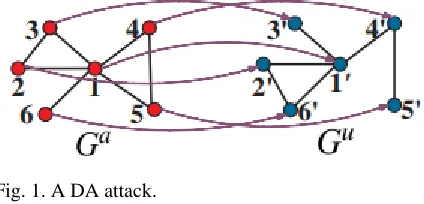
Privacy preserving data mining method of protecting the privacy of data without sacrificing the utility of data in this present world of internet people have become well aware that they should not share their personal data and sensitive information [1]. Data anonymization technique for privacy-preserving data publishing has received a lot of attention detailed data contains information about a person a household or an association. Most popular anonymization techniques are Generalization and Bucketization [2]. In contrast, social data increasingly contain the privacy information of users [3]. To protect users’ privacy, the data owners usually anonymize their data before sharing, transferring, and publishing it. Generally, data anonymization techniques can be placed into four classes: naive ID removal, k-anonymization differential privacy and other techniques [4]. One of the most notable characteristics of graph data is that the data items are structurally correlated with each other in addition to the semantic information they carried user of a social network is correlated with other users in the network in addition to the profile information associated with him [5]. On one hand the correlations carried by graph data make the data useful for comprehensive analysis and meaningful applications [6]. The trust crisis caused by security problems of cloud services is still one of the important factors of restricting the wide applications of cloud services. Many researchers tried to introduce the trust mechanism
into the cloud service selection process and achieved remarkable results [7]. Data mining techniques like k-means clustering can be applied to get the best investments based on customer’s profile. Privacy is the biggest challenge in banking [8]. The privacy depends upon not revealing customer information to the third party. They don't uncover the data about their clients unless certain conditions are fulfilled [9].
Fig. 1. A DA attack.
2. RELATED WORK
theory and the combinatorial optimization theory [11]. The proposed both active and passive DA attacks to graph data based on sub graph pattern matching is proposed the first scalable and robust two-phase DA attack in the first phase is used for seed identification and the second phase is for DA propagation [12]. We implement a large-scale evaluation of the perfect and partial de-anonymizability of 24 real-world social networks. In our evaluation, we show the conditions for perfectly and partially de-anonymizing a social network a social network is according to its topological properties, and how many users of a social network can be successfully [13]. The decentralized and stateless design of the Internet is particularly suitable for anonymous behavior to ensure privacy they should not be used as the sole means for ensuring privacy as they also allow for harmful activities, such as spamming, slander, and harmful attacks without fear of reprisal [14]. We present a new class of statistical de-anonymization attacks against high-dimensional micro-data, such as individual preferences, recommendations, transaction records and so on. Our techniques are robust to perturbation in the data and tolerate some mistakes in the adversary's background knowledge [15].
3. SYSTEM ARCHITECTURE
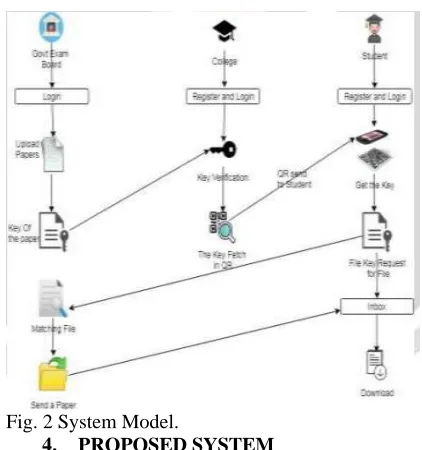
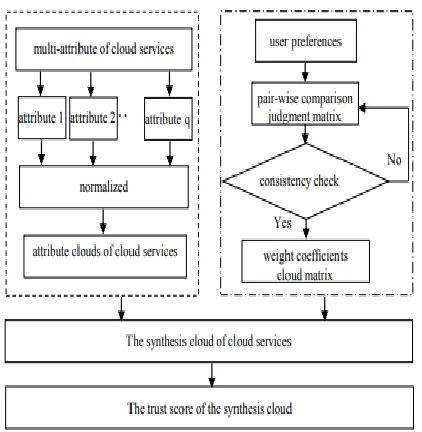
The systems architect establishes the basic structure of the system is propose a AES Algorithm and we can put a small part of data in local machine and fog server in order to protect the privacy based on computational intelligence this algorithm can compute the distribution proportion stored in cloud fog, and local machine, respectively [16]. We introduce the system model and related assumptions and definitions. For the sake of readability, we have summarized the frequently used acronyms and symbols [17]. We implement a large-scale evaluation of the perfect and partial de-anonymizability of 24 real-world social networks. The method aims to extract multiple normal could from the user experience data approximately following normal distributions as multi-granularity selection standard of trust level[18].
Fig. 2 System Model.
4. PROPOSED SYSTEM
Figure 3. Three numerical characteristics of the cloud model.
5. SLICING ALGORITHMS
Slicing first partitions attributes into columns. Each column contains a subset of attributes. This vertically partitions the table. Slicing also partition tuples into buckets. Each bucket contains a subset of tuples [21].
1. Attribute Partition and Columns: An attribute
partition consists of several subsets of A, such that each attribute belongs to exactly one subset. Each subset of S attributes is called a column. Specifically, let there be columnsC1, C2. . . Cc, then and for any 1≤ i1 ≠ i 2 ≤ c, C i1 ∩ Ci2 = For simplicity of discussion, consider only one sensitive attribute S. 2. Measures of Correlation: Two widely used measures of association are Pearson correlation coefficient [5] and mean square contingency coefficient [5]. Pearson correlation coefficient is used for measuring correlations between two continuous attributes while mean-square contingency coefficient is a chi-square measure of correlation between two categorical attributes.
3. Column Generalization: In the second phase, tuples are generalized to satisfy some minimal frequency requirement. We want to point out that column generalization is not an indispensable phase in our algorithm bucketization provides the same level of privacy protection as generalization with respect to attribute disclosure [22].
4. Tuple Partitioning: In the tuple partitioning phase, tuples are partitioned into buckets, no generalization is applied to the tuples gives the
description of the tuple-partition algorithm. The algorithm maintains two data structures:
1) a queue of buckets Q 2) a set of sliced buckets SB.
Initially, Q contains only one bucket which includes all tuples and SB is empty. For each the algorithm removes a bucket from Q and splits the bucket into two buckets.
A. Algorithm tuple-partition (T, l ) 1. Q = {T}; SB = .
2. while Q is not empty
3. Remove the first Bucket B from Q; Q= Q -{B}. 4. Split B into two Buckets B1 and B2, as in Mondrian.
5. if diversity-check (T,Q {B1,B2} SB, l) 6. Q= Q {B1,B2}.
7. else SB= SB {B}. 8. return SB.
B. M- DIVERSITY ALGORITHM
M-diversity is an efficient privacy technique that can be easily implemented. A class is said to be M- diversified if and only if there consists of „m‟ different values for the sensitive information in the dataset. As this technique supports property frequent data mining algorithms is analyze the sensitive data [23].
M-diversity algorithm: Step1. Read the input file
Step2. Identify clusters in the dataset(based upon Non-sensitive data)
Step3. Identify ranges of Quasi-Identifier (QI) value Step 4. Let „S‟ be a sensitive attribute in the dataset and check the ranges
Step5. If „S‟ are same in a group then rearrange the QI value ranges
Step6. Apply step-5 until sensitive attributes in a group are diversified.
6. EXPERIMENT RESULT
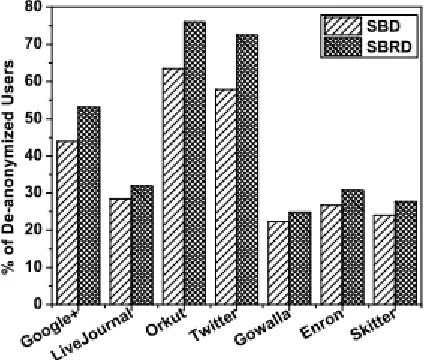
gives the same cloud services with the maximum and minimum trustworthiness. The two algorithms are different in local ranking results because the proposed algorithm can measure QoS attributes of cloud services accurately, depict the fuzziness and inaccuracy of user preference precisely, and provide users with more accurate decision-making basis.
Fig. 4. Comparisons with state-of-the-art techniques.
7. CONCLUSIONS AND FUTURE WORK
We study the structural importance-aware RD quantification problem for graph data. Specifically, we quantify both the seed-based and the seed-free RD of anonymized graph data for both perfect and partial de-anonymizaiton under a general graph model. In this paper the algorithm of multi-granularity standard trust cloud is proposed as the basis of judging the trust level of cloud services and the novel cloud service selection algorithm based on normal cloud model is given. we extend our quantification to general scenarios, where a social network can follow an arbitrary network. Third, based on our quantification, we conduct a large-scale evaluation of the de-anonymizability. Our comparison proves that slicing is better than generalization and Bucketization. In comparison it has been shown that, for high dimension data generalization loses considerable amount of information. In the future, we will establish an internet-based service sharing platform to gather the real service selection and usage data in different periods of time and design the self-adaptive computing model of describing the vagueness, inaccuracy and incompleteness of user preferences. 8. REFERENCES
[1] L. Sweeney, “k-anonymity: A model for protecting privacy,” International Journal on Uncertainty, Fuzziness and Knowledge-based Systems, vol. 10, no. 5, pp. 557–570, 2002.
[2] L. Sweeney, “Uniqueness of simple demographics in the U.S. population,” 2000.
[3] A. Narayanan and V. Shmatikov, “Robust de-anonymization of large sparse datasets,” in Security & Privacy, pp. 111–125, 2008.
[4] A. Machanavajjhala, D. Kifer, J. Gehrke, and M. Venkitasubramaniam, “`-diversity: Privacy beyond kanonymity,” ACM Trans. Knowl. Discov. Data, vol. 1, Mar. 2007.
[5] N. Li, T. Li, and S. Venkatasubramanian, “t-closeness: Privacy beyond k-anonymity and l-diversity,” in ICDE, pp. 106–115, 2007.
[6] N. Li,W. Qardaji, D. S. Purdue, Y.Wu, andW. Yang, “Membership privacy: A unifying framework for privacy definitions,” in CCS, (Berlin, Germany), 2013.
[7] N. Li, T. Li, and S. Venkatasubramanian, “t-Closeness: Privacy Beyond k-Anonymity and „l-Diversity,” Proc. IEEE 23rd Int’l Conf. Data Eng. (ICDE), pp. 106-115, 2007.
[8] A. Machanavajjhala, D. Kifer, J. Gehrke, and M. Venkitasubramaniam. “l-diversity: Privacy beyond kanonymity”. In ICDE, 2006.
[9]D. Martin, D. Kifer, A. Machanavajjhala, J. Gehrke, and J. Halpern. “Worst-case background knowledge for privacy-preserving data publishing”. In ICDE, 2007.
[10]G.Ghinita, Y. Tao, and P. Kalnis, “On the Anonymization of Sparse High-Dimensional Data,” Proc. IEEE 24th Int’l Conf. Data Eng. (ICDE), pp. 715-724, 2008.
[11] R. J. Bayardo and R. Agrawal, “Data Privacy through Optimal k- Anonymization,” in Proc. of ICDE, 2005, pp. 217–228.
[12]K. LeFevre, D. J. DeWitt, and R. Ramakrishnan, “Incognito: Efficient Full-domain k-Anonymity,” in Proc. of ACM SIGMOD, 2005, pp. 49– 60
[13] K. Liu and E. Terzi, “Towards identity anonymization on graphs,” in Proc. SIGMOD, 2008, pp. 93–106.
[14] C. Dwork, “Differential privacy,” in Proc. ICALP, 2006, pp. 1–12.
[16] Whaiduzzaman, M., Gani, A., Anuar, N. B., Shiraz, M., Haque, M. N., and Haque, I. T. "Cloud service selection using multicriteria decision analysis." The Scientific World Journal., 2014, 2014. [17] Ma, H., Hu, Z., Li, K., and Zhang, H. "Toward trustworthy cloud service selection: A time-aware approach using interval neutrosophic set." Journal of Parallel and Distributed Computing., vol. 96, pp. 75- 94, 2016.
[18] Zhang, L., Wang, S., Wong, R. K., Yang, F., and Chang, R. N. "Cognitively adjusting imprecise user preferences for service selection." IEEE Transactions on Network and Service Management., vol. 14, no. 3, pp. 717-729, 2017.
[19] P Garciateodoro, J Diazverdejo, G Maciafernandez, E Vazquez,"Anomaly-based network intrusion detection: Techniques,systems andchallenges," Computers & Security, Elsevier, vol. 28,Issue 1-2, pp. 18-28, Feb.-Mar. 2009.
[20] Christina Leslie, EleazarEskin and William Stafford Noble, "TheSpectrum kernel: A string kernel for SVM protein classification," Procsof the Pacific Symposium on Biocomputing, pp. 564-575, January 2-7,2002.
[21] G. Fung, O. L. Mangasarian, "A Feature Selection Newton Method forSupport Vector Machine Classification," Computational Optimizationand Applications, Volume 28, Issue 2, Pp. 185-202, July 2004.
[22] Isabelle Guyon, JhonsonWestren and Vladimir Vapnik,"Gene selectionfor cancer classification using support vector machines," MachineLearning, Vol. 46, pp. 389-422, 2002.
[23] EmreÇomak, Ahmet Arslan,"A new training method for support vectormachines: Clustering k-NN support vector machines," Expert SystemAppl. Volume 35, Issue 3, pp. 564-568, 2008.
Student details:
Tippireddy Indraja Mail id:[email protected]
Dr.Samuel George Institute of Technology, Markapur, AP.
G.Anantha Rao,M.tech
[email protected], Controller of Examinations Associate Professor ,Department of CSE