Scholarship@Western
Scholarship@Western
Electronic Thesis and Dissertation Repository
4-12-2018 10:00 AM
A numerical tool for predicting the spatial decay of freestream
A numerical tool for predicting the spatial decay of freestream
turbulence.
turbulence.
Dwaipayan Sarkar
The University of Western Ontario
Supervisor Savory, Eric
The University of Western Ontario
Graduate Program in Mechanical and Materials Engineering
A thesis submitted in partial fulfillment of the requirements for the degree in Master of Engineering Science
© Dwaipayan Sarkar 2018
Follow this and additional works at: https://ir.lib.uwo.ca/etd
Part of the Other Mechanical Engineering Commons
Recommended Citation Recommended Citation
Sarkar, Dwaipayan, "A numerical tool for predicting the spatial decay of freestream turbulence." (2018). Electronic Thesis and Dissertation Repository. 5331.
https://ir.lib.uwo.ca/etd/5331
This Dissertation/Thesis is brought to you for free and open access by Scholarship@Western. It has been accepted for inclusion in Electronic Thesis and Dissertation Repository by an authorized administrator of
i
The present numerical work is an attempt towards modelling of freely decaying
homogeneous isotropic turbulence with its application in experimental modelling of the
effect of incident turbulence on flow around 2D and 3D bluff-bodies. Both steady, Reynolds
Averaged Navier Stokes (RANS) and unsteady, Large Eddy simulation (LES), 3-D
numerical computational fluid dynamics (CFD) techniques have been employed to
characterise the inviscid decay of large-scale turbulence in terms of the characteristic rms
turbulent velocity fluctuations (u′) and the local integral length scale (Lu). The large-scale turbulent properties extracted from the current numerical simulations are inter-related and are
shown to behave predominantly as Saffman turbulence, which states u̅̅̅̅′2Lu3 ≈ constant. The other focus from the current study was on modelling inlet conditions for bluff-bodies in a
freestream flow. A set of three-correlation equations are formulated based on the large-scale
turbulent properties that are effective in estimating the initial and local freestream turbulence
conditions. The set of prediction equations can be deemed useful for researchers developing
wind-tunnel models in the presence of freestream turbulence. Additionally, the set of
equations is also reliable in determining appropriate near-constant turbulent conditions based
on the upstream inlet conditions. The current study aims at designing the region of constant
turbulent properties of a desired magnitude that can be helpful for boundary layer and heat
transfer studies over a bluff-body.
Keywords
Homogeneous, Isotropic, Reynolds Averaged Navier-Stokes (RANS), Large Eddy
Simulation (LES), Decay, Computational Fluid Dynamics (CFD), Freestream
ii
Co-Authorship Statement
This thesis has been prepared in accordance with the regulations for an Integrated-Article
format thesis, as stipulated by the School of Graduate and Postdoctoral studies at The
University of Western Ontario. This thesis includes co-authored articles and the following
passages explicitly state the contributors, and the nature and extent of their contribution.
Chapter 2: Numerical modelling of spatially decaying isotropic homogeneous
turbulence
The simulations conducted for this study were designed and carried out by D. Sarkar, with
the assistance of E. Savory. The text was primarily written by D. Sarkar with guidance from
E. Savory. All comparisons with literature were done by D. Sarkar, while the derivation of
the decay correlation was provided by E. Savory.
Chapter 2 will be submitted for publication under the co-authorship of Sarkar, D and Savory,
E.
Chapter 3: Comparison of RANS modelling against LES and experimental
measurements of spatially decaying isotropic homogeneous turbulence
The simulations performed for this study were carried out by D. Sarkar, with
recommendations from E. Savory. All the data processing was performed by D. Sarkar, with
guidance from E. Savory. The first draft of the text was written by D. Sarkar, whilst E.
Savory contributed to the final version of the manuscript by providing important comments
and providing recommendations for editing the text.
Chapter 3 will be submitted for publication under the co-authorship of Sarkar, D and Savory,
iii
Acknowledgments
First and foremost, I would like to express my sincere gratitude to my research supervisor Dr.
Eric Savory, who has been very supportive throughout the completion of the thesis with his
patience, valuable knowledge, feedback and constant encouragement throughout the course
of my MESc. program. This has helped me a lot to develop my learning and understanding
skills. I am thankful to him for providing me opportunities whilst allowing the room to work
in my own way. Professor Savory has always been available for constructive discussions on
my research and different other topics. Almost every time, I met him, I learned something
new. His advice on different avenues of research, as well as on my approach to graduate
studies in general, has been of great value over the past two years and I truly am grateful to
all the supports provided by him. I would also like to thank my thesis advisory committee
Professor Anthony Straatman and Professor Kamran Siddiqui. They have helped the
progression of the thesis by providing new research insights and different perspective of the
research outcomes.
I would also like to acknowledge the support, I received from my colleagues in the Advanced
Fluid Mechanics Group. They have been very supportive throughout my research progression
and always been available for discussion. I am also grateful to Dr. Shady Ali who helped me
a lot to get familiar with the different commercial CFD codes and was supportive while
working on the CFD simulations.
I would like to thank the Shared Hierarchical Academic Research Computing Network
(www.sharcnet.ca) and Compute/Calcul Canada for their facilities.
I would also like to acknowledge the financial support I received from the department of
Mechanical and Materials Engineering at Western University and Natural Sciences
Engineering Research council discovery (NSERC) discovery grants.
Last but not the least; I owe my thanks to my parents Dulal Chandra Sarkar and Luna Sarkar.
Without their mental support and constant encouragement, it would not have been possible
iv
Table of Contents
Abstract ... i
Co-Authorship Statement... ii
Acknowledgments... iii
Table of Contents ... iv
List of Tables ... viii
List of Figures ... x
List of Appendices ... xviii
List of Abbreviations, Symbols, and Nomenclature ... xix
Chapter 1 ... 1
1 Introduction ... 1
1.1 General Introduction ... 1
1.1.1 Grid-generated turbulence decay ... 7
1.2 Objective of the Thesis ... 9
1.3 Scope of the Thesis ... 10
1.4 Thesis layout ... 11
1.5 Summary ... 12
References ……….14
Chapter 2 ... 20
2 Numerical modelling of spatially decaying isotropic homogeneous turbulence ... 20
2.1 Background ... 20
2.2 Introduction ... 27
2.3 Computational Domain ... 28
2.4 Grid generation ... 29
v
2.5.1 Solver ... 30
2.5.2 Turbulence Models ... 31
2.5.3 Governing equations ... 32
2.5.4 Shear Stress Transport k-ω model ... 35
2.5.5 Large Eddy Simulation ... 38
2.5.6 Dynamic Smagorinsky-Lilly Model ... 40
2.5.7 Solution Parameters ... 42
2.6 Boundary Conditions ... 45
2.6.1 Boundary conditions for Steady Reynolds Averaged Navier-Stokes Model (RANS) ... 45
2.6.2 Inflow and Boundary conditions for Large Eddy Simulation (LES) ... 45
2.7 Flow Characteristics at the Inlet ... 46
2.7.1 Isotropy ... 47
2.7.2 Probability Density Function ... 51
2.7.3 Inertial sub-range of Spectral Energy Transfer ... 54
2.8 Model Convergence ... 55
2.8.1 Grid-Independence Test ... 55
2.8.2 Homogeneity and Isotropy of the velocity fields (LES) ... 61
2.8.3 Batchelor Turbulence or Saffman Turbulence? ... 67
2.8.4 Influence of the Time-Step Size ... 70
2.9 Comparison with previous studies (Validation of the CFD model) ... 74
2.9.1 Predictive methods for spatial decay of turbulent kinetic energy (TKE) . 79 2.9.2 Set of prediction correlation equations ... 98
2.9.3 Sensitivity of the virtual origin (x0) ... 100
2.9.4 Identification of nearly constant TKE conditions ... 105
vi
2.10Summary ... 119
2.11Conclusion ... 121
References………123
Chapter 3 ... 133
3 Comparison of RANS modelling against LES and experimental measurements of spatially decaying isotropic homogenous grid-generated turbulence ... 133
3.1 Introduction ... 133
3.2 Comparison between different commercial CFD codes against the spatial decay of isotropic homogeneous turbulence ... 135
3.3 Investigation of the differences between the solver (FLUENT, STAR-CCM+ and CFX) results ... 137
3.3.1 Limitations of the RANS based CFD solvers ... 139
3.4 Generic optimized SST-k-ω model for FLUENT, STAR-CCM+ and CFX ... 141
3.4.1 New optimized SST-k-ω models for FLUENT ... 141
3.4.2 New optimized SST-k-ω models for STAR-CCM+ ... 144
3.4.3 New optimized SST-k-ω models for CFX ... 145
3.5 Applicability of the proposed generic SST-k-ω model for varying initial conditions ... 147
3.5.1 Applicability of the improved SST-k-ω model in predicting the turbulence decay for varying turbulence intensities at the inlet ... 147
3.5.2 Applicability of the improved SST-k-ω in predicting the turbulence decay model for varying integral length scales at the inlet ... 149
3.6 Boundary layer validation for new optimized SST-k-ω model ... 151
3.6.1 Introduction ... 151
3.6.2 Computational domain ... 152
3.6.3 Grid-generation ... 153
3.6.4 Methodology ... 153
vii
3.6.6 Grid-Independence study ... 156
3.6.7 Boundary layer validation ... 163
3.7 Summary ... 174
3.8 Conclusion ... 175
References ………...176
Chapter 4 ... 179
4 Conclusions and Recommendations ... 179
4.1 Conclusions ... 179
4.2 Contributions... 181
4.3 Recommendations ... 182
References...……….…………183
Appendix A ... 184
Appendix B ... 188
Appendix C ... 195
Appendix D ... 207
Appendix E ... 210
Appendix F... 212
viii
List of Tables
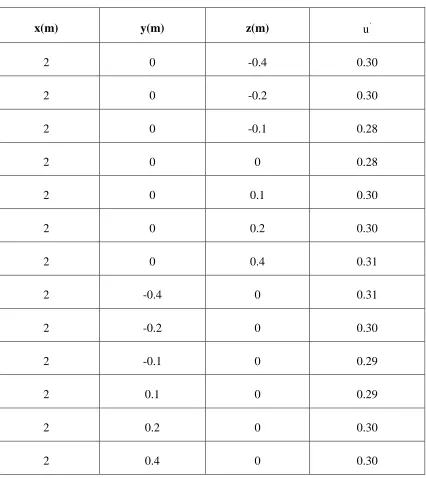
Table 2.1 Spanwise and normal variation of the root-mean square of the velocity fields at the
inlet with initial condition of U̅ = 4m/s, TI =10% and Lu =0.1m ... 49
Table 2.2 Percentage variation of root-mean square velocities at the inlet plane... 50
Table 2.3 Comparison between probability density function and normal distribution... 52
Table 2.4 Properties of the different grids used in the current study ... 56
Table 2.5 Grid independence study on three different grids for steady RANS predicting the turbulent kinetic energy decay along the streamwise distance ... 58
Table 2.6 Grid independence study on three different grids for steady RANS predicting the growth of integral length scales along the streamwise centreline ... 58
Table 2.7 Grid independence study on three different grids for LES simulations predicting the turbulence kinetic energy decay at 11 points along the streamwise centreline ... 61
Table 2.8 Grid independence study on three different grids for LES predicting the growth of integral length scales at 11 points along the streamwise centreline ... 61
Table 2.9 Spanwise and normal variation of the root-mean square of the streamwise velocity fields at the centre plane (U̅ = 4m/s, TI = 10% and Lu = 0.10m) ... 65
Table 2.10 Overview of performed simulations on the time-step independence ... 70
Table 2.11 Summary of the virtual origin location (x0) with respect to the physical grid location for both experimental results of Kang et al. (2003) and LES ... 76
Table 2.12 Initial TKE and length scale magnitudes for experimental data of Kang et al. (2003) and the present LES study ... 77
ix
Table 2.14 Constants obtained from best regression curve fitting procedure to equations 2.49
and 2.50 using the method of Non-linear least squares ... 99
Table 2.15 Constants obtained from best regression curve fitting procedure to equation 2.60
using the method of Non-linear least squares ... 99
Table 2.16 Constants obtained from best regression fit curve procedure using the method of
Non-linear Least Squares (shift in virtual origin) ... 104
Table 2.17 Constants obtained from best regression fit curve procedure using the method of
Non-linear Least Squares (shift in virtual origin) ... 104
Table 3.1 Non-dimensional distances of the four different locations along the centreline of
the plate ... 159
Table 3.2 Comparison between the dimensionless momentum thickness, displacement
thickness and the shape factor obtained from the improved SST-k-ω model and the
theoretical laminar velocity profiles ... 168
Table 3.3 Comparisons between the dimensionless velocity shape factor obtained from the
x
List of Figures
Figure 1.1 A schematic of a typical air-based open loop BIPV/T system (adapted from
Athienitis, 2008). ... 1
Figure 1.2 Pictorial representation of a turbomachine and downstream airfoil components
(“Rolls Royce Infographic” 2014) ... 2
Figure 1.3 A schematic of the oncoming wind flow over a flat plate ... 3
Figure 1.4 Turbulence generating grid having circular rods of diameter d and mesh width M
(adapted from Pope (2000)) ... 7
Figure 1.5 Schematic representation of the turbulence generating grid with wake vortices
being convected along the streamwise direction. The virtual origin (x0) is shown to be point where turbulence roughly re-organizes itself and complete mixing between the turbulent
structures has taken place ... 8
Figure 1.6 A schematic of the decay of turbulent kinetic energy in the streamwise distance x 9
Figure 2.1 Schematic of the 3D computational domain with specific boundary conditions .. 29
Figure 2.2 A schematic of the hexahedral grid distribution over the entire computational
domain... 30
Figure 2.3 Comparisons between different RANS turbulence models showing the decay of
TKE in the streamwise direction (FLUENT simulations). ... 35
Figure 2.4 Comparison between the 1st order and 2nd order discretization schemes of the SST k-ω model with respect to the spatial decay of TKE (U̅ = 4m/s, TI = 10% and Lu = 0.10m) 43
Figure 2.5 Skewness coefficient of the streamwise velocity component obtained from LES
xi
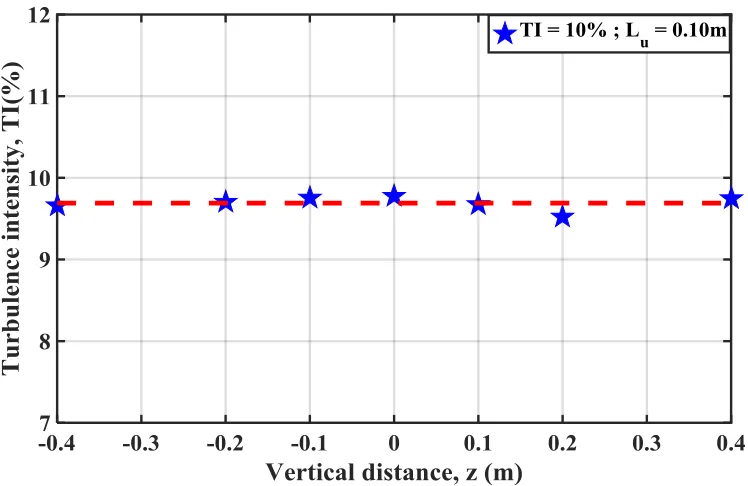
Figure 2.6 Transverse distribution of turbulence intensity laterally across the inlet plane
obtained from LES simulations with an initial condition of U̅ = 4m/s, TI = 10% and Lu = 0.10m ... 50
Figure 2.7 Normal Distribution of turbulence intensity vertically across the inlet plane
obtained from LES simulations with an initial condition of U̅ = 4m/s, TI = 10% and Lu = 0.10m ... 51
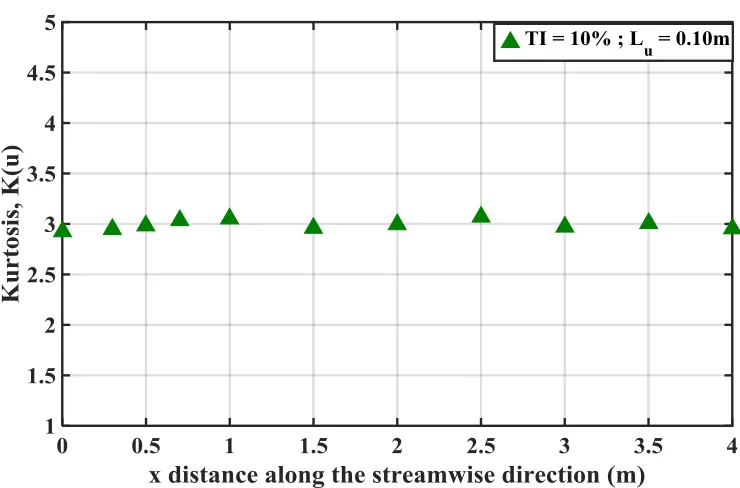
Figure 2.8 Kurtosis function of the streamwise velocity component obtained from LES
simulations with an initial condition of U̅ = 4m/s, TI = 10% and Lu = 0.10m ... 53
Figure 2.9 Probability density function plotted against the normal Gaussian distribution
normalized by mean velocity (U̅ = 4m/s, TI = 10% and Lu = 0.10m) ... 53
Figure 2.10 Turbulent kinetic energy spectra at the inlet plane plotted with a reference line of
slope (-5/3) representing Kolmogorov decay (U̅ = 4m/s, TI = 10% and Lu = 0.10m) ... 55
Figure 2.11 Comparison of streamwise decay of non-dimensional TKE for coarse, medium
and finer mesh (Steady RANS) (U̅ = 4m/s, TI = 10% and Lu = 0.10m) ... 57
Figure 2.12 Comparison of streamwise evolution of length scales for coarse, medium and
finer grids (Steady RANS) (U̅ = 4m/s, TI =10% and Lu = 0.10m) ... 57
Figure 2.13 Comparison of streamwise decay of non-dimensional TKE for coarse, medium
and fine grids (LES) (U̅ = 4m/s, TI = 10% and Lu = 0.10m) ... 59
Figure 2.14 Comparison of streamwise evolution of length scales for coarse, medium and
finer grids (LES) (U̅ = 4m/s, TI =10% and Lu = 0.10m) ... 60
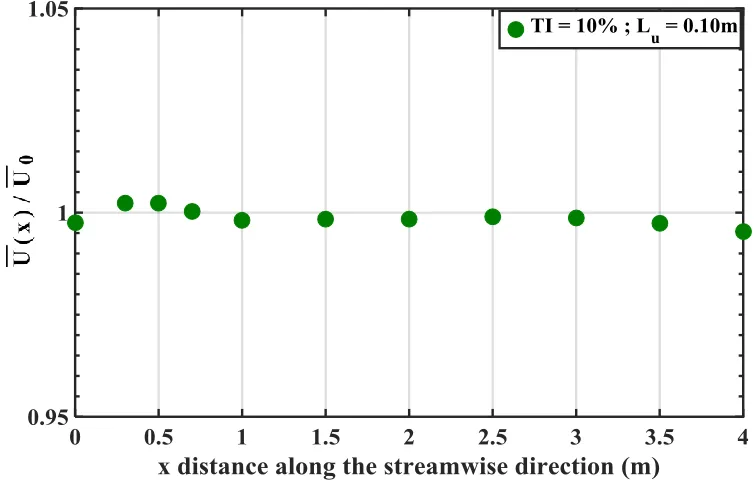
Figure 2.15 Streamwise distribution of U̅ along the centreline normalized by the mean
velocity at the inlet i.e. U0(U̅ = 4m/s, TI = 10% and Lu = 0.10m) ... 62
xii
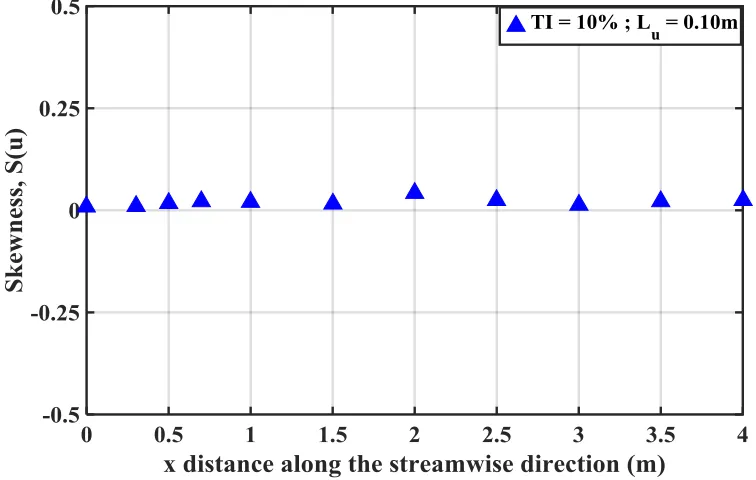
Figure 2.17 Downstream variation of velocity skewness S(u) along the centreline of the
domain (U̅ = 4m/s, TI = 10% and Lu = 0.10m) ... 66
Figure 2.18 Downstream variation of Kurtosis coefficient, K(u) along the centreline of the
domain (U̅ = 4m/s, TI = 10% and Lu = 0.10m) ... 67
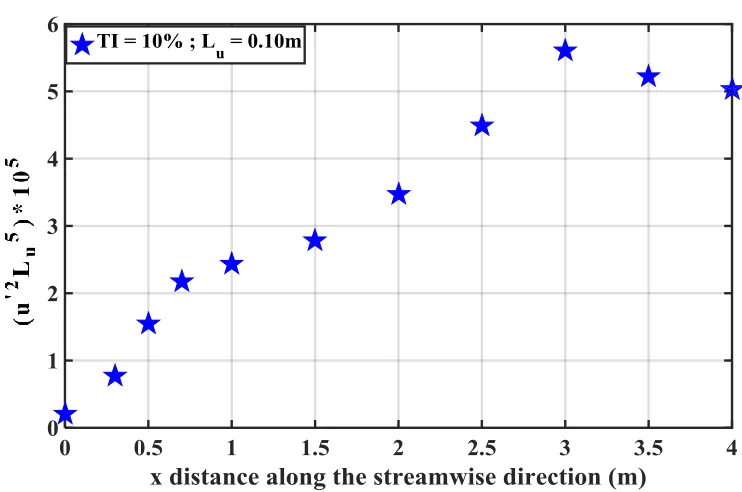
Figure 2.19 Downstream variation of '2 5 u
u L along the centreline of the domain (U̅ = 4m/s, TI
= 10% and Lu = 0.10m) ... 69
Figure 2.20 Downstream variation of u L along the centreline of the domain ('2 u3 U̅ = 4m/s, TI
= 10% and Lu = 0.10m) ... 69
Figure 2.21 Influence of the time-step size on the profiles of normalized mean velocity
component at different locations along the centreline (U̅ = 4m/s, TI = 10% and Lu = 0.10m) 71
Figure 2.22 Influence of the time step size on the streamwise turbulent kinetic energy
spectrum at the inlet (U̅ = 4m/s, TI = 10% and Lu = 0.10m) ... 72
Figure 2.23 Influence of the time-step size on the profiles of integral length scales at different
locations along the centreline (U̅ = 4m/s, TI = 10% and Lu = 0.10m) ... 73
Figure 2.24 Influence of the time-step size on the TKE decay along the centreline in the
streamwise direction (U̅ = 4m/s, TI = 10% and Lu = 0.10m) ... 74
Figure 2.25 Comparison of decay of TKE in the streamwise direction between Kang et al.
(2003) and the present LES results. ... 78
Figure 2.26 Physical distances of the virtual origin(x0) with respect to the physical grid location plotted against the ratio of physical grid element size (M/d), for all the experimental
studies of Kang et al. (2003); Krogstad & Davidson (2011); Torrano et al. (2015) ... 85
Figure 2.27 Quantitative comparisons of the spatial decay of TKE profiles between earlier
xiii
Figure 2.28 Spatial decay of TKE profiles of earlier experimental studies and present LES
study, scaled with local integral length scale (Lu) plotted with a solid line that shows the best fit power law ... 87
Figure 2.29 Spatial decay of TKE profiles for different experiments and the present LES
study scaled with initial integral length scale (Lu0) plotted with a solid line that shows the best fit power law ... 88
Figure 2.30 Comparison of the dissipation rate of turbulent kinetic energy computed as:
εq=
1 2U̅
du′2
̅̅̅̅̅̅̅
dx ) ; εiso=15ν u′2
̅̅̅̅̅
λ2 (U̅ = 4m/s, TI = 10% and Lu = 0.10m) ... 92
Figure 2.31 Ratio of the dissipation rate of turbulent kinetic energy, εεiso
q (U
̅ = 4m/s, TI = 10%
and Lu = 0.10m) ... 93
Figure 2.32 Streamwise distribution of D along the centreline of the domain obtained from
q q ' 3
u
D
(u ) L
and iso iso
' 3 u D (u ) L
... 94
Figure 2.33 Variation of the dimensionless dissipation constant D along the streamwise
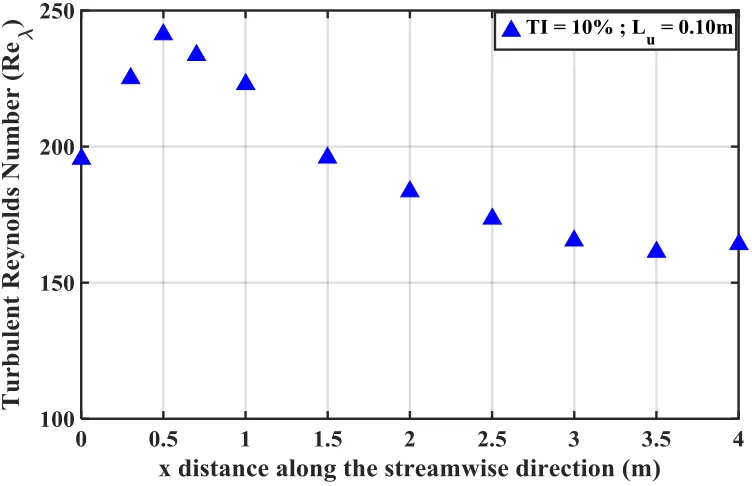
distance of the domain plotted to compare with the variation of the turbulent Reynolds
number (Rλ) along the same direction ... 96
Figure 2.34 Spatial decay of TKE profiles for different experiments and the present LES data
with the x abscissa scaled with local k and Lu plotted with a sold line that shows the best fit linear curve... 98
Figure 2.35 Spatial decay of TKE profiles for different experiments and the present LES
study scaled with local integral length scale (Lu) with a different choice of virtual origin (x0) plotted with a solid line that shows the best fit power law ... 101
Figure 2.36 Spatial decay of TKE profiles for different experiments and the present LES
xiv
Figure 2.37 Spatial decay of TKE profiles for different experiments and the present LES
study scaled with local TKE (k) and local integral length scale (Lu), with a different choice of virtual origin(x0) plotted with a solid line that shows the best fit power law ... 103
Figure 2.38 Spatial decay of TKE profile (LES) plotted against the streamwise distance x (U̅
= 4m/s, TI = 10% and Lu = 0.10m) ... 107
Figure 2.39 Rate of spatial decay of TKE profile (LES) along the streamwise distance x (U̅ =
4m/s, TI = 10% and Lu = 0.10m) ... 107
Figure 2.40 Rate of spatial decay of TKE profile in the form of
' 0.5
0 0 0 u
d(k / k ) / d((xx ) *(k ) / L plotted against (xx ) *(k )0 0' 0.5/ Lu for all the
experimental data and the LES results (U̅ = 4m/s, TI = 10% and Lu = 0.10m) ... 108
Figure 2.41 Spatial decay of TKE profiles for different Reynolds number (Re) prescribed at
the inlet (RANS) ... 110
Figure 2.42 Spatial decay of TKE profiles (RANS) for different integral length scales (Lu) prescribed at the Inlet ... 111
Figure 2.43 Spatial Decay of TKE profiles (RANS) for different turbulence Intensities
prescribed at the Inlet ... 111
Figure 2.44 Spatial decay of TKE profiles (RANS) for different turbulence intensities and
integral length scales plotted with a solid line that shows the best fit power law ... 112
Figure 2.45 Spatial decay of TKE profiles for different integral length scales (Lu) prescribed at the inlet (LES) ... 113
Figure 2.46 Spatial decay of TKE profiles for different turbulence intensities at the inlet
(LES) ... 114
Figure 2.47 Downstream variation of u L'2 u3/ U L2 u 03 along the centreline of the domain
xv
Figure 2.48 Spatial decay of TKE profiles for different Turbulence Intensities and Integral
length scales plotted with a solid line that shows the best fit power law... 115
Figure 2.49 Spatial decay of TKE profiles for different turbulence intensities and integral
length scales compared with the relevant experimental results plotted with a solid line that
shows the best fit power law ... 117
Figure 2.50 Spatial decay of TKE profiles for different inlet turbulence intensities (TI) and
integral length scales (Lu) along the streamwise distance x ... 118
Figure 2.51 Rate of spatial decay of TKE profiles for different inlet turbulence intensities
(TI) and integral length scales (Lu) along the streamwise distance x ... 119
Figure 3.1 Spatial decay of TKE profiles obtained from three different commercial codes
(FLUENT, STAR-CCM+ and CFX) compared with the LES and the previous experimental
studies ... 136
Figure 3.2 Spatial decay of TKE profiles obtained from the different optimized SST-k-ω
RANS model compared with the LES and the earlier experimental studies, (FLUENT
simulations) ... 142
Figure 3.3 Spatial decay of TKE profiles obtained from the different optimized SST-k-ω
RANS model compared with the LES and the earlier experimental studies, (FLUENT
simulations) ... 143
Figure 3.4 Spatial decay of TKE profiles obtained from the different optimized SST-k-ω
RANS model compared with the present LES study along the streamwise distance x
(FLUENT simulations) ... 144
Figure 3.5 Spatial decay of TKE profiles obtained from the different optimized SST-k-ω
RANS model compared with the present LES and the earlier experimental studies
(STAR-CCM+ simulations) ... 145
Figure 3.6 Spatial decay of TKE profiles obtained from the different optimized SST-k-ω
RANS model compared with the LES and the earlier experimental studies, (CFX
xvi
Figure 3.7 Spatial decay of TKE profiles from different optimized SST-k-ω model compared
with the LES and the earlier experimental studies (TI = 20%, Lu0 = 0.1m) ... 148
Figure 3.8 Spatial decay of TKE profiles from different optimized SST-k-ω model compared
with the LES and the earlier experimental studies (TI = 20%, Lu0 = 0.1m) ... 148
Figure 3.9 Spatial decay of TKE profiles from different optimized SST-k-ω model compared
with the LES and the earlier experimental studies (TI = 30%; Lu0 = 0.1m) ... 149
Figure 3.10 Spatial decay of TKE profiles obtained from optimized SST-k-ω model
compared with the LES and the earlier experimental studies (TI = 10%; Lu0 = 0.1m) ... 150
Figure 3.11 Spatial decay of TKE profiles obtained from optimized SST-k-ω model
compared with the LES and the earlier experimental studies (TI = 10%; Lu0 = 0.05m) ... 150
Figure 3.12 Spatial decay of TKE profiles obtained from the optimized SST-k-ω model
compared with the LES and the earlier experimental studies (TI= 10%; Lu0 = 0.02m) ... 151
Figure 3.13 Schematic of the computational domain with the plate along with the relevant
boundary conditions ... 152
Figure 3.14 Local skin-friction profiles plotted for three different grids measured along the
centreline of the plate ... 158
Figure 3.15 Schematic of the flat plate showing the location of four different measurement
points along the centreline of the plate ... 159
Figure 3.16 Normalized velocity profile plotted for three different grids along the centreline
of the plate at x = 2.0m (right) and x = 2.5m (left) ... 160
Figure 3.17 Normalized velocity profile plotted for three different grids along the centreline
of the plate at x = 1.0m (right) and x = 1.5m (left) ... 161
Figure 3.18 Local skin-friction profiles plotted for three different grids measured along the
xvii
Figure 3.19 Normalized velocity profile plotted for three different grids along the centreline
of the plate at x = 2.0m (right) and x = 2.5m (left) ... 163
Figure 3.20 Comparison of the local skin-friction profiles obtained from the standard and the
improved SST-k-ω model plotted against the theoretical laminar skin-friction profiles,
measured along the centreline of the plate ... 164
Figure 3.21 Normalized velocity profile obtained from the standard and the improved
SST-k-ω model plotted against the theoretical laminar velocity profiles, measured along the
centreline of the plate at x = 2.0m (right) and x = 2.5m (left) ... 166
Figure 3.22 Normalized velocity profile obtained from the standard and the improved
SST-k-ω model plotted against the theoretical laminar velocity profiles, measured along the
centreline of the plate at x = 1.0m (right) and x = 1.5m (left) ... 167
Figure 3.23 Normalized velocity profile obtained from the standard and the improved k-kl-ω
model plotted against the theoretical turbulent velocity profiles, measured along the
centreline of the plate at x = 2.0m (right) and x = 2.5m (left) ... 171
Figure 3.24 Plot of normalized velocity profile in the logarithmic form obtained from the
standard and the improved k-kl-ω model measured at x = 2.5m ... 172
Figure 3.25 Plot of normalized velocity profile in the logarithmic form obtained from the
standard and the improved k-kl-ω model measured at x = 2.0m ... 172
Figure 3.26 Comparison of the local skin-friction profiles obtained from the standard and the
improved k-kl-ω model plotted against the theoretical turbulent skin-friction profiles,
xviii
List of Appendices
Appendix A - Solution method of the linear dependency of (k/k0) with (x-x0)*(k′0)0.5/Lu
………184
Appendix B - Sample calculations to estimate the initial turbulent scales (k′0) and Lu0) based on the local TKE (k) and the integral length scale (Lu)……….………188
Appendix C - Comparisons between three different commercial codes against the spatial decay of isotropic homogeneous turbulence………….……….195
Appendix D - Near-wall treatment of boundary layer………...………207
Appendix E - Low Reynolds Number modelling approach………...……210
xix
List of Abbreviations, Symbols, and Nomenclature
Latin Symbols
1
a , c SST-k-1 ω model constants that are used to compute the turbulent
viscosity
A Decay coefficient
f
c Local skin-friction coefficient
p
c Specific heat capacity of the fluid (J/kg-K)
C Turbulence model constant (* for SST-k-ω model)
k
C , C Model constants for LES
s
C Smagorinsky-Lilly constant
d Diameter of the round-grid elements/Bar-width (m)
D Dimensionless dissipation constant
D Cross -Diffusion term
D Positive portion of the cross-diffusion term
1 2
F , F Blending functions for the SST-k-ω turbulence model
b
G Generation of turbulent kinetic energy due to buoyancy
k
G Generation of turbulent kinetic energy due to the mean velocity
gradients
xx
h Convective heat-transfer coefficient
k Turbulent kinetic energy (m2/s2)
'
k Non-dimensional TKE
kl Laminar kinetic energy (m2/s2)
kP Turbulent kinetic energy at centre point P of wall-adjacent wall (m2/s2)
ksgs Sub-grid scale kinetic energy (m2/s2)
Ls Mixing-length for the sub-grid scales (m)
Lu Integral length scale of an eddy (m)
x y, z
L , L L Physical dimensions of the computational domain in x, y
and z direction
M Mesh-width (m)
n Decay exponent
Nu Nusselt number
P Centre point of the wall adjacent wall
p Pressure (Pa)
Pr Prandtl number
t
Pr Turbulent Prandtl number
d
Re Reynolds number based on the grid-dimension d
xxi L
Re Average Reynolds number based on the plate length in the
streamwise direction
ReLu0 Turbulent Reynolds number based on the integral length scale at the inlet (Lu0)
t
Re Local turbulent Reynolds number
X
Re Reynolds number based on the distance from the leading
edge of the plate
Re Turbulent Reynolds number based on the Taylor length scale
k
R Constant used in the low Reynolds number correction factor
for the SST-k-ω model
1
S Scalar measure of the deformation tensor
ij
S Mean rate-of-strain rate tensor
k
S User defined source term for turbulent kinetic energy
St Stanton number
S User defined source term for turbulence dissipation rate
S User defined source term for turbulence specific dissipation rate
t Flow time (s)
pv
T Temperature of the photovoltaic panel (K)
surr
T Temperature of the surroundings (K)
xxii
Tu Turbulence intensity in fraction
i
u Velocity vector component along the i-th base coordinates
(x direction)
j
u Velocity vector component along the j-th base coordinates
(y direction)
*
u Boundary-layer friction velocity (m/s)
u, v, w Velocity component in x, y, z direction (m/s)
' ' '
u , v , w Root-mean square velocity fluctuations in x, y and z direction
(m/s)
' ' '
u (t), v (t), w (t) Time-dependent velocity fluctuations in x, y and z direction (m/s)
' ' ' '
u u , v v Reynolds normal stress components (m2/s2)
' '
u v Reynolds shear stress component (m2/s2)
du/dy Streamwise velocity gradient (s-1)
U Mean velocity (m/s)
v Velocity vector
x Distance along the streamwise direction (m)
0
x Virtual origin (m)
j
x Cartesian coordinate component along the j-th base vector
X Distance from the leading edge of the plate (m)
k
xxiii M
Y Contribution of the fluctuating dilatation in compressible
turbulence to the overall dissipation rate
Y Dissipation of ω due to turbulence
y Distance from the closest no-slip wall in the normal direction (m)
P
y Distance (normal) of centre point P of wall-adjacent cell to the wall
(m)
y Dimensional wall normal distance
Greek symbols
*
Coefficient for Low-Reynolds number correction for
the SST-k-ω turbulence model
* i
,
Constants used in computation of *
Local grid scale (m)
t
Time-step (s)
x. y, z
Grid-cell size (m)
T
Temperature difference (K)
Turbulent kinetic energy dissipation rate (m2/s3)
Wave-number of an eddy/Von-Kármán constant
Dynamic viscosity (N-s/m2)
t
Turbulent viscosity (N-s/m2)
xxiv Density (kg/m3)
Taylor micro-length scale (m)
ij
Stress tensor due to molecular viscosity (N/m2)
k
Turbulent Prandtl number of turbulent kinetic energy
Turbulent Prandtl number of turbulent dissipation rate
Turbulent Prandtl number of turbulent specific
dissipation rate
Specific dissipation rate of turbulent kinetic energy (s-1)
ij
Sub-grid scale stresses (N/m2)
kk
Isotropic part of the sub-grid scale stresses (N/m2)
Boundary layer thickness (m)
Momentum thickness (m)
* n, k1, k2, 1, 2, n, 1, 2, , 1, 2
SST-k-ω model constants
Abbreviations
ABL Atmospheric Boundary Layer
BIPV/T Building Integrated Photo-voltaic/Thermal systems
CFD Computational Fluid Dynamics
CFL Courant–Friedrichs–Lewy condition
xxv
COST European Cooperation in Science and Technology
DNS Direct Numerical Simulation
LES Large Eddy Simulation
LRC Low Reynolds Number Correction
LRNM Low Reynolds Number Modelling
PISO Pressure-Implicit with Splitting of Operators
PV Photovoltaic
PV/T Photovoltaic/Thermal
RANS Reynolds-Averaged Navier Stokes
RSM Reynolds Stress Model
SIMPLE Semi-Implicit Method for Pressure-Linked Equations
SST Shear-Stress Transport
TKE Turbulent Kinetic Energy
WF Wall Function
Chapter 1
1
Introduction
1.1
General Introduction
The performance of thermally integrated solar panel systems e.g. (building integrated
photo-voltaic thermal system (BIPV/T)) largely depends on the way the atmospheric
wind interacts with these panels. It is mainly due to the surface roughness of the ground
and abrupt bluff-body obstructions, that the incident wind profiles on these panels are
highly intermittent, turbulent and fluctuating in nature. The exterior layer of a (BIPV/T)
represents a smooth surface according to ASHRAE classification (ASHRAE (American
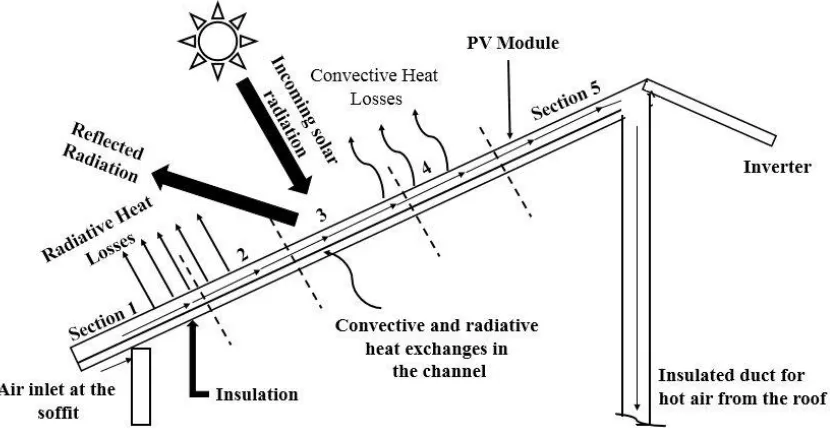
Society of Heating Refrigerating and Air-Conditioning Engineers), 2009). Figure (1.1) is a schematic of the BIPV/T system and the heat transfer terms responsible for heat transfer
over the panels.
Figure 1.1 A schematic of a typical air-based open loop BIPV/T system (adapted
from Athienitis, 2008).
Velocity and thermal boundary layers are formed at the immediate vicinity of the smooth
temperature. It is well known that boundary layers have a pronounced effect (drag, lift)
upon any object immersed in a fluid and, in many cases, they govern the dynamics of the
flow around three-dimensional bluff bodies, such as a cylinder (Geidt, (1951); Kestin &
Maeder, (1957); Smith, (1964); Bearman & Morel, (1983)) or sphere (Moradian et al.,
2009). The effect of turbulent free stream fluctuations on the boundary layer development
and its characterization is important in many thermal engineering applications such as
turbomachinery, reactors and the combustion chamber of engines. There are a number of
practical industrial situations where the boundary layers evolve differently in the
presence of an external free stream having high turbulence intensities. A most common
example is turbo-machinery flow where the wake of stators interacts with the
downstream rotors whose developing boundary layers experience that oncoming
turbulence (Fig 1.2). Similar flow patterns are also observed in heat exchanger and
combustor flows. As far as these different objects are concerned, flat plates have the
advantage of developing thicker boundary layers than those developing over rotor surface
or spheres, whose structures can be analyzed, which makes it possible to consider the
mechanisms responsible for the effect of turbulence on near wall heat transfer from these
bodies (Kondjoyan et al. (2002)).
Figure 1.2 Pictorial representation of a turbomachine and downstream airfoil components (“Rolls Royce Infographic” 2014)
Figure (1.3) shows a schematic of the fundamental problem examined in this thesis where
from it. In the figure, the term ReL represents the Reynolds number of the flow based on the plate length L given by
ReL UL
(1.1)
where U is the mean velocity of the flow, TI represents the turbulence intensity in
percentage given by
(
' 2 2 ' 2
1
(u v ' w )
3
TI 100
U
(1.2)
where u', v', w' are the r.m.s of the turbulent velocity fluctuations in each of the x, y
and z directions), Lu represents the streamwise integral length scale of an eddy, TKE represents the turbulent kinetic energy, Tsurr is the temperature of the surroundings , Tpv is the temperature of the photovoltaic thermal panel and BIPV/T represents building
integrated photo-voltaic thermal system.
Figure 1.3 A schematic of the oncoming wind flow over a flat plate
The investigation of convective modes of heat transfer has been an important aspect in
the empirical design of different geometrical structures under various external flow
conditions (Wang & Peng (1994); Ambatipudi & Rahman (2000); Tian et al. (2004)).
Convection coefficients determined analytically (Eckertf & Carlson, (1961); Foli et al.,
(2006)) and empirically (Kestin et al., (1961); Büyüktür et al., (1964); Simonich &
approximations with negligible freestream turbulence levels and invariant properties of
the fluid with temperature and pressure. The available correlations serve as a benchmark
for problems of steady, incompressible, low-speed, uniform flows over simple systems
such as smooth plane and curved surfaces. However, the correlations formulated include
negligible disturbances of the freestream flow which cannot be extended to problems of a
surrounding turbulent atmosphere.
For many years it has been recognized that the disturbances in the mean freestream flow
can alter the heat transfer rate within the boundary layer. The freestream conditions can
cause a change in the flow regime of the boundary layer and can also shift the position of
the transition point upstream. Previous experimental studies have confirmed the
augmentation in heat transfer from certain wall geometries (both plane and curved
surfaces) in the presence of freestream turbulence in the mean flow (Fage and Falkner
(1931); Comings et al. (1948); Edwards and Furber (1956); Reynolds et al. (1958); Van
Der Hegge Zijnen, (1958); Sugawara et al. (1988)).Most of these studies have also been
the subject of review articles (e.g. Kondjoyan et al. (2002)). However, due to a large
scatter in the published results (Reynolds et al. (1958); Simonich and Bradshaw, (1978);
Sugawara et al., (1988); Maciejewski and Moffat, (1992)) on the effect of freestream
turbulence on forced convective heat transfer, a fundamental challenge is presented to
correctly predict the enhanced thermal dynamics in the laminar and turbulent region of a
developing boundary layer. Earlier studies have reported that the velocity flow field in a
boundary layer, alters significantly when there is an entrainment of the freestream
turbulence into the boundary layer (Kline et al. (1960); Charnay et al. (1976)). Studies
have also shown that the thermal field is much more sensitive to the freestream
turbulence than the dynamic field (Reynolds et al. (1958); Kondjoyan et al. (2002);
Péneau et al. (2004)). A careful inspection of the previous studies leads to the fact that
there were many discrepancies and contradictions involved in the reported findings,
mainly due to the variability in the range of Reynolds number (Re), imprecise
identification of an isotropic and homogeneous field of turbulent flows, different initial
turbulent conditions and the influence of the different experimental set-ups used in those
The first experimental quantification of the effect of the freestream turbulence on a flat
plate boundary layer was carried out by Fage and Falkner, (1931) who considered the
laminar regime. Their study concluded that the laminar boundary layer mostly remains
unperturbed by the freestream turbulence. Similar results were also reported by Edwards
and Furber, (1956) who showed that that the oncoming turbulent flow had no effect on
the rate of heat transfer for a laminar boundary layer but significantly relocated the
transition point further upstream. However, studies by Dyban etal. (1977,1985) showed
an increase in local skin-friction coefficient (cf) (where cf is the ratio between the local
shear stress and the characteristic dynamic pressure given by f w
2
c
0.5* * U
) by 56%
at low Reynolds number flow (ReL<20000) with a freestream turbulence (TI) of 12.5%, contradicting the aforementioned previous studies. Subsequently, numerous experimental
studies (Simonich and Bradshaw, (1978); Sugawara et al., (1988); Maciejewski and
Moffat, (1992); have been carried out to understand the relationship between the heat
transfer enhancement (expressed in terms of Stanton number (St) ,where Stanton number
(St) is a dimensionless number given by the ratio of the heat transferred into the fluid to
the thermal capacity of the fluid given by
p
h St
Uc
, where h is convective heat transfer
coefficient, c is the specific heat capacity of the fluid) and the freestream turbulent p
fluctuations (TI) within the turbulent boundary layer regime. But there was a
considerable variation in the magnitude of the heat transfer enhancement in each of those
cases. The analysis of turbulent boundary layer skin friction (cf) and heat transfer rate (St) by Blair, (1983a;1983b) showed that these effects were, indeed, a function of freestream
turbulence intensity (TI), integral length scale (Lu) (where Lu gives the average size of an energy containing eddy) and Reθ (where Reθ is the momentum thickness Reynolds
number given by Re U.
, θ is the momentum thickness of the boundary layer . New
correlations for the effect of freestream turbulence on skin friction, heat transfer and the
Reynolds analogy factor were also presented by Blair (1983a ;1983b), which will be later
used in the future work for comparisons. A review by Kondjoyan et al., (2002) concluded
a turbulence level of 5% to 10% either in a laminar or turbulent boundary layer. The
alterations of the velocity log law and the law of the wake may make it possible to
explain a few of the disparities in the existing experimental results; Fage and Falkner,
(1931); Charnay et al., (1976); Dyban et al., (1977); Blair, (1983a; 1983b) Dyban et al.,
(1985)). However, Palyvos, (2008) in his study pointed out the lack of generality of the
existing heat transfer correlations relating Nusselt number (Nu), Reynolds number (Re)
and Prandtl number (Pr) and concluded that there is an obvious lack of physical
equivalence, because of the diverse experimental conditions under which they have been
measured. Test and Lessmann, (1980) and Loveday and Taki, (1996) anticipated that the
turbulence intensity (TI) of the approach flow might be one of the primary sources of
some of the discrepancies between the experimental studies. Thus, the turbulent
properties of the freestream flow approaching and passing the flat plate need to be
quantified in order to begin to understand their influence on heat transfer rates from flat
plates.
It is however, now well known that in absence of any external turbulent energy
generating source, the freestream eddy fluctuations exhibit continuous decay of kinetic
energy due to inertial eddy interactions at high Reynolds number. At low Reynolds
number the decay occurs mostly due to the molecular viscosity of the eddies. Thus, the
freestream turbulent kinetic energy (TKE) decay becomes an important factor of
consideration before invoking any heat transfer study related to it, since its decay will
have a direct effect on the evolution of the flow around any bluff body. It is hoped that
quantifying the incidence TKE over the leading edge of a flat plate will help in precise
estimation of the effect of freestream turbulence on boundary layer heat transfer in a
comprehensive manner and thereby reconcile some of the differences observed in the
earlier studies. Therefore, in the current study, attempts have been made to quantify the
streamwise decay of the freestream turbulent fluctuations in order to identify a region of
nearly uniform oncoming turbulent properties, so that any bluff body aerodynamics study
1.1.1
Grid-generated turbulence decay
Stationary grids or perforated screens are often used to generate turbulence in typical
wind-tunnel experiments where the Reynolds number (Red Ud
) based on the grid
-dimension (d) is high enough (order of few hundreds) in magnitude. Grid-generated
turbulence has served as a benchmark test case for turbulent theories and simulations
over several decades and continues to do so in the present. Turbulence generated by
grids decays downstream with a typical power-law of the form TI A * (x x0) n M
(Batchelor and Townsend, (1948), Pope, (2000)) (where x is the streamwise distance, x0 is the virtual origin, M is the mesh width, exponent n gives the decay rate and A gives the
decay coefficient for a specific grid and Reynolds number (Red)). For a better understanding of the variables related to the power law form of the grid-generated
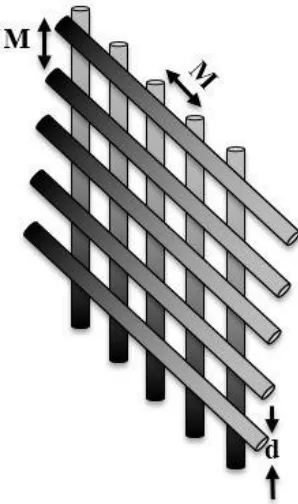
turbulence, figures (1.4) and (1.5) have been shown which gives a clear visual
representation of the grid elements and the importance of the virtual origin (x0).
Figure 1.4 Turbulence generating grid having circular rods of diameter d and mesh
Figure 1.5 Schematic representation of the turbulence generating grid with wake
vortices being convected along the streamwise direction. The virtual origin (x0) is
shown to be point where turbulence roughly re-organizes itself and complete mixing
between the turbulent structures has taken place
However, it has been observed that different sets of geometrical grids introduce a
variation in the magnitude of the exponent (n) of the kinetic energy decay that affects the
structure of turbulence at small scales (Tan-atichat et al., (1982); Lavoie et al., (2005)).
In recent years, numerous wind tunnel experiments have been focused on generating
homogeneous turbulence by different type of grids; passive (Ishida et al., (2006);
Krogstad and Davidson, (2010)), active (Kang et al., (2003); Mordant, (2008)) and
multiscale (fractal) (Mazzi and Vassilicos, (2004), Seoud and Vassilicos, (2007), Hurst
and Vassilicos, (2007), Krogstad and Davidson, (2011)). However, from this literature,
concerning both numerical simulations and experiments, a marked scatter of the exponent
(n) in the range (-1.0: -1.4) (Mohamed and Larue, 1990) is discovered which implies
there may not be a universal state for grid turbulence decay.
It is very clear from the bluff body heat transfer studies mentioned above, that none of
those studies commented on the streamwise decay of freestream turbulence prior to the
bluff-body interaction (e.g. plate) nor do they discuss this issue while reporting the
experimental setups or heat transfer results. As pointed out by Corrsin and Kistler,
(1955), Townsend, (1956) and Mobbs, (1968), that turbulence intensity (TI), integral
quantified accurately before making any correct predictions for any interacting turbulent
mechanisms including convective heat transfer (CHTC) . Karava et al., (2011) in their
study tried to overcome the previous gaps and propose correlations for exterior
convective heat transfer coefficient for flat plates and, hence, the present work is an
implicit continuation of that study quantifying the effect of freestream decay before the
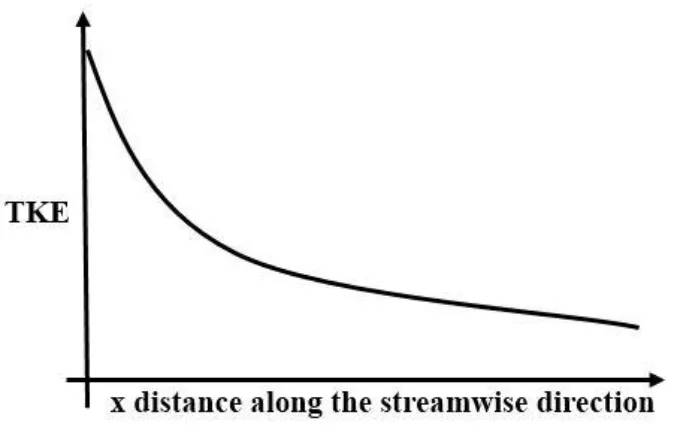
leading-edge incidence occurs. A conceptual schematic is shown in (fig. 1.6) that
illustrates the basic problem of the current investigation. The figure gives a perception of
the decay of TKE in the streamwise direction for the comprehensive understanding of the
reader.
Figure 1.6 A schematic of the decay of turbulent kinetic energy in the streamwise
distance x
1.2
Objective of the Thesis
The three main objectives of this thesis are: -
• To identify a region having negligible changes in the turbulent properties (such
as TKE and the integral length scale) along the streamwise distance.
• To highlight the differences and limitations of the different numerical CFD
formulations that are used as a computational tool to carry out the objectives and,
finally, to optimise those numerical models (if required) to have the correct
behaviour of turbulence decay.
However, it should be noted that this thesis only presents the objectives of the current
study which in turn attempts to fill the gap prior to addressing a larger objective, which is
to examine the influence of the freestream turbulence on convective heat transfer from
heated flat plate. Heat transfer studies are currently in progress and the analysis of the
results will form a part of future work.
In this research, three-dimensional (3D) based steady Reynolds Averaged Navier Stokes
(RANS) and unsteady Large Eddy Simulation (LES) formulations have been employed to
numerically predict the statistical properties of turbulent flows in order to overcome a
few of the challenges presented by experimental grid-generated turbulence. The RANS
study is expected to give quicker time-averaged results in comparison to LES but without
any instantaneous information of the flow variables, which will be provided by the
corresponding LES study. The RANS study also covers a wider range of turbulent flow
Reynolds number ( u0
L
Re ) (where u0
L
Re = ULu0
, U is the mean velocity, Lu0 is the
inlet integral length scale and is the kinematic viscosity of the fluid) flows that cannot
be covered in LES owing to the limiting constraint of available computational resources.
This is followed by a parametric analysis of the RANS and LES simulations to develop a
simple yet powerful predictive correlations of spatial decay of TKE using dimensionless
parameters.
1.3
Scope of the Thesis
The present thesis is aimed at studying and quantifying the streamwise decay of
the plate. Downstream evolution of turbulent kinetic energy (TKE) in the presence of
different initial turbulence intensities (TI) and inlet integral length scales (Lu) are also examined. Henceforth, a quantitative prediction methodology of the turbulence decay
mechanism is formulated that helps one to estimate both the local and initial values of the
turbulent parameters (TKE and Lu) in the flow field of the domain. Additionally, the study has been extended to identify regions of near constant TKE conditions in order to
allow bluff body studies in that region.
To this end, both 3-D steady RANS simulation and unsteady LES simulations have been
performed to evaluate the turbulent kinetic energy decay rate (TKE) downstream from
the inlet. The range of velocities covered in the RANS study are 4m/s, 10m/s, 20m/s,
30m/s, and 40m/s, whereas only one flow velocity (4m/s) has been simulated in the
current LES study. The corresponding turbulent Reynolds numbers based on the inlet
integral length scale ( u0
L
Re ) are 2.55×10³, 6.38×10³, 1.28×10⁴, 1.91×10⁴ and 2.55×10⁴
which fall under the category of moderate turbulent Reynolds number flows. The inlet
turbulence intensities covered in this study were 10%, 20%, 30% and the range of
integral length scales specified at the inlet were from 0.02m, 0.05m and 0.10m. The
turbulent parameters were varied at the inlet to quantify their influence on the decay rate
of TKE over the domain. The range of length scales studied here are of the order of the
boundary layer thickness that would impinge the leading edge of the plate and so would
be energetic enough to perturb the dynamic and the thermal boundary layer completely,
which is part of the heat transfer study. As a part of the future work, related to heat
transfer models, only the forced convection regime with a temperature difference (ΔT) of
30K, will be studied, as including all of free and mixed convective heat transfer regimes
is outside the scope of the study and proposed as future work.
1.4
Thesis layout
The numerical study presented herein is in the form of an Integrated Article format that
includes only statistically converged results for decaying isotropic homogeneous
Chapter 2 discusses the characteristic nature of the turbulence decay in an empty
numerical grid domain and a region of nearly constant incident turbulence intensity is
identified. The freestream decay of turbulent flow field is validated with the previous
experimental and numerical studies and a new form of decay law is suggested
considering the effect of inlet turbulence intensity (TI) and length scales (Lu). Attempts have also been made to model the turbulent inlet conditions that govern the decay rate of
free stream turbulent flows and, henceforth, a set of new correlation equations
characterizing the spatial decay of isotropic homogeneous turbulence has been
formulated. A region of nearly constant incident turbulent conditions has been identified
based on the above predictive correlation model so that the aerodynamic features of any
bluff body can be suitably studied under near constant TKE conditions. Finally, a
comprehensive review of its dependence on the initial TKE and length scales is presented
that extends our understanding of the dependence of turbulence decay on the initial
conditions.
Chapter 3 solely focuses on the qualitative and quantitative differences observed between
three different CFD commercial codes while employing RANS model in the current
study. The differences are highlighted in terms of the model constants used in these codes
and the limitations of the models are brought forward. Improvements are also suggested
for these commercial CFD codes that can be used to unify the results obtained for the
streamwise decay of isotropic homogeneous turbulence from LES. Finally, results have
been presented from these improved models to validate its prediction of the flat plate
boundary layer growth in presence of negligible free stream turbulence intensity.
The Conclusions from the present work and recommendations for future work are
presented in Chapter 4.
1.5
Summary
In summary, this chapter introduces the general nature of the current problem along with
the motivation that drives the necessity of the present study to be carried out on the
freestream decay of homogeneous isotropic turbulence. The present study is expected to
presence of freestream turbulent flow. As stated earlier, the current study only analyses
the freestream decay of isotropic homogeneous turbulence, but the final goal is to
develop relationships between the upstream incident turbulent parameters (TI, Lu and Re) and the dimensionless heat transfer variables (Nusselt number (Nu), Stanton number
(St)). Currently, investigations are being carried as a part of the future work out to
identify the fundamental features of turbulent flow over a smooth flat plate, in the
presence of freestream turbulence and, therefore, that work is not presented in the
subsequent chapters. The main intent of this current chapter was to introduce the broader
topic related to the field of convective heat transfer studies with the final aim of
quantifying the nature of thermal boundary layers in presence of freestream turbulence. It
is hoped that the present study will contribute to the fields of Environmental Fluid
Mechanics and Convective Heat Transfer to enhance our understanding of the responses
of the velocity fields and the heat transfer to incident turbulence in atmospheric boundary
layer flows.
The next chapter discusses the freestream decay of turbulence downstream of grids in a
more detail, including the limitations of the existing literature and with numerical
References
ASHRAE (American Society of Heating Refrigerating and Air-Conditioning Engineers)
(2009) ‘2009 Ashrae Handbook: Fundamentals, I-P Edition’, ASHRAE Journal,
30329(404), p. 926.
Ambatipudi, K.K. and Rahman, M.M., (2000).‘Analysis of conjugate heat transfer in
microchannel heat sinks’. Numerical Heat Transfer: Part A: Applications, 37(7),
pp.711-731.
Athienitis, A. K. (2008) ‘Design of advanced solar homes aimed at net-zero annual
energy consumtion in Canada’, in 3rd International Solar Energy Society Conference
-Asia Pacific Region. Sydney, Australia, pp. 1–14.
Batchelor, G. K. and Townsend, A. A. (1948a) ‘Decay of isotropic turbulence in the initial period’, Proceedings of the Royal Society of London, Series A, Mathematical and
Physical Sciences, 193(1035), pp. 539–558.
Bearman, P. W. and Morel, T. (1983) ‘Effect of free stream turbulence on the flow around bluff bodies’, Progress in Aerospace Sciences, 20(2–3), pp. 97–123.
Blair, M. F. (1983a) ‘Influence of free-stream turbulence on turbulent boundary layer
heat transfer and mean profile development, Part I—Experimental Data’, Journal of Heat
Transfer, 105, pp. 33–40.
Blair, M. F. (1983b) ‘Influence of free-stream turbulence on turbulent boundary layer
heat transfer and mean profile development, Part II—Analysis of Results’, Journal of
Heat Transfer, 105, pp. 41–47.
Büyüktür, A.R., Kestin, J. and Maeder, P.F., (1964). 'Influence of combined pressure
gradient and turbulence on the transfer of heat from a plate'. International Journal of
Heat and Mass Transfer, 7(11), pp.1175-1186.
Charnay, G., Mathieu, J. and Comte-Bellot, G. (1976) ‘Response of a turbulent boundary
1261-1272.
Comings, E. W., Clapp, J. T. and Taylor, J. F. (1948) ‘Air turbulence and transfer processes’, Industrial and Engineering Chemistry, 40(6), pp. 1076–1082.
Corrsin, S. and Kistler, A. L. (1955) ‘Free-stream boundaries of turbulent flows’,
NACA-report-1244, pp. 1–35.
Dyban, E. P., Epik, E. Y. and Surpun, T. T. (1977) ‘Characteristics of the laminar layer with increased turbulence of the outer stream’, Int. Chem. Eng., 17(3), pp. 501–504.
Dyban, E. P., Epik, E. Y., Zuzine, in: N. and (Eds.), A. K. (1985) ‘Transferts de chaleur et hydrodynamique dans les écoulements rendus turbulents’, in Monographie Traduite du
Russe par l’I.N.R.A. Naukova Dumka, Kiev.
Eckertf, E.R.G. and Carlson, W.O., (1961). 'Natural convection in an air layer enclosed
between two vertical plates with different temperatures'. International Journal of Heat
and Mass Transfer, 2(1-2), pp.106-120.
Edwards, A. and Furber, B. (1956) ‘The influence of free-stream turbulence on heat transfer by convection from an isolated region of a plane surface in parallel air flow’,
Proc. Inst. Mech., E 170, pp. 941–954.
Fage, A. and Falkner, V. (1931a) ‘Further experiments on the flow around a circular cylinder’, Reports and memoranda (Great Britain. Aeronautical Research Committee),
(1369).
Fage, A. and Falkner, V. M. (1931b) ‘On the relationship between heat transfer and surface friction for laminar flow’, British. Aeronautical Research Council Reports and
Memoranda, 1408(London: HMSO).
Foli, K., Okabe, T., Olhofer, M., Jin, Y. and Sendhoff, B., (2006). 'Optimization of micro
heat exchanger: CFD, analytical approach and multi-objective evolutionary algorithms'.
Geidt, W. H. (1951) ‘Effect of turbulence level of incident air stream on local heat transfer and skin friction on a cylinder’, Journal of the Aeronautical Sciences, 18(11), pp.
725–730.
Hurst, D. and Vassilicos, J. C. (2007) ‘Scalings and decay of fractal-generated turbulence’, Physics of Fluids, 19, pp. 1–31.
Ishida, T., Davidson, P. a. and Kaneda, Y. (2006) ‘On the decay of isotropic turbulence’,
Journal of Fluid Mechanics, 564, pp. 455-475.
Kestin, J. and Maeder, P.F., (1957). Influence of turbulence on transfer of heat from
cylinders, NACA Tech. Note 4018, pp. 1-78.
Kestin, J., Maeder, P.F. and Wang, H.E., (1961). 'Influence of turbulence on the transfer
of heat from plates with and without a pressure gradient'. International Journal of Heat
and Mass Transfer, 3(2), pp.133-154.
Kang, H. S., Chester, S. and Meneveau, C. (2003) ‘Decaying turbulence in an
active-grid-generated flow and comparisons with large-eddy simulation’, Journal of Fluid
Mechanics, 480, pp. 129–160.
Karava, P., Jubayer, C. M. and Savory, E. (2011) ‘Numerical modelling of forced
convective heat transfer from the inclined windward roof of an isolated low-rise building
with application to photovoltaic/thermal systems systems’, Applied Thermal Engineering,
31, pp. 1950–1963.
Kline, S. J., Lisin, A. V. and Waitman, B. A. (1960) ‘Preliminary experimental
investigation of the effect of free stream turbulence on turbulent boundary layer growth’,
NACA, Technical note, D-368, pp. 1–62.
Kondjoyan, A., Péneau, F. and Boisson, H. C. (2002) ‘Effect of high free stream
turbulence on heat transfer between plates and air flows: A review of existing
experimental results’, International Journal of Thermal Sciences, 41(1), pp. 1–16.
Generated by Multi-scale Grids’, Journal of Fluid Mechanics, 32042(680), pp. 417–434.
Lavoie, P., Burattini, P., Djenidi, L. and Antonia, R. A. (2005) ‘Effect of initial
conditions on decaying grid turbulence at low Rλ’, Experiments in Fluids, 39(5), pp. 865– 874.
Loveday, D. L. and Taki, A. H. (1996) ‘Convective heat transfer coefficients at a plane
surface on a full-scale building facade’, International Journal of Heat and Mass Transfer,
39(8), pp. 1729–1742.
Maciejewski, P. K. and Moffat, R. J. (1992) ‘Heat transfer with very high free-stream
turbulence: Part I - Experimental Data’, Journal of Heat Transfer, 114, pp. 827–833.
Mazzi, B. and Vassilicos, J. C. (2004) ‘Fractal-generated turbulence’, J. Fluid Mech, 502,
pp. 65–87.
Mobbs, F. R. (1968) ‘Spreading and contraction at the boundaries of free turbulent
flows’, Journal of Fluid Mechanics, 33, pp. 227–239.
Mohamed, M. S. and Larue, J. C. (1990) ‘The decay power law in grid-generated turbulence’, Journal of Fluid Mechanics, 219, pp. 195-214.
Moradian, N., Ting, D. S. K. and Cheng, S. (2009) ‘The effects of freestream turbulence
on the drag coefficient of a sphere’, Experimental Thermal and Fluid Science. Elsevier
Inc., 33(3), pp. 460–471.
Mordant, N. (2008) ‘Experimental high Reynolds number turbulence with an active grid’,
American Journal of Physics, 76(12), pp. 1092–1098.
Palyvos, J. A. (2008) ‘A survey of wind convection coefficient correlations for building envelope energy systems’ modeling’, Applied Thermal Engineering, 28(8–9), pp. 801–
808.
Péneau, F., Boisson, H.C., Kondjoyan, A. and Djilali, N., (2004). 'Structure of a flat plate