1
Abstract—In this paper, we first clarify the meaning of research on 1-resilient group rekeying protocols by showing that they are actually building blocks for constructing hybrid group rekeying protocols with tunable collusion-bandwidth tradeoffs. We then construct secure and efficient 1-resilient group rekeying protocols based on the idea of exclusive key. Given a group of users, an exclusive key for a user i is a key shared by all users in this group except i, and thus can be used to exclude i from this group effectively. We first present three personal key assignment algorithms based on this idea. The first is based on independent exclusive keys, and thus has a great storage requirement. The other two are based on functionally-dependent exclusive keys, and thus greatly reduce the storage requirement. Employing each personal key assignment algorithm, we propose both a stateful group rekeying protocol and a stateless one. We prove that all six protocols are secure against single-user attacks (i.e., 1-resilient) in a symbolic security model. Performance comparisons between our protocols and related ones show that either of the proposed Protocol III and Protocol III’ is the best in its own class.Index Terms—multicast key distribution, group rekeying, 1-resilient, collusion attack
1 I
NTRODUCTION1.1 A Brief Survey of Research on Group Rekeying
Recent years have seen the rise of a large variety of group-oriented applications, for instance, pay-per-view, Pay-TV, DVB
(Digital Video Broadcast), audio/video conferences, collaborative applications, stock quote streaming and so on. For some
group-oriented applications like stock quote streaming, providing a security guarantee of data authenticity will suffice.
However, for the other applications like pay-per-view, Pay-TV, audio/video conferences, providers would like to limit
content distribution to subscribers who paid for the service. Thus, providing a security guarantee of confidentiality for
group communication is mandatory. One of the most efficient ways to achieve private group communication is to use
symmetric-key encryption. The group controller (GC) provides a common symmetric key called group key to all members of
a group. Then a sender (or content provider) uses this shared group key to encrypt all digital contents and sends the
encrypted data to all members over a broadcast channel. All members can use this shared group key to decrypt the
encrypted data. However, the group key must be changed for every membership change due to the following reasons. To
prevent a new member from decoding messages exchanged before it joined a group (if it has recorded earlier messages
encrypted with the old group key), a new group key must be distributed for the group when a new member joins. This
Manuscript received 2011. Supported by the National Natural Science Foundation of China (No. 61173189)
Jing Liu is with the School of Information Science, and Technology and Guangdong Key Lab of Information Security and Technology, Sun Yat-Sen University, Guangzhou, 510006, China (e-mail: [email protected]).
Changji Wang is with the School of Information Science, and Technology and Guangdong Key Lab of Information Security and Technology, Sun Yat-Sen University, Guangzhou, 510006, China (e-mail: [email protected]).
Exclusive Key Based Group Rekeying
Protocols
2
security requirement is called group backward secrecy. On the other hand, to prevent a departing member from continuing
access to the group’s communication (if it keeps receiving the messages), the group key must be changed as soon as a
member leaves. This requirement is called group forward secrecy. The process of updating the group key among all members
upon every single change in group membership is referred to as (immediate) group rekeying in the literature. We further refer
to group rekeying process induced by a member’s departure (resp. join) as leave rekeying (resp. join rekeying). As we can
expect, designing a scalable and efficient immediate group rekeying protocol for large dynamic multicast groups is a
challenging problem.
Group rekeying protocols can be subdivided into two categories: the stateful and the stateless. For stateful group rekeying
protocols, receivers must remain online and keep updating their internal states (personal keys). A successful decipher of
current group key depends on successfully receiving all (or part) of past rekey messages. If a receiver happens to be off-line
when a group rekeying operation occurs, or current rekey message was lost due to a network failure, the receiver will not
be able to successfully decipher any future rekey messages. On the contrary, for stateless group rekeying protocols,
receivers are not allowed to maintain any internal state. After personal keys are given to registered receivers, they remain
unchanged thereafter. The same setting is also assumed by broadcast encryption (BE) protocols [1], therefore broadcast
encryption protocols can also be regarded as stateless group rekeying protocols. For example, the famous subset difference
based member revocation (SDR) protocol [2] is regarded both as a BE protocol and as a stateless group rekeying protocol in
the literature. In these protocols, current rekey message is independent of past rekey messages. A legitimate member can
extract the group key from current rekey message even if it has missed all previous rekey messages. Thus, these protocols
are very well suitable for application scenarios where members may go off-line frequently (e.g., pay-TV systems), or
communication channel is lossy, or no feedback channel exists (e.g., encrypted DVD distribution).
The last decade has seen an exciting growth of research on group rekeying protocols (See [3] for an excellent survey, and
two recent surveys are available in [4] and [5]). Most of group rekeying protocols in the literature are stateful. Among all
stateful group rekeying protocols, the tree-based ones are most efficient and popular. The first tree-based stateful group
rekeying protocol called Logical Key Hierarchies (LKH) was independently suggested by Wong et al. [6], Wallner et al. [7],
and Caronni et al.[8]. Since the LKH protocol, various stateful group rekeying protocols [9],[10],[11],[12] based on logic key
tree were proposed. For a multicast group of n users, immediate stateful group rekeying following these protocols has
communication, computational and storage complexity all logarithmic in n. In highly dynamic groups, immediate rekeying
upon every single membership change may be too expensive. To cope with this problem, researchers proposed to use batch
3
predetermined number of time units have passed irrespective of membership dynamics. In batch rekeying, a group rekeyingoperation will not be initiated until a predetermined number of group membership changes have happened. Obviously,
batch group rekeying is more general than immediate group rekeying. Given a batch group rekeying protocol, we
immediately obtain a corresponding immediate group rekeying one by simply restricting the number of changes in group
membership to 1.
Typical stateless group rekeying (BE) protocols are those based on so-called subset cover framework [2]: the complete
sub-tree (CS) protocol [2], the subset difference (SD) protocol [2], and the layered subset difference(LSD) protocol [15].
Removing R members from the group of size n following the CS protocol requires transmission of O(Rlog2(n/R)) encrypted
keys. Each member needs to store O(log2n) keys and perform 1 decryption operation. Revocation of R members following
the SD protocol requires transmission of at most 2R-1 encrypted keys. Each user needs to store O(log22n) keys and perform
O(log2n) computations. Revocation of R members following the LSD protocol requires transmission of O(R) encrypted keys.
The protocol requires each user holds O(log23/2n) keys and performs O(log2n) computations.
1.2 The Meaning of Research on 1-Resilient Group Rekeying Protocols
Recent research by Micciancio and Panjwani [16] confirmed that O(log2n) is actually the lower bound on the
communication complexity of generic collusion-resistant group rekeying protocols. This lower bound reveals that it is
impossible to achieve a lower communication overhead than O(log2n) without trading off some degree of collusion
resistance. Fiat and Naor [1] introduced the following concept called k-resilience to quantify the degree of collusion
resistance. Denote by U={1, 2,…, n} the universe of all users. A group rekeying protocol is called resilient to a set SU, if for
every subset TU\S, no eavesdropper that has all secrets associated with members of S, can obtain “knowledge” of the
secret common to T. A protocol is called k-resilient if it is resilient to any set SU of size k. According to this definition, a
protocol is called 1-resilient if it is secure against any single-user attack, but a coalition of two receivers might break its
security.
As claimed by Fan et al. in [17], some commercial content delivery applications (e.g., Internet based pay-per-minute
audio/video broadcast program provider) will be extremely cost sensitive and willing to trade off some degree of collusion
resistance for a decrease in rekeying message cost. Some resource-constraint environments may also require a
communication complexity lower than O(log2n). Interestingly, Fan et al. [17] proposed a framework called a hybrid
structure of receivers (HySOR) which is tunable between the LKH protocol [6], [7], [8] and a 1-resilient protocol called the
LORE protocol [17] (see Section 2.2 for details) extremes in the sense that one can trade off some degree of collusion
4
rekeying protocol (stateful or stateless) with constant communication overhead can be used in conjunction with a
collusion-resistant tree-based protocol to construct a hybrid protocol with tunable collusion-bandwidth tradeoffs. On the
other hand, Fiat and Naor [1] also showed that k-resilient BE (stateless group rekeying) protocols can be constructed from
1-resilient BE protocols. Therefore, research on designing secure and efficient 1-resilient group rekeying protocols has its
own value despite the fact that they are only secure against single-user attack.
1.3 Contributions and Organization
Besides clarifying the meaning of research on 1-resilient group rekeying protocols, we construct 1-resilient protocols based
on a useful concept called exclusive keys. Given a group of n users, an exclusive key for a user i is a key shared by all users in
this group except i, and thus can be used to exclude i from the group. In this paper, we present three personal key
assignment algorithms based on this idea. The first algorithm is based on independent exclusive keys, and has a storage
requirement of O(n) keys. The second is based on functionally-dependent exclusive keys which are derived using a dual
hash chain, and thus greatly reduce the storage requirement from O(n) keys to O(1) keys but at the cost of an average
computational complexity of O(n) evaluations of a one-way hash function. The third is also based on
functionally-dependent exclusive keys which are derived using a binary hash tree, and has a storage requirement of O(log2n)
keys and an average computational complexity of O(log2n) evaluations of a one-way hash function. Employing each of
these algorithms, we propose both a stateful group rekeying protocol and a stateless group rekeying protocol. Among the
proposed six protocols, the proposed Protocol III is in fact an improved version of a famous stateless group rekeying
protocol proposed by Fiat and Naor [1]. We use one of the subset-cover techniques called the complete sub-tree method [2]to
improve it with respect to both computational overhead and security. We prove that all six protocols are secure against
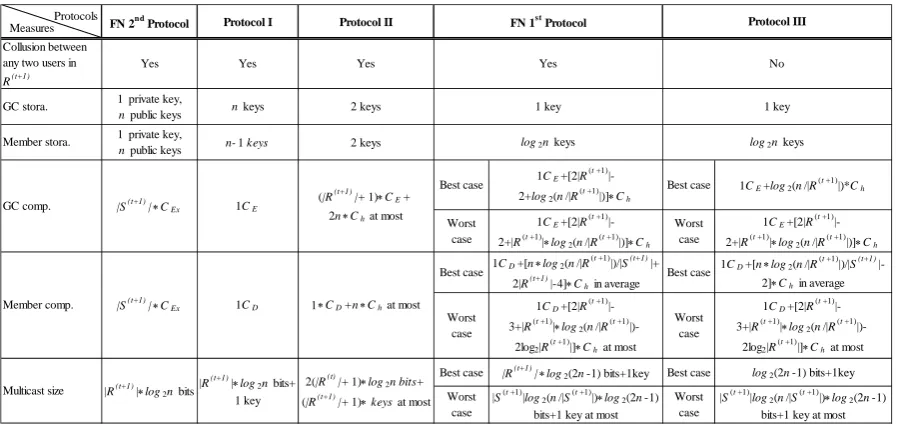
single-user attacks (i.e., 1-resilient) in a symbolic security model. Performance comparisons between our protocols and
related ones show that either of the proposed Protocol III and Protocol III’ is the best in its own class.
The rest of this paper is organized as follows. Section 2 reviews some related research results on 1-resilient group
rekeying protocols. In Section 3, we show that any 1-resilient group rekeying protocol (stateful or stateless) with constant
communication overhead can be used in conjunction with a collusion-resistant tree-based protocol to construct a hybrid
protocol with tunable collusion-bandwidth tradeoffs. In Section 4, we present formal definitions of exclusive keys and
three personal key assignment algorithms respectively based on independent exclusive keys, a dualhash chain and a binary
hash tree. Section 5 presents six group rekeying protocols respectively based on these three algorithms. In Section 6, we
prove all proposed protocols are secure against single-user attacks in a symbolic security model. In section 7, we give
5
paper and gives some interesting topics for future research.2 R
ELATEDR
ESEARCH ON1-R
ESILIENTG
ROUPR
EKEYINGRecall that we denote by U={1, 2,…, n} the universe of all users. In the rest of our paper, we denote the privileged subset of
users at time t by S(t)U and the complement of set S(t) with respect to U by R(t) (note that R(t) actually represents a subset
that includes all identities of receivers that have been revoked up to time t and all identities that have not been assigned yet
up to time t). For an arbitrary set S, we use |S| to denote the order of S. The group key used to encrypt all information sent
to S(t) is denoted by GK(t). Below, we interchangeably refer to S(t) as the group of legitimate users at time t or the set of ids of
users in S(t). We use {M}K to denote the symmetric encryption of M by K.
2.1 1-Resilient Stateless Group Rekeying (BE) Protocols
In [1], Fiat and Naor proposed a 1-resilient broadcast encryption (BE) protocol based on pseudo-random functions. A
complete binary tree is derived from a random seed by repeatedly applying two pseudo-random functions in a top-down
manner as follows. Suppose that the two pseudo-random functions are denoted by f1 and f2 respectively, and for an
arbitrary intermediate node S, its left child is denoted by Sl and its right child by Sr. We have Sl=f1(S) and Sr=f2(S). Every
user is associated with one of the leaves of the derived binary tree. Assignment of personal keys to users is based on the
derived binary tree such that each leaf key is known to all users except its associated user. To revoke multiple members,
GC only needs to Xor all their associated leaf-keys and uses the resulting key to encrypt the new group key. Thus all
members except those evictees can extract the new group key from the rekey message. For convenience, we call this
protocol the FN 1st protocol in the rest of this paper.
Fiat and Naor [1] also proposed a 1-resilient BE protocol that is cryptographically equivalent to the RSA scheme [18]. GC
chooses a random RSA composite N=PQ where P and Q are distinct primes. Given the group ZN*, GC selects an element g
with high order and keeps g secret. User i is assigned personal key pimod
i
g g N, where piand pj are relatively prime for
all i, jU. All users know what user index refers to what pi. For a privileged subset of users S(t), GC computes the
corresponding group key GK(t) as ( ) ( ) mod
t i i S p
t
GK g Nand broadcasts S(t) (or the corresponding revocation list R(t)).
After receiving the list S(t) or R(t), every user i in S(t)can compute ( )t j S( )t\{ }ipj mod
i
GK g N. Fiat and Naor proves that if
the problem of root extraction modulo an RSA composite is hard, then this protocol is secure against single-user attacks
(1-resilient). It is readily seen that any two user can collude to compute g. For convenience, we call this protocol the FN 2nd
6
2.2 1-Resilient Stateful Group Rekeying Protocols
Stateful (immediate or batch) join rekeying can be conducted trivially in either of the following two manners:
1) When a few new members join at time t, GC simply broadcasts a new group key GK(t+1) encrypted under current
group key GK(t), i.e., the rekey message is
( ) ( 1)t t
GK
GK . Thus, all members except the joining members can
decrypt GK(t+1) from the rekey message. For each of the joining members, GC sends it the new group key GK(t+1) and
its personal keys over a secure unicast channel;
2) GC can first apply a public one-way hash function h (MD5 [19], or SHA-1[20]) to current group key GK to obtain the
new group key as GK(t+1)=h(GK(t)), then broadcast a rekey notification message. After receiving this message, all
members except the joining members can derive the group key GK(t) as above.
Compared with join rekeying, designing an efficient leave rekeying algorithm is much harder, because a revoked
member always brings out information that may be used to encrypt future group keys. To ensure group forward secrecy,
we must invalidate all knowledge held by an evictee. However, this is not a trivial task. The following 1-resilient group
rekeying protocols all employ a join rekeying algorithm like either of the above. Thus, we only need to introduce their
leave rekeying algorithms.
Fan et al. [17] proposed a 1-resilient stateful group rekeying protocol called linear ordering of receivers (LORE) which has
constant communication overhead. Assignment of personal keys (also known as control keys in [17]) to users is based on
two independent one-way hash chains, respectively called forward chain and backward chain. GC assigns each user two
control keys, respectively selected from the forward chain and backward chain according to its rank in both chains. In leave
rekeying, these two control keys in conjunction with current group key will be used to encrypt the new group key such
that all users except the evictee can extract the new group key.
Kim et al. [21] proposed a 1-resilient stateful group rekeying protocol with constant communication overhead whose
personal key assignment is based on a structure similar to a binary hash tree (BHT) (see Section 4.3 for details) except that
instead of using traditional one-way hash functions to derive a binary key tree, they chose to use multiplicative one-way
functions to facilitate updating the whole key tree when a member leaves or joins the group. For convenience, we call their
protocol the KHYC protocol in the rest of this paper.
In [12], Waldvogel et al. proposed a 1-resilient stateful group rekeying protocol known as the flat-table (FT) protocol in the
literature. Its personal key assignment is based on a simple structure called flat-table. The table contains one entry for the
group key and 2log2n more entries for key encryption keys (KEKs), where log2n is the number of bits in the member id
7
bit in the member id, one associated with each possible value of the bit. A member knows only the key associated with thestate of its bit. In total, each member holds log2n+1 keys. Chang et al. [22] independently proposed a similar protocol and
employed Boolean function minimization techniques (BFM) to greatly reduce the communication overhead of batch rekeying.
However, compared with the LORE protocol and the KYHC protocol, immediate rekeying following these flat-table based
protocols require transmission of O(log2n) encrypted keys.
3 F
ROM1-R
ESILIENTG
ROUPR
EKEYING TOT
HAT WITHT
UNABLEC
OLLUSION-B
ANDWIDTHT
RADEOFFSFor all 1-resilient stateful/stateless group rekeying protocols reviewed in Section 2, a coalition of any two revoked receivers
can break their group forward secrecy. Given a 1-resilient stateful (resp. stateless) group rekeying protocol with constant
communication overhead, a straightforward solution to improve its collusion resistance is simply as follows. A group of n
receivers are divided into d divisions. GC simply employs an independent instance of the 1-resilient stateful/stateless
group rekeying protocol (i.e., each set of control keys respectively associated with each division is independent from each
other) for each division to rekey group keys. Since the communication overhead of the 1-resilient stateful/stateless group
rekeying protocol is O(1) encrypted keys, the communication overhead of the straightforward solution is O(d) encrypted
keys. Now we analyze this solution’s vulnerability to collusion attacks. To achieve the highest level of collusion protection,
GC has to allocate a receiver to a randomly-chosen division when it joins the group. It is readily seen that a group of k
colluding receivers can succeed if and only if at least two of them are allocated to the same division since combining
control keys from distinct divisions does not help the colluders. If we use Pk to denote the probability that at least two of
the k colluding receivers are allocated in the same division, then according to [17] we have
1,
!(
)!( )
1
,
.
!(
)!
k k
k
d
n
P
d n k
d
k
d
n d
k
It is readily seen that for given n and k, Pk is a decreasing function with respect to d. In other words, to reduce vulnerability
to collusion attack, we must increase the number of divisions, d. But a greater d means a higher communication overhead
(which is proportionate to d). Therefore, there exists a tradeoff between collusion resistance and bandwidth.
However, an obvious drawback of the above solution is that its communication overhead is linearly proportional to the
number of divisions. In the following, we will show how to further reduce the communication overhead of the
straightforward solution for stateful group rekeying (resp. the straightforward solution for stateless group rekeying) while
8
stateless) group rekeying the stateful straightforward solution (resp. the stateless straightforward solution) for short.
3.1 From 1-Resilient Stateful Group Rekeying to That with Tunable Collusion-Bandwidth Tradeoffs
Fan et al. [17] proposed a framework called a hybrid structure of
receivers (HySOR) which can be used to reduce the stateful
straightforward solution’s communication complexity from O(d) to
O(log2d) without compromising its security. HySOR uses a 1-resilient
protocol — the LORE protocol (see Section 2.2 for some details) and
the LKH protocol [6], [7], [8] to achieve tunable collusion-bandwidth
tradeoffs. As illustrated in Figure 1, receivers are also divided into d
divisions and each division is logically regarded as a leaf node (known
as d-node) in an LKH key tree. Division keys are represented by the leaf
k-nodes in an LKH key tree. Each receiver’s personal keys include not only the control keys as required by the LORE
protocol but also the auxiliary keys corresponding to the nodes in the path from its division key to the root as required by
the LKH protocol. For each division, GC employs an independent instance of the LORE protocol to rekey the
corresponding division key when there is a change in membership happened in that division. For simplicity, we assume
that every division has at least one active receiver after a change in membership. When some division has no active
receiver (i.e., it becomes inactive), the group rekeying procedure is a little different from the following. Please refer to [17]
for details. When a receiver of the i-th division joins/leaves the group, GC first uses the i-th instance of the LORE protocol
to update the corresponding division key Ki, and then uses the LKH protocol to update all the keys corresponding to the
nodes in the path from Ki to the root of the key tree (note that the root node corresponds to the group key). Of course, the
LORE protocol used by HySOR can be substituted by any 1-resilient stateful group rekeying protocol with constant
communication overhead. Suppose that the constant communication overhead of the 1-resilient protocol is C, then the
communication overhead of the resulting hybrid protocol is only 2log2d+C encrypted keys. That of the LKH protocol is
2log2n encrypted keys, where n>>d. Since the LKH protocol has been proved free from collusion attacks [23], the resulting
hybrid protocol maintains the same level of security as the stateful straightforward solution. And there is also a trade-off
between collusion resistance and bandwidth like the stateful straightforward solution.
3.2 From 1-Resilient Stateless Group Rekeying to That with Tunable Collusion-Bandwidth Tradeoffs
We can use a collusion-resistant tree-based stateless protocol (like those based on the subset-cover framework) to construct a
hybrid stateless protocol which reduces the stateless straightforward solution’s communication overhead without
9
compromising its security. Since all schemes based on the subset cover framework — the complete sub-tree (CS) protocol[2], the subset difference (SD) protocol [2], the layered subset difference(LSD) protocol [15] — have been proved
collusion-resistant, each of them can be used to construct this hybrid protocol. Personal key assignment is also based on the
hybrid structure illustrated in Figure 1. Specifically, each receiver’s personal keys include not only those control keys as
required by a 1-resilient stateless protocol but also those auxiliary keys in the key tree as required by a subset-cover based
stateless protocol. For example, for the CS protocol, the latter are those keys along the path from the corresponding d-node
to the root just like the LKH protocol. We call a division and its corresponding d-node in the key tree complete if all receivers
in that division are current members of a group; otherwise we call them incomplete. For each incomplete division, GC
simply uses an independent instance of a 1-resilient stateless group rekeying protocol to rekey group keys. From
perspective of the subset-cover based stateless group rekeying, all complete d-nodes are regarded as legitimate members
while all incomplete ones as evictees. Following a subset-cover based stateless protocol, GC needs to first find those
privileged subsets that together “cover” all complete d-nodes (we call these subsets “covering” subsets for short), and then
use their corresponding auxiliary keys to encrypt the new group key. To exemplify this idea, we use the CS protocol [2]
and an arbitrary 1-resilient stateless protocol to construct a hybrid protocol with tunable collusion-bandwidth tradeoffs.
We reuse Figure 1 to explain how to perform group rekeying following this hybrid protocol when all evictees are
distributed in divisions C, D and F (i.e., A, B, E, G and H are complete divisions). GC performs the following three steps to
complete group rekeying: (1) For each incomplete division, GC simply uses an independent instance of the 1-resilient
stateless protocol to rekey group keys; (2) GC uses the so-called complete sub-tree method on which the CS protocol is based
[2] to find those “covering” subsets (that covers all complete divisions) and their corresponding auxiliary keys. Specifically,
as illustrated in Figure 1, GC needs to first compute a Steiner tree that is spanning the root and all incomplete d-nodes (i.e.,
C, D, and F in this case). Then all auxiliary keys associated with those “covering” subsets are just those associated with the
roots of those sub-trees that hang off the Steiner tree. Taking the case illustrated by Figure 1 as an example, these “covering”
subsets are {A, B}, {E}, {G, H}, and their corresponding auxiliary keys are Kab, Ke, and Kgh, respectively; (3) GC sends the new
group key encrypted with these auxiliary keys respectively. For our example, GC sends the following rekey message:
{
'}
,{
'} ,{
'}
ab e gh
K K K
GK
GK
GK
.Suppose that the group is divided into d divisions, and all m (m>r) evictees are uniformly distributed in r (r<d)
incomplete divisions, then the communication overhead of this hybrid protocol is O(r)+O(rlog2(d/r)) encrypted keys which
is less than both that of the straightforward solution (O(d)) and that of the CS protocol (O(mlog2(n/m))). Since the CS
10
stateless straightforward solution. There is a trade-off between collusion and bandwidth like the stateless straightforward
solution.
In this section, we showed that any 1-resilient stateful (resp. stateless) group rekeying protocol with constant
communication overhead can be used in conjunction with a collusion-resistant stateful (resp. stateless) tree-based protocol
to construct a hybrid stateful (resp. stateless) protocol with tunable collusion-bandwidth tradeoffs. And communication
overhead of the resulting hybrid protocol is exactly between that of 1-resilient protocol and that of the tree-based protocol.
Therefore, research on designing secure and efficient 1-resilient group rekeying protocols has its own value despite the fact
that they are only secure against single-user attack. In the following, we focus on designing efficient and secure 1-resilient
group rekeying protocols with constant communication overhead.
4 1-R
ESILIENTP
ERSONALK
EYA
SSIGNMENTA
LGORITHMSB
ASED ONE
XCLUSIVE KEYSAn informal concept of exclusive key was first given by Kim et al. [21] recently, while the idea actually originated in [1] more
than a decade ago. In this section, we formalize this concept, and then propose three personal key assignment algorithms
for group rekeying based on this idea. We also prove the security of them.
Definition 1 — Given a universe U of n users, an exclusive keyKifor an arbitrary useriU is a long-term key shared by all
users in U\{i}.
We can extend Definition 1 to obtain Definition 2.
Definition 2 — Given a universe U of n users, an exclusive key KS for an arbitrary subsetSU is a long-term key shared by
all users in U\S.
In leave rekeying, an exclusive key Ki (resp. KS) can be used by GC to exclude i (resp. all users in S) in the sense that GC
can broadcast a new group key encrypted by Ki (resp. KS) such that all users in U except i (resp. all users in S) can decrypt
the rekey message.
Personal key assignment based on the idea of exclusive key is bound to be only 1-resilient, because a coalition of an
arbitrary pair of users i and j can break their security as follows. According to Definition 1, i and j both hold an exclusive
key that can be used to exclude each other. They can simply exchange those exclusive keys such that neither of them can be
excluded by GC.
If we want to construct a feasible group rekeying protocol based on exclusive key, then its personal key assignment
based on exclusive keys must at least satisfy the following three conditions:
11
2) Completeness — for every user iU, i must hold or is able to derive the exclusive key Kj for all ji. In fact, the key set
{Kj | ji} or the intermediate seeds used to derive this key set will be assigned to i by GC as its personal key.
3) Security (1-resilience) — for every user iU, it is (information-theoretically) impossible or (computationally)
infeasible for i to compute the exclusive key Ki for i given its personal key.
Now we present three personal key assignment algorithms that all fulfill the three conditions.
4.1 Personal Key Assignment Based on Independent Exclusive Keys (IEK) — the IEK Algorithm
GC (GC) first generates a set of n random (independent) keys denoted by
S={K1,…,Kn}. As illustrated in Table 1, each rank i (i=1,2,…,n) is associated with a
set of keys {K1,…,Ki-1, Ki+1,…,Kn} (i.e., S\{Ki}). When user i joins the group, GC
assign it a unique rank, namely i (for simplicity)and associated set of keys S\{Ki}
as its personal key. In the following, we interchangeably refer to i as a rank or a
user according to its context. Once user i is assigned a rank, i will occupy this rank
and its associated personal key forever in the sense that they will never be
assigned to other users even if i leaves the group. The effect of such a personal key assignment is such that each Ki is shared
among all users except i, and can be used to exclude i in a leaving rekeying algorithm (correctness). For example, if GC
wants to exclude user i, it broadcasts the new group key GK’ encrypted by Ki such that all member except i can decrypt the
new group key. It is easy to check that the IEK algorithm satisfies the completeness condition. According to the following
theorem, this algorithm is information-theoretically secure against single-user attacks (1-resilience).
Theorem 1: For an arbitrary user i, the exclusive key Ki for i is random given n-1 exclusive keys {K1,…,Ki-1, Ki+1,…,Kn} (i.e.,
personal key of i).
Proof: This claim is immediately followed from the fact that all n exclusive keys K1,…,Kn are generated randomly and
independently.
The storage requirement for each user is n-1 keys and that for GC is n keys. The computational cost for each user is zero.
4.2 Personal Key Assignment Based on Dual Hash Chain — the DHC Algorithm
This personal key assignment is similar to the IEK algorithm except that GC generates functionally-dependent exclusive
keys instead of independent random ones as illustrated in Table 2. More specifically, GC first chooses two random seeds f1
and b1, and then generates two (n-1)-length one-way hash chains — forward chain and backward chain by repeatedly
applying a public one-way hash function h to f1 and b1, respectively. That is, the (i+1)-th forward keyfi+1 (resp. the (i+1)-th
backward key bi+1) is computed as fi+1=h(fi) (resp. bi+1=h(bi)) (i=1,…,n-2). We call this structure comprised of two hash chains a
TABLE1
IEKALGORITHM
2 1 1
1 1 1
1 2 1
1 2 1 1
1 2 1
1 2 1 1
( ) 1 ( ) 2 ( ) 1 ( ) ( ) 1 ( )
i i i n
i i i n
i i n
i i n
i i n
i i i
Ranks Exclusive Keys
K K K K K
K K K K K
K K K K K
i
K K K K K
i
K K K K K
i
K K K K K
12
dual hash chain (DHC). For each rank i (i=1,2,…,n), GC associates i with two keys fi and bn-i+1 (here we regard both bn and fn
as null). With fi and bn-i+1, user i can derive all other exclusive keys as illustrated in Table 2 by repeatedly applying h. The
effect of such a personal key assignment is that GC can exclude user i by broadcasting a rekey message as
GK
fi1,
GK
bn i
. Thus users with ranks from 1 to i-1 can decrypt
fi1GK
to obtain the new group key because all
users with ranks from 1 to i-2 can derive the decryption key fi-1 and user i-1 holds fi-1 by itself. And users with ranks from
i+1 to n can decrypt
n i b
GK
to obtain the new group key because all users with ranks from i+2 to n can derive the
decryption key bn-i and user i+1 holds bn-i by itself. Whereas, user i can decrypt neither
1 i f
GK
nor
n i b
GK
.
According to Definition 1, the exclusive key for user i is a pair of keys {fi-1, bn-i}. It is easy to check that the DHC algorithm
satisfies the completeness condition. According to the following theorem, this algorithm is computationally secure against
single-user attacks.
Theorem 2: For an arbitrary user i, it is computationally infeasible to compute either of the exclusive key pair fi-1 and bn-i given two
exclusive keys fi and bn-i+1 (i.e., personal key of i).
Proof: This claim is immediately followed from the fact that h is a one-way hash function.
Compared with the IEK algorithm, the storage requirement for each user is only 2 keys at most, and for GC it is only two
keys. However, to derive the pair of exclusive keys for an evictee, each user and GC need to perform O(n) evaluations of a
one-way hash function in average.
Remark 1: The personal key assignment algorithm of the LORE protocol [17] is also based on DHC, but is different from
ours. Interestingly, both algorithms have the same storage and computation complexity.
4.3 Personal Key Assignment Based on Binary Hash Tree— the BHT Algorithm
As introduced in Section 2.1, to realize a 1-resilient broadcast encryption protocol — the FN 1st protocol, Fiat and Naor [1]
TABLE2
DHCALGORITHM
1 2 3 2 1 1 3 2 1
1 2 3 2 1 1 3
( ) 1 ( ) 2 1 1 1
i i i i i n n n
n i i i i i n
Ranks Exclusive keys
f f f f f f f f f f
b f f f f f f f
i i i n n 2 1
1 2 3 2 1 1 3 2 1
1 2 3 2 1 1 3 2 1
1 2 3 2 1 1 3 2 1
( ) ( )
( )
n n
n n n n i i i i n n n
n n n n i n i i i n n n
n n n n i n i n i i n n n
f f
b b b b f f f f f f
b b b b b f f f f f
b b b b b b f f f f
1 2 3 2 1 1 2 2 1
1 2 3 2 1 1 2 2 1
( ) ( )
n n n n i n i n i n i n i n
n n n n i n i n i n i n i
b b b b b b b b b f
b b b b b b b b b b
13
proposed a personal key assignment algorithm based on a binary tree which isderived from a random seed by repeatedly applying two pseudo-random
functions in a top-down manner. In practice, this binary tree can also be derived
by using two computationally-efficient one-way hash functions, e.g., MD5 [19] or
SHA-1 [20]. A binary tree derived by using hash functions is called Binary Hash
Tree (BHT) by Briscoe [24], and he proposed a time-based multicast key
distribution protocol based on BHT called MARKS [24]. Here, we use BHT for group rekeying protocols. GC first generates
a binary hash tree (BHT) that has n leaf k-nodes as illustrated in Figure 2. Specifically, a BHT is derived from a random seed
K1 in a top-down manner such that given a k-node Ki, its left child K2i is computed as K2i = fL(Ki), and its right child K2i+1as
K2i+1 = fR(Ki) where fL and fR are two different one-way hash functions. Every user is associated with a unique leaf k-node.
For convenience, given a user i, we call those keys in i’s path to the root path keys and those keys that are siblings of path
keys sibling keys. When a user i joins the group, GC associates it with a unique leaf k-node and assigns it the corresponding
sibling keys. With these sibling keys, i can compute all keys on the BHT except those path keys. For example, a user 2
associated with K9 will be assigned a set of sibling keys {K3, K5, K8}, and thus user 2 is able to compute all the keys on the
BHT except the set of path keys {K1, K2, K4, K9}. The effect of such a personal key assignment is that an intermediate key Ki is
shared among all users except those associated with the leaf nodes of the sub-tree rooted at Ki. Therefore Ki can be used to
exclude all users respectively associated with the leaf k-nodes of a sub-tree rooted at Ki (see next section for details).
According to Definition 2, Ki is the exclusive key for the set of users who are associated with the leaf nodes the sub-tree
rooted at Ki (correctness). It is easy to check that the BHT algorithm satisfies the completeness condition. According to the
following theorem, this algorithm is computationally secure against single-user attacks.
Theorem 3: For an arbitrary user i, it is computationally infeasible to computer any of its path keys given its sibling keys.
Proof: This claim is immediately followed from the fact that h is a one-way hash function.
The storage requirement for GC is only one key, but for each user it is log2n keys. However, to derive the exclusive key
for an evictee, each user and GC only need to perform O(log2n) evaluations of a one-way hash function in average.
Remark 2: Let us consider the tradeoff between the two relevant resources at user end: storage overhead and
computational overhead. The IEK-based algorithm achieves a storage complexity of O(n) keys and zero computational cost
at one end, whereas the DHC-based algorithm a storage complexity of O(1) keys and an averagecomputational complexity
of O(n) evaluations of one-way hash function at the other end. Between these two extremes, does the BHT algorithm
achieve a storage complexity of O(log2n) keys and an average computational complexity of O(log2n) evaluations of
1 2 3 4 5 6 7 8
K3 K2
K1
K4 K5 K6 K7
K15 K14 K13 K12 K11 K10 K9 K8
14
one-way hash function.
5 E
XCLUSIVEK
EY-B
ASED1-R
ESILIENTG
ROUPR
EKEYINGP
ROTOCOLSUsing each of the three personal key assignment algorithms, we can design both a stateless group rekeying protocol and a
stateful one. For the two protocols based on the same type of personal key assignment algorithm, we always introduce the
stateless one before the stateful one because the batch leave rekeying algorithm of the latter may use the stateless protocol.
Since immediate group rekeying is just a special case of batch group rekeying, we only need to deal with batch group
rekeying. Below, we denote “multicast” by “”and “secure unicast” by “”.
5.1 Group Rekeying Based the IEK Algorithm
5.1.1 A stateless group rekeying protocol
—
Protocol IWe first introduce the stateless group rekeying protocol (or BE protocol) that is based on the IEK algorithm — Protocol I.
Whenever a new member joins the group, GC assigns it a free rank and sends it associated personal keys by a secure
unicast channel. Suppose that there are changes in membership (joins or leaves) at time t and the privileged set changes
from S(t) to S(t+1). Recall that the complement of S(t+1) — R(t+1) represents a subset that includes all ranks of users that have
been revoked up to time t+1 and all ranks that have not been assigned yet up to time t+1. For the privileged set S(t+1), GC
generates a random group key GK(t+1) and then sends the following message by multicast:
GCS(t+1):
( 1) ( 1), ( 1)t i i R
t t
K
R GK
.
According to [1], every rekey message of a BE protocol (stateless group rekeying protocol) must contain a set identification
information that is used to uniquely identify a privileged set. Since |R(t+1)| is usually far less than |S(t+1)|, we choose to use
the blacklist R(t+1) instead of the white list S(t+1) as the set identification information. Note that the key used to encrypt the
group key is computed as (t1) i i R K
, i.e., Xoring all the exclusive keys associated with all revoked and unassigned ranks
in R(t+1).
The computational cost of GC is only 1 encryption and that of each group member is only one decryption. Note that we
don’t count the cost of the Xor operations in the remainder of this paper because the Xor operation is very computationally
efficient. And the multicast size is only one encrypted key plus a blacklist that amounts to |R(t+1)|log2n bits (recall that it
takes at least log2n bits to uniquely identify a member or a rank for a group of size n).
5.1.2 A stateful group rekeying protocol
—
Protocol I’15
users join the group S(t)U at the same time t and we denote this set of users by J={i1, i2,…, im}. For each ijJ (j=1,…, m), GCneeds to assign it a free rank also denoted by ij. Then GC derives the new group key GK(t+1) by computing GK(t+1)=h(GK(t))
where h is a public one-way hash function, and sends the following messages:
GCS(t): a rekey notification,
For each ijJ (j=1,…, m)
GCij:{K1,,Kij1,Kij1,,Kn}, GK (t+1).
After receiving the rekey notification message, every current member in S(t) can derive the new group key GK(t+1) by
computing GK(t+1)=h(GK(t)).
In fact, both immediate and batch leave rekeying can be supported by using the stateless counterpart — Protocol I in a
straightforward way. Suppose that m users leave the group S(t) at the same time t and we denote this set of users by L={i1,
i2,…, im}. GC simply uses Protocol I to exclude all users in R(t)L from obtaining the new group key. For convenience, we
call this straightforward approach of using the stateless counterpart for batch leave rekeying stateless leave rekeying in the
remainder of this paper. Here we introduce another approach called stateful leave rekeying. Because GK(t) is shared by all
users in S(t)=U\R(t), it can be regarded as a temporary exclusive key for subset R(t) at time t, although it is not a long-term
one as defined by Definition 2. Therefore, using the exclusive keys respectively for every currently-departing user in L in
conjunction with GK(t) (i.e., Xoring them together) to encrypt the new group key GK(t+1) is enough to exclude all users in
R(t+1)=LR(t) at time t. That is to say, GC needs to send the following rekey message:
GCS(t+1):
( )( 1)
1,2 , , t
ijL ij t
m
K GK
i i i GK
here S(t+1)=S(t)-L.
Every current member of S(t) except those in L can extract GK(t+1) from this message. Due to the usage of current group key,
this type of batch leave rekeying is stateful (see Remark 3 at the end of this section for the reason).
For join rekeying, the computational cost of GC and each group member except the joining member is only one
evaluation of a one-way hash function. The unicast size is mn keys in total and the multicast size is only one notification
message. For leave rekeying, the computational cost of GC is only 1 encryption, and that of each group member is only 1
decryptions. And the multicast size is only 1 encrypted key plus mlog2n bits for identifying m departing members.
5.2 Group Rekeying Based on the DHC Algorithm
5.2.1 A stateless group rekeying protocol
—
Protocol IIIn this section, we introduce the stateless group rekeying protocol that is based on the DHC algorithm — Protocol II. When
16
changes in group membership (joins or leaves) at time t and the privileged set
changes from S(t) to S(t+1). Given a privileged set S(t+1), ranks associated with all
legitimate users (legitimate ranks for short) are distributed by the pattern of
disjoint rank intervals. Or we would like to say legitimate ranks are covered by
disjoint rank intervals. As illustrated in the first column of Table 3, if U = {1, 2,…,
6} and the privileged set of users is {1, 3, 4, 6}, legitimate ranks are covered by
the following disjoint rank intervals: [1], [3,4] and [6]. We denote these rank
intervals by I1, I2,…, Ir. GC generates a random group key GK(t+1), and for each rank interval Ij = [j1, jm] (i.e., rank interval Ij
starts at rank j1 and ends at rank jm), creates a cipher text
1 1 ( 1)
j
n j jm t I b f C GK
. Referring to Table 3, it is readily seen
that only members whose associated rank is covered by Ij can decrypt this cipher text according to the DHC algorithm.
After creating all those cipher texts, GC sends the following rekey message by multicast:
GCS(t+1):
1 2
1, 2, , r, I , I , , Ir
I I I C C C .
We encourage the interested readers to refer to the proof of Theorem 7 in Section 6 for more details behind this
construction. The number of disjoint rank intervals r is at most |R(t+1)|+1. The computational cost of GC is 2n evaluations
of one-way hash function(for computing the exclusive key pairs for all revoked members) and |R(t+1)|+1 encryptions at
most. The computational cost of each group member is n evaluations of one-way hash functionat most plus one decryption.
And the multicast size is |R(t+1)|+1 encrypted keys plus (|R(t+1)|+1) 2log2n bits at most (recall that each rank interval is
uniquely identified by two ranks, therefore 2log2n bits).
5.2.2 A stateful group rekeying protocol
—
Protocol II’Now we introduce the stateful group rekeying protocol that is based on the DHC algorithm — Protocol II’. Suppose that m
users denoted by J={i1, i2,…, im} join the group S(t)U at the same time t. GD performs join rekeying similar to that of
Protocol I’ except that the unicast message is as follows:
For each ijJ (j=1,…, m)
GC ij:
fij,bn i j 1
, GK(t+1).
Both immediate and batch leave rekeying can be supported by using Protocol II in a straightforward manner. Suppose
that m users leave the group S(t) at the same time t and we denote this set of users by L={i1, i2,…, im}. GC first computes all
those rank intervals that cover all legitimate users in S(t)-L and then uses Protocol II to exclude all users in R(t)L from
TABLE3
PROTOCOL II
1 2 3 4 5
5 2 3 4 5
5 4 3 4 5
5 4 3 4 5
5 4 3 2 5
5 4 3 2 1
: ' ' ( ) 1 ( ) ( ) 3 ( ) 4 ( )
6 ( )
Note We use to locate revoked ra
Ranks Exclusive keys
f f f f f
b f f f f
b b f f f
b b b f f
b b b b f
b b b b b
17
obtaining the new group key. This is the so-called stateless leave rekeying approach. However, the worst-case multicastoverhead will be |R(t)|+m+1 encrypted keys plus (|R(t)|+m+1)2log2n bits and would become prohibitively high when
|R(t+1)| is big. Therefore, we would rather use a similar stateful leave rekeying approach as discussed in Section 5.1.2.
Suppose that the ranks intervals that cover the subset U-L (instead of S(t)-L as in above approach) are I1, I2,…, Ir. GC needs
to generate a random group key GK(t+1), and for each rank interval Ij = [j1, jm], create a cipher text
( )1 1 ( 1)
t j
n j jm t
I
b f GK
C GK
. After creating all those cipher texts, GC sends the following rekey message by multicast:
GCS(t+1):
1 2
1, 2, , r, I , I , , Ir
I I I C C C .
Every current member of S(t) except those in L can decrypt this message to obtain the new group key GK(t+1). Compared
with the stateless leave rekeying algorithm, the worst-case multicast size is only m+1 encrypted keys plus (m+1)2log2n
bits.
For join rekeying, the computational cost of GC is 2n+1 evaluations of a one-way hash function at most (for computing
the exclusive key pairs for the joining members and the new group key) and that of each group member except the joining
member is only one evaluation of a one-way hash function. The unicast size is only 3m keys in total and the multicast size
is only one notification message. For leave rekeying, the computational cost of GC is 2n evaluations of a one-way hash
function (for computing the exclusive key pairs for the departing members) plus m+1 encryptions at most. The
computational cost of each group member is n evaluations of a one-way hash function at most plus 1 decryption.
5.3 Group Rekeying Based on the BHT Algorithm
5.3.1 A stateless group rekeying protocol
—
Protocol IIINote that in the remainder of this paper, when referring to the FN 1st
protocol, we mean the BHT-based version of FN 1st protocol. In Section 3.2,
when using the CS protocol to construct a hybrid stateless protocol with
collusion-bandwidth tradeoffs, we used the complete sub-tree method to
help us find those subsets that cover legitimate users. Whereas in this
section, we use the same method to help find those subsets that cover
illegitimate users and their corresponding exclusive keys. Thus we improve
the FN 1st protocol with respect to both computational overhead and
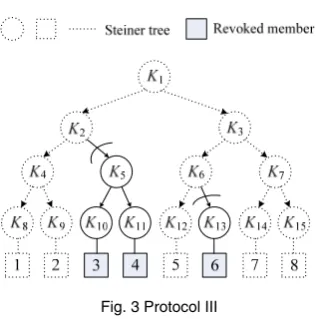
security. For convenience, we call the improved protocol Protocol III. Suppose that there are changes in group membership
18
tree that is spanning the root and all the u-nodes respectively associated with every member of a sub-set SU. As
illustrated in Figure 3, GC first computes a Steiner tree ST(S(t+1)) so as to obtain all those subsets that together cover all
revoked users in R(t+1). According to the BHT algorithm, all exclusive keys for these subsets are just those associated with
the roots of those sub-trees that hang off the Steiner tree ST(S(t+1)) as illustrated by Figure 3. Taking the case illustrated by
Figure 3 as an example, these “covering” subsets are {3,4} and {6}, and their corresponding exclusive keys are K5 and K13,
respectively. Suppose all these exclusive keys respectively corresponding to each of the covering subsets for R(t+1) are 1 i
K
,2 i
K
,…, andm i
K
. According to [2], the number of these keys is at most |S(t+1)|log2(n/|S(t+1)|). GC then generates a randomgroup key GK(t+1) and sends the following message by multicast:
GCS(t+1):
1 2 ( 1) 1, ,2 , ,i i im
t
m K K K
i i i GK
.
Obviously, only those users in S(t+1) are able to decrypt this message and obtain the new group key according to the BHT
algorithm. Compared with the CS protocol as illustrated by Figure 1, we compute the Steiner tree here to help find those
“covering” subsets for R(t+1) rather than S(t+1).
Note that all exclusive keys used to encrypt the new group key are computed by GC from the root key K1 on the fly
when it performs group rekeying. As illustrated in Figure 3, the computational cost for GC to compute all exclusive keys is
proportional to the size of the Steiner tree ST(R(t+1)) denoted by |ST(R(t+1))|. According to [10], we have
2|R(t+1)|-1+log2(n/|R(t+1)|)|ST(R(t+1))| 2|R(t+1)|-1+|R(t+1)|log2(n/|R(t+1)|). Intuitively, the minimum size of ST(R(t+1))
occurs when the ST(R(t+1)) is a densely embedded sub-tree of the key tree, as would happen when users in R(t+1) are
associated with adjacent u-nodes of the key tree. The maximum size occurs when the ST(R(t+1)) is sparsely embedded in the
key tree, as occurs when the u-nodes that users in R(t+1) are associated with are evenly distributed in the key tree. Since the
size of the Steiner tree ST(R(t+1)) is determined by the distribution pattern of the revoked u-nodes in the key tree which is
unpredictable due to group dynamics, we can only estimate the computational and communication cost of Protocol III (and
the FN 1st protocol) by analyzing the following two extreme cases:
(1) The best case —
When ST(R(t+1)) has the minimum size, the computational cost of both GC and members reaches its lowest level. The
minimum value of ST(R(t+1)) occurs when the ST(R(t+1)) includes a “densely packed” sub-tree of size 2|R(t+1)|-1 at the lowest
level of the key tree, and this sub-tree is attached to the root of the key tree by a single path of length log2(n/|R(t+1)|).
Therefore, the computational cost of GC amounts to log2(n/|R(t+1)|) evaluations of a one-way hash function plus 1
19
Xoring all leaf exclusive keys respectively associated with those revoked users in R(t+1). Therefore, for the FN 1st protocol,the computational cost of GC in this case amounts to 2|R(t+1)|-2+log2(n/|R(t+1)|) evaluations of a one-way hash function
plus 1 encryption. For both Protocol III and the FN 1st protocol, because the computational cost of a member is determined
by the relative position of its associated u-node with respect to the “densely packed” sub-tree, we only discuss the average
cost here. For Protocol III, the average computational cost of a member is
( 1) 2
( 1) log /
2 t
t
n n R
S
evaluations of a one-wayhash function plus 1 decryption. For the FN 1st protocol, the average computational cost of a member is
( 1)
2 ( 1)
( 1) log /
2 4
t
t
t
n n R
R S
evaluations of a one-way hash function plus 1 decryption. The multicast size is oneencrypted key plus log2(2n-1) bits (note that it takes log2(2n-1) bits to uniquely identify a node of a full binary tree with n
leaf nodes).
(2) The worst case —
When ST(R(t+1)) has the maximum size, the computational cost of both GC and members reaches its highest level. The
maximum value of ST(R(t+1)) occurs when the ST(R(t+1)) includes a subtree of size 2|R(t+1)|-1 at the highest level of the key
tree, with |R(t+1)| paths each of length log2(n/|R(t+1)|) flowing downward from its leaves to the leaves of the key tree. For
both Protocol III’ and the FN 1st protocol, the computational cost of GC amounts to 2|R(t+1)|-2+|R(t+1)|log2(n/|R(t+1)|)
evaluations of a one-way hash function plus 1 encryption and that of a member is
2|R(t+1)|-3+|R(t+1)|log2(n/|R(t+1)|)-2log2|R(t+1)| evaluations of a one-way hash function at most plus 1 decryption. For
both protocols, the multicast size is one encrypted key plus |S(t+1)|log2(n/|S(t+1)|)log2(2n-1) bits at most (this is what it
takes to identify all those exclusive keys used to encrypt the new group key, whose number is at most
|S(t+1)|log2(n/|S(t+1)|)).
Although both Protocol III and the FN 1st protocol have the same worst-case computational and communication
overhead, the advantage of Protocol III over the FN 1st protocol in both aspects increases as the revoked u-nodes become
more densely distributed in the key tree, and reaches its maximum when all revoked u-nodes can be covered by just one
subset.
Another interesting advantage of Protocol III over the FN 1st protocol is concerning collusion resistance. In the FN 1st
protocol, the new group key is encrypted by a key computed by Xoring all the leaf exclusive keys respectively for each
revoked user in R(t+1). An arbitrary pair of revoked users in R(t+1) can collectively compute all these exclusive keys from their